
Market Definition
The Global Automotive Fuel Tank Market encompasses the design, engineering, manufacturing, testing, and supply of fuel storage systems installed across passenger vehicles, light commercial vehicles, heavy commercial vehicles, two-wheelers, and off-highway equipment that utilize internal combustion engines powered by petrol, diesel, compressed natural gas, liquefied petroleum gas, liquefied natural gas, and ethanol blends as their primary or auxiliary energy source. An automotive fuel tank is a structurally integrated, fluid-tight vessel engineered to safely store volatile liquid or gaseous fuels under varying pressure and temperature conditions, while simultaneously minimizing evaporative hydrocarbon emissions through embedded barrier technologies, activated carbon canister evaporative emission control systems, and vapor management valves that are increasingly regulated to near-zero fugitive emission standards in major automotive markets globally. The market encompasses the complete fuel tank assembly value chain, including the primary tank vessel manufactured through high-density polyethylene blow molding or stamped and welded steel fabrication, in-tank fuel pump and sender unit modules, fuel level sensors, rollover and pressure relief valves, filler pipes and fuel caps, evaporative emission control canisters and associated purge valve systems, fuel tank straps and mounting hardware, and the heat shield and protective underbody components that constitute the complete fuel storage system delivered to automotive assembly lines. Beyond conventional liquid fuel tanks, the market includes compressed natural gas and liquefied petroleum gas cylinder and pressure vessel systems, saddle-type and auxiliary tank configurations for extended-range commercial vehicle applications, and lightweight composite and aluminum tank programs developed for premium vehicle weight reduction programs. Key participants include automotive OEMs exercising fuel system integration and validation responsibility, Tier-1 fuel system module suppliers, blow molding and metal fabrication specialists, raw material suppliers of high-density polyethylene resins and advanced steel grades, and regulatory bodies whose evaporative emission and crash safety standards define the fundamental engineering requirements governing fuel tank design across all major global markets.
Market Insights
The global automotive fuel tank market is navigating a period of structural complexity defined by two simultaneous and partially contradictory forces: a sustained near-term demand environment underpinned by the continuing dominance of internal combustion engine vehicles in global new vehicle production and an expanding installed base of fuel-dependent vehicles requiring aftermarket service, and a medium-to-long-term headwind generated by the accelerating penetration of battery electric vehicles that eliminate conventional liquid fuel tank requirements entirely and progressively compress the addressable new vehicle production volume available to fuel tank system suppliers. Global vehicle production reached approximately 93.2 million units in 2025, of which battery electric vehicles accounted for approximately 19.4% of new sales, leaving over 75 million new vehicles produced annually still equipped with internal combustion or hybrid powertrains requiring conventional fuel storage systems, while the global installed parc of internal combustion engine and hybrid vehicles exceeded 1.4 billion units, generating a structurally durable aftermarket demand stream for replacement fuel tanks, in-tank fuel pump modules, evaporative emission system components, and associated service parts that is substantially insensitive to near-term new vehicle production mix shifts. The global automotive fuel tank market was valued at approximately USD 18.6 billion in 2025 and is projected to reach USD 22.3 billion by 2034, advancing at a compound annual growth rate of 2.1% over the forecast period from 2027 to 2034, as sustained aftermarket volume growth and the increasing unit value of technologically advanced multi-layer barrier fuel tanks and alternative fuel storage systems partly offset the gradual compression of new vehicle fuel tank installation volumes attributable to rising battery electric vehicle penetration in key markets.
The material technology landscape of automotive fuel tanks has undergone a decisive shift over the past two decades from steel-dominated construction toward high-density polyethylene multilayer blow-molded systems, with plastic fuel tanks now constituting approximately 87% of global new vehicle fuel tank installations by unit volume in 2025, driven by plastic’s superior corrosion resistance, design flexibility enabling complex three-dimensional tank geometries that optimize packaging within constrained underbody spaces, lower manufacturing cost at volume, and approximately 30% weight advantage relative to equivalent steel tanks that contributes to vehicle fuel economy improvement. The most technically significant recent evolution in plastic fuel tank engineering is the development of six-layer and seven-layer co-extrusion barrier wall constructions that incorporate ethylene vinyl alcohol barrier layers of precisely controlled thickness within the tank wall laminate structure, achieving evaporative hydrocarbon permeation rates well below the 0.5 grams per 24-hour test cycle threshold mandated by California Air Resources Board LEV III Tier 2 evaporative emission standards and the equivalent Euro 7 regulation requirements currently being phased in across the European Union. Steel fuel tanks retain a meaningful market position in heavy commercial vehicle applications, where the structural robustness, puncture resistance, and repairability of steel construction are operationally valued, as well as in price-sensitive emerging market passenger vehicle segments where the established steel fabrication supply chain infrastructure and lower tooling investment of stamped steel tank manufacture maintains a cost advantage over blow-molded plastic alternatives. The development of aluminum fuel tanks for premium vehicle weight reduction programs, while commercially niche in volume terms, represents a technically advanced segment growing at approximately 8.4% annually, driven by the adoption of aluminum fuel storage systems in high-performance sports vehicles and premium SUV platforms where total vehicle weight reduction carries measurable fuel economy and performance benefits that justify the higher material and manufacturing cost of aluminum relative to plastic or steel tank construction.
The alternative fuel storage segment, encompassing compressed natural gas cylinders, liquefied petroleum gas pressure vessels, liquefied natural gas tanks for heavy commercial vehicle applications, and hydrogen storage systems for fuel cell electric vehicles, represents the most dynamic and technologically differentiated growth sub-segment within the broader automotive fuel tank market, driven by fleet operator, government, and logistics industry investment in natural gas and hydrogen-powered commercial vehicles as transition-period decarbonization solutions for long-haul trucking, municipal bus, and refuse collection vehicle applications where battery electric technology faces operational range and payload constraints that natural gas and hydrogen powertrains are better positioned to address. Compressed natural gas vehicle tanks are Type IV composite pressure vessels constructed from carbon fiber-reinforced polymer overwrapped liners, operating at working pressures of 200 to 250 bar and subject to periodic recertification requirements that generate structured aftermarket replacement demand cycles every 15 to 20 years across the global CNG vehicle parc. The global CNG vehicle parc exceeded 28 million units in 2025, concentrated primarily in China, India, Iran, Pakistan, and Argentina, with fleet procurement of CNG-powered light and heavy commercial vehicles continuing to grow in Asian and South American markets where natural gas infrastructure maturity and favorable compressed natural gas-to-diesel price differentials sustain operator economics. Hydrogen storage systems for fuel cell electric vehicles, Type IV carbon fiber composite tanks operating at 700 bar working pressure for passenger vehicle applications and 350 bar for heavy commercial vehicle applications, represent the highest per-unit value fuel storage technology within the automotive market, with a single passenger vehicle hydrogen storage system valued at approximately USD 2,800 to USD 4,500 per vehicle depending on tank capacity and pressure specification, creating a structurally high-value growth opportunity as fuel cell electric vehicle production volumes scale across commercial vehicle and passenger vehicle segments through the forecast period.
From a regional standpoint, Asia-Pacific constitutes the largest and most production-intensive regional market for automotive fuel tanks, driven by China’s position as the world’s largest vehicle manufacturing nation producing approximately 31.6 million vehicles in 2025, India’s rapidly expanding vehicle production base that reached 5.8 million four-wheelers and approximately 21 million two-wheelers annually, and the combined output of Japan, South Korea, Thailand, and Indonesia which together account for a substantial additional production volume served predominantly by regional Tier-1 fuel system suppliers operating within localized just-in-time delivery supply chain architectures. China’s domestic automotive fuel tank market, while experiencing gradual compression at the new vehicle installation level as battery electric vehicle penetration advances, retains strong growth momentum in the alternative fuel storage segment as a result of the Chinese government’s natural gas vehicle promotion policies, the scaling of hydrogen fuel cell commercial vehicle deployment programs in pilot regions including Beijing, Shanghai, and Guangdong, and the continuing expansion of the hybrid electric vehicle segment which retains conventional fuel tank requirements. Europe represents the second-largest regional market by revenue, characterized by the highest regulatory stringency in evaporative emission and fuel system crash safety standards globally, which drives sustained investment in advanced multi-layer barrier tank technology and evaporative emission control system innovation among European Tier-1 fuel system suppliers. North America, while a mature fuel tank market by production volume metrics, generates disproportionate revenue contribution from the premium fuel tank content of its light truck and SUV-dominated vehicle mix, where large-format fuel tanks of 70 to 100 litre capacity with advanced in-tank fuel pump modules, integrated fuel level sensing systems, and emissions-compliant evaporative control systems carry unit values significantly above the global average for passenger car fuel tank assemblies.
Key Drivers
Sustained Internal Combustion Engine and Hybrid Vehicle Production Volumes Maintaining Structural Fuel Tank Demand Across the Forecast Period
Despite the accelerating global transition toward battery electric vehicle adoption, the internal combustion engine and hybrid electric vehicle segments continue to account for the overwhelming majority of new vehicle production globally and will maintain substantial production volumes through the forecast period to 2034, sustaining the fundamental demand base for conventional automotive fuel tank installations and providing Tier-1 fuel system suppliers with a durable, high-volume production program revenue stream that supports the capital investment and engineering development capacity needed to simultaneously pursue growth opportunities in alternative fuel storage systems. The global hybrid electric vehicle segment, encompassing full hybrid, mild hybrid, and plug-in hybrid configurations, is itself growing robustly, with hybrid vehicle production reaching approximately 14.7 million units in 2025 and projected to grow to over 21 million units annually by 2030, as hybrid powertrains serve as a cost-effective and infrastructure-independent decarbonization pathway in markets where charging infrastructure deployment lags consumer adoption requirements. Hybrid electric vehicles, which universally retain conventional liquid fuel storage systems regardless of their degree of electrification, represent a fuel tank demand segment that is growing rather than contracting in the near to medium term, providing fuel tank manufacturers with a growing production program base that partially compensates for the unit volume compression occurring at the battery electric vehicle penetration frontier. The 1.4-billion-unit global installed base of internal combustion engine and hybrid vehicles additionally generates a structurally resilient aftermarket demand stream for replacement fuel tanks, in-tank fuel pump modules, fuel caps, and evaporative emission system service parts that grows with the aging of the vehicle parc and is substantially decoupled from new vehicle production mix trends across the forecast period.
Tightening Evaporative Emission Regulations Globally Driving Technology Upgrade Investment in Advanced Multi-Layer Barrier Tank Systems
Regulatory escalation in evaporative hydrocarbon emission standards across the United States, European Union, China, India, and other major automotive markets is compelling automotive OEMs and their fuel system suppliers to invest in technically advanced multi-layer barrier fuel tank constructions, enhanced evaporative emission canister systems, and more sophisticated vapor management valve architectures that deliver evaporative emission performance at or below the near-zero thresholds mandated by next-generation emission standards, generating a technology-driven increase in per-unit fuel tank system value even as production volumes in some markets experience electrification-related compression. The United States Environmental Protection Agency and California Air Resources Board LEV III standards impose running loss and diurnal evaporative emission limits that have essentially eliminated compliant single-layer and simple two-layer plastic tank constructions from the North American new vehicle market, compelling the universal adoption of multilayer barrier wall tanks with precisely engineered ethylene vinyl alcohol barrier layer specifications, coextruded barrier filler pipes, and sealed fuel cap assemblies capable of meeting the 0.054 grams per mile running loss limit and the 0.3 grams per test diurnal evaporative emission ceiling. The Euro 7 regulation, applicable to new type-approvals from 2026 and new registrations from 2027, introduces evaporative emission test conditions of substantially increased stringency relative to Euro 6, including extended soak periods, higher ambient temperature test conditions, and in-use compliance surveillance requirements, that are driving investment in next-generation fuel tank barrier technology across the European OEM and Tier-1 supply base, with total compliance-driven tank system cost increases estimated at USD 18 to USD 45 per vehicle depending on existing technology baseline and specific OEM program architecture.
Expanding Commercial Vehicle Natural Gas and Hydrogen Fleet Adoption Creating High-Value Alternative Fuel Storage System Demand
The strategic decarbonization imperative facing logistics operators, municipal fleet managers, and commercial vehicle OEMs is generating sustained and growing procurement of compressed natural gas-powered and hydrogen fuel cell-powered heavy commercial vehicles, refuse collection vehicles, and urban distribution trucks whose high-pressure fuel storage systems carry per-vehicle content values that are three to eight times greater than equivalent conventional diesel tank assemblies, creating a structurally high-value demand increment for fuel storage system suppliers capable of manufacturing and certifying Type III and Type IV composite pressure vessel systems to automotive quality standards. Major logistics operators including Amazon, DHL, and UPS have committed to natural gas and hydrogen vehicle fleet integration programs across their North American and European distribution networks, while municipal governments in China, the European Union, and the United Kingdom have mandated natural gas or zero-emission powertrains for new public bus and refuse vehicle fleet procurement, collectively generating a commercial vehicle alternative fuel storage demand stream whose growth trajectory is largely independent of passenger vehicle electrification dynamics. The hydrogen storage system segment is particularly commercially significant for Tier-1 fuel system suppliers with composite pressure vessel manufacturing capability, as the per-vehicle content of a hydrogen fuel cell heavy truck storage system, typically comprising three to five Type IV carbon fiber composite tanks with a combined storage capacity of 30 to 50 kilograms of hydrogen at 350 bar working pressure, is valued at approximately USD 18,000 to USD 35,000 per vehicle, representing an order-of-magnitude increase in fuel storage system revenue per vehicle relative to a conventional diesel saddle tank assembly.
Key Challenges
Battery Electric Vehicle Penetration Growth and the Structural Long-Term Compression of New Vehicle Fuel Tank Installation Volumes
The most strategically consequential and structurally irreversible challenge confronting the global automotive fuel tank market is the progressive displacement of internal combustion engine and hybrid electric vehicles by battery electric vehicles in the new vehicle sales mix of key automotive markets, which directly eliminates the requirement for conventional liquid fuel storage systems from an increasing proportion of new vehicle production volumes and represents a secular demand headwind that will intensify through the forecast period and accelerate substantially in the decade beyond 2034 as battery electric vehicle adoption broadens from current early-adopter geographic and demographic concentrations toward mass-market penetration across all vehicle segments and global regions. The strategic challenge for fuel tank system suppliers is compounded by the geographic and vehicle segment concentration of battery electric vehicle adoption, which is most advanced precisely in the high-value market segments, premium passenger vehicles, light commercial vehicles in urban distribution applications, and passenger cars in the European and Chinese markets, that have historically provided the highest per-unit revenue content and margin contribution for fuel tank system programs, meaning that the revenue impact of electrification on fuel tank suppliers is disproportionately weighted toward their most profitable business lines rather than distributed evenly across the market. Automotive Tier-1 fuel system suppliers must navigate the challenge of managing the long-run structural decline of their core internal combustion engine fuel tank business in developed markets while simultaneously investing in the engineering capabilities, manufacturing technologies, and supply chain relationships required to capture growth in alternative fuel storage system segments, compressed natural gas, hydrogen, and liquefied natural gas, whose aggregate volume opportunity is unlikely to fully offset the revenue displacement caused by the accelerating battery electric vehicle transition across the global passenger vehicle market.
Raw Material Price Volatility, High-Density Polyethylene Resin Supply Constraints, and Carbon Fiber Cost Barriers for Composite Pressure Vessel Systems
Automotive fuel tank manufacturers are exposed to raw material cost volatility across two structurally distinct material supply chains whose price dynamics are governed by fundamentally different market mechanisms, the high-density polyethylene resin market that supplies the majority of conventional plastic fuel tank production, and the carbon fiber and epoxy resin market that supplies the composite overwrap materials for compressed natural gas and hydrogen pressure vessel manufacturing, and whose simultaneous price movements and availability constraints impose margin pressure and supply security risks that are structurally difficult to hedge within the contractually fixed pricing frameworks that characterize automotive Tier-1 supply agreements. High-density polyethylene resin prices are intrinsically linked to crude oil and natural gas feedstock costs through the petrochemical value chain, generating fuel tank manufacturing cost volatility that correlates positively with the same energy market dynamics that drive vehicle operating fuel costs, creating a double exposure for automotive manufacturers and suppliers during energy price spike events. Carbon fiber, which constitutes 60% to 70% of the material cost of a Type IV composite pressure vessel for compressed natural gas or hydrogen storage applications, is produced by a globally concentrated manufacturing base in which Japan, the United States, and Germany account for the preponderance of aerospace and industrial grade fiber output, with automotive-grade carbon fiber supply constrained by the capital intensity and long lead times of carbon fiber precursor polyacrylonitrile conversion line capacity additions that cannot be rapidly scaled in response to emerging commercial vehicle alternative fuel storage demand growth, creating supply tightness and pricing pressure that is directly limiting the pace of cost reduction in compressed natural gas and hydrogen pressure vessel manufacturing and constraining the commercial scalability of high-pressure alternative fuel storage systems across mass-market vehicle applications.
Complex Crash Safety and Fuel Integrity Regulatory Requirements Across Diverse Global Markets and the Certification Cost of Multi-Jurisdiction Compliance
Automotive fuel tank systems must satisfy some of the most stringent and detailed crash safety, fuel integrity, and evaporative emission regulatory requirements applicable to any vehicle component category, with regulatory frameworks varying materially across major global automotive markets in terms of test methodology, performance threshold, vehicle classification applicability, and in-use compliance surveillance requirements, compelling multinational fuel system suppliers to maintain parallel development, testing, and certification programs for regulatory jurisdictions whose requirements are sufficiently distinct to preclude the use of a single globally harmonized tank design across all markets without market-specific engineering modification. United States Federal Motor Vehicle Safety Standard FMVSS 301 fuel system integrity requirements, United Nations Economic Commission for Europe Regulation ECE R34, Chinese national standard GB 18296, and the diverse regulatory frameworks applicable in India, Brazil, and Southeast Asian markets each impose different collision energy levels, impact directions, fuel leakage measurement periods, and vehicle orientation test configurations that require systematic engineering validation and regulatory submission processes to satisfy, adding development cost and timeline to new fuel tank programs that must achieve multi-jurisdiction compliance within compressed OEM vehicle development schedules. The introduction of regulatory requirements for fuel tank systems installed in vehicles equipped with automated driving and advanced driver assistance system capabilities, including considerations for fuel system integrity following autonomous emergency braking events, prolonged parking in garfield orientations, and remote parking maneuver scenarios that were not contemplated in legacy crash test protocols, is generating new engineering requirements for fuel tank mounting, venting, and valve system design that further increase development complexity and certification investment for next-generation vehicle platform fuel tank programs.
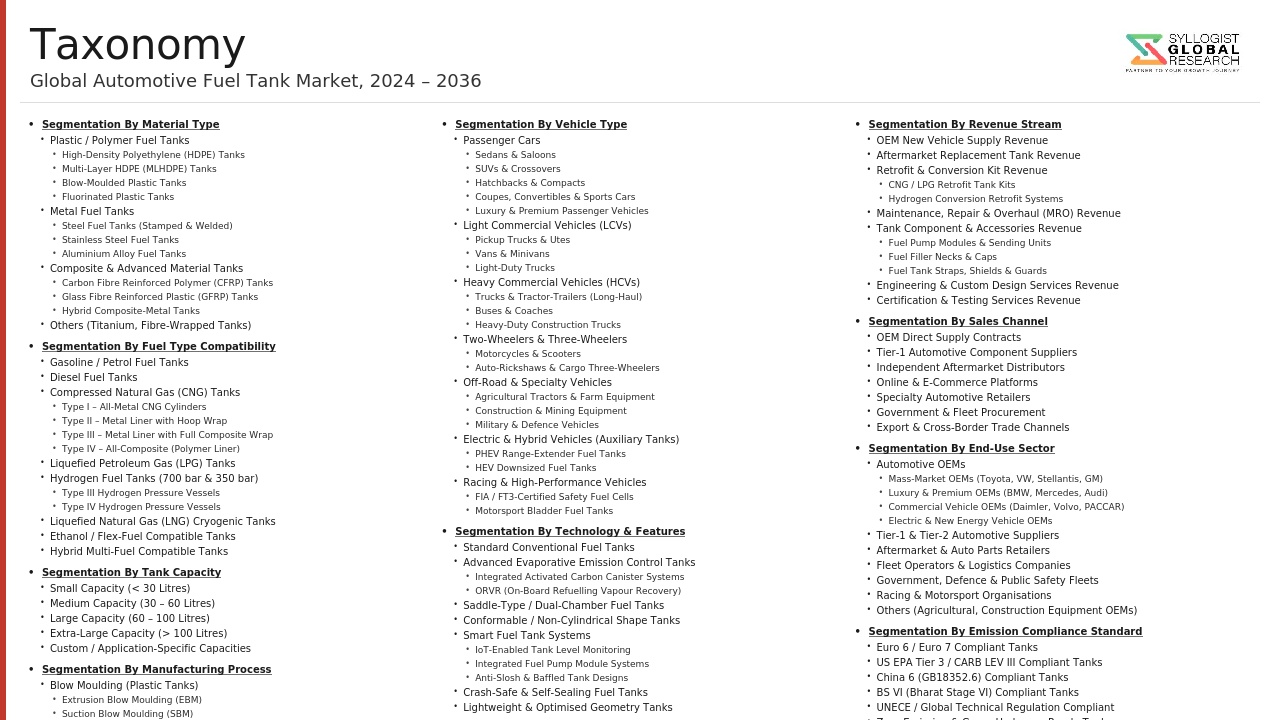
Market Segmentation
- Segmentation By Material Type
- High-Density Polyethylene (HDPE) Multilayer Plastic Fuel Tanks
- Steel Fuel Tanks (Stamped and Welded)
- Aluminum Fuel Tanks
- Type III Composite Tanks (Aluminum Liner with Carbon Fiber Overwrap)
- Type IV Composite Tanks (Polymer Liner with Carbon Fiber Overwrap)
- Others
- Segmentation By Fuel Type
- Petrol (Gasoline) Fuel Tanks
- Diesel Fuel Tanks
- Compressed Natural Gas (CNG) Storage Systems
- Liquefied Petroleum Gas (LPG) Pressure Vessels
- Liquefied Natural Gas (LNG) Cryogenic Tanks
- Hydrogen Storage Systems (350 Bar and 700 Bar)
- Flex-Fuel and Ethanol Blend Compatible Tanks
- Others
- Segmentation By Tank Capacity
- Below 30 Litres
- 30 Litres to 50 Litres
- 51 Litres to 70 Litres
- 71 Litres to 100 Litres
- Above 100 Litres (Commercial Vehicle and Auxiliary Tanks)
- Segmentation By Component
- Primary Fuel Tank Vessel
- In-Tank Fuel Pump and Sender Modules
- Fuel Level Sensors
- Rollover Valves and Pressure Relief Valves
- Filler Pipes, Fuel Caps, and Capless Filler Systems
- Evaporative Emission Control Canisters
- Purge Valves and Vapor Management Valves
- Fuel Tank Straps and Mounting Hardware
- Heat Shields and Protective Underbody Components
- Others
- Segmentation By Vehicle Type
- Passenger Cars (Compact and Sub-Compact)
- Passenger Cars (Mid-Size and Full-Size)
- Premium and Luxury Passenger Cars
- Sport Utility Vehicles (SUVs) and Crossovers
- Light Commercial Vehicles (LCV) and Pickup Trucks
- Medium and Heavy Commercial Trucks
- Buses and Coaches
- Two-Wheelers and Three-Wheelers
- Off-Highway and Agricultural Equipment
- Others
- Segmentation By Propulsion Type
- Internal Combustion Engine (ICE) Vehicles
- Full Hybrid Electric Vehicles (HEV)
- Plug-In Hybrid Electric Vehicles (PHEV)
- Mild Hybrid Electric Vehicles (MHEV)
- Compressed Natural Gas (CNG) Vehicles
- Liquefied Petroleum Gas (LPG) Vehicles
- Fuel Cell Electric Vehicles (FCEV)
- Others
- Segmentation By Manufacturing Process
- Multilayer Co-Extrusion Blow Molding
- Single-Layer Blow Molding
- Stamping and Welding (Steel)
- Aluminum Fabrication and Welding
- Filament Winding (Composite Pressure Vessels)
- Automated Fiber Placement (AFP)
- Others
- Segmentation By Sales Channel
- Original Equipment Manufacturer (OEM) Direct Supply
- Aftermarket Replacement Parts
- Independent Distributors and Wholesalers
- Online Retail and E-Commerce Platforms
- Others
- Segmentation By End User
- Passenger Vehicle OEMs
- Commercial Vehicle OEMs
- Two-Wheeler OEMs
- Off-Highway Equipment Manufacturers
- Fleet Operators and Logistics Companies
- Aftermarket Service Providers and Independent Repair Shops
- Others
- Segmentation By Region
- North America
- Europe
- Asia-Pacific
- Middle East and Africa
- Latin America
All market revenues are presented in USD
Historical Year: 2021–2024 | Base Year: 2025 | Estimated Year: 2026 | Forecast Period: 2027–2034
Key Questions this Study Will Answer
- What is the total global market valuation of the Automotive Fuel Tank Market in the base year 2025, and what is the projected market size and compound annual growth rate through 2034, disaggregated by material type, multilayer plastic, steel, aluminum, and composite pressure vessels, and by fuel type, petrol, diesel, CNG, LPG, LNG, and hydrogen, to enable fuel tank manufacturers, raw material suppliers, automotive OEMs, and investors to identify which material technology and fuel storage segments will generate the highest absolute revenue and the most durable growth trajectory across the forecast period in the context of the accelerating powertrain electrification transition?
- How is battery electric vehicle penetration growth across key automotive markets, specifically the European Union, China, and the United States, expected to compress new vehicle conventional fuel tank installation volumes on a market-by-market and vehicle segment basis through 2034, and what is the net revenue impact on the global fuel tank market when accounting for the partially offsetting effects of rising hybrid electric vehicle production, expanding alternative fuel storage system demand, sustained aftermarket replacement volume growth, and the increasing per-unit technology content value of advanced multilayer barrier tank systems required for next-generation evaporative emission compliance?
- What is the projected market size, compound annual growth rate, and competitive landscape of the automotive hydrogen storage system segment, encompassing Type IV carbon fiber composite 350-bar heavy commercial vehicle tanks and 700-bar passenger vehicle systems, through 2034, and which commercial vehicle fleet categories, geographic markets, and OEM programs are expected to generate the largest hydrogen storage system procurement volumes, at what per-vehicle content values, as fuel cell electric heavy truck and bus deployment scales across North America, Europe, and Asia-Pacific?
- How are evolving evaporative emission regulatory frameworks, specifically California ARB LEV III running loss and diurnal limits, Euro 7 evaporative emission stringency escalation, and equivalent China 6b and Bharat Stage VI requirements, reshaping the technology specification, barrier layer architecture, and per-unit cost structure of multilayer plastic fuel tanks across global OEM vehicle programs, and what is the estimated aggregate compliance-driven fuel tank system cost increase per vehicle that OEMs and their Tier-1 fuel system suppliers are absorbing across new model year programs entering production between 2026 and 2030?
- Who are the leading Tier-1 automotive fuel tank system suppliers, composite pressure vessel manufacturers, in-tank fuel pump module developers, and evaporative emission system specialists currently defining the competitive landscape of the global automotive fuel tank market, and what are their respective program portfolios across conventional, CNG, LPG, and hydrogen fuel storage segments, manufacturing footprint and capacity expansion strategies, regional market positioning, technology development roadmaps for next-generation barrier tank and composite pressure vessel systems, and strategic responses to the long-term structural challenge posed by battery electric vehicle adoption across their core passenger vehicle and commercial vehicle business lines?
- Product Definition
- Research Methodology
- Research Design & Framework
- Overall Research Approach: Descriptive, Exploratory & Quantitative Mixed-Method Design
- Market Definition & Scope Boundaries: What is Included and Excluded
- Segmentation Framework
- Key Research Assumptions & Limitations
- Secondary Research
- Primary Research Design & Execution
- Data Triangulation & Validation
- Market Sizing & Forecasting Methodology
- Competitive Intelligence Methodology
- Quality Assurance & Peer Review
- Definitions, Abbreviations & Data Notes
- Research Design & Framework
- Executive Summary
- Market Snapshot & Headline Numbers
- Key Findings & Research Highlights
- Market Dynamics
- Regional Market Summary
- Competitive Landscape Snapshot
- Technology & Innovation Highlights
- Market Dynamics
- Drivers
- Restraints
- Opportunities
- Challenges
- Porter’s Five Forces Analysis
- PESTLE Analysis
- Market Trends & Developments
- Emerging Trends
- Technological Developments
- Regulatory & Policy Changes
- Supply Chain & Sourcing Trends
- Manufacturing & Process Trends
- Investment & Funding Activity
- Sustainability & ESG Trends
- Risk Assessment Framework
- Raw Material & Supply Chain Risk
- Regulatory & Compliance Risk
- Market & Demand Risk
- Technology & Product Risk
- Environmental & Circular Economy Risk
- Regulatory Framework & Standards
- Evaporative Emission Regulations
- Fuel System Safety & Crash Integrity Standards
- Fuel Tank Material & Construction Standards
- Alternative Fuel & CNG / LPG Tank Standards
- Quality & Manufacturing Standards
- Global Automotive Fuel Tank Market Outlook
- Market Size & Forecast by Value
- Market Size & Forecast by Volume (Units & Litres Capacity)
- Market Size & Forecast by Material Type
- Plastic Fuel Tanks
- Steel Fuel Tanks
- Aluminium Fuel Tanks
- Composite & Hybrid Fuel Tanks
- Rubber & Bladder Fuel Tanks
- Market Size & Forecast by Tank Type
- Main / Primary Fuel Tank
- Auxiliary / Secondary Fuel Tank
- Saddle Fuel Tank
- Conform / Space-Fill Fuel Tank
- Saddle-Conform Hybrid Tank
- Wet Arm Tank
- External Auxiliary Fuel Tank (Aftermarket / OEM Add-On)
- Integral Structural Fuel Tank
- Market Size & Forecast by Fuel Type Compatibility
- Petrol / Gasoline Fuel Tank
- Diesel Fuel Tank
- Flex-Fuel / Ethanol-Blend Fuel Tank (E10 to E100 Compatible)
- Compressed Natural Gas (CNG) Fuel Storage System
- Liquefied Petroleum Gas (LPG) Fuel Tank
- Liquefied Natural Gas (LNG) Fuel Tank (Heavy Commercial Vehicles)
- Hydrogen (H2) High-Pressure Storage Tank (FCEV)
- Biodiesel & HVO Compatible Fuel Tank
- Market Size & Forecast by Vehicle Type
- Passenger Cars
- SUV & Crossover Utility Vehicles
- Light Commercial Vehicles (LCV)
- Heavy Commercial Vehicles (HCV)
- Hybrid Electric Vehicles (HEV & PHEV)
- Motorcycles & Three-Wheelers
- Off-Road & Agricultural Vehicles
- Military & Armoured Vehicles
- Racing & Motorsport Vehicles
- Market Size & Forecast by EVAP System Integration Level
- Basic Fuel Tank
- Tank with Integrated In-Tank EVAP Components
- Tank with Closed EVAP System
- Zero-Evaporative Tank Module
- Market Size & Forecast by Tank Capacity
- Small Capacity
- Medium Capacity
- Large Capacity
- Extra-Large Capacity
- Very Large Capacity
- Market Size & Forecast by Manufacturing Process
- Blow Moulding
- Twin-Sheet Thermoforming
- Rotational Moulding
- Stamping & Deep Drawing (Steel & Aluminium Tanks)
- Welding & Assembly (MIG/TIG Welding for Aluminium & Steel)
- Compression Moulding (Composite Tank Shells)
- Filament Winding (CNG & H2 Composite Cylinder Production)
- Market Size & Forecast by Sales Channel
- OEM (Original Equipment Manufacturer) Supply
- Aftermarket Replacement Fuel Tank
- OES (Original Equipment Supplier) Aftermarket
- Independent Aftermarket (IAM) Fuel Tank
- Online & E-Commerce Aftermarket Fuel Tank Sales
- Retrofit & Conversion Kits (CNG, LPG Conversion Fuel Tank Systems)
- North America Automotive Fuel Tank Market Outlook
- Market Size & Forecast
- By Value
- By Volume (Units)
- By Material Type
- By Tank Type
- By Fuel Type Compatibility
- By Vehicle Type
- By EVAP System Integration Level
- By Tank Capacity
- By Manufacturing Process
- By Sales Channel
- Market Size & Forecast
- Europe Automotive Fuel Tank Market Outlook
- Market Size & Forecast
- By Value
- By Volume (Units)
- By Material Type
- By Tank Type
- By Fuel Type Compatibility
- By Vehicle Type
- By EVAP System Integration Level
- By Tank Capacity
- By Manufacturing Process
- By Sales Channel
- Market Size & Forecast
- Asia-Pacific Automotive Fuel Tank Market Outlook
- Market Size & Forecast
- By Value
- By Volume (Units)
- By Material Type
- By Tank Type
- By Fuel Type Compatibility
- By Vehicle Type
- By EVAP System Integration Level
- By Tank Capacity
- By Manufacturing Process
- By Sales Channel
- Market Size & Forecast
- Latin America Automotive Fuel Tank Market Outlook
- Market Size & Forecast
- By Value
- By Volume (Units)
- By Material Type
- By Tank Type
- By Fuel Type Compatibility
- By Vehicle Type
- By EVAP System Integration Level
- By Tank Capacity
- By Manufacturing Process
- By Sales Channel
- Market Size & Forecast
- Middle East & Africa Automotive Fuel Tank Market Outlook
- Market Size & Forecast
- By Value
- By Volume (Units)
- By Material Type
- By Tank Type
- By Fuel Type Compatibility
- By Vehicle Type
- By EVAP System Integration Level
- By Tank Capacity
- By Manufacturing Process
- By Sales Channel
- Market Size & Forecast
- Country-Wise* Automotive Fuel Tank Market Outlook
- Market Size & Forecast
- By Value
- By Volume (Units)
- By Material Type
- By Tank Type
- By Fuel Type Compatibility
- By Vehicle Type
- By EVAP System Integration Level
- By Tank Capacity
- By Manufacturing Process
- By Sales Channel
- Market Size & Forecast
*Countries Analyzed in the Syllogist Global Research Portfolio: United States, Canada, Mexico, Germany, France, United Kingdom, Italy, Spain, Poland, Czech Republic, Russia, China, Japan, South Korea, India, Thailand, Indonesia, Australia, Brazil, Argentina, Saudi Arabia, UAE, South Africa
- Technology Landscape & Innovation Analysis
- Plastic Fuel Tank Technology Deep-Dive
- Multilayer Co-Extrusion Blow Moulding Technology
- 3D Blow Moulding & Suction Blow Moulding for Saddle & Conform Tank Production
- EVAP System Component Technology Integrated into Fuel Tank
- Advanced HDPE Fuel Tank Welding & Assembly Technology
- Smart Fuel Tank Technology: Sensing & Connectivity
- Steel & Aluminium Fuel Tank Technology
- CNG & LPG Fuel Tank (Alternative Fuel Cylinder) Technology
- Hydrogen Storage Tank Technology for FCEV
- Fuel Tank In-Mould Components & Sub-Systems Technology
- Digital & Simulation Technology for Fuel Tank Development
- Patent & IP Landscape in Automotive Fuel Tanks
- Plastic Fuel Tank Technology Deep-Dive
- Value Chain & Supply Chain Analysis
- Raw Material Supply Chain
- Fuel Tank Manufacturing Equipment Supply Chain
- In-Tank Fuel System Component Supply Chain
- Fuel Tank Tier-1 Manufacturer
- Automotive OEM Integration
- Aftermarket & Distribution
- End-of-Life & Circular Economy
- Pricing Analysis
- Plastic Fuel Tank Pricing Analysis
- Steel Fuel Tank Pricing Analysis
- Aluminium Fuel Tank Pricing Analysis
- CNG & Composite Cylinder Pricing Analysis
- In-Tank Component Pricing Analysis
- Total System & OEM Pricing Analysis
- Sustainability & Environmental Analysis
- Lifecycle Assessment (LCA) of Automotive Fuel Tank Materials
- HDPE Fuel Tank Recyclability & Circular Economy
- Alternative Fuel Tank Sustainability Impact
- Manufacturing Sustainability
- Regulatory-Driven Sustainability
- Competitive Landscape
- Market Structure & Concentration
- Market Consolidation Level (Fragmented vs. Consolidated by Segment)
- Top 10 Players Market Share
- HHI (Herfindahl-Hirschman Index) Concentration Analysis
- Competitive Intensity Map by Material Type, Vehicle Segment & Geography
- Player Classification
- Global Tier-1 Fuel Tank System Integrators
- Specialist Plastic Fuel Tank Manufacturers
- Specialist Steel & Aluminium Fuel Tank Manufacturers
- CNG & Composite Cylinder Manufacturers
- FCEV Hydrogen Storage Cylinder Manufacturers
- In-Tank Fuel Pump & Component Specialists
- Aftermarket Fuel Tank Specialists
- OEM Captive Fuel Tank Producers
- Competitive Analysis Frameworks
- Market Share Analysis by Material, Vehicle Type & Region
- Company Profile
- Company Overview & Headquarters
- Fuel Tank Products & Technology Portfolio
- Key OEM Customer Relationships & Platform Wins
- Manufacturing Footprint & Production Capacity
- Revenue (Fuel Tank Segment) & Backlog
- Technology Differentiators & IP
- Key Strategic Partnerships, JVs & M&A Activity
- Recent Developments (Contract Wins, Capacity Expansion, Product Launches)
- SWOT Analysis
- Strategic Focus Areas & Roadmap
- Competitive Positioning Map (Technology Capability vs. Market Penetration)
- Key Company Profiles
- Market Structure & Concentration
- Technology Landscape & Innovation Analysis
- Strategic Output
- Market Opportunity Matrix – By Material, Tank Type, Vehicle Segment & Geography
- White Space Opportunity Analysis
- Strategic Output
- Strategic Recommendations
- Product Portfolio & Technology Investment Strategy
- Manufacturing & Operational Excellence Strategy
- Geographic Expansion & Localisation Strategy
- Customer & OEM Engagement Strategy
- Partnership, M&A & Ecosystem Strategy
- Sustainability & Circular Economy Strategy
- Risk Mitigation & Future Roadmap
- Strategic Priority Matrix & Roadmap
- Near-term (2025–2028)
- Mid-term (2029–2032)
- Long-term (2033–2037)