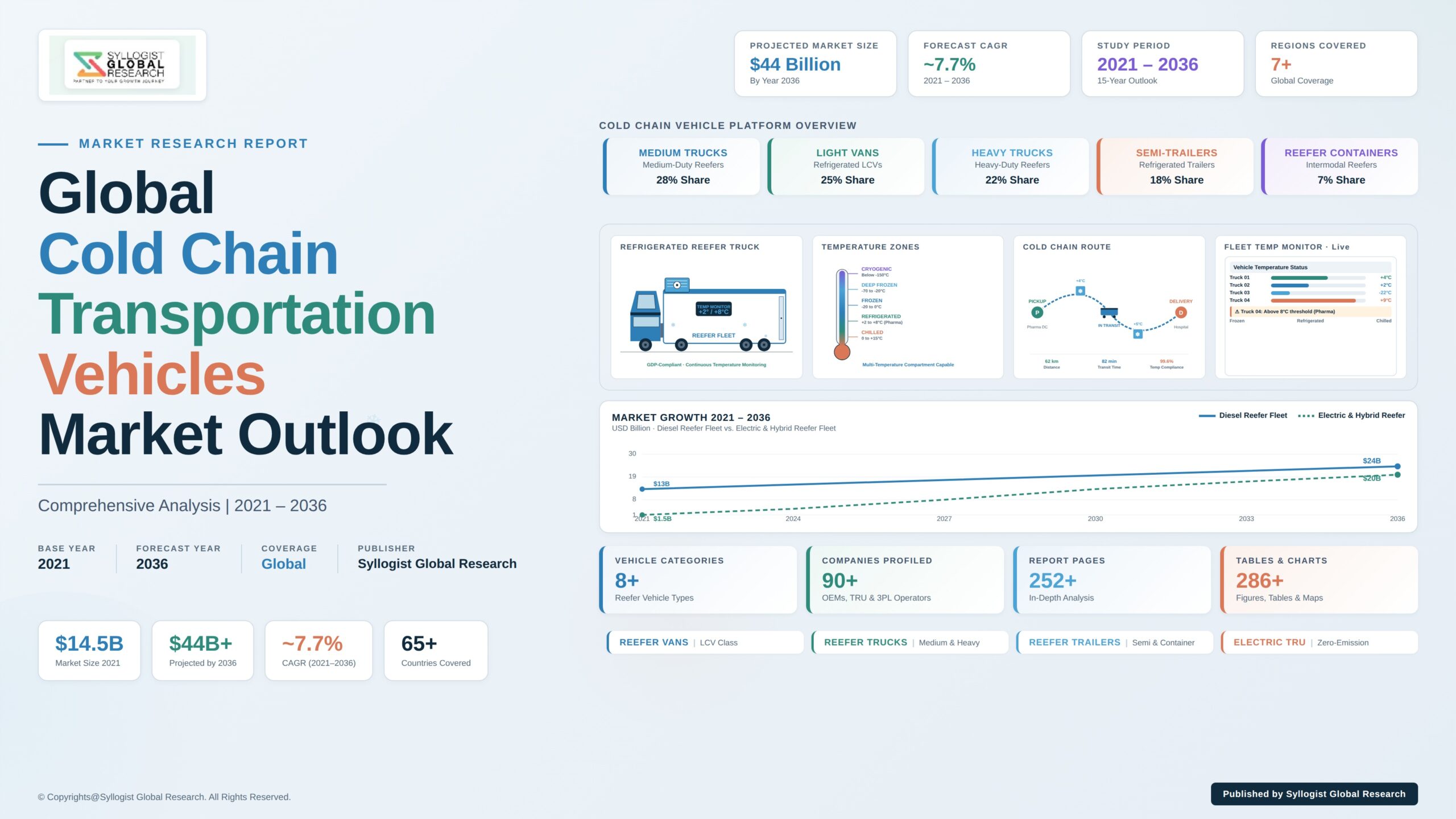
Global Cold Chain Transportation Vehicles Market By Vehicle Type, By Temperature Range, By Application, By Technology, By Tonnage Capacity, By Refrigeration Type, By End User, By Region, Competition, Forecast & Opportunities, 2021-2034F
Market Definition
Cold chain transportation vehicles are purpose-built temperature-controlled trucks, vans, trailers, refrigerated containers, and intermodal transport units engineered to preserve product integrity during the movement of temperature-sensitive cargo across primary, secondary, and last-mile distribution routes. The Global Cold Chain Transportation Vehicles Market encompasses the design, manufacturing, procurement, and operational deployment of refrigerated trucks, reefer trailers, refrigerated light commercial vans, insulated containers, multi-temperature compartment vehicles, and associated transport refrigeration units, telematics, and load monitoring systems supporting controlled-temperature logistics of perishable food, pharmaceutical products, biological samples, vaccines, fresh produce, dairy, meat, seafood, frozen goods, and specialty chemical shipments globally.
The cold chain transportation vehicles market includes diesel-powered, electric, hybrid, hydrogen fuel cell, and cryogenic propulsion and cooling configurations, alongside transport refrigeration units (TRU) sourced from independent specialist suppliers as well as integrated vehicle manufacturers. The scope covers single-temperature, dual-temperature, and multi-temperature compartment vehicles capable of simultaneously transporting chilled, frozen, and ambient cargo within segmented insulated zones. Market participants include refrigerated vehicle original equipment manufacturers, transport refrigeration unit suppliers, body builders, insulation panel producers, telematics and fleet monitoring providers, leasing and rental operators, and end-user fleet operators across logistics service provider, food and beverage distributor, pharmaceutical distributor, and grocery retail sectors. The cold chain transportation vehicles market also covers aftermarket services including TRU maintenance, insulation reconditioning, compliance certification, temperature mapping validation, and retrofit electrification programs. The scope explicitly excludes stationary cold storage warehouses, ocean reefer container manufacturing, air cargo temperature-controlled containers, and non-vehicle refrigeration infrastructure, focusing exclusively on land-based refrigerated transport vehicles supporting road and intermodal cold chain logistics applications worldwide.
Market Insights
The global cold chain transportation vehicles market is entering a sustained expansion phase, shaped by accelerating perishable food trade volumes, rapid pharmaceutical cold chain capacity buildout following pandemic-era distribution infrastructure investments, the structural emergence of grocery e-commerce and quick-commerce demand patterns requiring last-mile refrigerated fulfillment, and regulatory tightening of temperature monitoring compliance standards across food safety and pharmaceutical distribution frameworks globally. The cold chain transportation vehicles market was valued at approximately USD 17.6 billion in 2025 and is projected to reach USD 38.4 billion by 2034, advancing at a compound annual growth rate of 9.1% through the forecast period, as logistics service providers, food and beverage distributors, pharmaceutical wholesalers, and grocery retail operators scale refrigerated fleet capacity to support expanding perishable supply chains across mature and emerging economies.
The cold chain transportation vehicles market trajectory is being reshaped by accelerating commercial deployment of electric refrigerated vehicles, hybrid-electric transport refrigeration units, and cryogenic cooling configurations that address tightening urban low-emission zone restrictions and corporate sustainability commitments across logistics service providers, retail chains, and pharmaceutical distributors. Battery-electric refrigerated vans accounted for over 18% of new light commercial refrigerated vehicle registrations across European markets in 2024, with adoption accelerating through 2025 supported by zero-emission zone enforcement in London, Paris, Amsterdam, Brussels, and an expanding list of municipal authorities. Telematics integration has become a default specification in new refrigerated vehicle procurement, with over 85% of newly manufactured reefer trailers incorporating embedded temperature monitoring, geofencing, and remote diagnostics functionality supporting compliance documentation under the Hazard Analysis Critical Control Point (HACCP) and Good Distribution Practice (GDP) standards.
Refrigerated semi-trailers represent the largest revenue contributor within the cold chain transportation vehicles market, driven by long-haul food logistics, cross-border pharmaceutical distribution, and intermodal trade flows requiring high-capacity insulated trailers paired with diesel or electric TRUs supporting transit durations exceeding 24 hours. Light commercial refrigerated vans constitute the fastest-growing segment within the cold chain transportation vehicles market, propelled by grocery e-commerce expansion, quick-commerce 15-minute delivery models, restaurant supply chain densification, and last-mile pharmaceutical delivery applications connecting central distribution hubs to retail outlets, hospital pharmacies, clinical research sites, and end consumer locations. Multi-temperature compartment vehicles are gaining strategic procurement preference among grocery retailers and foodservice distributors, with simultaneous transport of chilled, frozen, and ambient cargo reducing fleet count requirements and consolidating distribution route economics across the cold chain transportation vehicles market.
Asia-Pacific is projected to record the highest regional compound annual growth rate through 2034 within the cold chain transportation vehicles market, underpinned by accelerating cold chain infrastructure investment in China, India, Indonesia, Vietnam, and the Philippines, where rising per-capita consumption of fresh and frozen foods, organized retail expansion, and pharmaceutical distribution modernization are driving sustained refrigerated fleet capacity additions. China hosts the largest national refrigerated truck and trailer fleet globally and continues to add over 60,000 new refrigerated vehicles annually. North America occupies the second largest regional position within the cold chain transportation vehicles market, supported by mature long-haul refrigerated trucking corridors, expanding pharmaceutical cold chain capacity, and grocery e-commerce fulfillment buildout. Europe represents the third major regional market, shaped by zero-emission urban delivery mandates, GDP-compliant pharmaceutical distribution, and the integration of refrigerated last-mile capacity into established municipal logistics frameworks across the cold chain transportation vehicles market.
Key Drivers
Accelerating Global Perishable Food Trade Volumes, Grocery E-Commerce Expansion, and Quick-Commerce Refrigerated Last-Mile Fulfillment Generating Sustained Refrigerated Vehicle Procurement Demand
The expansion of cross-border perishable food trade, organized cold chain retail penetration across emerging economies, and the structural emergence of grocery e-commerce and quick-commerce fulfillment models requiring temperature-controlled last-mile delivery are generating sustained procurement demand for refrigerated trucks, trailers, and light commercial vans across the cold chain transportation vehicles market. Global perishable food trade volumes increased by over 28% between 2018 and 2024, with fresh produce, dairy, meat, seafood, and frozen processed food categories driving sustained refrigerated logistics capacity requirements. Grocery e-commerce penetration across mature markets reached 12% to 15% of total grocery spend in 2024, with quick-commerce models requiring 10-minute to 30-minute delivery windows generating dense refrigerated vehicle deployment in urban catchment areas. Restaurant supply chain densification, ghost kitchen proliferation, and foodservice distribution route expansion are reinforcing refrigerated van procurement momentum within the cold chain transportation vehicles market. Fleet operators are structuring multi-year refrigerated vehicle procurement frameworks aligning fleet replacement cycles with grocery e-commerce capacity scaling, generating long-duration revenue commitments that anchor manufacturer production planning and component supplier capacity expansion decisions across the cold chain transportation vehicles value chain globally.
Pharmaceutical Cold Chain Capacity Expansion, Vaccine Distribution Infrastructure Investment, and GDP Compliance Frameworks Driving Specialty Refrigerated Vehicle Procurement
The structural expansion of pharmaceutical cold chain capacity following the pandemic-era acceleration of temperature-controlled vaccine distribution, biologics manufacturing growth, and tightening Good Distribution Practice (GDP) compliance requirements across major regulatory frameworks are driving sustained specialty refrigerated vehicle procurement within the cold chain transportation vehicles market. Pharmaceutical cold chain logistics spending globally reached approximately USD 22 billion in 2025, with biologics, vaccines, cell and gene therapy products, and clinical trial samples requiring tightly controlled temperature ranges spanning 2 degrees Celsius to 8 degrees Celsius, minus 20 degrees Celsius, minus 70 degrees Celsius, and minus 196 degrees Celsius cryogenic envelopes. Validated GDP-compliant refrigerated vehicles incorporating dual-redundant temperature monitoring, calibrated probe systems, automated alarm protocols, and real-time data logging are increasingly mandated across regulated pharmaceutical distribution corridors. The expansion of specialty pharmacy delivery programs serving home infusion therapy, clinical trial site logistics, and direct-to-patient pharmaceutical fulfillment is generating sustained demand for compact, validated refrigerated vans equipped with calibrated multi-zone temperature compartments and tamper-evident cargo controls suited to high-value, low-volume pharmaceutical consignments across the cold chain transportation vehicles market.
Refrigerated Fleet Electrification Mandates, Zero-Emission Urban Delivery Zones, and Corporate Sustainability Procurement Policies Accelerating Cold Chain Vehicle Fleet Modernization
Zero-emission urban delivery zone enforcement, low-emission zone (LEZ) expansion across European municipalities, California Advanced Clean Fleets regulation, and corporate sustainability procurement commitments from major retailers, logistics service providers, and pharmaceutical distributors are collectively driving accelerated modernization of the cold chain transportation vehicles fleet base toward battery-electric, hybrid-electric, and hydrogen fuel cell configurations. Battery-electric refrigerated vans accounted for over 18% of new light commercial refrigerated vehicle registrations across European markets in 2024, with adoption rates rising sharply through 2025 as urban LEZ enforcement intensifies in London, Paris, Amsterdam, Brussels, Stockholm, Oslo, Copenhagen, and Berlin. California Advanced Clean Fleets regulation mandates that high-priority fleet operators procure 100% zero-emission medium- and heavy-duty trucks for in-state operations on accelerated timelines, including refrigerated trucks operating within California ports, distribution hubs, and intrastate routes. Cryogenic and electrically driven transport refrigeration units that decouple cooling capacity from diesel engine operation are gaining specification preference for both diesel and electric chassis configurations, supporting cold chain transportation vehicles fleet operators in reducing scope 1 and scope 3 emissions associated with refrigerated transport activities while complying with the emerging Carbon Border Adjustment Mechanism and corporate climate reporting frameworks.
Key Challenges
High Total Cost of Ownership, Capital Intensity of Electric Refrigerated Vehicles, and Limited Charging Infrastructure for Heavy-Duty Refrigerated Fleet Operators
The transition to battery-electric and hydrogen fuel cell refrigerated vehicles within the cold chain transportation vehicles market continues to face material capital cost premiums, with electric refrigerated trucks priced approximately 60% to 90% above diesel-equivalent configurations and hydrogen fuel cell refrigerated trucks priced significantly higher still. Charging infrastructure supporting medium- and heavy-duty refrigerated truck operation remains constrained across major freight corridors in North America, Europe, and Asia-Pacific, with the requirement to power both vehicle propulsion and transport refrigeration units simultaneously generating elevated charging capacity demands relative to non-refrigerated electric trucks. Hydrogen refueling networks supporting heavy-duty refrigerated fleet operation are at early-stage deployment across most geographies, limiting practical adoption of hydrogen-powered refrigerated trucks to defined operating corridors with confirmed refueling access. The combined effect of vehicle capital cost premium, charging infrastructure capacity constraints, and operational range limitations under refrigeration load conditions extends payback periods for electric refrigerated vehicle investments and complicates fleet electrification roadmap development for cold chain logistics operators evaluating total cost of ownership decisions within the cold chain transportation vehicles market.
Persistent Driver Shortages, Regulatory Hours-of-Service Compliance, and Tightening Temperature Monitoring Documentation Burdens Constraining Refrigerated Fleet Operating Productivity
Cold chain logistics operators across North America, Europe, and Asia-Pacific continue to confront structural driver shortages estimated above 12% of authorized workforce capacity, accelerated by demographic aging, post-pandemic workforce attrition, and competitive wage pressure from less demanding logistics segments. The refrigerated trucking workforce confronts heightened operational complexity relative to dry van trucking, with additional pre-trip refrigeration unit inspection requirements, multi-temperature load planning, temperature monitoring documentation responsibilities, and pickup and delivery window precision demands constraining route productivity. Tightening regulatory compliance frameworks governing temperature monitoring documentation, electronic logging device synchronization with refrigeration unit data, and chain-of-custody validation across food safety and pharmaceutical distribution corridors are generating administrative overhead that reduces effective driver utilization and increases per-mile operating costs within the cold chain transportation vehicles market. Hours-of-service regulations limiting consecutive driving hours, combined with refrigerated trailer pickup and delivery appointment requirements at distribution centers, further compress productive operational windows for refrigerated fleet operators. The combination of driver scarcity, compliance documentation burden, and operational complexity is generating sustained pressure on per-load economics across refrigerated transport operations.
Transport Refrigeration Unit Reliability Risks, Cargo Loss Liability Exposure, and Cold Chain Integrity Failure Insurance Cost Escalation
Transport refrigeration unit reliability and cargo loss liability exposure represent persistent operational risks within the cold chain transportation vehicles market, with refrigeration unit failures during long-haul transit generating cargo loss exposures that can exceed USD 250,000 per incident for high-value pharmaceutical, vaccine, biologics, and premium perishable food consignments. Refrigeration unit mean time between failure metrics, combined with the operational requirement for continuous temperature maintenance across multi-day cross-border transit cycles, generate sustained insurance liability exposures that have driven cold chain cargo insurance premium rates upward by 15% to 30% across major underwriting markets in recent renewal cycles. Operational failures attributable to refrigeration unit defects, fuel exhaustion, software malfunction, sensor calibration drift, and inadequate pre-trip inspection protocols can trigger cargo claims that simultaneously generate financial loss, customer relationship damage, and regulatory scrutiny under pharmaceutical GDP compliance frameworks. The complexity of liability allocation among refrigerated vehicle manufacturers, transport refrigeration unit suppliers, fleet operators, and logistics service providers in multi-actor failure scenarios remains inconsistently developed across legal jurisdictions, complicating financial recovery and creating ongoing operational risk management challenges within the cold chain transportation vehicles market.
Market Segmentation
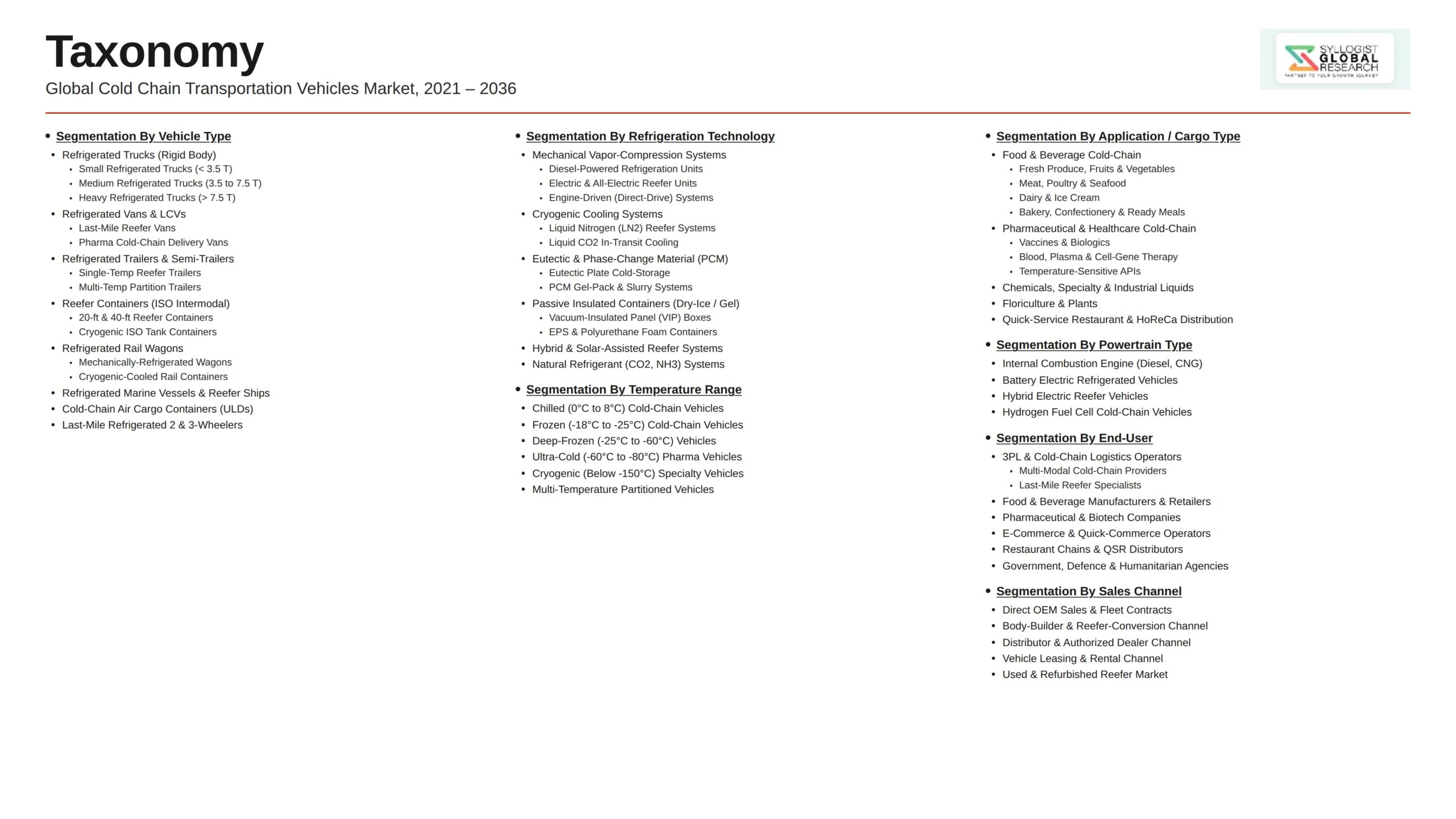
- Segmentation By Vehicle Type
- Light Commercial Refrigerated Vans
- Refrigerated Trucks (Medium-Duty)
- Refrigerated Trucks (Heavy-Duty)
- Refrigerated Semi-Trailers
- Refrigerated Intermodal Containers
- Others
- Segmentation By Temperature Range
- Chilled (0 to 15 degrees Celsius)
- Refrigerated (2 to 8 degrees Celsius)
- Frozen (Minus 20 to 0 degrees Celsius)
- Deep Frozen (Below Minus 20 degrees Celsius)
- Cryogenic (Below Minus 70 degrees Celsius)
- Multi-Temperature Compartment
- Segmentation By Application
- Food and Beverage Logistics
- Pharmaceutical and Healthcare Distribution
- Floral and Horticultural Products
- Chemicals and Industrial Goods
- Biological and Clinical Samples
- Others
- Segmentation By Technology
- Diesel-Powered Transport Refrigeration Units
- Electric Transport Refrigeration Units
- Hybrid-Electric Transport Refrigeration Units
- Cryogenic Cooling Systems
- Eutectic Plate Systems
- Others
- Segmentation By Tonnage Capacity
- Up to 3.5 Tonnes
- 5 to 7.5 Tonnes
- 5 to 16 Tonnes
- Above 16 Tonnes
- Segmentation By Refrigeration Type
- Single-Temperature
- Dual-Temperature
- Multi-Temperature
- Segmentation By End User
- Logistics and Third-Party Service Providers
- Food and Beverage Distributors
- Grocery and Retail Chains
- Pharmaceutical and Healthcare Distributors
- Restaurant and Foodservice Operators
- Floral and Specialty Goods Operators
- Others
- Segmentation By Region
- North America
- Europe
- Asia-Pacific
- Middle East and Africa
- Latin America
All market revenues are presented in USD
Historical Year: 2021-2024 | Base Year: 2025 | Estimated Year: 2026 | Forecast Period: 2027-2034
Key Questions this Study Will Answer
- What is the total global market valuation of the Cold Chain Transportation Vehicles Market in 2025, projected through 2034, segmented by vehicle type, temperature range, technology, and application, enabling vehicle manufacturers, transport refrigeration unit suppliers, fleet operators, and logistics investors to identify highest-growth segments and most durable revenue opportunities across the refrigerated transport landscape?
- How are logistics service providers, food and beverage distributors, pharmaceutical wholesalers, and grocery retailers structuring fleet procurement frameworks for refrigerated vehicles, and which operating models, including ownership, leasing, contract logistics, and outcome-based service contracts, are shaping commercial deployment economics within the cold chain transportation vehicles market through 2034?
- What zero-emission urban delivery mandates, California Advanced Clean Fleets regulations, and corporate sustainability procurement commitments are reshaping electrification timelines for refrigerated van, truck, and trailer fleets, and how are charging infrastructure investment decisions aligning with refrigerated fleet electrification roadmaps?
- Which transport refrigeration unit technologies, including diesel, electric, hybrid-electric, cryogenic, and eutectic plate configurations, are gaining the strongest procurement traction across light commercial, medium-duty, heavy-duty, and trailer applications, and what reliability, total cost of ownership, and emissions performance metrics are shaping technology selection decisions?
- How is the competitive landscape structured among refrigerated vehicle original equipment manufacturers, transport refrigeration unit suppliers, body builders, telematics providers, and integrated cold chain logistics operators within the cold chain transportation vehicles market, and what partnership and acquisition strategies are enabling new entrants to compete against incumbent suppliers?
- What pharmaceutical Good Distribution Practice (GDP) compliance requirements, food safety chain-of-custody frameworks, and temperature monitoring documentation standards are shaping specification requirements for refrigerated vehicle telematics, temperature probes, and validated load monitoring systems globally?
- Which regional markets, including Asia-Pacific, Europe, and North America, are projected to generate the largest incremental cold chain transportation vehicle procurement opportunities through 2034, and what demographic, retail penetration, pharmaceutical distribution, and regulatory factors are shaping capability investment priorities and supplier selection decisions in each regional cold chain transportation vehicles market?
- Product Definition
- Research Methodology
- Research Design & Framework
- Overall Research Approach: Descriptive, Exploratory & Quantitative Mixed-Method Design
- Market Definition & Scope Boundaries: What is Included and Excluded
- Segmentation Framework
- Key Research Assumptions & Limitations
- Secondary Research
- Primary Research Design & Execution
- Data Triangulation & Validation
- Market Sizing & Forecasting Methodology
- Competitive Intelligence Methodology
- Quality Assurance & Peer Review
- Definitions, Abbreviations & Data Notes
- Executive Summary
- Market Snapshot & Headline Numbers
- Key Findings & Research Highlights
- Market Dynamics
- Regional Market Summary
- Competitive Landscape Snapshot
- Technology & Innovation Highlights
- Market Dynamics
- Drivers
- Restraints
- Opportunities
- Challenges
- Porter’s Five Forces Analysis
- PESTLE Analysis
- Market Trends & Developments
- Emerging Trends
- Technological Developments
- Regulatory & Policy Changes
- Supply Chain & Sourcing Trends
- Manufacturing & Process Trends
- Investment & Funding Activity
- Sustainability & ESG Trends
- Risk Assessment Framework
- Electric Refrigerated Vehicle Capital Cost, Charging Infrastructure Constraint & Total Cost of Ownership Risk
- Transport Refrigeration Unit Reliability, Cargo Loss Liability & Insurance Cost Escalation Risk
- Driver Shortage, Hours-of-Service Compliance & Temperature Monitoring Documentation Burden Risk
- Cold Chain Integrity Failure, Pharmaceutical GDP Compliance & Regulatory Scrutiny Risk
- Fuel Cost Volatility, Diesel Phasedown & Stranded Asset Risk in Refrigerated Fleet Operations
- Regulatory Framework & Standards
- Zero-Emission Urban Delivery Zones, Low-Emission Zone Enforcement & California Advanced Clean Fleets Regulation
- Good Distribution Practice (GDP), Pharmaceutical Cold Chain Compliance & Continuous Temperature Monitoring Standards
- F-Gas Phasedown, Refrigerant Restrictions & Transport Refrigeration Unit (TRU) Emissions Standards
- Food Safety, HACCP Chain-of-Custody, Cold Chain Documentation & Cross-Border Perishable Trade Compliance Frameworks
- Vehicle Type Approval, Hours-of-Service, Electronic Logging Device & Cross-Border Refrigerated Transport Regulations
- Global Cold Chain Transportation Vehicles Market Outlook
- Market Size & Forecast by Value
- Market Size & Forecast by Volume (Refrigerated Vehicles in Service and Cold Chain Tonne-Kilometres in Billion)
- Market Size & Forecast by Vehicle Type
- Light Commercial Refrigerated Vans
- Refrigerated Trucks (Medium-Duty)
- Refrigerated Trucks (Heavy-Duty)
- Refrigerated Semi-Trailers
- Refrigerated Intermodal Containers
- Others
- Market Size & Forecast by Temperature Range
- Chilled (0 to 15 degrees Celsius)
- Refrigerated (2 to 8 degrees Celsius)
- Frozen (Minus 20 to 0 degrees Celsius)
- Deep Frozen (Below Minus 20 degrees Celsius)
- Cryogenic (Below Minus 70 degrees Celsius)
- Multi-Temperature Compartment
- Market Size & Forecast by Application
- Food and Beverage Logistics
- Pharmaceutical and Healthcare Distribution
- Floral and Horticultural Products
- Chemicals and Industrial Goods
- Biological and Clinical Samples
- Others
- Market Size & Forecast by Technology
- Diesel-Powered Transport Refrigeration Units
- Electric Transport Refrigeration Units
- Hybrid-Electric Transport Refrigeration Units
- Cryogenic Cooling Systems
- Eutectic Plate Systems
- Battery-Electric Refrigerated Vehicles
- Hydrogen Fuel Cell Refrigerated Vehicles
- Others
- Market Size & Forecast by Tonnage Capacity
- Up to 3.5 Tonnes
- 5 to 7.5 Tonnes
- 5 to 16 Tonnes
- Above 16 Tonnes
- Market Size & Forecast by Refrigeration Type
- Single-Temperature
- Dual-Temperature
- Multi-Temperature
- Market Size & Forecast by End-User
- Logistics and Third-Party Service Providers
- Food and Beverage Distributors
- Grocery and Retail Chains
- Pharmaceutical and Healthcare Distributors
- Restaurant and Foodservice Operators
- Floral and Specialty Goods Operators
- Others
- Market Size & Forecast by Sales Channel
- Direct OEM Vehicle Sales to Fleet Operators
- Lease, Rental & Subscription Fleet Procurement
- Dealership & Distributor Channel Sales
- Fleet-as-a-Service Operating Contracts
- Aftermarket Service, TRU Maintenance & Reconditioning Contracts
- North America Cold Chain Transportation Vehicles Market Outlook
- Market Size & Forecast
- By Value
- By Volume (Refrigerated Vehicles in Service and Cold Chain Tonne-Kilometres in Billion)
- By Vehicle Type
- By Temperature Range
- By Application
- By Technology
- By Tonnage Capacity
- By Refrigeration Type
- By End-User
- By Country
- By Sales Channel
- Market Size & Forecast
- Europe Cold Chain Transportation Vehicles Market Outlook
- Market Size & Forecast
- By Value
- By Volume (Refrigerated Vehicles in Service and Cold Chain Tonne-Kilometres in Billion)
- By Vehicle Type
- By Temperature Range
- By Application
- By Technology
- By Tonnage Capacity
- By Refrigeration Type
- By End-User
- By Country
- By Sales Channel
- Market Size & Forecast
- Asia-Pacific Cold Chain Transportation Vehicles Market Outlook
- Market Size & Forecast
- By Value
- By Volume (Refrigerated Vehicles in Service and Cold Chain Tonne-Kilometres in Billion)
- By Vehicle Type
- By Temperature Range
- By Application
- By Technology
- By Tonnage Capacity
- By Refrigeration Type
- By End-User
- By Country
- By Sales Channel
- Market Size & Forecast
- Latin America Cold Chain Transportation Vehicles Market Outlook
- Market Size & Forecast
- By Value
- By Volume (Refrigerated Vehicles in Service and Cold Chain Tonne-Kilometres in Billion)
- By Vehicle Type
- By Temperature Range
- By Application
- By Technology
- By Tonnage Capacity
- By Refrigeration Type
- By End-User
- By Country
- By Sales Channel
- Market Size & Forecast
- Middle East & Africa Cold Chain Transportation Vehicles Market Outlook
- Market Size & Forecast
- By Value
- By Volume (Refrigerated Vehicles in Service and Cold Chain Tonne-Kilometres in Billion)
- By Vehicle Type
- By Temperature Range
- By Application
- By Technology
- By Tonnage Capacity
- By Refrigeration Type
- By End-User
- By Country
- By Sales Channel
- Market Size & Forecast
- Country-Wise* Cold Chain Transportation Vehicles Market Outlook
- Market Size & Forecast
- By Value
- By Volume (Refrigerated Vehicles in Service and Cold Chain Tonne-Kilometres in Billion)
- By Vehicle Type
- By Temperature Range
- By Application
- By Technology
- By Tonnage Capacity
- By Refrigeration Type
- By End-User
- By Country
- By Sales Channel
- Market Size & Forecast
*Countries Analysed in the Global Research Portfolio: United States, Canada, Mexico, Germany, France, United Kingdom, Netherlands, Spain, Italy, Norway, Sweden, China, Japan, India, Australia, South Korea, Singapore, Brazil, Chile, Saudi Arabia, UAE, Egypt, South Africa, Israel
- Technology Landscape & Innovation Analysis
- Battery-Electric Refrigerated Vehicle & Heavy-Duty Refrigerated Fleet Electrification Technology Deep-Dive
- Hybrid-Electric & Cryogenic Transport Refrigeration Unit (TRU) Technology
- Hydrogen Fuel Cell Refrigerated Vehicle & Hydrogen Refuelling Integration Technology
- Telematics, Temperature Monitoring & GDP-Compliant Data Logging Technology
- Multi-Temperature Compartment, Dual-Zone Refrigerated Vehicle & Insulation Panel Technology
- Connected Fleet, Internet of Things (IoT) & Predictive Maintenance Technology
- Refrigerated Vehicle Aerodynamics, Insulation Innovation & Energy Efficiency Technology
- Patent & IP Landscape in Cold Chain Transportation Vehicles Technologies
- Value Chain & Supply Chain Analysis
- Refrigerated Vehicle Chassis, Body & Insulation Panel Manufacturing Supply Chain
- Transport Refrigeration Unit (TRU) Manufacturing & Component Supply Chain
- Battery, Charging Infrastructure & Electric Powertrain Supply Chain
- Telematics, Temperature Monitoring & Connected Vehicle Hardware Supply Chain
- Cold Chain Logistics Operator, Third-Party Logistics & Fleet Operator Procurement Channel
- Pharmaceutical, Food and Beverage, Grocery Retail Customer Procurement Landscape
- Aftermarket Service, TRU Maintenance, Reconditioning & Refrigerant Service Network
- Pricing Analysis
- Light Commercial Refrigerated Van Pricing Analysis Across Diesel, Electric & Hybrid Powertrains
- Medium- and Heavy-Duty Refrigerated Truck Pricing Analysis
- Refrigerated Semi-Trailer & Refrigerated Intermodal Container Pricing Analysis
- Transport Refrigeration Unit Pricing & TRU Replacement Economics Across Diesel, Electric & Cryogenic Configurations
- Charging Infrastructure & Hydrogen Refuelling Capital and Operating Cost Analysis
- Fleet Operating Cost: Per Tonne-Kilometre, Per Vehicle-Day & Per Route Economics
- Total Cost of Ownership & Electrification Payback Period Analysis Across Refrigerated Vehicle Powertrain Options
- Sustainability & Environmental Analysis
- Lifecycle Assessment (LCA) of Refrigerated Vehicles Across Diesel, Electric & Hydrogen Powertrain Configurations
- Tailpipe Emissions Reduction, Scope 3 Emissions Impact & Net Climate Contribution of Refrigerated Fleet Electrification
- Refrigerant Global Warming Potential, F-Gas Phasedown Impact & Low-GWP Alternative Adoption Across Transport Refrigeration Units
- End-of-Life Vehicle Recycling, Battery Recovery & Circular Economy Performance Across Refrigerated Fleet Operators
- Regulatory-Driven Sustainability, SDG 12 (Responsible Consumption) & SDG 13 (Climate Action) Alignment & Green Finance Eligibility
- Competitive Landscape
- Market Structure & Concentration
- Market Consolidation Level (Fragmented vs. Consolidated by Vehicle Type & Geography)
- Top 10 Players Market Share
- HHI (Herfindahl-Hirschman Index) Concentration Analysis
- Competitive Intensity Map by Vehicle Type, Technology & Geography
- Player Classification
- Integrated Refrigerated Vehicle Original Equipment Manufacturers (OEMs)
- Specialist Transport Refrigeration Unit (TRU) Manufacturers
- Body Builders & Insulation Panel Manufacturers
- Telematics, Temperature Monitoring & Connected Vehicle Hardware Providers
- Battery, Charging Infrastructure & Electric Powertrain Providers
- Hydrogen Fuel Cell & Cryogenic Cooling Technology Specialists
- Refrigerated Fleet Leasing, Rental & Fleet-as-a-Service Operators
- Cold Chain Logistics & Third-Party Logistics Service Providers
- Competitive Analysis Frameworks
- Market Share Analysis by Vehicle Type, Technology & Region
- Company Profile
- Company Overview & Headquarters
- Cold Chain Transportation Vehicle Products & Technology Portfolio
- Key Customer Relationships & Reference Fleet Deployments
- Manufacturing Footprint & Production Capacity
- Revenue (Cold Chain Transportation Vehicles Segment) & Order Backlog
- Technology Differentiators & IP
- Key Strategic Partnerships, JVs & M&A Activity
- Recent Developments (Contract Wins, Capacity Expansion, Product Launches)
- SWOT Analysis
- Strategic Focus Areas & Roadmap
- Competitive Positioning Map (Technology Capability vs. Market Penetration)
- Key Company Profiles
- Market Structure & Concentration
- Technology Landscape & Innovation Analysis
- Strategic Output
- Market Opportunity Matrix: By Vehicle Type, Technology, Application, End-User & Geography
- White Space Opportunity Analysis
- Strategic Recommendations
- Product Portfolio & Technology Investment Strategy
- Manufacturing & Operational Excellence Strategy
- Geographic Expansion & Localisation Strategy
- Customer & End-User Engagement Strategy
- Partnership, M&A & Ecosystem Strategy
- Sustainability & Circular Economy Strategy
- Risk Mitigation & Future Roadmap
- Strategic Priority Matrix & Roadmap
- Near-term (2025-2028)
- Mid-term (2029-2032)
- Long-term (2033-2037)