Market Definition
The Global Electric Aircraft and Hydrogen Aviation Market encompasses the design, development, certification, manufacturing, and commercial operation of aircraft propulsion systems that wholly or substantially eliminate the combustion of conventional fossil-based jet fuel, substituting it with electrical energy stored in battery packs, electrical energy generated onboard through hydrogen fuel cells, or thermal energy released through the direct combustion of liquid or gaseous hydrogen in modified gas turbine architectures. The market spans a broad spectrum of vehicle categories, including battery-electric and hybrid-electric fixed-wing aircraft optimized for short-haul regional and commuter missions, hydrogen fuel cell-powered aircraft targeting regional and narrow-body stage lengths, hydrogen combustion turbine demonstrators being developed for medium-haul applications, and electric vertical takeoff and landing vehicles serving urban and inter-city air mobility missions. Beyond the aircraft platform itself, the market encompasses the propulsion system value chain, including electric motors, power electronics, battery systems, fuel cell stacks and balance-of-plant components, liquid and gaseous hydrogen production and liquefaction infrastructure, airport hydrogen refueling and charging infrastructure, and the certification and airworthiness regulatory frameworks being developed by authorities including EASA, FAA, CAAC, and DGCA to govern the commercialization of these novel propulsion architectures. Key participants include established airframe OEMs, aerospace propulsion specialists, pure-play electric and hydrogen aviation startups, energy majors investing in green hydrogen production, airport operators, and national governments and multilateral bodies co-funding technology development and infrastructure deployment as part of decarbonization commitments under the Paris Agreement and ICAO’s net-zero 2050 goal.
Market Insights
The global electric aircraft and hydrogen aviation market is navigating one of the most ambitious and structurally complex technology transitions in the history of commercial aviation, driven by the convergence of a binding net-zero emissions mandate for the aviation sector by 2050, unprecedented levels of private and public capital flowing into zero-emission propulsion technologies, and a rapidly maturing ecosystem of startups, established OEMs, and energy infrastructure providers collectively advancing the commercialization readiness of electric and hydrogen aviation platforms. As of 2026, the total number of electric and hydrogen aircraft development programs globally, spanning eVTOL, regional commuter, short-haul fixed-wing, and demonstrator categories, has surpassed 820 active projects across more than 50 countries, reflecting an innovation intensity with few precedents in any industrial sector. The global market valuation for electric aircraft and hydrogen aviation stood at approximately USD 8.3 billion in 2025, encompassing propulsion hardware, vehicle platforms, associated ground infrastructure, and early commercial operations, and is projected to reach USD 47.6 billion by 2035, advancing at a compound annual growth rate of 19.2% over the forecast period from 2027 to 2035, as progressive entry into commercial service across vehicle categories from eVTOL to regional hydrogen aircraft begins to generate meaningful revenue streams from aircraft sales, leasing, and infrastructure deployment.
Within the electric aviation segment, the eVTOL sub-category has advanced furthest along the commercialization trajectory, with multiple developers having achieved piloted flight testing, regulatory type certification applications filed with EASA and the FAA, and commercial launch customer agreements signed with regional airlines, helicopter operators, and urban mobility platform companies. The certification pathway for eVTOL aircraft, while novel and still evolving, has benefited from the proactive engagement of aviation authorities that have developed dedicated airworthiness standards, including EASA’s SC-VTOL and FAA’s powered-lift category, providing developers with a defined regulatory roadmap. Battery energy density, which remains the most critical technical constraint governing the payload-range performance of battery-electric aviation platforms, has improved from approximately 250 watt-hours per kilogram at pack level in 2020 to approximately 320 watt-hours per kilogram in 2026, with next-generation solid-state battery chemistries targeting pack-level densities exceeding 500 watt-hours per kilogram by the early 2030s, a threshold that would unlock commercially viable battery-electric operations on stage lengths of 400 to 600 kilometers. The eVTOL market segment alone is projected to generate USD 12.8 billion in annual revenue by 2035, spanning aircraft sales, air taxi subscription and on-demand services, vertiport infrastructure, and maintenance and charging operations.
Hydrogen aviation represents the more complex and capital-intensive strand of the zero-emission propulsion transition, yet commands the greater long-range strategic importance by virtue of hydrogen’s superior gravimetric energy density relative to advanced battery chemistries and its theoretical applicability to aircraft categories, regional jets, narrow-body aircraft, and ultimately medium-haul widebodies, that are entirely beyond the performance envelope of foreseeable battery-electric systems. Two distinct hydrogen propulsion pathways are being pursued in parallel: hydrogen fuel cell systems, which electrochemically convert hydrogen into electricity to power electric motors, generating only water vapor as exhaust, and hydrogen combustion turbines, which burn liquid hydrogen in a modified gas turbine and offer a more direct integration path with existing engine architectures and maintenance ecosystems. Flight demonstration programs for hydrogen fuel cell-powered aircraft in the 9-to-19-seat commuter category are advancing in Europe, North America, and Japan, with first commercial operations in this category anticipated between 2028 and 2031 for short stage lengths where cryogenic ground infrastructure can be practically deployed. Green hydrogen, produced through electrolysis of water powered by renewable electricity, is the only hydrogen pathway consistent with a genuine life-cycle decarbonization benefit for aviation, and its production cost trajectory from approximately USD 5.8 per kilogram in 2025 toward a projected USD 2.1 per kilogram by 2035 will be the single most consequential variable determining the commercial competitiveness timeline of hydrogen aviation relative to sustainable aviation fuel.
From a regional standpoint, Europe has established the most comprehensive policy architecture supporting electric and hydrogen aviation development, anchored by the European Union’s Clean Aviation Joint Undertaking, which is co-funding technology development programs totaling over USD 1.7 billion in public-private investment through 2031, and by the ReFuelEU Aviation regulation mandating progressive sustainable fuel blending obligations that create a supportive adjacent market for hydrogen aviation as an eventual compliance pathway. North America is the principal geography for eVTOL commercialization activity, housing the majority of the world’s most capitalized eVTOL developers and benefiting from a large, underserved regional connectivity market and a regulatory environment in which the FAA is actively issuing powered-lift type certificates for the first time in the agency’s history. Asia-Pacific is emerging as a critical competitive region, with China’s domestic eVTOL developers, backed by substantial state-directed investment, advancing rapidly toward certification, Japan’s government-funded hydrogen aviation programs targeting commercial launch at the Osaka World Expo corridor by 2028, and South Korea and Singapore positioning their respective aviation regulatory authorities as certification hubs for regional hydrogen commuter operations. The Middle East, anchored by the UAE’s ambition to deploy commercial eVTOL services linking Dubai’s urban centers and airport corridors, has made USD 500 million in committed infrastructure and aircraft procurement investments as of 2025, establishing itself as an early deployment market of strategic commercial importance.
Key Drivers
Binding Net-Zero Aviation Commitments and the Accelerating Regulatory Pressure to Decarbonize Commercial Flight
The most structurally powerful demand driver for electric and hydrogen aviation is the aviation industry’s formal commitment, endorsed through ICAO’s Long-Term Aspirational Goal and reinforced by national legislative frameworks in the European Union, United Kingdom, United States, and Japan, to achieve net-zero carbon emissions across commercial aviation by 2050. This commitment is not aspirational in isolation but is being progressively operationalized through legally binding regulatory instruments, including the EU’s ReFuelEU mandating escalating sustainable fuel blending ratios, the UK Sustainable Aviation Fuel mandate requiring 22% SAF blending by 2030, and FAA reauthorization provisions funding electric and hydrogen propulsion research at federally mandated scales. Airlines, airports, and lessors operating within these regulatory jurisdictions face growing compliance cost exposure and investor-driven ESG disclosure obligations that are directly elevating the commercial urgency of fleet electrification and hydrogen adoption. National governments are reinforcing regulatory pressure with substantial capital commitments, with the European Clean Aviation Joint Undertaking, the US Department of Energy’s Hydrogen Shot program, and Japan’s Green Innovation Fund collectively directing over USD 6.2 billion in public co-investment into zero-emission aviation technology development between 2022 and 2031. This alignment of regulatory compulsion, investor pressure, and public capital creates an investment environment of unusual durability that is driving sustained technology development activity across the global electric and hydrogen aviation ecosystem.
Rapid Maturation of Enabling Technologies Across Battery Systems, Fuel Cells, and Green Hydrogen Production
The commercial viability of electric and hydrogen aviation is being progressively unlocked by parallel advances in a suite of enabling technologies whose performance trajectories have consistently outpaced expectations over the past decade. Lithium-ion battery energy density at the cell level has improved at a compound annual rate of approximately 5.8% since 2010, and the transition toward solid-state electrolyte architectures, being advanced by a number of well-capitalized battery developers, is expected to deliver step-change improvements in both energy density and thermal safety characteristics critical for aviation certification. Proton exchange membrane fuel cell power density has increased from approximately 1.0 kilowatt per kilogram in 2018 to approximately 2.3 kilowatts per kilogram in 2026, narrowing the performance gap with conventional gas turbines for sub-megawatt propulsion applications relevant to commuter and regional aircraft. Permanent magnet electric motor specific power has reached 10 kilowatts per kilogram in advanced aerospace-grade designs, approaching the performance thresholds required for single-aisle aircraft propulsion integration. Concurrently, the levelized cost of green hydrogen production is falling rapidly as electrolyzer manufacturing scales up and renewable electricity costs continue declining, with multiple credible techno-economic analyses projecting green hydrogen costs competitive with conventional jet fuel on a carbon-adjusted basis in leading renewable energy geographies by 2032, representing a fundamental shift in the long-run economic case for hydrogen aviation.
Surging Urban Air Mobility Demand and the Commercial Opportunity Created by Regional Connectivity Deficits
Beyond the decarbonization imperative, a structurally distinct and commercially immediate demand driver for electric aviation is the global proliferation of urban air mobility services leveraging eVTOL aircraft to address the acute surface transportation congestion and regional connectivity deficits afflicting major metropolitan areas on every inhabited continent. Urban road networks in megacities across Asia, Europe, North America, and the Middle East are operating at or beyond capacity during peak commuting hours, generating economic productivity losses estimated at USD 1.0 trillion annually across the world’s 50 largest urban economies. eVTOL aircraft, capable of point-to-point aerial operations at low altitude with minimal noise signatures and zero direct emissions, offer a commercially viable mechanism to bypass surface congestion for time-sensitive travelers, at operating cost structures that multiple operators project to approach parity with premium ground taxi services as fleet scale and battery cycle life improve. Simultaneously, the world’s regional aviation network contains over 3,400 underserved or unserved airport pairs with stage lengths below 800 kilometers, representing a latent demand pool for electric and hydrogen commuter aircraft that can serve these markets at materially lower operating costs than conventional turboprop and regional jet platforms. The combination of urban mobility demand and regional connectivity opportunity creates a two-tiered commercial market that allows electric aviation developers to pursue near-term revenue generation in the eVTOL segment while simultaneously building the technology and manufacturing foundations for longer-range hydrogen aviation at regional jet scale.
Key Challenges
Battery Energy Density Limitations, Certification Complexity, and the Payload-Range Performance Gap Relative to Conventional Aviation
The most fundamental technical challenge constraining the commercial scalability of battery-electric aviation is the persistent gap between achievable battery pack energy density and the energy density of conventional jet fuel, approximately 12,000 watt-hours per kilogram, which remains roughly 35 times greater than current best-in-class battery pack performance. This disparity fundamentally restricts battery-electric aviation to a narrow performance envelope of short stage lengths, low passenger counts, and limited payload fractions, confining its commercial applicability to urban air mobility and short-haul commuter missions for the foreseeable technological horizon. Achieving certification for novel electric propulsion architectures introduces a second layer of complexity, as aviation regulatory authorities are concurrently developing airworthiness standards for battery safety, electric motor reliability, power electronics fault tolerance, and distributed propulsion redundancy without the benefit of decades of in-service operational data that underpin existing turbine engine certification frameworks. The absence of established failure mode databases, maintenance interval frameworks, and in-service reliability benchmarks for electric propulsion components creates certification timelines that are longer and more uncertain than the investment models of many eVTOL developers initially anticipated, contributing to program delays and increased capital consumption ahead of revenue generation. Battery thermal runaway events, which represent a qualitatively different and potentially more severe failure mode than conventional fuel system fires, require novel airframe-level containment and suppression system designs whose weight penalties further constrain the payload-range performance of battery-electric platforms.
Hydrogen Infrastructure Deficit, Cryogenic Storage Complexity, and the Scale of Airport Retrofit Investment Required
The commercial deployment of hydrogen-powered aviation at meaningful scale requires the construction of an entirely new ground infrastructure ecosystem, encompassing green hydrogen production, liquefaction, cryogenic storage, airport dispensing systems, and aircraft tankage, for which virtually no precedent exists at commercial aviation scale and for which capital cost estimates are both substantial and subject to considerable uncertainty. Liquid hydrogen must be stored at cryogenic temperatures of minus 253 degrees Celsius, requiring vacuum-insulated storage vessels, specialized ground support equipment, and safety exclusion zones that impose significant spatial demands on airport infrastructure that was not designed to accommodate them. The cost of retrofitting a major international hub airport with the hydrogen production, storage, and dispensing infrastructure required to support even a modest initial fleet of hydrogen aircraft is estimated at USD 250 million to USD 800 million per facility depending on throughput capacity and site-specific constraints, representing a capital commitment that airport operators and energy companies are reluctant to make without guaranteed long-term off-take commitments from airlines that are themselves unwilling to commit without assured infrastructure availability, a classic chicken-and-egg coordination failure that requires government or multilateral facilitation to resolve. Hydrogen boil-off losses during storage and ground handling, which can reach 1% to 3% of stored volume per day for cryogenic liquid hydrogen in early-generation infrastructure designs, introduce an ongoing operational cost and safety management burden that further complicates the economics of hydrogen aviation ground operations relative to conventional jet fuel handling.
Capital Intensity, Investor Patience Requirements, and the Extended Timeline to Commercial Viability and Profitability
The development and commercialization of electric and hydrogen aviation platforms requires sustained capital deployment over investment horizons that are substantially longer than those typically associated with software-driven technology ventures, creating a structural mismatch between the patient capital requirements of aerospace-grade technology development and the return timeline expectations of a significant portion of the risk capital that has entered the sector. The total capital required to bring a novel eVTOL aircraft from initial concept through type certification and into scaled commercial production is estimated at USD 1.2 billion to USD 2.8 billion per platform, while hydrogen regional aircraft programs are estimated to require USD 4.0 billion to USD 8.5 billion in development funding before first revenue service. Several eVTOL developers that accessed capital markets through special purpose acquisition company mergers between 2020 and 2022 have subsequently faced severe liquidity pressures as certification timelines extended beyond initial projections, development costs escalated, and revenue generation was deferred, resulting in program cancellations, restructurings, and in several cases, insolvency proceedings that have moderated investor appetite for subsequent rounds. For hydrogen aviation, the investment horizon extends even further, as the technology readiness level of hydrogen combustion turbines for narrow-body applications remains below the threshold required to commit to full-scale development programs, and the green hydrogen cost reduction trajectory, while directionally favorable, introduces uncertainty into the long-run operating economics that makes long-tenure capital commitments exceptionally difficult to underwrite without government risk-sharing mechanisms.
Market Segmentation
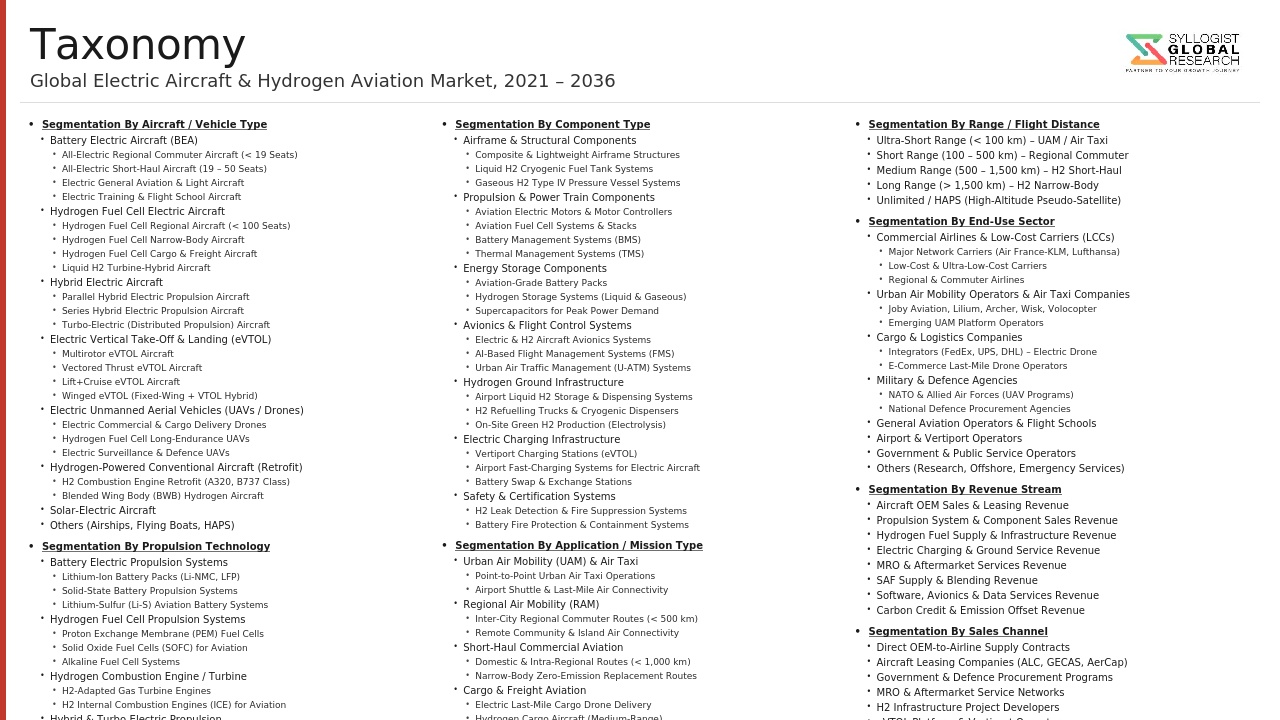
- Segmentation By Propulsion Technology
- Battery-Electric Propulsion
- Hybrid-Electric Propulsion (Turbo-Electric and Parallel Hybrid)
- Hydrogen Fuel Cell Electric Propulsion
- Hydrogen Combustion Turbine Propulsion
- Distributed Electric Propulsion (DEP)
- Others
- Segmentation By Aircraft Type
- Electric Vertical Takeoff and Landing (eVTOL) Aircraft
- Short-Takeoff and Landing (eSTOL) Aircraft
- Battery-Electric Fixed-Wing Commuter Aircraft (Up to 9 Seats)
- Battery-Electric Regional Aircraft (10 to 19 Seats)
- Hydrogen Fuel Cell Commuter and Regional Aircraft
- Hydrogen Combustion Narrow-Body Aircraft
- Unmanned Aerial Vehicles (UAVs) with Electric / Hydrogen Propulsion
- Others
- Segmentation By Range Category
- Ultra-Short Range (Below 50 km, Urban Air Mobility)
- Short Range (50 km to 200 km)
- Regional Range (200 km to 600 km)
- Medium Range (600 km to 1,500 km)
- Long Range (Above 1,500 km, Developmental / Conceptual Stage)
- Segmentation By Application
- Urban and Suburban Air Mobility (Passenger)
- Regional Passenger Aviation
- Air Cargo and Last-Mile Freight Delivery
- Medical Emergency and Medevac Services
- Military Surveillance and Logistics
- Flight Training and Pilot Education
- Tourism and Scenic Aviation
- Others
- Segmentation By Component
- Electric Motors and Drivetrain Systems
- Power Electronics and Inverters
- Battery Packs and Battery Management Systems
- Hydrogen Fuel Cell Stacks and Balance of Plant
- Hydrogen Storage Systems (Cryogenic and Compressed)
- Thermal Management Systems
- Avionics and Flight Control Systems for Electric Platforms
- Charging and Ground Power Equipment
- Others
- Segmentation By Energy Source
- Lithium-Ion Battery (Current Generation)
- Solid-State Battery (Next Generation)
- Green Hydrogen (Electrolysis-Based)
- Blue Hydrogen (SMR with CCS)
- Liquid Hydrogen
- Compressed Gaseous Hydrogen
- Others
- Segmentation By Seat Capacity
- 1 to 4 Seats
- 5 to 9 Seats
- 10 to 19 Seats
- 20 to 50 Seats
- Above 50 Seats (Developmental Stage)
- Segmentation By End User
- Commercial Airlines and Regional Carriers
- Urban Air Mobility Operators and Air Taxi Platforms
- Air Cargo and Express Freight Operators
- Defense and Government Aviation Agencies
- General Aviation and Private Operators
- Flight Training Organizations
- Others
- Segmentation By Infrastructure
- Vertiport and Skyport Facilities
- Charging Infrastructure for Battery-Electric Aircraft
- Green Hydrogen Production Facilities
- Hydrogen Liquefaction Plants
- Airport Hydrogen Refueling Stations
- Others
- Segmentation By Region
- North America
- Europe
- Asia-Pacific
- Middle East and Africa
- Latin America
All market revenues are presented in USD
Historical Year: 2021–2024 | Base Year: 2025 | Estimated Year: 2026 | Forecast Period: 2027–2035
Key Questions this Study Will Answer
- What is the total global market valuation of the Electric Aircraft and Hydrogen Aviation Market in the base year 2025, and what is the projected market size and compound annual growth rate through 2035, disaggregated by propulsion technology type, battery-electric, hybrid-electric, hydrogen fuel cell, and hydrogen combustion, to enable investors, OEMs, and infrastructure developers to identify which technology pathways offer the strongest near-term and long-term commercial returns?
- How will the commercialization timelines and certified entry-into-service dates for the leading eVTOL platforms, hydrogen fuel cell commuter aircraft, and hybrid-electric regional aircraft evolve across the forecast period, and which aircraft categories are expected to generate the largest cumulative revenue from aircraft sales, air taxi operations, and leasing arrangements between 2027 and 2035?
- What is the projected build-out trajectory and capital investment requirement for the global vertiport, aircraft charging, and hydrogen refueling infrastructure ecosystem through 2035, which regions are expected to attract the largest infrastructure investment volumes, and how are public-private partnership models evolving to distribute infrastructure risk between airport operators, energy majors, aircraft developers, and government entities?
- How is the green hydrogen production cost trajectory, from the current level of approximately USD 5.8 per kilogram to the projected sub-USD 2.5 per kilogram threshold by the early 2030s, expected to alter the competitive economics of hydrogen aviation relative to sustainable aviation fuel, and in which regional markets and stage-length categories will hydrogen-powered flight first achieve cost parity with conventional and SAF-blended aviation fuel?
- Who are the leading aircraft developers, propulsion system suppliers, battery and fuel cell technology providers, hydrogen infrastructure companies, and institutional investors currently defining the competitive landscape of the global electric aircraft and hydrogen aviation market, and what are their respective technology investment priorities, certification program status, commercial partnership structures, and strategic geographic expansion plans through the forecast horizon?
- Product Definition
- Research Methodology
- Research Design & Framework
- Overall Research Approach: Descriptive, Exploratory & Quantitative Mixed-Method Design
- Market Definition & Scope Boundaries: What is Included and Excluded
- Segmentation Framework
- Key Research Assumptions & Limitations
- Secondary Research
- Primary Research Design & Execution
- Data Triangulation & Validation
- Market Sizing & Forecasting Methodology
- Competitive Intelligence Methodology
- Quality Assurance & Peer Review
- Definitions, Abbreviations & Data Notes
- Research Design & Framework
- Executive Summary
- Market Snapshot & Headline Numbers
- Key Findings & Research Highlights
- Market Dynamics
- Regional Market Summary
- Competitive Landscape Snapshot
- Technology & Innovation Highlights
- Market Dynamics
- Drivers
- Restraints
- Opportunities
- Challenges
- Porter’s Five Forces Analysis
- PESTLE Analysis
- Market Trends & Developments
- Emerging Trends
- Technological Developments
- Regulatory & Policy Changes
- Supply Chain & Sourcing Trends
- Manufacturing & Industrialisation Trends
- Investment & Funding Activity
- Sustainability & ESG Trends
- Risk Assessment Framework
- Technology Readiness & Maturation Risk
- Regulatory & Certification Risk
- Supply Chain & Critical Material Risk
- Infrastructure Readiness Risk
- Financial & Market Risk
- Geopolitical & Trade Risk
- Competitive & Substitution Risk
- Regulatory Framework & Standards
- Global Certification & Airworthiness Standards
- Hydrogen Aviation Safety & Infrastructure Regulations
- Battery & Electrical System Standards for Aviation
- Urban Air Mobility (UAM) & eVTOL Regulatory Frameworks
- Environmental & Emissions Regulations Driving Electrification
- Global Electric Aircraft & Hydrogen Aviation Market Outlook
- Market Size & Forecast by Value
- Market Size & Forecast by Aircraft Deliveries (Units)
- Market Size & Forecast by Propulsion Technology Type
- Battery-Electric Propulsion
- Full Battery-Electric (All-Electric) Aircraft
- Parallel Hybrid-Electric Propulsion
- Series Hybrid-Electric Propulsion
- Turbo-Electric Propulsion
- Hydrogen Propulsion
- Hydrogen Fuel Cell Electric Propulsion
- Hydrogen Combustion (H2 Gas Turbine) Propulsion
- Hybrid Hydrogen-Electric Propulsion
- Solar-Electric Propulsion
- Others (Ammonia, Biofuel-Electric Hybrid)
- Battery-Electric Propulsion
- Market Size & Forecast by Aircraft Type
- Fixed-Wing Electric Aircraft
- Light Sport Aircraft (LSA) & Ultralight
- General Aviation (Single & Multi-Engine Piston Equivalent)
- Commuter Aircraft (9–19 Seats)
- Regional Turboprop Equivalent (20–50 Seats)
- Short-Haul Narrowbody (50–150 Seats)
- Future Medium-Haul Hydrogen Aircraft (150–300 Seats)
- eVTOL (Electric Vertical Takeoff & Landing) Aircraft
- Multirotor eVTOL
- Vectored Thrust eVTOL
- Lift + Cruise eVTOL
- Tilt-Rotor / Tilt-Wing eVTOL
- Electric UAV / Unmanned Aerial Systems (UAS)
- Fixed-Wing Electric UAS
- Multi-Rotor Electric UAS
- Hybrid-Electric Long-Endurance UAS
- Electric Seaplanes & Amphibious Aircraft
- Electric Training & Flight School Aircraft
- Fixed-Wing Electric Aircraft
- Market Size & Forecast by Application / Mission
- Passenger Transport
- Urban Air Mobility (Air Taxi & Commuter)
- Regional Passenger Air Services
- Short-Haul Commercial Aviation
- Cargo & Freight Transport
- Urban Cargo Drone Delivery (eVTOL / Multi-Rotor UAV)
- Regional Electric Cargo Aircraft
- Middle-Mile Electric Freight
- Military & Defence
- Electric ISR UAVs
- Electric VTOL for Tactical Mobility
- Hydrogen-Electric Long-Endurance Surveillance UAVs
- Flight Training & General Aviation
- Two-Seat Electric Trainer Aircraft
- Multi-Engine Electric Training Aircraft
- Tourism, Charter & Scenic Flights
- Emergency Medical Services (EMS) & SAR
- Others (Agricultural, Survey, Inspection)
- Passenger Transport
- Market Size & Forecast by Seating Capacity
- 1–4 Seats
- 5–9 Seats
- 10–19 Seats
- 20–50 Seats
- 51–150 Seats
- 150–300 Seats
- Market Size & Forecast by Range
- Ultra-Short Range (< 100 km)
- Short Range (100–500 km)
- Medium Range (500–1,500 km)
- Long Range (> 1,500 km)
- Market Size & Forecast by Powertrain Component
- Electric Motors & Motor Controllers
- Axial Flux Motors
- Radial Flux Motors
- Permanent Magnet Synchronous Motors (PMSM)
- Superconducting Motors
- Battery Systems
- Lithium-Ion (Li-Ion) Battery Packs
- Lithium-Polymer (Li-Po) Battery Packs
- Solid-State Battery Packs
- Lithium-Sulfur (Li-S) Battery Packs
- Battery Management Systems (BMS)
- Hydrogen Fuel Cell Systems
- Proton Exchange Membrane Fuel Cell (PEMFC)
- Solid Oxide Fuel Cell (SOFC)
- Alkaline Fuel Cell (AFC)
- Hydrogen Storage Systems
- Compressed Gaseous Hydrogen Storage (350–700 Bar)
- Cryogenic Liquid Hydrogen (LH2) Storage Tanks
- Cryo-Compressed Hydrogen Storage
- Solid-State Hydrogen Storage (Metal Hydrides)
- Power Electronics & Inverters
- Motor Inverters & Drive Units
- Power Distribution Units (PDUs)
- DC-DC Converters & Onboard Chargers
- Thermal Management Systems
- Battery Thermal Management
- Fuel Cell Thermal Management
- Electric Motor & Power Electronics Cooling
- Electric Propellers & Rotor Systems
- Variable-Pitch Electric Propellers
- Fixed-Pitch High-Efficiency Propellers
- Distributed Electric Propulsion (DEP) Rotor Arrays
- Avionics & Electric Power Management Systems
- Electric Motors & Motor Controllers
- Market Size & Forecast by End-Use Operator
- Commercial Airlines & Regional Carriers
- Air Taxi & Urban Air Mobility Operators
- General Aviation & Private Owners
- Flight Schools & Pilot Training Academies
- Military & Defence Forces
- Cargo & Logistics Operators
- Government & Public Sector
- Others (Tourism, Medical, Charter)
- Market Size & Forecast by Sustainability Attribute
- Zero Direct Emission Aircraft (Battery-Electric / Hydrogen Fuel Cell)
- Low-Emission Hybrid-Electric Aircraft
- Green Hydrogen-Powered Aircraft
- Conventional Hybrid with SAF Blending
- North America Electric Aircraft & Hydrogen Aviation Market Outlook
- Market Size & Forecast
- By Value
- By Aircraft Deliveries (Units)
- By Propulsion Technology Type
- By Aircraft Type
- By Application / Mission
- By Seating Capacity
- By Range
- By Powertrain Component
- By End-Use Operator
- By Sustainability Attribute
- Market Size & Forecast
- Europe Electric Aircraft & Hydrogen Aviation Market Outlook
- Market Size & Forecast
- By Value
- By Aircraft Deliveries (Units)
- By Propulsion Technology Type
- By Aircraft Type
- By Application / Mission
- By Seating Capacity
- By Range
- By Powertrain Component
- By End-Use Operator
- By Sustainability Attribute
- Market Size & Forecast
- Asia-Pacific Electric Aircraft & Hydrogen Aviation Market Outlook
- Market Size & Forecast
- By Value
- By Aircraft Deliveries (Units)
- By Propulsion Technology Type
- By Aircraft Type
- By Application / Mission
- By Seating Capacity
- By Range
- By Powertrain Component
- By End-Use Operator
- By Sustainability Attribute
- Market Size & Forecast
- Latin America Electric Aircraft & Hydrogen Aviation Market Outlook
- Market Size & Forecast
- By Value
- By Aircraft Deliveries (Units)
- By Propulsion Technology Type
- By Aircraft Type
- By Application / Mission
- By Seating Capacity
- By Range
- By Powertrain Component
- By End-Use Operator
- By Sustainability Attribute
- Market Size & Forecast
- Middle East & Africa Electric Aircraft & Hydrogen Aviation Market Outlook
- Market Size & Forecast
- By Value
- By Aircraft Deliveries (Units)
- By Propulsion Technology Type
- By Aircraft Type
- By Application / Mission
- By Seating Capacity
- By Range
- By Powertrain Component
- By End-Use Operator
- By Sustainability Attribute
- Market Size & Forecast
- Country-Wise* Electric Aircraft & Hydrogen Aviation Market Outlook
- Market Size & Forecast
- By Value
- By Aircraft Deliveries (Units)
- By Propulsion Technology Type
- By Aircraft Type
- By Application / Mission
- By Seating Capacity
- By Range
- By Powertrain Component
- By End-Use Operator
- By Sustainability Attribute
- Market Size & Forecast
*Countries Analyzed: United States, Canada, Germany, United Kingdom, France, Netherlands, Norway, Sweden, Switzerland, Spain, Italy, China, Japan, South Korea, Australia, Singapore, India, Brazil, UAE, Saudi Arabia, South Africa
- Technology Landscape & Innovation Analysis
- Electric Propulsion Technology Landscape
- Hydrogen Aviation Technology Landscape
- eVTOL Technology Landscape
- Airframe & Structural Technology for Electric & Hydrogen Aircraft
- Digital Technology & AI in Electric Aviation
- Patent & IP Landscape in Electric & Hydrogen Aviation
- Value Chain & Supply Chain Analysis
- Raw Materials & Critical Minerals
- Battery Cell & Module Supply Chain
- Electric Motor & Power Electronics Supply Chain
- Hydrogen Supply Chain
- Aircraft Airframe & Structural Component Supply Chain
- Aircraft OEM & System Integrators
- Airline & Operator Fleet Procurement
- Ground Infrastructure & Charging / Refuelling Ecosystem
- MRO & Aftermarket Supply Chain for Electric & Hydrogen Aircraft
- Pricing Analysis
- Electric Aircraft Pricing Analysis
- Hydrogen Aircraft Pricing Analysis
- Powertrain Component Pricing
- Green Hydrogen Fuel Cost Analysis
- Electric Aviation Operating Cost Analysis
- Electric & Hydrogen Aviation Infrastructure Analysis
- Electric Aircraft Charging Infrastructure
- Vertiport Infrastructure for eVTOL Operations
- Hydrogen Refuelling Infrastructure at Airports
- Air Traffic Management (ATM) & U-Space for Electric & eVTOL Operations
- Ground Support Equipment (GSE) Electrification
- Sustainability & Energy Efficiency
- Carbon Emission Reduction Potential
- Life Cycle Assessment (LCA)
- Battery & Fuel Cell End-of-Life & Circular Economy
- Noise Pollution Reduction
- ESG & Sustainability Commitments of Key Market Participants
- Competitive Landscape
- Market Structure & Concentration
- Player Classification
- Competitive Analysis Frameworks
- Market Share Analysis by Segment & Geography
- Company Profile
- Company Overview & Headquarters
- Products & Technology Portfolio
- Order Book, Delivery Timeline & Certification Status
- Technology Readiness Level (TRL) Assessment
- Revenue & Funding Raised
- Key Strategic Partnerships, Alliances & JVs
- Recent Developments (Funding Rounds, Certifications, Orders, Partnerships)
- SWOT Analysis
- Strategic Focus Areas & Roadmap
- Competitive Positioning Map (Technology Maturity vs. Commercial Readiness)
- Key Company Profiles
- Strategic Output
- Market Opportunity Matrix – By Aircraft Type, Propulsion & Geography
- White Space Opportunity Analysis
- Underserved Short-Haul Island Hopping Routes for Electric Aircraft
- Emerging eVTOL Corridors in Asia-Pacific Mega-Cities
- Hydrogen Aviation Opportunity in Long-Haul Nordic & Trans-Pacific Routes (Post-2035)
- Military Electric & Hydrogen UAV Markets
- Technology Gap: High-Power Charging & Green H2 Airport Infrastructure
- Strategic Recommendations
- Technology Investment & R&D Prioritisation Strategy
- Certification & Regulatory Engagement Strategy
- Partnership, M&A & Ecosystem Development Strategy
- Go-to-Market & Commercial Strategy
- Sustainability & Green Positioning Strategy
- Risk Mitigation & Future Roadmap
- Strategic Priority Matrix & Roadmap
- Near-term (2025–2028)
- Mid-term (2029–2032)
- Long-term (2033–2037)