
Market Definition
The Global EV Battery Passport Tracking Systems Market encompasses the development, deployment, and operational management of digital identification, data standardization, and lifecycle traceability platforms that create, maintain, and communicate a comprehensive and tamper-evident electronic record, referred to as a battery passport, for every individual battery unit or battery pack manufactured for use in electric vehicles, stationary energy storage systems, and other electromobility applications. A battery passport functions as a dynamic digital twin of a physical battery, capturing and continuously updating a structured dataset that covers the battery’s material composition and sourcing provenance, carbon footprint across the full value chain from raw material extraction through cell manufacturing, electrochemical performance specifications, state of health measurements recorded throughout active service life, maintenance and repair history, ownership and custody chain records, second-life application eligibility assessments, and end-of-life recycling routing and materials recovery documentation. The market encompasses the enabling technology stack required to implement battery passports at industrial scale, including unique identifier issuance and management systems, data collection and aggregation middleware interfacing with battery management systems and manufacturing execution systems, distributed ledger and blockchain-based data integrity and access control platforms, secure cloud-based data storage and sharing infrastructure, application programming interfaces enabling data exchange across supply chain partners, standardization bodies and regulatory compliance verification systems, and consumer and regulator-facing digital access portals. Key market participants include battery cell manufacturers and pack assemblers implementing passport data generation at production stage, electric vehicle OEMs integrating passport systems into vehicle platforms and ownership transfer workflows, raw material miners and refiners providing upstream provenance certification, independent software vendors developing battery passport platform solutions, blockchain infrastructure providers, regulatory compliance technology specialists, and governmental and intergovernmental bodies including the European Commission, whose Battery Regulation mandating battery passports for all EV batteries placed on the European Union market from February 2027 onward represents the most consequential single policy driver shaping global market development.
Market Insights
The global EV battery passport tracking systems market is transitioning at exceptional velocity from a concept debated primarily within academic, regulatory, and sustainability advocacy circles into a commercially operational and legally mandated industrial requirement, driven by the European Union’s Battery Regulation, formally Regulation (EU) 2023/1542, which establishes legally binding battery passport obligations for electric vehicle batteries placed on the EU market from February 18, 2027, creating a compliance deadline that is generating near-term investment urgency across the entire global EV battery supply chain regardless of whether individual companies are headquartered within or outside the European Union. The scale of the compliance challenge is substantial: with global EV battery production having reached approximately 1.1 terawatt-hours of annual output in 2025 across more than 4,200 distinct battery models and variants produced at over 380 manufacturing facilities worldwide, the implementation of unique digital identities, standardized data schemas, and interoperable data sharing infrastructure for each individual battery unit represents a data management and system integration undertaking of exceptional complexity that no single industry participant can accomplish in isolation. The global market valuation for EV battery passport tracking systems stood at approximately USD 1.2 billion in 2025, encompassing platform software licensing, system integration services, blockchain and distributed ledger infrastructure, unique identifier issuance, and associated consulting and compliance advisory services, and is projected to reach USD 9.4 billion by 2034, advancing at a compound annual growth rate of 25.7% over the forecast period from 2027 to 2034 as mandatory compliance deployment scales from the European Union’s initial implementation across the global EV market and as the scope of battery passport data requirements expands with successive regulatory revision cycles.
The technological architecture of battery passport systems is emerging as a contested design space in which competing paradigms, centralized cloud-based registry models, federated data space architectures in which data sovereignty remains with the data owner, and fully decentralized blockchain-based immutability approaches, are each attracting significant development investment and regulatory consideration, with the ultimate architectural standards likely to be determined by the interplay of European Union data governance policy preferences, automotive industry supply chain interoperability requirements, and the practical scalability constraints of blockchain transaction throughput at the volumes demanded by global EV production. The European Battery Alliance’s Batteries European Partnership Association and the Catena-X automotive data space initiative have emerged as influential frameworks for defining the data exchange standards and governance models that will govern battery passport implementation across European automotive supply chains, with Catena-X having onboarded over 170 automotive industry participants including all major European OEMs, Tier-1 suppliers, and battery manufacturers as of 2025. Simultaneously, the Global Battery Alliance’s Battery Passport initiative, which has engaged participants representing over 90% of global EV battery production capacity, is advancing a complementary framework that seeks to extend battery passport standards beyond the European regulatory jurisdiction into a globally interoperable traceability architecture applicable to batteries traded across North American, Asian, and emerging market supply chains. The divergence between jurisdiction-specific regulatory compliance implementations and globally harmonized voluntary framework adoption represents a structural complexity that battery passport platform developers must navigate in designing solutions that serve multinational supply chain participants operating simultaneously across multiple regulatory environments with partially overlapping but not fully aligned data requirement specifications.
The battery second-life and recycling value chain is emerging as one of the most commercially compelling application domains for battery passport data, transforming what is primarily conceived as a regulatory compliance requirement into a source of direct economic value that provides a financial return on the data collection and infrastructure investment incurred in passport implementation. A battery passport that accurately documents a used battery’s state of health, remaining capacity, cycle history, thermal stress exposure, and cell-level degradation pattern enables second-life application assessors to rapidly and reliably determine the battery’s suitability for repurposing into stationary energy storage applications, such as grid-scale buffer storage, commercial building backup power, or residential energy storage systems, without conducting the expensive and time-consuming physical diagnostic testing that currently constitutes the primary barrier to economically viable battery second-life operations at scale. Industry analyses estimate that reliable battery state of health documentation through passport systems could reduce second-life battery assessment costs by 60% to 75% relative to current testing-based approaches, unlocking a second-life battery market that is projected to reach USD 6.8 billion annually by 2030 and whose commercial viability is substantially dependent on the availability of trustworthy lifecycle data that only a systematically implemented passport system can reliably provide. At the end of battery life, passport data identifying the precise chemical composition, cell chemistry variant, and hazardous material content of each battery unit enables recyclers to optimize their hydrometallurgical and pyrometallurgical processing parameters for maximum critical mineral recovery efficiency, with estimates suggesting that composition-specific processing enabled by passport data can improve lithium, cobalt, nickel, and manganese recovery rates by 8% to 15% relative to composition-agnostic batch processing, representing a meaningful improvement in the economics and environmental performance of battery recycling operations that directly enhances the strategic value of domestic critical mineral recovery programs.
From a regional standpoint, the European Union is unambiguously the primary regulatory and commercial driver of the battery passport market, with the Battery Regulation’s implementation timeline creating a mandatory compliance market that is compelling investment decisions across every tier of the global EV battery supply chain. European automotive OEMs, battery cell manufacturers supplying the European market, including facilities operated by Asian battery producers in Poland, Hungary, Germany, and Sweden, and raw material suppliers providing certified provenance documentation are collectively committing hundreds of millions of euros to battery passport system implementation programs that must achieve operational readiness before the February 2027 compliance deadline. North America is the second most active market, with the United States Inflation Reduction Act’s critical mineral sourcing requirements and battery component domestic content provisions creating a parallel traceability imperative that, while structured differently from the European passport framework, demands comparable supply chain visibility and material provenance documentation infrastructure, driving investment in traceability platforms by North American battery manufacturers, EV OEMs, and critical mineral suppliers seeking to qualify for federal clean vehicle tax credits. Asia-Pacific, led by China, Japan, and South Korea, represents the largest concentration of EV battery manufacturing capacity globally, and while domestic regulatory mandates for battery passports in these markets are less advanced than the European framework as of 2026, the obligation to comply with EU Battery Regulation requirements for batteries exported to the European market is compelling Chinese, Japanese, and Korean battery producers to implement passport-compatible data infrastructure at their manufacturing facilities, effectively extending the EU regulation’s operational reach to the global production base of the EV battery industry.
Key Drivers
European Union Battery Regulation Mandatory Compliance and the Cascading Global Regulatory Alignment It Is Generating
The most structurally decisive driver of investment and adoption in the EV battery passport market is the European Union Battery Regulation’s legally binding requirement that all electric vehicle batteries placed on the EU market from February 18, 2027 must carry a battery passport accessible via a QR code, containing a standardized dataset covering material composition, carbon footprint, state of health, supply chain due diligence documentation, and recycled content information, with the data accessible to economic operators, consumers, and competent authorities through a federated registry system governed by EU data governance frameworks. The regulation applies to any battery sold into the EU market regardless of where it is manufactured, meaning that every major EV battery producer globally, including those headquartered in China, South Korea, Japan, and the United States, must implement passport-compatible data infrastructure and comply with EU data quality and accessibility requirements as a condition of continued market access to the world’s largest regulated EV market, generating a de facto global regulatory cascade effect analogous to the extraterritorial market-shaping impact historically observed with European chemical safety and product liability regulations. Beyond the 2027 initial implementation, the EU Battery Regulation contains provisions for progressive expansion of mandatory passport data requirements in subsequent regulatory review cycles, including increasing recycled content minimum thresholds, declining carbon footprint limits, and extended producer responsibility obligations, ensuring that battery passport compliance investment represents a continuing and escalating commitment rather than a one-time compliance expenditure, and providing the market with a durable and expanding regulatory demand signal through the forecast period and beyond.
Critical Mineral Supply Chain Transparency Imperatives and the Strategic Value of Raw Material Provenance Verification
The EV battery supply chain is structurally dependent on a concentrated set of critical minerals, lithium, cobalt, nickel, manganese, and graphite, whose production is geographically concentrated in a limited number of countries, many of which present elevated environmental, social, and governance risk profiles that are attracting escalating regulatory scrutiny and investor concern across the automotive and battery manufacturing industries. The Democratic Republic of Congo supplies approximately 70% of global cobalt production, Chile and Australia account for the majority of lithium extraction, and Indonesia dominates nickel supply, with each of these supply relationships carrying documented environmental degradation and human rights risks, including artisanal mining practices, deforestation, and community displacement, that create material reputational and regulatory liability for automotive OEMs and battery manufacturers whose supply chains cannot demonstrate credible sourcing provenance. Battery passport systems that capture and cryptographically certify mineral provenance data from mine-of-origin through each processing and manufacturing stage provide the evidentiary foundation for supply chain due diligence compliance under the EU’s Corporate Sustainability Due Diligence Directive, the US Uyghur Forced Labor Prevention Act’s supply chain documentation requirements, and equivalent emerging legislative frameworks in the United Kingdom, Canada, Germany, and France, creating a compliance-driven demand for mineral traceability functionality that extends battery passport adoption motivation well beyond the Battery Regulation’s direct scope and engages upstream supply chain participants who would not otherwise face direct regulatory passport obligations.
Rising EV Resale Market Sophistication and the Commercial Value of Verified Battery State of Health Documentation
As the global electric vehicle parc expands rapidly and the first generation of mass-market EVs enters the used vehicle market in material volumes, the state of health and remaining useful life of the traction battery is emerging as the single most commercially consequential determinant of used EV valuation, insurance underwriting, fleet procurement decisions, and financing eligibility assessments, creating a structurally robust commercial demand for standardized, independently verifiable battery condition documentation that battery passport systems are uniquely positioned to provide. Used EV transaction volumes reached approximately 3.4 million units globally in 2025, a figure projected to grow to 11.2 million units annually by 2030 as earlier EV model years enter the secondary market at scale, and the absence of trusted battery health documentation in current used EV transactions is creating a classic market-for-lemons dynamic in which buyers systematically undervalue used EVs relative to their actual remaining utility, suppressing resale values and thereby increasing the effective total cost of ownership of new EVs in ways that deter first-time adoption. Battery passport systems that provide buyers, insurers, fleet operators, and lenders with cryptographically authenticated historical state of health trajectories, charging behavior patterns, thermal event records, and projected remaining capacity profiles resolve this information asymmetry in a manner that is expected to increase average used EV transaction prices by 8% to 14% for vehicles with documented passport histories relative to equivalent vehicles without verified battery records, generating a direct financial incentive for EV owners and OEMs to maintain comprehensive battery passport records throughout vehicle ownership and creating a self-reinforcing commercial adoption driver that operates independently of regulatory compliance mandates.
Key Challenges
Data Standardization Fragmentation, Cross-Jurisdiction Regulatory Divergence, and the Interoperability Gap Across Competing Platform Ecosystems
The most technically and commercially consequential challenge confronting the EV battery passport market is the absence of a single, globally harmonized data schema, unique identifier standard, and interoperability protocol that would enable battery passport data generated by one platform in one regulatory jurisdiction to be seamlessly read, verified, and extended by a different platform operating under a different regulatory framework in a different geography, a gap that is generating costly platform proliferation and data silo risks as individual regulatory mandates drive the development of jurisdiction-specific passport implementations that are not natively interoperable with one another. The EU Battery Regulation specifies battery passport data requirements at a relatively high level of abstraction, delegating the detailed technical specification of data formats, identifier schemes, and registry architecture to implementing regulations that were still under development as of 2026, creating a standardization timeline uncertainty that is forcing platform developers to make architectural investment decisions on the basis of incomplete regulatory specification, with attendant risks of costly redesign if subsequent implementing regulations diverge from anticipated technical choices. The parallel development of multiple industry consortium data frameworks, including Catena-X, the Global Battery Alliance passport framework, the International Council on Clean Transportation’s battery traceability initiative, and various national government-sponsored registry programs, each with partially overlapping but not fully aligned data models and governance structures, risks producing a fragmented ecosystem of technically incompatible passport implementations that impose multi-platform compliance costs on multinational supply chain participants and undermine the cross-border supply chain transparency that battery passports are designed to deliver.
Data Quality Integrity at Upstream Supply Chain Tiers and the Verifiability Challenge for Mine-Level Provenance Claims
The fundamental value proposition of a battery passport rests on the assumption that the data it contains accurately reflects the physical reality of the battery’s material composition, manufacturing history, and operational performance, an assumption that is straightforward to satisfy for data generated by automated sensors and manufacturing execution systems in technologically sophisticated cell manufacturing facilities but that becomes progressively more difficult to assure as the data chain extends upstream through cathode active material processors, precursor chemical producers, mineral refiners, and ultimately artisanal and small-scale mining operations that may lack the digital infrastructure, data management capability, or organizational incentive to generate accurate, complete, and tamper-proof provenance records. The cobalt supply chain from artisanal mining sites in the Democratic Republic of Congo to battery-grade cobalt sulfate at refinery level passes through multiple intermediary trading, aggregation, and processing steps in which the physical commingling of material from different sources is routine and in which the documentary trail supporting mine-of-origin attribution is frequently incomplete, inconsistent, or susceptible to fraudulent substitution by economic actors with financial incentives to misrepresent sourcing provenance to circumvent supply chain due diligence exclusions. Blockchain-based immutability guarantees the integrity of data once it has been entered into the distributed ledger but provides no protection against the deliberate or negligent entry of inaccurate data at the point of origination, a limitation that renders the trustworthiness of upstream provenance claims in battery passports dependent on the deployment of physical verification mechanisms, including satellite monitoring, isotopic fingerprinting, in-situ sensor networks, and third-party on-site auditing, that add substantial cost and logistical complexity to the upstream supply chain data collection infrastructure and whose scalability across thousands of geographically dispersed mining and processing sites remains an insufficiently resolved implementation challenge.
Cybersecurity Vulnerabilities, Data Sovereignty Conflicts, and the Long-Term Data Governance Complexity of Multi-Decade Battery Lifecycle Records
Battery passport systems that aggregate detailed manufacturing, performance, ownership, and material composition data for hundreds of millions of individual battery units over operational lifespans potentially extending 15 to 20 years or more represent high-value and high-sensitivity data assets whose cybersecurity protection, jurisdictional governance, and long-term stewardship present challenges of a qualitatively different order of magnitude than those associated with conventional enterprise data management systems, and whose resolution requires policy, legal, and technical frameworks that do not yet exist in mature form in any jurisdiction. The battery passport data ecosystem will contain commercially sensitive manufacturing process parameters, proprietary cell chemistry formulations, and competitive supply chain relationship data whose unauthorized disclosure would cause material competitive harm to battery manufacturers and automotive OEMs, creating a tension between the regulatory requirement for accessibility to authorized parties across the supply chain and the legitimate commercial confidentiality interests of data-generating participants that must be resolved through access-controlled data sharing architectures of considerable technical sophistication. Data sovereignty conflicts arise when battery passport records for a single battery unit span manufacturing events in China, processing events in South Korea, vehicle integration in Germany, service events in the United Kingdom, and end-of-life processing in the Netherlands, with each jurisdiction’s data localization requirements, privacy regulations, and government access provisions potentially imposing conflicting obligations on the platform operators responsible for maintaining the passport record, requiring legal harmonization agreements and technical data partitioning architectures that are still being negotiated and developed as the compliance deadline approaches. The operational continuity and data accessibility obligations associated with a battery passport registry system that must remain accessible for the full operational and post-operational lifetime of every battery it records, potentially spanning 30 or more years from first registration to final recycling certification, impose governance and financial sustainability requirements on registry operators that have not been adequately addressed in current regulatory frameworks and that represent a material long-term liability whose allocation between private platform operators and public regulatory bodies remains unresolved.
Market Segmentation
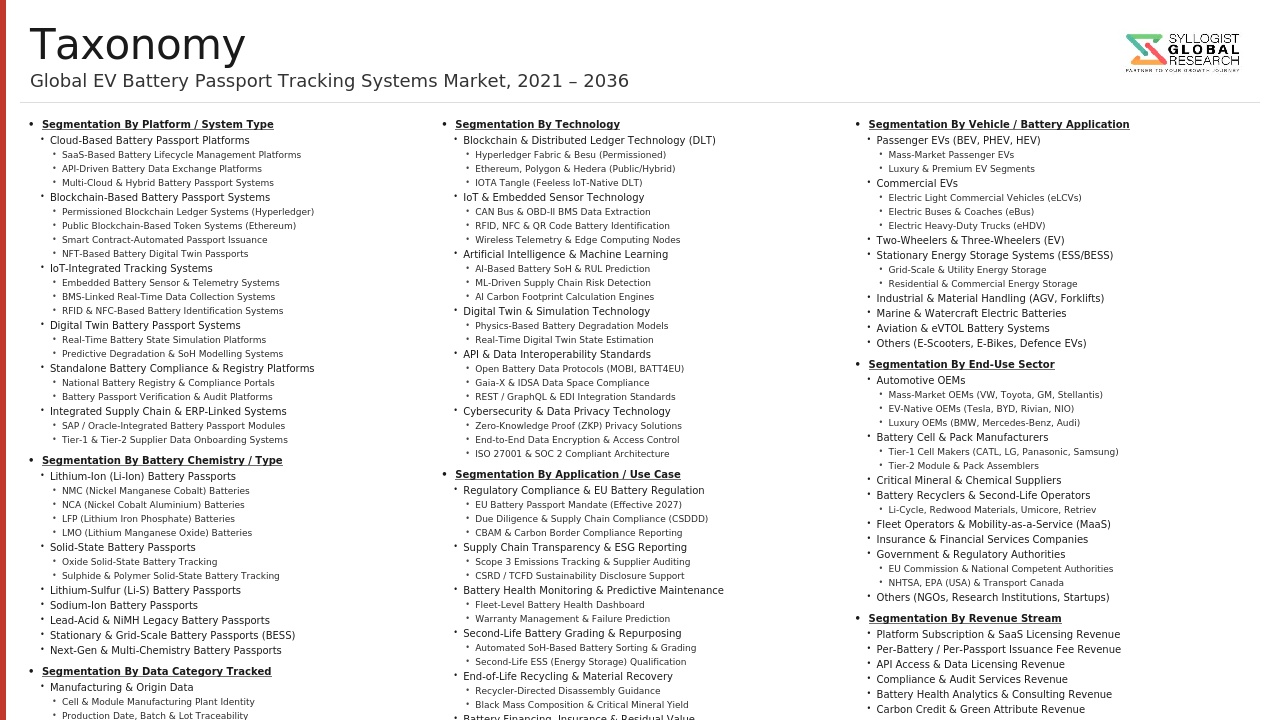
- Segmentation By Component
- Battery Passport Platform Software
- Unique Identifier Issuance and Management Systems
- Blockchain and Distributed Ledger Infrastructure
- Data Collection and Aggregation Middleware
- Battery Management System (BMS) Data Integration Modules
- Cloud-Based Data Storage and Registry Infrastructure
- Application Programming Interface (API) and Data Exchange Layers
- Consumer and Regulator-Facing Access Portals
- Compliance Verification and Audit Trail Systems
- Others
- Segmentation By Data Category Covered
- Material Composition and Raw Material Provenance
- Carbon Footprint and Life-Cycle Assessment Data
- Electrochemical Performance and State of Health Records
- Manufacturing Process and Quality Certification Data
- Ownership and Custody Chain Records
- Charging History and Usage Pattern Data
- Maintenance, Repair, and Incident History
- Second-Life Eligibility and Repurposing Assessment Data
- End-of-Life and Recycling Materials Recovery Documentation
- Others
- Segmentation By Technology Architecture
- Centralized Cloud Registry Model
- Federated Data Space Architecture (Catena-X Compatible)
- Fully Decentralized Blockchain-Based Architecture
- Hybrid Centralized-Blockchain Architecture
- Self-Sovereign Identity and Verifiable Credential Framework
- Others
- Segmentation By Battery Chemistry
- Lithium Iron Phosphate (LFP)
- Nickel Manganese Cobalt (NMC)
- Nickel Cobalt Aluminum (NCA)
- Lithium Manganese Oxide (LMO)
- Solid-State Batteries
- Sodium-Ion Batteries
- Others
- Segmentation By Vehicle Type
- Battery Electric Passenger Vehicles (BEV)
- Plug-In Hybrid Electric Vehicles (PHEV)
- Battery Electric Commercial Vehicles and Trucks
- Electric Two-Wheelers and Three-Wheelers
- Electric Buses and Mass Transit
- Electric Off-Highway and Construction Equipment
- Stationary Energy Storage Systems (Non-Automotive)
- Others
- Segmentation By Deployment Stage
- Manufacturing and Cell Production Stage
- Pack Assembly and Vehicle Integration Stage
- In-Service and Active Use Stage
- Second-Life Assessment and Repurposing Stage
- End-of-Life and Recycling Stage
- Segmentation By End User
- Battery Cell Manufacturers and Gigafactories
- Electric Vehicle OEMs
- Tier-1 Battery Pack Assemblers and Automotive Suppliers
- Raw Material Miners, Refiners, and Cathode Material Producers
- Second-Life Battery Operators and Energy Storage Integrators
- Battery Recyclers and Critical Mineral Recovery Companies
- Fleet Operators and Leasing Companies
- Insurance Underwriters and Financial Institutions
- Regulatory Bodies and Competent Authorities
- Others
- Segmentation By Service Type
- Platform Licensing and Subscription Services
- System Integration and Implementation Services
- Data Management and Analytics Services
- Regulatory Compliance Advisory and Audit Services
- Unique Identifier Issuance and Registry Management Services
- Third-Party Data Verification and Certification Services
- Others
- Segmentation By Region
- North America
- Europe
- Asia-Pacific
- Middle East and Africa
- Latin America
All market revenues are presented in USD
Historical Year: 2021–2024 | Base Year: 2025 | Estimated Year: 2026 | Forecast Period: 2027–2034
Key Questions this Study Will Answer
- What is the total global market valuation of the EV Battery Passport Tracking Systems Market in the base year 2025, and what is the projected market size and compound annual growth rate through 2034, disaggregated by component, platform software, blockchain infrastructure, data collection middleware, unique identifier systems, and compliance verification services, and by end user, battery cell manufacturers, EV OEMs, raw material suppliers, second-life operators, and recyclers, to enable platform developers, investors, and supply chain participants to identify which solution categories and customer segments offer the highest near-term revenue capture and long-term market share consolidation potential?
- How are the competing battery passport technology architectures, centralized cloud registry, federated data space models including Catena-X, and decentralized blockchain-based systems, evolving in terms of regulatory acceptance, scalability at global EV production volumes, data sovereignty compliance capability, and total cost of implementation, and which architecture or hybrid combination is expected to emerge as the dominant standard for EU Battery Regulation compliance implementations and for globally interoperable battery passport deployment across North American and Asia-Pacific supply chains through 2034?
- What is the current state of EU Battery Regulation implementing regulation development for technical battery passport specifications, including data schemas, unique identifier standards, registry architecture requirements, and data access control frameworks, and how are the specific technical requirements emerging from Brussels expected to shape platform development priorities, compliance investment timelines, and the competitive positioning of incumbent versus new-entrant battery passport solution providers through the February 2027 mandatory compliance deadline and beyond?
- How is battery passport data expected to transform the commercial economics of the EV battery second-life and recycling value chain through 2034, specifically in terms of the reduction in second-life battery assessment costs enabled by verified state of health documentation, the improvement in critical mineral recovery rates enabled by composition-specific processing informed by passport material data, and the cumulative value unlocked across the global second-life battery market projected to reach USD 6.8 billion annually by 2030?
- Who are the leading battery passport platform software developers, blockchain infrastructure providers, system integrators, industry consortium governance bodies, and regulatory technology specialists currently defining the competitive landscape of the global EV battery passport tracking systems market, and what are their respective platform capabilities, regulatory certification status, key customer and supply chain partner relationships, geographic market coverage, technology investment roadmaps, and strategic positioning strategies as the market transitions from early pilot deployments toward mandatory compliance-driven mass adoption across the global EV battery supply chain?
- Product Definition
- Research Methodology
- Research Design & Framework
- Overall Research Approach: Descriptive, Exploratory & Quantitative Mixed-Method Design
- Market Definition & Scope Boundaries: What is Included and Excluded
- Segmentation Framework
- Key Research Assumptions & Limitations
- Secondary Research
- Primary Research Design & Execution
- Data Triangulation & Validation
- Market Sizing & Forecasting Methodology
- Competitive Intelligence Methodology
- Quality Assurance & Peer Review
- Definitions, Abbreviations & Data Notes
- Research Design & Framework
- Executive Summary
- Market Snapshot & Headline Numbers
- Key Findings & Research Highlights
- Market Dynamics
- Regional Market Summary
- Competitive Landscape Snapshot
- Technology & Innovation Highlights
- Market Dynamics
- Drivers
- Restraints
- Opportunities
- Challenges
- Porter’s Five Forces Analysis
- PESTLE Analysis
- Market Trends & Developments
- Emerging Trends
- Technological Developments
- Regulatory & Policy Changes
- Supply Chain & Sourcing Trends
- Investment & Funding Activity
- Sustainability & ESG Trends
- Risk Assessment Framework
- Data Integrity & Fraud Risk
- Cybersecurity & Data Security Risk
- Regulatory & Compliance Risk
- Technology & Interoperability Risk
- Supply Chain & Adoption Risk
- Commercial & Business Model Risk
- Regulatory Framework & Standards
- EU Battery Regulation (EU 2023/1542) – Core Framework
- EU Digital Product Passport (DPP) Framework
- International Standards for Battery Traceability & Passport
- Sector-Specific Standards & Industry Initiatives
- National & Regional Regulatory Frameworks
- Global EV Battery Passport Tracking Systems Market Outlook
- Market Size & Forecast by Value
- Market Size & Forecast by Number of Battery Passports Issued (Units)
- Market Size & Forecast by Solution Type
- Battery Passport Platform Software
- Cloud-Based SaaS Battery Passport Platform
- On-Premise Battery Passport Software
- Hybrid (Cloud + On-Premise) Battery Passport Deployment
- Open-Source Battery Passport Platform
- Battery Identification & Labelling Systems
- QR Code Generation & Management Systems
- RFID (UHF / HF) Battery Tagging & Reader Systems
- NFC-Enabled Battery Label & Reader Systems
- Laser Engraving & Direct Part Marking (DPM) Systems
- Physical Unclonable Function (PUF) & Cryptographic Battery ID Systems
- Datamatrix & 2D Barcode Battery Identification Systems
- Blockchain & Distributed Ledger Technology (DLT) Infrastructure
- Public Blockchain Battery Passport Networks (Ethereum, Polygon-Based)
- Permissioned / Private Blockchain Battery Passport Networks (Hyperledger Fabric, Quorum)
- Consortium Blockchain Battery Passport Infrastructure (Catena-X, Mobi, GBA Ecosystem)
- Tokenisation & NFT-Based Battery Passport Asset Management
- IoT & Sensor Data Integration Middleware
- BMS (Battery Management System) Data Extraction & API Integration Layer
- IoT Gateway & Edge Computing for Real-Time Battery Passport Data Capture
- OBD-II / CAN Bus Data Aggregation for In-Vehicle Battery Passport Update
- Telematics Platform Integration for Fleet Battery Passport Management
- Data Management, Analytics & AI/ML Engine
- Battery State-of-Health (SoH) Estimation & Predictive Analytics Module
- Carbon Footprint Calculation Engine (Scope 1, 2 & 3 per Battery)
- Critical Mineral Due Diligence & Conflict Mineral Traceability Analytics
- Second-Life Battery Suitability Scoring & Remaining Useful Life (RUL) Forecasting
- Battery Degradation Pattern Recognition & Fleet Performance Benchmarking
- API & Interoperability Layer
- Open API Standards for Battery Passport Data Exchange (REST, GraphQL)
- Cross-Platform Interoperability Connectors (Catena-X, GBA Passport, EU DPP Registry)
- ERP / MES / PLM Integration Adapters (SAP, Oracle, Siemens Opcenter)
- Customs & Regulatory Reporting API (EU Battery Regulation, CBAM, REACH)
- Battery Passport Verification & Audit Systems
- Third-Party Audit & Certification Management Module
- Conformity Assessment & Notified Body Data Submission System
- Regulatory Authority Access Portal & Enforcement Inspection Interface
- Counterfeiting Detection & Physical Battery ID Verification System
- End-of-Life & Circular Economy Management Module
- Battery Collection & Take-Back Scheme Tracking via Passport
- Second-Life Battery Matching & Remarketing Platform Linked to Passport
- Recycling Process Optimisation via Passport Chemistry & SoH Data
- Extended Producer Responsibility (EPR) Compliance Reporting Module
- Market Size & Forecast by Battery Type
- Lithium-Ion (Li-Ion) Battery Passport
- NMC (Lithium Nickel Manganese Cobalt Oxide) Battery Passport
- NCA (Lithium Nickel Cobalt Aluminium Oxide) Battery Passport
- LFP (Lithium Iron Phosphate) Battery Passport
- LMO (Lithium Manganese Oxide) Battery Passport
- LNMO (Lithium Nickel Manganese Oxide) Battery Passport
- Solid-State Battery Passport (Emerging)
- Lithium Metal Solid-State Battery Passport
- Sulfide-Based Solid-State Battery Passport
- Oxide-Based Solid-State Battery Passport
- Sodium-Ion Battery Passport (Emerging)
- Lithium-Sulfur Battery Passport (R&D Stage)
- Others (Nickel-Metal Hydride – Legacy HEV, Zinc-Ion)
- Lithium-Ion (Li-Ion) Battery Passport
- Market Size & Forecast by Vehicle Type
- Battery Electric Vehicle (BEV)
- Passenger Car BEV
- Light Commercial Vehicle (LCV) BEV
- Heavy-Duty Truck & Bus BEV
- Two-Wheeler & Three-Wheeler BEV
- Plug-In Hybrid Electric Vehicle (PHEV)
- Passenger Car PHEV
- Light Commercial Vehicle PHEV
- Hybrid Electric Vehicle (HEV)
- Fuel Cell Electric Vehicle (FCEV) – H2 + Battery Integration
- Electric Two-Wheeler & Micro-Mobility (E-Scooter, E-Bike, E-Moped)
- Electric Commercial Vehicle (eCV) – Truck, Bus, Heavy Transport
- Electric Off-Road, Construction & Agricultural Vehicle
- Electric Marine & Watercraft
- Electric Rail & Rail Traction Batteries
- Battery Electric Vehicle (BEV)
- Market Size & Forecast by Battery Passport Data Attribute Category
- Battery Identity & General Information Data
- Battery ID, Serial Number & QR Code
- Manufacturer, Production Plant & Date of Manufacture
- Battery Chemistry, Cell Format & Nominal Capacity
- Rated Voltage, Energy & Power Specifications
- Carbon Footprint & Environmental Data
- Battery Carbon Footprint (kgCO₂e / kWh) – Full Lifecycle
- Manufacturing Carbon Footprint (Cell, Module, Pack Assembly)
- Raw Material Extraction & Processing Carbon Intensity
- Transport Emission Contribution to Battery Carbon Footprint
- End-of-Life Treatment Carbon Credit / Emission Factor
- Critical Raw Material & Supply Chain Data
- Cobalt Mine-of-Origin, Supplier & Certification (RCI, IRMA)
- Lithium Source: Brine vs. Hard Rock, Country & Mine Name
- Nickel & Manganese Upstream Supplier Traceability
- Conflict Mineral Due Diligence Status per OECD 5-Step Framework
- Recycled Content % by Material (Cobalt, Lithium, Nickel, Lead)
- Performance & State-of-Health Data
- Cycle Count & Depth of Discharge History
- State of Health (SoH %) – Current & Historical Trend
- State of Charge (SoC %) – At Time of Last Update
- Remaining Useful Life (RUL) Estimate
- Capacity Fade (Ah Loss), Power Fade (Ri Increase) Metrics
- Thermal History: Max / Min Operating Temperature & Thermal Events
- Ownership, Use & Custody Data
- Original Equipment Manufacturer (OEM) & First Owner
- Fleet Operator, Leasing Company & Service History
- Chain-of-Custody Transfer Records (Sale, Lease, Transfer Events)
- Geographic Location History & Country of Operation
- Accident, Impact & Deep Discharge Event Records
- End-of-Life & Recycling Data
- Battery Retirement Decision: First Life → Second Life / Recycling
- Second-Life Application Assignment (BESS, Grid Storage, Telecom)
- Recycler Identity, Certification & Process Route (Hydromet / Pyrometallurgy)
- Material Recovery Certificate & Compliance with EPR Obligations
- Market Size & Forecast by Deployment Model
- Cloud-Based SaaS Battery Passport Platform
- On-Premise Enterprise Battery Passport Software
- Hybrid Multi-Cloud Battery Passport Deployment
- Consortium / Industry Platform-as-a-Service (PaaS) Model
- Government-Operated National Battery Passport Registry
- Market Size & Forecast by End-User
- Battery Cell Manufacturers
- Battery Module & Pack Assemblers (Tier-1 & Tier-2 Suppliers)
- Electric Vehicle OEMs
- Fleet Operators & Leasing Companies
- Second-Life Battery (SLB) Operators & Energy Storage Integrators
- Battery Recyclers & Urban Miners
- Regulatory Authorities & Notified Bodies
- Insurance Companies & Financial Institutions
- Raw Material Miners & Refiners (Upstream Integration)
- Automotive Dealerships & Aftermarket Service Networks
- Battery Identity & General Information Data
- Battery Passport Platform Software
- North America EV Battery Passport Tracking Systems Market Outlook
- Market Size & Forecast
- By Value
- By Solution Type
- By Battery Type
- By Vehicle Type
- By Battery Passport Data Attribute Category
- By Deployment Model
- By End-User
- Market Size & Forecast
- Europe EV Battery Passport Tracking Systems Market Outlook
- Market Size & Forecast
- By Value
- By Solution Type
- By Battery Type
- By Vehicle Type
- By Battery Passport Data Attribute Category
- By Deployment Model
- By End-User
- Market Size & Forecast
- Asia-Pacific EV Battery Passport Tracking Systems Market Outlook
- Market Size & Forecast
- By Value
- By Solution Type
- By Battery Type
- By Vehicle Type
- By Battery Passport Data Attribute Category
- By Deployment Model
- By End-User
- Market Size & Forecast
- Latin America EV Battery Passport Tracking Systems Market Outlook
- Market Size & Forecast
- By Value
- By Solution Type
- By Battery Type
- By Vehicle Type
- By Battery Passport Data Attribute Category
- By Deployment Model
- By End-User
- Market Size & Forecast
- Middle East & Africa EV Battery Passport Tracking Systems Market Outlook
- Market Size & Forecast
- By Value
- By Solution Type
- By Battery Type
- By Vehicle Type
- By Battery Passport Data Attribute Category
- By Deployment Model
- By End-User
- Market Size & Forecast
- Country-Wise* EV Battery Passport Tracking Systems Market Outlook
- Market Size & Forecast
- By Value
- By Solution Type
- By Battery Type
- By Vehicle Type
- By Battery Passport Data Attribute Category
- By Deployment Model
- By End-User
- Market Size & Forecast
*Countries Analyzed in the Syllogist Global Research Portfolio: United States, Canada, Germany, France, United Kingdom, Netherlands, Sweden, Norway, Poland, Italy, Spain, China, Japan, South Korea, India, Australia, Singapore, Brazil, Mexico, Saudi Arabia, UAE, South Africa
- EU Battery Regulation Compliance Deep-Dive
- EU Battery Regulation (EU 2023/1542) Implementation Timeline & Milestones
- Digital Battery Passport Technical Requirements under EU Regulation
- Carbon Footprint Calculation Methodology under EU Battery Regulation
- Critical Raw Material & Responsible Sourcing Requirements
- State-of-Health & Second-Life Passport Requirements
- EU Battery Passport Data Governance & Access Rights Framework
- Technology Landscape & Innovation Analysis
- Battery Identification & Physical Tagging Technology
- Blockchain & Distributed Ledger Technology for Battery Passport
- AI & Machine Learning in Battery Passport Analytics
- IoT, BMS & Real-Time Data Integration Technology
- Cloud Platform & Data Infrastructure Technology
- Patent & IP Landscape in Battery Passport Tracking Systems
- Value Chain & Supply Chain Analysis
- Upstream: Raw Material Mining & Refining Integration
- Cell Manufacturing & Passport Generation
- Module & Pack Assembly: Passport Aggregation Layer
- EV OEM Integration: Vehicle-Battery Passport Linkage
- In-Use Lifecycle: Fleet Operator & Owner Data Contribution
- Second-Life Battery Operators: SLB Assessment & Remarking via Passport
- Battery Recyclers: End-of-Life Passport Closure
- Battery Passport Platform Vendors & Technology Enablers
- Regulatory Bodies & Third-Party Auditors
- Pricing Analysis
- Battery Passport Platform Software Pricing
- Blockchain Infrastructure Pricing for Battery Passport
- Battery Identification & Physical Tagging System Pricing
- IoT & BMS Data Integration Middleware Pricing
- Total Cost of Compliance: EU Battery Passport Implementation Cost Modelling
- Battery Passport Use Cases & Business Value Analysis
- Use Case 1: EU Battery Regulation Compliance & Market Access
- Use Case 2: Second-Life Battery (SLB) Market Enablement
- Use Case 3: Battery Recycling Optimisation
- Use Case 4: Battery Asset Finance, Insurance & Leasing
- Use Case 5: OEM Warranty & Product Liability Management
- Use Case 6: EV Fleet Optimisation & Total Cost of Ownership Reduction
- Use Case 7: Critical Mineral Supply Chain Transparency & ESG Reporting
- Competitive Landscape
- Market Structure & Concentration
- Market Consolidation Level (Fragmented vs. Consolidated)
- Top 10 Players Market Share
- HHI (Herfindahl-Hirschman Index) Concentration Analysis
- Competitive Intensity Map by Solution Type & Geography
- Player Classification
- Dedicated Battery Passport & Digital Product Passport Platform Vendors
- Enterprise IoT, Track-and-Trace & Industrial Software Vendors with Battery Passport Module
- Blockchain & DLT Infrastructure Providers Specialising in Battery Passport
- Automotive & Battery Industry Consortium Platforms
- Battery Analytics, AI & State-of-Health SaaS Providers Integrating Passport
- Management Consulting & System Integration Firms Implementing Battery Passport
- Emerging Startups & Deep-Tech Battery Passport Innovators
- Battery Manufacturer & OEM In-House Battery Passport Platform Developers
- Competitive Analysis Frameworks
- Market Share Analysis by Solution Type, Region & End-User Segment
- Company Profile
- Company Overview & Headquarters
- Battery Passport Products, Platform & Services Portfolio
- Key Customer Relationships, OEM & Battery Manufacturer Deployments
- Technology Stack, Data Architecture & IP
- Compliance Coverage: EU Battery Regulation, GBA, Catena-X Alignment
- Revenue & Investment in Battery Passport Segment
- Key Strategic Partnerships, Ecosystem & Consortium Memberships
- Recent Developments (Product Launches, Contract Wins, M&A, Regulatory Certifications)
- SWOT Analysis
- Strategic Focus Areas & Product Roadmap
- Competitive Positioning Map (Technology Capability vs. Regulatory Compliance Coverage)
- Key Company Profiles
- Market Structure & Concentration
- Strategic Output
- Market Opportunity Matrix – By Solution Type, End-User & Geography
- White Space Opportunity Analysis
- Strategic Recommendations
- Product Development & Technology Investment Strategy
- Regulatory Engagement & Compliance Leadership Strategy
- Go-to-Market & Customer Acquisition Strategy
- Partnership, Ecosystem & M&A Strategy
- Data Monetisation & Business Model Innovation Strategy
- Cybersecurity & Data Governance Strategy
- Sustainability & ESG Strategy
- Risk Mitigation & Future Roadmap
- Strategic Priority Matrix & Roadmap
- Near-term (2025–2027)
- Mid-term (2028–2031)
- Long-term (2032–2036)