Market Definition
The Global Micro-Fulfillment Centers Market encompasses the design, technology integration, construction, operation, and management of compact, highly automated order fulfillment facilities strategically located within or in close proximity to dense population centers, existing retail stores, urban distribution nodes, and last-mile delivery corridors to enable the rapid assembly, staging, and dispatch of e-commerce, grocery, quick commerce, and omnichannel retail orders at delivery speed and cost economics that large-format regional distribution centers positioned on urban peripheries cannot match for time-sensitive urban demand. Micro-fulfillment centers are defined by their combination of constrained physical footprint, typically ranging from 3,000 to 50,000 square feet, dense vertical storage utilization achieved through robotic goods-to-person technology, and proximity to delivery origin points that collectively enable order pick cycles of under ten minutes and last-mile delivery transit times of under one hour for the urban consumer catchment areas they serve.
The market encompasses robotic micro-fulfillment systems including automated storage and retrieval systems, goods-to-person robotic pick stations, autonomous mobile robots, and shuttle-based dense storage arrays integrated within purpose-built or retrofitted urban facilities; the software platforms governing inventory allocation, order routing, wave planning, and labor orchestration within micro-fulfillment operations; the real estate acquisition, lease, and fit-out of urban industrial, retail backroom, and dark store facilities converted to automated micro-fulfillment use; the systems integration, commissioning, and ongoing technical support services enabling retailer and logistics operator adoption of turnkey micro-fulfillment automation; and the last-mile delivery dispatch infrastructure connecting micro-fulfillment order output to gig economy delivery networks, owned fleet operations, and click-and-collect customer pickup points. Key participants include automated micro-fulfillment technology providers, grocery and general merchandise retailers deploying in-store and standalone automated fulfillment systems, e-commerce and quick commerce operators building proprietary urban dark store fulfillment networks, real estate developers and logistics property specialists developing urban fulfillment-optimized facilities, and logistics technology platforms integrating micro-fulfillment inventory with omnichannel order management systems across retail and e-commerce operator use cases.
Market Insights
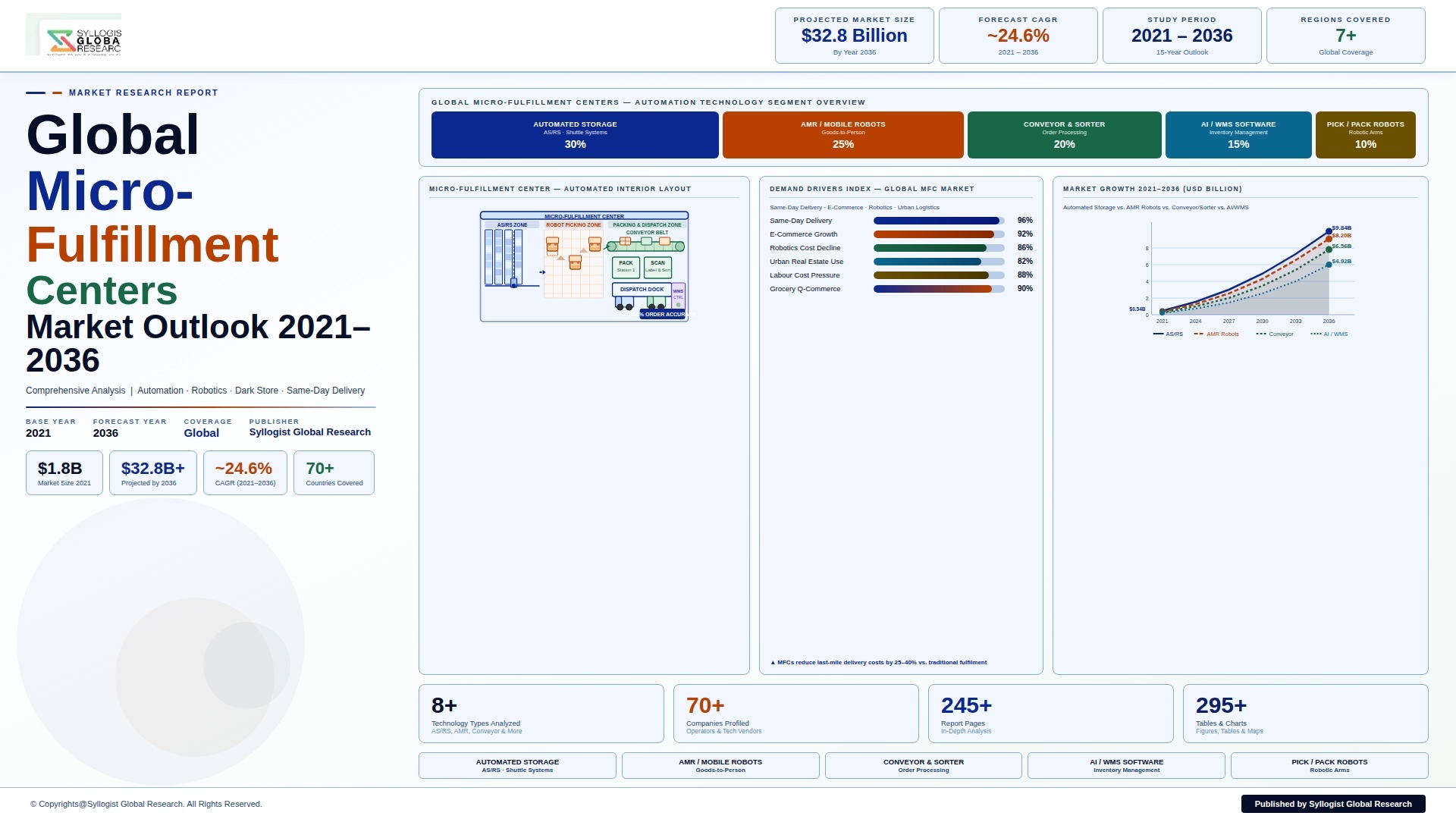
The global micro-fulfillment centers market is at a pivotal commercial inflection point where the structural forces of consumer delivery expectation escalation, e-commerce penetration deepening across grocery and daily essentials categories, and urban real estate cost optimization imperatives are compelling a fundamental rethinking of fulfillment network architecture by retailers and logistics operators who can no longer cost-efficiently serve urban consumer same-day and next-day delivery demand from large-format regional distribution centers located outside metropolitan cores. The global micro-fulfillment centers market was valued at approximately USD 4.2 billion in 2025 and is projected to reach USD 14.8 billion by 2034, advancing at a compound annual growth rate of 15.1% over the forecast period from 2027 to 2034, driven by the accelerating deployment of robotic micro-fulfillment systems within grocery retail chains across North America and Europe, the rapid expansion of quick commerce dark store networks across Asia-Pacific, Middle Eastern, and Latin American metropolitan markets, and the commercial maturation of goods-to-person robotic fulfillment technology platforms whose demonstrated pick rate, accuracy, and labor cost reduction outcomes are generating compelling return on investment evidence that is expanding the adopter base from pioneering early movers toward mainstream retail and logistics operators committed to urban fulfillment automation as a strategic infrastructure investment.
The grocery retail segment constitutes the most commercially significant and technologically mature application category within the global micro-fulfillment centers market, driven by the structural transformation of grocery purchasing behavior toward online ordering that accelerated sharply during the COVID-19 pandemic and has retained substantial penetration gains in the post-pandemic period, with online grocery penetration in the United States reaching approximately 13.4% of total grocery sales in 2025 and growing at approximately 11.2% annually as consumer comfort with digital grocery shopping, the expanding range of same-day delivery service offerings from major grocery chains, and the improving economics of micro-fulfillment-enabled grocery order assembly versus manual in-store picking combine to create a self-reinforcing adoption dynamic. Kroger’s partnership with Ocado Group for Customer Fulfillment Center deployment across its national store network, Albertsons Companies’ automated micro-fulfillment deployment within existing store backrooms using Takeoff Technologies and Fabric robotic systems, and Walmart’s investment in its own proprietary Market Fulfillment Center program using Alert Innovation’s Alphabot technology represent the three principal strategic models through which North American grocery operators are deploying micro-fulfillment automation, each reflecting different capital deployment philosophies, real estate utilization strategies, and technology partnership structures whose comparative commercial performance is generating valuable industry learning about the optimal micro-fulfillment model for different store formats, order volume profiles, and urban density contexts. In Europe, Ahold Delhaize’s proprietary CFC rollout through its Peapod Digital Labs platform, Tesco’s partnership with Knapp for automated micro-fulfillment at urban fulfillment sites, and Ocado’s continued expansion of its Customer Fulfillment Center network in the United Kingdom and international license partner markets are collectively establishing the European grocery micro-fulfillment deployment precedents whose unit economics and operational performance data are informing the investment decisions of the broader European grocery retail industry.
The quick commerce and on-demand delivery segment, encompassing the dark store-based fulfillment networks operated by Gopuff, Getir, Gorillas, Zapp, Zepto, Blinkit, and their regional equivalents across European, Middle Eastern, South Asian, and Latin American metropolitan markets, represents the most structurally disruptive application of micro-fulfillment principles within the global market, having demonstrated through their hyper-local dark store operating models that 10 to 30-minute delivery of grocery, pharmacy, and essential goods is commercially and operationally achievable within the cost structures of urban markets where rental costs, labor costs, and delivery network density reach the thresholds required for unit economic viability. The global quick commerce market reached approximately USD 76 billion in gross merchandise value in 2025, with micro-fulfillment dark store operations serving as the foundational infrastructure of every major quick commerce platform whose competitive differentiation depends on the inventory assortment depth, pick speed, order accuracy, and geographic coverage density achievable from hyper-local automated or semi-automated fulfillment nodes positioned within one to three kilometers of the consumer delivery destination. The consolidation dynamics within the global quick commerce sector, where the post-2022 profitability pressure and capital market retrenchment eliminated numerous undercapitalized market entrants and concentrated market position among better-capitalized operators including Gopuff in North America and the United Kingdom, Getir across European markets, and Blinkit and Zepto in India, have paradoxically accelerated the micro-fulfillment technology investment of surviving operators who recognize that operational efficiency improvement through fulfillment automation rather than geographic expansion speed is the primary path to sustainable unit economics in the capital-constrained quick commerce environment.
The technology platform competitive landscape within the global micro-fulfillment centers market has evolved through three distinct development phases: an initial pioneer phase dominated by Ocado Group’s large-scale CFC platform and the early goods-to-person robotic systems of Takeoff Technologies, Fabric, and AutoStore; a scaling phase in which multiple technology providers including Dematic, Knapp, Swisslog, SSI Schaefer, and Exotec competed for major grocery and e-commerce retailer deployments with differentiated robotic storage and picking architectures; and the current consolidation and capability expansion phase in which the market is bifurcating between large-scale automated fulfillment systems capable of processing thousands of orders per day for major grocery chains and light-weight modular micro-fulfillment solutions designed for deployment within existing retail store backrooms, urban mezzanine spaces, and repurposed parking structures at capital costs and space requirements accessible to mid-market retailers who cannot justify large-format CFC investment. AutoStore’s cubic storage and bin-lifting robot technology, which has secured deployments across major grocery, general merchandise, and pharmaceutical distribution applications globally, represents the most widely deployed robotic micro-fulfillment storage platform by installed unit count, with over 1,100 systems operational or under installation across more than 45 countries as of 2025, demonstrating the commercial scalability and cross-sector applicability of its compact high-density storage architecture. The emergence of artificial intelligence-driven inventory positioning optimization, real-time demand forecasting integration, and dynamic order batching algorithms within micro-fulfillment management software platforms is generating meaningful pick efficiency and delivery time performance differentiation between technology-advanced operators and those relying on static inventory slotting and wave-based order processing approaches, creating a competitive premium for micro-fulfillment operators whose software intelligence layer complements their physical automation investment.
Key Drivers
Consumer Demand for Same-Day and Sub-Hour Delivery of Grocery and Daily Essentials Compelling Retailers to Relocate Fulfillment Capacity Into Urban Market Cores
The irreversible consumer expectation reset toward same-day and sub-hour delivery fulfillment, established through the commercial success of Amazon Prime Now, Instacart same-day grocery delivery, and the hyper-local quick commerce platforms that have normalized 15 to 30-minute delivery as a competitive baseline in major metropolitan markets, is compelling grocery chains, general merchandise retailers, and consumer goods brands to fundamentally redesign their fulfillment network architectures by establishing urban fulfillment nodes whose proximity to consumer demand enables delivery speed and economics that peripheral distribution centers cannot match. The cost economics of same-day grocery delivery fulfilled from large regional distribution centers are structurally unviable for the majority of order values and consumer willingness-to-pay thresholds encountered in urban grocery e-commerce, with last-mile delivery cost per order from a distribution center positioned 20 to 40 kilometers from consumer delivery points averaging USD 12 to USD 22 per order compared to USD 4 to USD 8 per order from a micro-fulfillment location positioned within 3 to 5 kilometers of the delivery destination, creating a commercial imperative for urban fulfillment location strategy that directly drives micro-fulfillment center investment. The grocery click-and-collect adoption wave, through which consumers order online and collect from store or dedicated collection point without paying delivery charges, is generating parallel demand for in-store micro-fulfillment automation whose order assembly speed and accuracy advantages over manual in-aisle picking directly reduce the labor cost of fulfilling click-and-collect orders at the scale volumes that urban grocery store online order programs are generating, making automated micro-fulfillment the economically preferred alternative to the manual picking model that most grocery retailers are still operating despite its unfavorable labor cost trajectory.
Urban Real Estate Innovation and Repurposing of Underutilized Retail, Industrial, and Parking Assets Expanding the Viable Location Portfolio for Micro-Fulfillment Deployment
The structural transformation of urban retail real estate driven by the long-term decline of department store anchor tenants, the ongoing attrition of mid-market specialty retail formats, and the conversion of ground-floor retail in urban mixed-use developments toward experiential, food and beverage, and service-oriented tenancies is creating an expanding inventory of available urban spaces in accessible metropolitan locations whose physical characteristics, loading dock access, power supply capacity, and floor loading specifications make them well-suited to micro-fulfillment center conversion, providing logistics operators and retailers with viable urban fulfillment location options at rental economics substantially below the new development replacement cost of purpose-built urban logistics facilities. Real estate investment trusts and logistics property developers including Prologis, CBRE Investment Management, and GLP have identified urban micro-fulfillment as a strategic asset class whose location value characteristics of last-mile proximity, transportation node access, and dense consumer catchment density command rental premiums above conventional suburban industrial space, and are actively developing micro-fulfillment-optimized urban infill logistics facilities in former retail, light industrial, and repurposed multi-story car park structures that expand the urban footprint available for micro-fulfillment deployment beyond the limited supply of traditional last-mile logistics properties in dense city cores. The integration of micro-fulfillment operations within existing grocery store backrooms, a model pioneered by Takeoff Technologies and subsequently adopted by Fabric and other platform providers for in-store automated fulfillment deployments at Albertsons, Giant Food, and other North American grocery chains, demonstrates the commercial viability of micro-fulfillment deployment within the existing retail real estate footprint without requiring additional urban property acquisition, substantially improving the capital efficiency of micro-fulfillment investment for grocery retailers whose store network constitutes a distributed urban fulfillment infrastructure asset.
Robotic Goods-to-Person Technology Maturation and Total Cost of Ownership Improvement Making Automated Micro-Fulfillment Economically Viable Beyond the Largest Tier-One Operators
The commercial maturation of goods-to-person robotic storage and picking technologies over the past decade has driven a sustained reduction in system capital cost per storage position, improvement in picking throughput per robot unit, and expansion of the SKU range, temperature zone capability, and order profile flexibility addressable by automated micro-fulfillment platforms, collectively lowering the minimum viable order volume threshold at which automated micro-fulfillment delivers superior economics relative to manual fulfillment and extending the addressable adopter market from large national grocery chains and e-commerce operators toward regional grocery retailers, specialty food operators, pharmacy chains, and general merchandise retailers whose order volumes and capital budgets previously fell below the commercial viability threshold of first-generation micro-fulfillment systems. The AutoStore cubic storage system, whose modular scalable architecture allows deployment at system sizes from 500 to over 200,000 storage bins at capital costs of USD 3 million to over USD 50 million depending on system scale and picking station configuration, exemplifies the commercialization of modular scalability that has been critical in extending micro-fulfillment technology accessibility to mid-market retailer adopters whose order volume profiles require 500 to 3,000 orders per day rather than the 10,000-plus daily order volumes that justify the large-scale Ocado CFC platform investment. The transition of micro-fulfillment technology pricing from predominantly capital expenditure-intensive system sale models toward software-as-a-service, robotics-as-a-service, and fulfillment-as-a-service subscription models that convert upfront hardware investment into recurring operational expenditure is further expanding the adopter population by reducing the capital access barrier for smaller operators and enabling pay-per-pick commercial structures that align technology cost with actual fulfillment volume utilization rather than theoretical system capacity.
Key Challenges
High Capital Investment and Long Payback Periods Limiting Micro-Fulfillment Adoption Among Mid-Market Retailers and Constraining Network Scaling Economics
The capital investment required to deploy a robotic micro-fulfillment system within an existing store backroom or standalone urban facility, including system hardware, software, installation, commissioning, real estate preparation, and integration with existing retail and e-commerce platforms, ranges from USD 3 million to USD 25 million depending on system scale, technology provider, and facility configuration complexity, representing an investment threshold that requires sustained and growing online order volumes to justify on conventional retail capital expenditure return criteria, creating a commercial timing challenge for retailers operating in markets where online grocery penetration is growing but has not yet reached the order density levels needed to deliver the labor cost savings and fulfillment capacity utilization rates that generate acceptable payback periods within the two to five year window most retail capital allocation frameworks require. The payback period calculation for micro-fulfillment center investment is highly sensitive to online order volume assumptions, labor cost displacement from manual picking, and incremental online sales capture attributable to improved delivery speed and availability, all of which involve forecasting uncertainty that creates wide ranges in estimated financial return across different market conditions and operator execution effectiveness, making conservative financial committees at major retail organizations reluctant to commit capital at the scale and pace required to build out the urban fulfillment network density needed for competitive delivery speed performance. The network effect challenge inherent in micro-fulfillment deployment, where individual site economics improve significantly with higher order volume but the delivery speed and coverage competitive benefits only fully materialize when a sufficient number of geographically distributed micro-fulfillment nodes are operational to cover the full consumer catchment area, means that retailers face a staged capital commitment requirement spanning multiple years and tens of millions of dollars before the full competitive and operational benefits of their micro-fulfillment network strategy are realized.
SKU Rationalization Requirements and Inventory Positioning Complexity Limiting Assortment Breadth and Consumer Proposition Completeness at Micro-Fulfillment Locations
The constrained physical footprint and automated storage density constraints of micro-fulfillment center operations, while enabling high pick speed and labor efficiency within the available space envelope, impose fundamental limitations on the number of distinct SKUs that can be stocked at any individual micro-fulfillment location, with typical micro-fulfillment systems accommodating between 2,000 and 15,000 SKU positions compared to the 30,000 to 80,000 SKUs available in a full-format grocery store or the 500,000-plus SKUs stocked at large regional distribution centers, creating an assortment incompleteness challenge that requires sophisticated inventory allocation decisions to maximize the proportion of consumer order lines fulfilled from micro-fulfillment stock rather than requiring last-minute substitution, partial order fulfillment from alternative sources, or customer disappointment from out-of-stock notifications. The inventory positioning optimization challenge is compounded by the spatial demand variability characteristic of urban consumer markets, where the product preferences, ethnic food requirements, household income levels, and dietary pattern compositions of consumer populations served by different micro-fulfillment locations within the same metropolitan area vary substantially and evolve dynamically with neighborhood demographic change, seasonal demand patterns, and promotional event impacts, requiring continuous AI-driven inventory rebalancing and SKU mix adjustment that demands sophisticated demand forecasting and inventory management capabilities beyond the operational sophistication of many current micro-fulfillment adopters. The fresh and chilled product fulfillment dimension of grocery micro-fulfillment introduces additional complexity arising from the temperature zone segregation requirements, reduced shelf life tolerance, and higher shrinkage rates of ambient-temperature automated storage systems applied to products with cold chain integrity requirements, making the extension of micro-fulfillment automation from ambient grocery SKUs to the high-value fresh produce, dairy, and meat categories that represent 40% to 55% of grocery consumer basket value technically and economically challenging relative to ambient product automation.
Last-Mile Delivery Integration Complexity and Gig Economy Labor Availability Constraints Limiting Operational Consistency of Micro-Fulfillment Speed Promises
The operational value proposition of micro-fulfillment centers, which centers on the delivery of orders within one to four hours of placement at consumer price points and service reliability levels that build sustained e-commerce penetration growth, is critically dependent on the consistent availability of last-mile delivery capacity whose scheduling, geographic coverage, peak demand management, and delivery quality must be reliably coordinated with the order output cadence of the micro-fulfillment operation, and whose operational consistency is significantly challenged by the structural volatility of gig economy delivery labor markets whose worker availability, hourly cost, and service quality vary substantially by time of day, day of week, weather conditions, competing platform demand, and local labor market characteristics that are outside the control of micro-fulfillment operators. The real-time coordination of micro-fulfillment order pick completion timing with delivery agent dispatch, route assignment, and customer communication requires sophisticated order management and delivery orchestration software integration whose technical complexity, particularly in multi-vendor environments where micro-fulfillment platform software must interface with third-party delivery management systems from DoorDash Drive, Instacart, Uber Eats, or proprietary owned fleet management platforms, creates integration development and operational monitoring costs that add to the total cost of micro-fulfillment program ownership. The peak demand management challenge at micro-fulfillment operations, where lunch-hour and evening delivery demand spikes generate order volume multiples of three to five times average hourly throughput that must be absorbed within the fixed picking capacity of the automated system and the limited delivery agent availability of gig economy marketplaces at peak compensation rate requirements, creates operational planning complexity whose management requires both robotic system capacity headroom investment and sophisticated delivery agent incentive and pre-positioning strategies whose cost directly affects the unit economics of peak-period fulfillment.
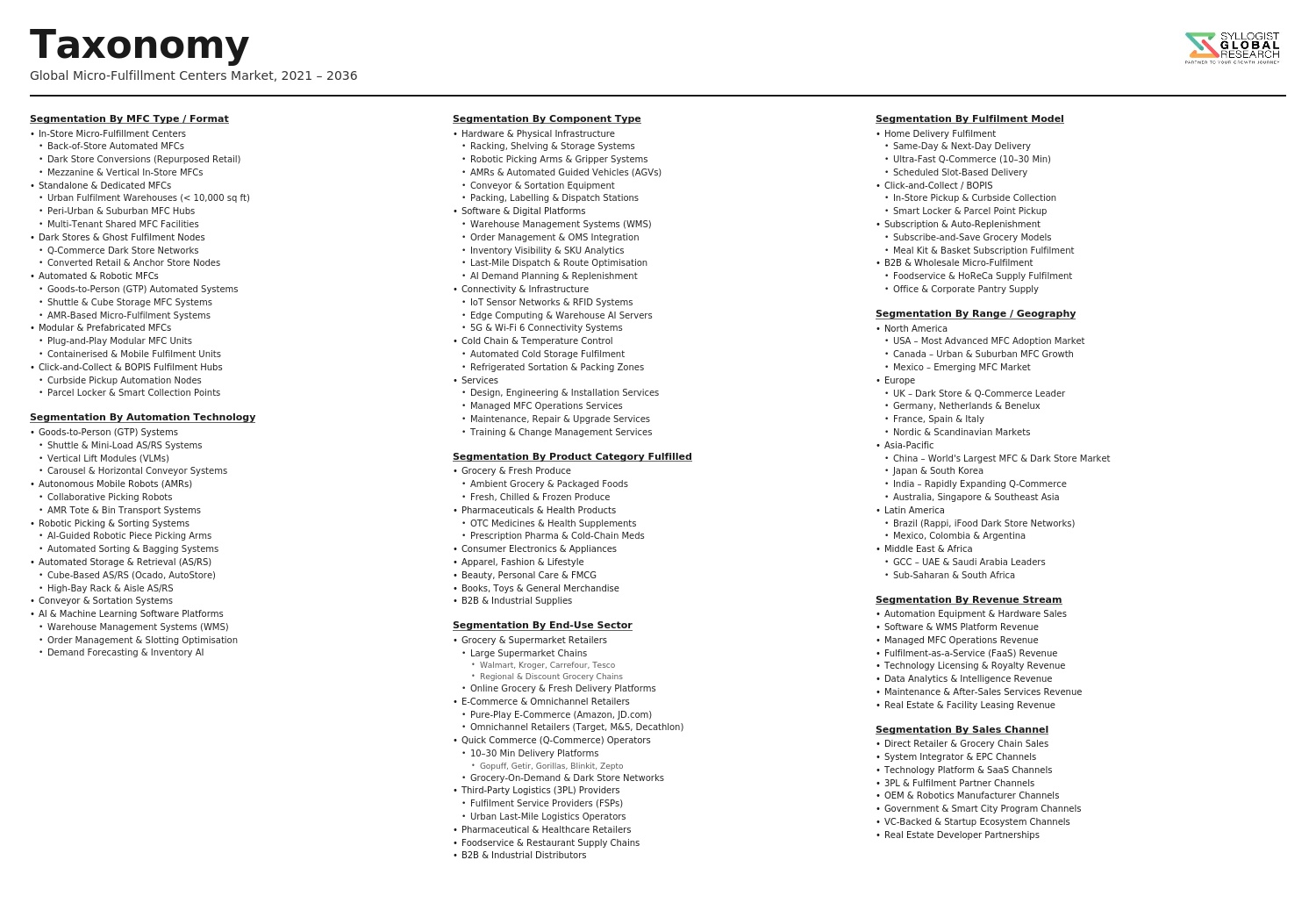
Market Segmentation
- Segmentation By Facility Type
- In-Store Backroom Micro-Fulfillment Centers
- Standalone Urban Dark Store Micro-Fulfillment Facilities
- Attached Store-Adjacent Automated Fulfillment Annexes
- Multi-Story Urban Micro-Fulfillment Buildings
- Repurposed Retail and Industrial Space Micro-Fulfillment Conversions
- Others
- Segmentation By Technology
- Goods-to-Person Robotic Storage and Retrieval Systems (AutoStore, Shuttle Systems)
- Autonomous Mobile Robots (AMR) for Order Picking
- Automated Storage and Retrieval Systems (AS/RS)
- Conveyor and Sortation Integrated Fulfillment Systems
- AI-Driven Inventory Management and Order Orchestration Software
- Digital Twin and Simulation Platforms for MFC Operations
- Click-and-Collect Automated Locker and Pickup Systems
- Others
- Segmentation By Product Category
- Grocery and Fresh Food
- Pharmacy and Health Products
- General Merchandise and Consumer Electronics
- Beauty, Personal Care, and Household Essentials
- Alcohol and Beverages
- Pet Food and Supplies
- Apparel and Fashion (Returns Processing and Rapid Replenishment)
- Others
- Segmentation By Order Fulfillment Model
- Same-Day and Sub-Hour Home Delivery
- Click-and-Collect and Curbside Pickup
- Next-Day and Scheduled Delivery Fulfillment
- On-Demand Quick Commerce (Under 30 Minutes)
- Omnichannel Hybrid Fulfillment (Online and In-Store)
- Others
- Segmentation By End User
- Grocery and Supermarket Retailers
- E-Commerce and Marketplace Operators
- Quick Commerce and On-Demand Delivery Platforms
- Pharmacy and Drug Store Chains
- General Merchandise and Big Box Retailers
- Convenience and Specialty Food Retailers
- Third-Party Logistics and Fulfillment Service Providers
- Others
- Segmentation By Facility Size
- Nano Fulfillment Nodes (Below 3,000 sq ft)
- Small Micro-Fulfillment Centers (3,000 to 10,000 sq ft)
- Medium Micro-Fulfillment Centers (10,000 to 30,000 sq ft)
- Large Micro-Fulfillment Centers (30,000 to 50,000 sq ft)
- Others
- Segmentation By Deployment Model
- Retailer-Owned and Operated Micro-Fulfillment
- Technology Provider-Operated (Robotics-as-a-Service)
- Third-Party Fulfillment-as-a-Service (Shared MFC Networks)
- Joint Venture and Co-Investment Deployment Models
- Others
- Segmentation By Region
- North America
- Europe
- Asia-Pacific
- Latin America
- Middle East and Africa
All market revenues are presented in USD
Historical Year: 2021-2024 | Base Year: 2025 | Estimated Year: 2026 | Forecast Period: 2027-2034
Key Questions this Study Will Answer
- What is the total global market valuation of the Micro-Fulfillment Centers Market in the base year 2025, and what is the projected market size and compound annual growth rate through 2034, disaggregated by facility type, technology platform, product category, order fulfillment model, end user, and region, to enable robotic technology providers, grocery and e-commerce retailers, logistics real estate developers, and infrastructure investors to identify which micro-fulfillment technology categories and geographic markets will generate the highest absolute investment and the most commercially durable deployment demand across the forecast period?
- How are the three principal grocery micro-fulfillment deployment models, the large-scale standalone Customer Fulfillment Center model exemplified by Kroger and Ocado, the in-store backroom automated fulfillment model deployed by Albertsons and Giant Food, and the proprietary dark store model operated by Walmart and Amazon, comparing on unit economics, capital efficiency, SKU coverage, order throughput capacity, and delivery speed performance across different urban density, order volume, and real estate cost environments, and what deployment model emerges as most commercially viable for different grocery operator profiles through 2034?
- What is the current installed base, growth trajectory, and geographic deployment distribution of AutoStore, Fabric, Takeoff Technologies, Dematic, Knapp, Exotec, and other leading micro-fulfillment robotic platform providers across grocery, quick commerce, and general merchandise end-use segments globally, and what are the documented pick rate, order accuracy, labor cost reduction, and return on investment outcomes that commercially operational deployments of each platform are generating for adopting retailers and logistics operators?
- How is the global quick commerce sector’s structural consolidation following the 2022 to 2024 capital market retrenchment reshaping the micro-fulfillment dark store deployment strategies, technology investment priorities, geographic market coverage decisions, and unit economic improvement programs of surviving operators including Gopuff, Getir, Blinkit, and Zepto, and what is the projected micro-fulfillment infrastructure investment trajectory of the consolidated quick commerce sector through 2034 as surviving operators pursue profitability through operational efficiency rather than geographic expansion?
- Who are the leading micro-fulfillment robotic technology providers, grocery and e-commerce retailer MFC program operators, fulfillment-as-a-service platform companies, logistics real estate developers specializing in urban micro-fulfillment assets, and last-mile delivery integration technology companies currently defining the competitive and investment landscape of the global micro-fulfillment centers market, and what are their respective technology platform capabilities, commercial deployment portfolios, robotics-as-a-service and capital-light business model innovations, AI-driven inventory optimization capabilities, geographic expansion strategies across emerging market quick commerce opportunities, and competitive differentiation positioning in response to the structural growth opportunity presented by the global e-commerce delivery speed escalation imperative through the forecast period?
- Product Definition
- Research Methodology
- Research Design & Framework
- Overall Research Approach: Descriptive, Exploratory & Quantitative Mixed-Method Design
- Market Definition & Scope Boundaries: What is Included and Excluded
- Segmentation Framework
- Key Research Assumptions & Limitations
- Secondary Research
- Primary Research Design & Execution
- Data Triangulation & Validation
- Market Sizing & Forecasting Methodology
- Competitive Intelligence Methodology
- Quality Assurance & Peer Review
- Definitions, Abbreviations & Data Notes
- Research Design & Framework
- Executive Summary
- Market Snapshot & Headline Numbers
- Key Findings & Research Highlights
- Market Dynamics
- Regional Market Summary
- Competitive Landscape Snapshot
- Technology & Innovation Highlights
- Market Dynamics
- Drivers
- Restraints
- Opportunities
- Challenges
- Porter’s Five Forces Analysis
- PESTLE Analysis
- Market Trends & Developments
- Emerging Trends
- Technological Developments
- Regulatory & Policy Changes
- Supply Chain & Sourcing Trends
- Manufacturing & Process Trends
- Investment & Funding Activity
- Sustainability & ESG Trends
- Risk Assessment Framework
- High Capital Investment, Long Payback Period & Return on Investment Uncertainty Risk for MFC Deployments
- Technology Integration Complexity, Legacy System Incompatibility & IT Infrastructure Readiness Risk
- Real Estate Availability, Urban Space Scarcity & Lease Cost Escalation Risk for MFC Site Selection
- Labour Transition, Workforce Displacement & Change Management Risk During MFC Automation Rollout
- Demand Forecasting Inaccuracy, SKU Rationalisation & Inventory Mismatch Risk in High-Velocity MFC Operations
- Regulatory Framework & Standards
- Zoning, Land Use & Urban Planning Regulations Governing MFC Facility Siting in Residential & Commercial Areas
- Building Safety Codes, Fire Protection Standards & Automated Equipment Certification Requirements for MFC Installations
- Labour & Employment Regulations: Automated Workplace Safety Standards, OSHA & EU Machinery Directive Compliance for MFC Robotics
- Food Safety & Cold Chain Regulations (FDA, EFSA & National Standards) Applicable to Grocery & Perishable MFC Operations
- Data Privacy, Consumer Protection & Last-Mile Delivery Regulations Governing MFC-Integrated E-Commerce Fulfilment Operations
- Global Micro-Fulfillment Centers Market Outlook
- Market Size & Forecast by Value
- Market Size & Forecast by Volume (Number of MFC Installations)
- Market Size & Forecast by MFC Type
- In-Store Micro-Fulfillment Centers (Retrofitted Back-of-Store & Mezzanine MFCs)
- Standalone Urban Dark Store & Dedicated MFC Facilities
- Attached & Adjacent MFC (Store-Proximate Standalone Unit)
- Pop-Up & Modular MFC (Pre-Fabricated & Rapidly Deployable Units)
- Automated Locker & Click-and-Collect Hub MFC
- Multi-Tenant Shared MFC & Collaborative Fulfilment Hub
- Cold Storage & Temperature-Controlled Micro-Fulfillment Centers
- Market Size & Forecast by Automation Technology
- Autonomous Mobile Robots (AMR) & Goods-to-Person Picking Systems
- Automated Storage & Retrieval Systems (AS/RS) & Mini-Load Systems
- Conveyor, Sortation & Tote-Based Automated Picking Systems
- Robotic Picking Arms & AI-Guided Vision Systems
- Vertical Lift Modules (VLMs) & Carousel Storage Systems
- Fully Automated & AI-Orchestrated End-to-End MFC Platforms
- Semi-Automated & Hybrid Human-Robot Collaboration MFCs
- Market Size & Forecast by Component
- Hardware (Robots, Conveyors, Racking, Storage Systems & Sensors)
- Software (WMS, OMS, Route Optimisation & AI Demand Forecasting Platforms)
- Connectivity & IoT Infrastructure (Edge Computing, 5G & Real-Time Tracking)
- Professional Services (System Integration, Installation & Commissioning)
- Maintenance, Support & Managed Operations Services
- Market Size & Forecast by Size & Capacity
- Extra-Small MFC (Below 1,000 sq ft, Below 2,000 SKUs)
- Small MFC (1,000 to 5,000 sq ft, 2,000 to 8,000 SKUs)
- Medium MFC (5,000 to 15,000 sq ft, 8,000 to 20,000 SKUs)
- Large MFC (Above 15,000 sq ft, Above 20,000 SKUs)
- Market Size & Forecast by Application
- Online Grocery & Fresh Food Fulfilment
- Quick Commerce & Rapid Delivery (Under 30 Minutes)
- E-Commerce General Merchandise & Omnichannel Retail Fulfilment
- Pharmacy & Healthcare Product Fulfilment
- Meal Kit, Prepared Food & Dark Kitchen Fulfilment
- B2B & Foodservice Distribution Fulfilment
- Market Size & Forecast by Deployment Model
- Retailer-Owned & Operated MFC
- Technology Provider-Operated & Managed MFC (MFC-as-a-Service)
- Third-Party Logistics (3PL) Operated MFC
- Franchise & White-Label MFC Network Model
- Joint Venture & Co-Investment MFC
- Market Size & Forecast by End-User
- Grocery Retailers & Supermarket Chains
- E-Commerce & Marketplace Operators
- Quick Commerce & On-Demand Delivery Platforms
- Pharmacy & Health & Beauty Retailers
- Specialty Food & Beverage Retailers
- Third-Party Logistics & Contract Fulfilment Providers
- North America Micro-Fulfillment Centers Market Outlook
- Market Size & Forecast
- By Value
- By Volume (Number of MFC Installations)
- By MFC Type
- By Automation Technology
- By Size & Capacity
- By Application
- By End-User
- By Country
- By Deployment Model
- Market Size & Forecast
- Europe Micro-Fulfillment Centers Market Outlook
- Market Size & Forecast
- By Value
- By Volume (Number of MFC Installations)
- By MFC Type
- By Automation Technology
- By Size & Capacity
- By Application
- By End-User
- By Country
- By Deployment Model
- Market Size & Forecast
- Asia-Pacific Micro-Fulfillment Centers Market Outlook
- Market Size & Forecast
- By Value
- By Volume (Number of MFC Installations)
- By MFC Type
- By Automation Technology
- By Size & Capacity
- By Application
- By End-User
- By Country
- By Deployment Model
- Market Size & Forecast
- Latin America Micro-Fulfillment Centers Market Outlook
- Market Size & Forecast
- By Value
- By Volume (Number of MFC Installations)
- By MFC Type
- By Automation Technology
- By Size & Capacity
- By Application
- By End-User
- By Country
- By Deployment Model
- Market Size & Forecast
- Middle East & Africa Micro-Fulfillment Centers Market Outlook
- Market Size & Forecast
- By Value
- By Volume (Number of MFC Installations)
- By MFC Type
- By Automation Technology
- By Size & Capacity
- By Application
- By End-User
- By Country
- By Deployment Model
- Market Size & Forecast
- Country-Wise* Micro-Fulfillment Centers Market Outlook
- Market Size & Forecast
- By Value
- By Volume (Number of MFC Installations)
- By MFC Type
- By Automation Technology
- By Size & Capacity
- By Application
- By End-User
- By Country
- By Deployment Model
- Market Size & Forecast
- *Countries Analyzed in the Syllogist Global Research Portfolio: United States, Canada, Mexico, Germany, France, United Kingdom, Netherlands, Spain, Italy, Norway, Sweden, China, Japan, India, Australia, South Korea, Singapore, Brazil, Chile, Saudi Arabia, UAE, Egypt, South Africa, Israel
- Technology Landscape & Innovation Analysis
- Autonomous Mobile Robot (AMR) & Goods-to-Person System Technology Deep-Dive: Navigation, Fleet Management & Pick Rate Optimisation
- AI-Powered Demand Forecasting, Inventory Optimisation & Dynamic SKU Slotting Technology for MFC Operations
- Robotic Picking Arm & AI Vision Technology: Grasping, Object Recognition & Multi-SKU Handling for MFC Automation
- Automated Storage & Retrieval System (AS/RS) & Vertical Lift Module Technology for Space-Constrained Urban MFC Environments
- Digital Twin & Simulation Technology for MFC Layout Design, Throughput Modelling & Operational Performance Optimisation
- Last-Mile Integration Technology: MFC-to-Door Route Optimisation, Drone Dispatch & Autonomous Delivery Vehicle Interface
- Cold Chain Automation Technology: Temperature-Controlled AMR, Cryogenic Storage & Automated Perishable Handling for Grocery MFCs
- Patent & IP Landscape in Micro-Fulfillment Center Technologies
- Value Chain & Supply Chain Analysis
- MFC Hardware Component: Robot, Conveyor, Racking & Sensor Manufacturing Supply Chain
- WMS, OMS & AI Platform Software Development & Cloud Infrastructure Supply Chain
- MFC Facility Construction, Fit-Out, Modular Assembly & Systems Integration Supply Chain
- Last-Mile Delivery Fleet, Carrier & Delivery Partner Integration Supply Chain
- Retailer, Grocery Chain & E-Commerce Operator MFC Procurement & Deployment Channel
- 3PL, Contract Logistics & MFC-as-a-Service Provider Channel
- Equipment Maintenance, Spare Parts, Software Update & Managed Service Value Chain
- Pricing Analysis
- MFC Hardware Capital Cost Benchmarking by Automation Technology & MFC Size
- MFC Software Licensing, SaaS Subscription & Per-Order Processing Fee Structure Analysis
- MFC-as-a-Service Pricing: Revenue Share, Per-Pick & Monthly Fixed Fee Model Comparison
- MFC Total Cost of Ownership (TCO) vs. Manual Dark Store & Traditional Fulfilment Centre Cost Comparison
- Real Estate, Lease & Site Preparation Cost Analysis for MFC Deployment Across Key Urban Markets
- Total MFC Fulfilment Cost per Order Across MFC Types, Automation Levels & Deployment Models
- Sustainability & Environmental Analysis
- Lifecycle Assessment (LCA) of Micro-Fulfillment Centers: Carbon Footprint, Energy Consumption & Material Use vs. Conventional Fulfilment
- MFC Contribution to Last-Mile Emission Reduction: Route Consolidation, Shorter Delivery Radius & Electric Vehicle Integration
- Food Waste Reduction & Perishable Spoilage Minimisation Through AI Demand Forecasting & Automated Grocery MFC Operations
- Green Building, Energy-Efficient Automation & Renewable Energy Integration in MFC Facility Design
- Regulatory-Driven Sustainability, SDG 9 (Industry & Innovation), SDG 11 (Sustainable Cities) & SDG 12 (Responsible Consumption) Alignment & ESG Disclosure
- Competitive Landscape
- Market Structure & Concentration
- Market Consolidation Level (Fragmented vs. Consolidated by MFC Type & Geography)
- Top 10 Players Market Share
- HHI (Herfindahl-Hirschman Index) Concentration Analysis
- Competitive Intensity Map by MFC Type, Automation Technology & Region
- Player Classification
- Dedicated MFC Automation Technology & Platform Providers
- AMR & Goods-to-Person System Manufacturers
- AS/RS, VLM & Automated Storage System Manufacturers
- Integrated WMS & OMS Software Platform Providers
- Grocery & E-Commerce Retailers with Proprietary MFC Technology
- 3PL & Contract Logistics Companies Offering MFC-as-a-Service
- Modular & Pre-Fabricated MFC Infrastructure Providers
- Start-Ups & AgTech Ventures in Quick Commerce & Dark Store Automation
- Competitive Analysis Frameworks
- Market Share Analysis by MFC Type, Automation Technology & Region
- Company Profile
- Company Overview & Headquarters
- MFC Products, Automation Systems & Platform Portfolio
- Key Customer Relationships & Reference MFC Installations
- Number of MFC Deployments & Geographic Footprint
- Revenue (MFC Segment) & Order Backlog
- Technology Differentiators & IP
- Key Strategic Partnerships, JVs & M&A Activity
- Recent Developments (New Deployments, Product Launches, Customer Wins)
- SWOT Analysis
- Strategic Focus Areas & Roadmap
- Competitive Positioning Map (Technology Capability vs. Deployment Scale)
- Key Company Profiles
- Market Structure & Concentration
- Strategic Opportunity Analysis
- Strategic Output
- Market Opportunity Matrix: By MFC Type, Automation Technology, Application, Deployment Model, End-User & Geography
- White Space Opportunity Analysis
- Strategic Recommendations
- Product Portfolio & Technology Investment Strategy
- Manufacturing & Operational Excellence Strategy
- Geographic Expansion & Localisation Strategy
- Customer & End-User Engagement Strategy
- Partnership, M&A & Ecosystem Strategy
- Sustainability & Circular Economy Strategy
- Risk Mitigation & Future Roadmap
- Strategic Priority Matrix & Roadmap
- Near-term (2025-2028)
- Mid-term (2029-2032)
- Long-term (2033-2037)
- Strategic Output