Global Sensors Market By Sensor Type, By Technology, By Output Signal, By End Use Industry, By Application, By Region, Competition, Forecast & Opportunities, 2021-2036F
Market Definition
The Global Sensors Market encompasses the design, manufacture, and commercial supply of physical, chemical, biological, and environmental transducer devices that detect, measure, and convert real-world stimuli including temperature, pressure, motion, proximity, light, humidity, flow, chemical concentration, and biological parameters into electrical signals for processing, monitoring, control, and data acquisition applications across automotive, industrial, consumer electronics, healthcare, aerospace, energy, and smart infrastructure end use industries worldwide.
Market Insights
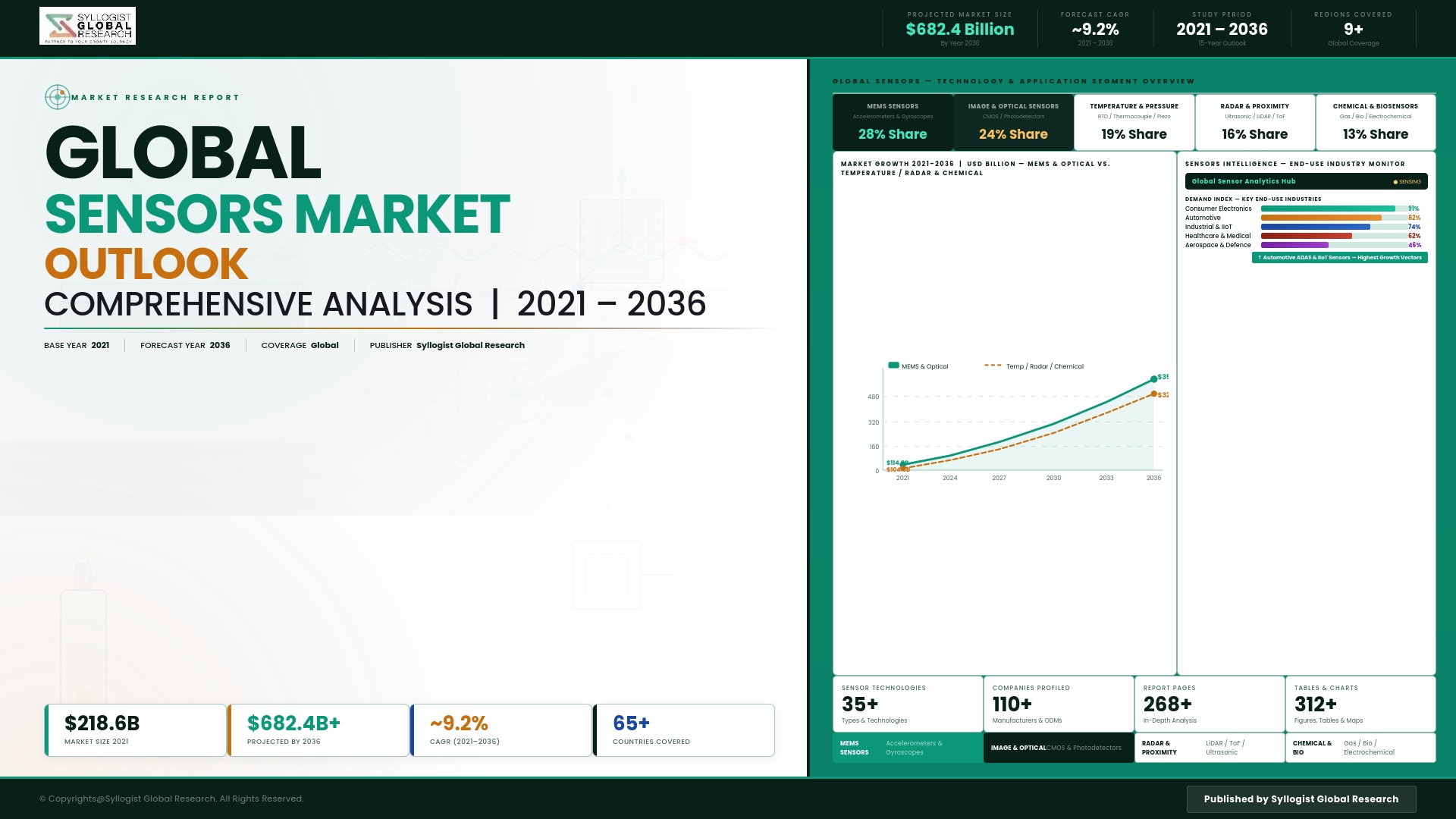
The global sensors market is experiencing a period of broad-based structural expansion, driven by the simultaneous proliferation of connected devices across consumer and industrial Internet of Things ecosystems, the deepening integration of sensor-derived data intelligence into automotive safety and autonomous driving systems, the accelerating adoption of industrial automation and predictive maintenance programs, and the growing deployment of environmental and health monitoring applications requiring continuous real-time physical world data capture at unprecedented scale and granularity. The market was valued at approximately USD 248.6 billion in 2025 and is projected to advance at a compound annual growth rate of 8.4% through 2034, as sensors transition from discrete measurement instruments into foundational data infrastructure components embedded pervasively across vehicles, factories, buildings, wearables, medical devices, agricultural systems, and urban infrastructure networks that collectively define the physical sensing fabric of an increasingly data-driven global economy.
The automotive sector represents the single largest end use industry for sensors by revenue, a position reinforced by the relentless escalation in sensor content per vehicle driven by advanced driver assistance system mandates, the proliferation of battery management, thermal monitoring, and powertrain control sensors in electric vehicle platforms, and the growing deployment of lidar, radar, camera, and ultrasonic sensor arrays in vehicles progressing along the autonomous driving capability spectrum. Regulatory requirements for forward collision warning, automatic emergency braking, lane departure warning, and blind spot detection across major automotive markets are establishing minimum sensor content thresholds that translate directly into durable procurement obligations for automotive sensor suppliers, while the additional sensor requirements of higher levels of driving automation introduce further content uplift that will sustain automotive sensor revenue growth well beyond the rate of vehicle production volume expansion alone.
The industrial sensors segment is undergoing a technology-driven transformation as manufacturers invest in factory digitalization, industrial Internet of Things connectivity, and AI-powered predictive maintenance programs that require dense sensor instrumentation of production equipment, process parameters, energy consumption, and environmental conditions to generate the operational data streams underpinning real-time process optimization and equipment health monitoring. Micro-electromechanical systems sensor technology continues to advance the miniaturization, power efficiency, and cost competitiveness of pressure, inertial, and environmental sensors across both consumer and industrial applications, enabling sensor deployment in form factors and at price points that were commercially impractical with earlier discrete sensing technologies. Medical and healthcare sensors are registering accelerating adoption across wearable continuous health monitoring, remote patient monitoring, implantable diagnostic devices, and point-of-care diagnostic systems, driven by aging population demographics, the expansion of preventive healthcare monitoring programs, and the proliferation of consumer health and fitness wearable devices that embed biosensors capable of continuous vital sign and metabolic parameter measurement.
Asia-Pacific dominates the global sensors market by both production volume and consumption, anchored by the concentration of consumer electronics and automotive manufacturing capacity across China, Japan, South Korea, and Taiwan, the large and rapidly expanding installed base of industrial automation equipment across Chinese manufacturing, and the fast-growing smart device and wearable consumer market across the region. North America maintains its position as the highest-revenue regional market per unit of industrial output, driven by the concentration of advanced automotive and aerospace sensor content, robust industrial automation investment, strong healthcare sensor adoption, and the density of technology sector demand for precision sensing components in computing, communications, and defense applications. Europe represents the third major regional market, supported by a strong automotive manufacturing base with high advanced driver assistance system content, significant industrial automation investment in Germany and Scandinavia, and growing smart building and environmental monitoring sensor deployment.
Key Drivers
Pervasive Internet of Things Deployment and Smart Connected Device Proliferation Generating Exponential Growth in Sensor Node Volumes Across Consumer, Industrial, and Infrastructure Applications
The accelerating deployment of Internet of Things connected devices across smart home systems, wearable consumer electronics, industrial equipment monitoring, smart building management, agricultural precision farming, smart city infrastructure, and supply chain logistics tracking is generating demand for sensor nodes at a scale and geographic distribution that dwarfs historical sensor deployment volumes, as each connected device or intelligent system requires one or more sensors to perceive its physical environment, monitor operating conditions, or detect user interactions. Continuing advances in low-power sensor design, energy harvesting integration, and wireless communication protocol efficiency are enabling sensor deployment in battery-operated and self-powered applications that extend the addressable market for sensors into previously inaccessible installation environments, further expanding the total connected device sensor content opportunity across all major Internet of Things application domains.
Automotive Electrification, Advanced Driver Assistance System Mandates, and Autonomous Vehicle Development Programs Driving Sustained Escalation in Sensor Content Per Vehicle Across Global Automotive Production
The transition of global automotive production toward electric vehicle platforms is substantially increasing per-vehicle sensor content requirements, as battery management systems, thermal monitoring networks, electric motor control systems, regenerative braking management, and high-voltage safety monitoring each require dedicated sensor arrays that have no equivalent in conventional internal combustion engine vehicles. Simultaneously, regulatory mandates requiring advanced driver assistance system features across new vehicle production in the United States, European Union, China, Japan, and South Korea are establishing minimum sensing system content standards that create non-discretionary sensor procurement obligations, while the commercial development of higher levels of vehicle automation by automotive manufacturers and technology companies is driving active investment in lidar, radar, high-resolution camera, and sensor fusion platform development that expands the automotive sensor market well beyond regulatory compliance procurement alone.
Industrial Automation, Factory Digitalization, and Predictive Maintenance Investment Driving Dense Sensor Instrumentation of Manufacturing and Process Industry Equipment at Unprecedented Scale
Manufacturing enterprises across automotive, semiconductor, chemical, food processing, pharmaceutical, and energy industries are investing in factory digitalization programs that deploy dense sensor networks across production equipment, process lines, energy systems, and environmental monitoring infrastructure to generate the real-time operational data required for AI-powered process optimization, quality control automation, and predictive maintenance systems capable of identifying equipment degradation signatures and scheduling maintenance interventions before unplanned failures cause costly production downtime. Labor cost pressures, supply chain resilience imperatives, and competitive efficiency requirements are simultaneously accelerating the automation of manufacturing operations through robotic systems whose reliable and safe operation depends on increasingly sophisticated sensor capabilities for environment perception, force measurement, proximity detection, and machine vision-guided manipulation.
Key Challenges
Intensifying Price Erosion and Margin Compression in Commoditized Sensor Categories Driven by Low-Cost Asian Manufacturer Competition and Accelerating Technology Standardization
Mature sensor categories including standard temperature sensors, humidity sensors, basic pressure transducers, and commodity inertial measurement units are experiencing persistent average selling price erosion driven by the entry and capacity expansion of low-cost manufacturers in China and other Asian production centers that have commoditized previously differentiated sensor product categories, compressing gross margins for established sensor manufacturers and requiring continuous migration toward higher-complexity, higher-specification sensor products and application-specific integrated sensor solutions that resist commoditization through superior performance, calibration quality, application software integration, or qualification for demanding end use environments. The pace of technology standardization in Internet of Things sensor interfaces and communication protocols is accelerating this commoditization dynamic by reducing the switching costs that previously supported premium pricing among incumbent sensor suppliers with proprietary interface technology.
Cybersecurity Vulnerabilities in Networked Sensor Infrastructure Creating Data Integrity, Privacy, and Operational Safety Risks That Complicate Industrial and Critical Infrastructure Sensor Deployment
The integration of large-scale networked sensor infrastructure into industrial control systems, critical infrastructure operations, connected vehicles, smart building management, and healthcare monitoring environments is creating expanded cybersecurity attack surfaces that adversaries can exploit to manipulate sensor data streams, inject false environmental readings into automated control systems, compromise patient safety in connected medical devices, or disrupt industrial process control operations through sensor network infiltration. The resource-constrained nature of many embedded sensor platforms, which lack the processing capacity and power budget to implement robust encryption, authentication, and intrusion detection capabilities, limits the cybersecurity defenses achievable at the sensor node level and places disproportionate security burden on network architecture and gateway-level security controls that cannot fully compensate for sensor-level vulnerability.
Sensor Calibration Drift, Long-Term Measurement Accuracy Degradation, and the Operational Complexity of Maintaining Large-Scale Distributed Sensor Network Performance Over Extended Deployment Lifetimes
Sensors deployed in industrial, environmental, automotive, and healthcare applications are subject to measurement accuracy degradation over time from physical contamination, chemical exposure, thermal cycling fatigue, mechanical stress, and component aging that cause calibration drift and reduced measurement reliability unless systematic recalibration and maintenance programs are implemented across the deployed sensor population. The operational complexity and cost of maintaining calibration accuracy and measurement integrity across large distributed sensor networks encompassing thousands of individual sensor nodes in geographically dispersed or physically inaccessible installation locations represents a significant total cost of ownership challenge that limits the practical deployment density achievable in cost-sensitive applications and constrains the data quality assurance capabilities of industrial Internet of Things and environmental monitoring programs dependent on long-term sensor measurement reliability.
Market Segmentation
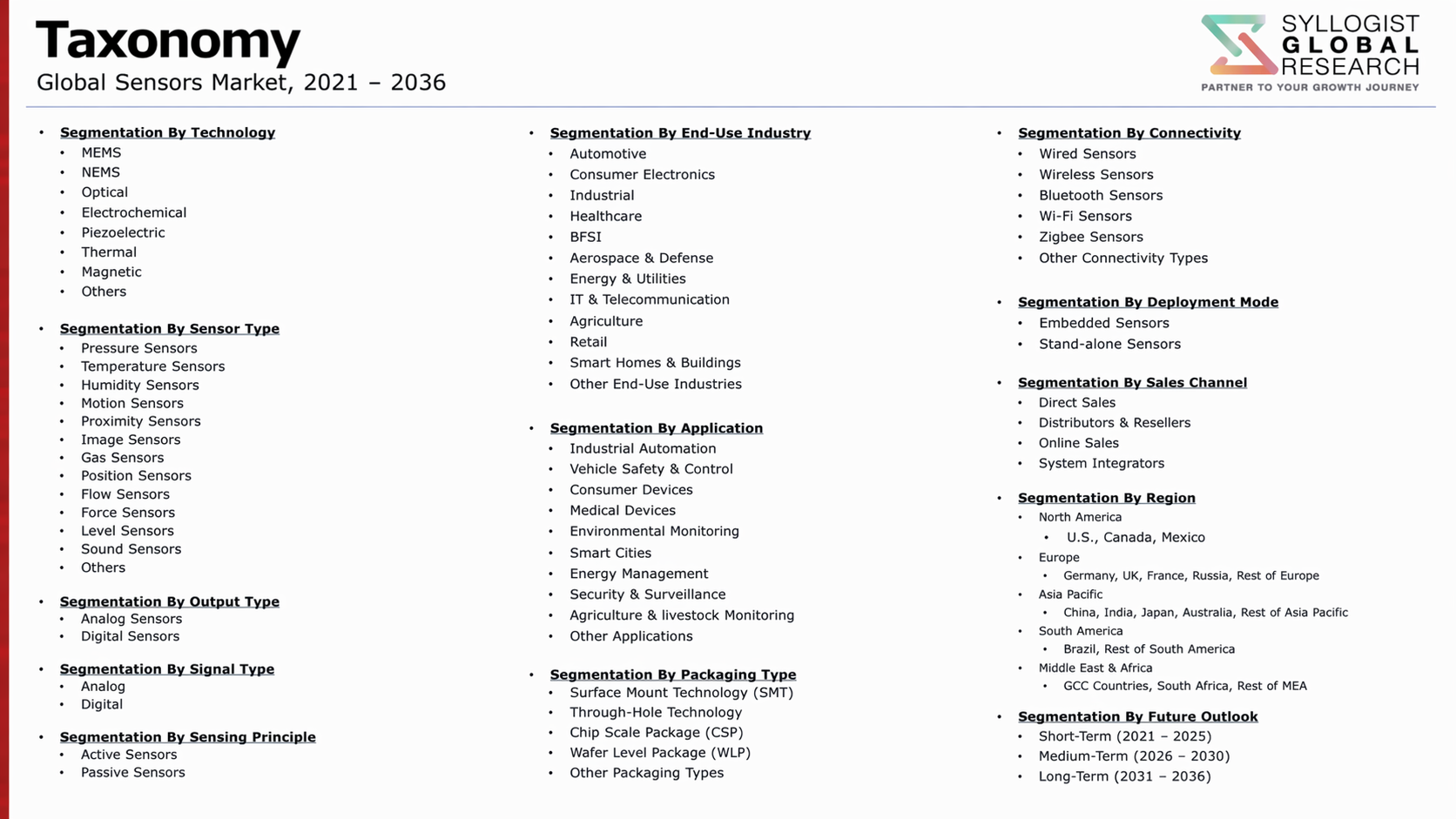
- Segmentation By Sensor Type
- Temperature Sensors
- Pressure Sensors
- Motion, Inertial, and Position Sensors
- Proximity and Presence Sensors
- Image and Vision Sensors
- Chemical and Gas Sensors
- Biosensors and Medical Sensors
- Flow and Level Sensors
- Lidar, Radar, and Ultrasonic Sensors
- Environmental and Humidity Sensors
- Others
- Segmentation By Technology
- Micro-Electromechanical Systems Sensors
- Complementary Metal Oxide Semiconductor Image Sensors
- Fiber Optic Sensors
- Piezoelectric Sensors
- Capacitive and Resistive Sensing Technologies
- Acoustic Wave Sensors
- Infrared and Optical Sensors
- Others
- Segmentation By Output Signal
- Analog Output Sensors
- Digital Output Sensors
- Wireless and IoT-Connected Smart Sensors
- Others
- Segmentation By End Use Industry
- Automotive and Electric Vehicles
- Industrial Automation and Manufacturing
- Consumer Electronics and Wearables
- Healthcare and Medical Devices
- Aerospace and Defense
- Energy and Utilities
- Smart Buildings and Infrastructure
- Agriculture and Environmental Monitoring
- Others
- Segmentation By Application
- Process Monitoring and Industrial Control
- Advanced Driver Assistance and Autonomous Driving
- Continuous Health and Vital Sign Monitoring
- Environmental and Air Quality Sensing
- Smart Factory and Predictive Maintenance
- Navigation, Positioning, and Motion Tracking
- Security, Surveillance, and Access Control
- Others
- Segmentation By Region
- North America
- Europe
- Asia-Pacific
- Middle East and Africa
- Latin America
All market revenues are presented in USD
Historical Year: 2021-2024 | Base Year: 2025 | Estimated Year: 2026 | Forecast Period: 2027-2034
Key Questions this Study Will Answer
- What is the total global sensors market valuation in 2025, projected through 2034, segmented by sensor type, technology, and end use industry, enabling sensor manufacturers, electronics distributors, and technology investors to identify the highest-growth product categories and most strategically significant demand opportunities across the global sensing technology landscape?
- How are automotive electrification, advanced driver assistance system regulatory mandates, and autonomous vehicle development programs reshaping per-vehicle sensor content requirements, sensor technology specifications, and supplier qualification standards, and which sensor categories, including lidar, radar, high-resolution vision sensors, and battery management sensing systems, are generating the highest incremental automotive procurement growth through 2034?
- Which industrial sensor segments, specifically process monitoring, predictive maintenance, robotic machine vision, and factory environmental sensing, are registering the highest adoption rates within manufacturing digitalization and industrial Internet of Things investment programs, and what data integration, edge processing, and AI analytics platform requirements are shaping advanced industrial sensor product development priorities among leading manufacturers?
- How is the competitive landscape structured among global semiconductor-integrated sensor manufacturers, specialized sensor technology developers, and regional sensor producers, and what micro-electromechanical systems technology investment, application-specific calibration and packaging innovation, system-level sensor fusion capability, and geographic market development strategies are enabling leading competitors to defend margin and share against commoditization pressure?
- What cybersecurity architecture requirements, sensor-level authentication standards, encrypted data transmission protocols, and network security frameworks are emerging to address the growing vulnerability of large-scale networked sensor infrastructure in industrial control, critical infrastructure, connected vehicle, and healthcare monitoring applications, and how are sensor manufacturers integrating security capabilities into sensor hardware and firmware design?
- How are advances in micro-electromechanical systems fabrication, energy harvesting integration, ultra-low power wireless communication, and AI-enabled edge inference capabilities expanding the addressable sensor deployment environments and application use cases across consumer wearables, agricultural monitoring, smart city infrastructure, and industrial asset tracking through 2034?
- Which regional sensor markets, specifically Asia-Pacific, North America, and Europe, are expected to generate the highest incremental revenue growth through 2034, and what industry-specific demand drivers, manufacturing capacity investment, technology innovation ecosystems, and end use industry concentration characteristics are defining regional sensor market leadership and competitive positioning across key sensor technology and application categories?
- Product Definition
- Research Methodology
- Research Design & Framework
- Overall Research Approach: Descriptive, Exploratory & Quantitative Mixed-Method Design
- Market Definition & Scope Boundaries: What is Included and Excluded
- Segmentation Framework
- Key Research Assumptions & Limitations
- Secondary Research
- Primary Research Design & Execution
- Data Triangulation & Validation
- Market Sizing & Forecasting Methodology
- Competitive Intelligence Methodology
- Quality Assurance & Peer Review
- Definitions, Abbreviations & Data Notes
- Research Design & Framework
- Executive Summary
- Market Snapshot & Headline Numbers
- Key Findings & Research Highlights
- Market Dynamics
- Regional Market Summary
- Competitive Landscape Snapshot
- Technology & Innovation Highlights
- Market Dynamics
- Drivers
- Restraints
- Opportunities
- Challenges
- Porter’s Five Forces Analysis
- PESTLE Analysis
- Market Trends & Developments
- Emerging Trends
- Technological Developments
- Regulatory & Policy Changes
- Supply Chain & Sourcing Trends
- Manufacturing & Process Trends
- Investment & Funding Activity
- Sustainability & ESG Trends
- Risk Assessment Framework
- Semiconductor Supply Chain Disruption, Chip Shortage & Component Availability Risk
- Sensor Calibration Drift, Measurement Accuracy & Long-Term Reliability Risk
- Cybersecurity, Data Privacy & IoT-Connected Sensor Network Vulnerability Risk
- Geopolitical Trade Restrictions, Export Controls & Raw Material Supply Risk
- Technology Obsolescence, Rapid Innovation Cycle & Customer Switching Cost Risk
- Regulatory Framework & Standards
- CE Marking, UL Certification & Regional Type Approval Standards for Sensor Products
- Automotive Sensor Safety Standards: ISO 26262 Functional Safety & ADAS Sensor Regulatory Frameworks
- Industrial Sensor Standards: IEC 61508, IEC 61511 Safety Integrity Level (SIL) & Hazardous Area (ATEX, IECEx) Certification
- Medical & Wearable Sensor Regulatory Frameworks: FDA 510(k), EU MDR & ISO 13485 Standards
- Environmental & Emissions Monitoring Sensor Standards: EPA, EU ETS & ISO Sensor Performance Requirements
- IoT Device Security, Data Protection & Smart Sensor Interoperability Standards (Matter, ETSI EN 303 645)
- Global Sensors Market Outlook
- Market Size & Forecast by Value
- Market Size & Forecast by Volume (Units Shipped)
- Market Size & Forecast by Sensor Type
- Temperature Sensors (Thermocouples, RTDs, Thermistors & Infrared Sensors)
- Pressure Sensors (Absolute, Gauge, Differential & Vacuum Pressure)
- Position, Proximity & Displacement Sensors
- Motion, Acceleration & Inertial Measurement Unit (IMU) Sensors
- Level Sensors (Ultrasonic, Capacitive, Float & Radar)
- Flow Sensors & Flow Meters
- Image & Vision Sensors (CCD, CMOS & Event-Based)
- Light, Colour & Ambient Optical Sensors
- Gas & Chemical Sensors
- Humidity & Moisture Sensors
- Biosensors & Electrochemical Sensors
- Force, Load & Torque Sensors
- Magnetic & Hall Effect Sensors
- Acoustic, Ultrasonic & Vibration Sensors
- LiDAR, Radar & Time-of-Flight (ToF) Sensors
- Multi-Sensor Fusion & Integrated Sensor Modules
- Market Size & Forecast by Technology
- MEMS (Micro-Electro-Mechanical Systems) Sensors
- Piezoelectric Sensors
- Capacitive Sensors
- Resistive & Piezoresistive Sensors
- Optical & Fibre Optic Sensors
- Inductive & Eddy Current Sensors
- Ultrasonic Sensors
- Infrared & Thermal Imaging Sensors
- AI-Enabled & Smart Sensor Technology with Edge Analytics
- Market Size & Forecast by Connectivity
- Wired Sensors (4-20mA, RS-485, Modbus, CAN Bus & IO-Link)
- Wireless Sensors (Bluetooth, Wi-Fi, Zigbee & Z-Wave)
- LPWAN-Connected Sensors (LoRaWAN, NB-IoT & Sigfox)
- 5G & Cellular-Connected Sensors
- HART, WirelessHART & Industrial IoT (IIoT) Protocol Sensors
- Market Size & Forecast by Output Signal
- Analogue Output Sensors
- Digital Output Sensors
- Smart & Programmable Output Sensors
- Market Size & Forecast by Application
- Automotive & Transportation (ADAS, Powertrain, Chassis & Cabin Sensing)
- Industrial Automation, Process Control & Factory Automation
- Consumer Electronics (Smartphones, Wearables, Smart Home & AR/VR)
- Healthcare & Medical Devices (Patient Monitoring, Diagnostics & Implantables)
- Aerospace & Defence (Navigation, Surveillance & Structural Monitoring)
- Energy & Utilities (Smart Grid, Oil & Gas, Wind & Solar Monitoring)
- Smart Buildings, HVAC & Environmental Monitoring
- Agriculture & Precision Farming (Soil, Weather & Crop Monitoring)
- Robotics & Autonomous Systems
- Environmental & Water Quality Monitoring
- Market Size & Forecast by End-User
- Automotive & Mobility Companies
- Industrial & Manufacturing Companies
- Consumer Electronics & OEM Device Manufacturers
- Healthcare & Medical Device Companies
- Aerospace & Defence Organisations
- Energy, Utility & Oil and Gas Companies
- Agriculture & Food Processing Companies
- Government & Smart City Infrastructure Operators
- Market Size & Forecast by Sales Channel
- Direct OEM & Sensor Manufacturer Sales
- Distributor & Electronic Component Reseller Network
- System Integrator & Value-Added Reseller (VAR) Channel
- Online & E-Commerce Channel
- Sensor-as-a-Service (SaaS) & Managed IoT Platform Channel
- North America Sensors Market Outlook
- Market Size & Forecast
- By Value
- By Volume (Units Shipped)
- By Sensor Type
- By Technology
- By Connectivity
- By Output Signal
- By Application
- By End-User
- By Country
- By Sales Channel
- Market Size & Forecast
- Europe Sensors Market Outlook
- Market Size & Forecast
- By Value
- By Volume (Units Shipped)
- By Sensor Type
- By Technology
- By Connectivity
- By Output Signal
- By Application
- By End-User
- By Country
- By Sales Channel
- Market Size & Forecast
- Asia-Pacific Sensors Market Outlook
- Market Size & Forecast
- By Value
- By Volume (Units Shipped)
- By Sensor Type
- By Technology
- By Connectivity
- By Output Signal
- By Application
- By End-User
- By Country
- By Sales Channel
- Market Size & Forecast
- Latin America Sensors Market Outlook
- Market Size & Forecast
- By Value
- By Volume (Units Shipped)
- By Sensor Type
- By Technology
- By Connectivity
- By Output Signal
- By Application
- By End-User
- By Country
- By Sales Channel
- Market Size & Forecast
- Middle East & Africa Sensors Market Outlook
- Market Size & Forecast
- By Value
- By Volume (Units Shipped)
- By Sensor Type
- By Technology
- By Connectivity
- By Output Signal
- By Application
- By End-User
- By Country
- By Sales Channel
- Market Size & Forecast
- Country-Wise* Sensors Market Outlook
- Market Size & Forecast
- By Value
- By Volume (Units Shipped)
- By Sensor Type
- By Technology
- By Connectivity
- By Output Signal
- By Application
- By End-User
- By Country
- By Sales Channel
- Market Size & Forecast
*Countries Analyzed in the Syllogist Global Research Portfolio: United States, Canada, Mexico, Germany, France, United Kingdom, Netherlands, Spain, Italy, Sweden, China, Japan, South Korea, India, Australia, Singapore, Taiwan, Brazil, Chile, Saudi Arabia, UAE, Egypt, South Africa, Israel
- Technology Landscape & Innovation Analysis
- MEMS Sensor Technology Deep-Dive: Fabrication Advances, Multi-Axis Integration & Miniaturisation Roadmap
- LiDAR & Solid-State Sensing Technology: Mechanical, MEMS-Based & Flash LiDAR for Automotive & Robotics
- AI-Integrated & Intelligent Sensor Technology: On-Chip Processing, Edge Inference & Self-Calibration
- Flexible, Stretchable & Printed Sensor Technology for Wearables & Soft Robotics
- Quantum Sensing Technology: Atomic Clocks, Gravimeters, Magnetometers & Next-Generation Precision Measurement
- Fibre Optic & Distributed Sensing Technology for Structural Health Monitoring & Perimeter Security
- Multispectral, Hyperspectral & Infrared Imaging Sensor Technology for Industrial & Defence Applications
- Patent & IP Landscape in Sensor Technologies
- Value Chain & Supply Chain Analysis
- Silicon Wafer, Specialty Substrate & Piezoelectric Crystal Raw Material Supply Chain
- Semiconductor Foundry, MEMS Fab & Specialty Process Supply Chain
- ASIC, Signal Conditioning IC & Application-Specific Electronics Supply Chain
- Sensor Housing, Packaging, Encapsulation & Environmental Protection Supply Chain
- Calibration, Testing & Quality Assurance Infrastructure Supply Chain
- OEM Integration, Module Assembly & System-Level Manufacturing Channel
- Distributor, System Integrator & Aftermarket Calibration Service Channel
- Pricing Analysis
- Sensor Unit Price Analysis by Sensor Type & Technology
- Commodity vs. High-Precision vs. Safety-Rated Sensor Price Band Analysis
- Total Cost of Ownership (TCO): Sensor Capex, Calibration, Maintenance & Replacement Analysis
- OEM Volume Pricing vs. Distribution Channel Pricing Structure Analysis
- Sensor-as-a-Service (SaaS) Subscription & Managed Sensing Platform Pricing Model Analysis
- Price Trend Analysis: Impact of MEMS Miniaturisation, Volume Scale & Semiconductor Costs on Sensor Pricing
- Sustainability & Environmental Analysis
- Lifecycle Assessment (LCA) of Sensor Products: Carbon Footprint, Rare Earth Material Use & End-of-Life WEEE Impact
- Role of Sensors in Enabling Energy Efficiency, Emissions Monitoring & Industrial Decarbonisation
- RoHS, REACH & Hazardous Substance Compliance in Sensor Manufacturing
- Conflict Mineral Sourcing, Responsible Procurement & ESG Supply Chain Standards for Sensor Components
- Low-Power Sensor Design, Energy Harvesting & Battery-Free Sensing for Sustainable IoT Deployments
- Competitive Landscape
- Market Structure & Concentration
- Market Consolidation Level (Fragmented vs. Consolidated by Sensor Type & Geography)
- Top 10 Players Market Share
- HHI (Herfindahl-Hirschman Index) Concentration Analysis
- Competitive Intensity Map by Sensor Type, Application & Geography
- Player Classification
- Large Diversified Sensor & Instrumentation Conglomerates
- Specialist MEMS Sensor Manufacturers
- Specialist Automotive Sensor Suppliers
- Specialist Industrial & Process Sensor Manufacturers
- Specialist Medical & Biosensor Companies
- LiDAR, Radar & Advanced Perception Sensor Companies
- Smart Sensor, IoT & Edge AI Sensor Platform Providers
- Competitive Analysis Frameworks
- Market Share Analysis by Sensor Type, Technology & Region
- Company Profile
- Company Overview & Headquarters
- Sensor Products & Technology Portfolio
- Key Customer Relationships & Reference Installations
- Manufacturing Footprint & Production Capacity
- Revenue (Sensor Segment) & Order Backlog
- Technology Differentiators & IP
- Key Strategic Partnerships, JVs & M&A Activity
- Recent Developments (Product Launches, Contract Wins, Capacity Expansion)
- SWOT Analysis
- Strategic Focus Areas & Roadmap
- Competitive Positioning Map (Technology Capability vs. Market Penetration)
- Key Company Profiles
- Market Structure & Concentration
- Technology Landscape & Innovation Analysis
- Strategic Output
- Market Opportunity Matrix: By Sensor Type, Technology, Application, End-User & Geography
- White Space Opportunity Analysis
- Strategic Recommendations
- Product Portfolio & Technology Investment Strategy
- Manufacturing & Operational Excellence Strategy
- Geographic Expansion & Localisation Strategy
- Customer & End-User Engagement Strategy
- Partnership, M&A & Ecosystem Strategy
- Sustainability & Circular Economy Strategy
- Risk Mitigation & Future Roadmap
- Strategic Priority Matrix & Roadmap
- Near-term (2025-2028)
- Mid-term (2029-2032)
- Long-term (2033-2037)
- Strategic Output