Market Definition
The Global Next-Generation Agrochemical Intermediates Market encompasses the synthesis, processing, purification, and commercial supply of advanced chemical building blocks and precursor compounds used in the manufacture of modern crop protection active ingredients, plant growth regulators, and biological crop performance enhancers that represent a new generation of agrochemical molecules distinguished by greater target specificity, lower use-rate requirements, improved environmental and toxicological profiles, and enhanced efficacy relative to legacy broad-spectrum agrochemical classes. Agrochemical intermediates are chemically defined organic compounds that serve as critical stage inputs within multi-step synthesis routes for fungicides, insecticides, herbicides, nematicides, and plant growth regulators, including heterocyclic building blocks such as pyrazoles, triazoles, pyridines, pyrimidines, and isoxazolines, halogenated aromatic and aliphatic intermediates, fluorinated chemical building blocks, chiral synthesis intermediates, and specialty amine and sulfonyl compounds whose structural complexity and technical synthesis requirements differentiate them from commodity petrochemical feedstocks. The next-generation designation within this market specifically encompasses intermediates for active ingredient classes that include succinate dehydrogenase inhibitor fungicides, diamide insecticides, mesoionic insecticides, arylpyrroline insecticides, hydroxyphenyl pyruvate dioxygenase herbicides, and protoporphyrinogen oxidase inhibitor herbicides, as well as intermediates for biological and semi-synthetic agrochemicals including fermentation-derived macrolide derivatives, lipochitooligosaccharide signal molecule analogs, and plant defense priming compounds. Key participants in this market include fine and specialty chemical manufacturers, custom synthesis and contract manufacturing organizations, fluorochemical producers, heterocyclic chemistry specialists, agrochemical active ingredient producers, and technology licensing companies whose intellectual property in synthesis pathway design governs the competitive structure and value distribution within the global agrochemical intermediate supply chain.
Market Insights
The global next-generation agrochemical intermediates market was valued at approximately USD 8.4 billion in 2025 and is projected to reach USD 16.7 billion by 2034, advancing at a compound annual growth rate of 7.9% over the forecast period from 2027 to 2034, driven by the accelerating pipeline of novel active ingredient registrations across leading agrochemical innovator companies, the progressive displacement of legacy organophosphate, carbamate, and older synthetic pyrethroid active ingredients by structurally complex next-generation molecules that require higher-value and technically sophisticated intermediate supply chains, and the growing demand for food security-oriented crop yield optimization in the context of climate-induced yield variability and expanding global population-driven caloric demand. The market’s structural growth trajectory reflects a fundamental shift in agrochemical innovation productivity toward molecularly targeted, mode-of-action-specific active ingredients that interact with discrete biochemical targets within pest organisms or plant physiology at nanomolar efficacy concentrations, necessitating increasingly precise and multi-step intermediate synthesis routes whose complexity generates substantially higher per-kilogram intermediate value relative to the relatively straightforward synthesis pathways of legacy broad-spectrum agrochemical classes. The global agrochemical active ingredient market consumed approximately 4.2 million metric tons of total active ingredient volume in 2025, with next-generation active ingredient classes representing approximately 31.6% of total active ingredient value sold despite accounting for a substantially smaller proportion of physical volume, reflecting the higher molecular complexity, lower application use rates, and premium pricing of modern targeted agrochemical molecules relative to legacy bulk active ingredient categories that continue to dominate physical volume metrics while contributing declining proportions of total market revenue.
Fluorinated agrochemical intermediates represent the single most commercially significant and fastest-growing product sub-segment within the global next-generation agrochemical intermediates market, accounting for approximately 34% of total market revenue in 2025 and growing at approximately 9.8% annually, driven by the disproportionate prevalence of fluorine atoms in the molecular structures of next-generation agrochemical active ingredients where fluorine substitution confers critical performance attributes including enhanced metabolic stability within target organisms, improved membrane permeability and systemic translocation within plant vascular systems, optimized receptor binding affinity through electronic and steric modulation, and favorable vapor pressure and photostability characteristics that extend field residual efficacy and reduce application frequency requirements. The incorporation of trifluoromethyl groups, difluoromethyl ether moieties, fluorinated aromatic rings, and fluorinated heterocycles within next-generation active ingredient molecular structures has created a structural dependency on a concentrated and technically demanding fluorochemical intermediate supply chain whose production capacity is geographically concentrated in China, Germany, France, and the United States, creating supply security considerations that are prompting agrochemical manufacturers to pursue geographic supply chain diversification and strategic inventory management practices for critical fluorinated intermediates. Heterocyclic intermediates, encompassing pyrazole, triazole, pyridine, pyrimidine, isoxazoline, and benzimidazole ring system building blocks, represent the second-largest intermediate category, accounting for approximately 27% of market revenue in 2025, reflecting the dominance of heterocyclic ring systems in the pharmacophore architecture of next-generation fungicide, insecticide, and herbicide active ingredients across all major crop protection chemistry innovation programs currently advancing through development pipelines globally.
Asia-Pacific constitutes the dominant regional production hub for next-generation agrochemical intermediates, contributing approximately 58% of global intermediate production volume in 2025, with China alone accounting for approximately 43% of global production capacity across fluorinated building blocks, heterocyclic intermediates, halogenated aromatics, and custom synthesis intermediates manufactured by an extensive network of fine chemical producers concentrated in Jiangsu, Zhejiang, Shandong, and Hebei provinces. The strategic importance of Chinese intermediate producers within global agrochemical supply chains was starkly illustrated during the 2020 to 2022 period when pandemic-related logistics disruptions, environmental compliance-driven production curtailments at Chinese chemical manufacturing parks, and energy rationing policies collectively caused critical intermediate supply shortages that propagated through global agrochemical formulation supply chains, demonstrating the systemic vulnerability of agrochemical active ingredient production to concentrated intermediate supply chains and accelerating strategic supply chain regionalization initiatives among major Western agrochemical companies. India is rapidly emerging as a strategically significant alternative production base for agrochemical intermediates, with domestic fine chemical manufacturers in Gujarat and Maharashtra investing in multi-step synthesis capabilities for pyrazole, triazole, and fluorinated intermediate categories, supported by government policy frameworks including the Production Linked Incentive scheme for specialty chemicals and the Chemicals and Petrochemicals Investment and Infrastructure Revitalization program that are collectively improving the investment economics for intermediate manufacturing capacity expansion within India.
The competitive and innovation landscape of the global next-generation agrochemical intermediates market is being reshaped by the convergence of continuous flow chemistry manufacturing technology, artificial intelligence-assisted synthetic route design, and green chemistry principles that are collectively enabling the development of more efficient, safer, and environmentally lower-impact synthesis pathways for complex agrochemical intermediates that reduce the hazardous reagent requirements, solvent consumption, and waste generation of multi-step synthesis routes while simultaneously improving yield efficiency and product purity specifications. Contract development and manufacturing organizations with specialist competencies in hazardous reaction chemistry including phosgenation, nitration, diazotization, halogenation, and high-pressure hydrogenation are capturing an increasing share of agrochemical intermediate production outsourced by innovator agrochemical companies pursuing asset-light manufacturing strategies that concentrate internal capital investment on discovery research and commercial formulation rather than intermediate synthesis infrastructure. The intellectual property landscape governing synthesis pathways for next-generation agrochemical intermediates is becoming progressively more contested, with innovator agrochemical companies filing increasingly specific synthesis route patents to establish exclusivity over preferred intermediate production methods, creating freedom-to-operate challenges for generic active ingredient manufacturers and their intermediate suppliers seeking to access off-patent active ingredient synthesis at commercially competitive cost structures as key product patents in next-generation active ingredient classes including diamide insecticides and succinate dehydrogenase inhibitor fungicides approach expiration during the forecast period.
Key Drivers
Accelerating Regulatory Phase-Out of Legacy Broad-Spectrum Agrochemicals Driving Structural Demand Shift Toward Next-Generation Active Ingredient Classes and Their Complex Intermediate Supply Chains
Regulatory agencies across the European Union, United States, United Kingdom, Australia, and increasingly across Asian and Latin American markets are systematically withdrawing registrations for legacy organophosphate, carbamate, and older pyrethroid active ingredients based on updated human health risk assessments, endocrine disruption evaluations, and non-target organism toxicity findings, compelling crop protection product portfolios to be restocked with next-generation active ingredients whose complex molecular architectures require technically demanding intermediate synthesis routes that generate substantially higher per-unit intermediate value relative to the simpler synthesis pathways of the compounds being displaced. The European Union’s Farm to Fork strategy, which has set a binding target of 50% reduction in chemical pesticide use and risk by 2030 alongside a 50% reduction in the use of more hazardous pesticides, is driving agricultural input companies and their farming customers toward adopting next-generation active ingredients that achieve superior crop protection efficacy at dramatically lower application rates, often measured in grams per hectare rather than hundreds of grams per hectare for legacy active ingredients, necessitating procurement of the specialized intermediates that enable synthesis of these high-potency modern molecules. The United States Environmental Protection Agency’s ongoing re-evaluation program for chlorpyrifos and related organophosphate active ingredients, combined with California’s accelerated cancellation program for multiple legacy active ingredient categories, is generating near-term active ingredient substitution volumes that directly translate into incremental demand for next-generation agrochemical intermediate categories across North American formulation supply chains through the forecast period.
Expanding Global Agricultural Production Intensification Demands and Climate-Adaptive Crop Protection Needs Sustaining Structural Investment in Novel Agrochemical Innovation Programs
The compound pressure of global population growth projecting 9.7 billion people by 2050, accelerating climate change-driven expansion of pest and disease geographic ranges, increasing frequency of extreme weather events that compromise crop immune systems and create opportunistic pest and pathogen infection windows, and the progressive development of resistance within economically important pest and pathogen populations to existing active ingredient classes are collectively sustaining high levels of investment in novel agrochemical discovery and development programs by major crop protection companies that generate continuous demand for innovative intermediate supply chains supporting new active ingredient synthesis. Climate-driven range expansion of key agricultural pests including fall armyworm, brown planthopper, wheat blast fungal pathogen, and soybean rust is extending the geographic addressable market for crop protection products into previously lower-pressure agricultural regions, increasing global crop protection product consumption volumes and stimulating demand for the next-generation active ingredients and their associated intermediates that address the novel pest spectrum challenges created by shifting climatic conditions. The growing commercial importance of sustainable agriculture certifications, integrated pest management compliance requirements, and maximum residue limit harmonization across export destination markets for agricultural commodities is compelling farmers and agricultural input distributors globally to adopt next-generation active ingredients with favorable ecotoxicological and residue profiles, creating a commercially driven adoption pull for next-generation agrochemical molecules whose synthesis requires the advanced intermediate categories that characterize this market.
Supply Chain Regionalization Initiatives and Strategic Intermediate Localization Investments by Major Agrochemical Companies Expanding Market Development Outside Established Chinese Production Dominance
The experience of critical agrochemical intermediate supply disruptions during the 2020 to 2022 period and the escalating geopolitical considerations surrounding dependence on Chinese chemical manufacturing for strategically important agrochemical active ingredient production have catalyzed a sustained and well-funded supply chain regionalization effort by major global agrochemical companies including Syngenta, Bayer Crop Science, BASF Agricultural Solutions, Corteva Agriscience, and FMC Corporation, each of which has announced or initiated programs to dual-source, multi-source, or partially reshore the production of critical next-generation agrochemical intermediates to European, North American, Indian, or other geographically diversified manufacturing locations. These supply chain regionalization investments are creating new intermediate manufacturing capacity in geographic markets outside China that require capital investment in fine chemical synthesis infrastructure, regulatory approval for new manufacturing sites, and development of technical process expertise in hazardous chemistry operations, collectively expanding the total market addressable by next-generation agrochemical intermediate producers globally and providing commercial development opportunities for fine chemical manufacturers in India, Europe, and North America to capture market share in intermediate categories historically dominated by Chinese producers. Government industrial policy support for domestic agrochemical intermediate manufacturing capability has emerged as an additional driver of regionalization, with the European Union’s Critical Raw Materials Act framework, India’s Production Linked Incentive scheme for specialty chemicals, and the United States agricultural supply chain resilience initiatives each providing financial support mechanisms that improve the investment economics of next-generation agrochemical intermediate manufacturing capacity establishment outside current production concentration zones.
Key Challenges
Extreme Technical Complexity and Hazardous Chemistry Requirements of Next-Generation Intermediate Synthesis Creating High Barriers to Entry and Capacity Expansion Constraints
The synthesis of next-generation agrochemical intermediates frequently involves reaction chemistries of exceptional technical difficulty and inherent process hazard, including cryogenic reactions at temperatures below negative 70 degrees Celsius, phosgenation chemistry for isocyanate and carbamate intermediate synthesis, highly exothermic nitration and diazotization reactions requiring precise thermal management under continuous operation conditions, high-pressure catalytic hydrogenation at pressures exceeding 100 bar, and handling of acutely toxic and environmentally persistent halogenated reagents including chlorine, bromine, and fluorinating agents such as hydrogen fluoride and sulfur tetrafluoride, whose combined technical demands require substantial capital investment in specialized reactor systems, safety engineering infrastructure, containment systems, and waste treatment facilities that create high barriers to entry for new intermediate producers and significantly extend the timeline and capital requirements for capacity expansion at existing production facilities. The regulatory approval requirements for new chemical manufacturing processes involving hazardous reagents across REACH in the European Union, the Toxic Substances Control Act in the United States, and equivalent frameworks in India, China, and Japan impose multi-year permitting timelines and substantial compliance investment requirements that further constrain the speed at which new next-generation agrochemical intermediate production capacity can be brought to market in response to emerging active ingredient demand growth. These combined technical and regulatory barriers mean that the global supply of several critical next-generation agrochemical intermediates remains structurally capacity-constrained relative to demand growth, creating price volatility and supply security risks for agrochemical active ingredient manufacturers dependent on single-source or geographically concentrated intermediate procurement.
Intellectual Property Complexity, Synthesis Route Patent Exclusivity, and Freedom-to-Operate Constraints Limiting Competitive Intermediate Supply Development for Next-Generation Active Ingredients
The intellectual property architecture surrounding next-generation agrochemical active ingredients and their synthesis intermediates has become a significant commercial barrier to the development of competitive and diversified intermediate supply chains, as innovator agrochemical companies invest strategically in synthesis route patent portfolios that establish exclusivity not only over the active ingredient molecule itself but over preferred synthetic intermediates, key reaction steps, purification methods, and crystalline form specifications that collectively restrict the freedom to operate of alternative intermediate suppliers seeking to develop commercially viable production processes for molecules targeted by innovator patent protection. The diamide insecticide class, encompassing chlorantraniliprole and cyantraniliprole developed by Corteva Agriscience, and the succinate dehydrogenase inhibitor fungicide class, whose numerous commercial products are protected by overlapping synthesis and intermediate patents held by Bayer, BASF, and Syngenta, represent examples of next-generation active ingredient categories where the synthesis patent landscape creates substantial legal uncertainty for generic intermediate suppliers attempting to develop commercial production scale in advance of active ingredient compound patent expiry, requiring freedom-to-operate analysis, alternative route development, and potentially patent challenge proceedings that add cost, time, and commercial risk to intermediate supply chain development. Generic agrochemical manufacturers and independent intermediate producers must invest in developing non-infringing synthesis alternatives for patented intermediate pathways, a process that requires sophisticated organic chemistry capability, substantial research and development expenditure, and regulatory re-submission of active ingredient dossiers referencing the alternative synthesis route, collectively creating a multi-year and capital-intensive pathway to competitive intermediate supply access that disproportionately disadvantages smaller market participants.
Environmental Compliance Cost Escalation, Effluent Treatment Requirements, and Sustainability Scrutiny of Hazardous Intermediate Manufacturing Processes Compressing Producer Margins
Next-generation agrochemical intermediate manufacturing generates complex and hazardous waste streams arising from the use of chlorinated solvents, halogenating agents, heavy metal catalysts, and nitrogen-containing reagents in multi-step synthesis processes that impose increasingly stringent and costly effluent treatment, air emissions control, solid hazardous waste management, and soil contamination remediation obligations on producers operating across all major manufacturing jurisdictions globally, with environmental compliance cost escalation representing one of the most significant margin compression drivers for intermediate producers whose product pricing is simultaneously constrained by customer pressure for year-on-year cost reduction. Chinese agrochemical intermediate producers, which account for the majority of global production capacity, have faced progressive tightening of environmental enforcement standards under China’s revised Environmental Protection Law, the Action Plan for Water Pollution Prevention and Control, and provincial-level chemical industry park management regulations that have imposed significant capital expenditure requirements for wastewater treatment upgrades, volatile organic compound emission controls, and hazardous waste incineration or treatment facility investments that have increased the total cost of regulatory compliance for Chinese intermediate manufacturers and contributed to the closure of non-compliant smaller producers. The growing focus of institutional investors, consumer goods company procurement sustainability programs, and agrochemical company supplier sustainability auditing frameworks on the environmental performance of chemical manufacturing supply chains is extending environmental scrutiny upstream to agrochemical intermediate producers, creating reputational and commercial access risks for intermediate manufacturers unable to demonstrate compliance with evolving environmental performance benchmarks and responsible chemistry manufacturing standards that go beyond minimum regulatory compliance thresholds.
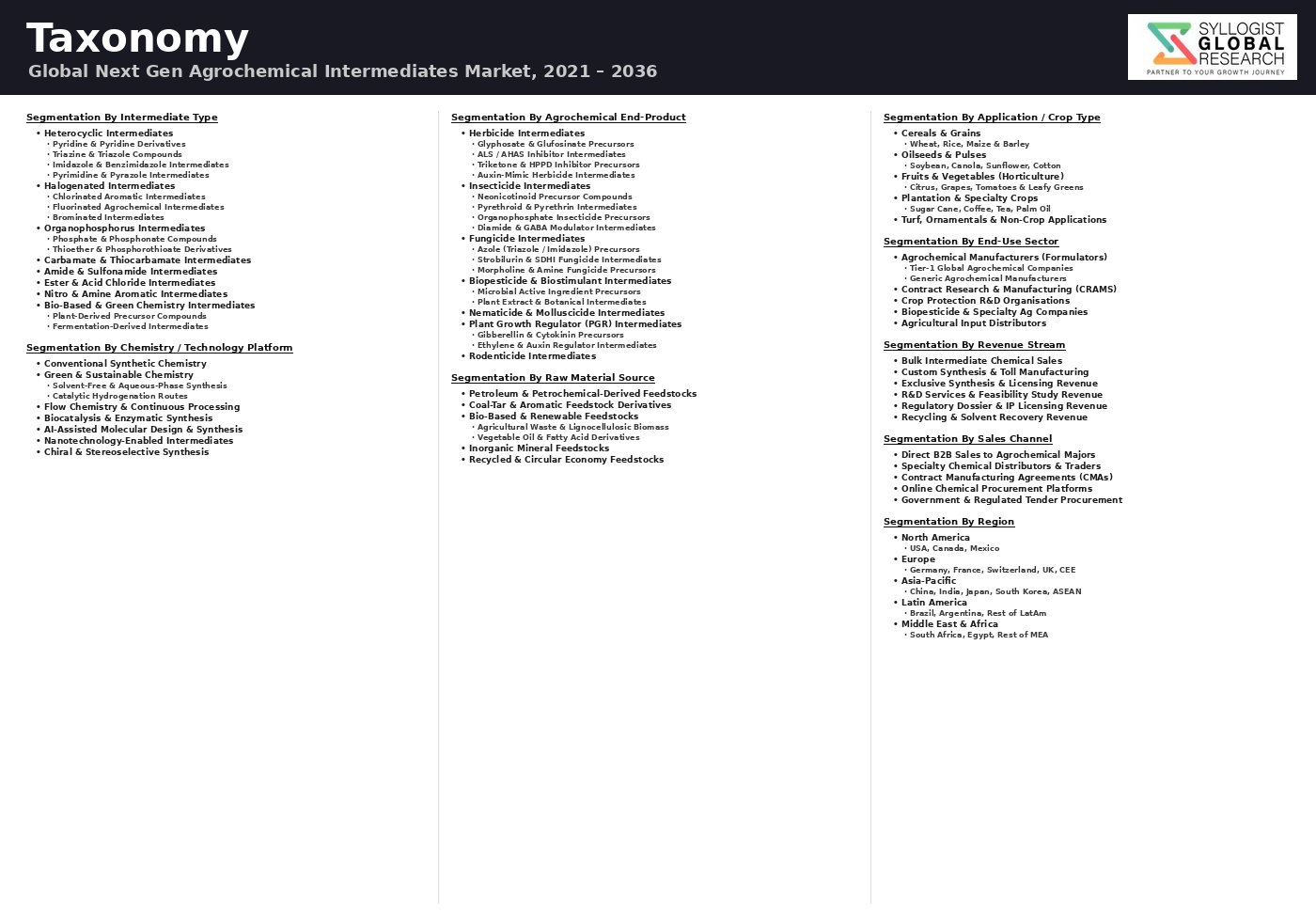
Market Segmentation
- Segmentation By Intermediate Type
- Fluorinated Aromatic and Aliphatic Intermediates
- Heterocyclic Building Blocks (Pyrazole, Triazole, Pyridine, Pyrimidine, Isoxazoline, and Others)
- Halogenated Intermediates (Chlorinated and Brominated)
- Chiral Synthesis Intermediates and Asymmetric Catalysis Products
- Sulfonyl and Sulfoxide Intermediates
- Amine and Isocyanate Intermediates
- Organophosphorus Synthesis Intermediates
- Carboxylate and Ester Intermediate Compounds
- Others
- Segmentation By Crop Protection Category
- Fungicide Intermediates (SDHI, DMI, QoI, and Next-Generation Classes)
- Insecticide Intermediates (Diamide, Mesoionic, Isoxazoline, and Others)
- Herbicide Intermediates (HPPD, PPO, ALS Inhibitor Classes, and Others)
- Nematicide and Soil Treatment Intermediates
- Plant Growth Regulator Intermediates
- Biological and Semi-Synthetic Agrochemical Intermediates
- Others
- Segmentation By Chemistry Class
- Fluorine Chemistry Intermediates
- Heterocyclic Chemistry Intermediates
- Organometallic Catalyst-Mediated Coupling Intermediates
- Asymmetric and Chiral Pool Chemistry Intermediates
- Photochemical and Flow Chemistry-Derived Intermediates
- Fermentation and Biotransformation Intermediates
- Others
- Segmentation By Manufacturing Process
- Batch Fine Chemical Synthesis
- Continuous Flow Chemistry
- Catalytic Hydrogenation
- Halogenation (Chlorination, Fluorination, Bromination)
- Nitration and Diazotization
- Fermentation and Biocatalysis
- Others
- Segmentation By End User
- Innovator Agrochemical Active Ingredient Manufacturers
- Generic Agrochemical Active Ingredient Producers
- Contract Development and Manufacturing Organizations (CDMOs)
- Biological Crop Protection Companies
- Specialty Agrochemical Formulators
- Others
- Segmentation By Sales Channel
- Direct Supply Agreements (Long-Term Offtake Contracts)
- Spot Market and Commodity Trading
- Toll Manufacturing and Custom Synthesis
- Distributors and Chemical Traders
- Others
- Segmentation By Region
- North America
- Europe
- Asia-Pacific
- Middle East and Africa
- Latin America
All market revenues are presented in USD
Historical Year: 2021-2024 | Base Year: 2025 | Estimated Year: 2026 | Forecast Period: 2027-2034
Key Questions this Study Will Answer
- What is the total global market valuation of the Next-Generation Agrochemical Intermediates Market in the base year 2025, and what is the projected market size and compound annual growth rate through 2034, disaggregated by intermediate type including fluorinated intermediates, heterocyclic building blocks, halogenated compounds, chiral synthesis intermediates, and sulfonyl and amine intermediates, and by crop protection category including fungicide, insecticide, herbicide, nematicide, and plant growth regulator intermediate classes, to enable intermediate producers, agrochemical active ingredient manufacturers, contract synthesis organizations, fine chemical investors, and supply chain strategists to identify which intermediate chemistry categories and crop protection application segments will generate the highest absolute revenue growth and the most commercially resilient demand trajectory across the forecast period to 2034?
- How is the accelerating global regulatory phase-out of legacy organophosphate, carbamate, and older synthetic pyrethroid active ingredients across the European Union, United States, and other major agricultural markets expected to drive structural volume substitution toward next-generation active ingredient classes, and what is the estimated aggregate intermediate demand increment arising from this regulatory-driven substitution across fungicide, insecticide, and herbicide active ingredient categories on a chemistry class, application volume, and revenue basis through 2034, and which specific next-generation active ingredient classes entering commercial scale growth are projected to generate the largest incremental intermediate procurement requirements from global agrochemical formulation supply chains?
- What is the current production capacity, synthesis technology platform, geographic footprint, key customer relationships, intellectual property position, and strategic investment priorities of the leading global next-generation agrochemical intermediate producers, including Chinese fine chemical manufacturers, European specialty chemical companies, Indian contract synthesis organizations, and integrated agrochemical companies with captive intermediate production, and how are these market participants responding to the supply chain regionalization initiatives, environmental compliance cost pressures, and intellectual property complexity challenges that are reshaping the competitive structure and geographic distribution of intermediate production capacity globally?
- How are the adoption of continuous flow chemistry manufacturing platforms, artificial intelligence-assisted synthetic route optimization, and green chemistry process engineering principles expected to alter the production economics, yield efficiency, environmental compliance cost profile, and minimum viable production scale requirements for next-generation agrochemical intermediate synthesis over the forecast period, and which intermediate chemistry categories are most likely to experience the most significant production cost reductions and competitive supply chain restructuring as these manufacturing technology transitions mature from pilot-scale demonstration to commercial-scale deployment within the agrochemical intermediate industry?
- What are the supply chain regionalization investment programs, dual-sourcing and strategic stockpiling strategies, and intermediate localization policy support frameworks being implemented by major agrochemical companies and national governments in North America, Europe, and India to reduce systemic supply security vulnerabilities arising from the geographic concentration of next-generation agrochemical intermediate production in China, and what is the projected timeline, capital investment requirement, and competitive market share impact of meaningful intermediate production capacity establishment in geographically diversified manufacturing locations outside current China-dominated production zones through the forecast period to 2034?
- Product Definition
- Research Methodology
- Research Design & Framework
- Overall Research Approach: Descriptive, Exploratory & Quantitative Mixed-Method Design
- Market Definition & Scope Boundaries: What is Included and Excluded
- Segmentation Framework
- Key Research Assumptions & Limitations
- Secondary Research
- Primary Research Design & Execution
- Data Triangulation & Validation
- Market Sizing & Forecasting Methodology
- Competitive Intelligence Methodology
- Quality Assurance & Peer Review
- Definitions, Abbreviations & Data Notes
- Research Design & Framework
- Executive Summary
- Market Snapshot & Headline Numbers
- Key Findings & Research Highlights
- Market Dynamics
- Regional Market Summary
- Competitive Landscape Snapshot
- Technology & Innovation Highlights
- Market Dynamics
- Drivers
- Restraints
- Opportunities
- Challenges
- Porter’s Five Forces Analysis
- PESTLE Analysis
- Market Trends & Developments
- Emerging Trends
- Technological Developments
- Regulatory & Policy Changes
- Supply Chain & Sourcing Trends
- Manufacturing & Process Trends
- Investment & Funding Activity
- Sustainability & ESG Trends
- Risk Assessment Framework
- Raw Material & Feedstock Supply Chain Risk
- Regulatory & Compliance Risk
- Market & Demand Risk
- Technology & Intellectual Property Risk
- Environmental, Health & Safety (EHS) Risk
- Regulatory Framework & Standards
- Pesticide Active Ingredient (AI) Registration & Intermediate Regulatory Interface
- Industrial Chemical Safety Regulations (REACH, TSCA, China CSAR & Equivalents)
- Environmental, Hazardous Substance & Effluent Discharge Standards
- Trade Controls, Export Restrictions & Dual-Use Chemical Regulations
- Quality, GMP, Supply Chain Traceability & Third-Party Certification Standards
- Global Next-Generation Agrochemical Intermediates Market Outlook
- Market Size & Forecast by Value
- Market Size & Forecast by Volume (Metric Tonnes)
- Market Size & Forecast by Intermediate Chemical Class
- Heterocyclic Intermediates (Pyrazole, Triazole, Pyridine, Pyrimidine, Thiazole & Oxazoline)
- Fluorinated & Trifluoromethyl (CF3) Intermediates
- Organophosphorus Intermediates (Phosphonates, Phosphorothioates & Phosphoramidates)
- Sulphur-Containing Intermediates (Sulfonamides, Sulfonates, Sulfoxides & SDHI Precursors)
- Nitrogen-Containing Intermediates (Amines, Nitro Compounds & Cyano Intermediates)
- Halogenated Intermediates (Chlorinated, Brominated & Multi-Halogenated)
- Chiral & Stereospecific Intermediates
- Bio-Based & Green Chemistry Intermediates (Fermentation-Derived & Enzymatic Synthesis)
- Organometallic & Transition Metal Complex Intermediates
- Market Size & Forecast by Application / End-Use Pesticide Category
- Herbicide Intermediates
- Pre-Emergence & Post-Emergence Herbicide Active Ingredient Synthesis
- Selective & Non-Selective Herbicide Intermediates
- Novel Mode-of-Action Herbicide Intermediates (HPPD, VLCFA, Protoporphyrinogen Oxidase Inhibitors)
- Insecticide Intermediates
- Diamide Insecticide Intermediates (Chlorantraniliprole, Cyantraniliprole, Tetraniliprole)
- Pyrethroid Synthesis Intermediates
- Novel Mode-of-Action Insecticide Intermediates (IRAK, Butenolide, Isoxazoline Classes)
- Fungicide Intermediates
- SDHI (Succinate Dehydrogenase Inhibitor) Fungicide Intermediates
- Azole Fungicide Intermediates (Triazole & Imidazole Classes)
- Strobilurin & OASIS Fungicide Intermediates
- Nematicide, Acaricide & Rodenticide Intermediates
- Biopesticide & Biological Active Ingredient Synthesis Intermediates
- Plant Growth Regulator (PGR) & Fertiliser Enhancer Intermediates
- Market Size & Forecast by Synthesis Chemistry Route
- Fluorination Chemistry (Electrochemical Fluorination, Direct Fluorination & Halex Process)
- Cross-Coupling Catalytic Chemistry (Suzuki, Buchwald-Hartwig, Negishi & Pd-Catalysed Routes)
- Continuous Flow & Microreactor Chemistry
- Nitration, Reduction & Diazotisation Chemistry
- Enzymatic & Biocatalytic Synthesis Routes
- Photochemical & Electrochemical Synthesis Routes
- Market Size & Forecast by Molecule Generation
- Next-Generation / Novel Mode-of-Action AI Intermediates (Patent-Protected, Post-2015 Discovery)
- Second-Generation Complex AI Intermediates (Multi-Step, 2000–2015 Era Molecules)
- First-Generation Generic & Off-Patent AI Intermediates
- Isomer-Specific & Chiral AI Intermediates (Enantioselective Synthesis)
- Market Size & Forecast by Manufacturing Stage
- Early-Stage Building Blocks & Primary Intermediates
- Multi-Step Process Intermediates
- Late-Stage Key Intermediates (Penultimate & Advanced Intermediates)
- Custom Synthesis & Exclusive Manufacturing Intermediates
- Market Size & Forecast by End-User
- Multinational Originator Agrochemical Companies (Syngenta, Bayer, BASF, Corteva, FMC, Sumitomo)
- Generic Agrochemical Manufacturers (Post-Patent AI Producers)
- Contract Manufacturing Organisations (CMOs) Serving Agrochemical Sector
- Biological & Biopesticide Active Ingredient Producers
- Market Size & Forecast by Sales Channel
- Direct Supply to Agrochemical AI Producers & Formulators (B2B Long-Term Supply Agreement)
- Specialty Chemical Distributor & Trader Network
- Contract Manufacturing & Toll Processing
- Online B2B Chemical Trading Platforms & Spot Market
- North America Next-Generation Agrochemical Intermediates Market Outlook
- Market Size & Forecast
- By Value
- By Volume (Metric Tonnes)
- By Intermediate Chemical Class
- By Application / End-Use Pesticide Category
- By Synthesis Chemistry Route
- By Molecule Generation
- By Manufacturing Stage
- By End-User
- By Country
- By Sales Channel
- Market Size & Forecast
- Europe Next-Generation Agrochemical Intermediates Market Outlook
- Market Size & Forecast
- By Value
- By Volume (Metric Tonnes)
- By Intermediate Chemical Class
- By Application / End-Use Pesticide Category
- By Synthesis Chemistry Route
- By Molecule Generation
- By Manufacturing Stage
- By End-User
- By Country
- By Sales Channel
- Market Size & Forecast
- Asia-Pacific Next-Generation Agrochemical Intermediates Market Outlook
- Market Size & Forecast
- By Value
- By Volume (Metric Tonnes)
- By Intermediate Chemical Class
- By Application / End-Use Pesticide Category
- By Synthesis Chemistry Route
- By Molecule Generation
- By Manufacturing Stage
- By End-User
- By Country
- By Sales Channel
- Market Size & Forecast
- Latin America Next-Generation Agrochemical Intermediates Market Outlook
- Market Size & Forecast
- By Value
- By Volume (Metric Tonnes)
- By Intermediate Chemical Class
- By Application / End-Use Pesticide Category
- By Synthesis Chemistry Route
- By Molecule Generation
- By Manufacturing Stage
- By End-User
- By Country
- By Sales Channel
- Market Size & Forecast
- Middle East & Africa Next-Generation Agrochemical Intermediates Market Outlook
- Market Size & Forecast
- By Value
- By Volume (Metric Tonnes)
- By Intermediate Chemical Class
- By Application / End-Use Pesticide Category
- By Synthesis Chemistry Route
- By Molecule Generation
- By Manufacturing Stage
- By End-User
- By Country
- By Sales Channel
- Market Size & Forecast
- Country-Wise* Next-Generation Agrochemical Intermediates Market Outlook
- Market Size & Forecast
- By Value
- By Volume (Metric Tonnes)
- By Intermediate Chemical Class
- By Application / End-Use Pesticide Category
- By Synthesis Chemistry Route
- By Molecule Generation
- By Manufacturing Stage
- By End-User
- By Country
- By Sales Channel
- Market Size & Forecast
*Countries Analyzed in the Syllogist Global Research Portfolio: United States, Canada, Mexico, Germany, France, United Kingdom, Italy, Spain, Switzerland, Netherlands, China, Japan, South Korea, India, Thailand, Singapore, Australia, Brazil, Argentina, Israel, Saudi Arabia, UAE, South Africa
- Technology Landscape & Innovation Analysis
- Fluorination Chemistry Technology Deep-Dive
- Electrochemical Fluorination (ECF) Technology: Process Design, Cell Architecture & Scale-Up for Agrochemical-Grade Perfluorinated Intermediates
- Direct Fluorination Using F2 Gas: Reactor Safety Design, Temperature Control & Selectivity Management for Aromatic & Aliphatic Fluorination
- Halex & Balz-Schiemann Processes for Aromatic Fluorination: Nucleophilic & Electrophilic Fluorine Substitution Route Selection for Key Agrochemical Intermediates
- DAST, Morpho-DAST & Deoxofluor Reagent-Based Fluorinating Agent Technology: Bench-to-Pilot Scale Handling, Safety Protocol & Flow Chemistry Integration
- Continuous Flow Fluorination Technology for Safe Commercial Scale-Up: Microreactor & Tube Reactor Design for Hazardous Fluorination Reaction Management
- Heterocyclic Synthesis Technology for Next-Generation Agrochemical Intermediates
- Cross-Coupling & Transition Metal Catalytic Chemistry Technology (Pd, Ni, Cu-Catalysed)
- Continuous Flow & Microreactor Chemistry Technology for Agrochemical Intermediate Production
- Green Chemistry, Enzymatic & Biocatalytic Synthesis Technology
- Chiral Synthesis, Asymmetric Catalysis & Optical Resolution Technology
- Process Analytical Technology (PAT), Quality-by-Design (QbD) & Digital Chemistry Platforms
- Patent & IP Landscape in Next-Generation Agrochemical Intermediates
- Fluorination Chemistry Technology Deep-Dive
- Value Chain & Supply Chain Analysis
- Raw Material, Bulk Chemical & Feedstock Supply Chain (Aromatics, Fluorspar, Phosphorus, Chlorine)
- Synthesis Equipment, Reactor & Process Technology Supply Chain
- Contract Manufacturing Organisation (CMO) & Toll Processing Landscape
- Key Agrochemical Intermediate Manufacturer & Supplier Landscape
- Agrochemical AI Producer & Formulator Integration
- Specialty Chemical Logistics, Regulatory Distribution & Hazardous Goods Compliance
- Waste Treatment, By-Product Valorisation & Circular Economy
- Pricing Analysis
- Fluorinated & Trifluoromethyl Intermediate Pricing Analysis
- Heterocyclic Intermediate Pricing Analysis
- Custom Synthesis & Exclusive Manufacturing Intermediate Pricing Analysis
- Generic Off-Patent Intermediate Pricing Analysis
- CMO & Toll Manufacturing Pricing Analysis
- Total Supply Chain, OEM & Long-Term Supply Agreement Pricing Analysis
- Sustainability & Environmental Analysis
- Lifecycle Assessment (LCA) of Next-Generation Agrochemical Intermediate Synthesis Routes
- Green Chemistry Adoption & Environmental Impact Reduction in Intermediate Production
- Hazardous & Restricted Substance Management in Agrochemical Intermediate Manufacturing
- Manufacturing Sustainability, Effluent Treatment & Zero Liquid Discharge (ZLD)
- Regulatory-Driven Sustainability & Extended Producer Responsibility (EPR)
- Competitive Landscape
- Market Structure & Concentration
- Market Consolidation Level (Fragmented vs. Consolidated by Chemical Class & Geography)
- Top 10 Players Market Share
- HHI (Herfindahl-Hirschman Index) Concentration Analysis
- Competitive Intensity Map by Intermediate Class, Application & Geography
- Player Classification
- Multinational Integrated Agrochemical & Intermediate Producers
- Specialist Agrochemical Intermediate Manufacturers (China-Based)
- Specialist Agrochemical Intermediate Manufacturers (India-Based)
- Specialist Agrochemical Intermediate Manufacturers (Europe & North America-Based)
- Contract Manufacturing Organisations (CMOs) Serving the Agrochemical Sector
- Specialty Fluorochemical & Halogenated Intermediate Producers
- Bio-Based & Green Chemistry Agrochemical Intermediate Specialists
- Generic AI & Off-Patent Intermediate Manufacturers
- Competitive Analysis Frameworks
- Market Share Analysis by Intermediate Class, Application & Region
- Company Profile
- Company Overview & Headquarters
- Agrochemical Intermediate Products & Technology Portfolio
- Key Agrochemical Customer Relationships & Supply Agreements
- Manufacturing Footprint & Production Capacity
- Revenue (Agrochemical Intermediate Segment) & Backlog
- Technology Differentiators & IP
- Key Strategic Partnerships, JVs & M&A Activity
- Recent Developments (Capacity Expansion, Product Launches, Regulatory Approvals)
- SWOT Analysis
- Strategic Focus Areas & Roadmap
- Competitive Positioning Map (Technology Capability vs. Market Penetration)
- Key Company Profiles
- Market Structure & Concentration
- Technology Landscape & Innovation Analysis
- Strategic Output
- Market Opportunity Matrix: By Intermediate Class, Application, Synthesis Route & Geography
- White Space Opportunity Analysis
- Strategic Output
- Strategic Recommendations
- Product Portfolio & Technology Investment Strategy
- Manufacturing & Operational Excellence Strategy
- Geographic Expansion & Localisation Strategy
- Customer & OEM Engagement Strategy
- Partnership, M&A & Ecosystem Strategy
- Sustainability & Circular Economy Strategy
- Risk Mitigation & Future Roadmap
- Strategic Priority Matrix & Roadmap
- Near-term (2025–2028)
- Mid-term (2029–2032)
- Long-term (2033–2037)