Market Definition
The Global Petrochemical Feedstock Transition Market encompasses the technologies, investments, infrastructure developments, policy frameworks, and commercial activities associated with the deliberate and systematic shift in the raw material inputs used by petrochemical producers away from fossil-derived feedstocks including naphtha, ethane, propane, butane, condensate, and gas oil toward alternative feedstocks including bio-based materials, recycled plastic waste, green hydrogen, captured carbon dioxide, and biomethane, with the overarching objective of reducing the lifecycle carbon intensity and fossil resource dependency of petrochemical production while maintaining the essential chemical functionality and derivative product specifications that the downstream plastics, synthetic rubber, fibers, and specialty chemicals industries require. Petrochemical feedstock transition encompasses a spectrum of approaches ranging from incremental feedstock diversification, in which bio-naphtha, bio-LPG, or pyrolysis oil from plastic waste are co-processed alongside conventional fossil feedstocks in existing steam crackers and refinery fluid catalytic cracking units using existing equipment with minimal process modifications, through fundamental process technology change where green hydrogen replaces fossil fuel-derived syngas in methanol and ammonia production and electrified steam crackers use renewable electricity to supply cracking reaction energy instead of natural gas combustion, to wholly novel production pathways including the synthesis of chemical building blocks from carbon dioxide and green hydrogen through reverse water-gas shift and Fischer-Tropsch chemistry, fermentation of biomass-derived sugars to chemical intermediates, and the electrochemical reduction of carbon dioxide to ethylene, ethanol, and other platform chemicals that represent genuinely carbon-negative or carbon-neutral production routes under full lifecycle accounting. The market additionally encompasses the certification, chain of custody, mass balance accounting, and carbon footprint disclosure infrastructure that enables producers to commercialize transition feedstock-derived chemicals and polymers with credible sustainability claims, and the sustainability-linked financial instruments including green bonds, sustainability-linked loans, and carbon market credits that provide the financial architecture for transition feedstock investment programs. Key participants include petrochemical producers, bio-based feedstock suppliers, plastic waste collection and processing companies, green hydrogen producers, technology licensors, certification bodies, and the brand owner and consumer goods customers whose sustainability procurement requirements drive commercial demand for transition feedstock-derived products.
Market Insights
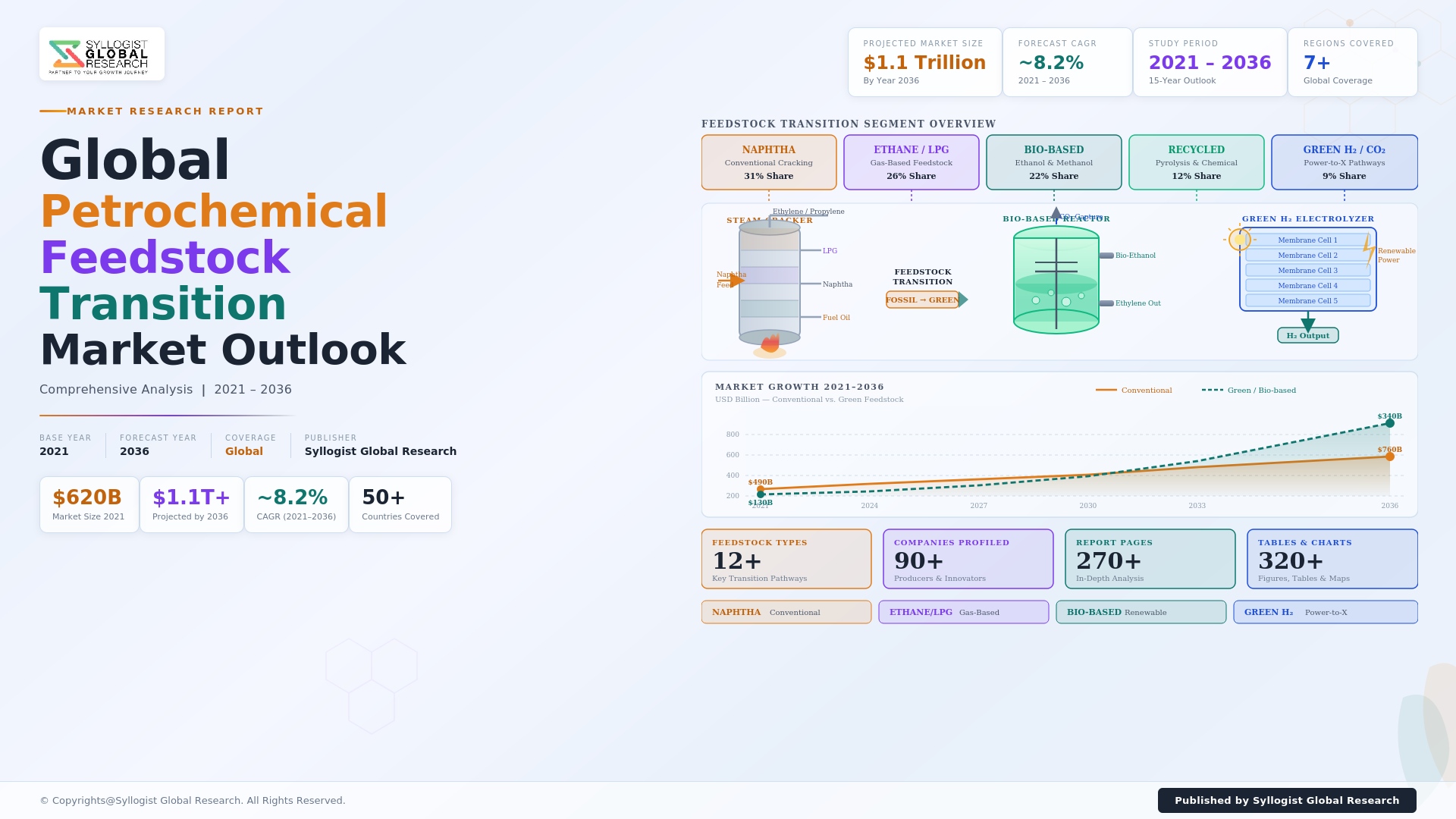
The global petrochemical feedstock transition market was valued at approximately USD 16.8 billion in 2025 and is projected to reach USD 86.4 billion by 2034, advancing at a compound annual growth rate of 19.8% over the forecast period from 2027 to 2034, representing one of the most rapid structural investment transitions in the history of the global chemical industry as the convergence of regulatory plastic recycled content mandates, carbon pricing expansion, consumer brand owner sustainability commitments, and the rapidly declining cost of alternative feedstock production technologies creates a commercially compelling case for systematic decarbonization of petrochemical production that was absent from the industry’s investment calculus as recently as five years ago. The total annual production volume of chemicals and polymers from transition feedstocks reached approximately 42 million metric tons across all sources including bio-based, chemically recycled, and low-carbon production routes in 2025, representing approximately 4.8% of total global petrochemical production volume and establishing a commercial base that is small but growing at rates that suggest transition feedstocks could supply 18% to 25% of global petrochemical production volume by 2034 as technology scale-up, regulatory mandates, and consumer demand premiums collectively accelerate adoption across major production regions. The chemical recycling segment, which converts post-consumer plastic waste into pyrolysis oil, gasification-derived syngas, and solvent-purified recycled polymer through a range of thermal, catalytic, and chemical dissolution technologies, represented the largest and fastest-growing component of petrochemical feedstock transition investment at approximately USD 7.2 billion in 2025, driven by the European Union’s Packaging and Packaging Waste Regulation recycled content mandates and brand owner commitments to incorporate post-consumer recycled content into polymer-intensive packaging products by defined timelines.
The bio-based feedstock transition segment, encompassing the production and petrochemical plant integration of bio-naphtha from hydroprocessed vegetable oils and fats, bio-LPG as a co-product of hydrotreated vegetable oil refining, sugarcane bioethanol dehydration to bio-ethylene, fermentation-derived bio-based intermediates including bio-butanol, bio-isobutylene, and bioacids from agricultural biomass, and lignocellulosic biomass-to-chemicals conversion through gasification and biochemical pathways, is advancing from commercial demonstration toward commercial scale across multiple platform chemical production routes, with bio-naphtha emerging as the most immediately deployable bio-based feedstock due to its chemical similarity to fossil naphtha and compatibility with existing steam cracker equipment without process modification. Bio-naphtha supply reached approximately 3.8 million metric tons globally in 2025, derived predominantly from hydroprocessed vegetable oil refining co-product streams and waste and residue fat feedstocks including used cooking oil, animal fats, and municipal organic waste whose sustainable feedstock certification under the European Union’s Renewable Energy Directive provides the sustainability credentials required for bio-based chemical production under European bio-based product certification frameworks. The International Sustainability and Carbon Certification, Roundtable on Sustainable Biomaterials, and ISCC PLUS certification systems provide the chain of custody and sustainability verification infrastructure that enables petrochemical producers to claim certified bio-based content in their polymer products using mass balance attribution approaches that allocate bio-based feedstock sustainability attributes to specific product volumes without requiring physical segregation of bio-based and fossil-based material flows through integrated production facilities, enabling existing steam cracker operators to generate certified bio-based polymer volumes without dedicated bio-based plant infrastructure at the cost of certification system participation and rigorous mass balance accounting. The bio-naphtha market is expected to grow to approximately 12 million metric tons by 2034 as new hydroprocessed vegetable oil refining capacity comes online specifically targeting sustainable aviation fuel and bio-chemical co-product markets.
The chemical recycling technology sector, which is the most commercially active and heavily invested component of the petrochemical feedstock transition landscape, is advancing through multiple parallel technology approaches whose distinct feedstock quality tolerance, output product portfolio, scale-up characteristics, and carbon lifecycle profiles create differentiated commercial positioning across the complex landscape of post-consumer plastic waste streams and downstream petrochemical application requirements. Pyrolysis technology, which thermally decomposes mixed plastic waste streams at temperatures of 400 to 600 degrees Celsius in the absence of oxygen to produce a hydrocarbon liquid oil that is refined and processed as steam cracker feedstock or as refinery co-feed, has achieved the most widespread commercial deployment with operating facilities from companies investing in the space in Germany, the Netherlands, the United Kingdom, South Korea, and the United States achieving pyrolysis oil production volumes of 10,000 to 50,000 metric tons per year per facility, with the pyrolysis oil certified as chemically recycled content under mass balance accounting enabling petrochemical producers to issue certified recycled content certificates to brand owner customers seeking to substantiate recycled polymer claims. Advanced chemical recycling approaches including hydrothermal liquefaction for wet mixed plastic waste, solvent-based purification for polypropylene and polyethylene recovery without depolymerization, enzymatic and chemical depolymerization of polyethylene terephthalate and polylactic acid, and glycolysis-based polyurethane recycling collectively represent a technical portfolio whose distinct capabilities address the plastic waste streams and downstream product quality requirements that pyrolysis cannot efficiently serve, providing complementary recycling pathways whose combined deployment could theoretically process the entire global mixed plastic waste stream of approximately 350 million metric tons per year into chemically recycled petrochemical feedstock if deployed at sufficient scale.
The green hydrogen and carbon dioxide utilization pathway for petrochemical feedstock production represents the most transformative and longest-timeline component of the petrochemical feedstock transition, as the synthesis of methanol, ammonia, methane, and liquid hydrocarbon fuels and chemicals from green hydrogen and captured carbon dioxide provides a genuinely fossil-free production route for petrochemical building blocks whose carbon footprint approaches or achieves net zero under full lifecycle accounting when powered by renewable electricity and carbon dioxide sourced from direct air capture or biogenic point sources. Green methanol produced from green hydrogen and carbon dioxide has emerged as the first commercially viable large-scale synthetic chemical feedstock, with Denmark’s European Energy, Netherlands’s OCI, and multiple Middle Eastern and Chinese projects producing green methanol at commercial scale for marine fuel and subsequently as chemical feedstock for methanol-to-olefins and downstream polymer production, with green methanol production cost declining from approximately USD 1,100 to USD 1,400 per metric ton in 2022 to approximately USD 800 to USD 1,100 per metric ton in 2025 and projected toward USD 450 to USD 650 per metric ton by the early 2030s as electrolyzer costs and renewable electricity prices decline simultaneously, approaching commercial competitiveness with grey methanol in carbon-priced markets. The Dow-Carbon Clean partnership for electrified steam cracking, the BASF ChemCycling program integrating pyrolysis oil into Verbund production, the LyondellBasell MoReTec chemical recycling technology, and the Sabic Project ACT certified circular polymer initiative collectively illustrate the breadth and scale of investment by major petrochemical companies in transitioning their feedstock portfolios and production processes toward lower-carbon alternatives, with aggregate announced transition feedstock investment by the twenty largest global petrochemical producers exceeding USD 42 billion through 2030.
Key Drivers
Mandatory Recycled Content Requirements, Extended Producer Responsibility Legislation, and Single-Use Plastic Restrictions Creating Regulatory Pull for Transition Feedstock-Derived Polymers
The legislative framework being built across the European Union, United Kingdom, United States, China, Japan, South Korea, and multiple emerging market economies to mandate minimum recycled content in plastic packaging, restrict single-use plastic formats, and impose financial responsibility on producers for end-of-life collection and recycling of plastic products is creating a legally enforceable and commercially quantifiable demand pull for transition feedstock-derived polymers that is the most structurally reliable driver of petrochemical feedstock transition investment, as regulatory compliance obligations cannot be deferred or avoided in the manner that voluntary sustainability commitments can be softened under commercial pressure. The European Union Packaging and Packaging Waste Regulation mandates minimum recycled content of 10% for contact-sensitive flexible plastic packaging, 35% for PET beverage bottles, 30% for PET trays, and 25% for other rigid plastic packaging by 2030, rising further to 55% to 65% for most categories by 2040, creating a cumulative demand for certified recycled polymer in Europe of approximately 8.4 million metric tons per year by 2030 and approximately 18.6 million metric tons per year by 2040 that significantly exceeds current mechanical recycling supply capacity, making chemical recycling-derived certified recycled content a structurally necessary supply source for European packaging converters and brand owners seeking regulatory compliance. The United Kingdom’s Plastic Packaging Tax at GBP 210.82 per metric ton on plastic packaging components containing less than 30% recycled content by weight, effective from April 2022 and progressively increasing, applies a direct financial cost of approximately USD 265 per metric ton to virgin polymer use in UK packaging that improves the economic competitiveness of recycled content polymer by an equivalent amount and represents one of the first fiscal instruments specifically designed to accelerate chemical and mechanical recycling feedstock adoption.
Carbon Pricing Escalation, EU Emissions Trading System Full-Cost Carbon Allocation, and Corporate Net-Zero Chemical Procurement Commitments Improving the Financial Case for Low-Carbon Feedstocks
The progressive strengthening of carbon pricing mechanisms and the expansion of corporate net-zero procurement commitments across the chemical industry’s customer base is fundamentally altering the financial calculus for petrochemical feedstock transition by increasing the effective cost of fossil-based production through carbon price liability while simultaneously creating premium revenue opportunities for certified low-carbon chemicals and polymers sold to corporate buyers seeking to reduce their Scope 3 supply chain emissions through chemical feedstock decarbonization strategies. The European Union Emissions Trading System Phase IV trajectory, combined with the phase-out of free carbon allowance allocation for the chemical sector with full auctioning phased in from 2026 to 2034, will add approximately USD 70 to USD 120 per metric ton of ethylene production cost to European cracker operations at projected 2030 ETS carbon prices of EUR 90 to EUR 130, materially narrowing the production cost premium of bio-based and chemically recycled feedstock-derived ethylene relative to conventional fossil feedstock production and potentially inverting the cost differential for low-carbon ethylene in carbon-priced European market context by the early 2030s as renewable electricity costs, electrolyzer costs, and bio-feedstock availability improve simultaneously. Brand owner commitments to Scope 3 chemical supply chain decarbonization are creating direct commercial demand signals for transition feedstock chemicals, with Unilever’s commitment to 100% reusable, recyclable, or compostable plastic packaging by 2025, Procter and Gamble’s target for 50% recycled plastic across product portfolios, and Nestlé’s commitment to making 95% of its packaging recyclable or reusable creating direct procurement specifications for certified recycled content and bio-based polymer supply that petrochemical producers can satisfy only through transition feedstock investment programs, generating the offtake certainty required to justify project financing.
Declining Green Hydrogen and Renewable Electricity Costs, Electrolyzer Scale-Up, and Power-to-Chemicals Technology Maturation Creating Commercial Pathways for Fossil-Free Chemical Production
The dramatic and continuing reduction in green hydrogen production costs driven by electrolyzer capital cost decline, renewable electricity price reduction, and manufacturing scale-up is progressively creating a commercial pathway for fossil-free chemical production through power-to-chemicals routes that will fundamentally transform the petrochemical feedstock landscape by enabling the synthesis of methanol, ammonia, synthetic natural gas, and ultimately olefins and aromatics from renewable electricity, water, and atmospheric or point-source carbon dioxide without any fossil feedstock input. Electrolyzer capital costs declined from approximately USD 1,400 per kilowatt in 2020 to approximately USD 720 per kilowatt in 2025 and are projected toward approximately USD 280 per kilowatt by 2032 as alkaline and PEM electrolyzer manufacturing scales under Inflation Reduction Act production tax credits in the United States, European Hydrogen Bank subsidy programs, and Chinese electrolyzer manufacturer volume expansion, enabling green hydrogen production cost decline from approximately USD 5.0 per kilogram in 2023 toward USD 1.5 to USD 2.5 per kilogram in optimal renewable electricity resource locations by the early 2030s, a cost trajectory that creates commercial competitiveness with grey hydrogen from natural gas steam methane reforming in carbon-priced markets at projected carbon costs above USD 80 per metric ton of carbon dioxide. Green methanol production cost declining toward USD 450 to USD 650 per metric ton by the early 2030s approaches competitiveness with grey methanol at approximately USD 280 to USD 380 per metric ton plus carbon cost, with the differential closeable through a combination of carbon pricing, green premium market access, and government subsidy support that collectively create investment-viable economics for early commercial green methanol and power-to-chemicals plants whose establishment builds the cost reduction learning curve that drives subsequent commercial competitiveness without subsidy support.
Key Challenges
Transition Feedstock Cost Premium Over Fossil Alternatives, Scale Limitations of Sustainable Biomass Supply, and Chemical Recycling Output Quality Constraints Restricting Commercial Penetration
The petrochemical feedstock transition faces a fundamental economic challenge in that every commercially available alternative feedstock including bio-naphtha, pyrolysis oil, bio-LPG, bioethanol, and green hydrogen-derived methanol carries a production cost premium of 50% to 300% over the conventional fossil feedstock it replaces at current market prices and production scale, creating a persistent green premium that can only be commercially recovered through regulatory compliance value, certified sustainability attribute pricing premiums from brand owner customers, or carbon price differential between fossil and low-carbon production routes whose current levels in most markets remain insufficient to fully bridge the transition feedstock cost gap without government subsidy supplementation. Sustainable biomass feedstock availability represents a structural ceiling on the scale of bio-based petrochemical feedstock transition, with responsible bio-based feedstock supply from waste and residue sources including used cooking oil, animal fats, and agricultural residues estimated at approximately 200 to 400 million metric tons of dry biomass equivalent globally in 2025, a supply base that is insufficient to displace more than a small fraction of the approximately 2 billion metric tons of fossil feedstocks consumed by the global petrochemical industry annually and is subject to competition from the biofuel, bio-aviation fuel, and biomethane sectors whose demand is simultaneously escalating under regulatory incentive programs. Pyrolysis oil quality variability, including chlorine, silicon, oxygen, and nitrogen contamination from mixed plastic waste inputs that can reach concentrations of 500 to 2,000 parts per million in poorly sorted waste streams compared to the below 1 to 5 parts per million specifications of petroleum naphtha, creates cracker equipment contamination, catalyst poisoning, and product quality risk that requires either expensive upstream waste sorting and pre-treatment or development of tolerant cracker pretreatment units whose capital cost adds to the economic burden of chemical recycling integration.
Mass Balance Accounting Complexity, Chain of Custody Integrity Uncertainty, and Certification System Fragmentation Undermining Consumer and Regulatory Trust in Transition Feedstock Claims
The commercial value of transition feedstock-derived polymers is fundamentally dependent on the credibility of the sustainability claims that certified bio-based, certified recycled, or certified low-carbon content designations enable, and the mass balance chain of custody accounting systems that attribute the sustainability characteristics of bio-based or recycled feedstock inputs to specific polymer output volumes through shared production facilities where physical segregation of different feedstock streams is impractical are inherently vulnerable to integrity challenges that can undermine the market premium and brand value of transition feedstock products if certification system rigor, auditing frequency, and verification independence are insufficient to prevent misrepresentation or systematic misapplication of mass balance attribution rules. The proliferation of competing certification schemes for bio-based content, recycled content, and carbon footprint claims including ISCC PLUS, REDcert, TUV SUD, Intertek, SGS, and multiple company-proprietary schemes creates a fragmented verification landscape in which different certification standards apply different mass balance allocation rules, different audit frequencies, different minimum recycled or bio-based content thresholds, and different scope definitions for eligible feedstock sources, generating buyer confusion and regulatory compliance uncertainty that complicates procurement decision-making for brand owners seeking to substantiate packaging sustainability claims under the European Union Green Claims Directive’s forthcoming mandatory scientific substantiation requirements. The European Union’s forthcoming regulatory framework for substantiating green marketing claims, currently in legislative development under the Green Claims Directive that will require independent verification of environmental claims against specified scientific methodologies, is expected to impose stricter documentation and evidence requirements for bio-based and recycled content claims that will increase certification cost and potentially disqualify marketing claims currently used by brand owners that rely on mass balance attribution without physical traceability, creating a compliance risk for petrochemical producers whose transition feedstock certification systems are not sufficiently rigorous to meet forthcoming regulatory standards.
Infrastructure Investment Requirements for Plastic Waste Collection, Sorting, and Chemical Recycling Processing That Far Exceed Current Capacity and Funding Availability
The realization of petrochemical feedstock transition through chemical recycling at the scale required to meet European Union Packaging Regulation mandatory recycled content requirements and equivalent regulatory mandates globally requires a fundamental transformation of plastic waste collection, sorting, and processing infrastructure whose current capacity is wholly insufficient to supply the certified chemically recycled feedstock volumes that compliance-driven demand will require, with the European Chemical Industry Council estimating that approximately EUR 50 billion of investment in chemical recycling capacity, plastic waste collection infrastructure enhancement, and advanced sorting technology deployment is required in Europe alone through 2030 to meet the regulatory recycled content demand. Chemical recycling facilities at commercially viable scale require capital investments of approximately USD 80 million to USD 350 million per facility for pyrolysis-based operations capable of processing 50,000 to 150,000 metric tons of plastic waste input annually, with development and permitting timelines of three to five years from investment decision to first production creating a structural lag between the regulatory demand for recycled content and the available certified supply that will create compliance shortfalls for brand owners and packaging converters through the late 2020s regardless of investment pace acceleration from current levels. The plastic waste collection and sorting infrastructure deficit is particularly acute in developing economies where the formal waste management systems necessary to aggregate, sort, and consistently supply clean plastic waste to chemical recycling facilities are underdeveloped, creating a geographic concentration of available feedstock supply in Western Europe, Japan, South Korea, and the United States that limits the geographic distribution of chemical recycling capacity development and restricts the scale of global certified recycled content supply relative to the growing worldwide demand from brand owners whose plastic packaging consumption spans the full geographic extent of their consumer markets globally.
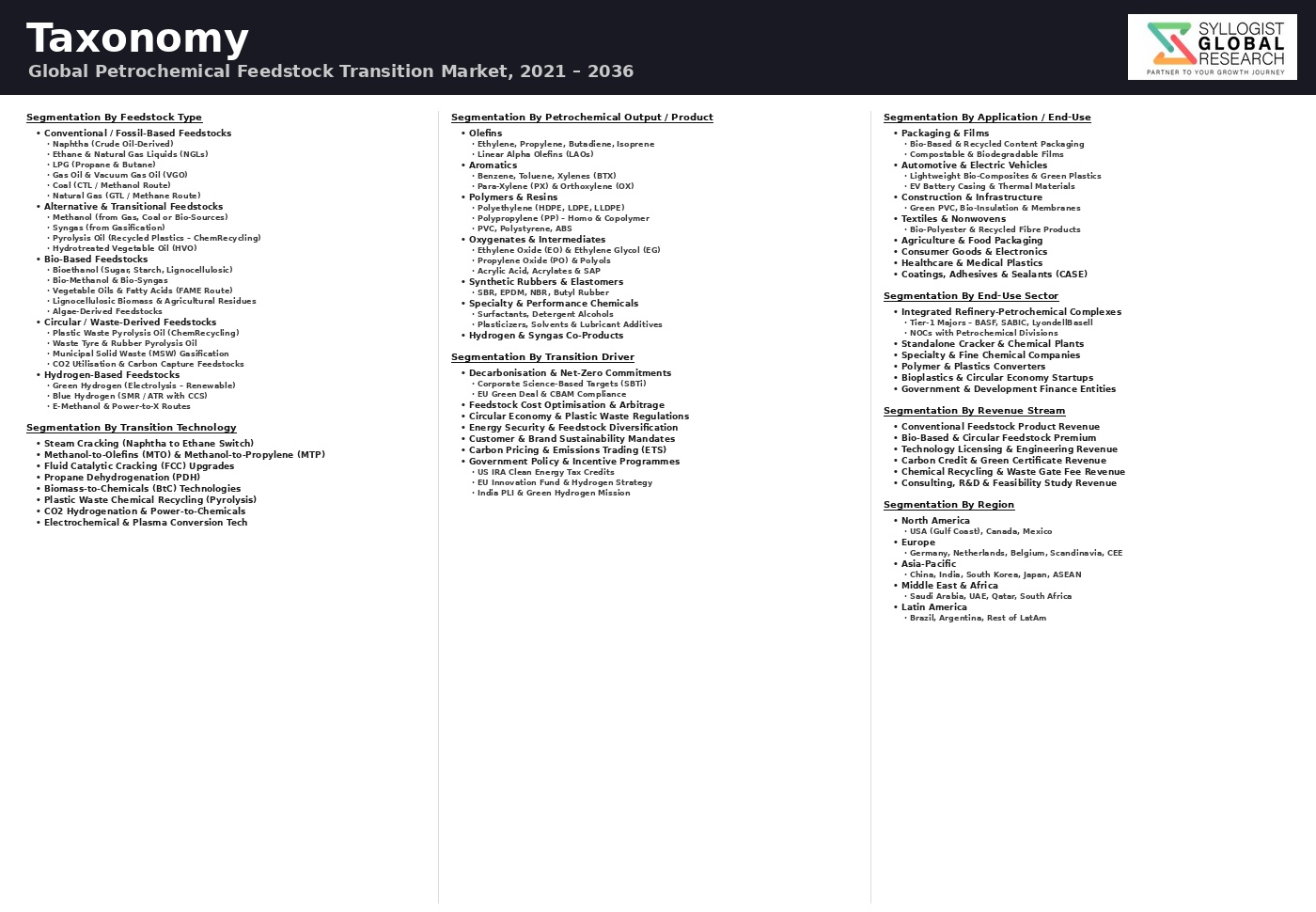
Market Segmentation
- Segmentation By Transition Feedstock Type
- Plastic Waste-Derived Pyrolysis Oil
- Bio-Naphtha and Bio-LPG from Hydrotreated Vegetable Oil Refining
- Bioethanol from Agricultural Biomass (Sugarcane and Corn)
- Green Hydrogen from Electrolysis
- Green Methanol from Green Hydrogen and Carbon Dioxide
- Bio-Methanol from Biomass Gasification and Fermentation
- Biomass Syngas from Gasification
- Solvent-Purified Recycled Polymer from Chemical Dissolution
- Depolymerization Products (PET, PU, and Nylon Recyclate)
- Carbon Dioxide Utilization (CO2-to-Chemicals)
- Others
- Segmentation By Transition Technology
- Pyrolysis (Thermal and Catalytic)
- Hydrothermal Liquefaction
- Gasification and Syngas Chemistry
- Fermentation and Biochemical Conversion
- Green Hydrogen Electrolysis (Alkaline, PEM, and SOEC)
- Electrified Steam Cracking
- Carbon Capture and Utilization
- Solvent-Based Purification and Dissolution
- Enzymatic and Chemical Depolymerization
- Others
- Segmentation By Target Chemical Platform
- Ethylene and Polyethylene
- Propylene and Polypropylene
- Methanol and Methanol-Derived Chemicals
- Ammonia and Nitrogen Chemicals
- BTX Aromatics (Benzene, Toluene, and Xylene)
- Butadiene and Synthetic Rubber
- Specialty Monomers and Polymer Intermediates
- Others
- Segmentation By End-Use Sector
- Packaging (Flexible and Rigid Plastic Packaging)
- Automotive and Transportation Materials
- Construction and Building Materials
- Consumer Goods and Household Products
- Textiles and Apparel
- Healthcare and Medical Devices
- Agriculture and Horticulture
- Electronics and Electrical
- Others
- Segmentation By Sustainability Certification
- ISCC PLUS Mass Balance Certified
- REDcert-EU Certified
- RSB (Roundtable on Sustainable Biomaterials) Certified
- TUV SUD and Intertek Certified Recycled Content
- EU Taxonomy-Aligned Sustainable Chemistry
- Company-Proprietary Certification Schemes
- Non-Certified Transition Feedstock Production
- Segmentation By Region
- North America
- Europe
- Asia-Pacific
- Middle East and Africa
- Latin America
All market revenues are presented in USD
Historical Year: 2021-2024 | Base Year: 2025 | Estimated Year: 2026 | Forecast Period: 2027-2034
Key Questions this Study Will Answer
- What is the total global market valuation of the Petrochemical Feedstock Transition Market in the base year 2025, and what is the projected market size and compound annual growth rate through 2034, disaggregated by transition feedstock type including plastic waste pyrolysis oil, bio-naphtha and bio-LPG, bioethanol, green hydrogen, green methanol, solvent-purified recycled polymer, and depolymerization recyclate, by transition technology including pyrolysis, hydrothermal liquefaction, gasification, fermentation, electrolysis, and electrified cracking, and by target chemical platform including ethylene and polyethylene, propylene and polypropylene, methanol, ammonia, and aromatics, to enable petrochemical producers, technology developers, sustainability-linked investors, brand owner customers, certification bodies, and government policy designers to quantify the commercial scale and growth trajectory of each transition pathway across the forecast period to 2034?
- What is the certified recycled content polymer supply available from chemical recycling operations in Europe, the United States, and Asia-Pacific in 2025 and projected through 2034, disaggregated by technology including pyrolysis, hydrothermal liquefaction, solvent purification, and depolymerization, and how does this supply projection compare to the demand for certified recycled content required for brand owners and packaging converters to meet the European Union Packaging and Packaging Waste Regulation mandatory recycled content thresholds of 10% to 35% by 2030 and 55% to 65% by 2040, and what is the estimated supply shortfall by material category and timeline that will require acceleration of chemical recycling investment, mechanical recycling expansion, or regulatory compliance pathway adjustment?
- What are the current production cost structures, carbon lifecycle assessment outcomes, scale-up trajectories, certification framework availability, and commercial offtake dynamics for each of the major bio-based feedstock pathways including bio-naphtha from hydroprocessed vegetable oil co-products, bioethanol-derived bio-ethylene from sugarcane and corn, biomass gasification-derived syngas-to-chemicals, fermentation-derived bio-intermediates, and lignocellulosic biomass conversion technologies, and which bio-based feedstock pathways offer the most commercially viable near-term certified bio-based polymer production at cost premiums that are recoverable through market pricing premiums from sustainability-committed brand owner customers in European and North American premium consumer goods markets?
- How are the European Union Emissions Trading System full-cost carbon allocation for the chemical sector phased in from 2026 to 2034, the Carbon Border Adjustment Mechanism potential scope expansion to organic chemicals and polymers, the United Kingdom Plastic Packaging Tax, the United States Inflation Reduction Act production tax credits for clean hydrogen and clean manufacturing, and national carbon pricing frameworks in South Korea, Singapore, and China collectively reshaping the production cost competitiveness of transition feedstock-derived chemicals versus conventional fossil feedstock production in each major petrochemical production region, and at what projected carbon price levels in each jurisdiction do bio-based, chemically recycled, and green hydrogen-derived petrochemicals achieve production cost parity with conventional fossil-based alternatives?
- What is the aggregate announced transition feedstock investment program value, technology selection rationale, target certified product volume, offtake agreement structure, sustainability certification approach, and timeline to commercial production for the twenty largest global petrochemical producers including BASF, Dow, LyondellBasell, Sabic, Ineos, Evonik, Covestro, Braskem, Formosa Plastics, and Reliance Industries, and how are their transition investment strategies differentiating between proprietary technology development, technology licensing from chemical recycling specialists, joint venture partnership with plastic waste processors and bio-feedstock suppliers, and sustainability-linked financial instrument issuance as complementary mechanisms for achieving stated transition feedstock procurement targets within their published net-zero and circular economy roadmap commitments?
- Product Definition
- Research Methodology
- Research Design & Framework
- Overall Research Approach: Descriptive, Exploratory & Quantitative Mixed-Method Design
- Market Definition & Scope Boundaries: What is Included and Excluded
- Segmentation Framework
- Key Research Assumptions & Limitations
- Secondary Research
- Primary Research Design & Execution
- Data Triangulation & Validation
- Market Sizing & Forecasting Methodology
- Competitive Intelligence Methodology
- Quality Assurance & Peer Review
- Definitions, Abbreviations & Data Notes
- Research Design & Framework
- Executive Summary
- Market Snapshot & Headline Numbers
- Key Findings & Research Highlights
- Market Dynamics
- Regional Market Summary
- Competitive Landscape Snapshot
- Technology & Innovation Highlights
- Market Dynamics
- Drivers
- Restraints
- Opportunities
- Challenges
- Porter’s Five Forces Analysis
- PESTLE Analysis
- Market Trends & Developments
- Emerging Trends
- Technological Developments
- Regulatory & Policy Changes
- Supply Chain & Sourcing Trends
- Manufacturing & Process Trends
- Investment & Funding Activity
- Sustainability & ESG Trends
- Risk Assessment Framework
- Alternative Feedstock Cost Premium, Price Volatility & Commercial Parity Risk vs. Fossil Naphtha & Ethane Baseline
- Feedstock Availability, Land Use Conflict & Biomass Supply Scalability Risk for Bio-Based Transition Route
- Technology Scale-Up, Process Yield & Commercial Readiness Risk for Emerging Circular & Power-to-X Feedstock Routes
- Consumer Willingness-to-Pay, Brand Commitment Sustainability & Green Premium Acceptance Risk
- Regulatory Uncertainty, Carbon Price Trajectory, Plastic Regulation Scope Change & Mass Balance Certification Credibility Risk
- Regulatory Framework & Standards
- EU Plastics & Circular Economy Regulation: Single-Use Plastics Directive, Packaging & Packaging Waste Regulation (PPWR) Recycled Content Mandate, Critical Raw Material Act Chemical Circularity Provision & Green Claims Directive
- Renewable Feedstock Policy: EU Renewable Energy Directive (RED III) Biomass Sustainability Criteria, ILUC Risk Classification, Renewable Carbon Index (RCI) Framework & US Renewable Fuel Standard (RFS) for Bio-Based Chemical Feedstock
- Chemical Recycling & Mass Balance Certification Standards: ISCC PLUS, REDcert2, RSB & TUV SUD Mass Balance Chain-of-Custody Certification for Attributed Circular & Bio-Based Feedstock Content Claims
- Carbon Pricing, EU ETS & CBAM Impact: Fossil Feedstock Carbon Cost Pass-Through, EU Carbon Border Adjustment Mechanism for Imported Petrochemical Products & Sectoral Decarbonisation Policy for Chemical Industry
- Corporate Sustainability Commitments & Extended Producer Responsibility (EPR): Science-Based Targets for Chemical Sector, EU Taxonomy for Sustainable Chemicals, REACH Reform & EPR Plastic Packaging Producer Fee Incentive for Circular Feedstock Adoption
- Global Petrochemical Feedstock Transition Market Outlook
- Market Size & Forecast by Value
- Market Size & Forecast by Volume (Million Tonnes of Alternative Feedstock Consumed)
- Market Size & Forecast by Feedstock Transition Route
- Bio-Based Feedstock Route (Bio-Naphtha, Bioethanol, Bio-Methanol, Vegetable Oil & Lignocellulosic Biomass)
- Chemical Recycling & Circular Feedstock Route (Pyrolysis Oil, Solvolysis Product & Depolymerisation)
- Mechanical Recycling-Derived Polymer & Post-Consumer Recycled (PCR) Content Integration
- Green Hydrogen & Power-to-X Route (E-Methanol, E-Naphtha & E-Syngas via Green H2 + CO2)
- CO2 Utilisation (CCU) Route (Captured CO2 as Chemical Feedstock via Catalytic & Electrochemical Conversion)
- Biomass & Waste Gasification Syngas for Chemical Feedstock Production
- Fermentation & Industrial Biotechnology Route (Ethanol, Lactic Acid, Succinic Acid & PHA Bioplastic)
- Natural Gas & LNG as Low-Carbon Bridge Transition Feedstock
- Market Size & Forecast by Transition Technology
- Bio-Naphtha Production: HVO Co-Processing, Dedicated Hydrotreating & Bio-Refinery Integration
- Bioethanol-to-Ethylene (BtE) Catalytic Dehydration & Bio-Based Olefin Production
- Pyrolysis & Thermal Depolymerisation of Mixed Plastic Waste to Pyrolysis Oil
- Advanced Chemical Recycling: Solvolysis (Glycolysis, Methanolysis & Hydrolysis) & Dissolution
- Green Methanol Synthesis & Fischer-Tropsch Power-to-Liquids for Synthetic Chemical Feedstock
- CO2 Electrochemical Reduction & Catalytic Hydrogenation to Chemical Intermediates
- Fermentation, Metabolic Engineering & Industrial Biotechnology Platform for Bio-Chemical Production
- Market Size & Forecast by Output Chemical Product
- Ethylene & Polyethylene (Bio-PE, Recycled-PE & E-Ethylene)
- Propylene & Polypropylene (Bio-PP & Recycled-PP)
- BTX Aromatics: Bio & Recycled Benzene, Toluene & Paraxylene for PTA & PET
- Methanol & Methanol Derivatives from Renewable & Circular Route
- Bioplastic Monomers: Lactic Acid (PLA), Succinic Acid, PHAs, Bio-PET & Bio-PA
- Specialty Chemicals, Bio-Intermediates & High-Value Bio-Based Molecules
- Market Size & Forecast by Feedstock Origin & Generation
- First-Generation Bio-Based (Food & Feed Crop: Corn, Sugarcane, Vegetable Oil)
- Second-Generation Bio-Based (Non-Food: Lignocellulosic Biomass, Agricultural Residue & Waste Wood)
- Waste & Post-Consumer Recycled (PCR Plastic, Municipal Solid Waste & Industrial Off-Gas)
- Electrolytic & Power-to-X (Green H2 + CO2 via Renewable Electricity)
- Novel & Emerging Feedstock (Algae, Syngas Fermentation & Direct CO2 Electrochemical Conversion)
- Market Size & Forecast by Petrochemical Sector
- Plastics & Polymers (Packaging, Automotive, Construction & Consumer Goods)
- Synthetic Fibres & Textiles (Polyester, Nylon & Spandex)
- Surfactants, Detergents & Personal Care
- Coatings, Adhesives & Sealants
- Specialty & Performance Chemicals
- Fertilisers & Agricultural Chemicals (Bio-Based & Circular Nitrogen Input)
- Market Size & Forecast by End-User
- Integrated Petrochemical Company & Chemical Major
- Polymer & Plastic Manufacturer Transitioning to Circular & Bio Feedstock
- Consumer Goods, FMCG & Packaging Brand with Bio-Based & Recycled Content Commitment
- Automotive OEM & Mobility Sector with Bio & Recycled Polymer Sourcing Target
- Government, Strategic Industrial Programme & National Bioeconomy Initiative
- Market Size & Forecast by Sales Channel
- Long-Term Feedstock Offtake Agreement & Supply Contract
- Technology Licence, Process Design Package & Catalyst Supply
- Certified Spot Market & Mass Balance Attribution Trading Platform
- Joint Venture, Co-Investment & Strategic Partnership Channel
- North America Petrochemical Feedstock Transition Market Outlook
- Market Size & Forecast
- By Value
- By Volume (Million Tonnes of Alternative Feedstock)
- By Feedstock Transition Route
- By Transition Technology
- By Output Chemical Product
- By Feedstock Origin & Generation
- By Petrochemical Sector
- By End-User
- By Country
- By Sales Channel
- Market Size & Forecast
- Europe Petrochemical Feedstock Transition Market Outlook
- Market Size & Forecast
- By Value
- By Volume (Million Tonnes of Alternative Feedstock)
- By Feedstock Transition Route
- By Transition Technology
- By Output Chemical Product
- By Feedstock Origin & Generation
- By Petrochemical Sector
- By End-User
- By Country
- By Sales Channel
- Market Size & Forecast
- Asia-Pacific Petrochemical Feedstock Transition Market Outlook
- Market Size & Forecast
- By Value
- By Volume (Million Tonnes of Alternative Feedstock)
- By Feedstock Transition Route
- By Transition Technology
- By Output Chemical Product
- By Feedstock Origin & Generation
- By Petrochemical Sector
- By End-User
- By Country
- By Sales Channel
- Market Size & Forecast
- Latin America Petrochemical Feedstock Transition Market Outlook
- Market Size & Forecast
- By Value
- By Volume (Million Tonnes of Alternative Feedstock)
- By Feedstock Transition Route
- By Transition Technology
- By Output Chemical Product
- By Feedstock Origin & Generation
- By Petrochemical Sector
- By End-User
- By Country
- By Sales Channel
- Market Size & Forecast
- Middle East & Africa Petrochemical Feedstock Transition Market Outlook
- Market Size & Forecast
- By Value
- By Volume (Million Tonnes of Alternative Feedstock)
- By Feedstock Transition Route
- By Transition Technology
- By Output Chemical Product
- By Feedstock Origin & Generation
- By Petrochemical Sector
- By End-User
- By Country
- By Sales Channel
- Market Size & Forecast
- Country-Wise* Petrochemical Feedstock Transition Market Outlook
- Market Size & Forecast
- By Value
- By Volume (Million Tonnes of Alternative Feedstock)
- By Feedstock Transition Route
- By Transition Technology
- By Output Chemical Product
- By Feedstock Origin & Generation
- By Petrochemical Sector
- By End-User
- By Country
- By Sales Channel
- Market Size & Forecast
*Countries Analyzed in the Syllogist Global Research Portfolio: United States, Canada, Germany, France, Netherlands, Belgium, United Kingdom, Sweden, Norway, Finland, China, Japan, South Korea, India, Brazil, Argentina, Saudi Arabia, UAE, Singapore, Malaysia, Indonesia, Australia, Italy
- Technology Landscape & Innovation Analysis
- Bio-Naphtha Production Technology Deep-Dive: HVO Co-Processing in Existing Refinery, Dedicated Bio-Naphtha Hydrotreating & Lignocellulosic Pyrolysis Oil Upgrading
- Plastic Waste Chemical Recycling Technology: Pyrolysis, Gasification, Solvolysis (Glycolysis, Methanolysis) & Dissolution-Reprecipitation Route
- Green Methanol, E-Naphtha & Power-to-X Chemical Feedstock: Green H2 plus CO2 Hydrogenation, RWGS & Fischer-Tropsch Synthesis Technology
- Bioethanol-to-Ethylene (BtE), Bio-Propylene & Bio-BTX Aromatics Production Technology
- Fermentation & Industrial Biotechnology: Succinic Acid, Lactic Acid, PHAs, Furanics (FDCA, HMF) & Bioplastic Monomer Production Technology
- CO2 Electrochemical Reduction, Catalytic CO2 Hydrogenation & CO2 Utilisation for Chemical Feedstock Technology
- Mass Balance Chain-of-Custody, ISCC PLUS Certification, Renewable Carbon Tracking & Digital Feedstock Provenance Traceability Technology
- Patent & IP Landscape in Petrochemical Feedstock Transition Technologies
- Value Chain & Supply Chain Analysis
- Biomass, Agricultural Residue & Waste Feedstock Origination, Collection & Pre-Treatment Supply Chain
- Plastic Waste Collection, Sorting, Pre-Processing & Chemical Recycling Feedstock Quality Management
- Bio-Refinery, Chemical Recycling Plant & Power-to-X Facility Equipment & Technology Supply Chain
- Petrochemical Company, Polymer Manufacturer & Transition Feedstock Adopter Landscape
- Certification Body, Mass Balance Auditor, Chain-of-Custody Standard & Carbon Accounting Provider
- Corporate Brand Offtake, Green Premium Pricing & Consumer Product Integration Channel
- Co-Product, Waste Stream, Biogas, Bioenergy & Circular Economy Integration
- Pricing Analysis
- Bio-Naphtha Price Premium vs. Fossil Naphtha: HVO Bio-Naphtha, Lignocellulosic Bio-Naphtha & Pyrolysis Oil Upgraded Benchmark
- Chemical Recycling Pyrolysis Oil & Solvolysis Product Pricing vs. Fossil Feedstock & Certified Circular Premium Analysis
- Green Methanol & E-Naphtha Production Cost Analysis: Electrolyser + CO2 + Synthesis Plant Cost Trajectory to 2030 & 2035
- Bio-Based Chemical & Bioplastic Monomer Price Premium vs. Fossil-Derived Equivalent: PLA, PHAs, Bio-PE & Bio-PET
- Mass Balance Attribution Credit, Certified Circular Feedstock Premium & ISCC PLUS Attribute Trading Price Analysis
- Total Cost of Transition: Feedstock Premium, Capex Upgrade, Certification Cost & Carbon Saving Value Net Analysis for Chemical Producer by Route
- Sustainability & Environmental Analysis
- Lifecycle Assessment (LCA) of Alternative Feedstock Routes vs. Fossil Naphtha Baseline: GHG Intensity, Energy Consumption & Water Footprint by Transition Technology
- Renewable Carbon Index (RCI) & Fossil Carbon Displacement: Quantifying Renewable & Recycled Carbon Content in Transitioning Petrochemical Portfolio
- Land Use, Indirect Land Use Change (ILUC) & Biodiversity Risk for Bio-Based Feedstock Transition Routes
- Circularity & End-of-Life Impact: Chemical Recycling Contribution to Plastic Waste Diversion, Circular Economy Target Achievement & Extended Producer Responsibility Compliance
- Regulatory-Driven Sustainability: EU PPWR Recycled Content Mandate, SBTN Corporate Nature Target, SBTi Chemical Sector Pathway & Science-Based Net Zero Alignment for Petrochemical Feedstock Portfolio
- Competitive Landscape
- Market Structure & Concentration
- Market Consolidation Level (Fragmented vs. Consolidated by Feedstock Route & Geography)
- Top 10 Players Market Share by Alternative Feedstock Volume Supplied & Technology Deployment
- HHI (Herfindahl-Hirschman Index) Concentration Analysis
- Competitive Intensity Map by Feedstock Route, Chemical Output & Geography
- Player Classification
- Integrated Petrochemical & Chemical Major with Alternative Feedstock Transition Programme
- Specialist Bio-Based Chemical & Bio-Refinery Company
- Plastic Waste Chemical Recycler & Circular Feedstock Supplier
- Green Hydrogen & Power-to-X E-Chemical Feedstock Producer
- Industrial Biotechnology & Fermentation-Based Chemical Feedstock Company
- CO2 Utilisation & Carbon Capture Technology Developer for Chemical Feedstock
- Mass Balance Certification Body, Traceability Platform & Digital Provenance Provider
- Agricultural Feedstock Producer, Biomass Aggregator & Waste Collection Company
- Competitive Analysis Frameworks
- Market Share Analysis by Feedstock Route, Chemical Output & Region
- Company Profile
- Company Overview & Headquarters
- Alternative Feedstock Products, Technology Portfolio & Certification Status
- Key Customer Relationships & Offtake Agreements
- Production Facility Footprint & Annual Feedstock Supply Capacity
- Revenue (Alternative Feedstock Segment) & Backlog
- Technology Differentiators & IP Portfolio
- Key Strategic Partnerships, JVs & M&A Activity
- Recent Developments (Plant Start-Ups, Offtake Agreements, Certifications)
- SWOT Analysis
- Strategic Focus Areas & Roadmap
- Competitive Positioning Map (Feedstock Carbon Intensity vs. Commercial Scale)
- Key Company Profiles
- Market Structure & Concentration
- Technology Landscape & Innovation Analysis
- Strategic Output
- Market Opportunity Matrix: By Feedstock Route, Transition Technology, Chemical Output, Sector & Geography
- White Space Opportunity Analysis
- Strategic Output
- Strategic Recommendations
- Feedstock Portfolio & Technology Investment Strategy
- Manufacturing & Operational Transition Excellence Strategy
- Geographic Expansion & Feedstock Localisation Strategy
- Customer, Brand & Downstream Partner Engagement Strategy
- Partnership, M&A & Ecosystem Strategy
- Sustainability, Certification, Mass Balance & Circular Economy Strategy
- Risk Mitigation & Future Roadmap
- Strategic Priority Matrix & Roadmap
- Near-term (2025-2028)
- Mid-term (2029-2032)
- Long-term (2033-2037)