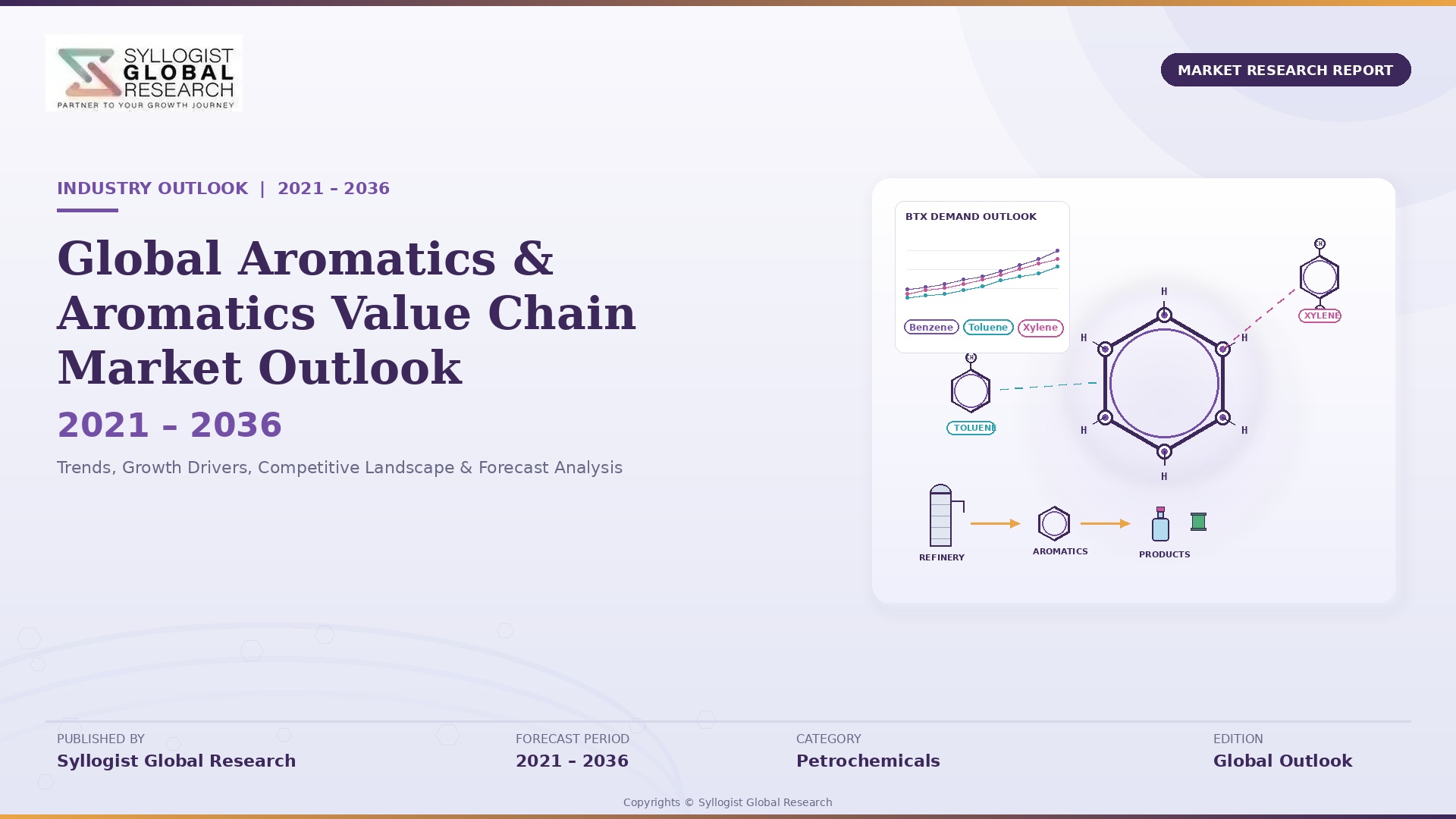
Global Aromatics and Aromatics Value Chain Market By Aromatic Type, By Production Process, By Derivative, By End Use Industry, By Feedstock, By Region, Competition, Forecast & Opportunities, 2021-2036F
Market Definition
The Global Aromatics and Aromatics Value Chain Market encompasses the production, processing, and commercial supply of benzene, toluene, xylenes, and their downstream chemical derivatives obtained through catalytic reforming, steam cracking, and toluene disproportionation processes, including purified terephthalic acid, paraxylene, styrene, cumene, phenol, acetone, caprolactam, and other aromatic intermediates that serve as foundational petrochemical feedstocks for polyester fibers and resins, polystyrene, polycarbonate, nylon, synthetic rubber, pharmaceuticals, and specialty chemicals across industrial and consumer end use markets globally.
Market Insights
The global aromatics and aromatics value chain market is navigating a pivotal structural transition, shaped by the simultaneous forces of robust downstream polyester and packaging demand growth from emerging economy consumer markets, the accelerating shift of aromatics production capacity toward Asia-Pacific and the Middle East as integrated refinery and chemical complex development reshapes the global petrochemical supply landscape, and the growing strategic question of how aromatics producers will manage the long-term feedstock and demand implications of plastic regulation, bio-based aromatics development, and energy transition policy impacts on naphtha availability from conventional refinery operations. The market was valued at approximately USD 218.4 billion in 2025 and is projected to grow at a compound annual growth rate of 4.2% through 2034, underpinned by sustained paraxylene and purified terephthalic acid demand from Asia-Pacific polyester fiber and PET resin production, growing styrene and cumene derivative consumption in construction and durable goods, and the strategic expansion of integrated aromatics complexes in China, India, and the Middle East that are vertically integrating crude oil conversion with downstream aromatic derivatives production to capture full chain value.
Paraxylene and its immediate derivative purified terephthalic acid constitute the most commercially significant and volume-intensive segment of the global aromatics value chain, reflecting the foundational role of PTA in polyethylene terephthalate resin production for polyester textile fiber, PET bottle packaging for carbonated beverages, water, and food packaging applications, and engineering polyester films and specialty resins serving electronics, photovoltaic backsheet, and packaging applications. China dominates global paraxylene and PTA production and consumption, having constructed the world’s largest integrated aromatics complex clusters in Zhejiang, Fujian, and Hainan provinces over the past decade, and its continued capacity expansion is progressively repositioning China from a net aromatics importer to a significant aromatics exporter whose surplus production is being directed toward Southeast Asian and South Asian downstream polyester markets, reshaping regional trade flows and competitive dynamics for established paraxylene producers in South Korea, Japan, Taiwan, and the Middle East whose market positions are being compressed by Chinese supply expansion at scale.
The benzene and styrene segment is experiencing a more complex demand trajectory, reflecting the maturation of styrene polymer markets in developed economies where polystyrene consumption is declining under single-use plastic regulation pressure and packaging sustainability commitments from major consumer goods companies, while simultaneously growing in developing economy construction, appliance, and automotive applications where expanded polystyrene insulation and acrylonitrile-butadiene-styrene engineering plastic consumption growth partially offsets demand contraction in regulated packaging segments. Cumene and phenol derivative chains serving bisphenol A, polycarbonate, and epoxy resin production are benefiting from growing construction and electronic applications demand, with polycarbonate consumption growing in automotive glazing, medical device, and optical lens applications that leverage its combination of impact resistance, optical clarity, and design flexibility. The strategic development of bio-based aromatics production routes including bio-paraxylene from bio-based para-xylene derived from sugars through fermentation pathways and mixed aromatics from lignin depolymerization is attracting investment from both petrochemical producers and bio-based materials developers seeking to establish supply chain positions in renewable aromatics that can serve sustainability-committed downstream customers willing to pay certified bio-content premiums.
Asia-Pacific overwhelmingly dominates the global aromatics market in both production and consumption, with China alone accounting for the largest share of global paraxylene, PTA, styrene, and benzene consumption driven by the massive scale of its polyester textile, PET packaging, synthetic rubber, and specialty chemical manufacturing industries. The Middle East represents the second most significant production region, leveraging the combination of low-cost naphtha and natural gas liquid feedstocks from integrated refinery and gas processing operations with strategically positioned export infrastructure serving European, Asian, and African aromatics derivative demand. North America and Europe represent mature aromatics production markets experiencing structural capacity rationalization as high-cost naphtha-based production faces competitive pressure from Middle Eastern and Asian capacity additions, with both regions shifting investment emphasis toward higher-value aromatic derivatives and specialty chemical downstream applications that are less exposed to commodity aromatics import competition.
Key Drivers
Sustained Polyester Fiber and PET Packaging Demand Growth in Emerging Economies Driving Structural Long-Term Paraxylene and Purified Terephthalic Acid Capacity Investment
Rising per capita income and expanding middle-class consumer populations across South and Southeast Asia, Africa, and Latin America are driving sustained growth in polyester textile fiber consumption for apparel, home textiles, and technical fabrics, PET resin demand for beverage and food packaging, and polyester film consumption for flexible packaging, capacitor dielectric, and photovoltaic applications, collectively sustaining robust demand growth for paraxylene and PTA across the forecast period that underpins multi-billion dollar integrated aromatics complex investment programs in China, India, and the Middle East. The displacement of cotton by lower-cost polyester blends in developing economy textile markets and the continued lightweighting of packaging formats through PET substitution for glass and aluminum in beverage and food categories are providing durable structural demand growth vectors for the upper aromatic value chain independent of short-term economic cycle volatility.
Integrated Refinery and Petrochemical Complex Development in the Middle East and Asia Capturing Full Aromatics Value Chain Economics and Reshaping Global Production Cost Competitiveness
National oil companies and state-backed petrochemical corporations in Saudi Arabia, the United Arab Emirates, China, and India are investing in deeply integrated crude-to-chemicals complexes that capture the full economic value of naphtha reforming and aromatics extraction within vertically integrated production chains extending from crude oil refining through aromatics separation, purification, and downstream derivative conversion to polyester, polystyrene, polycarbonate, and specialty chemical end products. These integrated facilities achieve aromatics production cost structures that standalone aromatics extraction units and naphtha crackers in high-cost developed market locations cannot match, progressively displacing import-dependent aromatics production in Europe, Japan, and North America with cost-advantaged integrated supply from Middle Eastern and Asian complex expansions.
Construction, Automotive, and Electronics Sector Demand Growth for Styrene, Phenol, and Cumene Derivatives Expanding Aromatics Value Chain Revenue Beyond Polyester and Packaging Applications
Expanding construction activity in Asia, the Middle East, and Africa is driving growing consumption of expanded polystyrene insulation, acrylonitrile-butadiene-styrene pipe fittings, and epoxy resin adhesives and coatings that collectively sustain benzene, styrene, and phenol derivative demand growth across the construction segment independently of the polyester and packaging markets that dominate aromatics volume consumption. Automotive lightweighting programs substituting polycarbonate glazing, acrylonitrile-butadiene-styrene body panels, and nylon components for glass and metal increase benzene and cumene chain consumption per vehicle produced, while the proliferation of consumer electronics incorporating acrylonitrile-butadiene-styrene, polycarbonate, and epoxy encapsulant materials generates additional durable aromatics derivative demand growth across the technology manufacturing sector.
Key Challenges
Naphtha Feedstock Availability and Price Volatility Under Energy Transition Scenarios Creating Long-Term Supply Cost Uncertainty for Conventional Aromatic Production Operations
The predominant production route for aromatics in Europe, Japan, South Korea, and established Asian petrochemical complexes is catalytic reforming of naphtha derived from crude oil refinery operations, creating a structural dependence on naphtha availability and pricing that is subject to crude oil market volatility and, over a longer timeframe, to the potential reduction in naphtha production volumes as petroleum product demand declines under energy transition scenarios that reduce transportation fuel refinery runs and thereby reduce the naphtha by-product available for petrochemical feedstock extraction. The uncertainty over the trajectory of naphtha availability and cost competitiveness relative to alternative aromatics production routes including coal-based aromatics in China and bio-based aromatics from emerging fermentation pathways is creating strategic feedstock planning uncertainty for aromatics producers managing long-lived capital assets with multi-decade investment horizons.
Plastic Sustainability Regulation, Single-Use Plastic Restrictions, and Corporate Packaging Sustainability Commitments Creating Structural Demand Headwinds for Polystyrene and Aromatic Polymer Applications
Expanding single-use plastic regulation across the European Union, United Kingdom, India, and a growing number of national and subnational jurisdictions is creating structural demand restrictions for polystyrene food service packaging and expanded polystyrene containers that represent significant styrene consumption markets in affected geographies, while corporate voluntary plastic reduction commitments from major consumer goods companies and food processors are accelerating the substitution of polystyrene packaging with paper, cardboard, and alternative materials in retail and food service applications. These regulatory and corporate demand destruction forces for certain aromatic polymer applications are creating challenging commercial environments for styrene producers and downstream polystyrene manufacturers in regulated markets, requiring strategic portfolio repositioning toward less regulated aromatic derivative applications or geographic expansion into markets with lower regulatory plastic restriction intensity.
Chinese Aromatics Capacity Surplus and Export Pressure Creating Pricing Compression and Market Displacement Risks for Established Aromatics Producers Across Regional Markets
China’s decade-long investment in massive integrated aromatics complexes, which were designed primarily to achieve domestic supply self-sufficiency in paraxylene, PTA, and styrene, has resulted in production capacity additions that increasingly exceed domestic demand growth rates, creating surplus production volumes that are being directed to export markets across Southeast Asia, South Asia, and the Middle East at prices that reflect Chinese facility operating cost economics rather than market equilibrium pricing, compressing regional aromatics margins for producers in South Korea, Japan, Taiwan, and the Middle East whose competitive cost positions are less favorable than the large new Chinese integrated complexes. This structural Chinese surplus overhang introduces sustained downward price pressure across multiple aromatic commodity chains that limits the return on capital achievable by aromatics producers globally during periods when Chinese export volumes elevate regional supply availability above demand growth rates.
Market Segmentation
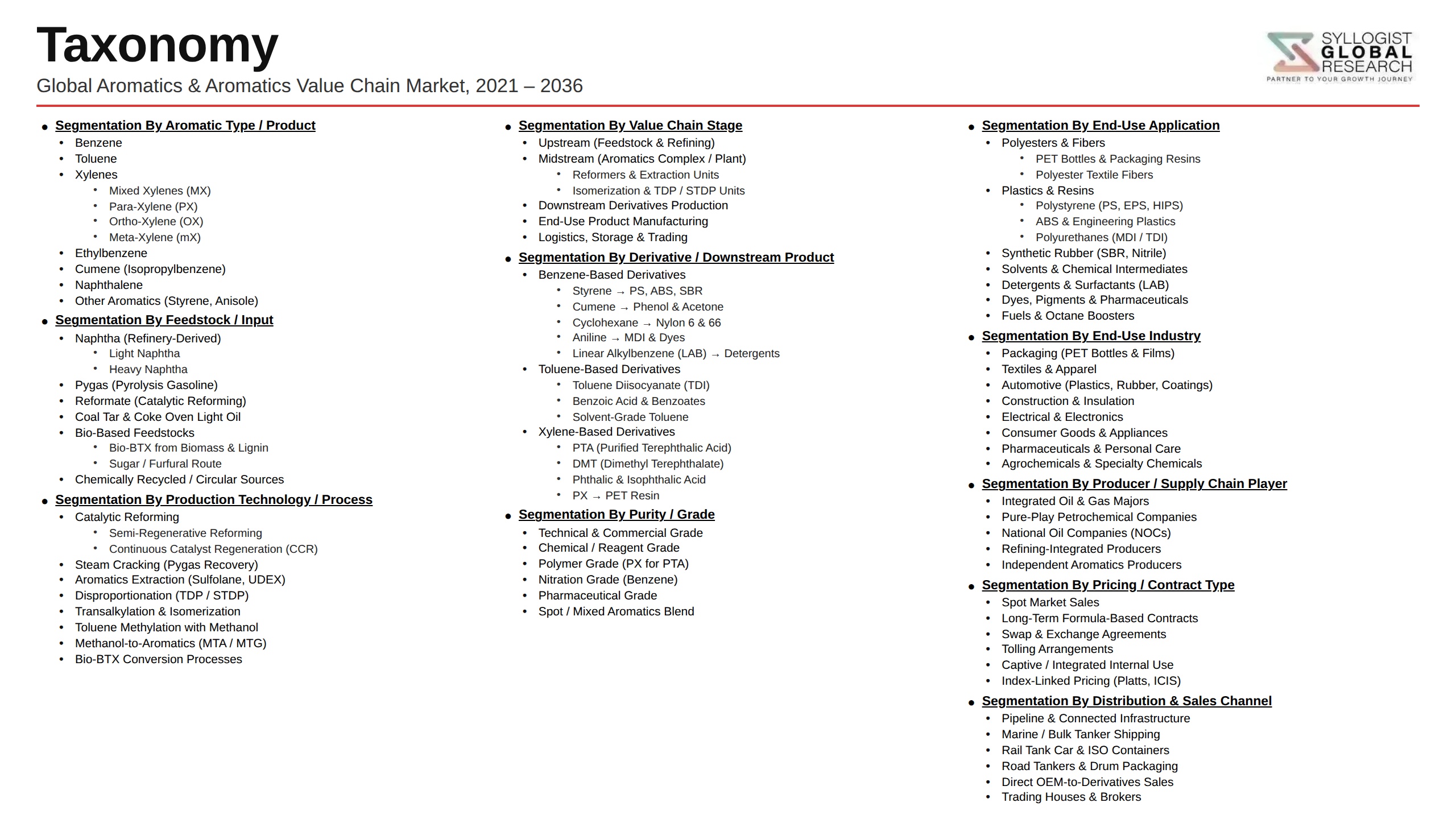
- Segmentation By Aromatic Type
- Benzene
- Toluene
- Paraxylene (Para-Xylene)
- Orthoxylene and Metaxylene
- Mixed Xylenes
- Naphthalene and Heavy Aromatics
- Others
- Segmentation By Production Process
- Catalytic Reforming of Naphtha
- Steam Cracking Pyrolysis Gasoline Extraction
- Toluene Disproportionation and Transalkylation
- Coal-Based Aromatics Production
- Bio-Based and Renewable Aromatics Routes
- Others
- Segmentation By Derivative
- Purified Terephthalic Acid and Polyethylene Terephthalate
- Styrene and Styrenic Polymers
- Cumene, Phenol, and Acetone
- Caprolactam and Nylon
- Aniline, Nitrobenzene, and MDI
- Cyclohexane and Adipic Acid
- Phthalic Anhydride and Plasticizers
- Others
- Segmentation By End Use Industry
- Polyester Fiber and Textile Manufacturing
- PET Packaging and Bottle Resins
- Construction and Building Materials
- Automotive and Transportation
- Consumer Electronics and Electrical
- Pharmaceuticals and Specialty Chemicals
- Adhesives, Coatings, and Solvents
- Others
- Segmentation By Feedstock
- Naphtha and Petroleum Reformate
- Pyrolysis Gasoline from Steam Crackers
- Coal Tar Aromatics
- Bio-Based Sugars and Lignocellulosic Biomass
- Others
- Segmentation By Region
- North America
- Europe
- Asia-Pacific
- Middle East and Africa
- Latin America
All market revenues are presented in USD
Historical Year: 2021-2024 | Base Year: 2025 | Estimated Year: 2026 | Forecast Period: 2027-2034
Key Questions this Study Will Answer
- What is the total global aromatics and aromatics value chain market valuation in 2025, projected through 2034, segmented by aromatic type, derivative, and end use industry, enabling petrochemical producers, derivative processors, and investors to identify the highest-growth value chain segments and most commercially resilient aromatics derivative positions across the evolving global petrochemical landscape?
- How is China’s large-scale integrated paraxylene and PTA capacity expansion reshaping global aromatics supply balances, regional trade flows, and competitive economics for established producers in South Korea, Japan, Taiwan, India, and the Middle East, and what production cost repositioning, capacity rationalization, and derivative specialization strategies are established aromatics producers adopting to sustain commercial viability in a Chinese surplus environment?
- Which aromatics derivative chains, specifically PTA and polyester, styrene and engineering polymers, cumene and phenol derivatives, and bio-based aromatic development programs, are generating the most favorable demand growth trajectories and investment returns through 2034, and what end use market dynamics, feedstock cost positions, and regulatory environment factors are differentiating the commercial performance outlook across derivative segments?
- How are integrated crude-to-chemicals complex developments in Saudi Arabia, the United Arab Emirates, India, and China capturing full aromatics value chain economics, and what feedstock cost advantages, vertical integration benefits, and downstream market proximity characteristics are enabling these integrated facilities to achieve production economics that standalone naphtha reforming and aromatics extraction operations in higher-cost locations cannot match?
- What naphtha feedstock availability risks, crude oil refinery throughput trajectory uncertainty under energy transition scenarios, and competitive pressure from coal-based and bio-based aromatics production routes are most significantly affecting the long-term strategic planning and capital investment decisions of conventional naphtha-based aromatics producers in Europe, Japan, South Korea, and North America?
- How are single-use plastic regulations, corporate plastic reduction commitments, extended producer responsibility frameworks, and mechanical and chemical recycling investment programs reshaping demand trajectories for polystyrene, PET, polycarbonate, and other aromatic polymer applications, and what product portfolio adjustments, recycled content integration strategies, and market diversification approaches are aromatics producers and polymer converters pursuing in response?
- What is the current commercial readiness and investment pipeline for bio-based aromatics production from fermentation-derived bio-paraxylene, lignin depolymerization aromatic streams, and other renewable feedstock routes, and what cost reduction milestones, scale-up investment requirements, and sustainability premium market development trajectories are required for bio-based aromatics to achieve commercially meaningful penetration of the global aromatics market through 2034?
- Product Definition
- Research Methodology
- Research Design & Framework
- Overall Research Approach: Descriptive, Exploratory & Quantitative Mixed-Method Design
- Market Definition & Scope Boundaries: What is Included and Excluded
- Segmentation Framework
- Key Research Assumptions & Limitations
- Secondary Research
- Primary Research Design & Execution
- Data Triangulation & Validation
- Market Sizing & Forecasting Methodology
- Competitive Intelligence Methodology
- Quality Assurance & Peer Review
- Definitions, Abbreviations & Data Notes
- Research Design & Framework
- Executive Summary
- Market Snapshot & Headline Numbers
- Key Findings & Research Highlights
- Market Dynamics
- Regional Market Summary
- Competitive Landscape Snapshot
- Technology & Innovation Highlights
- Market Dynamics
- Drivers
- Restraints
- Opportunities
- Challenges
- Porter’s Five Forces Analysis
- PESTLE Analysis
- Market Trends & Developments
- Emerging Trends
- Technological Developments
- Regulatory & Policy Changes
- Supply Chain & Sourcing Trends
- Manufacturing & Process Trends
- Investment & Funding Activity
- Sustainability & ESG Trends
- Risk Assessment Framework
- Crude Oil & Naphtha Feedstock Price Volatility & Refinery Margin Compression Risk
- Overcapacity, New Capacity Addition & Margin Cycle Downturn Risk in Asia-Pacific
- Energy Transition, Plastics Regulation & Long-Term Demand Erosion Risk for Aromatics Derivatives
- Geopolitical Trade Disruption, Tariff Escalation & Supply Chain Rerouting Risk
- Environmental Regulation, VOC & Benzene Emission Tightening & Compliance Cost Risk
- Substitution Risk: Bio-Based Aromatics, Recycled Feedstock & Circular Economy Alternative Development
- Regulatory Framework & Standards
- REACH, TSCA & Global Chemical Registration, Evaluation & Authorisation Standards for Benzene, Toluene & Xylenes
- Occupational Exposure Limits (OEL), Benzene Carcinogen Classification & Workplace Safety Standards
- Environmental Emission Standards: VOC Limits, Benzene Air Quality Standards & EPA MACT Rules for Aromatics Facilities
- EU Plastics & Packaging Regulation, Single-Use Plastics Directive & Impact on PET & Polystyrene Derivative Demand
- Chemical Site Safety, Process Hazard Analysis (PHA), OSHA PSM & Seveso III Directive for Aromatics Facilities
- Bio-Aromatics, Green Chemistry Certification & Sustainable Aromatic Feedstock Standards & Incentive Frameworks
- Global Aromatics and Aromatics Value Chain Market Outlook
- Market Size & Forecast by Value
- Market Size & Forecast by Volume (Million Tonnes per Annum, MTPA)
- Market Size & Forecast by Aromatic Compound
- Benzene
- Toluene
- Mixed Xylenes (MX)
- Paraxylene (PX)
- Orthoxylene (OX)
- Metaxylene (MX)
- Cumene
- Styrene
- Naphthalene
- Cyclohexane
- Market Size & Forecast by Value Chain Stage
- Feedstock Supply: Naphtha, Reformate, Pyrolysis Gasoline (Pygas) & Coal Tar
- Aromatic Extraction & Separation: Reforming, Solvent Extraction & Distillation
- Aromatic Conversion: Isomerisation, Transalkylation, Disproportionation & Toluene Disproportionation (TDP)
- Primary Aromatic Derivatives: PTA, AN, Phenol, Acetone, Caprolactam, MDI & TDI
- Secondary & Downstream Polymer & Chemical Production
- Blending, Formulation & Specialty Aromatic Chemical Production
- Market Size & Forecast by Production Technology
- Catalytic Naphtha Reforming
- Steam Cracker Pyrolysis Gasoline (Pygas) Hydrotreatment & Extraction
- Coal Tar Distillation & Coke Oven Light Oil Processing
- Toluene Disproportionation (TDP) & Selective TDP (STDP)
- Xylene Isomerisation & C8 Aromatics Processing
- Simulated Moving Bed (SMB) Adsorption Paraxylene Separation
- Bio-Based Aromatics Production (p-Xylene from Bio-Feedstock & Lignin Depolymerisation)
- Market Size & Forecast by Key Derivative
- Purified Terephthalic Acid (PTA) from Paraxylene
- Polyethylene Terephthalate (PET) Resin & Fibre
- Acrylonitrile (AN) from Propylene-Ammoxidation & Benzene Route
- Phenol & Acetone (Cumene-to-Phenol Process)
- Polystyrene (PS), Expandable PS (EPS) & Acrylonitrile-Butadiene-Styrene (ABS)
- Phthalic Anhydride (PA) from Orthoxylene
- Isophthalic Acid (IPA) from Metaxylene
- Caprolactam & Nylon 6 from Cyclohexane-Benzene Route
- MDI & TDI (Polyurethane Diisocyanates from Toluene & Benzene)
- Nitrobenzene, Aniline & Downstream Dyestuff & Agrochemical Derivatives
- Market Size & Forecast by Application
- Polyester Fibres, Packaging Films & PET Bottle Resin
- Plastics, Polymers & Engineering Resins
- Synthetic Rubber, Elastomers & Tyres
- Paints, Coatings, Inks & Adhesives
- Agrochemicals, Pesticides & Herbicides
- Pharmaceuticals & Fine Chemicals
- Solvents & Petrochemical Intermediates
- Polyurethanes, Insulation & Foam Products
- Market Size & Forecast by End-User
- Integrated Refinery-Petrochemical Complexes
- Standalone Aromatic Complex & Chemical Plant Operators
- Polyester & Textile Industry Operators
- Packaging, Plastic & Resin Manufacturers
- Coatings, Adhesives, Rubber & Specialty Chemical Producers
- Pharmaceutical & Agrochemical Companies
- Market Size & Forecast by Sales Channel
- Direct Producer-to-Consumer Bilateral Contract Channel
- Commodity Trader, Broker & Spot Market Channel
- Exchange-Traded & Index-Linked Aromatic Chemical Contract Channel
- Distributor & Regional Merchant Channel
- North America Aromatics and Aromatics Value Chain Market Outlook
- Market Size & Forecast
- By Value
- By Volume (MTPA)
- By Aromatic Compound
- By Value Chain Stage
- By Production Technology
- By Key Derivative
- By Application
- By End-User
- By Country
- By Sales Channel
- Market Size & Forecast
- Europe Aromatics and Aromatics Value Chain Market Outlook
- Market Size & Forecast
- By Value
- By Volume (MTPA)
- By Aromatic Compound
- By Value Chain Stage
- By Production Technology
- By Key Derivative
- By Application
- By End-User
- By Country
- By Sales Channel
- Market Size & Forecast
- Asia-Pacific Aromatics and Aromatics Value Chain Market Outlook
- Market Size & Forecast
- By Value
- By Volume (MTPA)
- By Aromatic Compound
- By Value Chain Stage
- By Production Technology
- By Key Derivative
- By Application
- By End-User
- By Country
- By Sales Channel
- Market Size & Forecast
- Latin America Aromatics and Aromatics Value Chain Market Outlook
- Market Size & Forecast
- By Value
- By Volume (MTPA)
- By Aromatic Compound
- By Value Chain Stage
- By Production Technology
- By Key Derivative
- By Application
- By End-User
- By Country
- By Sales Channel
- Market Size & Forecast
- Middle East & Africa Aromatics and Aromatics Value Chain Market Outlook
- Market Size & Forecast
- By Value
- By Volume (MTPA)
- By Aromatic Compound
- By Value Chain Stage
- By Production Technology
- By Key Derivative
- By Application
- By End-User
- By Country
- By Sales Channel
- Market Size & Forecast
- Country-Wise* Aromatics and Aromatics Value Chain Market Outlook
- Market Size & Forecast
- By Value
- By Volume (MTPA)
- By Aromatic Compound
- By Value Chain Stage
- By Production Technology
- By Key Derivative
- By Application
- By End-User
- By Country
- By Sales Channel
- Market Size & Forecast
- *Countries Analyzed in the Syllogist Global Research Portfolio: United States, Canada, Mexico, Germany, France, United Kingdom, Netherlands, Belgium, Spain, Italy, China, Japan, South Korea, India, Singapore, Thailand, Taiwan, Malaysia, Brazil, Argentina, Saudi Arabia, UAE, Iran, Qatar, South Africa, Egypt
- Technology Landscape & Innovation Analysis
- Paraxylene Production Technology Deep-Dive: SMB Adsorption, Crystallisation & Zeolite-Based Isomerisation Advances
- Toluene Disproportionation (TDP & STDP) Technology: Catalyst Development, Selectivity Improvement & Benzene/PX Yield Optimisation
- Integrated Naphtha Cracker & Reformer Technology: Feedstock Flexibility, Energy Integration & Aromatic Yield Maximisation
- Coal-to-Aromatics & Methanol-to-Aromatics (MTA) Technology: Chinese Process Routes & Alternative Feedstock Pathways
- Bio-Based Aromatics Technology: Bio-PX from Biomass, Lignin-Derived Aromatics & Catalytic Fast Pyrolysis Routes
- Catalytic Recycling of Plastics to Aromatics: Pyrolysis-to-BTX & Chemical Recycling Feedstock Valorisation
- Digital Twin, Advanced Process Control (APC) & AI-Based Optimisation Technology for Aromatic Complex Operations
- Patent & IP Landscape in Aromatics Production & Processing Technologies
- Value Chain & Supply Chain Analysis
- Crude Oil, Condensate, Naphtha & Natural Gas Liquid (NGL) Feedstock Supply Chain
- Catalyst, Solvents & Process Chemicals Supply Chain for Aromatic Complex Operations
- Aromatic Extraction, Reforming & Separation Unit Equipment Supply Chain
- Aromatic Product Storage, Blending & Terminal Logistics Supply Chain
- Aromatic Chemical Shipping, Tankage & Marine Transportation Supply Chain
- PTA, PET, Styrene & Primary Derivative Manufacturing Supply Chain
- Downstream Polymer, Fibre & Specialty Chemical Converter Supply Chain
- Trader, Merchant & End-User Procurement Channel
- Pricing Analysis
- Global Aromatic Benchmark Price Analysis: Benzene, Toluene, Paraxylene, Orthoxylene & Styrene FOB/CFR Pricing
- Naphtha-to-Aromatic Spread, Reforming Margin & Pygas Extraction Economics Analysis
- Paraxylene-to-PTA & PTA-to-PET Conversion Margin Analysis
- Benzene-to-Styrene, Benzene-to-Cumene & Benzene-to-Cyclohexane Derivative Margin Analysis
- Regional Aromatic Price Differential & Arbitrage: Asia-Pacific vs. Europe vs. US Gulf Coast
- Price Cycle Analysis: Historical Aromatic Margin Cycles, Capacity Additions & Demand Growth Impact
- Sustainability & Environmental Analysis
- Lifecycle Assessment (LCA) of Aromatic Chemicals: Carbon Footprint from Feedstock, Processing & End-of-Life for Key Aromatics
- Benzene Carcinogenicity, Toxicology & Occupational Health Impact: Industry Standards & Exposure Reduction Technology
- Decarbonisation of Aromatic Production: Green Hydrogen, Electrification, CCS & Steam Cracker Emissions Reduction
- Bio-Based & Recycled Aromatic Feedstock: Circular Economy Contribution, Mass Balance Approach & Sustainability Certification
- Plastics Regulation, Extended Producer Responsibility (EPR) & Impact on Aromatic Derivative Demand Outlook
- Competitive Landscape
- Market Structure & Concentration
- Market Consolidation Level (Fragmented vs. Consolidated by Aromatic Compound & Geography)
- Top 10 Players Market Share
- HHI (Herfindahl-Hirschman Index) Concentration Analysis
- Competitive Intensity Map by Aromatic Compound, Value Chain Stage & Geography
- Player Classification
- Integrated Refinery-Petrochemical Majors with Large-Scale Aromatic Complex Ownership
- Dedicated Aromatic Complex & Petrochemical Operators
- State-Owned & National Oil Company Aromatics Producers
- PTA, PET & Primary Aromatic Derivative Producers
- Specialty Aromatic Chemical & Fine Chemical Producers
- Aromatic Chemical Traders & Commodity Marketing Companies
- Competitive Analysis Frameworks
- Market Share Analysis by Aromatic Compound, Value Chain Stage & Region
- Company Profile
- Company Overview & Headquarters
- Aromatic Products, Production Portfolio & Value Chain Integration
- Key Customer Relationships & Offtake Agreements
- Manufacturing Footprint, Aromatic Complex Capacity & Production Volume
- Revenue (Aromatics Segment) & Order Backlog
- Technology Differentiators & IP
- Key Strategic Partnerships, JVs & M&A Activity
- Recent Developments (Capacity Expansions, New Plants, Product Launches)
- SWOT Analysis
- Strategic Focus Areas & Roadmap
- Competitive Positioning Map (Integration Depth vs. Market Penetration)
- Key Company Profiles
- Market Structure & Concentration
- Technology Landscape & Innovation Analysis
- Strategic Output
- Market Opportunity Matrix: By Aromatic Compound, Value Chain Stage, Application, End-User & Geography
- White Space Opportunity Analysis
- Strategic Recommendations
- Product Portfolio & Value Chain Integration Strategy
- Capacity Expansion, Feedstock Flexibility & Manufacturing Excellence Strategy
- Geographic Expansion & New Market Penetration Strategy
- Customer, Offtake Partner & End-User Engagement Strategy
- Partnership, M&A & Petrochemical Ecosystem Strategy
- Sustainability, Decarbonisation & Circular Economy Strategy
- Risk Mitigation & Future Roadmap
- Strategic Priority Matrix & Roadmap
- Near-term (2025-2028)
- Mid-term (2029-2032)
- Long-term (2033-2037)
- Strategic Output