
Market Definition
The Global AI-Driven Water Management Platforms Market encompasses the development, deployment, integration, and operation of software platforms, analytics engines, decision support systems, and digital management tools that apply artificial intelligence, machine learning, deep learning, computer vision, natural language processing, and advanced predictive modelling techniques to the monitoring, optimisation, control, and planning of water supply, distribution, treatment, wastewater management, irrigation, stormwater, and industrial water systems. AI-driven water management platforms ingest, process, and analyse continuous data streams from smart meters, pressure sensors, flow monitors, water quality analysers, remote sensing satellites, weather stations, supervisory control and data acquisition systems, and operational technology networks to generate real-time operational intelligence, predictive maintenance alerts, demand forecasting models, leak detection and localisation outputs, water quality anomaly warnings, treatment process optimisation recommendations, and infrastructure investment prioritisation insights that enable water utility operators, industrial water managers, irrigation system operators, and municipal water planners to make faster, more informed, and more economically efficient decisions than conventional rule-based monitoring and control systems permit. The market encompasses cloud-hosted and on-premise platform deployments, edge computing architectures for low-latency field device intelligence, application programming interface-enabled integration middleware connecting operational technology and information technology systems, digital twin environments that simulate water network behaviour under varying demand and operational scenarios, and the data science, machine learning operations, and cybersecurity infrastructure that underpin production-grade AI water management system performance and reliability. Key application domains include non-revenue water reduction and leakage management, distribution network pressure optimisation, drinking water treatment process control, wastewater treatment process optimisation, demand forecasting and supply planning, predictive asset maintenance, water quality monitoring and early warning, precision agricultural irrigation scheduling, stormwater network management, and enterprise water resource planning. Key participants include water technology platform developers, industrial software companies, water utility digital transformation service providers, smart meter and sensor manufacturers, cloud infrastructure providers, engineering consultancies with digital water practices, and the municipal and industrial water operators whose service delivery, operational efficiency, and regulatory compliance requirements define the demand structure of the global AI-driven water management platforms market.
Market Insights
The global AI-driven water management platforms market was valued at approximately USD 4.6 billion in 2025 and is projected to reach USD 16.8 billion by 2034, advancing at a compound annual growth rate of 15.4% over the forecast period from 2027 to 2034, representing one of the highest growth trajectories within the broader water technology sector as water utilities and industrial water operators accelerate investment in digital intelligence platforms whose return on investment in non-revenue water reduction, energy optimisation, and treatment process improvement is increasingly well documented and commercially compelling. The fundamental demand driver is the widening gap between the operational complexity and performance requirements placed on water infrastructure systems by population growth, climate variability, and ageing asset bases, and the capacity of conventional manual monitoring, rule-based control, and periodic engineering assessment approaches to manage these systems at the service quality, cost efficiency, and resilience standards demanded by regulators and customers across major global water markets.
Non-revenue water reduction and distribution network leakage management represent the largest and most commercially mature application segment within AI-driven water management platforms, with global non-revenue water losses estimated at approximately 126 billion cubic metres annually in 2025, equivalent to approximately USD 39 billion in lost treated water value, establishing a structurally enormous economic incentive for AI platform investment that enables utilities to detect, localise, and prioritise repair of leaks and measurement inaccuracies at a fraction of the cost and time required by conventional physical inspection methods. Advanced machine learning-based leak detection platforms that analyse pressure transient patterns, flow balance anomalies, and acoustic sensor data across distribution networks are demonstrating leak detection accuracies of 85% to 94% on validation datasets, compared to 30% to 50% detection rates achievable through conventional district metered area monitoring alone, with the incremental leak detection performance of AI platforms generating average non-revenue water reduction of 18% to 32% relative to pre-deployment baselines at utility deployments where implementation is supported by adequate sensor density and data quality management. Drinking water treatment process optimisation platforms applying machine learning to continuous influent quality monitoring, chemical dosing control, membrane filtration management, and disinfection byproduct formation prediction are generating documented energy savings of 8% to 16% and chemical dosing cost reductions of 12% to 22% at treatment plants where AI optimisation has been implemented, with the combined operating cost reduction generating payback periods of two to four years at medium and large treatment facilities that provide the financial justification for platform investment independent of the water quality compliance improvement benefits.
North America represents the largest regional market for AI-driven water management platforms, accounting for approximately 36% of global market revenue in 2025, driven by the combination of the United States Environmental Protection Agency Safe Drinking Water Act and Clean Water Act compliance obligations that motivate treatment optimisation and water quality monitoring investment, the ageing water distribution infrastructure whose capital replacement needs drive demand for AI-enabled condition assessment and maintenance prioritisation, and the highly active digital water technology vendor ecosystem concentrated in the United States and Canada that generates continuous product innovation and competitive pricing pressure across platform capability categories. Europe is the second-largest regional market and the most advanced in terms of regulatory framework enablement of AI water management adoption, with the European Union Water Framework Directive, the Drinking Water Directive recast requirements for leak detection and distribution system monitoring, and national water utility performance benchmarking regimes in the United Kingdom, France, Germany, and the Netherlands providing regulatory and commercial incentives for AI platform adoption across both municipal water utilities and industrial water operators. Asia-Pacific is the fastest-growing regional market at approximately 18.6% annually, driven by China’s smart water management programs embedded in successive Five Year Plans that have mobilised approximately USD 3.2 billion in government and utility investment in water network digitalisation and AI management platform deployment between 2020 and 2025, India’s Jal Jeevan Mission and AMRUT urban water infrastructure programs generating procurement demand for smart monitoring and AI operational platforms at newly commissioned water supply systems across hundreds of cities, and the rapidly expanding water technology procurement programs of Singapore, Australia, South Korea, and Japan.
The convergence of digital twin technology with AI predictive analytics is creating a new generation of water management platform capability that combines the physics-based behavioural simulation of water network digital twins with the pattern recognition and anomaly detection capability of machine learning models, enabling water utility operators to not only monitor current network state in real time but to simulate the operational and infrastructure consequences of demand fluctuations, asset failures, weather events, and operational interventions before implementing decisions whose physical consequences at scale are difficult or impossible to reverse without service disruption. Industrial water management represents an increasingly significant market segment for AI-driven platforms, with water-intensive industries including semiconductors, food and beverage, pharmaceuticals, and power generation deploying AI optimisation platforms across cooling water systems, process water recycling circuits, wastewater treatment operations, and water procurement and allocation functions, with the water cost management and regulatory compliance imperatives of these industries generating AI platform investment demand that is growing at approximately 17.3% annually and is less dependent on utility regulatory frameworks than the municipal water market. Cybersecurity has emerged as a critical and commercially significant dimension of AI water management platform development and procurement, with the high-profile exposure of water utility operational technology networks to ransomware attacks and the potential for AI platform vulnerabilities to be exploited to compromise water treatment chemical dosing or distribution network pressure management systems creating a structured and growing market for cybersecurity-integrated AI water management platforms whose architecture embeds zero-trust network access, operational technology threat detection, and resilient failsafe control capability as standard design features rather than supplementary additions to core analytics functionality.
Key Drivers
Escalating Non-Revenue Water Losses, Ageing Distribution Infrastructure, and Utility Financial Pressure Creating Compelling Return on Investment for AI Leakage and Asset Management Platforms
Water utilities across developed and developing nations face a structural combination of ageing distribution infrastructure whose pipe burst frequency and leakage rates are increasing as assets exceed design service lives, chronic underinvestment in pipe replacement programs constrained by utility revenue limitations and regulatory capital expenditure approvals, and customer and regulatory pressure to maintain or improve service levels at lower unit cost, creating a financially urgent business case for AI-driven leak detection, pressure management, and asset health monitoring platforms whose operational expenditure savings and capital expenditure deferral benefits generate measurable return on investment within regulatory investment planning cycles. Global average non-revenue water rates of approximately 30% to 35% of water produced represent an operating efficiency deficit whose reduction through AI platform-enabled leak detection and network optimisation translates directly into avoidable water treatment energy and chemical costs, deferred water source development capital, and improved utility revenue recovery that collectively justify AI platform investment at medium and large utilities without requirement for additional regulatory mandate. The United States alone estimates its water distribution infrastructure replacement liability at approximately USD 1.2 trillion over the next 25 years, a capital requirement that utilities can partially defer through AI-driven condition assessment platforms that prioritise pipe replacement investment based on failure probability modelling and consequence analysis rather than age-based scheduling, with documented capital expenditure deferral of USD 0.8 million to USD 4.5 million per year at utilities implementing AI asset management platforms replacing a fraction of annual platform subscription and implementation costs.
Intensifying Water Scarcity, Climate-Driven Demand Variability, and Utility Resilience Requirements Driving AI Forecasting, Planning, and Optimisation Platform Adoption
The increasing frequency and severity of drought events, heat waves, and extreme precipitation affecting previously water-secure regions is fundamentally challenging the operational planning frameworks of water utilities whose historical demand forecasting models, reservoir operating rules, and treatment capacity sizing assumptions were calibrated on climate patterns that no longer reliably characterise current and projected hydrological conditions, creating a structural requirement for AI-driven demand forecasting, reservoir operations optimisation, and supply-demand balancing platforms that can incorporate real-time weather data, soil moisture indices, vegetation stress indicators, and socioeconomic demand drivers into adaptive supply planning models that update continuously rather than annually. AI-based demand forecasting platforms that integrate smart meter interval data, weather variables, land use information, demographic indicators, and historical consumption patterns are generating demand forecast accuracy improvements of 25% to 45% relative to conventional regression-based utility forecasting models at the hourly and daily resolution required for real-time pumping schedule optimisation and energy tariff management, with the improved forecasting accuracy enabling pump scheduling optimisation that reduces distribution system energy consumption by 10% to 20% and generates annual energy cost savings of USD 150,000 to USD 2.3 million per utility depending on system scale and current pumping efficiency. Precision agricultural irrigation scheduling platforms powered by machine learning models integrating satellite remote sensing, soil moisture sensor networks, evapotranspiration modelling, and crop phenology data are growing at approximately 19.8% annually, as water-scarce agricultural regions in the western United States, India, the Middle East, and Australia adopt AI irrigation management to achieve 20% to 40% reductions in irrigation water application per unit of crop yield relative to conventional schedule-based irrigation practices.
Regulatory Digital Reporting Requirements, Water Quality Compliance Obligations, and Smart Meter Deployment Mandates Generating Structured AI Platform Adoption Demand
The progressive introduction of digital reporting mandates, real-time water quality monitoring obligations, and smart meter infrastructure requirements by water regulators across the European Union, United States, United Kingdom, and Australia is generating structured and time-bound AI platform adoption demand from water utilities that must comply with regulatory requirements for continuous network performance monitoring, water quality surveillance, and customer consumption data management that conventional manual monitoring and billing systems cannot satisfy within the performance and reporting frequency standards that regulators are imposing. The United Kingdom water regulator Ofwat’s Price Review 24 framework has embedded digital transformation performance commitments and leakage reduction targets into the regulatory contract of all major water companies, with AI platform adoption a functionally necessary component of the leakage detection, pressure management, and customer smart metering performance metrics against which utility regulatory reward and penalty provisions apply in the 2025 to 2030 regulatory period. The European Union Drinking Water Directive recast, requiring member states to implement risk-based monitoring, continuous quality surveillance of distribution systems, and leak detection programs for distribution networks with losses exceeding 15% by 2027, is generating procurement demand for AI water quality monitoring and network intelligence platforms across European water utilities whose current monitoring infrastructure and management systems are insufficient to satisfy the directive’s performance and reporting requirements within the mandated compliance timeline, creating a time-constrained adoption imperative that is accelerating European AI water platform procurement ahead of the voluntary adoption pace that commercial return on investment alone would generate.
Key Challenges
Data Quality Deficits, Legacy Operational Technology Integration Complexity, and Sensor Infrastructure Gaps Constraining AI Platform Performance at Municipal Utilities
The operational value of AI-driven water management platforms is fundamentally dependent on the availability of high-quality, high-frequency, spatially distributed sensor data whose collection requires smart meter penetration, pressure and flow monitoring sensor density, and water quality analyser coverage that most water utilities globally have not yet achieved, creating a data infrastructure gap whose remediation requires capital investment in sensing hardware, communication networks, and data management systems that substantially exceeds the cost of AI platform software licensing and must be funded and implemented before AI analytics can generate meaningful operational intelligence at production scale. The majority of water utility operational technology environments include supervisory control and data acquisition systems, programmable logic controllers, and field devices from multiple generations of technology and multiple vendors whose proprietary communication protocols, data schemas, and network architectures are incompatible with modern cloud-based AI platform data ingestion requirements without the deployment of integration middleware, protocol converters, and data normalisation systems whose implementation requires specialist operational technology integration expertise that is scarce in most utility information technology departments. Data quality problems including sensor drift and calibration failures, communication transmission errors, missing data during network outages, and timestamp inconsistencies across heterogeneous data sources propagate through AI model training and inference pipelines to generate degraded prediction accuracy, false positive alerts, and unreliable optimisation recommendations that erode operator trust in AI platform outputs and create organisational resistance to AI-guided operational decision making that is difficult to overcome once established through early deployment performance disappointments.
Cybersecurity Vulnerability of AI-Integrated Water Operational Technology and the Regulatory and Liability Consequences of Platform Security Failures
The integration of AI analytics platforms with water utility operational technology systems that control physical water treatment and distribution processes creates attack surface vulnerabilities whose exploitation could result in contaminated water reaching consumers, loss of water supply to critical service areas, or damage to treatment and pumping infrastructure, elevating the cybersecurity risk profile of AI-integrated water management systems to a level that is attracting increasing regulatory scrutiny and imposing security architecture requirements whose implementation substantially increases AI platform deployment complexity and cost relative to conventional enterprise software procurement. The United States Environmental Protection Agency cybersecurity assessment requirement for drinking water systems serving more than 3,300 people, the United Kingdom National Cyber Security Centre guidelines for operational technology security in critical national infrastructure, and equivalent regulatory frameworks in Australia, the European Union, and Israel are imposing cybersecurity assessment, incident response planning, and operational technology network security implementation obligations on water utilities that must be satisfied before AI platforms accessing operational control systems can be approved for production deployment. Insurance underwriting for water utility cyber liability policies is becoming significantly more demanding and expensive for utilities that have implemented AI platforms with operational technology connectivity without demonstrating compliance with recognised operational technology security frameworks including IEC 62443 or NIST Cybersecurity Framework, creating a financial incentive for water utilities to invest substantially in cybersecurity infrastructure as a prerequisite for AI water management platform deployment rather than as a parallel or subsequent investment, adding to total platform implementation cost and extending deployment timelines.
Workforce Capability Gaps in Water Utility Data Science, AI Model Governance, and Digital Operations Limiting Platform Value Realisation and Sustained Adoption
Water utilities globally face a significant and growing gap between the data science, machine learning operations, and digital operational management capabilities required to deploy, govern, and continuously improve AI water management platforms at production scale and the workforce skills available within utility organisations whose technical staffing has historically been oriented toward civil and environmental engineering, trades maintenance, and process operations rather than data analytics, software engineering, and AI model management competencies. The implementation of AI-driven water management platforms requires not only the technical capability to configure and integrate platform software but also the organisational capability to redesign operational workflows, retrain field and control room operators to act on AI-generated recommendations rather than established rule-based procedures, implement data governance frameworks that ensure training data quality and model performance monitoring, and maintain the model refresh cycles that prevent AI prediction accuracy degradation as water network conditions evolve over time. Water utility regulators and the communities they serve expect a level of explainability, auditability, and human oversight of AI-assisted water management decisions that creates tension with the black-box characteristics of deep learning models whose superior predictive performance in certain applications is difficult to reconcile with the regulatory and public accountability requirements of critical public health infrastructure management, requiring AI platform developers and water utilities to invest in explainable AI model architectures, human-in-the-loop decision validation workflows, and model performance audit documentation that add development and operational overhead beyond what would be required for equivalent AI platform deployments in less critically regulated application domains.
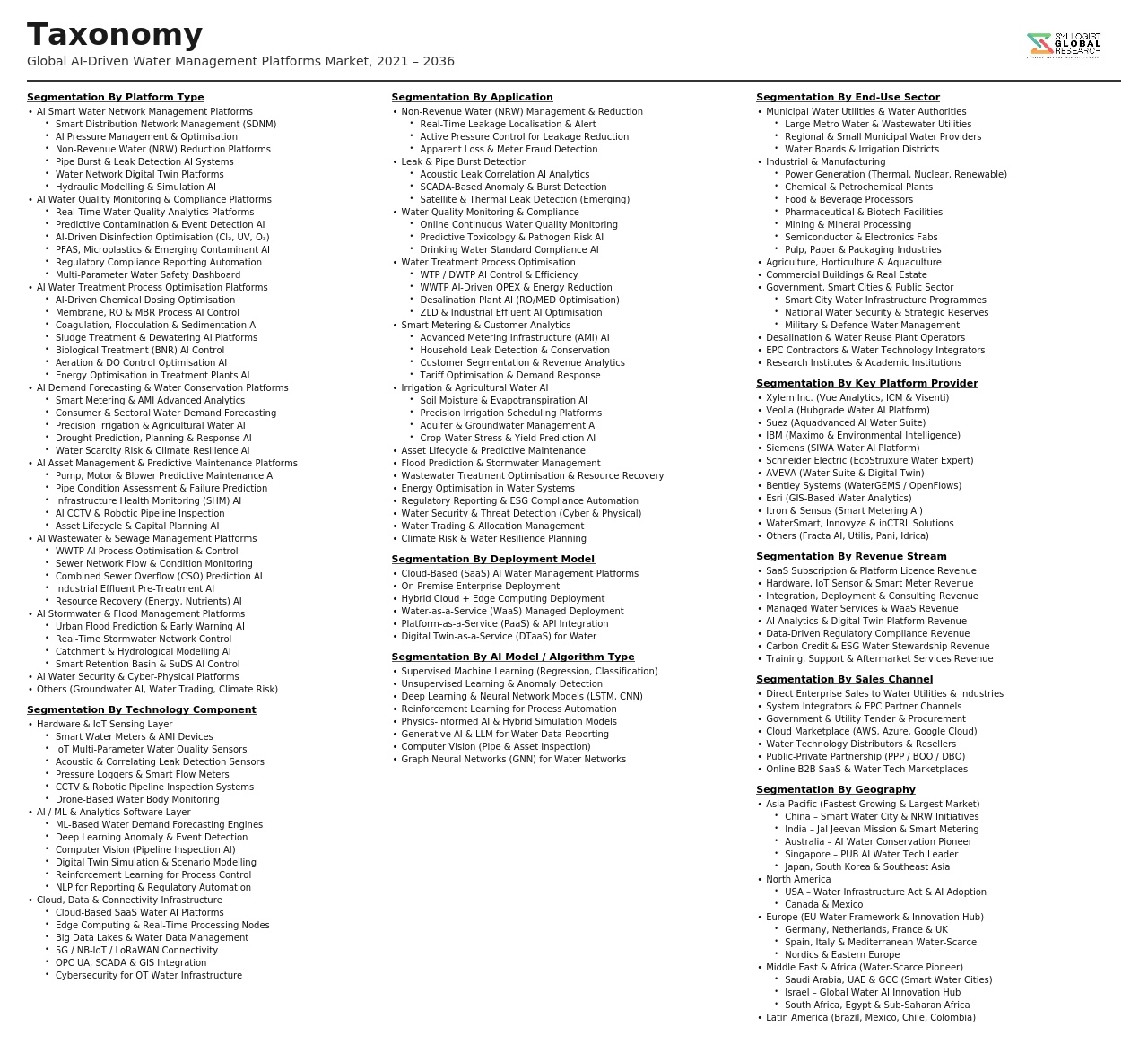
Market Segmentation
- Segmentation By Application Domain
- Non-Revenue Water Reduction and Leakage Detection
- Distribution Network Pressure Optimisation and Management
- Drinking Water Treatment Process Optimisation
- Wastewater Treatment Process Optimisation
- Water Demand Forecasting and Supply Planning
- Predictive Asset Maintenance and Condition Assessment
- Water Quality Monitoring and Early Warning Systems
- Precision Agricultural Irrigation Scheduling
- Stormwater Network Management and Flood Prediction
- Enterprise Water Resource Planning and Reporting
- Others
- Segmentation By AI and Analytics Technology
- Machine Learning and Deep Learning Predictive Models
- Computer Vision and Image Recognition Systems
- Natural Language Processing and Conversational Interfaces
- Digital Twin and Physics-Informed Neural Networks
- Anomaly Detection and Unsupervised Learning Algorithms
- Reinforcement Learning for Autonomous Process Control
- Explainable AI and Interpretable Model Architectures
- Others
- Segmentation By End-User Type
- Municipal Drinking Water Utilities
- Municipal Wastewater Utilities
- Combined Water and Wastewater Utilities
- Industrial Water Managers (Semiconductor and Electronics)
- Industrial Water Managers (Food, Beverage, and Pharmaceutical)
- Industrial Water Managers (Power Generation and Energy)
- Agricultural Irrigation Operators and Districts
- Mining and Resource Industry Water Managers
- Others
- Segmentation By Deployment Model
- Cloud-Hosted Software-as-a-Service Platform
- On-Premise Enterprise Software Deployment
- Hybrid Cloud and On-Premise Architecture
- Edge Computing and Field Device Intelligence
- Managed Digital Water Service (Outsourced Operations)
- Segmentation By Data Source Integration
- Smart Meter and Advanced Metering Infrastructure Data
- SCADA and Operational Technology System Integration
- IoT Pressure, Flow, and Water Quality Sensor Networks
- Satellite Remote Sensing and Aerial Imaging
- Weather, Climate, and Hydrological Data Feeds
- Geographic Information System and Asset Register Data
- Others
- Segmentation By Platform Functionality
- Real-Time Network Monitoring and Visualisation
- Predictive Analytics and Alert Generation
- Optimisation and Autonomous Control Recommendation
- Digital Twin Simulation and Scenario Planning
- Regulatory Reporting and Compliance Documentation
- Asset Management and Maintenance Scheduling
- Customer Engagement and Demand Side Management
- Segmentation By Organisation Size
- Large Utilities and Industrial Operators (Above 500,000 connections or high-volume industrial)
- Medium Utilities and Operators (50,000 to 500,000 connections)
- Small and Rural Utilities and Operators (Below 50,000 connections)
- Segmentation By Region
- North America (United States and Canada)
- Europe (European Union and United Kingdom)
- Asia-Pacific (China, India, Australia, Singapore, Japan, and Others)
- Middle East and North Africa
- Latin America
- Sub-Saharan Africa
All market revenues are presented in USD
Historical Year: 2021-2024 | Base Year: 2025 | Estimated Year: 2026 | Forecast Period: 2027-2034
Key Questions this Study Will Answer
- What is the total global market valuation of the AI-Driven Water Management Platforms Market in the base year 2025, and what is the projected market size and compound annual growth rate through 2034, disaggregated by application domain, non-revenue water and leakage management, treatment process optimisation, demand forecasting, predictive asset maintenance, water quality monitoring, and precision irrigation, by end-user type, municipal utilities, industrial operators, and agricultural water managers, and by deployment model, cloud-hosted and on-premise, to enable technology platform vendors, water utilities, industrial water managers, and investors to identify which application segments and end-user markets will generate the highest absolute revenue and most commercially significant adoption momentum across the forecast period?
- How are the regulatory frameworks governing water utility digital reporting, real-time water quality monitoring, smart meter deployment, and leakage detection performance across the European Union Drinking Water Directive recast, United Kingdom Ofwat Price Review 24 commitments, United States EPA water infrastructure requirements, and equivalent national regulatory programs in Australia, Singapore, and India expected to shape AI water management platform procurement timelines and investment volumes through 2034, and which regulatory markets are generating the most time-bound and commercially significant AI platform adoption mandates for municipal water utilities in the near-term forecast horizon?
- What is the projected commercial trajectory of AI-integrated water distribution network digital twin platforms through 2034, which capability combinations, physics-based hydraulic simulation, machine learning anomaly detection, real-time sensor data fusion, and scenario-based planning, are generating the highest documented operational value at reference utility deployments, what are the data infrastructure, sensor density, and operational technology integration prerequisites that determine the readiness of utility networks for production-grade digital twin deployment, and how are leading platform vendors differentiating their digital twin product architectures relative to standalone AI analytics competitors and general-purpose industrial digital twin platforms seeking to enter the water sector?
- How is the industrial water management AI platform segment expected to grow through 2034 across semiconductor manufacturing, food and beverage processing, pharmaceutical production, and power generation end-use sectors, what are the specific AI application domains generating the highest return on investment at industrial water management deployments, how are water cost escalation, zero liquid discharge regulatory requirements, and corporate water stewardship reporting obligations collectively shaping industrial water AI platform procurement priorities, and which technology platform vendors are establishing the most commercially significant positions in the industrial water AI management market relative to their municipal water utility platform capabilities?
- Who are the leading AI-driven water management platform developers, smart water analytics software companies, operational technology integration specialists, and digital water service providers currently defining the competitive landscape of the global market, and what are their respective platform capability coverage across application domains and end-user segments, reference deployment track records with documented operational performance outcomes, data partnership and smart sensor ecosystem strategies, research and development investment in large language model integration and explainable AI capabilities, cybersecurity architecture and certification program investments, and competitive positioning responses to the data quality, workforce capability, and cybersecurity challenges constraining AI water management platform adoption and value realisation across municipal and industrial water operator segments globally?
- Product Definition
- Research Methodology
- Research Design & Framework
- Overall Research Approach: Descriptive, Exploratory & Quantitative Mixed-Method Design
- Market Definition & Scope Boundaries: What is Included and Excluded
- Segmentation Framework
- Key Research Assumptions & Limitations
- Secondary Research
- Primary Research Design & Execution
- Data Triangulation & Validation
- Market Sizing & Forecasting Methodology
- Competitive Intelligence Methodology
- Quality Assurance & Peer Review
- Definitions, Abbreviations & Data Notes
- Research Design & Framework
- Executive Summary
- Market Snapshot & Headline Numbers
- Key Findings & Research Highlights
- Market Dynamics
- Regional Market Summary
- Competitive Landscape Snapshot
- Technology & Innovation Highlights
- Market Dynamics
- Drivers
- Restraints
- Opportunities
- Challenges
- Porter’s Five Forces Analysis
- PESTLE Analysis
- Market Trends & Developments
- Emerging Trends
- Technological Developments
- Regulatory & Policy Changes
- Supply Chain & Sourcing Trends
- Manufacturing & Process Trends
- Investment & Funding Activity
- Sustainability & ESG Trends
- Risk Assessment Framework
- Data Privacy, Cybersecurity & Critical Water Infrastructure Protection Risk
- AI Model Accuracy, Bias, Explainability & Decision Reliability Risk
- Legacy System Integration, Interoperability & Data Quality Risk
- Regulatory Compliance, Data Sovereignty & Cross-Border Data Governance Risk
- Talent Scarcity, Technology Adoption Barriers & Organisational Change Risk
- Regulatory Framework & Standards
- Water Utility Digital Transformation, Smart Water Network & SCADA Cybersecurity Regulatory Frameworks
- AI Governance, Algorithmic Accountability & Responsible AI Standards Applicable to Water Management
- Water Quality Monitoring, Real-Time Reporting & Environmental Data Disclosure Regulatory Requirements
- Data Sovereignty, Cloud Infrastructure & Cross-Border Data Transfer Regulations for Water Sector
- Green Finance, Smart City, ESG Disclosure & Digital Water Infrastructure Investment Standards
- Global AI-Driven Water Management Platforms Market Outlook
- Market Size & Forecast by Value
- Market Size & Forecast by Platform Type
- Integrated AI Water Management Platforms (End-to-End Suite)
- AI-Powered SCADA & Operational Technology (OT) Platforms
- Smart Metering Analytics & Demand Forecasting Platforms
- Leak Detection, Pressure Management & Network Optimisation Platforms
- Water Quality Monitoring & Predictive Compliance Platforms
- Asset Performance Management & Predictive Maintenance Platforms
- Stormwater, Flood Forecasting & Urban Drainage Management Platforms
- Irrigation Scheduling & Agricultural Water Management Platforms
- Digital Twin & Hydraulic Modelling Platforms
- Market Size & Forecast by Deployment Mode
- Cloud-Based (Public Cloud & SaaS)
- On-Premise
- Hybrid (Cloud & On-Premise)
- Edge Computing & Embedded AI
- Market Size & Forecast by AI Technology
- Machine Learning & Deep Learning
- Natural Language Processing (NLP) & Conversational AI
- Computer Vision & Imaging Analytics
- Predictive Analytics & Forecasting Models
- Reinforcement Learning & Autonomous Optimisation
- Digital Twin & Physics-Informed AI Modelling
- Market Size & Forecast by Component
- Software (Platform Licence, SaaS Subscription & Analytics Modules)
- Hardware (IoT Sensors, Edge Devices & Smart Meters)
- Services (Implementation, Integration, Training & Managed Services)
- Market Size & Forecast by Application
- Water Distribution Network Management & Loss Reduction
- Water & Wastewater Treatment Process Optimisation
- Water Quality Monitoring & Real-Time Compliance Assurance
- Asset Lifecycle Management & Predictive Maintenance
- Customer Engagement, Demand Forecasting & Tariff Optimisation
- Stormwater Management, Flood Prediction & Urban Resilience
- Agricultural Irrigation Scheduling & Water Use Efficiency
- Industrial Process Water Optimisation & Reuse
- Market Size & Forecast by End-User
- Municipal Water & Wastewater Utilities
- Industrial Manufacturers & Process Industries
- Agricultural Operators & Irrigation Scheme Managers
- Government Agencies & National Water Authorities
- Smart City & Urban Infrastructure Operators
- Mining, Oil & Gas Operators
- Market Size & Forecast by Organisation Size
- Large Enterprises
- Small & Medium Enterprises (SMEs)
- Market Size & Forecast by Sales Channel
- Direct Sales & Enterprise Licensing
- System Integrators & Technology Partners
- Cloud Marketplace & SaaS Subscription
- Managed Service & Outcome-Based Contracts
- North America AI-Driven Water Management Platforms Market Outlook
- Market Size & Forecast
- By Value
- By Platform Type
- By Deployment Mode
- By AI Technology
- By Application
- By End-User
- By Organisation Size
- By Sales Channel
- By Country
- Market Size & Forecast
- Europe AI-Driven Water Management Platforms Market Outlook
- Market Size & Forecast
- By Value
- By Platform Type
- By Deployment Mode
- By AI Technology
- By Application
- By End-User
- By Organisation Size
- By Sales Channel
- By Country
- Market Size & Forecast
- Asia-Pacific AI-Driven Water Management Platforms Market Outlook
- Market Size & Forecast
- By Value
- By Platform Type
- By Deployment Mode
- By AI Technology
- By Application
- By End-User
- By Organisation Size
- By Sales Channel
- By Country
- Market Size & Forecast
- Latin America AI-Driven Water Management Platforms Market Outlook
- Market Size & Forecast
- By Value
- By Platform Type
- By Deployment Mode
- By AI Technology
- By Application
- By End-User
- By Organisation Size
- By Sales Channel
- By Country
- Market Size & Forecast
- Middle East & Africa AI-Driven Water Management Platforms Market Outlook
- Market Size & Forecast
- By Value
- By Platform Type
- By Deployment Mode
- By AI Technology
- By Application
- By End-User
- By Organisation Size
- By Sales Channel
- By Country
- Market Size & Forecast
- Country-Wise* AI-Driven Water Management Platforms Market Outlook
- Market Size & Forecast
- By Value
- By Platform Type
- By Deployment Mode
- By AI Technology
- By Application
- By End-User
- By Organisation Size
- By Sales Channel
- By Country
- Market Size & Forecast
- *Countries Analyzed in the Syllogist Global Research Portfolio: United States, Canada, Mexico, Germany, France, United Kingdom, Netherlands, Spain, Italy, Norway, Sweden, China, Japan, India, Australia, South Korea, Singapore, Brazil, Chile, Saudi Arabia, UAE, Egypt, South Africa, Israel
- Technology Landscape & Innovation Analysis
- AI-Powered Leak Detection & Non-Revenue Water (NRW) Reduction Platform Technology Deep-Dive
- Machine Learning-Based Water Demand Forecasting, Pressure Optimisation & Smart Network Technology
- Real-Time Water Quality Monitoring, Anomaly Detection & Predictive Compliance AI Technology
- Digital Twin & Hydraulic Modelling Platform Technology for Water Distribution & Treatment Systems
- Predictive Asset Management, Failure Forecasting & Maintenance Scheduling AI Technology
- AI-Driven Agricultural Irrigation Scheduling, Remote Sensing & Crop Water Stress Detection Technology
- Stormwater, Urban Flood Forecasting & Climate Resilience AI Platform Technology
- Patent & IP Landscape in AI-Driven Water Management Platform Technologies
- Value Chain & Supply Chain Analysis
- AI Platform Software Development, Data Science & Algorithm Engineering Supply Chain
- IoT Sensor, Smart Meter, Edge Device & Hardware Component Supply Chain
- Cloud Infrastructure, Data Centre & Hyperscaler Service Provider Channel
- Telecommunications & Connectivity Infrastructure Supply Chain for Water Networks
- System Integrator, Implementation Partner & Water Sector Consulting Channel
- Water Utility, Industrial & Agricultural End-User Procurement & Decision-Making Channel
- Data Marketplace, Open Data & Third-Party Analytics Partner Ecosystem
- Pricing Analysis
- AI Water Platform SaaS Subscription & Per-Connection Licensing Pricing Analysis
- On-Premise & Hybrid Deployment Licence, Implementation & Integration Cost Analysis
- IoT Sensor, Smart Meter & Edge Device Hardware Cost Analysis
- Managed Service, Outcome-Based & Performance Contract Pricing Analysis
- Total Cost of Ownership (TCO) & ROI Analysis for AI Water Management Platform Deployments
- SaaS vs. On-Premise vs. Hybrid Deployment Cost Comparison & Value Benchmarking Analysis
- Sustainability & Environmental Analysis
- Lifecycle Assessment (LCA) of AI Water Management Platform Deployments: Carbon Footprint, Energy Consumption & Hardware Waste
- Water Loss Reduction, Non-Revenue Water (NRW) Savings & Freshwater Conservation Contribution of AI Platforms
- Energy Efficiency Gains in Water Treatment & Distribution Achieved Through AI-Driven Optimisation
- Agricultural Water Use Efficiency, Irrigation Savings & Food Security Contribution of AI Water Platforms
- Regulatory-Driven Sustainability, SDG 6 (Clean Water & Sanitation) Alignment & Green Finance Eligibility for AI Water Platforms
- Competitive Landscape
- Market Structure & Concentration
- Market Consolidation Level (Fragmented vs. Consolidated by Platform Type, Deployment Mode & Geography)
- Top 10 Players Market Share
- HHI (Herfindahl-Hirschman Index) Concentration Analysis
- Competitive Intensity Map by Platform Type, Application & Geography
- Player Classification
- Integrated Water Technology Companies with AI Platform Divisions
- Pure-Play AI & Advanced Analytics Platform Providers for Water
- Smart Metering, IoT & Sensor Technology Companies with AI Analytics Capabilities
- Cloud Hyperscalers & Enterprise AI Platform Vendors Serving Water Utilities
- Digital Twin & Hydraulic Modelling Software Providers
- System Integrators & IT Consultancies Specialising in Water Digital Transformation
- Start-ups & Scale-ups in AI-Driven Water Intelligence & Predictive Analytics
- Competitive Analysis Frameworks
- Market Share Analysis by Platform Type, Application & Region
- Company Profile
- Company Overview & Headquarters
- AI Water Management Platform Products & Technology Portfolio
- Key Customer Relationships & Reference Utility & Industrial Deployments
- R&D Investment & AI Innovation Pipeline
- Revenue (AI Water Platform Segment) & Annual Recurring Revenue (ARR)
- Technology Differentiators & IP
- Key Strategic Partnerships, JVs & M&A Activity
- Recent Developments (Contract Wins, Product Launches, Funding Rounds)
- SWOT Analysis
- Strategic Focus Areas & Roadmap
- Competitive Positioning Map (AI Capability vs. Market Penetration)
- Key Company Profiles
- Market Structure & Concentration
- Technology Landscape & Innovation Analysis
- Strategic Output
- Market Opportunity Matrix: By Platform Type, AI Technology, Application, End-User & Geography
- White Space Opportunity Analysis
- Strategic Recommendations
- Product Portfolio & Technology Investment Strategy
- Manufacturing & Operational Excellence Strategy
- Geographic Expansion & Localisation Strategy
- Customer & End-User Engagement Strategy
- Partnership, M&A & Ecosystem Strategy
- Sustainability & Circular Economy Strategy
- Risk Mitigation & Future Roadmap
- Strategic Priority Matrix & Roadmap
- Near-term (2025-2028)
- Mid-term (2029-2032)
- Long-term (2033-2037)
- Strategic Output