Global Underground Gas Storage Market By Storage Type, By Reservoir Geology, By Working Gas Capacity, By Operating Pressure, By Service Type, By Application, By End User, By Region, Competition, Forecast & Opportunities, 2021-2036F
Market Definition
The Global Underground Gas Storage Market encompasses the engineering, development, construction, expansion, operation, and lifecycle servicing of subsurface natural gas storage facilities that hold working gas inventory in geological formations to balance seasonal demand, manage peak shaving, support LNG roundtripping, secure strategic reserves, and provide flexibility for gas pipeline networks. The market includes depleted oil and gas reservoir storage that exploits the original trap, caprock integrity, and reservoir properties of producing formations after primary depletion; aquifer storage that injects gas into saline porous formations beneath an impermeable caprock; salt cavern storage created by solution mining of bedded and domal salt formations to produce high-deliverability, low-cushion-gas storage cells; and a small share of abandoned hard-rock mine storage. Within scope are surface compressor stations, gas treatment and dehydration facilities, custody transfer metering and measurement, gathering and distribution headers, injection and withdrawal wells, downhole completions, monitoring and integrity management systems, cushion gas inventory financing, and the geological characterization, geomechanical modeling, and seismic surveillance workflows that underpin facility safety. The market also covers storage capacity service contracting, including bundled and unbundled storage services, firm and interruptible storage rights, hub services, virtual storage products, and balancing services offered by storage operators to shippers and end users. End users include gas utilities, transmission system operators, industrial gas consumers, LNG terminal operators, power generators, gas trading and marketing firms, strategic reserve agencies, and emerging hydrogen storage developers adapting depleted reservoir and salt cavern assets for hydrogen service. For this study, the market is measured by equipment, EPC project, and storage service revenue in USD across greenfield development, capacity expansion, and operating facilities.
Market Insights
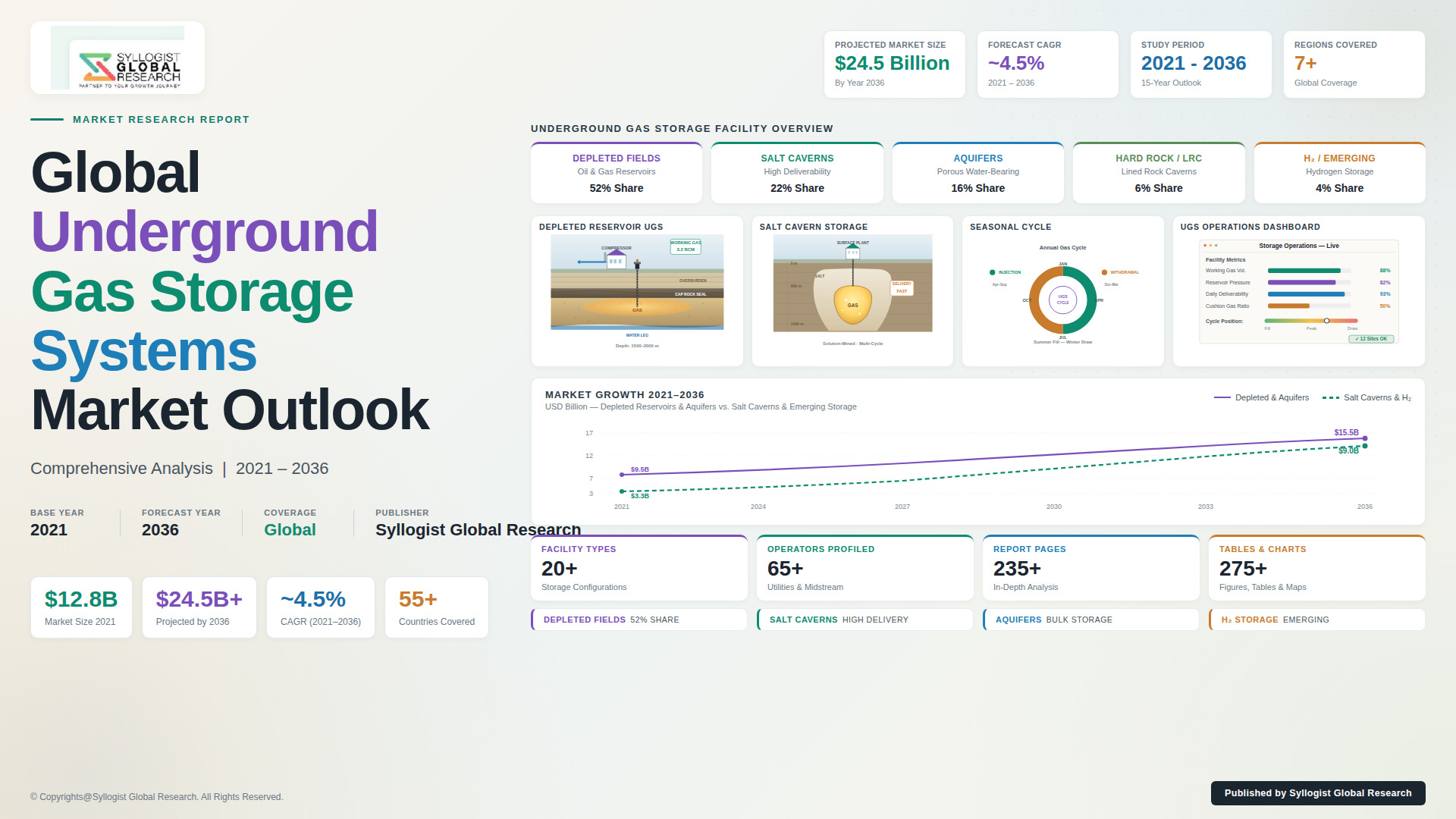
The global underground gas storage market is moving through a structurally elevated investment cycle, reshaped by the post-2022 European energy security reset, accelerating LNG import dependence, growing seasonal gas demand swings, and emerging long-cycle optionality from hydrogen storage adaptation. The market was valued at approximately USD 4.8 billion in 2025 and is projected to reach USD 8.6 billion by 2034, advancing at a compound annual growth rate of 6.7% through the forecast period, as new facility development, brownfield expansion, salt cavern leaching, and integrity-driven retrofit programs underpin a multi-year orderbook for EPC contractors, compressor OEMs, and well services providers. Global working gas storage capacity reached approximately 424 bcm by the end of 2024 across roughly 672 active facilities, with depleted reservoirs accounting for 76% of working gas capacity, aquifers for 12%, salt caverns for 11%, and abandoned mines and others for the remaining 1%.
The United States hosts the largest installed working gas storage capacity at 116 bcm across approximately 400 active facilities, supplying flexibility to a domestic gas market consuming 950 bcm per year and increasingly to the LNG export complex now exceeding 96 mtpa under construction on the Gulf Coast. Europe holds the second-largest pool of working gas storage at 110 bcm, with the largest national positions in Germany at 24.4 bcm, Italy at 17.4 bcm, Ukraine at 30.9 bcm, France at 13.6 bcm, the Netherlands at 13.1 bcm including the 4.6 bcm Bergermeer field, and the United Kingdom rebuilding capacity through the reopened Rough facility now delivering 7.5 bcm. Russia and the broader CIS hold approximately 120 bcm of working gas, while Asia Pacific stores 36 bcm with China expanding rapidly from 19.5 bcm in 2024 toward a national target of 55 bcm by 2030.
Salt cavern storage has emerged as the fastest-growing storage segment, driven by its high deliverability, low cushion gas ratio of 30% versus 50% to 60% for depleted reservoirs, multiple annual cycle capability, and natural adaptability to hydrogen service. Announced salt cavern projects with committed FID exceed 19.4 bcm of new working gas capacity through 2032, anchored by expansion at Etzel and Epe in Germany, Inčukalns in Latvia upgrading from 2.3 bcm to 3.2 bcm, the Liquid Air Energy Storage and hydrogen-ready cavern programs at Teesside in the United Kingdom, and Chinese salt cavern programs in Jintan and Jianghan. Cushion gas inventory financing costs have climbed materially with TTF reference prices stabilizing at EUR 36 per MWh in 2025, with cushion gas representing 38% of total project capex on greenfield salt cavern facilities and 52% on depleted reservoir conversions.
Hydrogen storage adaptation has emerged as the most significant long-cycle structural opportunity reshaping investment thesis across the market. Salt caverns are the proven hydrogen storage medium, with the Mossmorran and Teesside facilities in the United Kingdom, the SoutH2 corridor across Germany, and the HyStock facility in Zuidwending in the Netherlands actively converting from natural gas to hydrogen service. European Hydrogen Backbone planning estimates a hydrogen storage requirement of 270 TWh by 2030 and 450 TWh by 2050, equivalent to a salt cavern volume requirement of 22 bcm at 200 bar storage pressure, generating durable demand for cavern leaching, wellhead conversion, and hydrogen-compatible compression equipment. The competitive landscape spans storage operators including Storengy, Uniper, Equinor, Gazprom, SoCalGas, EnBW, and Verbundnetz Gas, EPC contractors, and a long tail of specialist well services and compressor vendors, with the top 12 operators controlling 64% of global working gas storage capacity.
Key Drivers
European Energy Security Reset, LNG Import Dependence, and Mandatory Minimum Storage Filling Targets Driving Capacity Build-Out and Retrofit Investment
The post-2022 European reset has converted underground gas storage from a commercial flexibility tool into a strategic energy security infrastructure category, with the EU Gas Storage Regulation mandating 90% storage fill by November 1 each year, the United Kingdom subsidizing the reopening of the Rough facility at 7.5 bcm, and Germany providing federal financial guarantees for storage filling. The structural rise in European LNG import dependence at 174 bcm in 2024 against piped gas of 116 bcm has elevated storage as the primary balancing mechanism, anchoring multi-year retrofit, integrity, and expansion programs.
Salt Cavern Storage Adaptation for Hydrogen Service and European Hydrogen Backbone Programs Generating New Long-Cycle Demand for Subsurface Storage Assets
The European Hydrogen Backbone planning estimate of 270 TWh of hydrogen storage requirement by 2030 and 450 TWh by 2050, combined with active hydrogen storage projects at HyStock in the Netherlands, Mossmorran and Teesside in the United Kingdom, the SoutH2 corridor in Germany, and the Hychico project in Argentina, is generating sustained demand for salt cavern leaching, wellhead conversion, hydrogen-compatible compression, and integrity monitoring services. Salt cavern storage developers are increasingly designing dual-service capability, providing both natural gas and hydrogen storage flexibility within the same asset base.
Chinese Strategic Storage Capacity Expansion, Asian LNG Import Growth, and Seasonal Demand Volatility Driving Asia Pacific Underground Gas Storage Investment
China’s strategic storage capacity expansion target of 55 bcm of working gas by 2030, up from 19.5 bcm in 2024, is underpinning sustained demand for depleted reservoir characterization, salt cavern leaching, and integrated EPC packages across Jintan, Jianghan, and Hutubi storage hubs. India, Japan, South Korea, and the Philippines are evaluating greenfield UGS programs to balance accelerating LNG import dependence, while Australia and Thailand are pursuing brownfield depleted reservoir conversions, collectively representing USD 18 billion of committed capex through 2032.
Key Challenges
Long-Term Demand Uncertainty Under Decarbonization Pathways, Stranded Asset Risk, and Investor ESG Pressure Constraining Greenfield Storage Investment Decisions
Investor scrutiny of long-cycle hydrocarbon infrastructure, the structural uncertainty around long-term gas demand under accelerated decarbonization pathways, and the strategic shift of European utilities toward integrated low-carbon platforms are constraining the ability of operators to sanction multi-decade greenfield UGS programs. Project payback hurdles have lengthened to 12 to 18 years on cavern projects against a regulatory and demand horizon increasingly uncertain beyond 2035, shifting capital toward expansion, integrity retrofit, and hydrogen-ready dual-service configurations rather than single-purpose grassroots natural gas storage.
Aging Infrastructure, Well Integrity Risk, and Post-Aliso Canyon Regulatory Tightening Increasing Compliance and Lifecycle Operating Costs
Approximately 53% of US working gas storage capacity is located in facilities exceeding 50 years of operating life, with similar profiles across Western Europe and the CIS. Post-Aliso Canyon regulatory tightening under PHMSA 192 Subpart M and equivalent European safety frameworks has elevated baseline compliance costs, requires single-barrier well replacement, real-time wellbore integrity monitoring, and seismic surveillance, while insurance premiums for storage operators have risen 47% on average since 2017, eroding storage service margins and complicating brownfield expansion economics.
Cushion Gas Financing Costs, Salt Cavern Leaching Brine Disposal Constraints, and Induced Seismicity Concerns Slowing New Cavern Development
Cushion gas inventory financing costs have escalated with European TTF gas prices stabilizing at EUR 36 per MWh, pushing cushion gas to 38% of total greenfield cavern project capex and 52% of depleted reservoir conversion capex. Salt cavern leaching requires brine disposal in environmentally acceptable receiving environments, which is increasingly constrained in inland European jurisdictions, while community concerns over induced seismicity in stimulation-intensive operations have triggered moratoria and extended permitting timelines beyond 36 months in several European countries.
Market Segmentation
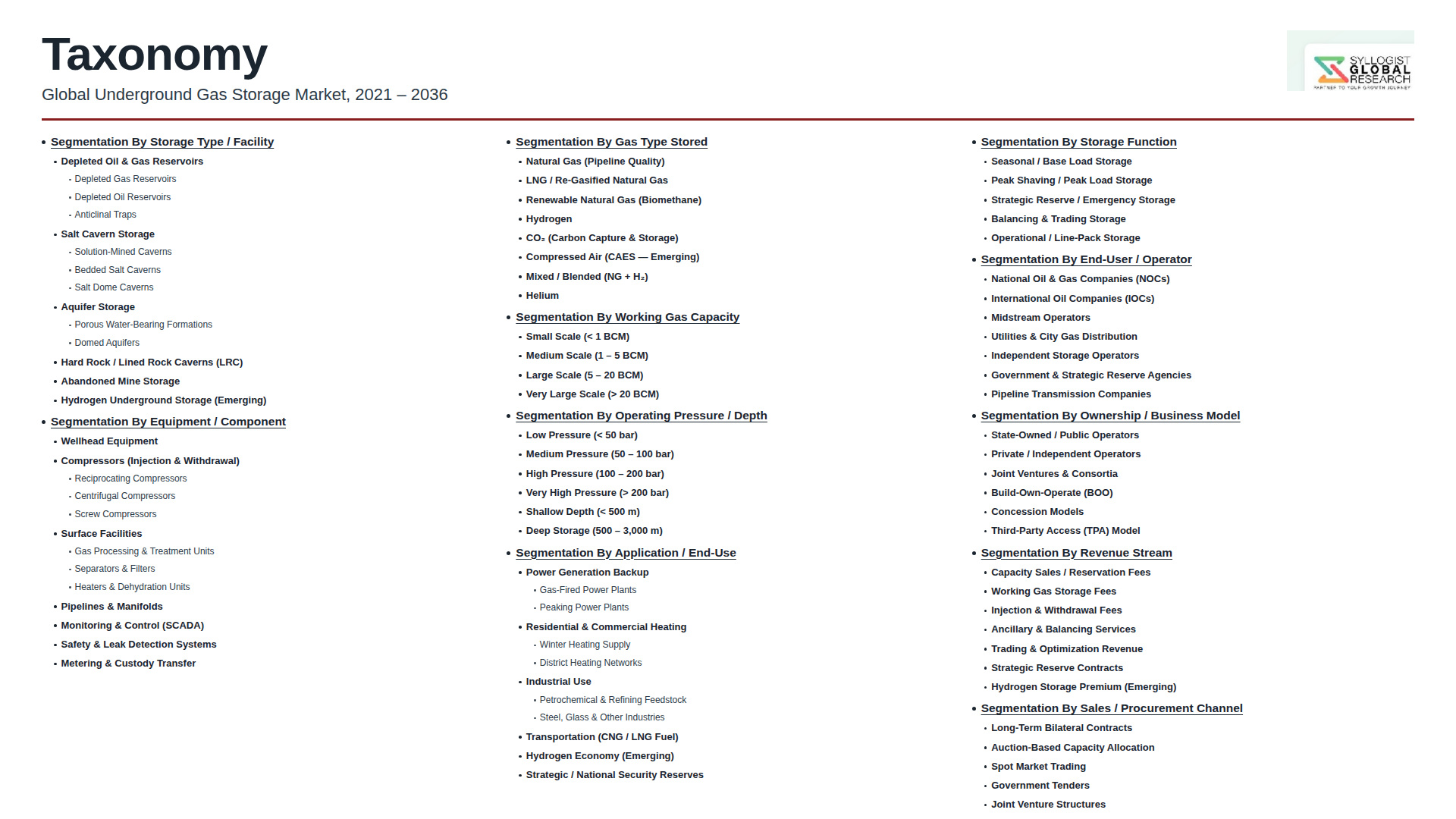
- Segmentation By Storage Type
- Depleted Oil and Gas Reservoir Storage
- Aquifer Storage
- Salt Cavern Storage (Bedded and Domal)
- Abandoned Mine and Hard-Rock Storage
- Others
- Segmentation By Reservoir Geology
- Sandstone Reservoir
- Carbonate and Limestone Reservoir
- Bedded Salt Formation
- Domal Salt Formation
- Other Geological Formations
- Segmentation By Working Gas Capacity
- Small Scale (Up to 0.5 bcm)
- Medium Scale (0.5 to 2 bcm)
- Large Scale (2 to 5 bcm)
- Very Large Scale (Above 5 bcm)
- Segmentation By Operating Pressure
- Low Pressure (Up to 100 bar)
- Medium Pressure (100 to 200 bar)
- High Pressure (Above 200 bar)
- Segmentation By Service Type
- Bundled Storage Services
- Unbundled Storage Services
- Firm Storage Rights
- Interruptible Storage Rights
- Hub Services and Park-and-Loan
- Virtual Storage Products
- Balancing Services
- Others
- Segmentation By Application
- Seasonal Demand Balancing
- Peak Shaving and Daily Load Following
- LNG Roundtripping and Reload Optimization
- Strategic Gas Reserves
- Pipeline Network Balancing
- Hydrogen Storage Adaptation
- Power Generation Fuel Buffering
- Industrial Supply Continuity
- Others
- Segmentation By End User
- Gas Utilities and LDCs
- Transmission System Operators
- LNG Terminal Operators
- Power Generator
- Industrial Gas Consumers
- Gas Trading and Marketing Firms
- Strategic Reserve Agencies
- Hydrogen Storage Developers
- Others
- Segmentation By Region
- North America
- Europe
- Asia-Pacific
- CIS and Russia
- Middle East and Africa
- Latin America
All market revenues are presented in USD
Historical Year: 2021-2024 | Base Year: 2025 | Estimated Year: 2026 | Forecast Period: 2027-2034
Key Questions this Study Will Answer
- What is the total global market valuation of the Underground Gas Storage Market in 2025, projected through 2034, disaggregated by storage type, reservoir geology, working gas capacity, service type, and application, enabling EPC contractors, equipment OEMs, storage operators, transmission system operators, and infrastructure investors to identify the highest-growth segments and most durable revenue opportunities across the underground gas storage landscape?
- How are leading underground gas storage jurisdictions in the United States, Germany, Italy, the United Kingdom, the Netherlands, France, Ukraine, China, India, and the Gulf Cooperation Council region allocating capital across depleted reservoir storage, aquifer storage, salt cavern storage, and hydrogen-ready dual-service configurations, and which national programs are setting the technical specification, regulatory, and procurement benchmarks shaping the global market through 2034?
- What are the relative deliverability, cushion gas ratio, cycle frequency, integrity, geomechanical, and adaptability advantages of depleted reservoir, aquifer, and salt cavern storage architectures across seasonal balancing, peak shaving, LNG roundtripping, strategic reserves, and hydrogen storage applications, and which storage types are most likely to capture incremental share between 2025 and 2034?
- Which application segments, including seasonal demand balancing, LNG roundtripping, pipeline network balancing, strategic gas reserves, power generation fuel buffering, and hydrogen storage adaptation, are generating the highest investment velocity through 2034, and what storage architectures, service contract structures, and integrity monitoring frameworks are most critical to operational performance in each category?
- How is the competitive landscape structured among major storage operators including Storengy, Uniper, Equinor, Gazprom, SoCalGas, EnBW, and Verbundnetz Gas, EPC contractors specializing in salt cavern leaching and reservoir conversion, and equipment OEMs supplying compressors, dehydration units, and integrity monitoring, and what partnership, joint venture, capacity expansion, and acquisition strategies are enabling new entrants to compete in next-generation underground gas storage and hydrogen storage programs?
- What are the most significant long-term demand uncertainty, well integrity risk, cushion gas financing, brine disposal, induced seismicity, and post-Aliso Canyon regulatory compliance risks affecting underground gas storage deployments, and how are operators, regulators, insurers, and project financiers addressing integrity management, dual-service flexibility, and risk allocation within evolving underground storage regulatory and technical frameworks?
- Which regional underground gas storage markets, specifically Europe, North America, Asia Pacific, the CIS, the Middle East and Africa, and Latin America, are expected to generate the most substantial incremental storage capacity additions and equipment procurement through 2034, and what regulatory frameworks, EU Gas Storage Regulation fill mandates, hydrogen backbone planning, strategic reserve policies, and LNG import balancing requirements are driving project development priorities and supplier selection in each regional market?
- Product Definition
- Research Methodology
- Research Design & Framework
- Overall Research Approach: Descriptive, Exploratory & Quantitative Mixed-Method Design
- Market Definition & Scope Boundaries: What is Included and Excluded
- Segmentation Framework
- Key Research Assumptions & Limitations
- Secondary Research
- Primary Research Design & Execution
- Data Triangulation & Validation
- Market Sizing & Forecasting Methodology
- Competitive Intelligence Methodology
- Quality Assurance & Peer Review
- Definitions, Abbreviations & Data Notes
- Research Design & Framework
- Executive Summary
- Market Snapshot & Headline Numbers
- Key Findings & Research Highlights
- Market Dynamics
- Regional Market Summary
- Competitive Landscape Snapshot
- Technology & Innovation Highlights
- Market Dynamics
- Drivers
- Restraints
- Opportunities
- Challenges
- Porter’s Five Forces Analysis
- PESTLE Analysis
- Market Trends & Developments
- Emerging Trends
- Technological Developments
- Regulatory & Policy Changes
- Cushion Gas, Working Gas & Capacity Sourcing Trends
- Storage Development, Drilling & Commissioning Trends
- Investment, Storage Project Pipeline & Funding Activity
- Sustainability & ESG Trends
- Risk Assessment Framework
- Reservoir Integrity, Gas Migration, Caprock Containment & Subsurface Performance Risk
- Cushion Gas Investment, Working Gas Cycling Performance & Operational Reliability Risk
- Regulatory, Strategic Reserve Mandate (EU Storage Regulation 2022/1032) & Cross-Jurisdictional Compliance Risk
- Gas Price Volatility, Summer-Winter Storage Spread & Commercial Margin Risk
- Energy Transition, Demand Decline, Stranded Asset & Hydrogen Repurposing Conversion Risk
- Regulatory Framework & Standards
- National Gas Storage Codes, Strategic Reserve Mandates & EU Gas Storage Regulation (2022/1032) Filling-Level Frameworks
- API RP 1170 & RP 1171 (Salt Caverns), API RP 1114 (Depleted Reservoirs) & EN 1918 Underground Gas Storage Standards
- Well Integrity, Subsurface Containment, Monitoring & Reservoir Management Operational Standards
- Methane Emissions, Fugitive Leakage, PHMSA & Environmental Discharge Standards for Underground Gas Storage Sites
- Hydrogen Storage Emerging Standards (ISO/TC 197, NACE Material Compatibility) & Cross-Sector Energy Storage Frameworks
- Global Underground Gas Storage Market Outlook
- Market Size & Forecast by Value
- Market Size & Forecast by Volume (Working Gas Capacity, Bcm & Peak Withdrawal Capacity, MMcm/d)
- Market Size & Forecast by Storage Reservoir Type
- Depleted Oil & Gas Reservoir Storage
- Aquifer Storage
- Salt Cavern Storage
- Lined Rock Cavern (LRC) & Engineered Subsurface Storage
- Abandoned Coal Mine & Other Repurposed Subsurface Storage
- Market Size & Forecast by Equipment & Infrastructure Type
- Wellhead Equipment, Christmas Trees & Subsurface Safety Valves
- Injection & Withdrawal Compression Systems
- Gas Treatment, Dehydration, Heating & Filtration Equipment
- Pipeline Connections, Gathering Systems & Custody Transfer Equipment
- Metering, Quality Control & Allocation Systems
- Control, SCADA, Monitoring & Cybersecurity Systems
- Above-Ground Surface Facilities & Process Plant Equipment
- Drilling, Workover & Subsurface Services Equipment
- Market Size & Forecast by Gas Stored
- Natural Gas (Methane)
- Hydrogen
- Synthetic Methane, Biomethane & Renewable Natural Gas (RNG)
- Hydrogen-Natural Gas Blends
- Compressed Air (CAES-Adjacent Subsurface Storage)
- Market Size & Forecast by Project Scale
- Large-Scale Strategic Storage (Above 1 Bcm Working Gas Capacity)
- Medium-Scale Storage (300 MMcm to 1 Bcm Working Gas Capacity)
- Small-Scale Storage (100 to 300 MMcm Working Gas Capacity)
- Distributed & Peaking Storage (Below 100 MMcm Working Gas Capacity)
- Market Size & Forecast by Application
- Seasonal Demand Balancing
- Strategic National Energy Security & Mandated Reserves
- Peak Shaving & Peaking Service
- LNG Trade Flexibility & Cargo Optionality
- Pipeline Balancing & Linepack Management
- Hydrogen Storage for Energy System Resilience
- Renewable Integration & Power-to-Gas Storage
- Gas Trading, Hub Arbitrage & Forward Curve Optimisation
- Hub Services (Title Transfer, Park & Loan, Wheeling)
- Market Size & Forecast by End-User
- Gas Utility & Distribution Companies
- Gas Transmission System Operators (TSOs)
- Independent Underground Gas Storage Operators
- Government Agencies & Strategic Reserve Operators
- Upstream Gas Producers (Production Balancing)
- Gas-Fired Power Generators & Peaker Operators
- Industrial Captive Users & Petrochemical Off-Takers
- LNG Importers, Regasification & Terminal Operators
- Hydrogen Project Developers & Clean Energy Off-Takers
- Market Size & Forecast by Sales Channel & Service Type
- Long-Term Firm Capacity Contract
- Short-Term & Spot Capacity Auction
- Interruptible Storage Service
- Hub-Based & Title Transfer Storage Service (Park & Loan, Wheeling)
- Strategic & Regulated Reserve Allocation
- Build-Own-Operate (BOO) & Project Development Channel
- North America Underground Gas Storage Market Outlook
- Market Size & Forecast
- By Value
- By Volume (Working Gas Capacity, Bcm & Peak Withdrawal Capacity, MMcm/d)
- By Storage Reservoir Type
- By Equipment & Infrastructure Type
- By Gas Stored
- By Project Scale
- By Application
- By End-User
- By Country
- By Sales Channel & Service Type
- Europe Underground Gas Storage Market Outlook
- Market Size & Forecast
- By Value
- By Volume (Working Gas Capacity, Bcm & Peak Withdrawal Capacity, MMcm/d)
- By Storage Reservoir Type
- By Equipment & Infrastructure Type
- By Gas Stored
- By Project Scale
- By Application
- By End-User
- By Country
- By Sales Channel & Service Type
- Asia-Pacific Underground Gas Storage Market Outlook
- Market Size & Forecast
- By Value
- By Volume (Working Gas Capacity, Bcm & Peak Withdrawal Capacity, MMcm/d)
- By Storage Reservoir Type
- By Equipment & Infrastructure Type
- By Gas Stored
- By Project Scale
- By Application
- By End-User
- By Country
- By Sales Channel & Service Type
- Latin America Underground Gas Storage Market Outlook
- Market Size & Forecast
- By Value
- By Volume (Working Gas Capacity, Bcm & Peak Withdrawal Capacity, MMcm/d)
- By Storage Reservoir Type
- By Equipment & Infrastructure Type
- By Gas Stored
- By Project Scale
- By Application
- By End-User
- By Country
- By Sales Channel & Service Type
- Middle East & Africa Underground Gas Storage Market Outlook
- Market Size & Forecast
- By Value
- By Volume (Working Gas Capacity, Bcm & Peak Withdrawal Capacity, MMcm/d)
- By Storage Reservoir Type
- By Equipment & Infrastructure Type
- By Gas Stored
- By Project Scale
- By Application
- By End-User
- By Country
- By Sales Channel & Service Type
- Country-Wise* Underground Gas Storage Market Outlook
- Market Size & Forecast
- By Value
- By Volume (Working Gas Capacity, Bcm & Peak Withdrawal Capacity, MMcm/d)
- By Storage Reservoir Type
- By Equipment & Infrastructure Type
- By Gas Stored
- By Project Scale
- By Application
- By End-User
- By Country
- By Sales Channel & Service Type
- *Countries Analyzed in the Syllogist Global Research Portfolio: United States, Canada, Mexico, Germany, France, United Kingdom, Netherlands, Spain, Italy, Norway, Sweden, China, Japan, India, Australia, South Korea, Singapore, Brazil, Chile, Saudi Arabia, UAE, Egypt, South Africa, Israel
- Technology Landscape & Innovation Analysis
- Depleted Oil & Gas Reservoir Storage Technology Deep-Dive
- Aquifer Storage Technology & Geological Site Characterisation
- Salt Cavern Storage Technology (Solution Mining, Cavern Design, Brine Management & Cycling Performance)
- Lined Rock Cavern (LRC) & Engineered Subsurface Storage Technology
- Injection & Withdrawal Compression Technology for Storage Cycling Service
- Gas Treatment, Dehydration, Heating & Surface Facilities Technology for Storage Operations
- Well Integrity, Casing Design, Monitoring & Subsurface Surveillance Technology
- Hydrogen Storage in Salt Caverns & Depleted Reservoirs: Material Compatibility, Cushion Gas & Cycling Technology
- Digital Twin, AI-Enabled Reservoir Modelling & Predictive Performance Management Technology
- Patent & IP Landscape in Underground Gas Storage Technologies
- Value Chain & Supply Chain Analysis
- Underground Gas Storage Operator Landscape (Utility, TSO, Independent, Strategic Reserve)
- Storage Compression, Wellhead, Christmas Tree & Surface Facility OEM Supply Chain
- Drilling, Workover, Well Services & Subsurface Engineering Supply Chain
- Salt Cavern Solution Mining, Brine Disposal & Cavern Development Service Providers
- Gas Treatment Equipment, Dehydration, Heating & Filtration Supply Chain
- EPC Contractor, Storage Project Developer & System Integrator Channel
- Gas Trader, Hub Operator & Capacity Allocation Platform Channel
- Utility, Power Generator, Industrial & LNG End-User Procurement Channel
- Operations, Maintenance, Well Integrity & Lifecycle Service Provider Channel
- Pricing Analysis
- Working Gas Capacity Pricing (Per Bcm & Per Bcf) Across Storage Reservoir Types
- Peak Withdrawal Capacity Pricing & Peaking Storage Service Premium Analysis
- Long-Term Firm vs. Short-Term Interruptible Capacity Auction Pricing Analysis
- Hub-Based & Title Transfer Storage Service Pricing (NBP, TTF, Henry Hub & Major Hub Linked)
- Storage Spread (Summer-Winter, Forward Curve) Pricing & Arbitrage Margin Analysis
- Capital Cost Per Bcm of Storage Capacity & EPC Project Pricing Analysis
- Hydrogen vs. Natural Gas Underground Storage Cost Comparison & Conversion Capex Analysis
- Sustainability & Environmental Analysis
- Methane Emissions, Fugitive Leakage & Wellhead Integrity Performance of Modern Underground Gas Storage
- Role of Underground Gas Storage in Energy Security, Renewable Integration & Power Grid Decarbonisation
- Repurposing of Underground Gas Storage Assets for Hydrogen & Synthetic Methane Storage
- CO2 Co-Storage, Carbon Capture Integration & Subsurface Multi-Use Considerations
- Alignment of Underground Gas Storage with Energy Transition, IEA Global Methane Pledge, SDG 7 (Clean Energy), SDG 13 (Climate Action) & Sustainable Finance Eligibility
- Competitive Landscape
- Market Structure & Concentration
- Market Consolidation Level (Fragmented vs. Consolidated by Reservoir Type & Geography)
- Top 10 Players Market Share
- HHI (Herfindahl-Hirschman Index) Concentration Analysis
- Competitive Intensity Map by Reservoir Type, Storage Service & Geography
- Player Classification
- Integrated Gas Utility & TSO Storage Operators
- Independent Underground Gas Storage Operators
- National & State-Owned Strategic Reserve Storage Operators
- Salt Cavern Storage Specialists
- Aquifer & Depleted Reservoir Storage Operators
- LNG Importer & Terminal-Linked Storage Operators
- Hydrogen Storage Developers & Salt Cavern Hydrogen Specialists
- EPC, Engineering & Project Development Specialists for Underground Gas Storage
- Competitive Analysis Frameworks
- Market Share Analysis by Reservoir Type, Storage Service & Region
- Company Profile
- Company Overview & Headquarters
- Underground Gas Storage Portfolio (Reservoir Type, Working Gas, Withdrawal Capacity)
- Key Customer Relationships & Hub / Counterparty Engagements
- Storage Site Footprint, Geographic Coverage & Capacity Development Pipeline
- Revenue (Underground Gas Storage Segment) & Capacity Sold
- Technology Differentiators & IP
- Key Strategic Partnerships, JVs & M&A Activity
- Recent Developments (Capacity Expansions, Hydrogen Pilots, Repurposing Projects)
- SWOT Analysis
- Strategic Focus Areas & Roadmap
- Competitive Positioning Map (Storage Capability vs. Market Penetration)
- Key Company Profiles
- Market Structure & Concentration
- Technology Landscape & Innovation Analysis
- Strategic Output
- Market Opportunity Matrix: By Storage Reservoir Type, Gas Stored, Application, End-User & Geography
- White Space Opportunity Analysis
- Strategic Recommendations
- Storage Portfolio, Reservoir Type & Working Gas Capacity Investment Strategy
- Compression Capacity, Wellhead Modernisation & Operational Excellence Strategy
- Geographic Expansion & Localisation Strategy (LNG Import Hubs, Strategic Reserves, Salt Cavern Belts)
- Customer & End-User Engagement Strategy (TSO, Trader, Industrial, Hydrogen Off-Taker)
- Partnership, JV & M&A Strategy
- Hydrogen Repurposing, Energy Transition & Future-Proof Storage Strategy
- Risk Mitigation & Future Roadmap
- Strategic Priority Matrix & Roadmap
- Near-term (2025-2028)
- Mid-term (2029-2032)
- Long-term (2033-2037)
- Market Size & Forecast
- Market Size & Forecast
- Market Size & Forecast
- Market Size & Forecast
- Market Size & Forecast
- Market Size & Forecast