Global Gas Processing Equipment Market By Equipment Type, By Technology, By Treatment Type, By Construction Type, By Capacity, By Application, By End User, By Region, Competition, Forecast & Opportunities, 2021-2036F
Market Definition
The Global Gas Processing Equipment Market encompasses the engineering, manufacturing, supply, installation, commissioning, and aftermarket servicing of mechanical equipment and integrated process packages that condition, treat, separate, and fractionate natural gas, associated gas, sour gas, and unconventional gas streams between the wellhead and the pipeline, LNG terminal, petrochemical plant, or final consumer. The market includes inlet separators, slug catchers, two-phase and three-phase gas-liquid separation vessels, glycol and triethylene glycol dehydration units, molecular sieve dehydrators, amine-based acid gas removal units using MDEA, MEA, DEA, and proprietary formulated solvents, sulfur recovery units based on Claus, SuperClaus, and tail gas treatment technology, mercury and arsenic removal beds, nitrogen rejection units, dew point control units, NGL recovery and fractionation trains including turboexpanders, demethanizers, deethanizers, depropanizers, and debutanizers, gas sweetening and dehydration packages, mercaptan removal systems, and CO2 capture units integrated with sour gas treatment. Within scope are skid-mounted modular gas processing units for shale and stranded gas applications, stick-built central processing facilities, offshore platform gas treatment skids, and floating production storage and offloading topsides gas processing modules. The market also covers heat exchangers, compressors, columns, vessels, control systems, valves, and pressure relief equipment integrated into processing trains, along with engineering, procurement, fabrication, and field commissioning services. End users include integrated oil and gas majors, national oil companies, midstream operators, independent gas producers, LNG developers, petrochemical operators, and renewable natural gas and biomethane upgrading project sponsors. For this study, the market is measured by equipment, package, and aftermarket service revenue in USD across greenfield, expansion, and debottlenecking projects.
Market Insights
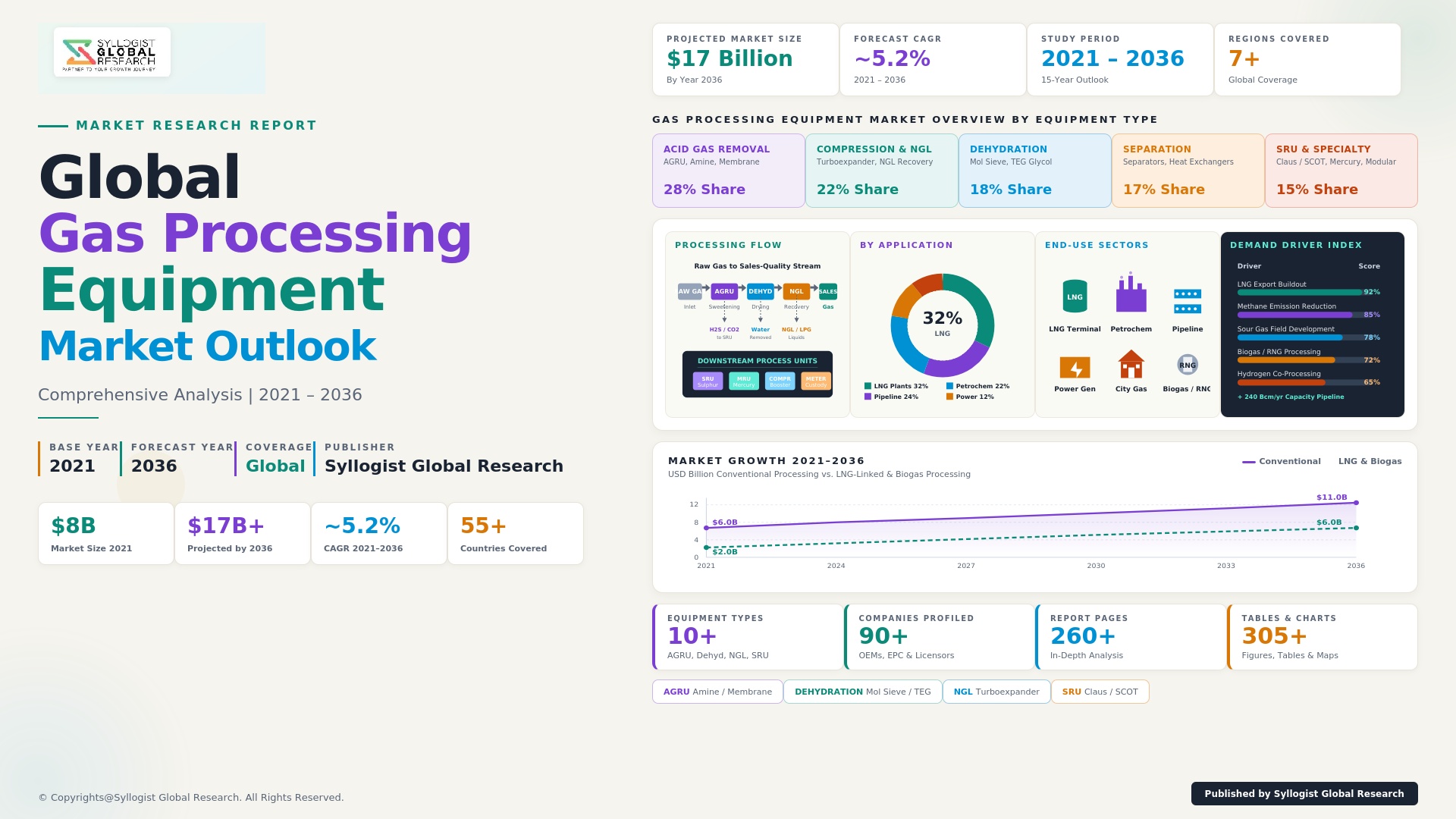
The global gas processing equipment market is in a structurally elevated investment cycle anchored by the unprecedented buildout of LNG export capacity, expansion of unconventional and sour gas resource development, accelerating regional gas demand growth, and the integration of carbon capture with conventional sour gas treatment. The market was valued at approximately USD 7.4 billion in 2025 and is projected to reach USD 13.8 billion by 2034, advancing at a compound annual growth rate of 7.2% through the forecast period, as midstream operators commission both modular shale gas processing plants and stick-built central processing facilities to serve a global gas demand profile crossing 4,260 bcm in 2025. Amine-based acid gas removal units account for the largest revenue category at 24% of equipment revenue, followed by dehydration units at 18%, NGL recovery and fractionation trains at 21%, sulfur recovery and tail gas treatment units at 14%, separators and slug catchers at 12%, and the remaining 11% across mercury and arsenic removal, nitrogen rejection, dew point control, and ancillary equipment.
The LNG export capacity buildout is the single most consequential driver of new equipment orders. Global liquefaction capacity reached 488 million tons per annum in 2024, with an additional 190 mtpa under construction across the United States Gulf Coast, Qatar, Mozambique, Mexico, and Canada, and a further 274 mtpa announced through 2032. The US Gulf Coast alone is adding 96 mtpa of liquefaction capacity through 2028, anchored by Plaquemines LNG, Rio Grande LNG Phase 1, Corpus Christi Stage III, Port Arthur LNG Phase 1, and Driftwood, each requiring upstream gas processing trains for inlet gas conditioning, dehydration, and mercaptan removal. Qatar’s North Field East and North Field South projects together add 48 mtpa of liquefaction with associated 8 GTL-equivalent volumes of acid gas removal, sulfur recovery, and NGL extraction capacity, placing 14 multi-billion-dollar EPC packages into the global pipeline through 2030.
Sour gas development is reshaping equipment specifications in the Middle East and North Africa. Saudi Aramco’s Jafurah unconventional shale gas program targets 2 bcfd of raw gas production by 2030, with the integrated processing complex carrying 24% hydrogen sulfide content and requiring dedicated amine units, three Claus sulfur recovery trains, and SCOT tail gas treatment capable of meeting 99.95% sulfur recovery. ADNOC’s Hail and Ghasha sour gas project, the Iraq integrated gas master plan, and Algeria’s sour gas expansion programs collectively represent USD 96 billion in committed midstream and processing capex through 2032. Across North America, Permian gas processing capacity additions exceed 8.4 bcfd through 2028 supported by 11 new processing plants and 4 fractionation trains, while Marcellus and Haynesville debottlenecking is sustaining a continuous stream of dehydration, NGL recovery, and dew point control equipment orders.
Decarbonization is reshaping the competitive structure of the market in two parallel ways. First, integrated CO2 capture is increasingly co-located with amine units serving sour gas streams, with announced capture-integrated gas processing capex of USD 18 billion across projects in Norway, the United Kingdom, Saudi Arabia, the UAE, and Australia. Second, renewable natural gas and biomethane upgrading capacity additions reached 8.6 bcm per year of installed capacity in 2024, with another 14.2 bcm per year under construction, generating recurring demand for small-scale dehydration, amine treatment, and membrane separation packages adapted from conventional technology. The competitive landscape spans integrated EPC contractors including Honeywell UOP, Bechtel, Saipem, Worley, McDermott, and Wood, equipment OEMs including Sulzer, Schlumberger, Baker Hughes, Pentair, and Howden, and a long tail of modular processing specialists, with the top 10 vendors accounting for 61% of equipment revenue.
Key Drivers
Unprecedented Global LNG Export Capacity Buildout and US Gulf Coast, Qatar, and Mozambique Liquefaction Project Pipeline Driving Multi-Year Equipment Orderbook Expansion
Global liquefaction capacity additions of 190 mtpa under construction and a further 274 mtpa announced through 2032 are generating durable multi-year procurement commitments for inlet gas processing trains, dehydration units, mercaptan removal beds, and CO2 removal packages installed upstream of every liquefaction train. Each 1 mtpa of LNG capacity requires approximately USD 28 million of associated gas processing equipment investment, placing the LNG-driven processing equipment opportunity at over USD 13 billion of cumulative incremental capex through 2032, anchoring orderbooks for amine, glycol, mol sieve, and turboexpander OEMs.
Sour Gas Resource Development Across the Middle East, North Africa, and Central Asia Generating Sustained Demand for Acid Gas Removal and Sulfur Recovery Equipment
The development of high-H2S unconventional and conventional sour gas resources including Saudi Aramco’s Jafurah at 2 bcfd with 24% H2S, ADNOC’s Hail and Ghasha complex, Iraq’s integrated gas master plan, Algeria’s sour gas expansion, and Kazakhstan’s Tengiz and Kashagan future phases is sustaining a multi-year demand profile for amine units, Claus and SuperClaus sulfur recovery trains, tail gas treatment, and integrated sour gas processing complexes. Cumulative committed capex on sour gas projects exceeds USD 96 billion through 2032, with associated processing equipment scope of USD 22 billion.
Carbon Capture Integration with Amine Acid Gas Removal Units and Renewable Natural Gas Upgrading Buildout Expanding the Adjacent Processing Equipment Opportunity
Carbon capture integrated with conventional amine acid gas removal is emerging as the most cost-effective decarbonization route for natural gas processing operators, with announced capture-integrated processing capex of USD 18 billion across Norway, the United Kingdom, Saudi Arabia, the UAE, and Australia. Simultaneously, renewable natural gas and biomethane upgrading capacity additions of 14.2 bcm per year under construction are generating recurring demand for small-scale dehydration, amine treatment, and membrane separation packages adapted from conventional gas processing technology platforms.
Key Challenges
Oil and Gas Price Volatility, Counter-Cyclical Capex Discipline, and Project Sanction Timing Risk Affecting Equipment Orderbook Visibility
Gas processing equipment manufacturers operate against a backdrop of oil and gas commodity price volatility that drives counter-cyclical operator capex discipline, with Brent oil price swings between USD 68 and USD 96 per barrel through 2024 and Henry Hub gas prices ranging between USD 1.9 and USD 13.5 per MMBtu over the last three years. Project sanction timing remains highly sensitive to commodity outlook, with FID delays of 12 to 24 months common on tier-two projects, eroding orderbook visibility and complicating equipment vendor capacity planning and supply chain commitments.
Specialty Alloy Supply Constraints, Long-Lead Equipment Bottlenecks, and EPC Resource Shortages Extending Project Delivery Timelines
Pressure-containing vessels in sour service require duplex stainless steel, Inconel, and Hastelloy materials whose lead times have extended from 18 weeks pre-pandemic to over 64 weeks in 2024, while heavy-wall amine column fabrication slots at qualified shops are fully booked through 2028. Specialist EPC labor for sour gas and LNG-adjacent processing projects is structurally oversubscribed, with skilled welders for high-pressure stainless steel fabrication, instrumentation engineers, and commissioning teams in deficit across the United States Gulf Coast, the Middle East, and East Africa, extending project delivery timelines and elevating cost-of-completion risk.
Long-Term Demand Uncertainty from Energy Transition, Stranded Asset Risk, and Investor ESG Pressure Constraining Greenfield Gas Processing Investment Decisions
Investor scrutiny of long-cycle hydrocarbon infrastructure, the strategic shift of European majors toward integrated energy platforms, and the structural uncertainty around long-term gas demand under accelerated decarbonization pathways are constraining the ability of midstream operators to sanction multi-decade greenfield gas processing investments. Project payback hurdles have lengthened to 8 to 11 years, third-party debt providers are increasingly applying ESG screens to project finance, and asset stranding risk is shifting capital toward shorter-tenor brownfield expansion and CCS-integrated configurations.
Market Segmentation
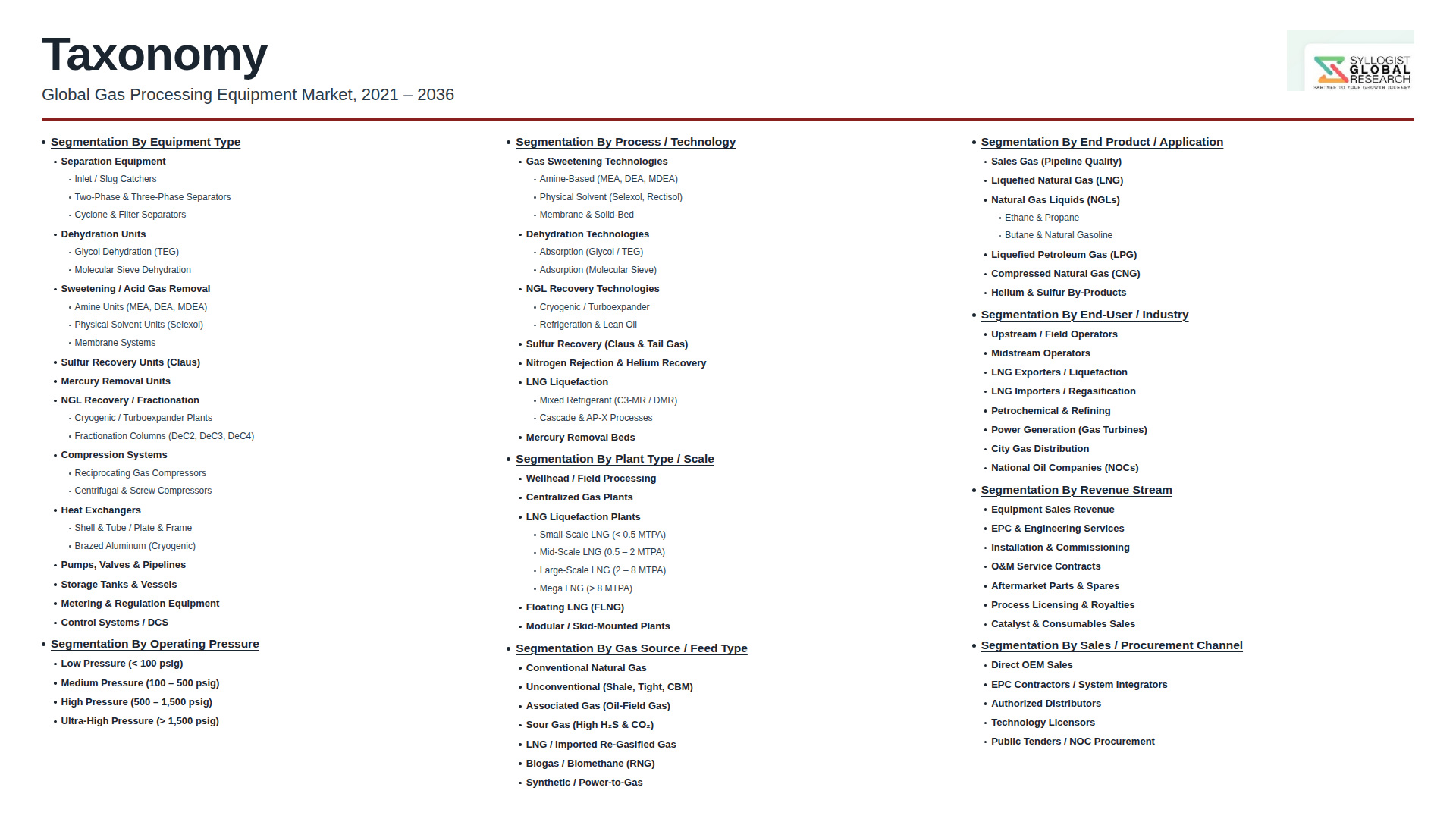
- Segmentation By Equipment Type
- Separators and Slug Catchers
- Dehydration Units (TEG, Glycol, Molecular Sieve)
- Acid Gas Removal Units (Amine-Based)
- Sulfur Recovery and Tail Gas Treatment Units
- NGL Recovery and Fractionation Trains
- Mercury and Arsenic Removal Beds
- Nitrogen Rejection Units
- Dew Point Control Units
- Compressors, Columns, Vessels, and Heat Exchangers
- Others
- Segmentation By Technology
- Cryogenic NGL Recovery
- Turboexpander-Based Processes
- Membrane Separation
- Solvent-Based Acid Gas Removal (MDEA, MEA, DEA, Proprietary)
- Claus and SuperClaus Sulfur Recovery
- Tail Gas Treatment (SCOT, BSR, Hydrogenation)
- Adsorption-Based Treatment
- Others
- Segmentation By Treatment Type
- Sweet Gas Processing
- Sour Gas Processing
- Ultra-Sour Gas Processing (Above 15% H2S)
- Wet Gas and NGL-Rich Processing
- Dry Gas Processing
- Segmentation By Construction Type
- Modular and Skid-Mounted Units
- Stick-Built Central Processing Facilities
- Offshore Platform Topsides
- FPSO and Floating Topsides
- Segmentation By Capacity
- Small Scale (Up to 50 MMscfd)
- Medium Scale (50 to 250 MMscfd)
- Large Scale (250 MMscfd to 1 bcfd)
- Mega Scale (Above 1 bcfd)
- Segmentation By Application
- Midstream Pipeline Gas Conditioning
- LNG Export Terminal Inlet Processing
- NGL Recovery and Fractionation
- Sour Gas Field Development
- Offshore Platform Gas Treatment
- Carbon Capture Integrated Processing
- Renewable Natural Gas and Biomethane Upgrading
- Stranded and Associated Gas Monetization
- Others
- Segmentation By End User
- Integrated Oil and Gas Majors
- National Oil Companies
- Midstream Operators
- Independent Gas Producers
- LNG Developers and Operators
- Petrochemical Operators
- Renewable Natural Gas and Biomethane Producers
- Others
- Segmentation By Region
- North America
- Europe
- Asia-Pacific
- Middle East and Africa
- Latin America
All market revenues are presented in USD
Historical Year: 2021-2024 | Base Year: 2025 | Estimated Year: 2026 | Forecast Period: 2027-2034
Key Questions this Study Will Answer
- What is the total global market valuation of the Gas Processing Equipment Market in 2025, projected through 2034, disaggregated by equipment type, technology, treatment type, capacity class, and application, enabling equipment OEMs, EPC contractors, midstream operators, LNG developers, and infrastructure investors to identify the highest-growth segments and most durable revenue opportunities across the gas processing equipment landscape?
- How are leading gas processing investment hubs in the United States Gulf Coast, Qatar, Saudi Arabia, the UAE, Iraq, Algeria, Mozambique, Australia, Canada, Mexico, and Central Asia allocating capital across LNG inlet processing, sour gas treatment, NGL recovery and fractionation, and carbon capture integration, and which national programs are setting the technical specification and procurement benchmarks shaping the global gas processing equipment market through 2034?
- What are the relative performance, lifecycle cost, capacity, footprint, and reliability advantages of cryogenic NGL recovery, turboexpander-based processes, membrane separation, solvent-based amine acid gas removal, Claus and SuperClaus sulfur recovery, tail gas treatment, and adsorption-based treatment technologies across LNG inlet, sour gas, sweet gas, and unconventional gas applications, and which technologies are most likely to capture incremental share between 2025 and 2034?
- Which application segments, including LNG inlet processing, sour gas field development, NGL recovery and fractionation, offshore platform treatment, CCS-integrated processing, renewable natural gas upgrading, and stranded and associated gas monetization, are generating the highest growth rates through 2034, and what equipment specifications, fabrication standards, and modularization strategies are most critical to operational performance in each category?
- How is the competitive landscape structured among integrated EPC contractors including Honeywell UOP, Bechtel, Saipem, Worley, McDermott, and Wood, equipment OEMs including Sulzer, Schlumberger, Baker Hughes, Pentair, and Howden, and the long tail of modular gas processing specialists, and what partnership, acquisition, capacity expansion, and platformization strategies are enabling new entrants to compete with established players in next-generation gas processing programs?
- What are the most significant commodity price volatility, FID timing, specialty alloy lead time, EPC resource bottleneck, and energy transition demand uncertainty risks affecting gas processing equipment deployments in operational delivery, and how are OEMs, operators, regulators, and project financiers addressing supply chain resilience, modularization, brownfield versus greenfield trade-offs, and risk allocation within evolving gas processing project frameworks?
- Which regional gas processing markets, specifically North America, the Middle East and Africa, Asia Pacific, Europe, and Latin America, are expected to generate the most substantial incremental gas processing equipment procurement through 2034, and what regulatory frameworks, LNG export licensing regimes, sour gas development policies, CCS incentives, and renewable natural gas mandates are driving capability investment priorities and supplier selection in each regional market?
- Product Definition
- Research Methodology
- Research Design & Framework
- Overall Research Approach: Descriptive, Exploratory & Quantitative Mixed-Method Design
- Market Definition & Scope Boundaries: What is Included and Excluded
- Segmentation Framework
- Key Research Assumptions & Limitations
- Secondary Research
- Primary Research Design & Execution
- Data Triangulation & Validation
- Market Sizing & Forecasting Methodology
- Competitive Intelligence Methodology
- Quality Assurance & Peer Review
- Definitions, Abbreviations & Data Notes
- Research Design & Framework
- Executive Summary
- Market Snapshot & Headline Numbers
- Key Findings & Research Highlights
- Market Dynamics
- Regional Market Summary
- Competitive Landscape Snapshot
- Technology & Innovation Highlights
- Market Dynamics
- Drivers
- Restraints
- Opportunities
- Challenges
- Porter’s Five Forces Analysis
- PESTLE Analysis
- Market Trends & Developments
- Emerging Trends
- Technological Developments
- Regulatory & Policy Changes
- Supply Chain, Specialty Alloy & Sourcing Trends
- Manufacturing, Modular Fabrication & Commissioning Trends
- Investment, Gas Project Pipeline & Funding Activity
- Sustainability & ESG Trends
- Risk Assessment Framework
- Hydrocarbon Price Volatility, Final Investment Decision (FID) Delay & Project Capex Risk
- Sour Gas Composition Variability, Specialty Material & Corrosion-Resistant Alloy Supply Risk
- Regulatory, Methane Emissions, Permitting & Cross-Jurisdictional Compliance Risk
- HSE, Hazardous Service, Hazardous Area Classification & Operational Safety Risk
- Energy Transition, Stranded Asset, Demand Cycle & Decarbonisation Mandate Risk
- Regulatory Framework & Standards
- National Hydrocarbon Codes, Gas Pricing Frameworks, Domestic Beneficiation Mandates & LNG Export Policies
- API (API 6A, 11P, 14C, 660, 661), ASME BPVC, ISO 10434 & Industry Engineering Codes for Gas Processing Equipment
- Methane Emissions Regulations (EPA NSPS OOOO / OOOOa, EU Methane Regulation, IEA Global Methane Pledge)
- Sulphur Recovery, Acid Gas Re-Injection, Flaring & Environmental Discharge Standards
- Biogas, Renewable Natural Gas, Renewable Fuel Standard, Low-Carbon Fuel Standard & Green Gas Certification Standards
- Global Gas Processing Equipment Market Outlook
- Market Size & Forecast by Value
- Market Size & Forecast by Volume (Installed Processing Capacity, Bcf/d & MMSCFD)
- Market Size & Forecast by Equipment Type
- Acid Gas Removal Units (Amine Plants, Selexol, Rectisol, Hot Potassium Carbonate)
- Dehydration Units (Glycol TEG / DEG, Molecular Sieve, Solid Desiccant)
- Sulphur Recovery Units (SRU) & Tail Gas Treatment Units
- Mercury Removal Units (MRU) & Mercaptan / Polishing Units
- NGL Recovery, Fractionation & Cryogenic Turboexpander Systems
- Compression Equipment (Reciprocating, Centrifugal, Screw) for Gas Processing Service
- Heat Exchangers (Shell & Tube, Plate-Fin, Printed Circuit, Air-Cooled)
- Separators, Slug Catchers, Coalescers & Filtration Equipment
- Membrane Separation Units (CO2, H2, Helium, Hydrocarbon Recovery)
- Modular & Skid-Mounted Gas Processing Packages
- Market Size & Forecast by Process Technology
- Chemical Solvent Amine Gas Treating (MEA, DEA, MDEA, Activated MDEA)
- Physical Solvent Gas Treating (Selexol, Rectisol, Purisol)
- Hybrid Solvent Gas Treating (Sulfinol, ADIP-X)
- Hot Potassium Carbonate (Benfield, Catacarb) Technology
- Membrane Separation Technology
- Cryogenic Turboexpander Technology
- Joule-Thomson, Mechanical Refrigeration & Lean Oil Absorption Technology
- Molecular Sieve, Solid Desiccant & Adsorption Technology
- Claus, Tail Gas Treating (SCOT) & Sulphur Recovery Technology
- Pressure Swing Adsorption (PSA) & Temperature Swing Adsorption (TSA) Technology
- Market Size & Forecast by Gas Type & Feedstock
- Conventional Natural Gas (Sweet)
- Sour Natural Gas (H2S & CO2 Rich)
- Shale Gas & Unconventional Gas
- Associated Gas (from Oil Production)
- LNG Feed Gas
- Biogas & Renewable Natural Gas (RNG) Feedstock
- Coal Seam Gas & Coal Bed Methane (CBM)
- Hydrogen-Containing & Synthetic Gas Streams
- Market Size & Forecast by Project Scale
- Large-Scale Gas Processing Plants (Above 500 MMSCFD)
- Medium-Scale Gas Processing Plants (100 to 500 MMSCFD)
- Small-Scale Gas Processing Plants (10 to 100 MMSCFD)
- Modular & Skid-Mounted Packages (Below 10 MMSCFD)
- Market Size & Forecast by Application
- Sweet Gas Conditioning & Dehydration
- Sour Gas Sweetening (H2S & CO2 Removal)
- Natural Gas Liquids (NGL) Recovery & Fractionation
- LNG Feed Gas Pre-Treatment
- Biogas Upgrading to Renewable Natural Gas (RNG) & Biomethane
- Helium Recovery & Purification
- CO2 Capture & Sequestration Pre-Processing
- Hydrogen Separation & Purification
- City Gate Conditioning & Pipeline-Quality Polishing
- Market Size & Forecast by End-User
- Upstream Oil & Gas Operators
- Midstream Gas Processors & Transmission Operators
- LNG Liquefaction Plant Operators
- City Gas, Utility & Distribution Companies
- Biogas & Renewable Natural Gas Project Developers
- Refining, Petrochemical & Industrial Off-Takers
- Industrial Captive & Power Generation Operators
- Government Agencies & National Oil Companies (NOCs)
- Market Size & Forecast by Sales Channel
- Direct OEM & Original Equipment Manufacturer Sales
- EPC, Turnkey, Lump Sum & Consortium Channel
- Modular, Skid-Mounted & Pre-Engineered Package Channel
- Long-Term Operations, Maintenance, Spare Parts & Lifecycle Service Contract Channel
- North America Gas Processing Equipment Market Outlook
- Market Size & Forecast
- By Value
- By Volume (Installed Processing Capacity, Bcf/d & MMSCFD)
- By Equipment Type
- By Process Technology
- By Gas Type & Feedstock
- By Project Scale
- By Application
- By End-User
- By Country
- By Sales Channel
- Europe Gas Processing Equipment Market Outlook
- Market Size & Forecast
- By Value
- By Volume (Installed Processing Capacity, Bcf/d & MMSCFD)
- By Equipment Type
- By Process Technology
- By Gas Type & Feedstock
- By Project Scale
- By Application
- By End-User
- By Country
- By Sales Channel
- Asia-Pacific Gas Processing Equipment Market Outlook
- Market Size & Forecast
- By Value
- By Volume (Installed Processing Capacity, Bcf/d & MMSCFD)
- By Equipment Type
- By Process Technology
- By Gas Type & Feedstock
- By Project Scale
- By Application
- By End-User
- By Country
- By Sales Channel
- Latin America Gas Processing Equipment Market Outlook
- Market Size & Forecast
- By Value
- By Volume (Installed Processing Capacity, Bcf/d & MMSCFD)
- By Equipment Type
- By Process Technology
- By Gas Type & Feedstock
- By Project Scale
- By Application
- By End-User
- By Country
- By Sales Channel
- Middle East & Africa Gas Processing Equipment Market Outlook
- Market Size & Forecast
- By Value
- By Volume (Installed Processing Capacity, Bcf/d & MMSCFD)
- By Equipment Type
- By Process Technology
- By Gas Type & Feedstock
- By Project Scale
- By Application
- By End-User
- By Country
- By Sales Channel
- Country-Wise* Gas Processing Equipment Market Outlook
- Market Size & Forecast
- By Value
- By Volume (Installed Processing Capacity, Bcf/d & MMSCFD)
- By Equipment Type
- By Process Technology
- By Gas Type & Feedstock
- By Project Scale
- By Application
- By End-User
- By Country
- By Sales Channel
- *Countries Analyzed in the Syllogist Global Research Portfolio: United States, Canada, Mexico, Germany, France, United Kingdom, Netherlands, Spain, Italy, Norway, Sweden, China, Japan, India, Australia, South Korea, Singapore, Brazil, Chile, Saudi Arabia, UAE, Egypt, South Africa, Israel
- Technology Landscape & Innovation Analysis
- Amine Gas Treating (MEA, DEA, MDEA, Activated MDEA) Technology Deep-Dive
- Physical & Hybrid Solvent (Selexol, Rectisol, Sulfinol, ADIP-X) Gas Treating Technology
- Membrane Separation Technology for CO2, H2, Helium & Hydrocarbon Recovery
- Cryogenic Turboexpander, Joule-Thomson & Mechanical Refrigeration NGL Recovery Technology
- Molecular Sieve, Solid Desiccant, PSA & TSA Adsorption Technology
- Claus, Tail Gas Treating (SCOT) & Sulphur Recovery Technology
- Modular, Skid-Mounted & Pre-Engineered Gas Processing Package Technology
- Biogas Upgrading & Renewable Natural Gas (RNG) Production Technology
- Digital Twin, AI-Enabled Process Optimisation & Predictive Maintenance Technology for Gas Processing Plants
- Patent & IP Landscape in Gas Processing Equipment Technologies
- Value Chain & Supply Chain Analysis
- Gas Processing Equipment OEM & Original Equipment Manufacturer Landscape
- Specialty Alloy, Corrosion-Resistant Material & Pressure Vessel Fabrication Supply Chain
- Heat Exchanger, Cryogenic Cold Box & Specialty Process Equipment Supply Chain
- Compressor, Turbine & Rotating Machinery Supply Chain for Gas Processing Service
- Solvent, Amine, Catalyst, Molecular Sieve & Process Chemicals Supply Chain
- Membrane Module, Cartridge & Replacement Supply Chain
- EPC Contractor, Modular Package Fabricator & System Integrator Channel
- Upstream, Midstream, LNG & Industrial Customer Procurement Channel
- Operations, Maintenance, Spare Parts & Lifecycle Service Provider Channel
- Pricing Analysis
- Acid Gas Removal Unit (Amine, Selexol, Rectisol, Membrane) Capital Cost Analysis
- Dehydration Unit (Glycol, Molecular Sieve) Capital and Operating Cost Analysis
- NGL Recovery, Fractionation & Cryogenic Turboexpander Capex & OPEX Analysis
- Sulphur Recovery Unit (Claus, SCOT) Capital and Operating Cost Analysis
- Compression Equipment Capex, OPEX & Per-MW Pricing Analysis for Gas Processing Service
- Modular, Skid-Mounted & Pre-Engineered Package Pricing & Per-MMSCFD Benchmark Analysis
- EPC, Turnkey & Lump Sum Gas Processing Plant Pricing Analysis
- Total Cost of Ownership & Levelised Cost of Gas Processing Across Plant Designs
- Sustainability & Environmental Analysis
- Methane Emissions, Fugitive Leakage & Flaring Reduction Contribution of Modern Gas Processing Equipment
- Lifecycle Carbon Footprint of Gas Processing Plants & Energy Efficiency Improvement Pathways
- Role of Gas Processing Equipment in Biogas, RNG & Low-Carbon Gas Value Chain Decarbonisation
- Sulphur Recovery, Acid Gas Re-Injection & Environmental Compliance Contribution
- Alignment of Gas Processing Equipment with Energy Transition, IEA Global Methane Pledge, SDG 7 (Clean Energy), SDG 13 (Climate Action) & Sustainable Finance Eligibility
- Competitive Landscape
- Market Structure & Concentration
- Market Consolidation Level (Fragmented vs. Consolidated by Equipment Type & Geography)
- Top 10 Players Market Share
- HHI (Herfindahl-Hirschman Index) Concentration Analysis
- Competitive Intensity Map by Equipment Type, Process Technology & Geography
- Player Classification
- Integrated Global Gas Processing Equipment OEMs & Process Licensors
- Cryogenic, NGL Recovery & Turboexpander Specialists
- Amine, Solvent Gas Treating Licensors & Process Technology Providers
- Membrane Separation Technology Specialists
- Compressor & Rotating Machinery OEMs for Gas Processing Service
- Heat Exchanger, Cold Box & Cryogenic Equipment Specialists
- Modular, Skid-Mounted Package Fabricators
- Biogas Upgrading & Renewable Natural Gas Equipment Specialists
- EPC Contractors & Project Engineering Specialists
- Competitive Analysis Frameworks
- Market Share Analysis by Equipment Type, Process Technology & Region
- Company Profile
- Company Overview & Headquarters
- Gas Processing Equipment Products, Process Technology & Solution Portfolio
- Key Customer Relationships & Reference Gas Plant Installations
- Manufacturing Footprint, Modular Fabrication Yards & Production Capacity
- Revenue (Gas Processing Equipment Segment) & Order Backlog
- Technology Differentiators & IP
- Key Strategic Partnerships, JVs & M&A Activity
- Recent Developments (Contract Wins, Capacity Expansions, Product Launches)
- SWOT Analysis
- Strategic Focus Areas & Roadmap
- Competitive Positioning Map (Technology Capability vs. Market Penetration)
- Key Company Profiles
- Market Structure & Concentration
- Technology Landscape & Innovation Analysis
- Strategic Output
- Market Opportunity Matrix: By Equipment Type, Process Technology, Application, End-User & Geography
- White Space Opportunity Analysis
- Strategic Recommendations
- Product Portfolio, Process Technology & Equipment Investment Strategy
- Manufacturing Capacity, Modularisation & Operational Excellence Strategy
- Geographic Expansion & Localisation Strategy (LNG Hubs, NGL Basins, RNG Markets)
- Customer & End-User Engagement Strategy
- Partnership, M&A & Ecosystem Strategy
- Energy Transition, RNG & Low-Carbon Gas Strategy
- Risk Mitigation & Future Roadmap
- Strategic Priority Matrix & Roadmap
- Near-term (2025-2028)
- Mid-term (2029-2032)
- Long-term (2033-2037)
- Market Size & Forecast
- Market Size & Forecast
- Market Size & Forecast
- Market Size & Forecast
- Market Size & Forecast
- Market Size & Forecast