Global Delivery Locker-as-a-Service Market By Locker Type, By Service Model, By Application, By Technology, By Location Type, By Deployment Mode, By End User, By Region, Competition, Forecast & Opportunities, 2021-2034F
Market Definition
Delivery Locker-as-a-Service refers to a subscription, pay-per-use, or revenue-share commercial model in which third-party service operators deploy, manage, and monetize networks of automated parcel lockers, smart lockers, and refrigerated lockers across residential complexes, retail premises, transit hubs, office buildings, university campuses, and dedicated public locations to enable contactless parcel pickup, returns, and click-and-collect transactions on behalf of e-commerce retailers, parcel carriers, foodservice operators, grocery retailers, and end consumers. The Global Delivery Locker-as-a-Service Market encompasses the design, manufacturing, deployment, operation, and monetization of automated locker hardware, embedded software platforms, mobile and web user interfaces, payment integration modules, carrier-agnostic delivery management software, and associated installation, maintenance, and customer support services delivered under a service-based commercial framework.
The delivery locker-as-a-service market includes ambient parcel lockers, refrigerated and frozen lockers supporting grocery and meal delivery applications, and high-security lockers supporting pharmaceutical, prescription, and high-value item collection. Market participants include locker hardware original equipment manufacturers, locker network operators, carrier-agnostic software platform providers, payment processors, real estate operators, retailers integrating locker collection points within their physical premises, and dedicated locker-as-a-service operators monetizing locker networks through carrier transaction fees, retailer fees, and consumer subscriptions. The delivery locker-as-a-service market also covers value-added services including reverse logistics returns processing, locker-to-locker transfers, contactless delivery confirmation, dynamic locker allocation, and integration with e-commerce checkout flows enabling consumers to nominate locker collection at point of purchase. The scope explicitly excludes carrier-captive locker networks operated exclusively by single parcel operators, in-store retail click-and-collect counters, and traditional post office box services, focusing exclusively on commercially operated multi-carrier, multi-retailer locker networks delivered under a service-based commercial model globally.
Market Insights
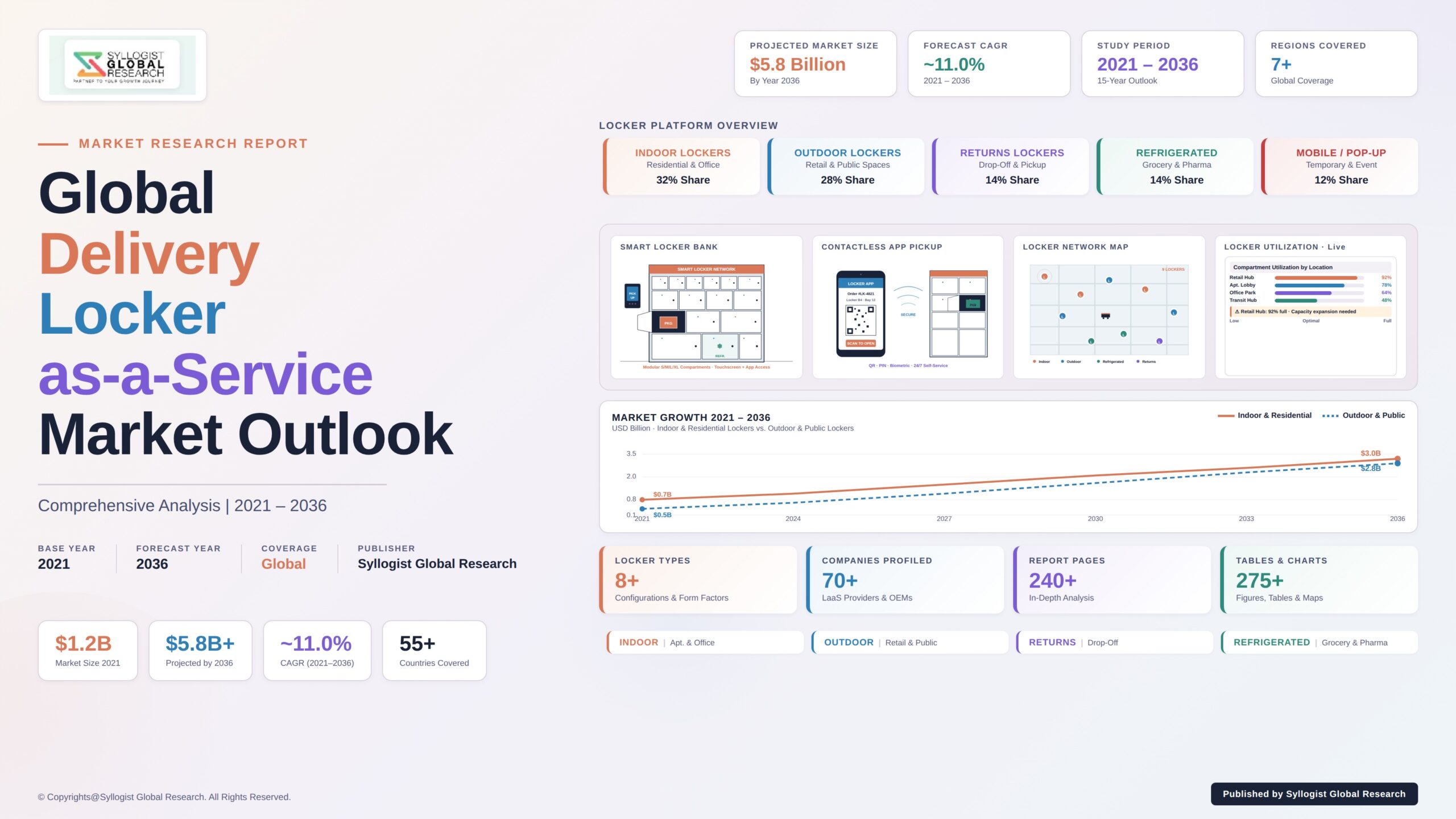
The global delivery locker-as-a-service market is entering an accelerated structural growth phase, shaped by the rapid scaling of e-commerce parcel volumes, intensifying last-mile delivery cost pressure, urban consumer preference for contactless and time-flexible parcel collection, the structural emergence of grocery e-commerce requiring refrigerated last-mile drop-off capability, and increasing real estate operator interest in monetizing common-area space through hosted locker installations. The delivery locker-as-a-service market was valued at approximately USD 1.4 billion in 2025 and is projected to reach USD 6.8 billion by 2034, advancing at a compound annual growth rate of 19.2% through the forecast period, as locker network operators, parcel carriers, retailers, real estate operators, and municipal authorities scale automated locker capacity across residential, retail, transit, and dedicated public locations.
The delivery locker-as-a-service market trajectory is being reshaped by the commercial maturation of carrier-agnostic software platforms supporting parallel access by multiple parcel carriers, retailers, and foodservice operators, alongside the deployment of refrigerated and multi-temperature lockers supporting grocery, meal kit, and pharmaceutical delivery use cases. Carrier-agnostic locker networks operating with parallel access from over 5 to 12 parcel carriers per locker installation have become the dominant commercial structure within the delivery locker-as-a-service market, replacing single-carrier captive networks with monetization models that maximize utilization rates and amortize hardware capital costs across higher transaction volumes. Refrigerated locker deployments scaled by over 40% between 2023 and 2025 across mature operating regions, supporting grocery e-commerce, meal kit delivery, and pharmaceutical fulfillment applications that require temperature-controlled drop-off without consumer availability constraints.
Parcel pickup applications represent the largest revenue contributor within the delivery locker-as-a-service market, propelled by sustained e-commerce parcel volume growth and the structural shift of carrier last-mile cost optimization toward locker-based consolidated delivery away from individual residence delivery. Returns processing represents the fastest-growing application segment within the delivery locker-as-a-service market, driven by e-commerce returns volumes scaling at over 12% annually and retailer interest in offering contactless returns drop-off capability that materially reduces returns processing cost relative to store-based or pickup-based returns models. Indoor lockers located within residential complexes, retail premises, and transit hubs represent the dominant deployment location type, while outdoor parcel lockers in dedicated public locations are scaling rapidly within the delivery locker-as-a-service market, supported by municipal authorities permitting locker installations across sidewalk and public space catchments to reduce parcel carrier delivery vehicle density in urban centers.
Europe represents the largest regional market within the delivery locker-as-a-service market, anchored by mature parcel locker networks across Poland, Germany, the Czech Republic, Slovakia, Hungary, the United Kingdom, and the Nordic countries, where parcel locker penetration exceeds 30 lockers per 10,000 residents in select urban catchments. Poland alone hosts over 30,000 automated parcel locker installations and serves as the global benchmark for delivery locker-as-a-service network density and consumer adoption. Asia-Pacific is projected to record the highest regional compound annual growth rate through 2034 within the delivery locker-as-a-service market, underpinned by accelerating e-commerce parcel volumes in China, South Korea, Japan, Singapore, and Australia, alongside expanding refrigerated locker deployments supporting grocery delivery in dense urban catchments. North America represents the third regional position within the delivery locker-as-a-service market, with continued investment in locker networks across residential complexes, retail premises, and transit hubs, supported by major retailer click-and-collect investment and parcel carrier last-mile cost optimization initiatives.
Key Drivers
Accelerating E-Commerce Parcel Volumes, Last-Mile Delivery Cost Inflation, and Failed Delivery Rate Reduction Driving Locker-Based Consolidated Delivery Procurement
The structural acceleration of e-commerce parcel volumes, sustained last-mile delivery cost inflation, and elevated failed first-attempt delivery rates affecting residential parcel delivery economics are collectively driving accelerated procurement of delivery locker-as-a-service capacity by parcel carriers, retailers, and real estate operators across mature and emerging operating regions. Global e-commerce parcel volumes are projected to exceed 250 billion shipments annually by 2027, with last-mile delivery cost per parcel rising by 18% to 25% across mature operating regions between 2021 and 2025, propelled by driver wage inflation, urban congestion-driven productivity erosion, and rising vehicle insurance and fuel costs. Locker-based consolidated delivery materially reduces per-parcel last-mile delivery cost relative to individual residence delivery, with carrier route efficiency gains of 35% to 50% achievable when 8 to 15 parcels are delivered to a single locker installation versus dispersed residential addresses. Failed first-attempt delivery rates of 8% to 15% across mature operating regions translate into substantial redelivery cost exposure that the delivery locker-as-a-service model eliminates entirely. Parcel carriers and retailers are structuring multi-year delivery locker-as-a-service procurement frameworks, generating long-duration revenue commitments that anchor locker network operator capacity scaling and hardware manufacturer production planning decisions across the delivery locker-as-a-service market globally.
Grocery E-Commerce Scaling, Meal Kit Delivery Expansion, and Refrigerated Locker Demand Driving Specialty Locker Network Deployment
The structural scaling of grocery e-commerce, sustained meal kit delivery program expansion, and growing pharmaceutical home delivery requirements are driving sustained procurement of refrigerated and multi-temperature delivery lockers within the delivery locker-as-a-service market across residential complexes, retail premises, and dedicated grocery pickup locations. Grocery e-commerce penetration across mature operating regions reached 12% to 15% of total grocery spend in 2024, with refrigerated locker deployments offering retailers a cost-efficient alternative to residential delivery for chilled, frozen, and ambient grocery basket fulfillment. Refrigerated locker installations scaled by over 40% between 2023 and 2025 across mature operating regions, with major grocery retailers including Walmart, Kroger, Tesco, Carrefour, and Albert Heijn investing in refrigerated locker network capacity supporting click-and-collect grocery fulfillment models. Meal kit delivery operators are increasingly using refrigerated locker drop-off as an alternative to residential cold chain delivery, materially reducing per-delivery cost and eliminating cold chain integrity risks attributable to consumer absence at scheduled delivery windows. Pharmaceutical home delivery operators are deploying secure refrigerated lockers supporting GDP-compliant prescription pickup across mature healthcare markets, expanding the addressable application envelope within the delivery locker-as-a-service market value chain.
Urbanization, Curbside Delivery Congestion, and Municipal Sustainability Policies Driving Public Space Locker Deployment Authorization
Sustained urbanization, intensifying curbside delivery congestion in dense urban centers, and the emergence of municipal sustainability policies targeting reduction of last-mile delivery vehicle density are collectively driving accelerated authorization of public space locker installations by city authorities across major urban catchments within the delivery locker-as-a-service market. Curbside delivery vehicle activity in central business districts has grown by over 25% between 2021 and 2025, contributing to congestion, double-parking, air quality concerns, and infrastructure stress that municipal authorities are increasingly addressing through coordinated delivery consolidation policies. Major municipal authorities including New York City, Paris, London, Amsterdam, Vienna, and Singapore have authorized public space delivery locker installations across sidewalks, transit station perimeters, and dedicated parcel hub locations, providing the regulatory clarity that delivery locker-as-a-service network operators require to deploy at scale within urban catchments. Municipal sustainability targets including net-zero last-mile delivery commitments, low-emission zone enforcement, and curbside delivery vehicle access restrictions are reinforcing procurement preference for consolidated locker-based delivery across major operating regions, generating durable demand growth for delivery locker-as-a-service deployments aligned with municipal infrastructure investment frameworks.
Key Challenges
Network Density Requirements, Real Estate Acquisition Complexity, and Capital Intensity of Geographic Scaling Constraining Profitability of Locker Network Operators
Delivery locker-as-a-service operators face material network density requirements that fundamentally shape commercial viability, with consumer adoption and per-locker transaction volumes scaling above commercial breakeven thresholds typically requiring locker installations within walking distance of over 60% of catchment population, generating capital deployment requirements that constrain geographic scaling pace and challenge unit economics for network operators in early geographic expansion phases. Real estate acquisition for outdoor locker installations requires coordination with municipal authorities, residential property managers, retail real estate operators, and transit authorities, with each location-specific agreement involving distinct lease terms, revenue share arrangements, and operational responsibilities that limit standardized rollout pace. Capital intensity for delivery locker-as-a-service network expansion remains substantial, with individual locker hardware unit costs ranging from USD 8,000 to USD 35,000 depending on module size, refrigeration capability, and security features, multiplied across networks of thousands of installations to achieve catchment density targets. The combined effect of density requirements, real estate acquisition complexity, and capital intensity continues to constrain the pace at which delivery locker-as-a-service operators can scale network coverage in new geographic markets, generating extended capital deployment timelines and elevated commercial risk during network buildout phases within the delivery locker-as-a-service market.
Locker Utilization Variability, Peak Capacity Sizing Trade-Offs, and Returns Stream Complexity Constraining Per-Locker Revenue Optimization
Delivery locker-as-a-service operators face persistent locker utilization variability, with average utilization rates across mature operating networks ranging materially below peak-day utilization, generating capacity sizing trade-offs that affect per-locker revenue optimization and overall network economics within the delivery locker-as-a-service market. Peak shopping period parcel volumes can exceed average daily volumes by 200% to 300%, generating locker capacity constraints during major shopping events including Black Friday, Cyber Monday, Singles Day, and pre-holiday gift seasons that translate into refused delivery rates, carrier dissatisfaction, and lost transaction revenue when consumers cannot retrieve parcels within standard locker holding windows. Returns stream complexity additionally constrains locker utilization, with returns parcels frequently requiring larger compartment sizes than original outbound delivery, generating mismatch between locker hardware compartment distribution and parcel size profile across high returns volume periods. Locker network operators must balance peak capacity sizing against average utilization economics, with overbuilt capacity reducing per-locker revenue yield while undersized capacity generating consumer dissatisfaction and carrier dissatisfaction that erode commercial relationships. The persistent gap between peak and average utilization rates continues to constrain network operator margin economics and complicate capacity planning decisions across the delivery locker-as-a-service market value chain.
Consumer Adoption Variability, Geographic Catchment Sensitivity, and Last-Mile Delivery Operator Integration Complexity
Consumer adoption variability across geographic catchments, sustained sensitivity of locker utilization to catchment density, and continued integration complexity with parcel carrier last-mile delivery operations represent persistent commercial challenges across the delivery locker-as-a-service market. Consumer parcel locker adoption rates vary materially across geographic markets, ranging from over 60% of e-commerce parcel volumes routed through lockers in Poland to under 8% in major North American urban centers, reflecting variations in consumer awareness, locker network density, e-commerce platform integration, and cultural acceptance of contactless parcel collection. Geographic catchment sensitivity affects locker network operator unit economics, with rural and suburban catchments often unable to support locker installations at commercial breakeven thresholds, constraining geographic scope of profitable network deployment within the delivery locker-as-a-service market. Last-mile delivery operator integration complexity remains substantial, with parcel carriers requiring data exchange protocols, locker access permissions, dynamic locker allocation algorithms, and proof-of-delivery validation that vary across delivery locker-as-a-service operators, generating integration overhead that limits the pace at which carriers expand locker-based delivery volume through new locker network partnerships. Variations in checkout integration with e-commerce platforms further complicate consumer adoption growth and require sustained commercial development investment by delivery locker-as-a-service operators seeking to expand network monetization opportunities globally.
Market Segmentation
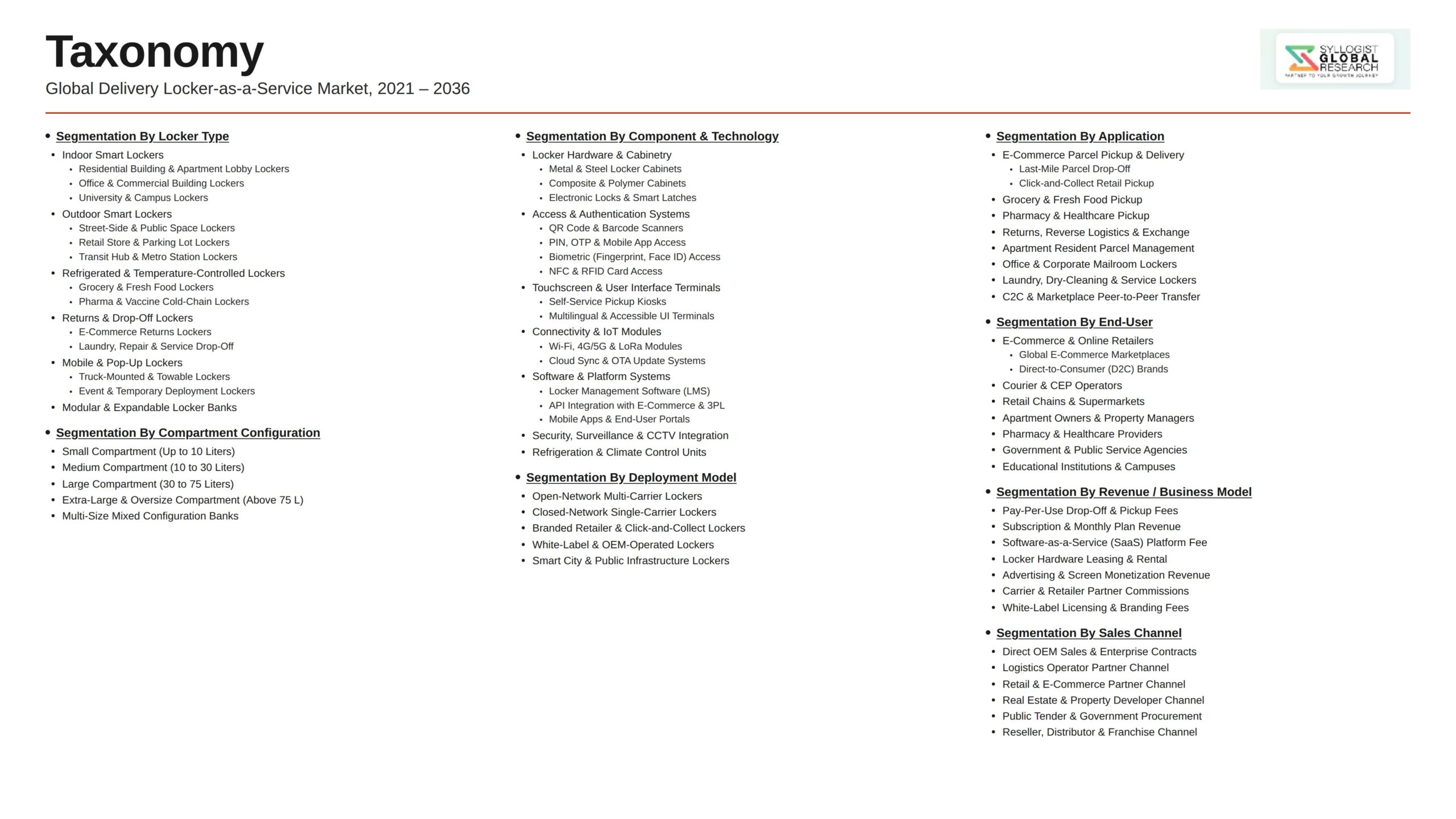
- Segmentation By Locker Type
- Ambient Parcel Lockers
- Refrigerated and Chilled Lockers
- Frozen Lockers
- Multi-Temperature Lockers
- High-Security and Pharmaceutical Lockers
- Modular Customizable Lockers
- Others
- Segmentation By Service Model
- Subscription-Based Model
- Pay-Per-Use Model
- Revenue-Share Model
- Hybrid Service Model
- Segmentation By Application
- Parcel Pickup and Collection
- Returns Processing
- Click-and-Collect Retail
- Grocery and Meal Kit Delivery
- Pharmaceutical and Prescription Pickup
- Laundry, Dry Cleaning, and Personal Services
- Locker-to-Locker Transfer
- Others
- Segmentation By Technology
- Mechanical Keypad-Operated Lockers
- QR Code and Barcode-Enabled Lockers
- Mobile App-Controlled Smart Lockers
- Biometric-Enabled Lockers
- IoT-Integrated Connected Lockers
- Others
- Segmentation By Location Type
- Residential Complexes
- Retail Premises and Shopping Centers
- Transit Hubs (Stations, Airports)
- Office Buildings and Campuses
- University and Educational Campuses
- Dedicated Public Spaces
- Convenience Stores and Petrol Stations
- Others
- Segmentation By Deployment Mode
- Indoor Installations
- Outdoor Installations
- Mobile and Pop-Up Lockers
- Segmentation By End User
- Parcel and Express Carriers
- E-Commerce Retailers
- Grocery and Food Retailers
- Pharmaceutical and Healthcare Operators
- Real Estate and Property Operators
- Municipal Authorities
- Others
- Segmentation By Region
- North America
- Europe
- Asia-Pacific
- Middle East and Africa
- Latin America
All market revenues are presented in USD
Historical Year: 2021-2024 | Base Year: 2025 | Estimated Year: 2026 | Forecast Period: 2027-2034
Key Questions this Study Will Answer
- What is the total global market valuation of the Delivery Locker-as-a-Service Market in 2025, projected through 2034, segmented by locker type, service model, application, and technology, enabling locker hardware manufacturers, network operators, carriers, retailers, and infrastructure investors to identify highest-growth segments and most durable revenue opportunities across the delivery locker-as-a-service landscape?
- How are parcel carriers, e-commerce retailers, grocery retailers, real estate operators, and municipal authorities structuring procurement frameworks for delivery locker-as-a-service networks, and which commercial models, including subscription-based, pay-per-use, revenue-share, and hybrid frameworks, are shaping commercial deployment economics within the delivery locker-as-a-service market through 2034?
- What e-commerce parcel volume growth, last-mile delivery cost inflation, and grocery e-commerce expansion dynamics are shaping the pace and geographic distribution of locker network deployment across mature and emerging operating regions?
- Which locker technologies, including ambient, refrigerated, multi-temperature, mobile app-controlled, biometric, and IoT-enabled configurations, are gaining the strongest procurement traction across parcel pickup, returns, grocery delivery, and pharmaceutical pickup applications, and what reliability, security, and total cost of ownership metrics are shaping technology selection?
- How is the competitive landscape structured among locker hardware original equipment manufacturers, carrier-agnostic locker network operators, software platform providers, and end-to-end delivery locker-as-a-service operators within the delivery locker-as-a-service market, and what partnership, acquisition, and platform expansion strategies are enabling new entrants to compete against incumbent locker network operators?
- What municipal sustainability policies, urban delivery consolidation initiatives, and curbside delivery management frameworks are reshaping public space locker deployment authorization, network density planning, and commercial real estate access conditions across major operating regions globally?
- Which regional markets, including Europe, Asia-Pacific, and North America, are projected to generate the largest incremental delivery locker-as-a-service procurement opportunities through 2034, and what e-commerce penetration, urban density, carrier consolidation, and municipal policy factors are shaping capability investment priorities and supplier selection decisions in each regional delivery locker-as-a-service market?
- Product Definition
- Research Methodology
- Research Design & Framework
- Overall Research Approach: Descriptive, Exploratory & Quantitative Mixed-Method Design
- Market Definition & Scope Boundaries: What is Included and Excluded
- Segmentation Framework
- Key Research Assumptions & Limitations
- Secondary Research
- Primary Research Design & Execution
- Data Triangulation & Validation
- Market Sizing & Forecasting Methodology
- Competitive Intelligence Methodology
- Quality Assurance & Peer Review
- Definitions, Abbreviations & Data Notes
- Executive Summary
- Market Snapshot & Headline Numbers
- Key Findings & Research Highlights
- Market Dynamics
- Regional Market Summary
- Competitive Landscape Snapshot
- Technology & Innovation Highlights
- Market Dynamics
- Drivers
- Restraints
- Opportunities
- Challenges
- Porter’s Five Forces Analysis
- PESTLE Analysis
- Market Trends & Developments
- Emerging Trends
- Technological Developments
- Regulatory & Policy Changes
- Supply Chain & Sourcing Trends
- Manufacturing & Process Trends
- Investment & Funding Activity
- Sustainability & ESG Trends
- Risk Assessment Framework
- Network Density Requirement, Real Estate Acquisition Complexity & Capital Intensity of Geographic Scaling Risk
- Locker Utilisation Variability, Peak Capacity Sizing Trade-Off & Per-Locker Revenue Optimisation Risk
- Consumer Adoption Variability, Geographic Catchment Sensitivity & Last-Mile Delivery Operator Integration Risk
- Cybersecurity, Locker Access Control Compromise & Parcel Theft Liability Risk
- Cold Chain Integrity, Pharmaceutical GDP Compliance & Refrigerated Locker Operating Cost Risk
- Regulatory Framework & Standards
- Municipal Permitting, Public Space Authorisation & Sidewalk Right-of-Way Frameworks for Outdoor Locker Installations
- Data Privacy, Personal Data Protection & Locker User Information Handling Compliance Regulations
- Pharmaceutical Locker Compliance, Good Distribution Practice (GDP) & Controlled Substance Locker Delivery Standards
- Accessibility, Universal Design & ADA Compliance Standards for Public Locker Installations
- Energy Efficiency, Refrigeration Equipment & F-Gas Phasedown Regulations for Refrigerated Lockers
- Global Delivery Locker-as-a-Service Market Outlook
- Market Size & Forecast by Value
- Market Size & Forecast by Volume (Installed Lockers in Thousands and Annual Locker Transactions in Million)
- Market Size & Forecast by Locker Type
- Ambient Parcel Lockers
- Refrigerated and Chilled Lockers
- Frozen Lockers
- Multi-Temperature Lockers
- High-Security and Pharmaceutical Lockers
- Modular Customisable Lockers
- Others
- Market Size & Forecast by Service Model
- Subscription-Based Model
- Pay-Per-Use Model
- Revenue-Share Model
- Hybrid Service Model
- Market Size & Forecast by Application
- Parcel Pickup and Collection
- Returns Processing
- Click-and-Collect Retail
- Grocery and Meal Kit Delivery
- Pharmaceutical and Prescription Pickup
- Laundry, Dry Cleaning and Personal Services
- Locker-to-Locker Transfer
- Others
- Market Size & Forecast by Technology
- Mechanical Keypad-Operated Lockers
- QR Code and Barcode-Enabled Lockers
- Mobile App-Controlled Smart Lockers
- Biometric-Enabled Lockers
- IoT-Integrated Connected Lockers
- Others
- Market Size & Forecast by Location Type
- Residential Complexes
- Retail Premises and Shopping Centers
- Transit Hubs (Stations, Airports)
- Office Buildings and Campuses
- University and Educational Campuses
- Dedicated Public Spaces
- Convenience Stores and Petrol Stations
- Others
- Market Size & Forecast by Deployment Mode
- Indoor Installations
- Outdoor Installations
- Mobile and Pop-Up Lockers
- Market Size & Forecast by End-User
- Parcel and Express Carriers
- E-Commerce Retailers
- Grocery and Food Retailers
- Pharmaceutical and Healthcare Operators
- Real Estate and Property Operators
- Municipal Authorities
- Others
- Market Size & Forecast by Sales Channel
- Direct Locker-as-a-Service Subscription Contracts
- Carrier-Agnostic Multi-Carrier Platform Operating Contracts
- Real Estate Operator Revenue-Share Partnership Agreements
- Municipal Public Space Concession & Licence Models
- Aftermarket Service, Maintenance & Software Update Contracts
- North America Delivery Locker-as-a-Service Market Outlook
- Market Size & Forecast
- By Value
- By Volume (Installed Lockers in Thousands and Annual Locker Transactions in Million)
- By Locker Type
- By Service Model
- By Application
- By Technology
- By Location Type
- By Deployment Mode
- By End-User
- By Country
- By Sales Channel
- Europe Delivery Locker-as-a-Service Market Outlook
- Market Size & Forecast
- By Value
- By Volume (Installed Lockers in Thousands and Annual Locker Transactions in Million)
- By Locker Type
- By Service Model
- By Application
- By Technology
- By Location Type
- By Deployment Mode
- By End-User
- By Country
- By Sales Channel
- Asia-Pacific Delivery Locker-as-a-Service Market Outlook
- Market Size & Forecast
- By Value
- By Volume (Installed Lockers in Thousands and Annual Locker Transactions in Million)
- By Locker Type
- By Service Model
- By Application
- By Technology
- By Location Type
- By Deployment Mode
- By End-User
- By Country
- By Sales Channel
- Latin America Delivery Locker-as-a-Service Market Outlook
- Market Size & Forecast
- By Value
- By Volume (Installed Lockers in Thousands and Annual Locker Transactions in Million)
- By Locker Type
- By Service Model
- By Application
- By Technology
- By Location Type
- By Deployment Mode
- By End-User
- By Country
- By Sales Channel
- Middle East & Africa Delivery Locker-as-a-Service Market Outlook
- Market Size & Forecast
- By Value
- By Volume (Installed Lockers in Thousands and Annual Locker Transactions in Million)
- By Locker Type
- By Service Model
- By Application
- By Technology
- By Location Type
- By Deployment Mode
- By End-User
- By Country
- By Sales Channel
- Country-Wise* Delivery Locker-as-a-Service Market Outlook
- Market Size & Forecast
- By Value
- By Volume (Installed Lockers in Thousands and Annual Locker Transactions in Million)
- By Locker Type
- By Service Model
- By Application
- By Technology
- By Location Type
- By Deployment Mode
- By End-User
- By Country
- By Sales Channel
- Market Size & Forecast
- Market Size & Forecast
- Market Size & Forecast
- Market Size & Forecast
- Market Size & Forecast
- Market Size & Forecast
*Countries Analysed in the Global Research Portfolio: United States, Canada, Mexico, Germany, France, United Kingdom, Netherlands, Spain, Italy, Norway, Sweden, China, Japan, India, Australia, South Korea, Singapore, Brazil, Chile, Saudi Arabia, UAE, Egypt, South Africa, Israel
- Technology Landscape & Innovation Analysis
- Mobile App-Controlled Smart Locker, QR Code & Biometric Access Technology Deep-Dive
- Refrigerated, Multi-Temperature & Pharmaceutical Locker Technology
- Carrier-Agnostic Software Platform, Dynamic Locker Allocation & Multi-Carrier Integration Technology
- IoT-Integrated Connected Locker, Real-Time Monitoring & Remote Diagnostics Technology
- Computer Vision, Package Recognition & Automated Locker Loading Technology
- Modular Customisable Locker Design & Scalable Capacity Configuration Technology
- E-Commerce Platform Integration, Checkout Flow & Returns Reverse Logistics Technology
- Patent & IP Landscape in Delivery Locker-as-a-Service Technologies
- Value Chain & Supply Chain Analysis
- Locker Hardware Manufacturing (Modules, Doors, Locks, Refrigeration Units) Supply Chain
- Smart Locker Software, Mobile App & Carrier-Agnostic Platform Supply Chain
- IoT Sensor, Connected Hardware & Network Connectivity Supply Chain
- Real Estate Site Acquisition, Lease Agreement & Public Space Authorisation Network
- Carrier Integration, Last-Mile Delivery Operator & Platform Partnership Channel
- Retailer, Grocery, Pharmacy & End-Customer Integration Channel
- Aftermarket Service, Network Maintenance & Software Update Provider Network
- Pricing Analysis
- Locker Hardware Capital Cost & Per-Unit Pricing Analysis Across Ambient, Refrigerated, Pharmaceutical & High-Security Configurations
- Subscription-Based Pricing Analysis & Average Revenue Per Locker (ARPL) Benchmarks
- Pay-Per-Use & Transactional Pricing Economics for Carrier and Retailer Customers
- Revenue-Share Pricing Models & Real Estate Operator Partnership Economics
- Locker Network Operating Cost Analysis: Per-Locker Maintenance, Energy & Software Cost Benchmarks
- Total Cost per Transaction & Unit Economics Analysis for Delivery Locker-as-a-Service Operators
- Network Density Payback Period & Locker Network Build-Out Economics
- Sustainability & Environmental Analysis
- Lifecycle Assessment (LCA) of Delivery Locker Networks vs Individual Residential Delivery
- Carbon Reduction Through Consolidated Locker-Based Delivery, Avoided Vehicle Miles & Curbside Congestion Reduction
- Refrigerant Global Warming Potential & F-Gas Phasedown Impact on Refrigerated Locker Operations
- End-of-Life Locker Hardware Recycling, Component Recovery & Circular Economy Performance
- Regulatory-Driven Sustainability, SDG 11 (Sustainable Cities) & SDG 12 (Responsible Consumption) Alignment & Green Finance Eligibility
- Competitive Landscape
- Market Structure & Concentration
- Market Consolidation Level (Fragmented vs. Consolidated by Locker Type & Geography)
- Top 10 Players Market Share
- HHI (Herfindahl-Hirschman Index) Concentration Analysis
- Competitive Intensity Map by Locker Type, Application & Geography
- Player Classification
- Integrated Locker Hardware Original Equipment Manufacturers (OEMs)
- Carrier-Agnostic Locker Network Operators
- Refrigerated & Multi-Temperature Locker Specialists
- Pharmaceutical & High-Security Locker Specialists
- Carrier-Owned Captive Locker Network Operators
- Mobile App, Smart Locker Software & Platform Providers
- Real Estate-Integrated Locker Network Partners
- Municipal & Public Space Locker Network Operators
- Competitive Analysis Frameworks
- Market Share Analysis by Locker Type, Application & Region
- Company Profile
- Company Overview & Headquarters
- Delivery Locker-as-a-Service Products & Technology Portfolio
- Key Customer Relationships & Reference Locker Network Deployments
- Manufacturing Footprint & Production Capacity
- Revenue (Delivery Locker-as-a-Service Segment) & Installed Network Base
- Technology Differentiators & IP
- Key Strategic Partnerships, JVs & M&A Activity
- Recent Developments (Contract Wins, Geographic Expansion, Product Launches)
- SWOT Analysis
- Strategic Focus Areas & Roadmap
- Competitive Positioning Map (Technology Capability vs. Market Penetration)
- Key Company Profiles
- Market Structure & Concentration
- Technology Landscape & Innovation Analysis
- Strategic Output
- Market Opportunity Matrix: By Locker Type, Application, Location Type, End-User & Geography
- White Space Opportunity Analysis
- Strategic Recommendations
- Product Portfolio & Technology Investment Strategy
- Network Density & Geographic Expansion Strategy
- Geographic Expansion & Localisation Strategy
- Customer & End-User Engagement Strategy
- Partnership, M&A & Ecosystem Strategy
- Sustainability & Circular Economy Strategy
- Risk Mitigation & Future Roadmap
- Strategic Priority Matrix & Roadmap
- Near-term (2025-2028)
- Mid-term (2029-2032)
- Long-term (2033-2037)