Global Robotic Welding Systems Market By Robot Type, By Welding Process, By Payload, By Component, By Application, By End-Use Industry, By Region, Competition, Forecast & Opportunities, 2021-2036F
Market Definition
The Global Robotic Welding Systems Market covers the design, manufacture, supply, integration, programming, installation, and aftermarket service of automated welding cells, robotic arms, collaborative welding robots, welding power sources, weld seam tracking systems, fume extraction, fixturing, positioners, and end-of-arm tooling used to automate arc welding, spot welding, laser welding, friction stir welding, and emerging hybrid welding processes across automotive, heavy equipment, shipbuilding, aerospace, energy, construction, and general fabrication industries worldwide. The market encompasses articulated industrial welding robots, collaborative welding cobots, gantry welding systems, dedicated spot welding robots, laser welding cells, friction stir welding systems, integrated turnkey welding cells, alongside welding-specific software covering offline programming, weld simulation, adaptive seam tracking, weld quality monitoring, and emerging AI-enabled weld process optimization and digital twin platforms. The supplier landscape spans major industrial robotics suppliers including FANUC, ABB, Yaskawa Motoman, KUKA (Midea Group), Kawasaki Robotics, Nachi Robotics, Mitsubishi Electric, Comau (Stellantis), Stäubli, Universal Robots (Teradyne), Doosan Robotics, Hyundai Robotics, Estun, Siasun, alongside welding power source and integrated systems providers Lincoln Electric, ESAB, Miller Electric (Illinois Tool Works), Fronius, Panasonic Welding Systems, OTC Daihen, Kemppi, EWM, Hyundai Welding, Cloos, IGM Robotersysteme, Wolf Robotics (Lincoln Electric), Hirebotics, Path Robotics, and emerging AI welding entrants. Market dynamics are governed by accelerating manufacturing automation, structural skilled welder shortages, electric vehicle and battery manufacturing build-out, shipbuilding and offshore wind expansion, US reshoring under CHIPS Act and IRA, China Plus One manufacturing migration, and the structural emergence of AI-enabled and collaborative welding robotics.
Market Insights
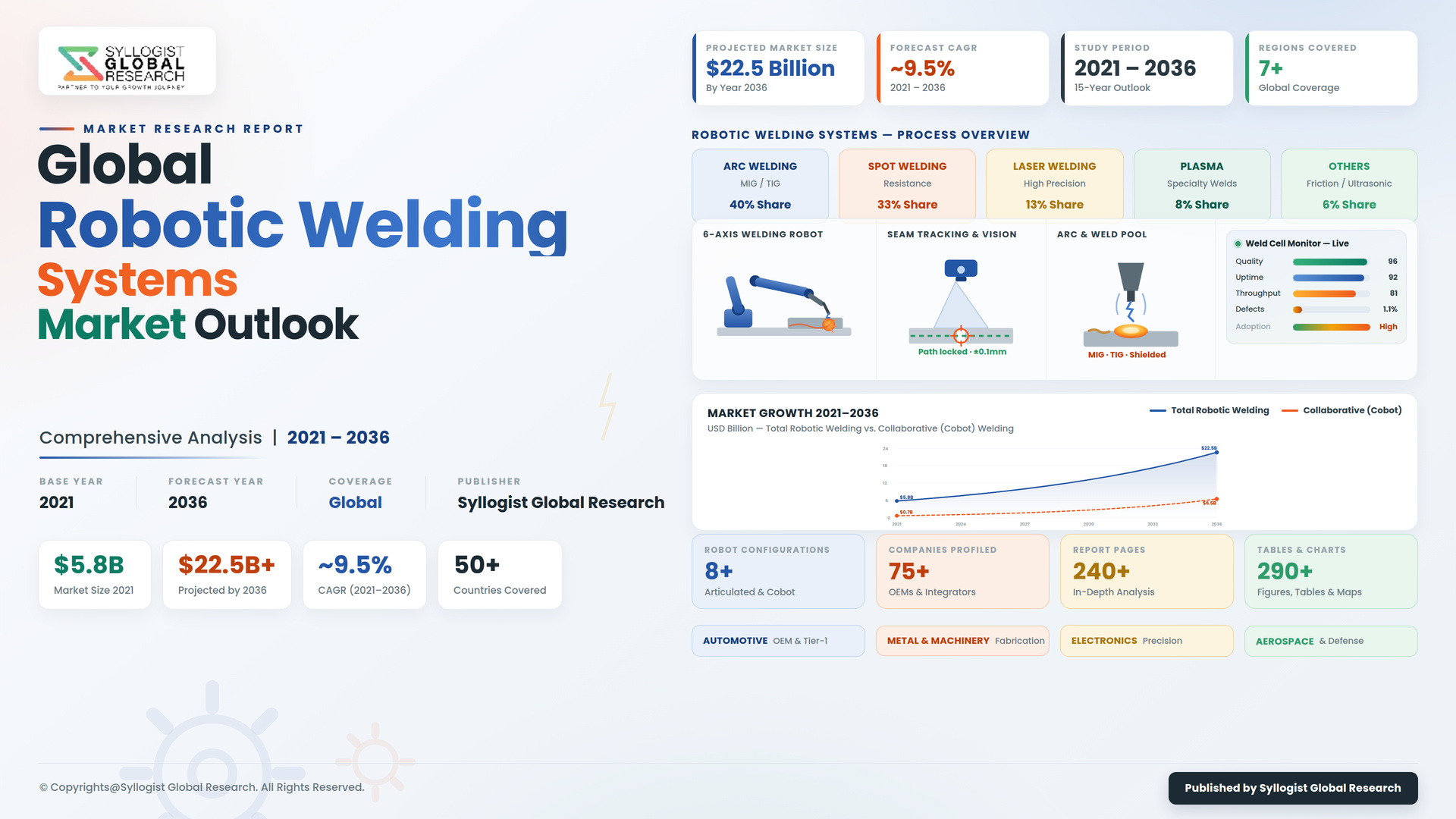
The global robotic welding systems market is entering a sustained high-growth phase driven by accelerating manufacturing automation, structural skilled welder shortages across major industrial economies, electric vehicle and battery manufacturing build-out, shipbuilding and offshore wind sector expansion, US reshoring under CHIPS Act, Inflation Reduction Act, and Bipartisan Infrastructure Law frameworks, China Plus One manufacturing migration to Southeast Asia and India, and the structural emergence of AI-enabled, vision-guided, and collaborative welding robotics. The market was valued at USD 7.84 billion in 2025 and is projected to reach USD 18.64 billion by 2034, advancing at a compound annual growth rate of 10.1% through the forecast period, supported by greenfield robotic welding cell procurement, brownfield manufacturing modernization, EV and battery production line build-out, and emerging AI-native welding platform adoption across major industrial economies.
Automotive remains the dominant end-user segment accounting for approximately 48% of global robotic welding revenue in 2025, anchored by Toyota, Volkswagen, Stellantis, GM, Ford, Hyundai-Kia, Honda, Tesla, BYD, Geely, SAIC, BMW, Mercedes-Benz, Renault-Nissan, and emerging Chinese EV manufacturers deploying integrated welding cells across body-in-white, chassis, and powertrain production lines. Each modern automotive body-in-white facility typically deploys between 380 and 1,400 welding robots, with EV-specific gigafactory build-out at Tesla Gigafactories, BYD plants, CATL battery facilities, LG Energy Solution, Samsung SDI, SK On, Northvolt, ACC, Ford Marshall, Stellantis StarPlus, Hyundai Metaplant, Toyota Battery Plant, and Honda Alliance Battery driving substantial incremental welding system procurement. Spot welding remains the most prevalent automotive process accounting for nearly 38% of welding robot deployments globally, while arc welding holds approximately 42% share supporting body framing, chassis, and structural fabrication.
Collaborative welding robots have emerged as the fastest growing segment, advancing at over 22.4% CAGR through 2034, supported by sub-USD-90,000 cobot welding cell price points enabling broader adoption across small and medium-sized fabrication shops, contract manufacturers, and emerging job shop operators. Universal Robots, Doosan Robotics, Hanwha Robotics, Hirebotics, Path Robotics, Vectis Automation, and emerging AI-native welding entrants are collectively shipping over 24,000 cobot welding cells annually across North America, Europe, and Asia-Pacific, while AI-enabled weld vision systems from Path Robotics, ARC Specialties, Servo-Robot, Scansonic, and Meta Vision Systems are reshaping deployment economics. Friction stir welding for EV battery enclosures, gigacasting structural components, and aluminum body-in-white at Tesla, Lucid, Rivian, NIO, and Mercedes-Benz is simultaneously gaining traction, supported by ESAB, Bond Technologies, MTI, and PaR Systems FSW platforms.
Asia-Pacific dominates the global robotic welding systems market with approximately 52% revenue share in 2025, anchored by China, Japan, South Korea, India, and Southeast Asia hosting dense automotive, shipbuilding, electronics, heavy equipment, and emerging EV manufacturing ecosystems. China alone accounts for nearly 28% of global robotic welding procurement, while India is the fastest growing major market advancing at over 14.8% CAGR through 2034, supported by automotive PLI scheme investment, Make in India manufacturing programs, defense indigenization, and infrastructure expansion. Europe represents the second largest regional market with approximately 26% share, anchored by German, Italian, French, Spanish, and Swedish automotive and heavy industry, alongside accelerating shipbuilding, offshore wind monopile fabrication, and rail rolling stock investment. North America at 18% share is advancing rapidly under CHIPS Act, IRA, and BIL reshoring frameworks driving semiconductor, EV, battery, solar, and aerospace welding investment through 2034.
Key Drivers
EV and Battery Manufacturing Build-Out, Gigacasting Adoption, and Structural Welding Demand Driving Greenfield Procurement
Accelerating EV and battery manufacturing build-out at Tesla Gigafactories, BYD plants, CATL, LG Energy Solution, Samsung SDI, SK On, Northvolt, ACC, Ford Marshall, Stellantis StarPlus, Hyundai Metaplant, Toyota Battery Plant, and Honda Alliance Battery is anchoring durable greenfield robotic welding procurement. Friction stir welding for EV battery enclosures and aluminum body-in-white at Tesla, Lucid, Rivian, NIO, and Mercedes-Benz, alongside gigacasting adoption, is reshaping welding demand patterns. Each modern body-in-white facility deploys between 380 and 1,400 welding robots, anchoring procurement growth through 2034.
Skilled Welder Shortages, Labor Cost Inflation, and Manufacturing Automation Driving Capital Substitution Toward Robotic Welding
Persistent skilled welder shortages with the American Welding Society projecting a shortfall of over 336,000 welders in the United States by 2027, alongside structural shortages across the EU, Japan, South Korea, Australia, and major industrial economies, are anchoring durable capital substitution toward robotic welding. US welder hourly wages advancing from approximately 22 USD in 2020 to over 30 USD in 2025, alongside EU labor cost inflation, are reinforcing capex deployment toward welding cells, while collaborative welding cobot adoption is enabling smaller fabrication shops to access robotic welding economics.
Shipbuilding, Offshore Wind Monopile Fabrication, and Heavy Equipment Manufacturing Driving Premium Welding Cell Demand
Shipbuilding capacity expansion at Hyundai Heavy Industries, Samsung Heavy Industries, Daewoo Shipbuilding, Mitsubishi Heavy Industries, Imabari, China State Shipbuilding Corporation, and Fincantieri, alongside offshore wind monopile and transition piece fabrication at Sif Group, EEW, Bladt, Steelwind Nordenham, and US monopile facilities, is driving premium welding cell demand. Global offshore wind installation projected to exceed 250 GW by 2030, alongside heavy equipment manufacturing at Caterpillar, Komatsu, Volvo CE, Liebherr, and Sany, is anchoring welding procurement across structural fabrication applications through 2034.
Key Challenges
High Capital Intensity, Long Payback Periods, and Integration Complexity Constraining SMB Adoption
Integrated robotic welding cells remain materially capital intensive, with greenfield installations typically requiring USD 180,000 to USD 1.4 million per cell depending on payload, process complexity, fixturing, vision systems, and software integration, alongside payback periods extending from 18 to 48 months. Smaller fabrication shops, contract manufacturers, and mid-sized job shops frequently lack the capital allocation flexibility, project financing capability, and operational sophistication to deploy comprehensive welding automation, while equipment lead times of 12 to 36 months are introducing execution risk through 2034.
Programming Complexity, Skilled Integrator Shortages, and Weld Quality Variability Constraining Deployment Pace
Robotic welding deployment introduces material programming complexity across offline programming, weld simulation, adaptive seam tracking, and weld quality monitoring, with traditional teach pendant programming consuming 28% to 45% of deployment timelines. Skilled robotic welding integrator, programmer, and process engineer shortages across the US, EU, India, and emerging markets are extending project commissioning timelines, while weld quality variability across diverse part geometries, material thicknesses, and joint configurations is complicating production ramp at brownfield deployments and constraining adoption pace across smaller fabrication operators through 2034.
Geopolitical Risks, Tariff Pressures, and Supply Chain Constraints Reshaping Robot Procurement Economics
Escalating geopolitical risks including US-China trade tensions, EU-China tariff debates on Chinese industrial robotics, semiconductor export controls, and emerging robot tariff frameworks under US Trade Representative Section 301 reviews are reshaping robot procurement economics and supply chain configurations. Chinese welding robot makers Estun and Siasun are facing rising market access scrutiny across Western markets, while Japanese FANUC, Yaskawa, Kawasaki, Nachi, Mitsubishi, and OTC Daihen, alongside European ABB, KUKA, Comau, and Stäubli, are reshaping regional manufacturing footprints to navigate tariff and supply chain risk through 2034.
Market Segmentation
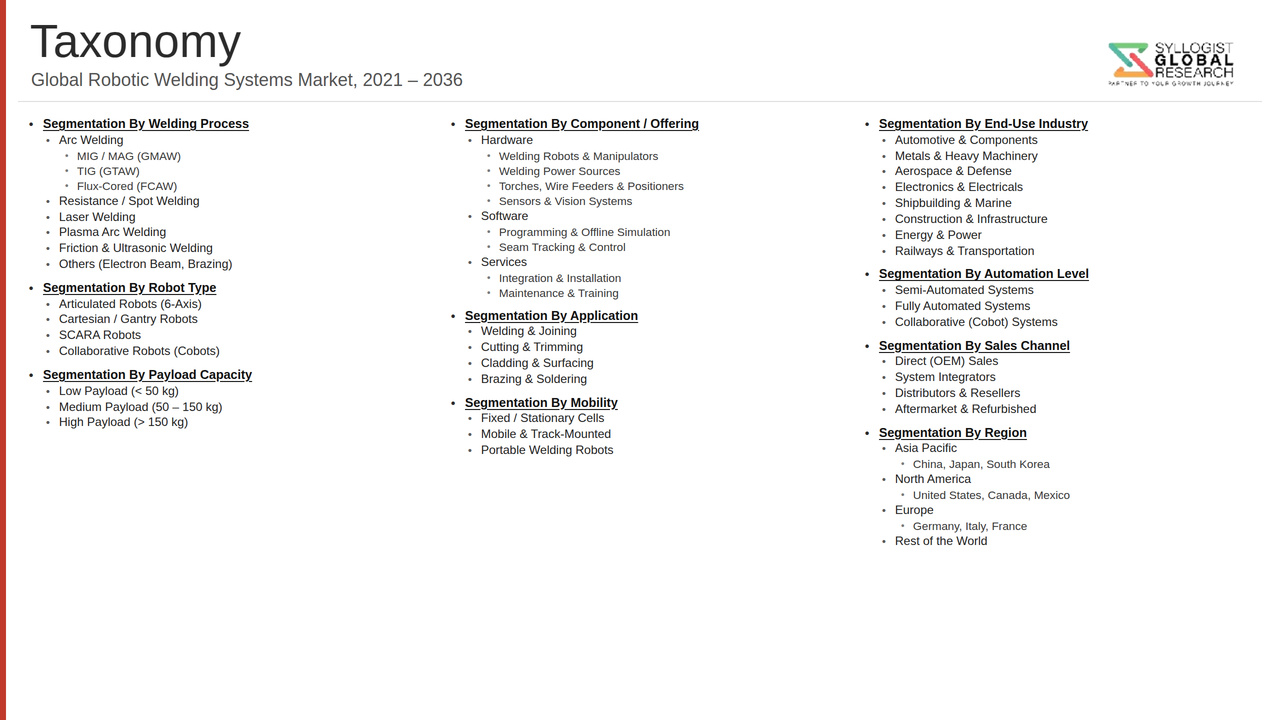
- Segmentation By Robot Type
- Articulated Industrial Welding Robots
- Collaborative Welding Robots (Cobots)
- Gantry Welding Robots
- SCARA Welding Robots
- Cartesian and Linear Welding Robots
- Others
- Segmentation By Welding Process
- Arc Welding (MIG/MAG, TIG, Submerged Arc)
- Spot Welding (Resistance)
- Laser Welding
- Friction Stir Welding (FSW)
- Plasma Arc Welding
- Hybrid Laser-Arc Welding
- Ultrasonic Welding
- Others
- Segmentation By Payload
- Less than 10 kg
- 10 kg to 50 kg
- 50 kg to 150 kg
- 150 kg to 500 kg
- Above 500 kg
- Others
- Segmentation By Component
- Robot Manipulator
- Welding Power Source
- Controller
- End-of-Arm Tooling (Torches, Grippers)
- Positioners and Fixtures
- Seam Tracking and Vision Systems
- Fume Extraction Systems
- Software (Offline Programming, Simulation, Digital Twin)
- Services (Integration, Programming, Aftermarket)
- Others
- Segmentation By Application
- Body-in-White and Chassis Welding
- Powertrain and Drivetrain Welding
- Structural Fabrication
- Pipe and Pipeline Welding
- Shipbuilding and Offshore Structures
- Battery Enclosure and EV Component Welding
- Aerospace Component Welding
- Rail Rolling Stock
- Others
- Segmentation By End-Use Industry
- Automotive and Transportation
- Heavy Equipment and Construction Machinery
- Shipbuilding and Marine
- Aerospace and Defense
- Energy (Oil and Gas, Offshore Wind, Power Generation)
- Rail and Rolling Stock
- General Industrial Fabrication
- Electronics and Semiconductors
- Battery and EV Manufacturing
- Others
- Segmentation By Region
- Asia-Pacific (China, India, Japan, South Korea, Southeast Asia, Australia)
- Europe
- North America
- Middle East and Africa
- Latin America
All market revenues are presented in USD
Historical Year: 2021-2024 | Base Year: 2025 | Estimated Year: 2026 | Forecast Period: 2027-2034
Key Questions this Study Will Answer
- What is the total market valuation of the Global Robotic Welding Systems Market in 2025, projected through 2034, disaggregated by robot type, welding process, payload, component, application, end-use industry, and region, enabling robotic welding suppliers, automotive OEMs, EV and battery manufacturers, shipbuilders, heavy equipment manufacturers, fabrication shops, and investors to identify the highest-growth opportunities and most durable revenue corridors across the robotic welding value chain?
- How is EV and battery manufacturing build-out at Tesla Gigafactories, BYD plants, CATL, LG Energy Solution, Samsung SDI, SK On, Northvolt, ACC, Ford Marshall, Stellantis StarPlus, Hyundai Metaplant, Toyota Battery Plant, and Honda Alliance Battery reshaping robotic welding procurement, alongside friction stir welding adoption at Tesla, Lucid, Rivian, NIO, and Mercedes-Benz for EV battery enclosures and aluminum body-in-white?
- Which robotic welding categories including articulated industrial robots, collaborative cobots, gantry systems, arc welding, spot welding, laser welding, friction stir welding, and hybrid laser-arc welding are generating the highest growth rates, and how is the supply landscape evolving across FANUC, ABB, Yaskawa Motoman, KUKA, Kawasaki Robotics, Nachi Robotics, Mitsubishi Electric, Comau, Stäubli, Universal Robots, Doosan Robotics, Hyundai Robotics, Estun, Siasun, Lincoln Electric, ESAB, Miller Electric, Fronius, Panasonic Welding Systems, OTC Daihen, Kemppi, EWM, Cloos, IGM, Hirebotics, and Path Robotics?
- How are skilled welder shortages with the American Welding Society projecting a shortfall of over 336,000 welders in the US by 2027, alongside structural shortages across the EU, Japan, South Korea, and Australia, and US welder hourly wages advancing from approximately 22 USD in 2020 to over 30 USD in 2025, driving capital substitution toward robotic welding through 2034?
- How are collaborative welding robots advancing at over 22.4% CAGR through 2034, supported by sub-USD-90,000 cobot welding cell price points and emerging AI-enabled weld vision systems from Path Robotics, ARC Specialties, Servo-Robot, Scansonic, and Meta Vision Systems, reshaping deployment economics across small and medium-sized fabrication shops?
- How are shipbuilding capacity expansion at Hyundai Heavy Industries, Samsung Heavy Industries, Daewoo Shipbuilding, Mitsubishi Heavy Industries, Imabari, China State Shipbuilding Corporation, and Fincantieri, alongside offshore wind monopile fabrication at Sif Group, EEW, Bladt, and Steelwind Nordenham, and global offshore wind installation projected to exceed 250 GW by 2030, anchoring premium welding cell demand?
- How are geopolitical risks including US-China trade tensions, EU-China trade tariff debates on Chinese industrial robotics, semiconductor export controls, and emerging robot tariff frameworks under US Trade Representative Section 301 reviews reshaping robot procurement economics, supply chain configurations, and competitive positioning across Chinese, Japanese, European, and Korean welding robot suppliers through 2034?
- Product Definition
- Research Methodology
- Research Design & Framework
- Overall Research Approach: Descriptive, Exploratory & Quantitative Mixed-Method Design
- Market Definition & Scope Boundaries: What is Included and Excluded
- Segmentation Framework
- Key Research Assumptions & Limitations
- Secondary Research
- Primary Research Design & Execution
- Data Triangulation & Validation
- Market Sizing & Forecasting Methodology
- Competitive Intelligence Methodology
- Quality Assurance & Peer Review
- Definitions, Abbreviations & Data Notes
- Research Design & Framework
- Executive Summary
- Market Snapshot & Headline Numbers
- Key Findings & Research Highlights
- Market Dynamics
- Regional Market Summary
- Competitive Landscape Snapshot
- Technology & Innovation Highlights
- Market Dynamics
- Drivers
- Restraints
- Opportunities
- Challenges
- Porter’s Five Forces Analysis
- PESTLE Analysis
- Market Trends & Developments
- Emerging Trends
- Technological Developments
- Regulatory & Policy Changes
- Supply Chain & Sourcing Trends
- Manufacturing & Process Trends
- Investment & Funding Activity
- Sustainability & ESG Trends
- Risk Assessment Framework
- High Capital Investment, ROI Uncertainty & Payback Period Risk
- Skilled Labor Shortage, Programming & Integration Complexity Risk
- Technology Integration, Legacy Compatibility & Interoperability Risk
- Demand Cyclicality, Manufacturing Slowdown & End-Market Volatility Risk
- Component Supply, Semiconductor & Vendor Lock-In Risk
- Regulatory Framework & Standards
- Industrial Robot Safety & Machinery Standards (ISO 10218, ISO/TS 15066 & ANSI/RIA)
- Welding Procedure, Qualification & Quality Standards (ISO 3834, AWS & EN)
- Workplace Safety, Fume Extraction & Occupational Health Standards
- Electrical, EMC & Functional Safety Compliance Standards
- Sustainability, Energy Efficiency & ESG Disclosure Standards
- Global Robotic Welding Systems Market Outlook
- Market Size & Forecast by Value
- Market Size & Forecast by Volume (Units & System Installations)
- Market Size & Forecast by Component
- Welding Robots (Manipulators)
- Welding Power Sources & Controllers
- Robot Controllers & Programming Systems
- Welding Torches, Guns & End-Effectors
- Positioners, Fixtures & Workholding Systems
- Sensors, Vision & Seam-Tracking Systems
- Safety, Fume Extraction & Peripheral Equipment
- Software, Simulation & Offline Programming
- Other Components & Integration Services
- Market Size & Forecast by Welding Type
- Arc Welding (MIG / MAG)
- Arc Welding (TIG)
- Spot & Resistance Welding
- Laser Welding
- Plasma Welding
- Friction & Friction Stir Welding
- Ultrasonic Welding
- Hybrid & Multi-Process Welding
- Other & Emerging Welding Processes
- Market Size & Forecast by Robot Type
- Articulated Robots
- Cartesian & Gantry Robots
- SCARA Robots
- Collaborative Robots (Cobots)
- Other & Hybrid Robot Configurations
- Market Size & Forecast by Payload Capacity
- High-Payload Systems (Above 50 Kilograms)
- Medium-Payload Systems (10 to 50 Kilograms)
- Low-Payload Systems (Below 10 Kilograms)
- Market Size & Forecast by Application
- Automotive & Transportation Manufacturing
- Metal Fabrication & Heavy Machinery
- Aerospace & Defense
- Shipbuilding & Marine
- Construction & Infrastructure Equipment
- Electronics & Other Applications
- Market Size & Forecast by End-Use Industry
- Automotive OEMs & Tier Suppliers
- Metal Fabrication & Job Shops
- Heavy Machinery & Industrial Manufacturers
- Aerospace, Defense & Shipbuilding
- Electronics & Other End-Use Industries
- Market Size & Forecast by Sales Channel
- Direct Sales & OEM Supply
- System Integrators & Solution Providers
- Distributors & Value-Added Resellers
- Robotics-as-a-Service (RaaS) & Leasing Channel
- North America Robotic Welding Systems Market Outlook
- Market Size & Forecast
- By Value
- By Volume (Units & System Installations)
- By Component
- By Welding Type
- By Robot Type
- By Payload Capacity
- By Application
- By End-Use Industry
- By Country
- By Sales Channel
- Europe Robotic Welding Systems Market Outlook
- Market Size & Forecast
- By Value
- By Volume (Units & System Installations)
- By Component
- By Welding Type
- By Robot Type
- By Payload Capacity
- By Application
- By End-Use Industry
- By Country
- By Sales Channel
- Asia-Pacific Robotic Welding Systems Market Outlook
- Market Size & Forecast
- By Value
- By Volume (Units & System Installations)
- By Component
- By Welding Type
- By Robot Type
- By Payload Capacity
- By Application
- By End-Use Industry
- By Country
- By Sales Channel
- Latin America Robotic Welding Systems Market Outlook
- Market Size & Forecast
- By Value
- By Volume (Units & System Installations)
- By Component
- By Welding Type
- By Robot Type
- By Payload Capacity
- By Application
- By End-Use Industry
- By Country
- By Sales Channel
- Middle East & Africa Robotic Welding Systems Market Outlook
- Market Size & Forecast
- By Value
- By Volume (Units & System Installations)
- By Component
- By Welding Type
- By Robot Type
- By Payload Capacity
- By Application
- By End-Use Industry
- By Country
- By Sales Channel
- Country-Wise* Robotic Welding Systems Market Outlook
- Market Size & Forecast
- By Value
- By Volume (Units & System Installations)
- By Component
- By Welding Type
- By Robot Type
- By Payload Capacity
- By Application
- By End-Use Industry
- By Country
- By Sales Channel
- *Countries Analyzed in the Syllogist Global Research Portfolio: United States, Canada, Mexico, Germany, France, United Kingdom, Netherlands, Spain, Italy, Norway, Sweden, China, Japan, India, Australia, South Korea, Singapore, Brazil, Chile, Saudi Arabia, UAE, Egypt, South Africa, Israel
- Technology Landscape & Innovation Analysis
- Arc Welding (MIG / MAG & TIG) Robotic Technology Deep-Dive
- Laser & Hybrid Laser-Arc Welding Technology
- Spot & Resistance Welding Robotic Technology
- Collaborative Robot (Cobot) Welding Technology
- Vision, Seam-Tracking & Adaptive Control Technology
- Offline Programming, Simulation & Digital Twin Technology
- AI, Machine Learning & Weld Quality Monitoring Technology
- Patent & IP Landscape in Robotic Welding Technologies
- Value Chain & Supply Chain Analysis
- Robot Manipulator, Servo & Mechanical Component Manufacturing Supply Chain
- Welding Power Source, Controller & Torch Component Supply Chain
- Sensor, Vision & Seam-Tracking Component Supply Chain
- Software, Simulation & Offline Programming Landscape
- System Integrator & Solution Provider Procurement Landscape
- Automotive, Fabrication & Industrial Manufacturer Channel
- Installation, Maintenance, Service & Circular Economy
- Pricing Analysis
- Arc Welding Robotic Cell Capital and Operating Cost Analysis
- Laser & Hybrid Welding System Cost Analysis
- Spot & Resistance Welding Cell Cost Analysis
- Collaborative Robot (Cobot) Welding System Cost Analysis
- Software, Integration & Robotics-as-a-Service Pricing Analysis
- Total Robotic Welding Economics: Cost-per-Weld and ROI / Payback Optimisation Analysis
- Sustainability & Environmental Analysis
- Lifecycle Assessment (LCA) of Robotic Welding Systems: Energy Intensity, Carbon Footprint & Material Use Across System Types
- Energy Efficiency & Net Zero Contribution: Pathway to Low-Carbon and Renewable-Powered Welding Operations
- Circular Economy & Equipment Reuse: Refurbishment, Component Recovery and E-Waste Contribution
- Environmental Compliance, Welding Fume, Emissions & Material Waste Consideration in Operations
- Regulatory-Driven Sustainability, SDG 9 (Industry & Innovation) & SDG 12 (Responsible Consumption) Alignment & Green Finance Eligibility
- Competitive Landscape
- Market Structure & Concentration
- Market Consolidation Level (Fragmented vs. Consolidated by Welding Type & Geography)
- Top 10 Players Market Share
- HHI (Herfindahl-Hirschman Index) Concentration Analysis
- Competitive Intensity Map by Welding Type, Robot Type & Geography
- Player Classification
- Integrated Industrial Robot & Welding System Companies
- Specialist Welding Robot Manufacturers
- Welding Power Source & Equipment Providers
- Laser & Advanced Welding Technology Providers
- Collaborative Robot (Cobot) Welding Providers
- Vision, Sensor & Seam-Tracking Technology Providers
- System Integrators & Automation Solution Providers
- Emerging & Niche Robotic Welding Entrants
- Competitive Analysis Frameworks
- Market Share Analysis by Welding Type, Robot Type & Region
- Company Profile
- Company Overview & Headquarters
- Robotic Welding Products & Technology Portfolio
- Key Customer Relationships & Reference Deployments
- Manufacturing Footprint & Production Capacity
- Revenue (Robotic Welding Segment) & Backlog
- Technology Differentiators & IP
- Key Strategic Partnerships, JVs & M&A Activity
- Recent Developments (Contract Wins, Capacity Expansion, Product Launches)
- SWOT Analysis
- Strategic Focus Areas & Roadmap
- Competitive Positioning Map (Technology Capability vs. Market Penetration)
- Key Company Profiles
- Market Structure & Concentration
- Technology Landscape & Innovation Analysis
- Strategic Output
- Market Opportunity Matrix: By Welding Type, Robot Type, Application, End-Use Industry & Geography
- White Space Opportunity Analysis
- Strategic Recommendations
- Product Portfolio & Technology Investment Strategy
- Manufacturing & Operational Excellence Strategy
- Geographic Expansion & Localisation Strategy
- Customer & End-User Engagement Strategy
- Partnership, M&A & Ecosystem Strategy
- Sustainability & Circular Economy Strategy
- Risk Mitigation & Future Roadmap
- Strategic Priority Matrix & Roadmap
- Near-term (2025-2028)
- Mid-term (2029-2032)
- Long-term (2033-2037)
- Strategic Output
- Market Size & Forecast
- Market Size & Forecast
- Market Size & Forecast
- Market Size & Forecast
- Market Size & Forecast
- Market Size & Forecast