Global Welding Market By Product Type, By Welding Technology, By Arc Welding Process, By Automation, By Material, By Application, By Region, Competition, Forecast & Opportunities, 2021-2034F
Market Definition
Welding is the fabrication process that joins metals and thermoplastics by applying heat, pressure, or both to form a permanent, load-bearing bond across industrial and structural applications worldwide. The Global Welding Market covers the supply of welding equipment, consumables, and services spanning arc welding, resistance welding, oxy-fuel welding, laser beam welding, and electron beam welding, together with the power sources, robotic and automation systems, electrodes, solid and flux-cored wires, fluxes, and shielding gases that enable metal joining. Within the Global Welding Market, arc welding processes include shielded metal arc welding (SMAW), gas metal arc welding (GMAW or MIG), gas tungsten arc welding (GTAW or TIG), flux-cored arc welding (FCAW), and submerged arc welding (SAW), deployed in manual, semi-automatic, and automatic or robotic configurations. The Global Welding Market serves the joining of mild steel, stainless steel, aluminium, and high-strength alloys across automotive and transportation, building and construction, heavy engineering, oil and gas, shipbuilding and marine, aerospace and defense, and energy and power applications. Participants in the Global Welding Market include welding equipment manufacturers, consumable producers, automation and robotics integrators, distributors, and service and repair providers. End users span automotive original equipment manufacturers, construction contractors, fabrication shops, shipyards, energy and infrastructure developers, and general manufacturing. The Global Welding Market excludes adhesive bonding, mechanical fastening, soldering and brazing of electronics, and additive manufacturing systems not used for joining, focusing on the equipment, consumables, and services that perform fusion and pressure welding across the global metal fabrication value chain.
Market Insights
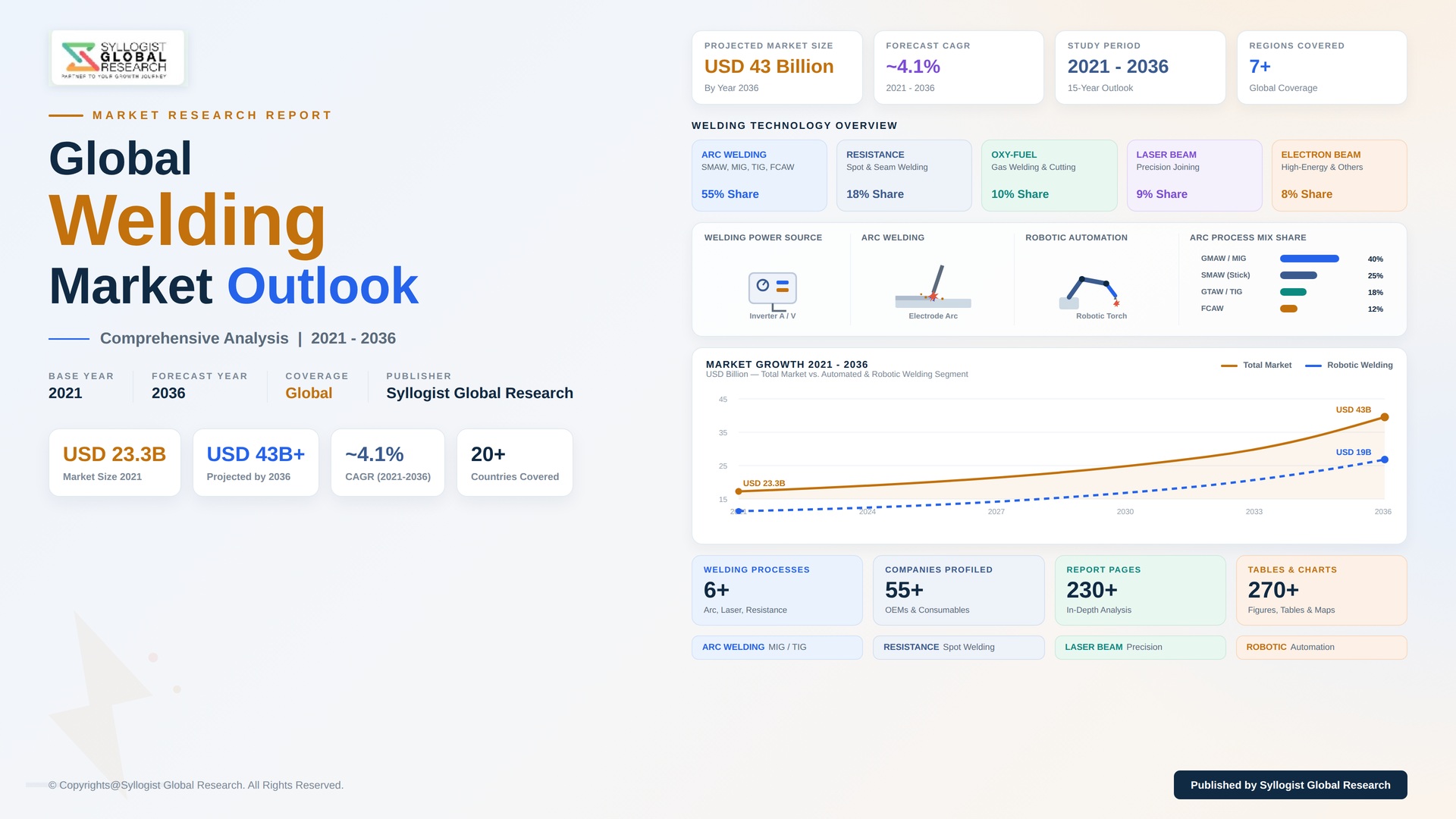
The Global Welding Market is in a steady growth phase, propelled by expanding infrastructure and construction activity, rising automotive production, and accelerating adoption of welding automation across manufacturing economies. The Global Welding Market was valued at USD 27.4 billion in 2025 and is projected to reach USD 39.5 billion by 2034, advancing at a compound annual growth rate of 4.1% across the forecast period, as fabricators scale capacity to meet structural steel, vehicle, pipeline, and energy infrastructure demand. Construction is a foundational pillar of the Global Welding Market, with the United States alone consuming more than 40 million tonnes of steel each year, much of it welded into structural frameworks. Automotive production sustains parallel demand within the Global Welding Market, since close to 80 million vehicles are manufactured each year, each requiring hundreds of individual welds across body, chassis, and assembly operations.
Arc welding is the dominant technology within the Global Welding Market, accounting for close to 55% of total welding revenue, supported by its flexibility, cost efficiency, and use across nearly every end-use industry. Within the product split of the Global Welding Market, welding equipment holds the larger share, while welding consumables are growing faster at close to 5.3% compound annual growth, driven by sustained electrode, solid wire, and flux-cored wire demand. Solid wires and stick electrodes remain the most widely used consumables across the Global Welding Market, and mild steel accounts for close to 47% of welding consumable material demand given its dominance in structural fabrication. Stainless steel and aluminium consumables command premium positioning within the Global Welding Market where corrosion resistance and lightweighting are structural requirements.
Automation is the defining shift reshaping the Global Welding Market, as robotic welding, adaptive arc control, and digital weld monitoring move from automotive lines into general fabrication and shipbuilding. Close to 32% of welding manufacturers introduced new robotic arc welding platforms in 2025, and automatic welding equipment is the fastest growing equipment category within the Global Welding Market. Electric vehicle production is reshaping demand across the Global Welding Market, since electric vehicle platforms are projected to reach close to 48% of global automotive production by 2034, creating new welding applications in battery pack assembly and lightweight aluminium structures. The energy and power segment is the fastest growing application within the Global Welding Market at close to 5.3% compound annual growth, supported by wind tower, transmission structure, hydrogen facility, and pressure vessel fabrication.
Asia-Pacific holds the largest share of the Global Welding Market, close to 35%, driven by the manufacturing scale of China and the industrial expansion of India, Japan, and South Korea. The automotive industry is the single largest end-use consumer within the Global Welding Market at close to 32% of demand, while building and construction holds close to 32% in consumable consumption, underscoring the centrality of structural fabrication. North America and Europe remain advanced markets within the Global Welding Market, anchored by automation adoption, energy infrastructure, and stringent quality and safety standards. Competition across the Global Welding Market is led by equipment and consumable manufacturers including Lincoln Electric, ESAB, Illinois Tool Works, Fronius, Panasonic, Kobe Steel, and Kemppi, which compete through automation breadth, consumable performance, and digital welding software.
Key Drivers
Infrastructure and Construction Expansion with Rising Automotive Production
Expanding infrastructure and construction activity, combined with rising automotive production, is driving sustained demand across the Global Welding Market. Structural steel fabrication for roads, bridges, ports, and buildings, alongside high-volume vehicle assembly, generates durable equipment and consumable demand, keeping the Global Welding Market firmly tied to industrial and infrastructure growth through the forecast period, particularly across fast-urbanising emerging economies where structural fabrication volumes continue to climb.
Welding Automation, Robotics, and Industry 4.0 Adoption
Accelerating adoption of welding automation, robotics, and Industry 4.0 technologies is reshaping the Global Welding Market. Robotic welding, adaptive control, and digital weld monitoring raise productivity, repeatability, and quality while reducing dependence on scarce manual labour, compelling fabricators across automotive, heavy engineering, and shipbuilding to modernise within the Global Welding Market.
Energy Transition Fabrication and Electric Vehicle Manufacturing
Energy transition fabrication and electric vehicle manufacturing are opening new demand pools within the Global Welding Market. Wind towers, transmission structures, hydrogen facilities, pipelines, and battery pack assembly require high-integrity welds and specialised consumables, driving advanced equipment and high-performance consumable demand across the Global Welding Market as the energy and mobility transitions advance and tighten weld integrity and qualification requirements.
Key Challenges
Persistent Shortage of Skilled Welders
A persistent shortage of skilled welders is a leading constraint across the Global Welding Market. Close to 29% of manufacturing plants struggle to find welders trained in MIG, TIG, and multi-process welding, limiting throughput, raising labour cost, and slowing project delivery, while pushing fabricators toward automation to offset the talent gap within the Global Welding Market, even as automated cells still require trained programmers and certified weld inspectors.
High Equipment and Automation Capital Cost with Consumable Price Pressure
High capital cost for advanced equipment and automation, together with consumable price pressure, restrains adoption across the Global Welding Market. Robotic welding cells and specialised power sources demand heavy upfront investment, and close to 37% of manufacturing plants report rising costs for welding machines and consumables, slowing modernization for smaller fabricators within the Global Welding Market.
Weld Quality, Inspection, and Safety and Fume Regulation
Weld quality assurance, inspection capacity, and tightening safety and fume regulation challenge the Global Welding Market. Close to 23% of production facilities face delays from limited inspection and weld-quality testing capability, while stricter operator safety and emissions rules raise compliance cost and operational complexity for fabricators across the Global Welding Market, especially in high-volume environments.
Market Segmentation
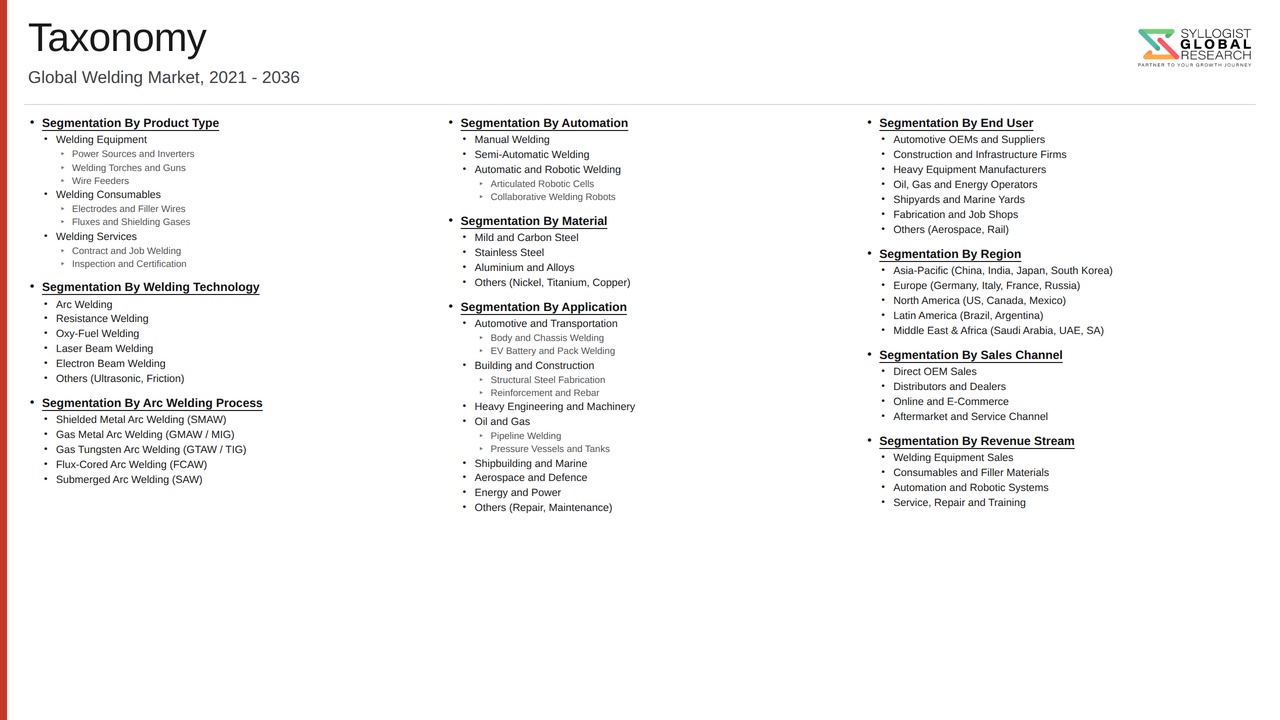
- Segmentation By Product Type
- Welding Equipment
- Welding Consumables
- Welding Services
- Segmentation By Welding Technology
- Arc Welding
- Resistance Welding
- Oxy-Fuel Welding
- Laser Beam Welding
- Electron Beam Welding
- Others
- Segmentation By Arc Welding Process
- Shielded Metal Arc Welding (SMAW)
- Gas Metal Arc Welding (GMAW / MIG)
- Gas Tungsten Arc Welding (GTAW / TIG)
- Flux-Cored Arc Welding (FCAW)
- Submerged Arc Welding (SAW)
- Segmentation By Automation
- Manual
- Semi-Automatic
- Automatic and Robotic
- Segmentation By Material
- Mild Steel
- Stainless Steel
- Aluminium
- Others
- Segmentation By Application
- Automotive and Transportation
- Building and Construction
- Heavy Engineering
- Oil and Gas
- Shipbuilding and Marine
- Aerospace and Defense
- Energy and Power
- Others
- Segmentation By Region
- North America
- Europe
- Asia-Pacific
- Middle East and Africa
- Latin America
All market revenues are presented in USD
Historical Year: 2021-2024 | Base Year: 2025 | Estimated Year: 2026 | Forecast Period: 2027-2034
Key Questions this Study Will Answer
- What is the total valuation of the Global Welding Market in 2025, projected through 2034, segmented by product type, welding technology, arc welding process, automation, and application, enabling equipment manufacturers, consumable producers, automation integrators, and investors to identify the highest growth segments and most durable revenue opportunities across the Global Welding Market?
- How are infrastructure expansion, automotive production, and the shift toward welding automation reshaping equipment and consumable demand across the Global Welding Market through 2034?
- Which welding technologies and processes, including arc, resistance, laser, and the major arc processes such as GMAW, GTAW, FCAW, and SAW, are gaining the strongest procurement traction across automotive, construction, energy, and heavy engineering applications, and what productivity, quality, and total cost of ownership metrics are shaping selection within the Global Welding Market?
- How are robotic welding, adaptive arc control, and digital weld monitoring influencing the pace of automation adoption and the balance between manual, semi-automatic, and automatic welding across the Global Welding Market?
- What role do electric vehicle manufacturing, energy transition fabrication, and lightweight material joining play in creating new high-value demand for advanced welding equipment and consumables within the Global Welding Market?
- How is the competitive landscape structured among welding equipment manufacturers, consumable producers, and automation integrators within the Global Welding Market, and what automation, consumable performance, and digital software strategies are shaping competitive position?
- Which regional markets, including Asia-Pacific, North America, Europe, the Middle East and Africa, and Latin America, are projected to generate the largest incremental welding opportunities through 2034, and what manufacturing, infrastructure, automotive, and skilled labour factors are shaping supplier selection in each regional Global Welding Market?
- Product Definition
- Research Methodology
- Research Design & Framework
- Overall Research Approach: Descriptive, Exploratory & Quantitative Mixed-Method Design
- Market Definition & Scope Boundaries: What is Included and Excluded
- Segmentation Framework
- Key Research Assumptions & Limitations
- Secondary Research
- Primary Research Design & Execution
- Data Triangulation & Validation
- Market Sizing & Forecasting Methodology
- Competitive Intelligence Methodology
- Quality Assurance & Peer Review
- Definitions, Abbreviations & Data Notes
- Executive Summary
- Market Snapshot & Headline Numbers
- Key Findings & Research Highlights
- Market Dynamics
- Regional Market Summary
- Competitive Landscape Snapshot
- Technology & Innovation Highlights
- Market Dynamics
- Drivers
- Restraints
- Opportunities
- Challenges
- Porter’s Five Forces Analysis
- PESTLE Analysis
- Market Trends & Developments
- Emerging Trends
- Technological Developments
- Regulatory & Policy Changes
- Supply Chain & Sourcing Trends
- Manufacturing & Process Trends
- Investment & Funding Activity
- Sustainability & ESG Trends
- Risk Assessment Framework
- Skilled Welder Shortage, Workforce Availability & Throughput Risk
- High Equipment & Automation Capital Cost & Consumable Price Pressure Risk
- Weld Quality, Inspection Capacity & Defect Liability Risk
- Operator Safety, Welding Fume & Emission Compliance Risk
- Raw Material Volatility, Supply Chain Disruption & Component Shortage Risk
- Regulatory Framework & Standards
- Welding Procedure, Qualification & AWS / EN / ISO Code Compliance Frameworks
- Operator Safety, Welding Fume Exposure & Occupational Health Standards
- Pressure Vessel, Pipeline & Structural Welding Certification Standards
- Energy Efficiency, Emissions & Sustainable Manufacturing Regulations
- Robotic & Automated Welding Safety, Machinery & Compliance Standards
- Global Welding Market Outlook
- Market Size & Forecast by Value
- Market Size & Forecast by Volume (Units of Welding Equipment Sold and Tonnes of Welding Consumables Consumed per Year)
- Market Size & Forecast by Product Type
- Welding Equipment
- Welding Consumables
- Welding Services
- Market Size & Forecast by Welding Technology
- Arc Welding
- Resistance Welding
- Oxy-Fuel Welding
- Laser Beam Welding
- Electron Beam Welding
- Others
- Market Size & Forecast by Arc Welding Process
- Shielded Metal Arc Welding (SMAW)
- Gas Metal Arc Welding (GMAW / MIG)
- Gas Tungsten Arc Welding (GTAW / TIG)
- Flux-Cored Arc Welding (FCAW)
- Submerged Arc Welding (SAW)
- Market Size & Forecast by Automation
- Manual
- Semi-Automatic
- Automatic and Robotic
- Market Size & Forecast by Material
- Mild Steel
- Stainless Steel
- Aluminium
- Others
- Market Size & Forecast by Application
- Automotive and Transportation
- Building and Construction
- Heavy Engineering
- Oil and Gas
- Shipbuilding and Marine
- Aerospace and Defense
- Energy and Power
- Others
- North America Welding Market Outlook
- Market Size & Forecast
- By Value
- By Volume (Units of Welding Equipment Sold and Tonnes of Welding Consumables Consumed per Year)
- By Product Type
- By Welding Technology
- By Arc Welding Process
- By Automation
- By Material
- By Application
- By Country
- Market Size & Forecast
- Europe Welding Market Outlook
- Market Size & Forecast
- By Value
- By Volume (Units of Welding Equipment Sold and Tonnes of Welding Consumables Consumed per Year)
- By Product Type
- By Welding Technology
- By Arc Welding Process
- By Automation
- By Material
- By Application
- By Country
- Market Size & Forecast
- Asia-Pacific Welding Market Outlook
- Market Size & Forecast
- By Value
- By Volume (Units of Welding Equipment Sold and Tonnes of Welding Consumables Consumed per Year)
- By Product Type
- By Welding Technology
- By Arc Welding Process
- By Automation
- By Material
- By Application
- By Country
- Market Size & Forecast
- Latin America Welding Market Outlook
- Market Size & Forecast
- By Value
- By Volume (Units of Welding Equipment Sold and Tonnes of Welding Consumables Consumed per Year)
- By Product Type
- By Welding Technology
- By Arc Welding Process
- By Automation
- By Material
- By Application
- By Country
- Market Size & Forecast
- Middle East & Africa Welding Market Outlook
- Market Size & Forecast
- By Value
- By Volume (Units of Welding Equipment Sold and Tonnes of Welding Consumables Consumed per Year)
- By Product Type
- By Welding Technology
- By Arc Welding Process
- By Automation
- By Material
- By Application
- By Country
- Market Size & Forecast
- Country-Wise* Welding Market Outlook
- Market Size & Forecast
- By Value
- By Volume (Units of Welding Equipment Sold and Tonnes of Welding Consumables Consumed per Year)
- By Product Type
- By Welding Technology
- By Arc Welding Process
- By Automation
- By Material
- By Application
- By Country
- Market Size & Forecast
*Countries Analysed in the Global Research Portfolio: China, India, Japan, South Korea, Australia, United States, Canada, Mexico, Brazil, Germany, France, United Kingdom, Italy, Spain, Russia, Türkiye, Saudi Arabia, UAE, South Africa, Vietnam, Indonesia
- Technology Landscape & Innovation Analysis
- Arc Welding (SMAW, GMAW, GTAW, FCAW, SAW) Process Technology Deep-Dive
- Resistance, Laser Beam & Electron Beam Welding Technology
- Robotic Welding, Adaptive Arc Control & Automation Technology
- Inverter-Based Power Source & Energy-Efficient Welding Technology
- Digital Welding, Weld Monitoring & Quality Data Analytics Technology
- Advanced Consumables, Flux-Cored & High-Deposition Wire Technology
- Lightweight, Aluminium & High-Strength Material Joining Technology
- Patent & IP Landscape in Welding Technologies
- Value Chain & Supply Chain Analysis
- Steel, Wire Rod, Flux & Shielding Gas Raw Material Supply Chain
- Welding Equipment & Power Source Manufacturing Supply Chain
- Welding Consumable (Electrode, Wire, Flux) Manufacturing Supply Chain
- Robotic & Automation Integrator Supply Chain
- Distributor, Dealer & Direct Sales Channel
- End-User Customer Channel (Automotive, Construction, Energy, Shipbuilding)
- Aftermarket Service, Spare Parts & Training Network
- Pricing Analysis
- Welding Equipment Pricing Across Arc, Resistance, Laser & Electron Beam
- Pricing Across Manual, Semi-Automatic & Robotic Configurations
- Welding Consumable Pricing Across Electrodes, Solid Wires & Flux-Cored Wires
- Robotic Welding Cell Cost Economics & Per-Weld Cost Analysis
- Operating Cost: Energy, Gas & Consumable Consumption Economics
- Capital Cost, Installation & Total Cost of Ownership Across Automation Tiers
- Aftermarket, Spare Parts & Service Contract Pricing
- Sustainability & Environmental Analysis
- Lifecycle Assessment (LCA) of Welding Across Processes & Automation Levels
- Energy Consumption, Carbon Footprint & Net Climate Impact of Welding
- Welding Fume, Emission Capture & Operator Health Performance
- Consumable Efficiency, Spatter Reduction & Material Waste Management
- Regulatory-Driven Sustainability, SDG 9 (Industry and Innovation) & SDG 12 (Responsible Consumption) Alignment
- Competitive Landscape
- Market Structure & Concentration
- Market Consolidation Level (Fragmented vs. Consolidated by Product Type & Geography)
- Top 10 Players Market Share
- HHI (Herfindahl-Hirschman Index) Concentration Analysis
- Competitive Intensity Map by Product Type, Welding Technology & Geography
- Player Classification
- Integrated Welding Equipment & Consumable Manufacturers
- Welding Equipment & Power Source Manufacturers
- Welding Consumable Producers
- Robotic & Automation Welding Integrators
- Laser & Electron Beam Welding Specialists
- Distributors & Channel Partners
- Aftermarket Service & Training Providers
- Competitive Analysis Frameworks
- Market Share Analysis by Product Type, Welding Technology & Region
- Company Profile
- Company Overview & Headquarters
- Welding Equipment & Consumable Product Portfolio
- Key Customer Relationships & Reference Accounts
- Operational Footprint & Distribution Network Coverage
- Revenue (Welding Segment) & Order Backlog
- Technology Differentiators & IP
- Key Strategic Partnerships, JVs & M&A Activity
- Recent Developments (Product Launches, Capacity Expansion, Automation Rollouts)
- SWOT Analysis
- Strategic Focus Areas & Roadmap
- Competitive Positioning Map (Technology Capability vs. Market Penetration)
- Key Company Profiles
- Market Structure & Concentration
- Technology Landscape & Innovation Analysis
- Strategic Output
- Market Opportunity Matrix: By Product Type, Welding Technology, Automation, Application & Geography
- White Space Opportunity Analysis
- Strategic Recommendations
- Product Portfolio & Automation Technology Investment Strategy
- Operational Excellence & Distribution Network Expansion Strategy
- Geographic Expansion & Localisation Strategy
- Customer & End-User Account Engagement Strategy
- Partnership, M&A & Ecosystem Strategy
- Sustainability & Circular Economy Strategy
- Risk Mitigation & Future Roadmap
- Strategic Priority Matrix & Roadmap
- Near-term (2025-2028)
- Mid-term (2029-2032)
- Long-term (2033-2037)