Global Endpoint Security Market By Solution Type, By Deployment, By Component, By Organization Size, By Application, By End-Use Industry, By Region, Competition, Forecast & Opportunities, 2021-2036F
Market Definition
The Global Endpoint Security Market covers the design, development, supply, integration, software-as-a-service delivery, and managed security service operation of cybersecurity platforms that protect laptops, desktops, servers, mobile devices, virtual machines, containers, IoT devices, operational technology (OT) endpoints, and emerging edge computing assets from malware, ransomware, advanced persistent threats, insider threats, fileless attacks, supply chain attacks, and AI-enabled adversarial threats across enterprise, government, and small business environments worldwide. The market encompasses traditional antivirus, next-generation antivirus (NGAV), endpoint detection and response (EDR), extended detection and response (XDR), managed detection and response (MDR), mobile threat defense (MTD), unified endpoint management (UEM) with security overlays, application allowlisting, exploit prevention, behavioral analytics, identity-aware endpoint protection, browser isolation, and emerging AI-driven autonomous endpoint security platforms. The supplier landscape spans pure-play endpoint security vendors including CrowdStrike, SentinelOne, Palo Alto Networks (Cortex XDR), Microsoft Defender for Endpoint, Sophos, Trend Micro, Trellix (McAfee Enterprise plus FireEye), Bitdefender, ESET, Kaspersky, F-Secure (WithSecure), VMware Carbon Black (Broadcom), Cybereason, Tanium, Cisco Secure Endpoint, BlackBerry Cylance, Check Point Harmony, Fortinet FortiEDR, Elastic Security, Deep Instinct, Huntress, ThreatLocker, Malwarebytes, alongside MDR specialists Arctic Wolf, Red Canary, eSentire, Expel, Rapid7, Secureworks, and managed service providers. Market dynamics are governed by accelerating ransomware and AI-enabled threats, hybrid work persistence, OT and IoT convergence, NIS2 Directive and DORA compliance in the European Union, US SEC cybersecurity disclosure rules, CMMC 2.0 defense contractor requirements, cyber insurance underwriting standards, and the structural transition toward AI-driven autonomous endpoint protection.
Market Insights
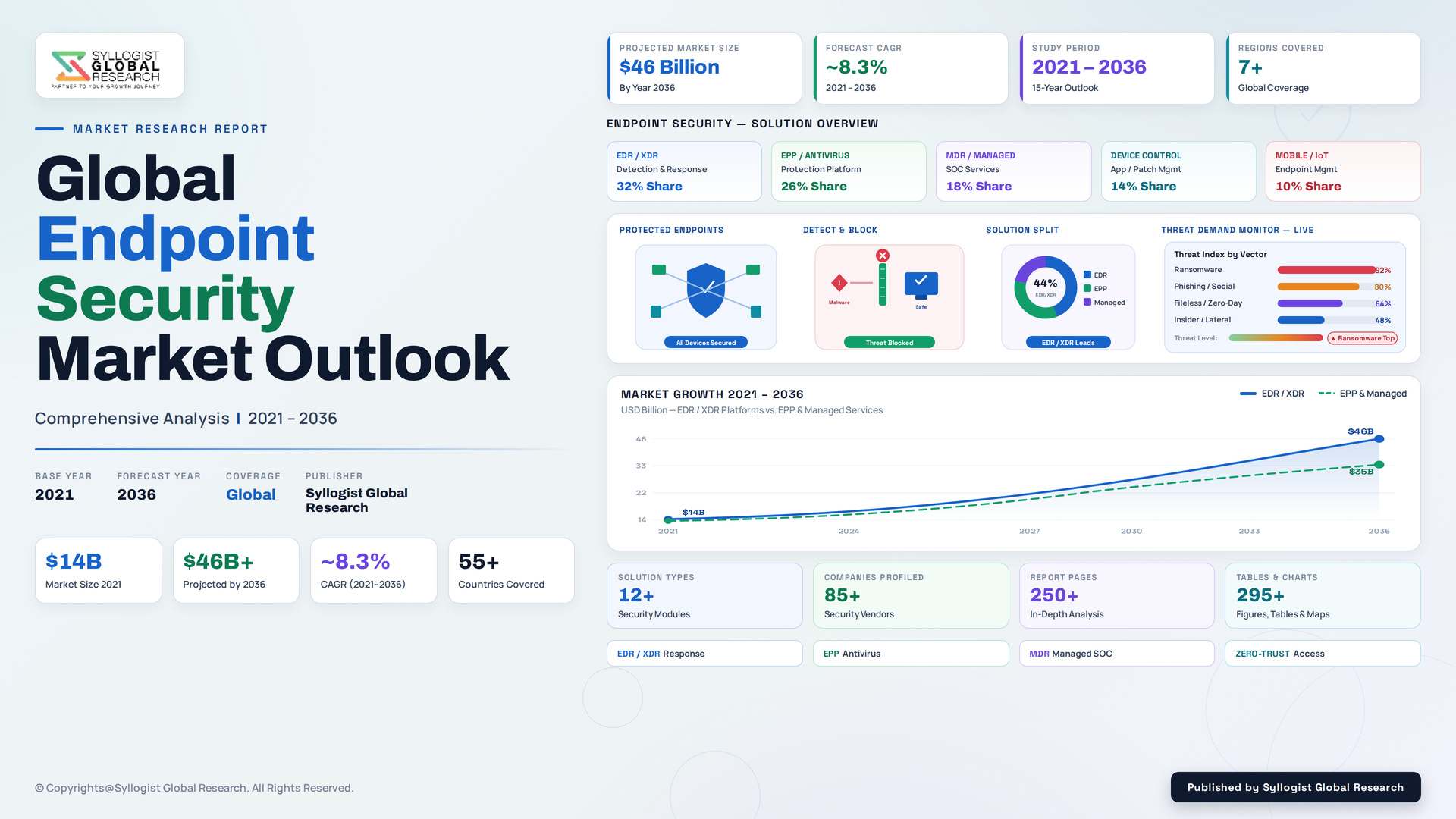
The global endpoint security market is entering a sustained high-growth phase driven by accelerating ransomware activity, AI-enabled adversarial threats, hybrid and remote work persistence, OT and IoT endpoint convergence, NIS2 Directive and DORA compliance in the European Union, US SEC cybersecurity disclosure rules, CMMC 2.0 defense contractor requirements, escalating cyber insurance underwriting standards, and the structural transition from signature-based antivirus toward AI-driven autonomous endpoint detection and response. The market was valued at USD 18.6 billion in 2025 and is projected to reach USD 52.4 billion by 2034, advancing at a compound annual growth rate of 12.2% through the forecast period, supported by greenfield platform deployments, MDR service procurement, XDR consolidation programs, and emerging AI-native endpoint protection adoption.
Endpoint detection and response (EDR) and extended detection and response (XDR) have emerged as the dominant solution categories, collectively accounting for nearly 58% of global endpoint security revenue in 2025, anchored by CrowdStrike Falcon, SentinelOne Singularity, Microsoft Defender for Endpoint, Palo Alto Cortex XDR, Sophos Intercept X, Trend Micro Vision One, and Trellix XDR. CrowdStrike, SentinelOne, and Microsoft collectively hold approximately 48% of EDR market share in 2025, with Microsoft Defender for Endpoint share expansion accelerating as enterprises consolidate security under Microsoft E5 licensing agreements. The 2024 CrowdStrike outage affecting over 8.5 million Windows endpoints globally has materially reshaped resilience requirements, multi-vendor strategies, and procurement evaluation criteria across major enterprise customers through 2034.
Managed detection and response (MDR) services have emerged as the fastest growing segment, advancing at over 17.4% CAGR through 2034, supported by persistent SOC analyst talent shortages, escalating threat sophistication, and the structural difficulty of operating 24×7 detection and response capabilities at smaller and mid-market organizations. Arctic Wolf, Red Canary, eSentire, Expel, Rapid7, Secureworks, Sophos MDR, CrowdStrike Falcon Complete, SentinelOne Vigilance, Huntress, and Trustwave are collectively serving over 38,000 enterprise customers globally, with average MDR contract values ranging from USD 48,000 to USD 480,000 per year depending on endpoint count and service scope. AI-driven autonomous endpoint protection from Deep Instinct, Darktrace, and emerging entrants is simultaneously gaining commercial traction with predictive prevention capabilities reducing dwell time from weeks to seconds.
North America dominates the global endpoint security market with approximately 44% revenue share in 2025, anchored by mature US enterprise security investment, dense pure-play vendor ecosystems, accelerating CISA Binding Operational Directives, US SEC cybersecurity disclosure rules effective from 2023, and CMMC 2.0 defense contractor cybersecurity requirements ramping through 2028. Europe represents the second largest regional market with nearly 26% share, driven by NIS2 Directive transposition across EU member states, DORA financial services digital operational resilience requirements effective from January 2025, GDPR security obligations, and UK Cyber Essentials Plus and forthcoming Cyber Resilience Act frameworks. Asia-Pacific is the fastest growing regional market advancing at over 15.4% CAGR through 2034, supported by accelerating Japanese, South Korean, Australian, Singaporean, and Indian enterprise security investment, alongside cybersecurity regulation tightening in China, Vietnam, and Southeast Asia under data localization and critical infrastructure protection frameworks. Latin America and Middle East and Africa together contribute the balance of regional revenue, with Brazilian, Mexican, Saudi, and UAE enterprise security spending advancing rapidly under cybersecurity regulation tightening and digital transformation programs.
Key Drivers
Ransomware Acceleration, AI-Enabled Threats, and Hybrid Work Persistence Driving Structural Endpoint Security Demand
Global ransomware incidents exceeded 5,800 disclosed attacks in 2024 with average ransom demands reaching USD 4.8 million and total ransomware-related costs including downtime exceeding USD 42 billion globally, anchoring durable enterprise endpoint security procurement growth. AI-enabled adversarial threats including generative AI phishing, deepfake-driven social engineering, polymorphic malware, and emerging autonomous attack agents are reshaping defensive posture priorities, while hybrid work persistence with over 64% of knowledge workers operating from outside traditional corporate perimeters is anchoring structural shift toward identity-aware, zero-trust endpoint security architectures through 2034.
NIS2, DORA, US SEC Disclosure Rules, and CMMC 2.0 Compliance Driving Regulatory-Mandated Endpoint Security Investment
NIS2 Directive transposition across EU member states effective from October 2024, DORA financial services digital operational resilience requirements effective from January 2025, US SEC cybersecurity disclosure rules effective from December 2023 mandating 4-day material incident reporting, CMMC 2.0 defense contractor cybersecurity requirements ramping through 2028, and accelerating cyber insurance underwriting standards are anchoring regulatory-mandated endpoint security investment. NIS2 alone covers over 160,000 European organizations across critical and important entities, expanding the addressable market for endpoint security platforms and MDR services through 2034.
XDR Consolidation, AI-Driven Autonomous Endpoint Protection, and Platform Convergence Reshaping Enterprise Security Stack Strategy
XDR consolidation programs across CrowdStrike Falcon, SentinelOne Singularity, Microsoft Defender XDR, Palo Alto Cortex XDR, Trellix XDR, Sophos XDR, and Trend Micro Vision One are reshaping enterprise security stack rationalization, with average enterprises consolidating from 7-12 endpoint and security tools to 3-5 integrated platforms. AI-driven autonomous endpoint protection at Deep Instinct, Darktrace, SentinelOne Purple AI, CrowdStrike Charlotte AI, and Microsoft Security Copilot is reshaping detection economics, while platform convergence with identity, cloud security, and data security is anchoring premium platform adoption through 2034.
Key Challenges
Vendor Outage Risk, Resilience Concerns, and Multi-Vendor Strategy Complexity Reshaping Procurement Decisions
The July 2024 CrowdStrike Falcon sensor outage affecting over 8.5 million Windows endpoints globally, causing widespread aviation, healthcare, and financial services disruptions and total economic impact estimated above USD 5.4 billion, has materially reshaped enterprise resilience requirements and procurement strategies. Multi-vendor endpoint security strategies, kernel mode access scrutiny, deployment ring rollout discipline, and Microsoft endpoint API restructuring under the Windows Resilient Initiative are reshaping vendor selection criteria, while tension between consolidation and resilience is complicating long-term platform strategy decisions through 2034.
SOC Analyst Talent Shortages, Alert Fatigue, and Detection Complexity Constraining Enterprise Operational Effectiveness
Global SOC analyst and threat hunter talent shortages exceeding 4.8 million unfilled cybersecurity positions, alongside persistent alert fatigue with average enterprise SOCs receiving over 11,000 alerts per day and investigating less than 38% of high-priority signals, are constraining endpoint security operational effectiveness. Detection complexity, false positive rates, manual triage burden, and SIEM and SOAR integration challenges are extending mean time to detect (MTTD) and mean time to respond (MTTR), while smaller and mid-market organizations are increasingly outsourcing to MDR providers as in-house capability constraints intensify through 2034.
OT, IoT, and Unmanaged Endpoint Coverage Gaps Limiting Comprehensive Enterprise Protection
OT and IoT endpoint coverage gaps remain materially significant, with over 42% of enterprise OT and IoT endpoints in 2025 lacking adequate endpoint security protection due to legacy operating system constraints, performance sensitivity, and operational continuity concerns. Unmanaged BYOD endpoints, contractor devices, and shadow IT assets are introducing attack surface that is difficult to inventory and protect, while emerging edge computing, robotics, autonomous vehicles, and smart facility endpoints are creating new protection categories that exceed traditional endpoint security platform capabilities through 2034.
Market Segmentation
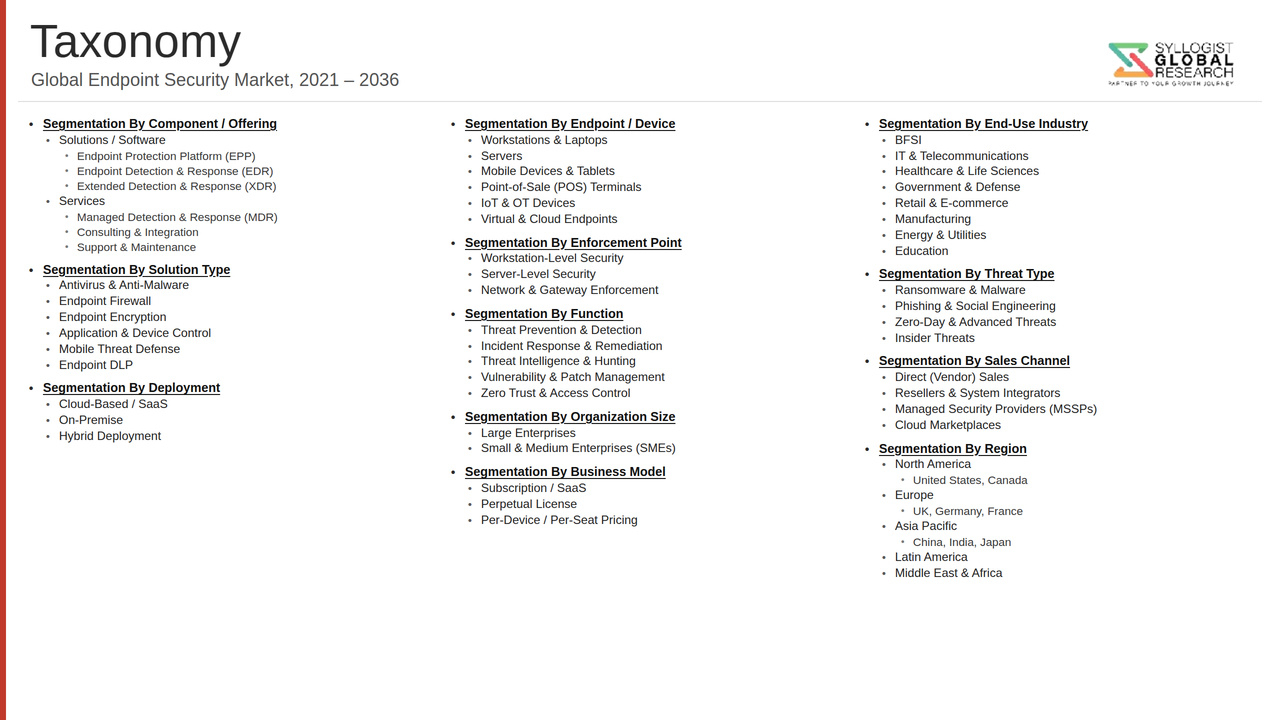
- Segmentation By Solution Type
- Next-Generation Antivirus (NGAV)
- Endpoint Detection and Response (EDR)
- Extended Detection and Response (XDR)
- Managed Detection and Response (MDR)
- Mobile Threat Defense (MTD)
- Unified Endpoint Management (UEM) with Security
- Application Allowlisting and Privilege Management
- Browser Isolation
- AI-Driven Autonomous Endpoint Protection
- Others
- Segmentation By Deployment
- Cloud-Based (SaaS)
- On-Premise
- Hybrid
- Air-Gapped and Sovereign Cloud
- Others
- Segmentation By Component
- Software
- Services (Implementation, Consulting, Managed Services)
- Threat Intelligence Feeds
- Incident Response Retainers
- Others
- Segmentation By Organization Size
- Large Enterprises
- Mid-Market
- Small and Medium-Sized Businesses (SMBs)
- Others
- Segmentation By Application
- Workstation and Laptop Protection
- Server Protection
- Mobile Device Protection
- Virtual Machine and Container Protection
- IoT and Edge Device Protection
- OT and Industrial Endpoint Protection
- Cloud Workload Endpoint Protection
- Others
- Segmentation By End-Use Industry
- Banking, Financial Services, and Insurance (BFSI)
- Government and Defense
- Healthcare and Life Sciences
- Manufacturing and Industrial
- Energy and Utilities
- Retail and E-Commerce
- Telecommunications and Media
- Education
- Technology and SaaS
- Critical Infrastructure
- Others
- Segmentation By Region
- North America
- Europe
- Asia-Pacific (China, India, Japan, South Korea, Australia, Singapore, Southeast Asia)
- Middle East and Africa
- Latin America
All market revenues are presented in USD
Historical Year: 2021-2024 | Base Year: 2025 | Estimated Year: 2026 | Forecast Period: 2027-2034
Key Questions this Study Will Answer
- What is the total market valuation of the Global Endpoint Security Market in 2025, projected through 2034, disaggregated by solution type, deployment, component, organization size, application, end-use industry, and region, enabling endpoint security suppliers, enterprise CISOs, MDR providers, and investors to identify the highest-growth opportunities and most durable revenue corridors across the endpoint security value chain?
- How are ransomware incidents exceeding 5,800 disclosed attacks in 2024 with average ransom demands reaching USD 4.8 million, AI-enabled adversarial threats, hybrid work persistence with over 64% of knowledge workers outside traditional perimeters, and OT and IoT endpoint convergence reshaping enterprise endpoint security procurement priorities through 2034?
- Which endpoint security solution categories including NGAV, EDR, XDR, MDR, mobile threat defense, unified endpoint management, application allowlisting, browser isolation, and AI-driven autonomous endpoint protection are generating the highest growth rates, and how is the supply landscape evolving across CrowdStrike, SentinelOne, Palo Alto Networks, Microsoft Defender for Endpoint, Sophos, Trend Micro, Trellix, Bitdefender, ESET, Kaspersky, F-Secure, VMware Carbon Black, Cybereason, Tanium, Cisco Secure Endpoint, BlackBerry Cylance, Check Point, Fortinet, Elastic Security, Deep Instinct, Huntress, ThreatLocker, Malwarebytes, Arctic Wolf, Red Canary, eSentire, Expel, Rapid7, and Secureworks?
- How are NIS2 Directive transposition across EU member states effective from October 2024 covering over 160,000 European organizations, DORA financial services digital operational resilience requirements effective from January 2025, US SEC cybersecurity disclosure rules effective from December 2023, and CMMC 2.0 defense contractor requirements ramping through 2028 anchoring regulatory-mandated endpoint security investment?
- How is managed detection and response (MDR) advancing at over 17.4% CAGR through 2034, with Arctic Wolf, Red Canary, eSentire, Expel, Rapid7, Secureworks, Sophos MDR, CrowdStrike Falcon Complete, SentinelOne Vigilance, Huntress, and Trustwave collectively serving over 38,000 enterprise customers, reshaping enterprise security operations strategy through 2034?
- How has the July 2024 CrowdStrike Falcon sensor outage affecting over 8.5 million Windows endpoints globally with total economic impact estimated above USD 5.4 billion reshaped enterprise resilience requirements, multi-vendor strategies, kernel mode access scrutiny, and procurement evaluation criteria across major enterprise customers?
- How are SOC analyst and threat hunter talent shortages exceeding 4.8 million unfilled cybersecurity positions, alert fatigue with average SOCs receiving 11,000+ alerts per day, OT and IoT endpoint coverage gaps with 42% of endpoints unprotected, and emerging edge, robotics, autonomous vehicle, and smart facility protection requirements reshaping enterprise endpoint security strategy and platform investment through 2034?
- Product Definition
- Research Methodology
- Research Design & Framework
- Overall Research Approach: Descriptive, Exploratory & Quantitative Mixed-Method Design
- Market Definition & Scope Boundaries: What is Included and Excluded
- Segmentation Framework
- Key Research Assumptions & Limitations
- Secondary Research
- Primary Research Design & Execution
- Data Triangulation & Validation
- Market Sizing & Forecasting Methodology
- Competitive Intelligence Methodology
- Quality Assurance & Peer Review
- Definitions, Abbreviations & Data Notes
- Research Design & Framework
- Executive Summary
- Market Snapshot & Headline Numbers
- Key Findings & Research Highlights
- Market Dynamics
- Regional Market Summary
- Competitive Landscape Snapshot
- Technology & Innovation Highlights
- Market Dynamics
- Drivers
- Restraints
- Opportunities
- Challenges
- Porter’s Five Forces Analysis
- PESTLE Analysis
- Market Trends & Developments
- Emerging Trends
- Technological Developments
- Regulatory & Policy Changes
- Supply Chain & Sourcing Trends
- Manufacturing & Process Trends
- Investment & Funding Activity
- Sustainability & ESG Trends
- Risk Assessment Framework
- Evolving Threat Landscape, Zero-Day & Ransomware Risk
- Alert Fatigue, Detection Accuracy & False-Positive Risk
- Platform Integration, Tool Sprawl & Interoperability Risk
- Talent Shortage, Skills Gap & Managed-Service Dependence Risk
- Vendor Lock-In, Subscription Churn & Technology Shift Risk
- Regulatory Framework & Standards
- Data Privacy & Breach Notification Frameworks (GDPR, CCPA & Equivalent)
- Cybersecurity & Critical Infrastructure Protection Regulations
- Security Certification, Assurance & Compliance Standards (ISO 27001, SOC 2 & NIST)
- Industry-Specific Compliance Standards (HIPAA, PCI DSS & Equivalent)
- Cyber Incident Reporting, Governance & ESG Disclosure Standards
- Global Endpoint Security Market Outlook
- Market Size & Forecast by Value
- Market Size & Forecast by Volume (Subscriptions & Protected Endpoints)
- Market Size & Forecast by Offering
- Endpoint Protection Platforms (EPP)
- Endpoint Detection & Response (EDR)
- Extended Detection & Response (XDR)
- Antivirus & Anti-Malware Software
- Mobile & IoT Endpoint Security
- Endpoint Encryption & Data Protection
- Patch & Configuration Management
- Managed Detection & Response (MDR) Services
- Other Solutions, Components & Services
- Market Size & Forecast by Technology
- Artificial Intelligence & Machine Learning Technology
- Behavioral Analytics & Anomaly Detection Technology
- Signature & Heuristic Detection Technology
- Threat Intelligence & Sandboxing Technology
- Zero Trust & Identity-Centric Technology
- Cloud-Native & SaaS Security Technology
- Automation, Orchestration & SOAR Technology
- Deception & Endpoint Isolation Technology
- Other Emerging & Hybrid Security Technologies
- Market Size & Forecast by Endpoint Type
- Workstation & Desktop Security
- Server & Workload Security
- Mobile Device Security
- IoT & Operational Technology (OT) Endpoint Security
- Other & Hybrid Endpoint Types
- Market Size & Forecast by Deployment Mode
- Cloud-Based Deployment
- On-Premise Deployment
- Hybrid Deployment
- Market Size & Forecast by Application
- Threat Prevention & Malware Protection
- Threat Detection, Hunting & Response
- Data Loss Prevention & Encryption
- Vulnerability, Patch & Configuration Management
- Compliance, Audit & Reporting
- Other Endpoint Security Applications
- Market Size & Forecast by End-Use Industry
- Banking, Financial Services & Insurance (BFSI)
- Healthcare & Life Sciences
- Government & Defense
- IT, Telecommunications & Technology
- Retail, Manufacturing & Other End-Use Industries
- Market Size & Forecast by Sales Channel
- Direct Sales & Subscription Licensing
- Channel Partners, Resellers & System Integrators
- Marketplace & Cloud Platform Distribution
- Managed Security Service Provider (MSSP) Channel
- North America Endpoint Security Market Outlook
- Market Size & Forecast
- By Value
- By Volume (Subscriptions & Protected Endpoints)
- By Offering
- By Technology
- By Endpoint Type
- By Deployment Mode
- By Application
- By End-Use Industry
- By Country
- By Sales Channel
- Europe Endpoint Security Market Outlook
- Market Size & Forecast
- By Value
- By Volume (Subscriptions & Protected Endpoints)
- By Offering
- By Technology
- By Endpoint Type
- By Deployment Mode
- By Application
- By End-Use Industry
- By Country
- By Sales Channel
- Asia-Pacific Endpoint Security Market Outlook
- Market Size & Forecast
- By Value
- By Volume (Subscriptions & Protected Endpoints)
- By Offering
- By Technology
- By Endpoint Type
- By Deployment Mode
- By Application
- By End-Use Industry
- By Country
- By Sales Channel
- Latin America Endpoint Security Market Outlook
- Market Size & Forecast
- By Value
- By Volume (Subscriptions & Protected Endpoints)
- By Offering
- By Technology
- By Endpoint Type
- By Deployment Mode
- By Application
- By End-Use Industry
- By Country
- By Sales Channel
- Middle East & Africa Endpoint Security Market Outlook
- Market Size & Forecast
- By Value
- By Volume (Subscriptions & Protected Endpoints)
- By Offering
- By Technology
- By Endpoint Type
- By Deployment Mode
- By Application
- By End-Use Industry
- By Country
- By Sales Channel
- Country-Wise* Endpoint Security Market Outlook
- Market Size & Forecast
- By Value
- By Volume (Subscriptions & Protected Endpoints)
- By Offering
- By Technology
- By Endpoint Type
- By Deployment Mode
- By Application
- By End-Use Industry
- By Country
- By Sales Channel
- *Countries Analyzed in the Syllogist Global Research Portfolio: United States, Canada, Mexico, Germany, France, United Kingdom, Netherlands, Spain, Italy, Norway, Sweden, China, Japan, India, Australia, South Korea, Singapore, Brazil, Chile, Saudi Arabia, UAE, Egypt, South Africa, Israel
- Technology Landscape & Innovation Analysis
- AI & Machine Learning for Threat Detection Deep-Dive
- Endpoint Detection & Response (EDR) & Extended Detection & Response (XDR) Technology
- Behavioral Analytics, Anomaly Detection & Threat Hunting Technology
- Zero Trust & Identity-Centric Endpoint Technology
- Threat Intelligence, Sandboxing & Deception Technology
- Automation, Orchestration & SOAR Technology
- Cloud-Native, SaaS & Mobile / IoT Endpoint Technology
- Patent & IP Landscape in Endpoint Security Technologies
- Value Chain & Supply Chain Analysis
- Platform Development, Software & Cloud Infrastructure Landscape
- Threat Intelligence & Research Capability Supply Chain
- AI, Analytics & Detection Capability Supply Chain
- Integration, API & Security Ecosystem Partner Landscape
- MSSP, System Integrator & Consulting Partner Landscape
- Enterprise, SME & Government Customer Procurement Landscape
- Implementation, Support, Managed Detection & Response Services
- Pricing Analysis
- Subscription & Per-Endpoint Licensing Pricing Analysis
- Tiered & Module-Based Pricing Analysis
- Managed Detection & Response (MDR) Service Pricing Analysis
- Cloud-Native & Consumption-Based Pricing Model Analysis
- Implementation, Integration & Professional Service Cost Analysis
- Total Security Economics: Cost-per-Endpoint and ROI / Breach-Avoidance Optimisation Analysis
- Sustainability & Environmental Analysis
- Data Center, Cloud Energy & Carbon Footprint Consideration of Endpoint Security Platforms
- Net Zero & Energy Efficiency Contribution: Pathway to Sustainable Cloud and Security Operations
- Digital Trust, Responsible Data & Resilience Contribution
- Environmental Compliance, Data Minimisation & Resource Efficiency Consideration
- Regulatory-Driven Sustainability, SDG 9 (Industry & Innovation) & SDG 16 (Peace, Justice & Strong Institutions) Alignment & Green Finance Eligibility
- Competitive Landscape
- Market Structure & Concentration
- Market Consolidation Level (Fragmented vs. Consolidated by Offering & Geography)
- Top 10 Players Market Share
- HHI (Herfindahl-Hirschman Index) Concentration Analysis
- Competitive Intensity Map by Offering, Technology & Geography
- Player Classification
- Integrated Endpoint Security Platform Companies
- EDR & XDR Specialist Vendors
- Antivirus & Endpoint Protection Vendors
- Cloud-Native & Next-Generation Security Vendors
- Mobile & IoT / OT Security Providers
- Managed Detection & Response (MDR) & MSSP Providers
- System Integrators & Implementation Partners
- Emerging & Niche Security Entrants
- Competitive Analysis Frameworks
- Market Share Analysis by Offering, Technology & Region
- Company Profile
- Company Overview & Headquarters
- Endpoint Security Products & Technology Portfolio
- Key Customer Relationships & Reference Deployments
- Manufacturing Footprint & Production Capacity
- Revenue (Endpoint Security Segment) & Backlog
- Technology Differentiators & IP
- Key Strategic Partnerships, JVs & M&A Activity
- Recent Developments (Customer Wins, Product Launches, Funding Rounds)
- SWOT Analysis
- Strategic Focus Areas & Roadmap
- Competitive Positioning Map (Technology Capability vs. Market Penetration)
- Key Company Profiles
- Market Structure & Concentration
- Technology Landscape & Innovation Analysis
- Strategic Output
- Market Opportunity Matrix: By Offering, Technology, Application, End-Use Industry & Geography
- White Space Opportunity Analysis
- Strategic Recommendations
- Product Portfolio & Technology Investment Strategy
- Manufacturing & Operational Excellence Strategy
- Geographic Expansion & Localisation Strategy
- Customer & End-User Engagement Strategy
- Partnership, M&A & Ecosystem Strategy
- Sustainability & Circular Economy Strategy
- Risk Mitigation & Future Roadmap
- Strategic Priority Matrix & Roadmap
- Near-term (2025-2028)
- Mid-term (2029-2032)
- Long-term (2033-2037)
- Strategic Output
- Market Size & Forecast
- Market Size & Forecast
- Market Size & Forecast
- Market Size & Forecast
- Market Size & Forecast
- Market Size & Forecast