Global Customer Data Platforms Market By Platform Type, By Deployment, By Component, By Organization Size, By Application, By End-Use Industry, By Region, Competition, Forecast & Opportunities, 2021-2036F
Market Definition
The Global Customer Data Platforms (CDP) Market covers the design, development, supply, integration, software-as-a-service delivery, and managed service operation of unified customer data infrastructure used to ingest, resolve, govern, activate, and analyze first-party customer data across marketing, sales, service, commerce, and product organizations worldwide. CDPs unify identity across web, mobile, in-store, call center, email, SMS, push, advertising, IoT, and emerging conversational AI touchpoints, build persistent customer profiles, support consent and preference management under GDPR, CCPA, LGPD, PDPA, and DPDP frameworks, and orchestrate personalization, journey activation, predictive analytics, and AI-driven decisioning across enterprise martech stacks. The market encompasses traditional packaged CDP suites, composable CDPs running on data warehouse and lakehouse foundations, real-time CDPs supporting sub-second activation, B2B CDPs serving account-based marketing, and emerging AI-native CDPs delivering generative personalization, agentic customer experience, and zero-copy data sharing. The supplier landscape spans pure-play CDP vendors including Segment (Twilio), mParticle (Rokt), Treasure Data, Tealium, Lytics, BlueShift, ActionIQ, RudderStack, Hightouch, Census, Amperity, BlueVenn, Bloomreach, NGDATA, alongside enterprise CDPs embedded within Adobe Real-Time CDP, Salesforce Data Cloud, Oracle Unity, Microsoft Customer Insights, SAP Customer Data Platform, HubSpot Smart CRM, Acquia CDP, Optimizely, and Klaviyo, with growing competition from data cloud-native platforms Snowflake Native Apps, Databricks, Google BigQuery, and Amazon Redshift. Market dynamics are governed by third-party cookie deprecation, zero-party and first-party data prioritization, privacy regulation tightening, AI-driven personalization adoption, composable architecture migration, retail media network growth, and the structural emergence of data clean rooms as collaboration infrastructure across brands, retailers, and media owners.
Market Insights
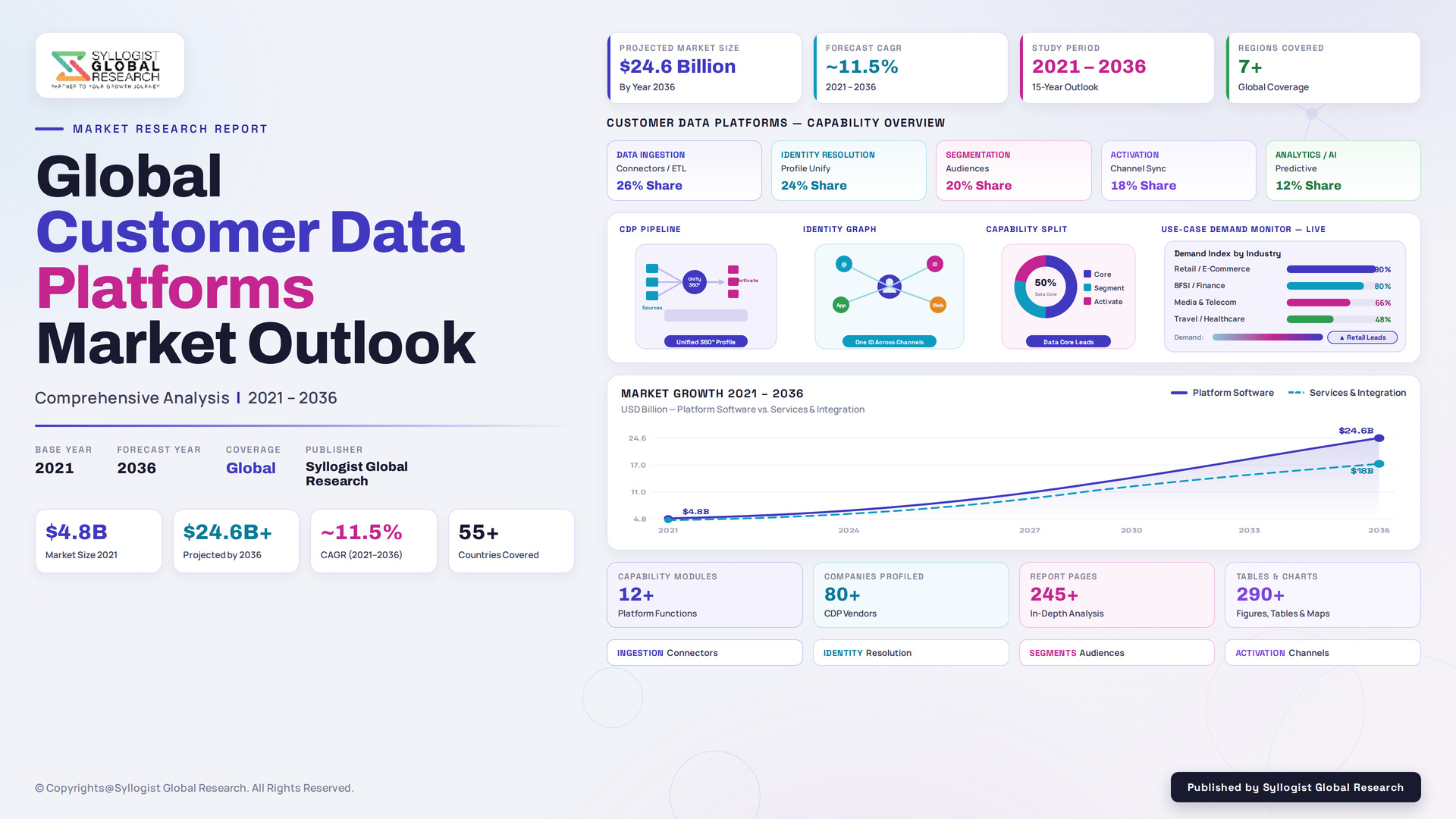
The global customer data platforms market is entering a sustained high-growth phase driven by accelerating third-party cookie deprecation, zero-party and first-party data prioritization across marketing organizations, privacy regulation tightening under GDPR, CCPA, LGPD, PDPA, and DPDP frameworks, AI-driven personalization adoption, composable architecture migration toward data warehouse and lakehouse foundations, and the structural emergence of retail media networks and data clean rooms as critical activation infrastructure. The market was valued at USD 9.82 billion in 2025 and is projected to reach USD 38.4 billion by 2034, advancing at a compound annual growth rate of 16.4% through the forecast period, supported by greenfield enterprise deployments, composable CDP migration programs, AI-native platform adoption, and emerging B2B account-based marketing CDP procurement.
Composable CDPs built on cloud data warehouses and lakehouses have emerged as the most consequential architectural shift, advancing at over 28.4% CAGR through 2034, as enterprises including Walmart, Target, Best Buy, Nike, Adidas, Levi’s, H&M, Inditex, Marriott, Hilton, IHG, Delta Air Lines, United Airlines, JPMorgan Chase, Bank of America, Wells Fargo, T-Mobile, Verizon, AT&T, Comcast, and Disney migrate from packaged CDPs toward zero-copy architectures activating directly on Snowflake, Databricks, BigQuery, Redshift, Microsoft Fabric, and Azure Synapse. Hightouch, Census, RudderStack, and emerging composable entrants are advancing reverse-ETL, activation, and orchestration capabilities that materially reduce duplicate data storage, accelerate time-to-value, and align customer data infrastructure with broader enterprise data platform investments. Adobe Real-Time CDP, Salesforce Data Cloud, Microsoft Customer Insights, and Oracle Unity are simultaneously expanding zero-copy interoperability with major data clouds to defend competitive positioning.
AI-driven personalization and agentic customer experience have emerged as the highest-impact emerging capability layer, with over 78% of major enterprise CDPs in 2025 incorporating generative AI for content personalization, customer journey orchestration, predictive next-best-action, churn prediction, lifetime value modeling, and emerging agentic customer experience workflows. Salesforce Agentforce, Adobe AI Assistant, Microsoft Copilot for Customer Insights, Twilio Segment CustomerAI, and emerging AI-native entrants are reshaping enterprise activation strategies, while retail media network monetization at Walmart Connect, Amazon Ads, Target Roundel, Kroger Precision Marketing, Best Buy Ads, Macy’s Media Network, and emerging hospitality and travel media networks is anchoring substantial incremental CDP procurement to support audience targeting, attribution, and measurement use cases through 2034.
North America dominates the global CDP market with approximately 48% revenue share in 2025, anchored by mature US enterprise marketing technology investment, dense pure-play CDP and AI-native vendor ecosystems, and accelerating retail media network monetization across major retailers. Europe represents the second largest regional market with nearly 28% share, driven by GDPR-driven first-party data prioritization, ePrivacy Directive considerations, EU AI Act compliance frameworks, and Digital Markets Act competitive dynamics reshaping advertising and customer data architectures at L’Oreal, Unilever, Procter & Gamble Europe, LVMH, Kering, Schibsted, and Axel Springer. Asia-Pacific is the fastest growing regional market advancing at over 21.8% CAGR through 2034, supported by Chinese enterprise CDP adoption at Alibaba, JD.com, Tencent, Meituan, alongside Japanese, South Korean, Indian, Australian, and Southeast Asian enterprise digital transformation programs and accelerating retail media adoption at Flipkart Ads, Lazada Sponsored Solutions, Shopee Ads, and Coupang Ads.
Key Drivers
Third-Party Cookie Deprecation, First-Party Data Prioritization, and Privacy Regulation Tightening Driving Structural CDP Procurement
Google Chrome third-party cookie deprecation timelines, alongside Apple Safari Intelligent Tracking Prevention and Firefox Enhanced Tracking Protection, are anchoring durable enterprise CDP procurement growth as marketing organizations pivot decisively toward first-party and zero-party data strategies. Privacy regulation tightening under GDPR, CCPA, CPRA, LGPD, PDPA, India DPDP Act, Quebec Law 25, and emerging US state privacy laws covering Virginia, Colorado, Connecticut, Utah, Texas, Florida, Oregon, and Washington is reinforcing consent management, preference center, and data governance investment priorities, with CDP procurement at over 78% of Fortune 500 organizations through 2034.
Composable CDP Architecture Migration to Cloud Data Warehouses and Lakehouses Reshaping Enterprise Deployment Strategies
Composable CDPs built on Snowflake, Databricks, Google BigQuery, Amazon Redshift, Microsoft Fabric, and Azure Synapse are advancing at over 28.4% CAGR through 2034, as enterprises migrate from packaged CDPs toward zero-copy architectures that reduce duplicate data storage, accelerate time-to-value, and align with broader enterprise data platform investments. Hightouch, Census, RudderStack, and emerging composable entrants are driving substantial share capture, while Adobe Real-Time CDP, Salesforce Data Cloud, Microsoft Customer Insights, and Oracle Unity expand zero-copy interoperability to defend competitive positioning through 2034.
AI-Driven Personalization, Agentic Customer Experience, and Retail Media Network Monetization Driving Premium CDP Adoption
Over 78% of major enterprise CDPs in 2025 incorporate generative AI capabilities for content personalization, journey orchestration, predictive next-best-action, churn prediction, and emerging agentic workflows. Salesforce Agentforce, Adobe AI Assistant, Microsoft Copilot for Customer Insights, and Twilio Segment CustomerAI are reshaping activation strategies, while retail media monetization at Walmart Connect, Amazon Ads, Target Roundel, Kroger Precision Marketing, Best Buy Ads, and Macy’s Media Network is anchoring incremental CDP procurement to support audience targeting, attribution, and measurement use cases through 2034.
Key Challenges
Implementation Complexity, Data Quality Issues, and Long Time-to-Value Constraining Enterprise CDP Adoption Pace
Enterprise CDP implementations remain materially complex, with typical deployment cycles extending from 6 to 18 months across identity resolution, schema design, integration with CRM, marketing automation, advertising platforms, and downstream activation channels. Data quality issues, fragmented source systems, identity stitching complexity at cross-device and cross-channel scale, and limited near-term ROI at mid-sized enterprises are constraining adoption pace, with over 32% of CDP deployments missing original go-live targets by more than 90 days. Skilled solution architect, customer data engineer, and AI specialist shortages are extending project timelines through 2034.
Composable vs Packaged CDP Architectural Debate and Vendor Lock-In Concerns Reshaping Procurement Decisions
The composable versus packaged CDP architectural debate is introducing strategic complexity for enterprise procurement teams, with composable CDPs delivering data warehouse efficiency and architectural flexibility while packaged CDPs offer faster time-to-value, integrated identity resolution, and packaged AI capabilities. Vendor lock-in concerns around proprietary identity graphs, prebuilt connectors, and AI model dependencies are reshaping multi-vendor strategies, while debates around control plane ownership, data residency, governance, and cost optimization are complicating long-term selection and contract negotiation through 2034.
AI Governance, Algorithmic Bias, and EU AI Act Compliance Reshaping Regulatory and Operational Risk Profiles
EU AI Act compliance effective from 2026, alongside emerging algorithmic accountability frameworks in the US, UK, Canada, Australia, Japan, and Brazil, is escalating compliance burdens for CDP suppliers and enterprise customers deploying AI-driven personalization, predictive analytics, and agentic workflows. Algorithmic bias scrutiny, fairness testing, model explainability requirements, and emerging guidance on automated decision-making are reshaping CDP product roadmaps, while data sovereignty pressures across the EU, India, China, and emerging jurisdictions are introducing architectural complexity into global CDP deployments through 2034.
Market Segmentation
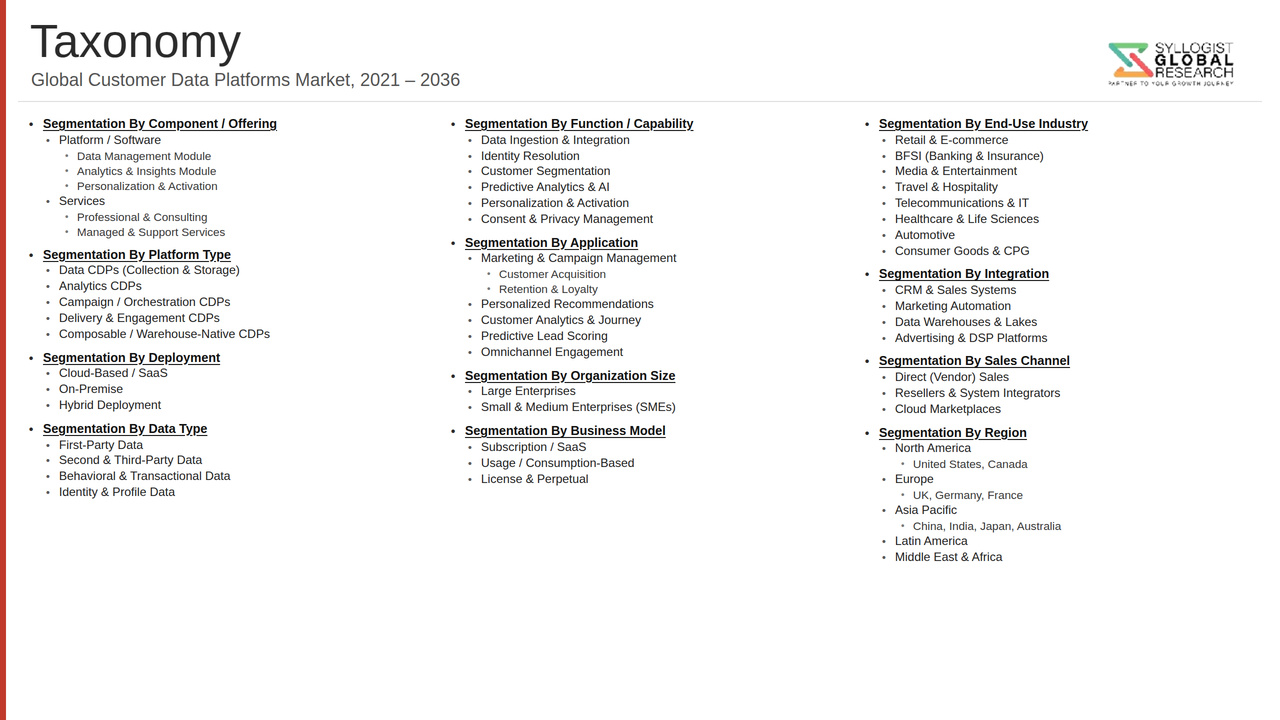
- Segmentation By Platform Type
- Packaged CDPs
- Composable CDPs (Warehouse-Native)
- Real-Time CDPs
- B2B Account-Based CDPs
- AI-Native CDPs
- Data Clean Room Platforms
- Others
- Segmentation By Deployment
- Cloud-Based (SaaS)
- On-Premise
- Hybrid
- Data Cloud-Native (Snowflake, Databricks, BigQuery, Redshift, Fabric)
- Others
- Segmentation By Component
- Software
- Services (Implementation, Consulting, Managed Services)
- Identity Resolution and Graph Services
- Activation and Reverse-ETL Connectors
- AI and Predictive Analytics Modules
- Consent and Preference Management
- Others
- Segmentation By Organization Size
- Large Enterprises
- Mid-Market
- Small and Medium-Sized Businesses (SMBs)
- Others
- Segmentation By Application
- Marketing Personalization and Journey Orchestration
- Advertising Audience Activation
- Sales Enablement and Account Engagement
- Customer Service and Support
- E-Commerce and Product Personalization
- Loyalty and Membership Programs
- Retail Media Network Monetization
- Data Clean Room Collaboration
- Predictive Analytics and Churn Prediction
- Others
- Segmentation By End-Use Industry
- Retail and Consumer Goods
- Banking, Financial Services, and Insurance (BFSI)
- Telecommunications and Media
- Travel, Hospitality, and Restaurants
- Automotive
- Healthcare and Pharmaceuticals
- Manufacturing
- Technology and SaaS
- Government and Public Sector
- Education
- Others
- Segmentation By Region
- North America
- Europe
- Asia-Pacific (China, India, Japan, South Korea, Australia, Southeast Asia)
- Latin America
- Middle East and Africa
All market revenues are presented in USD
Historical Year: 2021-2024 | Base Year: 2025 | Estimated Year: 2026 | Forecast Period: 2027-2034
Key Questions this Study Will Answer
- What is the total market valuation of the Global Customer Data Platforms Market in 2025, projected through 2034, disaggregated by platform type, deployment, component, organization size, application, end-use industry, and region, enabling CDP suppliers, enterprise marketing leaders, technology integrators, and investors to identify the highest-growth opportunities and most durable revenue corridors across the CDP value chain?
- How is third-party cookie deprecation across Google Chrome, Apple Safari, and Firefox, alongside privacy regulation tightening under GDPR, CCPA, CPRA, LGPD, PDPA, India DPDP Act, Quebec Law 25, and emerging US state privacy laws covering Virginia, Colorado, Connecticut, Utah, Texas, Florida, Oregon, and Washington reshaping enterprise CDP procurement priorities through 2034?
- Which CDP platform categories including packaged CDPs, composable CDPs running on Snowflake, Databricks, BigQuery, Redshift, Microsoft Fabric, and Azure Synapse, real-time CDPs, B2B account-based CDPs, AI-native CDPs, and data clean room platforms are generating the highest growth rates, and how is the supply landscape evolving across Segment, mParticle, Treasure Data, Tealium, Lytics, BlueShift, ActionIQ, RudderStack, Hightouch, Census, Amperity, BlueVenn, Bloomreach, NGDATA, Adobe Real-Time CDP, Salesforce Data Cloud, Oracle Unity, Microsoft Customer Insights, SAP Customer Data Platform, HubSpot, Acquia, Optimizely, and Klaviyo?
- How is composable CDP architecture migration to cloud data warehouses and lakehouses advancing at over 28.4% CAGR through 2034 reshaping enterprise deployment strategies at Walmart, Target, Best Buy, Nike, Adidas, Levi’s, H&M, Inditex, Marriott, Hilton, IHG, Delta Air Lines, United Airlines, JPMorgan Chase, Bank of America, Wells Fargo, T-Mobile, Verizon, AT&T, Comcast, and Disney?
- How is AI-driven personalization, agentic customer experience, and generative AI integration across Salesforce Agentforce, Adobe AI Assistant, Microsoft Copilot for Customer Insights, Twilio Segment CustomerAI, and emerging AI-native entrants reshaping CDP product roadmaps, with over 78% of major enterprise CDPs in 2025 incorporating generative AI capabilities?
- How is retail media network monetization at Walmart Connect, Amazon Ads, Target Roundel, Kroger Precision Marketing, Best Buy Ads, Macy’s Media Network, and emerging hospitality, travel, and Asian retail media networks anchoring substantial incremental CDP procurement to support audience targeting, attribution, and measurement use cases through 2034?
- How are EU AI Act compliance effective from 2026, algorithmic accountability frameworks, data sovereignty pressures, and AI governance debates reshaping CDP product roadmaps, enterprise adoption decisions, and global deployment architectures across regulated industries and jurisdictions through 2034?
- Product Definition
- Research Methodology
- Research Design & Framework
- Overall Research Approach: Descriptive, Exploratory & Quantitative Mixed-Method Design
- Market Definition & Scope Boundaries: What is Included and Excluded
- Segmentation Framework
- Key Research Assumptions & Limitations
- Secondary Research
- Primary Research Design & Execution
- Data Triangulation & Validation
- Market Sizing & Forecasting Methodology
- Competitive Intelligence Methodology
- Quality Assurance & Peer Review
- Definitions, Abbreviations & Data Notes
- Research Design & Framework
- Executive Summary
- Market Snapshot & Headline Numbers
- Key Findings & Research Highlights
- Market Dynamics
- Regional Market Summary
- Competitive Landscape Snapshot
- Technology & Innovation Highlights
- Market Dynamics
- Drivers
- Restraints
- Opportunities
- Challenges
- Porter’s Five Forces Analysis
- PESTLE Analysis
- Market Trends & Developments
- Emerging Trends
- Technological Developments
- Regulatory & Policy Changes
- Supply Chain & Sourcing Trends
- Manufacturing & Process Trends
- Investment & Funding Activity
- Sustainability & ESG Trends
- Risk Assessment Framework
- Data Privacy, Consent & Regulatory Compliance Risk
- Data Quality, Identity Resolution & Integration Accuracy Risk
- Platform Adoption, Customer Retention & Subscription Churn Risk
- Cybersecurity, Data Breach & Vendor Lock-In Risk
- Third-Party Cookie Deprecation, Signal Loss & Technology Shift Risk
- Regulatory Framework & Standards
- Data Privacy & Consumer Protection Frameworks (GDPR, CCPA & Equivalent)
- Consent Management, Cookie & Tracking Regulations
- Cross-Border Data Transfer & Data Residency Standards
- Data Interoperability, API & Identity Standards
- Cybersecurity, Data Governance & ESG Disclosure Standards
- Global Customer Data Platforms Market Outlook
- Market Size & Forecast by Value
- Market Size & Forecast by Volume (Subscriptions & Customer Profiles Managed)
- Market Size & Forecast by Offering
- Data Collection & Ingestion Modules
- Identity Resolution & Profile Unification Modules
- Segmentation & Audience Management Modules
- Analytics, Insights & Predictive Modeling Modules
- Activation, Orchestration & Personalisation Modules
- Data Governance, Privacy & Consent Modules
- Integration, API & Connector Services
- Managed & Professional Services
- Other Platform Components & Add-Ons
- Market Size & Forecast by Technology
- Artificial Intelligence & Machine Learning Technology
- Identity Resolution & Graph Technology
- Real-Time Streaming & Event Processing Technology
- Predictive & Prescriptive Analytics Technology
- Data Warehouse & Composable (Warehouse-Native) Technology
- Privacy-Enhancing & Clean Room Technology
- API, Integration & Middleware Technology
- Cloud & SaaS Platform Technology
- Other Emerging & Hybrid Platform Technologies
- Market Size & Forecast by CDP Type
- Data CDPs (Collection & Unification)
- Analytics CDPs
- Campaign / Orchestration CDPs
- Composable & Warehouse-Native CDPs
- Other & Hybrid CDP Types
- Market Size & Forecast by Deployment Mode
- Cloud-Based Deployment
- On-Premise Deployment
- Hybrid & Warehouse-Native Deployment
- Market Size & Forecast by Application
- Customer Segmentation & Audience Management
- Personalisation & Customer Experience
- Marketing Campaign Management & Activation
- Predictive Analytics & Customer Intelligence
- Data Governance, Privacy & Consent Management
- Other Customer Data Applications
- Market Size & Forecast by End-Use Industry
- Retail & E-Commerce
- Banking, Financial Services & Insurance (BFSI)
- Media, Entertainment & Telecommunications
- Travel, Hospitality & Consumer Services
- Healthcare & Other End-Use Industries
- Market Size & Forecast by Sales Channel
- Direct Sales & Subscription Licensing
- Channel Partners, Resellers & System Integrators
- Marketplace & Cloud Platform Distribution
- Managed-Service & Agency Channel
- North America Customer Data Platforms Market Outlook
- Market Size & Forecast
- By Value
- By Volume (Subscriptions & Customer Profiles Managed)
- By Offering
- By Technology
- By CDP Type
- By Deployment Mode
- By Application
- By End-Use Industry
- By Country
- By Sales Channel
- Europe Customer Data Platforms Market Outlook
- Market Size & Forecast
- By Value
- By Volume (Subscriptions & Customer Profiles Managed)
- By Offering
- By Technology
- By CDP Type
- By Deployment Mode
- By Application
- By End-Use Industry
- By Country
- By Sales Channel
- Asia-Pacific Customer Data Platforms Market Outlook
- Market Size & Forecast
- By Value
- By Volume (Subscriptions & Customer Profiles Managed)
- By Offering
- By Technology
- By CDP Type
- By Deployment Mode
- By Application
- By End-Use Industry
- By Country
- By Sales Channel
- Latin America Customer Data Platforms Market Outlook
- Market Size & Forecast
- By Value
- By Volume (Subscriptions & Customer Profiles Managed)
- By Offering
- By Technology
- By CDP Type
- By Deployment Mode
- By Application
- By End-Use Industry
- By Country
- By Sales Channel
- Middle East & Africa Customer Data Platforms Market Outlook
- Market Size & Forecast
- By Value
- By Volume (Subscriptions & Customer Profiles Managed)
- By Offering
- By Technology
- By CDP Type
- By Deployment Mode
- By Application
- By End-Use Industry
- By Country
- By Sales Channel
- Country-Wise* Customer Data Platforms Market Outlook
- Market Size & Forecast
- By Value
- By Volume (Subscriptions & Customer Profiles Managed)
- By Offering
- By Technology
- By CDP Type
- By Deployment Mode
- By Application
- By End-Use Industry
- By Country
- By Sales Channel
- *Countries Analyzed in the Syllogist Global Research Portfolio: United States, Canada, Mexico, Germany, France, United Kingdom, Netherlands, Spain, Italy, Norway, Sweden, China, Japan, India, Australia, South Korea, Singapore, Brazil, Chile, Saudi Arabia, UAE, Egypt, South Africa, Israel
- Technology Landscape & Innovation Analysis
- Identity Resolution & Profile Unification Technology Deep-Dive
- Artificial Intelligence & Machine Learning for Customer Intelligence
- Real-Time Streaming, Event Processing & Activation Technology
- Composable & Warehouse-Native CDP Architecture
- Privacy-Enhancing, Clean Room & Consent Technology
- Predictive Analytics, Segmentation & Personalisation Technology
- API, Integration, Middleware & Interoperability Technology
- Patent & IP Landscape in Customer Data Platform Technologies
- Value Chain & Supply Chain Analysis
- Platform Development, Software & Cloud Infrastructure Landscape
- Data, Identity & Enrichment Provider Supply Chain
- AI, Analytics & Modeling Capability Supply Chain
- Integration, API & Connector Partner Landscape
- Agency, System Integrator & Consulting Partner Landscape
- Enterprise & Brand Customer Procurement Landscape
- Implementation, Support, Managed Service & Data Governance
- Pricing Analysis
- Subscription & SaaS Licensing Pricing Analysis
- Volume & Profile-Based Pricing Analysis
- Tiered & Module-Based Pricing Analysis
- Composable & Warehouse-Native Pricing Model Analysis
- Implementation, Integration & Professional Service Cost Analysis
- Total Platform Economics: Cost-per-Profile and ROI / Customer-Value Optimisation Analysis
- Sustainability & Environmental Analysis
- Data Center, Cloud Energy & Carbon Footprint Consideration of Customer Data Platforms
- Net Zero & Energy Efficiency Contribution: Pathway to Sustainable Cloud and Data Processing
- Responsible Data, Privacy & Ethical AI Governance Contribution
- Environmental Compliance, Data Minimisation & Resource Efficiency Consideration
- Regulatory-Driven Sustainability, SDG 9 (Industry & Innovation) & SDG 12 (Responsible Consumption) Alignment & Green Finance Eligibility
- Competitive Landscape
- Market Structure & Concentration
- Market Consolidation Level (Fragmented vs. Consolidated by Offering & Geography)
- Top 10 Players Market Share
- HHI (Herfindahl-Hirschman Index) Concentration Analysis
- Competitive Intensity Map by Offering, Technology & Geography
- Player Classification
- Integrated Customer Data Platform Companies
- Marketing Cloud & Enterprise Suite Providers
- Standalone & Pure-Play CDP Vendors
- Composable & Warehouse-Native CDP Providers
- Analytics & Customer Intelligence Platform Providers
- Identity Resolution & Data Enrichment Providers
- System Integrators & Implementation Partners
- Emerging & Niche CDP Entrants
- Competitive Analysis Frameworks
- Market Share Analysis by Offering, Technology & Region
- Company Profile
- Company Overview & Headquarters
- Customer Data Platform Products & Technology Portfolio
- Key Customer Relationships & Reference Deployments
- Manufacturing Footprint & Production Capacity
- Revenue (Customer Data Platform Segment) & Backlog
- Technology Differentiators & IP
- Key Strategic Partnerships, JVs & M&A Activity
- Recent Developments (Customer Wins, Product Launches, Funding Rounds)
- SWOT Analysis
- Strategic Focus Areas & Roadmap
- Competitive Positioning Map (Technology Capability vs. Market Penetration)
- Key Company Profiles
- Market Structure & Concentration
- Technology Landscape & Innovation Analysis
- Strategic Output
- Market Opportunity Matrix: By Offering, Technology, Application, End-Use Industry & Geography
- White Space Opportunity Analysis
- Strategic Recommendations
- Product Portfolio & Technology Investment Strategy
- Manufacturing & Operational Excellence Strategy
- Geographic Expansion & Localisation Strategy
- Customer & End-User Engagement Strategy
- Partnership, M&A & Ecosystem Strategy
- Sustainability & Circular Economy Strategy
- Risk Mitigation & Future Roadmap
- Strategic Priority Matrix & Roadmap
- Near-term (2025-2028)
- Mid-term (2029-2032)
- Long-term (2033-2037)
- Strategic Output
- Market Size & Forecast
- Market Size & Forecast
- Market Size & Forecast
- Market Size & Forecast
- Market Size & Forecast
- Market Size & Forecast