Global OLED Materials Market By Material Type, By Layer, By Technology, By Display Type, By Application, By End User, By Region, Competition, Forecast & Opportunities, 2021-2036F
Market Definition
The Global OLED Materials Market covers the development, synthesis, manufacture, supply, and qualification of organic and metal-organic compounds used to construct organic light-emitting diode display stacks across small, medium, and large area panel production. The market includes emissive dopants and host materials covering red, green, and blue phosphorescent and fluorescent emitters, hyperfluorescence and thermally activated delayed fluorescence (TADF) molecules, alongside charge transport layer materials such as hole injection layers, hole transport layers, electron transport layers, electron injection layers, and capping layer compounds that govern device efficiency, color purity, and operational lifetime. The market also encompasses common layer materials, n-dopants and p-dopants, blocking layer compounds, charge generation layer materials used in tandem OLED architectures, and encapsulation materials including thin-film encapsulation inorganic and organic layers. OLED materials are procured by panel manufacturers including Samsung Display, LG Display, BOE Technology Group, Visionox, Tianma, EverDisplay Optronics, Japan Display, Sharp, and AUO, supplying smartphone OEMs, television brands, automotive infotainment integrators, wearables makers, monitor manufacturers, laptop OEMs, augmented and virtual reality device producers, and emerging foldable and rollable display segments. The supplier landscape is concentrated among specialized OLED materials companies including Universal Display Corporation, Merck KGaA, Idemitsu Kosan, Dow Chemical, Doosan Solus, LG Chem, Samsung SDI, Duksan Neolux, SFC, P&H Tech, Hodogaya Chemical, JNC Corporation, and Toray Industries. Competition is shaped by intellectual property positions covering phosphorescent host-dopant systems, blue emitter performance, deuterated material lifetime improvements, color purity metrics, vacuum thermal evaporation versus solution-process compatibility, and qualification cycles across panel maker mass production lines.
Market Insights
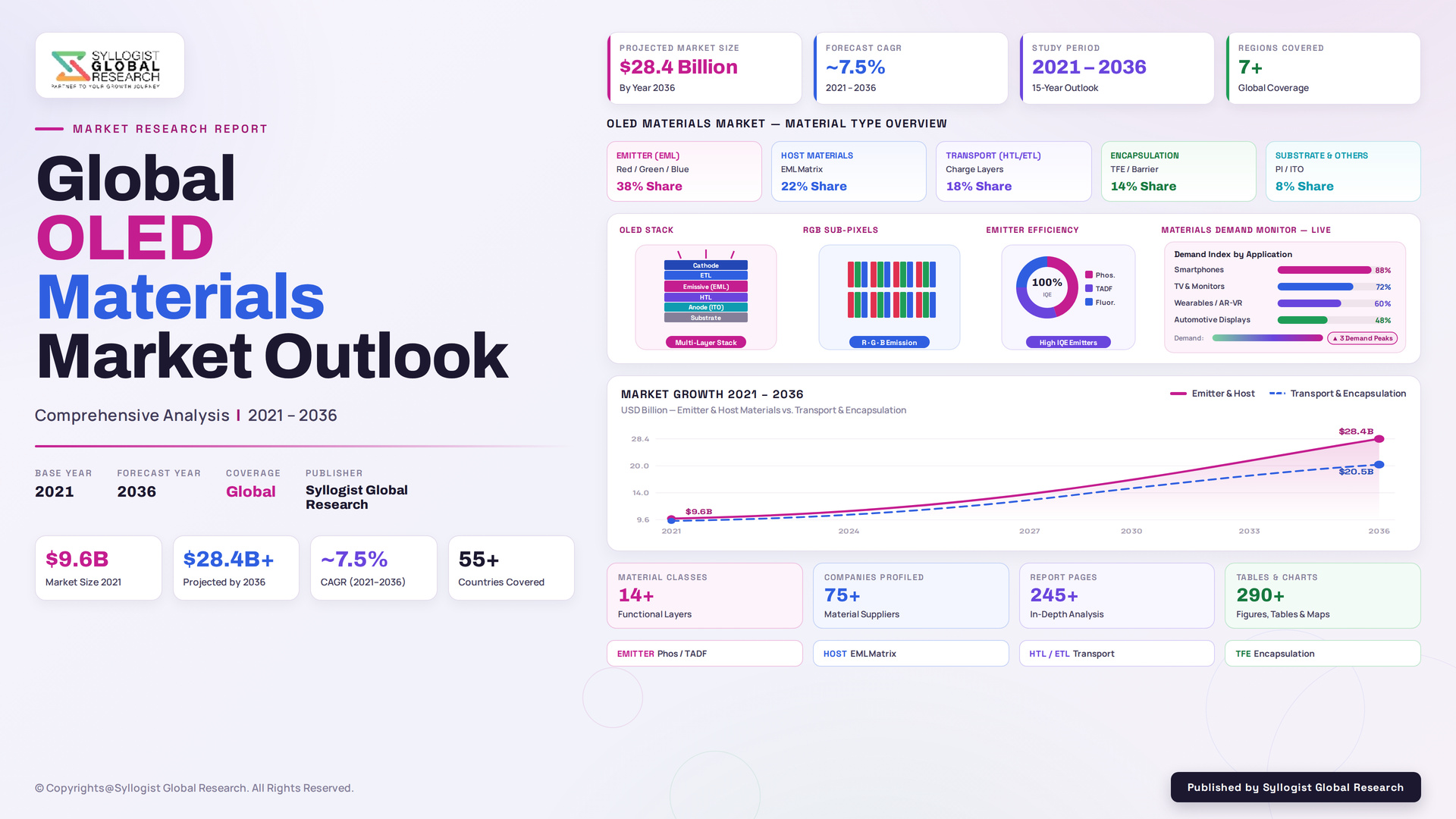
The global OLED materials market is undergoing a sustained expansion phase, propelled by accelerating OLED penetration across smartphones, premium televisions, automotive displays, IT panels including laptops, monitors, and tablets, and emerging XR head-mounted devices, alongside the structural shift from rigid OLED to flexible, foldable, and rollable form factors. The market was valued at USD 2.34 billion in 2025 and is projected to reach USD 5.62 billion by 2034, advancing at a compound annual growth rate of 10.2% through the forecast period, supported by material consumption growth across small and medium sized panels, the ramp of Generation 8.6 OLED fabs targeting IT and tablet applications, and the rising volumetric intensity of advanced OLED stacks incorporating tandem and three-stack architectures.
Smartphone displays remain the largest single application accounting for nearly 62% of OLED materials demand by value in 2025, driven by structural OLED penetration across Apple iPhone, Samsung Galaxy, Xiaomi, Oppo, Vivo, Honor, Huawei, and Google Pixel product portfolios, with global smartphone OLED panel shipments projected to exceed 920 million units in 2025 and surpass 1.18 billion units by 2030. The transition from LTPS rigid OLED to LTPO flexible OLED across premium smartphones is materially increasing per-unit OLED materials consumption, with LTPO displays incorporating additional charge generation and transport layers, while Apple flagship adoption of two-stack tandem OLED on iPad Pro is establishing a template for premium IT display architecture that is expected to expand into MacBook Pro, Surface Pro, and high-end Android tablet platforms through 2028.
Tandem OLED architectures are emerging as the most consequential technology transition for the OLED materials market, with two-stack and three-stack designs consuming approximately 1.8 to 2.6 times the material volume of conventional single-stack OLEDs while delivering brightness improvements above 1,500 nits and lifetime extensions exceeding 4 times conventional benchmarks. Samsung Display, LG Display, and BOE Technology Group are simultaneously advancing Generation 8.6 oxide backplane OLED fab investments exceeding USD 12 billion of aggregate capital deployment between 2024 and 2028, targeting IT panel production for tablets, laptops, and monitors that will materially expand OLED materials consumption beyond the small-panel smartphone base. Phosphorescent blue emitters, long considered the holy grail of OLED chemistry, are advancing toward commercial viability with Universal Display Corporation and select Korean and Japanese partners targeting initial commercial introduction within the forecast horizon.
Asia-Pacific dominates the global OLED materials market with approximately 88% revenue share in 2025, anchored by South Korean panel makers Samsung Display and LG Display collectively producing over 70% of global OLED panel output, followed by Chinese panel manufacturers BOE Technology Group, Visionox, Tianma, and EverDisplay Optronics, which are advancing aggressive capacity expansion under domestic display self-sufficiency programs. China is the fastest growing regional consumer of OLED materials, advancing at over 13% CAGR through 2034, supported by Generation 8.6 fab investments at BOE Chengdu, Visionox Hefei, and Tianma Xiamen, alongside accelerating OLED penetration across Chinese smartphone, IT, and automotive display production. Japan and the United States remain critical supplier geographies, with Universal Display Corporation, Idemitsu Kosan, JNC Corporation, Hodogaya Chemical, Toray Industries, and Merck KGaA together accounting for the dominant share of high-performance emissive and transport material supply.
Key Drivers
Smartphone OLED Penetration Expansion and LTPO Backplane Adoption Driving Sustained Premium Display Materials Demand
Structural OLED adoption across premium and mid-range smartphone platforms anchors durable OLED materials demand growth, with global smartphone OLED penetration projected to advance from 54% in 2025 to nearly 72% by 2030, supported by Apple, Samsung, Xiaomi, Oppo, Vivo, Honor, Huawei, and Google Pixel portfolio transitions. The migration from LTPS rigid OLED to LTPO flexible OLED across flagship and high-end mid-range platforms is materially increasing per-unit OLED materials intensity, while foldable shipments projected to exceed 48 million units by 2030 are creating incremental demand for advanced transport layer compounds and bend-tolerant encapsulation.
Generation 8.6 IT Panel Fab Investments and Tandem OLED Adoption Multiplying Per-Panel Materials Consumption
Generation 8.6 oxide backplane OLED fab investments at Samsung Display A6, LG Display E6, and BOE B16, with aggregate capital deployment exceeding USD 12 billion, are positioning OLED for mass adoption across tablets, laptops, and monitors. Tandem two-stack and three-stack OLED architectures consuming 1.8 to 2.6 times the materials volume of conventional designs are anchoring durable consumption growth, with Apple iPad Pro tandem OLED adoption and forthcoming MacBook Pro transition expected to drive incremental materials demand through 2034.
Automotive OLED Penetration, Augmented Reality, and Premium Television Adoption Diversifying Materials Demand Beyond Smartphones
Automotive OLED adoption across premium electric vehicles, infotainment systems, instrument clusters, and pillar-to-pillar displays at Mercedes-Benz, Audi, Cadillac, Lexus, and leading Chinese EV brands is creating a durable secondary demand vector, with automotive OLED shipments projected to exceed 22 million units by 2030. AR and VR head-mounted displays leveraging Micro-OLED architectures from Sony, BOE Yunnan, eMagin, and Kopin, alongside premium OLED television adoption at LG Electronics, Samsung Electronics, Sony, Panasonic, and Hisense, are broadening the OLED materials demand base.
Key Challenges
Phosphorescent Blue Emitter Lifetime Limitations and Stability Constraints Restricting Full Phosphorescent Stack Adoption
Commercial OLED stacks continue to rely on fluorescent blue emitters with luminous efficiency materially below phosphorescent red and green counterparts, creating a structural performance gap that limits device efficiency and constrains tandem OLED architecture optimization. Phosphorescent blue emitter lifetime stability remains the principal technical barrier, with laboratory benchmarks delivering operational lifetimes substantially below the 30,000 hour LT95 threshold required for mass-market integration, and commercial introduction timelines remain subject to materials maturation, qualification cycles, and IP licensing dynamics that introduce execution risk into supplier revenue forecasts.
Intellectual Property Concentration, Licensing Royalties, and Patent Cliff Risks Reshaping Materials Supply Economics
OLED materials economics are materially shaped by intellectual property concentration, with Universal Display Corporation holding dominant patent positions across phosphorescent host-dopant systems and capturing licensing royalties from major panel makers, while patent cliffs across foundational OLED chemistry approaching expiration between 2026 and 2030 are reshaping competitive dynamics. Korean and Chinese materials suppliers including Doosan Solus, Duksan Neolux, SFC, P&H Tech, and emerging Chinese entrants are pursuing patent-free alternative compound development and generic phosphorescent pathways that may compress pricing power and margins across the established supplier base.
Chinese Panel Maker Capacity Expansion, Materials Localization Pressure, and Pricing Compression Across Global Supply
Chinese OLED panel capacity expansion at BOE, Visionox, Tianma, and EverDisplay Optronics, supported by domestic display self-sufficiency policies and provincial subsidies, is generating sustained pressure on incumbent OLED materials suppliers to localize production, qualify Chinese suppliers, and accept compressed pricing on common layer and transport material categories. Chinese government industrial policy supporting domestic OLED materials companies through subsidies, R&D grants, and procurement preferences is accelerating import substitution with downstream pricing implications across the OLED materials value chain through 2034.
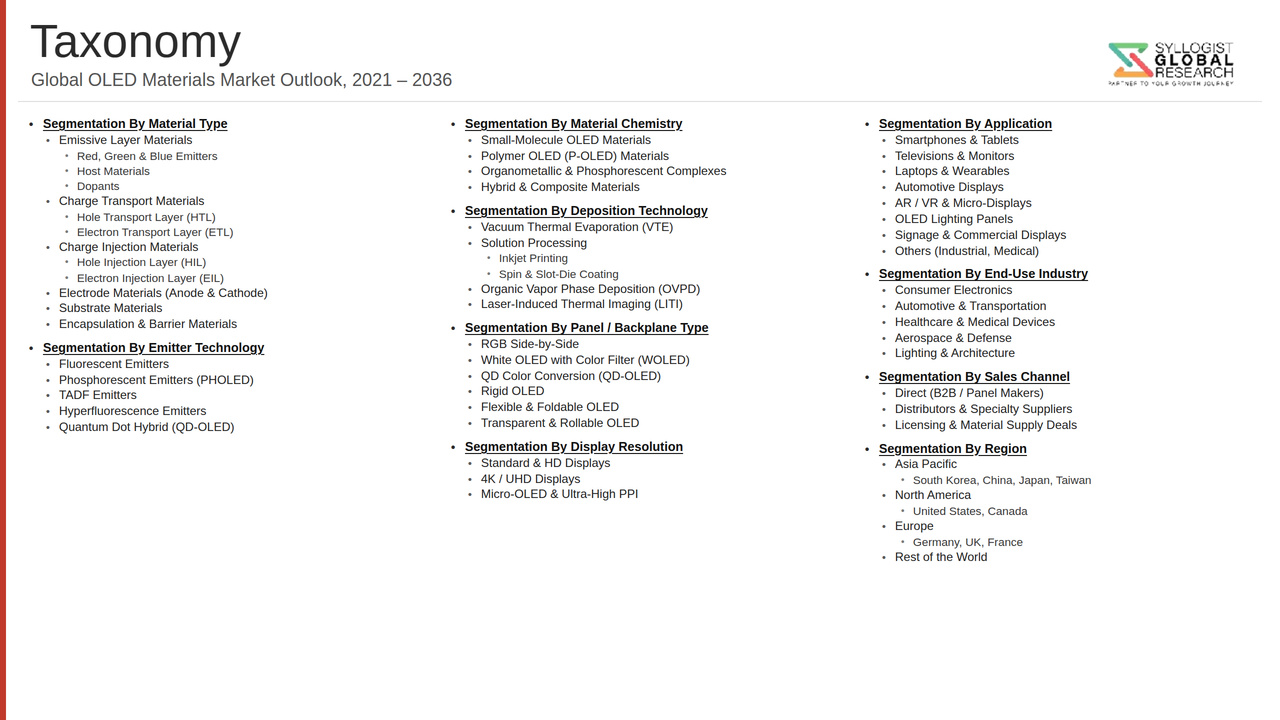
Market Segmentation
- Segmentation By Material Type
- Emissive Materials (Red, Green, Blue Hosts and Dopants)
- Hole Injection Layer (HIL) Materials
- Hole Transport Layer (HTL) Materials
- Electron Transport Layer (ETL) Materials
- Electron Injection Layer (EIL) Materials
- Blocking Layer Materials
- Charge Generation Layer (CGL) Materials
- Capping Layer (CPL) Materials
- Encapsulation Materials
- Others
- Segmentation By Layer
- Anode and Cathode Materials
- Common Layer Materials
- Emissive Layer Stack
- Charge Transport and Injection Layers
- Thin-Film Encapsulation Layers
- Others
- Segmentation By Technology
- Vacuum Thermal Evaporation
- Solution-Process OLED
- Inkjet-Printed OLED
- Tandem Two-Stack OLED
- Tandem Three-Stack OLED
- Phosphorescent (PHOLED)
- Fluorescent and Hyperfluorescence (TADF)
- Others
- Segmentation By Display Type
- Rigid OLED
- Flexible OLED
- Foldable OLED
- Rollable and Stretchable OLED
- Transparent OLED
- Micro-OLED (OLED on Silicon)
- Others
- Segmentation By Application
- Smartphones
- Televisions and Premium Displays
- Tablets, Laptops, and Monitors (IT Panels)
- Automotive Displays
- Wearables and Smartwatches
- Augmented Reality and Virtual Reality Devices
- Lighting Applications
- Others
- Segmentation By End User
- Consumer Electronics OEMs
- Automotive OEMs and Tier 1 Integrators
- Industrial and Commercial Display Integrators
- Healthcare and Medical Imaging
- Defense and Aerospace
- Others
- Segmentation By Region
- Asia-Pacific (South Korea, China, Japan, Taiwan, Southeast Asia)
- North America
- Europe
- Middle East and Africa
- Latin America
All market revenues are presented in USD
Historical Year: 2021-2024 | Base Year: 2025 | Estimated Year: 2026 | Forecast Period: 2027-2034
Key Questions this Study Will Answer
- What is the total market valuation of the Global OLED Materials Market in 2025, projected through 2034, disaggregated by material type, layer, technology, and application, enabling materials suppliers, panel makers, display OEMs, and investors to identify the highest-growth opportunities and most durable revenue corridors across the OLED materials value chain?
- How are smartphone OLED penetration expansion, the migration from LTPS rigid OLED to LTPO flexible OLED, and the accelerating adoption of foldable form factors reshaping per-unit OLED materials demand across Apple, Samsung, Xiaomi, Oppo, Vivo, Honor, Huawei, and Google Pixel product portfolios through 2034?
- How are Generation 8.6 oxide backplane OLED fab investments at Samsung Display A6, LG Display E6, and BOE B16, alongside tandem two-stack and three-stack OLED architecture adoption on iPad Pro and forthcoming MacBook Pro, multiplying per-panel materials consumption across tablets, laptops, and monitors?
- Which OLED materials categories including emissive dopants, host materials, hole injection layers, hole transport layers, electron transport layers, charge generation layers, and capping layers are generating the highest growth rates, and how is the supply landscape evolving across Universal Display Corporation, Merck KGaA, Idemitsu Kosan, Dow Chemical, Doosan Solus, LG Chem, Duksan Neolux, SFC, and Chinese entrants?
- How is the commercial introduction trajectory for phosphorescent blue emitters progressing across Universal Display Corporation and partner panel makers, and what materials chemistry, qualification, and intellectual property dynamics will shape adoption timelines, royalty economics, and competitive positioning across the OLED materials value chain through 2034?
- How are automotive OLED penetration across premium electric vehicles, Micro-OLED adoption in augmented and virtual reality headsets, and premium OLED television demand at LG Electronics, Samsung Electronics, Sony, Panasonic, and Hisense diversifying OLED materials demand beyond smartphones, and what application-level growth rates are projected through 2034?
- How are Chinese OLED panel capacity expansion at BOE, Visionox, Tianma, and EverDisplay Optronics, domestic display self-sufficiency policies, and Chinese OLED materials supplier development reshaping global materials supply economics, pricing power, and competitive dynamics across the OLED materials industry through 2034?
- Product Definition
- Research Methodology
- Research Design & Framework
- Overall Research Approach: Descriptive, Exploratory & Quantitative Mixed-Method Design
- Market Definition & Scope Boundaries: What is Included and Excluded
- Segmentation Framework
- Key Research Assumptions & Limitations
- Secondary Research
- Primary Research Design & Execution
- Data Triangulation & Validation
- Market Sizing & Forecasting Methodology
- Competitive Intelligence Methodology
- Quality Assurance & Peer Review
- Definitions, Abbreviations & Data Notes
- Research Design & Framework
- Executive Summary
- Market Snapshot & Headline Numbers
- Key Findings & Research Highlights
- Market Dynamics
- Regional Market Summary
- Competitive Landscape Snapshot
- Technology & Innovation Highlights
- Market Dynamics
- Drivers
- Restraints
- Opportunities
- Challenges
- Porter’s Five Forces Analysis
- PESTLE Analysis
- Market Trends & Developments
- Emerging Trends
- Technological Developments
- Regulatory & Policy Changes
- Supply Chain & Sourcing Trends
- Manufacturing & Process Trends
- Investment & Funding Activity
- Sustainability & ESG Trends
- Risk Assessment Framework
- Display Panel Capex Cyclicality, Fab Demand Volatility & Customer Concentration Risk
- Intellectual Property Litigation, Phosphorescent Emitter Patent & Licensing Royalty Risk
- Specialty Material, Iridium, Rare Element & Precursor Chemical Supply Chain Risk
- Technology Substitution by MicroLED, MiniLED & QLED Competing Display Risk
- Blue Emitter Lifetime, Efficiency & TADF / Phosphorescent Blue Commercialisation Risk
- Regulatory Framework & Standards
- RoHS, REACH, K-REACH & Restricted Substances Frameworks for OLED Materials
- Export Control Regulations: US Entity List, BIS, EAR & Cross-Border Display Material Trade Restrictions
- Display Industry Standards (SID, SEMI, IEC) & OLED Performance Qualification Frameworks
- Energy Efficiency, ENERGY STAR & Display Power Consumption Disclosure Standards
- Conflict Minerals, Chemical Safety, VOC & ESG Disclosure Standards for OLED Material Suppliers
- Global OLED Materials Market Outlook
- Market Size & Forecast by Value
- Market Size & Forecast by Volume (Tons & Kilograms)
- Market Size & Forecast by Material Category
- Emissive & Dopant Materials (Red, Green & Blue Emitters)
- Host Materials (Phosphorescent & Fluorescent Hosts)
- Hole Transport Layer (HTL) & Hole Injection Layer (HIL) Materials
- Electron Transport Layer (ETL) & Electron Injection Layer (EIL) Materials
- Hole Blocking & Electron Blocking Layer (HBL / EBL) Materials
- Substrate Materials (Rigid Glass, Polyimide & Ultra-Thin Glass)
- Encapsulation Materials (Thin-Film Encapsulation, Desiccants & Edge Sealants)
- Electrode Materials (ITO, Transparent Conductors & Cathode Metals)
- Color Conversion & Quantum Dot Materials (QD-OLED)
- Optical, Polariser, Touch Sensor & Adhesive Materials
- Market Size & Forecast by Emitter Technology
- Fluorescent Emitters
- Phosphorescent Emitters (PHOLED)
- Thermally Activated Delayed Fluorescence (TADF) Emitters
- Hyperfluorescence Emitters
- Quantum Dot-Enhanced Emitters
- Market Size & Forecast by Material Form
- Small-Molecule Materials (Evaporation-Based)
- Polymer Materials (Solution-Processable)
- Dendrimer & Hybrid Materials
- Market Size & Forecast by Manufacturing Process
- Vacuum Thermal Evaporation (VTE) with Fine Metal Mask (FMM)
- Organic Vapor Phase Deposition (OVPD)
- Inkjet Printing & Soluble OLED Processing
- Spin, Slot-Die & Nozzle Coating
- Roll-to-Roll Flexible OLED Processing
- White OLED with Colour Filter (WOLED) Process
- Market Size & Forecast by OLED Display Architecture
- Active Matrix OLED (AMOLED)
- Passive Matrix OLED (PMOLED)
- White OLED (WOLED) with Colour Filters
- RGB Side-by-Side OLED
- Tandem & Stacked OLED Structures
- Top-Emission & Bottom-Emission OLED
- Flexible, Foldable, Rollable & Stretchable OLED
- Transparent OLED
- Silicon-Backplane OLED Microdisplays (OLEDoS)
- QD-OLED Hybrid Architecture
- Market Size & Forecast by Application
- Smartphone Displays
- Television & Large-Format Displays
- Tablet, Laptop & Monitor Displays
- Smartwatch & Wearable Displays
- Automotive Displays (Instrument Cluster, CID, HUD & Rear-Seat)
- AR / VR / XR Microdisplays
- OLED General & Decorative Lighting
- Industrial, Medical & Aerospace Displays
- Signage, Commercial & Digital Out-of-Home Displays
- Market Size & Forecast by End-User Industry
- Display Panel Manufacturers
- Consumer Electronics OEMs
- Automotive OEMs & Tier-1 Display Module Suppliers
- AR / VR Headset & Microdisplay Manufacturers
- Lighting Manufacturers & Architectural Lighting Specialists
- Industrial, Medical & Aerospace Display Manufacturers
- Market Size & Forecast by Sales Channel
- Direct Supply Agreements with Panel Makers
- Licensing & Royalty-Based Material Supply
- Distributors & Specialty Material Channel Partners
- System House, Toll Manufacturing & Custom Synthesis
- North America OLED Materials Market Outlook
- Market Size & Forecast
- By Value
- By Volume (Tons & Kilograms)
- By Material Category
- By Emitter Technology
- By Material Form
- By Manufacturing Process
- By OLED Display Architecture
- By Application
- By End-User Industry
- By Country
- By Sales Channel
- Europe OLED Materials Market Outlook
- Market Size & Forecast
- By Value
- By Volume (Tons & Kilograms)
- By Material Category
- By Emitter Technology
- By Material Form
- By Manufacturing Process
- By OLED Display Architecture
- By Application
- By End-User Industry
- By Country
- By Sales Channel
- Asia-Pacific OLED Materials Market Outlook
- Market Size & Forecast
- By Value
- By Volume (Tons & Kilograms)
- By Material Category
- By Emitter Technology
- By Material Form
- By Manufacturing Process
- By OLED Display Architecture
- By Application
- By End-User Industry
- By Country
- By Sales Channel
- Latin America OLED Materials Market Outlook
- Market Size & Forecast
- By Value
- By Volume (Tons & Kilograms)
- By Material Category
- By Emitter Technology
- By Material Form
- By Manufacturing Process
- By OLED Display Architecture
- By Application
- By End-User Industry
- By Country
- By Sales Channel
- Middle East & Africa OLED Materials Market Outlook
- Market Size & Forecast
- By Value
- By Volume (Tons & Kilograms)
- By Material Category
- By Emitter Technology
- By Material Form
- By Manufacturing Process
- By OLED Display Architecture
- By Application
- By End-User Industry
- By Country
- By Sales Channel
- Country-Wise* OLED Materials Market Outlook
- Market Size & Forecast
- By Value
- By Volume (Tons & Kilograms)
- By Material Category
- By Emitter Technology
- By Material Form
- By Manufacturing Process
- By OLED Display Architecture
- By Application
- By End-User Industry
- By Country
- By Sales Channel
- *Countries Analyzed in the Syllogist Global Research Portfolio: United States, Canada, Mexico, Germany, France, United Kingdom, Netherlands, Spain, Italy, Norway, Sweden, China, Japan, India, Australia, South Korea, Taiwan, Singapore, Brazil, Chile, Saudi Arabia, UAE, Egypt, South Africa, Israel
- Technology Landscape & Innovation Analysis
- Phosphorescent (PHOLED) Emitter Material Deep-Dive: Iridium, Platinum & Heavy-Metal Complex Chemistry
- Thermally Activated Delayed Fluorescence (TADF) & Hyperfluorescence Material Technology
- Blue Emitter Material Innovation: Lifetime, Efficiency & Deep-Blue Spectrum Optimisation
- Charge Transport, Host & Functional Layer Material Technology
- Flexible, Foldable & Rollable Substrate, Barrier Film & Encapsulation Material Technology
- Solution-Processable, Inkjet-Printable & Roll-to-Roll OLED Material Technology
- Quantum Dot-OLED (QD-OLED) Colour Conversion & Hybrid Material Technology
- Silicon-Backplane OLED Microdisplay (OLEDoS) Material Technology for AR / VR
- Patent & IP Landscape in OLED Materials Technologies
- Value Chain & Supply Chain Analysis
- Precursor Chemical, Iridium, Platinum & Specialty Metal Supply Chain
- OLED Material Synthesis, Purification & Sublimation-Grade Manufacturing Supply Chain
- Patent Licensor, IP Holder & Royalty-Based Material Distribution Landscape (UDC Model)
- Substrate, Barrier Film, Encapsulation & Optical Film Supplier Network
- Display Panel Maker, OEM Qualification & Customer Co-Development Channel
- Distributors, Custom Synthesis & Specialty Channel Partners
- End-of-Life Display Collection, Material Recovery & Circular Economy
- Pricing Analysis
- Phosphorescent Emitter & Iridium Complex Pricing & Royalty Analysis
- Fluorescent, TADF & Hyperfluorescence Emitter Pricing Analysis
- Host, Charge Transport & Functional Layer Material Pricing Analysis
- Substrate, Barrier Film & Thin-Film Encapsulation Material Pricing Analysis
- Quantum Dot, Colour Conversion & Optical Material Pricing Analysis
- OLED Material Cost per Square Metre & Cost per Device Analysis
- Total Bill-of-Materials Economics: Material, Process Yield & Panel Maker Margin Co-Optimisation Analysis
- Sustainability & Environmental Analysis
- Lifecycle Assessment (LCA) of OLED Materials: Carbon Footprint, Energy Intensity & Critical Mineral Footprint Across Material Categories
- Critical Raw Material, Iridium & Heavy-Metal Sourcing, Reuse & Recovery Pathway
- Energy Efficiency of OLED Displays vs. LCD, MiniLED & MicroLED Competing Technologies
- Circular Economy: End-of-Life Display Recycling, Material Recovery & Recycled Substrate Integration
- Regulatory-Driven Sustainability, RoHS, REACH, SDG 12 (Responsible Consumption) Alignment & Green Procurement Standards
- Competitive Landscape
- Market Structure & Concentration
- Market Consolidation Level (Fragmented vs. Consolidated by Material Category & Geography)
- Top 10 Players Market Share
- HHI (Herfindahl-Hirschman Index) Concentration Analysis
- Competitive Intensity Map by Material Category, Emitter Technology & Geography
- Player Classification
- Patent-Holding Material & Licensing Specialists (Universal Display Corporation, Kyulux)
- Integrated Chemical & Specialty Material Majors (Merck, LG Chem, Samsung SDI, Sumitomo Chemical)
- Specialist OLED Emitter & Host Material Manufacturers (Idemitsu Kosan, Doosan Solus, Duksan Neolux)
- Hole / Electron Transport & Functional Layer Material Suppliers (Hodogaya, Nippon Steel Chemical, DIC)
- Substrate, Polyimide & Ultra-Thin Glass Material Producers
- Thin-Film Encapsulation, Barrier Film & Sealant Material Companies
- Quantum Dot, Colour Conversion & Optical Film Material Providers
- Chinese & Emerging OLED Material Localisation Specialists
- Competitive Analysis Frameworks
- Market Share Analysis by Material Category, Emitter Technology & Region
- Company Profile
- Company Overview & Headquarters
- OLED Materials Products & Technology Portfolio
- Key Customer Relationships & Reference Panel Maker Qualifications
- Manufacturing Footprint & Production Capacity
- Revenue (OLED Materials Segment) & Order Book
- Technology Differentiators & IP
- Key Strategic Partnerships, JVs & M&A Activity
- Recent Developments (Material Qualifications, Capacity Expansion, Product Launches)
- SWOT Analysis
- Strategic Focus Areas & Roadmap
- Competitive Positioning Map (Technology Capability vs. Market Penetration)
- Key Company Profiles
- Market Structure & Concentration
- Technology Landscape & Innovation Analysis
- Strategic Output
- Market Opportunity Matrix: By Material Category, Emitter Technology, OLED Architecture, Application, End-User & Geography
- White Space Opportunity Analysis
- Strategic Recommendations
- Material Portfolio & Technology Investment Strategy
- Manufacturing, Sublimation-Grade Synthesis & Operational Excellence Strategy
- Geographic Expansion & Localisation Strategy
- Panel Maker, OEM & Customer Co-Development Engagement Strategy
- Partnership, M&A, Licensing & Ecosystem Strategy
- Sustainability, Critical Mineral Recovery & Circular Economy Strategy
- Risk Mitigation & Future Roadmap
- Strategic Priority Matrix & Roadmap
- Near-term (2025-2028)
- Mid-term (2029-2032)
- Long-term (2033-2037)
- Market Size & Forecast
- Market Size & Forecast
- Market Size & Forecast
- Market Size & Forecast
- Market Size & Forecast
- Market Size & Forecast