Global Leakage Acoustic Sensors Market By Sensor Type, By Technology, By Deployment, By Pipe Material, By Application, By End User, By Region, Competition, Forecast & Opportunities, 2021-2036F
Market Definition
The Global Leakage Acoustic Sensors Market covers the design, manufacture, supply, installation, integration, and aftermarket service of advanced acoustic-based leak detection sensors, correlators, noise loggers, and integrated smart water network monitoring platforms used to detect, locate, and quantify leaks across pressurized water distribution networks, gas pipelines, industrial process piping, district heating and cooling networks, and emerging hydrogen infrastructure. The market encompasses fixed-position permanent acoustic noise loggers, portable correlator-based detection systems, ground microphones, hydrophones, fiber-optic distributed acoustic sensing (DAS), accelerometers, hybrid IoT acoustic platforms, and emerging artificial intelligence-enabled cloud analytics platforms that aggregate, correlate, and prioritize leak signatures across utility-scale deployments. Acoustic sensors are deployed for active leak detection, pressure management, network asset condition assessment, district metered area (DMA) monitoring, real-time non-revenue water (NRW) reduction, gas pipeline integrity management, and emerging hydrogen leak detection programs across rapidly expanding hydrogen distribution and storage infrastructure. The supplier landscape spans specialized acoustic sensor vendors including Gutermann, Hydrosave, Vodatec, Aquaview, HWM-Water, Primayer, SebaKMT, Mueller Water Products, Halma, Sensus, Diehl Metering, Itron, Kamstrup, Trimble, Stantec, Veolia, SUEZ, AVK Smart Water, Echologics, Aquilus, Aquam, Atmos International, Krohne, Siemens Energy, and emerging AI-enabled software platforms from Aquanostics, Watershed, FIDO Tech, Aganova, and Aquai Sense. Market dynamics are governed by accelerating utility digital transformation, mounting non-revenue water reduction mandates, climate-driven drought response programs, smart water network investment under EU Drinking Water Directive recast, US BIL infrastructure funding, Asia-Pacific urban water security programs, and the structural emergence of hydrogen leak detection as a fast growing adjacent application segment.
Market Insights
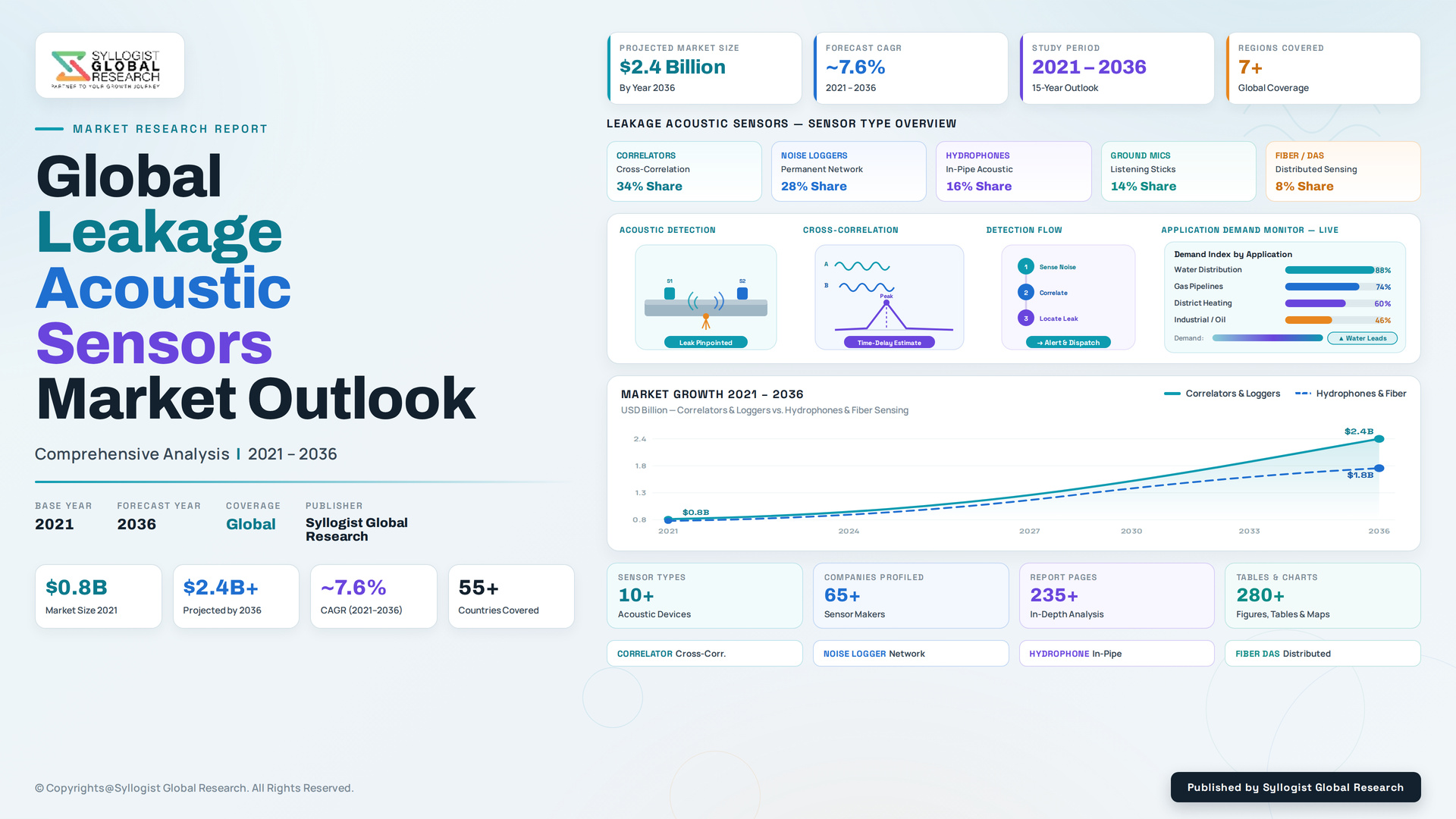
The global leakage acoustic sensors market is entering a sustained high-growth phase driven by accelerating utility digital transformation, mounting regulatory pressure on non-revenue water reduction, climate-driven drought response programs across drought-stressed regions, smart water network investment under the EU Drinking Water Directive recast and US Bipartisan Infrastructure Law, and the structural emergence of hydrogen leak detection as a high-value adjacent application segment. The market was valued at USD 1.46 billion in 2025 and is projected to reach USD 3.62 billion by 2034, advancing at a compound annual growth rate of 10.6% through the forecast period, supported by greenfield smart water network deployments, brownfield utility digital transformation programs, gas pipeline integrity management investment, and emerging hydrogen infrastructure leak detection programs across major distribution geographies.
Non-revenue water remains the single largest economic driver shaping acoustic sensor procurement, with global municipal water utilities losing approximately 126 billion cubic meters of treated water annually, representing 36% of total water produced and economic losses exceeding USD 42 billion per year. Acoustic sensor deployments at utilities including Thames Water, Severn Trent, Anglian Water, Yorkshire Water, Singapore PUB, Sydney Water, Melbourne Water, Brisbane Urban Utilities, Tokyo Metropolitan Waterworks Bureau, Seoul Metropolitan Government Waterworks, Mumbai Municipal Corporation, and Delhi Jal Board are delivering documented NRW reductions of 18% to 38% across pilot and full-scale deployments, materially improving utility operational economics and supporting capital allocation toward expanded sensor coverage across distribution networks. Fixed-position permanent acoustic noise loggers account for nearly 48% of global market revenue in 2025, driven by sustained DMA-based monitoring deployment, while AI-enabled cloud analytics platforms are advancing at over 18% CAGR.
Fiber-optic distributed acoustic sensing (DAS) has emerged as one of the fastest growing acoustic detection technologies, advancing at over 15.4% CAGR through 2034, supported by gas pipeline integrity management programs at TC Energy, Enbridge, Williams, Kinder Morgan, Energy Transfer, Snam, Gasunie, National Grid, and emerging hydrogen distribution network operators. DAS platforms from Silixa, Bandweaver, OptaSense, AP Sensing, Hifi Engineering, and Halliburton enable continuous monitoring of pipelines extending over 50 kilometers per fiber circuit with leak localization accuracy below 5 meters. Hydrogen leak detection is rapidly emerging as a critical adjacent application, with hydrogen-specific acoustic sensor development advancing across major suppliers in response to RWE, Equinor, Air Liquide, Linde, Shell, BP, and Iberdrola hydrogen infrastructure investments across Germany, the Netherlands, Spain, the United Kingdom, Australia, the United States, and emerging Middle Eastern hydrogen export corridors.
Europe represents the largest regional market with approximately 34% revenue share in 2025, anchored by the United Kingdom, Germany, France, the Netherlands, Italy, and Spain where stringent EU Drinking Water Directive recast NRW reduction obligations, advanced utility digital transformation, and aggressive smart water investment frameworks are driving structural acoustic sensor procurement. North America represents the second largest regional market with nearly 28% share, driven by US Bipartisan Infrastructure Law water infrastructure funding exceeding USD 55 billion, EPA Lead and Copper Rule revisions, aging pipeline replacement programs, and Canadian municipal water digital transformation investments. Asia-Pacific is the fastest growing regional market advancing at over 13.4% CAGR through 2034, supported by Singapore PUB smart water programs, Japanese and South Korean utility modernization, Chinese 14th Five-Year Plan urban water infrastructure investment, and Indian AMRUT 2.0 and Jal Jeevan Mission programs increasingly mandating smart metering and acoustic leak detection integration.
Key Drivers
Non-Revenue Water Reduction Mandates and Climate-Driven Drought Response Driving Structural Acoustic Sensor Procurement
Global municipal water utilities losing approximately 126 billion cubic meters of treated water annually, representing 36% of total water produced and economic losses exceeding USD 42 billion per year, are anchoring durable acoustic sensor procurement growth. EU Drinking Water Directive recast NRW reduction obligations, climate-driven drought response programs across California, Australia, Cape Town, Chennai, and Singapore, alongside utility commitments to reduce NRW by 18% to 38% across pilot and full-scale acoustic deployments, are reinforcing structural sensor demand across utilities through 2034.
Smart Water Network Investment Under EU Drinking Water Directive, US BIL, and Asia-Pacific Programs Driving Greenfield Sensor Procurement
Smart water network investment under the EU Drinking Water Directive recast, US Bipartisan Infrastructure Law funding exceeding USD 55 billion for water infrastructure, China 14th Five-Year Plan urban water programs, and Indian AMRUT 2.0 and Jal Jeevan Mission frameworks is driving sustained greenfield acoustic sensor procurement. Combined committed smart water network capital deployment across major regional markets exceeds USD 124 billion through 2030, anchoring durable acoustic sensor and AI-enabled cloud analytics platform demand across utility digital transformation programs.
Hydrogen Infrastructure Expansion and Pipeline Integrity Management Driving High-Value Adjacent Acoustic Sensor Demand
Hydrogen infrastructure expansion across RWE, Equinor, Air Liquide, Linde, Shell, BP, and Iberdrola programs in Germany, the Netherlands, Spain, the UK, Australia, the US, and emerging Middle Eastern hydrogen export corridors is driving high-value adjacent acoustic sensor demand. Hydrogen-specific acoustic sensor development is advancing across major suppliers, while fiber-optic distributed acoustic sensing platforms are simultaneously scaling at over 15.4% CAGR through 2034 across natural gas pipeline integrity management at TC Energy, Enbridge, Williams, Kinder Morgan, Snam, Gasunie, and National Grid.
Key Challenges
Limited Utility Budgets, Capital Allocation Constraints, and Affordability Concerns Slowing Smart Water Investment
Municipal water utility budgets remain structurally constrained across emerging and developed market jurisdictions, with smart water network investment competing against asset replacement, treatment plant upgrades, and operational expenditure pressures. Smaller utilities serving populations below 100,000 frequently lack the capital allocation flexibility, project financing capability, and technical expertise to deploy comprehensive acoustic sensor networks, while ratepayer affordability concerns are slowing capital deployment toward digital water investments across multiple US, Indian, Latin American, and African utility jurisdictions through 2034.
Acoustic Signal Interference, Pipe Material Variability, and Detection Accuracy Limitations Constraining Sensor Performance
Acoustic leak detection performance remains materially sensitive to pipe material, network pressure, ambient noise, and ground conditions, with detection accuracy varying substantially between metallic pipes including cast iron and ductile iron, where acoustic propagation is favorable, and non-metallic pipes including PVC, HDPE, and asbestos cement, where signal attenuation reduces detection range. Network pressure fluctuations, traffic noise, electromagnetic interference, and seasonal soil moisture variability are introducing operational complexity that complicates sensor deployment planning, false positive management, and overall reliability targets across the leakage acoustic sensors market through 2034.
Cybersecurity Risks, Data Integration Complexity, and Aftermarket Service Capacity Constraints Across Utility Digital Transformation
Smart water network deployments incorporating IoT acoustic sensors, AI-enabled cloud analytics, and SCADA integration introduce cybersecurity risks, data sovereignty concerns, and integration complexity that complicate utility digital transformation programs. NIS2 Directive compliance across the EU, CISA water sector cybersecurity guidance in the US, and emerging Asian cybersecurity frameworks are escalating compliance burdens, while data integration complexity across legacy SCADA, GIS, hydraulic modeling, and asset management platforms, alongside aftermarket service capacity constraints, are extending project commissioning timelines and introducing execution risk through 2034.
Market Segmentation
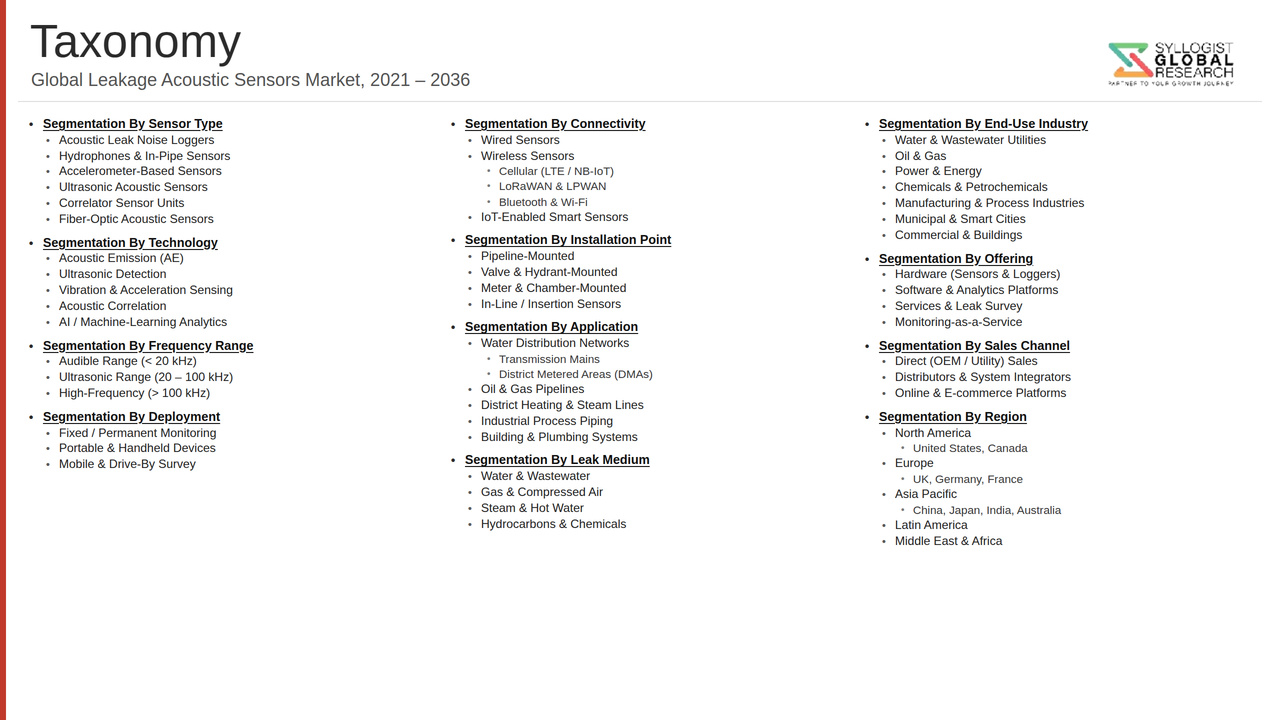
- Segmentation By Sensor Type
- Fixed-Position Permanent Acoustic Noise Loggers
- Portable Correlator-Based Detection Systems
- Ground Microphones
- Hydrophones
- Accelerometers
- Fiber-Optic Distributed Acoustic Sensing (DAS)
- Hybrid IoT Acoustic Sensor Platforms
- AI-Enabled Cloud Analytics Platforms
- Others
- Segmentation By Technology
- Active Acoustic Detection
- Passive Acoustic Monitoring
- Cross-Correlation Detection
- Vibration-Based Detection
- Fiber-Optic Sensing
- AI and Machine Learning-Enabled Analytics
- Others
- Segmentation By Deployment
- Permanent Installations
- Portable and Mobile Deployments
- Drive-By and Walk-By Surveys
- Drone and Aerial-Mounted Sensors
- Others
- Segmentation By Pipe Material
- Cast Iron and Ductile Iron
- Steel
- Copper
- Polyvinyl Chloride (PVC)
- High-Density Polyethylene (HDPE)
- Asbestos Cement
- Concrete and Prestressed Concrete
- Others
- Segmentation By Application
- Active Leak Detection
- Pressure Management
- District Metered Area (DMA) Monitoring
- Non-Revenue Water Reduction
- Pipeline Integrity Management
- Asset Condition Assessment
- Hydrogen Leak Detection
- District Heating and Cooling Network Monitoring
- Others
- Segmentation By End User
- Municipal Water Utilities
- Gas Pipeline Operators
- Industrial Process Operators
- District Heating and Cooling Operators
- Oil and Gas Midstream Operators
- Hydrogen Infrastructure Operators
- Mining and Metals
- Power Generation
- Others
- Segmentation By Region
- Europe
- North America
- Asia-Pacific (China, India, Japan, South Korea, Singapore, Southeast Asia, Australia)
- Middle East and Africa
- Latin America
All market revenues are presented in USD
Historical Year: 2021-2024 | Base Year: 2025 | Estimated Year: 2026 | Forecast Period: 2027-2034
Key Questions this Study Will Answer
- What is the total market valuation of the Global Leakage Acoustic Sensors Market in 2025, projected through 2034, disaggregated by sensor type, technology, deployment, pipe material, application, and end user, enabling acoustic sensor suppliers, municipal water utilities, gas pipeline operators, hydrogen infrastructure operators, and investors to identify the highest-growth opportunities and most durable revenue corridors across the leakage acoustic sensors value chain?
- How are non-revenue water reduction mandates under the EU Drinking Water Directive recast, climate-driven drought response programs across California, Australia, Cape Town, Chennai, and Singapore, and utility commitments to reduce NRW by 18% to 38% reshaping acoustic sensor procurement across Thames Water, Severn Trent, Anglian Water, Yorkshire Water, Singapore PUB, Sydney Water, Tokyo Metropolitan Waterworks Bureau, Mumbai Municipal Corporation, and Delhi Jal Board through 2034?
- Which acoustic sensor technologies including fixed-position permanent noise loggers, portable correlator-based systems, ground microphones, hydrophones, accelerometers, fiber-optic distributed acoustic sensing, hybrid IoT platforms, and AI-enabled cloud analytics platforms are generating the highest growth rates, and how is the supply landscape evolving across Gutermann, Hydrosave, Vodatec, HWM-Water, Primayer, SebaKMT, Mueller Water Products, Halma, Sensus, Diehl Metering, Itron, Kamstrup, Echologics, Atmos International, Silixa, Bandweaver, OptaSense, and AP Sensing?
- How are smart water network investment programs under the EU Drinking Water Directive recast, US Bipartisan Infrastructure Law funding exceeding USD 55 billion, China 14th Five-Year Plan, and Indian AMRUT 2.0 and Jal Jeevan Mission frameworks driving acoustic sensor procurement and digital transformation across global utility jurisdictions through 2034?
- How is hydrogen infrastructure expansion across RWE, Equinor, Air Liquide, Linde, Shell, BP, and Iberdrola programs in Germany, the Netherlands, Spain, the UK, Australia, the US, and emerging Middle Eastern hydrogen export corridors driving high-value adjacent acoustic sensor demand, and what hydrogen-specific sensor development trajectories are emerging across major suppliers?
- How are pipe material variability across cast iron, ductile iron, steel, copper, PVC, HDPE, asbestos cement, and concrete networks, alongside acoustic signal interference, network pressure fluctuations, and ambient noise, constraining sensor performance and reshaping deployment planning across utility digital transformation programs?
- How is the competitive landscape structured among acoustic sensor specialists Gutermann, Hydrosave, Vodatec, HWM-Water, Primayer, SebaKMT, Mueller Water Products, Halma, Echologics, Atmos International, fiber-optic DAS suppliers Silixa, Bandweaver, OptaSense, AP Sensing, Hifi Engineering, and emerging AI software platforms Aquanostics, Watershed, FIDO Tech, Aganova, and Aquai Sense, and what partnership, acquisition, and capacity expansion strategies are reshaping market share dynamics through 2034?
- Product Definition
- Research Methodology
- Research Design & Framework
- Overall Research Approach: Descriptive, Exploratory & Quantitative Mixed-Method Design
- Market Definition & Scope Boundaries: What is Included and Excluded
- Segmentation Framework
- Key Research Assumptions & Limitations
- Secondary Research
- Primary Research Design & Execution
- Data Triangulation & Validation
- Market Sizing & Forecasting Methodology
- Competitive Intelligence Methodology
- Quality Assurance & Peer Review
- Definitions, Abbreviations & Data Notes
- Research Design & Framework
- Executive Summary
- Market Snapshot & Headline Numbers
- Key Findings & Research Highlights
- Market Dynamics
- Regional Market Summary
- Competitive Landscape Snapshot
- Technology & Innovation Highlights
- Market Dynamics
- Drivers
- Restraints
- Opportunities
- Challenges
- Porter’s Five Forces Analysis
- PESTLE Analysis
- Market Trends & Developments
- Emerging Trends
- Technological Developments
- Regulatory & Policy Changes
- Supply Chain & Sourcing Trends
- Manufacturing & Process Trends
- Investment & Funding Activity
- Sustainability & ESG Trends
- Risk Assessment Framework
- False-Positive, Detection Accuracy & Signal Reliability Risk
- Connectivity, Battery Life & Field Durability Risk
- Utility Capex Dependence, Funding & Long Procurement-Cycle Risk
- Technology Substitution (Pressure, Flow & Satellite Detection) & Competitive Displacement Risk
- Data Security, Interoperability & Integration Risk
- Regulatory Framework & Standards
- Water Loss, Non-Revenue Water (NRW) Reduction & Leakage Mandate Frameworks
- Sensor Performance, Accuracy & Calibration Standards
- Wireless Communication, Spectrum & Telemetry Regulations
- Data Privacy, Cybersecurity & Interoperability Standards
- Green Finance, Carbon Accounting, ESG Disclosure & Sustainable Procurement Standards
- Global Leakage Acoustic Sensors Market Outlook
- Market Size & Forecast by Value
- Market Size & Forecast by Volume (Units & Installed Sensors)
- Market Size & Forecast by Sensor Type
- Hydrophone Acoustic Sensors
- Accelerometer-Based Acoustic Sensors
- Acoustic Logger / Noise Logger Sensors
- Leak Noise Correlators
- Ground Microphone & Listening Stick Sensors
- Fiber-Optic Acoustic Sensors (DAS)
- Hydrant & In-Pipe Acoustic Sensors
- Smart / IoT-Enabled Acoustic Sensors
- Other & Hybrid Acoustic Sensor Types
- Market Size & Forecast by Technology
- Permanent (Fixed) Acoustic Monitoring Technology
- Mobile & Lift-and-Shift Acoustic Monitoring Technology
- Leak Noise Correlation Technology
- Distributed Acoustic Sensing (DAS) Fiber-Optic Technology
- Wireless & IoT (NB-IoT, LoRaWAN & Cellular) Connectivity Technology
- Edge Analytics & On-Sensor Signal Processing Technology
- AI / Machine Learning Leak Classification Technology
- Cloud Platform & Data Analytics Technology
- Other Emerging & Hybrid Sensing Technologies
- Market Size & Forecast by Deployment Mode
- Permanent / Fixed Network Deployment
- Mobile / Survey-Based Deployment
- Lift-and-Shift / Temporary Deployment
- Correlation-Based Pinpointing Deployment
- Hybrid & Multi-Mode Deployment
- Market Size & Forecast by Connectivity
- Wired & Fixed-Line Connectivity
- Cellular & NB-IoT Connectivity
- LoRaWAN & Low-Power Wide-Area Connectivity
- Other Wireless & Hybrid Connectivity
- Market Size & Forecast by Application
- Water Distribution Network Leak Detection
- Water Transmission & Trunk Main Monitoring
- District Metered Area (DMA) Monitoring
- Gas Pipeline Leak Detection
- Industrial & Process Pipeline Monitoring
- Oil, Hydrogen & Other Pipeline Applications
- Market Size & Forecast by End-User
- Municipal Water Utilities
- Gas Utilities & Pipeline Operators
- Industrial & Manufacturing Facilities
- Oil & Gas Companies
- Commercial, Municipal & Other End-Users
- Market Size & Forecast by Sales Channel
- Direct Sales & OEM Supply
- Distributors & Authorised Resellers
- System Integrator & Engineering Contractor Channel
- Monitoring-as-a-Service & Subscription Channel
- North America Leakage Acoustic Sensors Market Outlook
- Market Size & Forecast
- By Value
- By Volume (Units & Installed Sensors)
- By Sensor Type
- By Technology
- By Deployment Mode
- By Connectivity
- By Application
- By End-User
- By Country
- By Sales Channel
- Europe Leakage Acoustic Sensors Market Outlook
- Market Size & Forecast
- By Value
- By Volume (Units & Installed Sensors)
- By Sensor Type
- By Technology
- By Deployment Mode
- By Connectivity
- By Application
- By End-User
- By Country
- By Sales Channel
- Asia-Pacific Leakage Acoustic Sensors Market Outlook
- Market Size & Forecast
- By Value
- By Volume (Units & Installed Sensors)
- By Sensor Type
- By Technology
- By Deployment Mode
- By Connectivity
- By Application
- By End-User
- By Country
- By Sales Channel
- Latin America Leakage Acoustic Sensors Market Outlook
- Market Size & Forecast
- By Value
- By Volume (Units & Installed Sensors)
- By Sensor Type
- By Technology
- By Deployment Mode
- By Connectivity
- By Application
- By End-User
- By Country
- By Sales Channel
- Middle East & Africa Leakage Acoustic Sensors Market Outlook
- Market Size & Forecast
- By Value
- By Volume (Units & Installed Sensors)
- By Sensor Type
- By Technology
- By Deployment Mode
- By Connectivity
- By Application
- By End-User
- By Country
- By Sales Channel
- Country-Wise* Leakage Acoustic Sensors Market Outlook
- Market Size & Forecast
- By Value
- By Volume (Units & Installed Sensors)
- By Sensor Type
- By Technology
- By Deployment Mode
- By Connectivity
- By Application
- By End-User
- By Country
- By Sales Channel
- *Countries Analyzed in the Syllogist Global Research Portfolio: United States, Canada, Mexico, Germany, France, United Kingdom, Netherlands, Spain, Italy, Norway, Sweden, China, Japan, India, Australia, South Korea, Singapore, Brazil, Chile, Saudi Arabia, UAE, Egypt, South Africa, Israel
- Technology Landscape & Innovation Analysis
- Hydrophone & Accelerometer Acoustic Sensing Technology Deep-Dive
- Acoustic Logger & Noise Logging Technology
- Leak Noise Correlation & Pinpointing Technology
- Distributed Acoustic Sensing (DAS) Fiber-Optic Technology
- Wireless, IoT & Low-Power Connectivity Technology
- Edge Analytics, Signal Processing & Noise Filtering Technology
- AI / Machine Learning Leak Detection & Classification Technology
- Patent & IP Landscape in Acoustic Leak Detection Technologies
- Value Chain & Supply Chain Analysis
- Sensor Element, Transducer & MEMS Component Manufacturing Supply Chain
- Electronics, Battery & Communication Module Supply Chain
- Sensor Assembly, Enclosure & Calibration Supply Chain
- Software, Analytics Platform & Cloud Service Landscape
- Distributor, System Integrator & Engineering Contractor Channel
- Water & Gas Utility Procurement Landscape
- Installation, Maintenance, Service & Circular Economy
- Pricing Analysis
- Permanent / Fixed Acoustic Sensor Network Cost Analysis
- Mobile & Lift-and-Shift Acoustic Sensor Cost Analysis
- Leak Noise Correlator & Survey Equipment Pricing Analysis
- Distributed Acoustic Sensing (DAS) System Cost Analysis
- Software, Analytics & Monitoring-as-a-Service Subscription Pricing Analysis
- Total Leak Detection Economics: Cost-per-Kilometre Monitored and Water-Loss-Saving Optimisation Analysis
- Sustainability & Environmental Analysis
- Water Loss Reduction & Resource Conservation Contribution of Acoustic Leak Detection
- Energy & Carbon Savings from Reduced Water Loss and Pumping Demand
- Sensor Lifecycle, Battery, E-Waste & Material Footprint Consideration
- Environmental Compliance, Non-Revenue Water & Water-Stress Mitigation Contribution
- Regulatory-Driven Sustainability, SDG 6 (Clean Water) & SDG 12 (Responsible Consumption) Alignment & Green Finance Eligibility
- Competitive Landscape
- Market Structure & Concentration
- Market Consolidation Level (Fragmented vs. Consolidated by Sensor Type & Geography)
- Top 10 Players Market Share
- HHI (Herfindahl-Hirschman Index) Concentration Analysis
- Competitive Intensity Map by Sensor Type, Technology & Geography
- Player Classification
- Integrated Water Network & Leak Detection Solution Companies
- Specialist Acoustic Sensor & Logger Manufacturers
- Leak Noise Correlator & Survey Equipment Providers
- Distributed Acoustic Sensing (DAS) & Fiber-Optic Technology Players
- Smart Water & IoT Sensor Platform Providers
- Analytics, AI & Software Platform Providers
- System Integrators & Engineering Service Providers
- Monitoring-as-a-Service & Managed-Service Providers
- Competitive Analysis Frameworks
- Market Share Analysis by Sensor Type, Technology & Region
- Company Profile
- Company Overview & Headquarters
- Acoustic Sensor Products & Technology Portfolio
- Key Customer Relationships & Reference Deployments
- Manufacturing Footprint & Production Capacity
- Revenue (Leak Detection Segment) & Backlog
- Technology Differentiators & IP
- Key Strategic Partnerships, JVs & M&A Activity
- Recent Developments (Contract Wins, Capacity Expansion, Product Launches)
- SWOT Analysis
- Strategic Focus Areas & Roadmap
- Competitive Positioning Map (Technology Capability vs. Market Penetration)
- Key Company Profiles
- Market Structure & Concentration
- Technology Landscape & Innovation Analysis
- Strategic Output
- Market Opportunity Matrix: By Sensor Type, Technology, Application, End-User & Geography
- White Space Opportunity Analysis
- Strategic Recommendations
- Product Portfolio & Technology Investment Strategy
- Manufacturing & Operational Excellence Strategy
- Geographic Expansion & Localisation Strategy
- Customer & End-User Engagement Strategy
- Partnership, M&A & Ecosystem Strategy
- Sustainability & Circular Economy Strategy
- Risk Mitigation & Future Roadmap
- Strategic Priority Matrix & Roadmap
- Near-term (2025-2028)
- Mid-term (2029-2032)
- Long-term (2033-2037)
- Strategic Output
- Market Size & Forecast
- Market Size & Forecast
- Market Size & Forecast
- Market Size & Forecast
- Market Size & Forecast
- Market Size & Forecast