
Market Definition
The Global AI Crop Disease Prediction Platforms Market encompasses the design, development, training, deployment, and commercial operation of artificial intelligence-powered software platforms, mobile applications, and integrated hardware-software systems that detect, identify, classify, monitor, and predict fungal, bacterial, viral, pest-induced, and abiotic stress diseases in agricultural crops using machine learning algorithms, deep learning convolutional neural networks, computer vision, multispectral and hyperspectral image analysis, Internet of Things sensor data fusion, satellite and drone-derived remote sensing imagery, and epidemiological disease spread modeling to provide farmers, agronomists, crop advisors, and agribusiness operators with early warning, location-specific diagnosis, severity quantification, and treatment prescription intelligence that reduces crop losses, optimizes fungicide and pesticide application timing and rate, and improves crop yield and quality outcomes across field, orchard, greenhouse, and controlled environment production systems. The market is distinguished from conventional agricultural disease management tools by its reliance on data-driven probabilistic prediction rather than reactive symptom observation, enabling farmers to initiate protective interventions before visible disease symptoms appear at economic threshold levels by identifying environmental conditions and early biological signals that precede outbreak escalation, a predictive capability that is commercially validated to reduce crop losses by 15% to 45% in high-susceptibility crops including potatoes, grapes, tomatoes, wheat, rice, and maize relative to calendar-based or threshold-triggered spray programs that lack predictive disease incidence intelligence. The platform market encompasses cloud-hosted software-as-a-service subscription products providing web and mobile dashboard access to disease risk scores, infection alerts, and treatment recommendations, edge computing solutions for connectivity-limited farm environments, integrated satellite imagery and weather data analytics platforms, precision sprayer control integration systems that link disease prediction outputs directly to variable-rate application commands, and artificial intelligence model training services for developing crop and region-specific disease prediction capabilities. Key participants include agri-technology software developers, precision agriculture platform providers, satellite and remote sensing data companies, agrochemical corporations deploying digital advisory platforms, telecommunications companies offering agricultural Internet of Things connectivity, and agricultural extension services and cooperative organizations delivering AI disease advisory services to farmer member bases.
Market Insights
The global AI crop disease prediction platforms market was valued at approximately USD 1.84 billion in 2025 and is projected to reach USD 7.6 billion by 2034, advancing at a compound annual growth rate of 17.1% over the forecast period from 2027 to 2034, driven by the escalating global economic losses attributable to crop diseases estimated at approximately USD 220 billion annually representing approximately 14% of total global crop production value, the accelerating capability of deep learning computer vision models in plant disease image recognition that has progressed from research laboratory demonstrations to commercially deployable mobile applications over the past five years, the expanding availability of low-cost weather stations, soil sensors, and multispectral drone and satellite imagery that provide the real-time environmental data inputs that AI disease prediction models require, and the growing adoption of digital agriculture platforms by commercial-scale farmers who recognize that disease prediction intelligence generates a measurable and rapidly realized return on investment through reduced crop losses and optimized fungicide application expenditure. The mobile application-based disease diagnosis segment represents the most widely deployed component of the AI crop disease prediction market by user count, with smartphone-based image recognition applications for crop disease identification achieving installation bases of tens of millions of users across India, Sub-Saharan Africa, and Southeast Asia where the combination of high-value crop loss risk, widespread smartphone penetration, and limited access to trained plant pathologists creates the strongest demand for accessible digital disease diagnosis tools at minimal cost. The accuracy performance of leading artificial intelligence plant disease detection models has advanced substantially, with top-performing convolutional neural network architectures trained on large labeled image datasets of over one million disease symptom images achieving identification accuracy above 92% for the most common crop disease categories across wheat, rice, maize, soybean, potato, and tomato when tested on standardized benchmark datasets, providing the technical performance validation that commercial-scale farm operators and agrochemical advisory services require before adopting AI diagnosis recommendations as inputs to high-value spray program decisions.
The field crop segment, encompassing AI disease prediction applications for wheat, rice, maize, soybean, and potato cultivation across large-scale commercial and smallholder production systems, constitutes the largest application category by crop area addressable, with wheat blast, rice blast and brown spot, maize gray leaf spot and northern corn leaf blight, late blight and early blight of potato, and soybean sudden death syndrome among the specific disease targets whose economic impact and predictability characteristics make them the most commercially compelling use cases for AI prediction platforms whose value is directly proportional to the frequency and severity of disease outbreak events that the platform can anticipate and help prevent. The viticultural and specialty crop segment, encompassing grape downy mildew and powdery mildew prediction, apple scab and fire blight forecasting, tomato late blight and bacterial speck detection, and strawberry botrytis and angular leaf spot monitoring, represents the highest unit-value AI disease prediction deployment category with subscription prices of approximately USD 25 to USD 80 per hectare annually for precision disease risk monitoring services in European and North American premium wine, apple, and tomato production systems where the cost of a single uncontrolled disease outbreak can represent USD 5,000 to USD 20,000 per hectare in crop value loss and salvage cost, justifying premium subscription pricing and driving the deepest adoption of sophisticated AI prediction capabilities among commercially motivated farm operators. European viticulture has been at the vanguard of AI crop disease prediction commercial adoption, with French, German, Italian, and Spanish wine producers adopting downy mildew and powdery mildew prediction platforms at adoption rates approaching 35% to 40% of commercial vineyard area in leading wine regions, supported by the integration of these platforms with automated weather station networks installed across major wine appellations whose high spatial density provides the localized microclimate data that disease prediction model accuracy depends on.
The integration of satellite multispectral imagery with artificial intelligence disease detection algorithms is creating a new and commercially significant subcategory of AI crop disease prediction that enables field-wide and regional disease surveillance at spatial scales and coverage extents that ground-based sensing and drone monitoring cannot match, with vegetation index anomaly detection algorithms applied to Sentinel-2, Planet Labs, and Maxar satellite imagery identifying stressed crop areas whose spectral signature deviations from healthy baseline profiles can indicate early-stage fungal or bacterial disease infection, water stress, nutritional deficiency, or pest damage before the causative factor is visually obvious to field scouts operating at ground level. Satellite-based disease surveillance platforms are being integrated with weather-driven epidemiological disease spread models that simulate the spore dispersal, infection period accumulation, and latent period progression of specific fungal diseases including Phytophthora infestans, Botrytis cinerea, Plasmopara viticola, and Puccinia striiformis using meteorological data including temperature, humidity, leaf wetness duration, and solar radiation to predict infection event timing and spatial progression across georeferenced field and regional scales, providing farm advisors and agrichemical distribution networks with regional disease pressure maps that inform spray program scheduling decisions across multiple farm clients simultaneously. The agrochemical industry is increasingly investing in AI crop disease prediction platforms as a strategic component of their digital advisory service ecosystems, recognizing that disease prediction intelligence creates a data-driven rationale for fungicide product recommendations that is more trusted by commercial farmers than traditional sales representative product promotion, with leading crop protection companies integrating AI prediction tools within their digital customer platforms to provide value-added advisory services that support fungicide product line sales while simultaneously demonstrating commitment to precision application practices that reduce total chemical input volumes in compliance with regulatory pesticide reduction requirements.
The developing economy market for AI crop disease prediction, encompassing India, Sub-Saharan Africa, Southeast Asia, and Latin America where smallholder farmers cultivate the majority of staple food crops with limited access to plant pathology expertise, extension advisory services, and diagnostic laboratory infrastructure, represents the largest underserved opportunity within the global market and the deployment context in which AI disease prediction platforms can generate the most transformative impact on food security and farmer income outcomes by providing early warning and treatment guidance that prevents the catastrophic crop losses that currently represent one of the primary causes of rural poverty and food insecurity. India’s agricultural extension system, with approximately one agricultural extension officer serving approximately 800 farmers compared to international recommendations of one per 400 farmers, creates a structural advisory service gap that AI disease prediction mobile applications accessible at smartphone cost and data charges below USD 0.10 per day are progressively filling, with platforms combining disease diagnosis with input dealer integration, agronomy advisory content in local languages, and connection to credit and crop insurance services creating comprehensive digital farm advisory ecosystems that serve the total information needs of smallholder farmers across disease management, agronomic decision support, market price information, and rural financial service access. The emergence of artificial intelligence foundation models trained on vast multi-crop, multi-geography plant disease image datasets and fine-tuned for specific regional crop systems is reducing the data collection burden and model development cost for deploying new disease prediction capabilities in underserved crop and geography combinations, with open-source disease image datasets including PlantVillage at over 87,000 labeled disease images and PlantDoc providing the training data foundations that accelerate new model development at cost points compatible with deployment in low-average-revenue-per-user agricultural markets.
Key Drivers
Escalating Global Crop Disease Economic Losses, Climate Change-Driven Disease Pressure Intensification, and Resistance Development in Pathogen Populations Creating Urgent Demand for Predictive Disease Intelligence
The convergence of increasing crop disease incidence driven by climate change-altered temperature and humidity conditions that expand disease-favorable weather windows, the evolution of fungicide resistance in economically important pathogen populations that reduces the efficacy of standard treatment protocols and demands more precise application timing, and the rising economic value of high-quality crop production that amplifies the financial consequence of yield and quality losses from disease outbreaks is creating a compelling and commercially urgent demand for AI disease prediction platforms that can provide the early warning and intervention timing intelligence required to protect crop investments at acceptable chemical input cost. Climate change is expanding the geographic range and lengthening the seasonal activity windows of key crop pathogens, with wheat blast now documented in South Asia, Fusarium head blight progression northward across European wheat belts, citrus huanglongbing continuing its global spread, and late blight pressure intensifying in traditionally lower-risk highland potato production zones across the Andes and East Africa as temperature and humidity patterns shift outside the historical ranges on which conventional disease forecasting models were calibrated, creating new prediction requirements that AI platforms trained on diverse environmental and pathogen data are better positioned to address than rule-based phenological forecasting models. The development of multi-fungicide resistance in Botrytis cinerea in European berry and vegetable production, Zymoseptoria tritici resistance to demethylation inhibitor fungicides in European wheat production, and downy mildew resistance to mefenoxam in global lettuce and basil production are increasing the importance of accurate disease incidence timing prediction because resistant pathogen populations cannot be managed with calendar-based spray programs and require precise infection event timing data to apply alternative chemistry products at the specific infection windows where they provide meaningful disease control benefit.
Regulatory Pesticide Reduction Mandates and Integrated Pest Management Requirements Compelling Precision Disease Prediction Technology Adoption as the Enabler of Compliant Chemical Use Reduction
The European Union Farm to Fork strategy’s binding 50% pesticide use reduction target by 2030, integrated pest management requirement enforcement across all professional agricultural sectors from 2023 under Directive 2009/128/EC, and equivalent pesticide stewardship regulations in the United Kingdom, United States, Australia, and several Asian markets are creating a legally enforceable demand for AI disease prediction platforms as the precision decision-support tools that enable commercial farmers to reduce total fungicide and pesticide application volumes through disease-risk-based spray program optimization while maintaining crop protection performance that calendar-based or threshold-triggered spray programs without predictive intelligence cannot achieve on reduced application budgets. Integrated pest management principles require that protective and curative pesticide applications be justified by quantified disease risk evidence rather than calendar schedules or precautionary protocols, a requirement that AI disease prediction platforms uniquely satisfy by providing georeferenced, real-time disease risk scores and infection period accumulation data that meet the decision-support standard demanded by integrated pest management compliance auditors and sustainable farming certification inspectors across Global G.A.P., Rainforest Alliance, and organic certification schemes. The European Union Green Deal’s chemicals strategy for sustainability, which is evaluating restriction of multiple fungicide active ingredients under the Registration, Evaluation, Authorisation and Restriction of Chemicals framework based on endocrine disruption, groundwater contamination, and aquatic toxicity profiles, is progressively reducing the number of fungicide chemistries available to farmers while simultaneously requiring that the remaining permitted chemistries be applied with greater precision and at lower cumulative seasonal doses to manage resistance risk, creating a dual scarcity in treatment options and application frequency that makes AI prediction platforms for optimizing remaining fungicide application timing the most commercially valuable input to crop disease management decision-making in regulated markets.
Smartphone Proliferation Among Farming Communities, Rural Mobile Connectivity Expansion, and Low-Cost AI Model Deployment Enabling Mass Market Adoption Across Developing Country Agriculture
The dramatic expansion of smartphone ownership and affordable mobile data connectivity among farming communities in India, Sub-Saharan Africa, Southeast Asia, and Latin America is creating a mass market deployment pathway for AI crop disease prediction applications at a scale and geographic reach that previous precision agriculture technology generations delivered exclusively through expensive hardware platforms accessible only to large-scale commercial farmers with substantial capital resources, with smartphone-based disease diagnosis apps accessible at zero or nominal subscription cost to millions of smallholder farmers who can upload field photographs or receive push notification disease alerts through the same device they use for personal communication, financial transactions, and market price information. India’s smartphone penetration among agricultural households reached approximately 68% in 2025 and is growing at approximately 12% annually, with rural 4G connectivity coverage exceeding 95% of India’s approximately 640,000 inhabited villages following government-supported BharatNet broadband rollout and private telecommunications network expansion, creating a connected farmer population of approximately 140 million individuals accessible through mobile-delivered AI advisory services at a marginal delivery cost per user that is commercially viable at subscription pricing below USD 5 per season for basic disease alert services. The development of efficient artificial intelligence model architectures that can operate on mobile device hardware with limited computational resources through model quantization, knowledge distillation, and edge deployment optimization is enabling offline-capable disease diagnosis functionality that maintains accuracy performance without cloud connectivity, a capability that is essential for deployment in regions where mobile data connectivity is intermittent or expensive and where farmers must be able to access disease diagnosis recommendations without real-time network access during field scouting visits.
Key Challenges
Training Data Scarcity for Diverse Crop-Disease-Geography Combinations, Annotation Cost, and Model Generalization Failure Across Unseen Field Conditions Limiting Platform Deployment Breadth
The development of reliable AI disease prediction models for specific crop-disease-geography combinations requires large, geographically diverse, expertly annotated training datasets of field disease images that are extraordinarily expensive and time-consuming to assemble at the scale and quality required for robust commercial deployment, with the cost of building a certified training dataset of 50,000 to 150,000 accurately annotated field images for a single crop-disease combination involving expert plant pathologist annotation, multi-season field photography under diverse lighting, growth stage, and symptom severity conditions estimated at USD 400,000 to USD 1.2 million before model development and validation costs, creating a data acquisition barrier that limits the addressable crop-disease scope of most commercial AI disease prediction platforms to a small number of economically high-priority disease targets in well-funded deployment contexts. The model generalization challenge, in which AI disease detection models trained on image datasets from one geographic region or production system exhibit substantially degraded accuracy performance when deployed in different geographic regions, cultivar portfolios, climate zones, or photography device types whose image characteristics differ from the training distribution, is a persistent technical limitation that requires region-specific model fine-tuning and local dataset augmentation for each new deployment geography, adding development cost and deployment timeline to platform geographic expansion programs and creating quality consistency challenges for global platform providers seeking to maintain accuracy performance standards across heterogeneous farm customer bases in multiple countries. The annotation quality challenge is particularly acute for early-stage disease detection applications where the distinction between healthy and early-infected plant tissue requires expert plant pathologist judgment that cannot be crowdsourced from non-expert annotators, limiting the annotation throughput achievable through scalable labeling programs and maintaining a dependency on scarce specialist expertise whose availability constrains the pace of training dataset development for new crop-disease target expansion.
Farmer Trust Barriers, Digital Literacy Limitations, and Last-Mile Advisory Delivery Challenges Constraining Smallholder Adoption in Developing Economy Markets
The commercial scaling of AI crop disease prediction platform adoption among smallholder farming communities in developing countries faces persistent human and behavioral barriers that technology capability improvements alone cannot resolve, as farmers whose disease management decisions have historically been based on observation, community knowledge, and trusted personal relationships with input dealers or extension officers require sustained behavioral change support, demonstrated local performance evidence, and trusted intermediary endorsement before replacing or supplementing their established decision frameworks with AI-generated risk alerts and treatment recommendations whose algorithmic basis is opaque and whose failure consequences in crop protection decision-making can be severe. Digital literacy limitations among older farming populations in India, Sub-Saharan Africa, and Southeast Asia, where the average age of a farmer is approximately 55 years and formal education levels in rural areas frequently do not include prior experience with smartphone applications or data-driven decision tools, create usability barriers for AI disease prediction apps whose interface design requirements must be simplified to voice-assisted navigation, visual-dominant icon interfaces, and local language audio advisory delivery to achieve adoption rates that generate commercially viable active user bases for subscription-based or advertising-supported business models. The last-mile advisory delivery challenge, in which AI disease prediction platforms must connect their diagnostic outputs to farmer action through input procurement, treatment application timing, and agrochemist guidance that may require physical interaction with local dealer networks, extension officers, or cooperative agronomists who must themselves understand and trust the AI platform outputs before recommending them to farmer clients, creates a dependency on human intermediary adoption that slows the pace of farmer-level behavior change and requires platform providers to invest in agrochemist and extension officer training and engagement programs alongside their farmer-facing user acquisition activities.
Connectivity and Infrastructure Limitations in Rural Agricultural Regions, Sensor Data Quality Variability, and Weather Data Spatial Resolution Constraints Reducing Prediction Model Accuracy
The accuracy performance of AI crop disease prediction models that integrate real-time weather, humidity, leaf wetness, and crop microclimate data depends critically on the spatial density, calibration quality, and continuous availability of the sensor and weather station infrastructure that provides the environmental data inputs to disease risk calculation algorithms, with prediction accuracy degrading significantly in agricultural regions where the nearest official weather station is more than 10 to 20 kilometers from the farm location, where Internet of Things field sensor networks providing real-time crop canopy microclimate data are absent, or where mobile connectivity interruptions prevent timely upload of sensor data to cloud-hosted disease prediction models during critical infection period accumulation windows. The interpolation error introduced by using regional weather station data as a proxy for farm-level microclimate conditions in heterogeneous agricultural landscapes can generate disease risk score errors of 20% to 40% in prediction accuracy for disease models whose infection period accumulation calculations are highly sensitive to temperature and leaf wetness duration parameters that exhibit substantial spatial variation across topographic features including slope aspect, frost pocket locations, irrigation-influenced humidity gradients, and forest edge wind shelter effects that regional station data cannot capture. The quality and maintenance consistency of low-cost Internet of Things agricultural weather stations deployed by platform providers or farm operators to generate localized microclimate data for disease prediction varies significantly depending on installation quality, battery replacement regularity, sensor calibration drift over time, and physical damage from agricultural machinery operations, with sensor data quality failures silently degrading disease prediction model inputs in ways that create false security if the platform does not incorporate sensor data quality validation and anomaly detection algorithms that identify and flag compromised sensor readings before they corrupt disease risk score calculations.
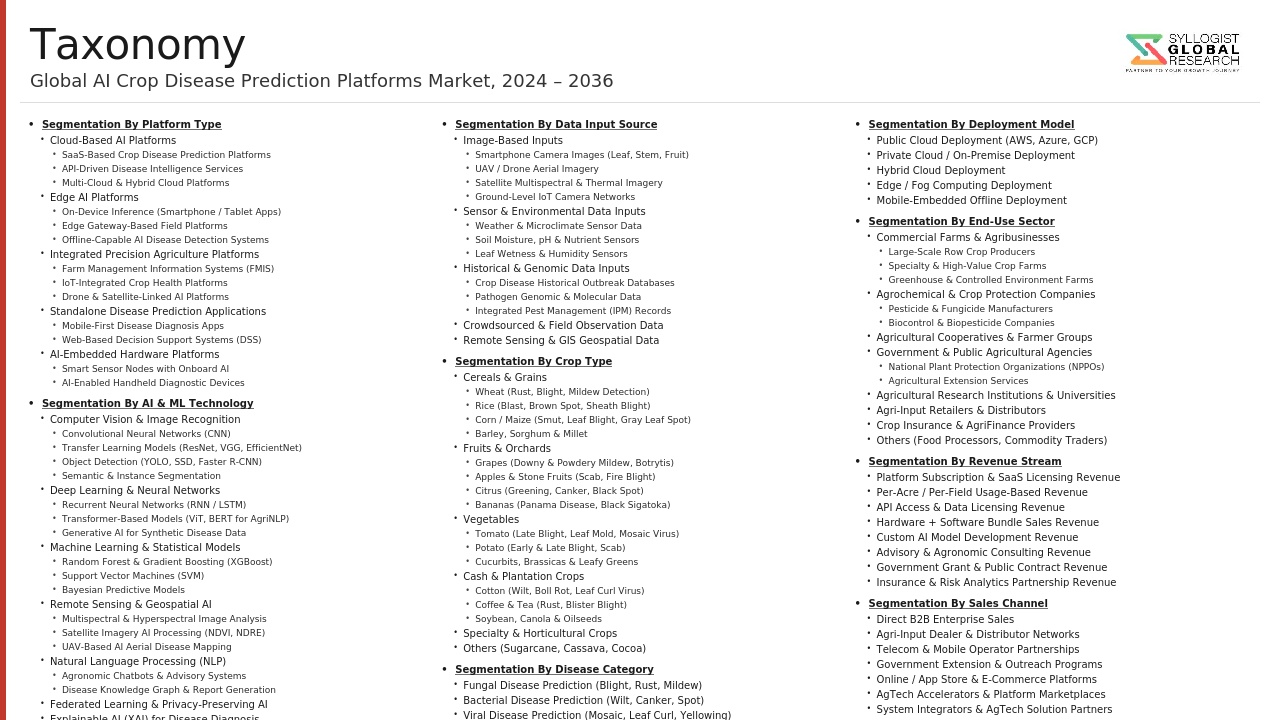
Market Segmentation
- Segmentation By Platform Type
- Mobile Application-Based Disease Diagnosis and Advisory Platforms
- Cloud-Based SaaS Disease Risk Monitoring and Alert Platforms
- Satellite and Remote Sensing Disease Surveillance Platforms
- IoT Sensor-Integrated Weather-Driven Disease Forecasting Systems
- Drone Imaging and AI Disease Detection Platforms
- Edge Computing Offline Disease Detection Systems
- Integrated Precision Sprayer Control and Disease Prediction Systems
- Others
- Segmentation By AI Technology
- Convolutional Neural Network (CNN) Image Classification
- Object Detection and Instance Segmentation Models
- Recurrent Neural Networks and Time-Series Disease Spread Forecasting
- Generative AI and Synthetic Training Data Augmentation
- Epidemiological and Mechanistic Disease Spread Models
- Multi-Modal Fusion (Image, Weather, Satellite, and IoT Data)
- Others
- Segmentation By Crop Type
- Cereals and Grains (Wheat, Rice, Maize, and Barley)
- Vegetables (Tomato, Potato, Pepper, Lettuce, and Cucumber)
- Fruits and Berries (Grapes, Apple, Strawberry, and Citrus)
- Oilseeds (Soybean, Rapeseed, and Sunflower)
- Pulses and Legumes
- Tropical Crops (Banana, Coffee, Cacao, and Sugarcane)
- Greenhouse and Controlled Environment Crops
- Others
- Segmentation By Disease Target
- Fungal Diseases
- Bacterial Diseases
- Viral Diseases and Phytoplasmas
- Insect Pest Damage and Infestation Detection
- Abiotic Stress (Nutrient Deficiency and Water Stress)
- Others
- Segmentation By End User
- Individual Farmers and Farm Operators
- Agricultural Cooperatives and Farmer Organizations
- Agronomy Consultants and Crop Advisors
- Agrochemical and Seed Companies
- Government Agricultural Extension Services
- Crop Insurance Providers
- Food and Beverage Supply Chain Companies
- Others
- Segmentation By Deployment Model
- Free Mobile Application (Ad-Supported or Freemium)
- Subscription-Based SaaS Platform
- Pay-Per-Use and Season-Based Licensing
- Embedded within Agrochemical Advisory Services
- Government-Subsidized Public Agricultural Advisory Platforms
- Others
- Segmentation By Region
- North America
- Europe
- Asia-Pacific
- Middle East and Africa
- Latin America
All market revenues are presented in USD
Historical Year: 2021-2024 | Base Year: 2025 | Estimated Year: 2026 | Forecast Period: 2027-2034
Key Questions this Study Will Answer
- What is the total global market valuation of the AI Crop Disease Prediction Platforms Market in the base year 2025, and what is the projected market size and compound annual growth rate through 2034, disaggregated by platform type including mobile application diagnosis, cloud SaaS risk monitoring, satellite disease surveillance, IoT weather-driven forecasting, and drone imaging platforms, by crop type including cereals, vegetables, fruits and berries, oilseeds, and tropical crops, and by end user including individual farmers, cooperatives, crop advisors, agrochemical companies, government extension services, and crop insurers, to enable AI platform developers, agrochemical corporations, precision agriculture investors, agricultural development agencies, and crop insurance providers to identify the highest-growth platform categories, crop segments, and geographic markets generating the most commercially durable revenue trajectories across the forecast period to 2034?
- What are the diagnostic accuracy benchmarks, training dataset sizes, geographic generalization performance characteristics, and model architecture comparisons of the leading AI plant disease detection approaches including convolutional neural network image classifiers, object detection models, multi-modal data fusion systems, and foundation model fine-tuning approaches across the major commercially deployed crop-disease combinations including wheat blast, potato late blight, grape downy mildew, rice blast, tomato late blight, and maize gray leaf spot, and how are AI disease prediction platform developers addressing the model degradation and accuracy reduction challenges that occur when models trained in one geographic production region are deployed across different cultivar portfolios, climate zones, and field photography device types encountered in diverse global deployment environments?
- How are the European Union Farm to Fork 50% pesticide reduction mandate, integrated pest management enforcement under Directive 2009/128/EC, and the progressive withdrawal of fungicide active ingredients under the Registration, Evaluation, Authorisation and Restriction of Chemicals regulation collectively creating compliance-driven adoption demand for AI disease prediction platforms among European commercial farmers and agronomy advisors, and what is the demonstrated fungicide use reduction percentage and crop protection performance maintenance record of leading AI disease prediction platform deployments in European viticulture, potato production, wheat cultivation, and vegetable horticulture in France, Germany, the Netherlands, Spain, and Italy that provides the evidence base for platform adoption justification within integrated pest management compliance frameworks?
- What is the current active user base, geographic coverage, revenue model, subscription pricing, retention rate, agronomic impact evidence, and commercialization strategy of AI crop disease prediction platforms targeting smallholder farmers in India, Sub-Saharan Africa, and Southeast Asia through mobile application distribution, with specific attention to the approaches being used to overcome digital literacy barriers, build farmer trust in AI-generated recommendations, integrate last-mile delivery through agronomy advisor and input dealer networks, and achieve commercial sustainability at the low average revenue per user levels that smallholder agricultural markets require while generating sufficient impact scale to attract development finance institution and impact investor capital that can supplement commercial revenue in early market development phases?
- How are major agrochemical corporations integrating AI crop disease prediction capabilities within their digital customer advisory platforms as a strategic tool for fungicide product recommendation, usage data collection, precision application service differentiation, and farmer relationship deepening, and what are the competitive implications of agrochemical corporation AI platform investment for independent precision agriculture software companies and AI disease prediction startups seeking to establish subscription-based recurring revenue businesses in markets where agrochemical corporation platforms offering disease prediction at zero incremental subscription cost as a bundled value-added service within product purchase relationships represent a structurally subsidized competitive alternative that independent platform providers must differentiate against through superior agronomic performance, crop and disease breadth, geographic coverage, or integration with multi-brand product ecosystems?
- Product Definition
- Research Methodology
- Research Design & Framework
- Overall Research Approach: Descriptive, Exploratory & Quantitative Mixed-Method Design
- Market Definition & Scope Boundaries: What is Included and Excluded
- Segmentation Framework
- Key Research Assumptions & Limitations
- Secondary Research
- Primary Research Design & Execution
- Data Triangulation & Validation
- Market Sizing & Forecasting Methodology
- Competitive Intelligence Methodology
- Quality Assurance & Peer Review
- Definitions, Abbreviations & Data Notes
- Research Design & Framework
- Executive Summary
- Market Snapshot & Headline Numbers
- Key Findings & Research Highlights
- Market Dynamics
- Regional Market Summary
- Competitive Landscape Snapshot
- Technology & Innovation Highlights
- Market Dynamics
- Drivers
- Restraints
- Opportunities
- Challenges
- Porter’s Five Forces Analysis
- PESTLE Analysis
- Market Trends & Developments
- Emerging Trends
- Technological Developments
- Regulatory & Policy Changes
- Supply Chain & Sourcing Trends
- Manufacturing & Process Trends
- Investment & Funding Activity
- Sustainability & ESG Trends
- Risk Assessment Framework
- Model Accuracy, False Positive & False Negative Prediction Risk in Field Conditions
- Data Scarcity, Training Dataset Bias & Geographic Disease Variant Generalisation Risk
- Farmer Digital Literacy, Smartphone & Connectivity Adoption Barrier Risk in Developing Markets
- Data Privacy, Farm Data Sovereignty, AI Liability & Regulatory Compliance Risk
- Platform Monetisation, Willingness-to-Pay & Unit Economics Sustainability Risk
- Regulatory Framework & Standards
- Agricultural Data Governance & Farm Data Ownership Policy: EU Agricultural Data Act, US Federal Farm Data Frameworks, India Digital Agriculture Mission Data Policy & GDPR Application to Farm Data Collection
- Pesticide & Crop Protection Recommendation Regulation: EU Plant Protection Product Regulation (1107/2009), US EPA FIFRA Label Compliance for AI-Recommended Applications & National Agrochemical Advisory Licensing Requirements
- AI Act & Algorithmic Accountability: EU AI Act Classification of AI Crop Advisory Systems, High-Risk AI Designation, Transparency & Explainability Requirements for Automated Agricultural Decision Support
- Drone & UAV Remote Sensing Regulation for Crop Disease Surveillance: FAA Part 107, EU UAS Regulation, DGCA RPAS Rules (India) & National Agricultural Aerial Survey Permit Frameworks
- Digital Agriculture Policy & Incentive Framework: EU Farm to Fork Digital Strategy, India National e-Governance Plan for Agriculture (NeGPA), USDA Farm Service Agency Digital Programme & National Precision Farming Mission Incentives
- Global AI Crop Disease Prediction Platforms Market Outlook
- Market Size & Forecast by Value
- Market Size & Forecast by Volume (Active Users, Hectares Monitored & API Calls)
- Market Size & Forecast by Platform Type
- Cloud-Based AI Disease Detection & Prediction Platform (SaaS & Web Dashboard)
- Mobile App-Based Disease Diagnosis Platform (Smartphone-Native iOS & Android)
- Edge AI Platform (On-Device, Offline-Capable & Low-Bandwidth Enabled)
- Drone & UAV-Integrated AI Disease Surveillance & Mapping Platform
- IoT Sensor & In-Field Remote Crop Health Monitoring Platform
- Satellite & Remote Sensing-Based Crop Health & Disease Early Warning Platform
- Integrated Precision Agriculture Platform with Embedded Disease Prediction Module
- Conversational AI & Generative AI (LLM) Agronomic Advisory Platform
- Market Size & Forecast by AI & Machine Learning Technology
- Convolutional Neural Network (CNN) & Deep Learning Image Classification
- Computer Vision with Multispectral & Hyperspectral Image Analysis
- Machine Learning Predictive Analytics (Gradient Boosting, Random Forest & Ensemble Models)
- Natural Language Processing (NLP) & Conversational AI for Crop Advisory
- Generative AI & Large Language Model (LLM) for Disease Diagnosis & Recommendation
- IoT Data Fusion, Time-Series Modelling & Disease Epidemiology Forecasting
- Federated Learning & On-Device Model Training for Privacy-Preserving Farm AI
- Market Size & Forecast by Deployment Mode
- Cloud SaaS (Software as a Service, Multi-Tenant & Single-Tenant)
- On-Premise & Private Cloud Deployment
- Edge & On-Device Embedded AI (Offline-First)
- Hybrid Cloud plus Edge Deployment
- Market Size & Forecast by Data Input Type
- Leaf & Plant Image from Smartphone Camera
- Drone & UAV Multispectral & RGB Aerial Imagery
- Satellite Remote Sensing (NDVI, Red Edge, NIR & Thermal Band)
- IoT In-Field Sensor Data (Temperature, Humidity, Leaf Wetness & Soil Moisture)
- Weather, Climate & Forecast Data Integration
- Historical Disease Incidence, Agronomic Record & Crop Calendar Data
- Market Size & Forecast by Crop Type
- Cereals & Grains (Wheat, Rice, Corn, Barley & Sorghum)
- Fruits (Grape, Apple, Banana, Citrus, Mango & Stone Fruit)
- Vegetables (Tomato, Potato, Pepper, Onion, Cucumber & Leafy Greens)
- Cash Crops (Cotton, Sugarcane, Coffee, Tea & Tobacco)
- Oilseeds & Pulses (Soybean, Groundnut, Sunflower, Lentil & Chickpea)
- Specialty & High-Value Crops (Herbs, Hops, Floriculture & Mushroom)
- Market Size & Forecast by Disease & Stress Type Covered
- Fungal Disease (Blast, Blight, Rust, Powdery Mildew & Anthracnose)
- Bacterial Disease (Bacterial Leaf Blight, Fire Blight & Crown Gall)
- Viral Disease (Mosaic Virus, Yellow Dwarf, Streak & Leaf Curl)
- Pest & Insect Damage Detection (Aphid, Whitefly, Thrips, Fall Armyworm & Mite)
- Nutrient Deficiency & Abiotic Stress Detection (Nitrogen, Iron & Water Stress)
- Weed Detection, Species Identification & Mapping
- Market Size & Forecast by End-User
- Individual Farmer & Smallholder (B2C Direct Subscription)
- Commercial Farm & Agribusiness (B2B Enterprise Licence)
- Agrochemical Company & Pesticide Manufacturer (Embedded Advisory Tool)
- Agricultural Input Dealer & Retail Agronomy Service Provider
- Government Agricultural Extension Service & National Advisory Programme
- Crop Insurance & AgriFinance Institution
- Agricultural Research Institution & University
- Market Size & Forecast by Sales Channel
- Direct SaaS Subscription (B2B & B2C Platform)
- AgriTech App Marketplace & App Store Distribution
- Government Programme, Cooperative & NGO Deployment
- API Integration, White-Label Licence & Enterprise Partnership Channel
- North America AI Crop Disease Prediction Platforms Market Outlook
- Market Size & Forecast
- By Value
- By Volume (Active Users & Hectares Monitored)
- By Platform Type
- By AI & Machine Learning Technology
- By Deployment Mode
- By Data Input Type
- By Crop Type
- By End-User
- By Country
- By Sales Channel
- Market Size & Forecast
- Europe AI Crop Disease Prediction Platforms Market Outlook
- Market Size & Forecast
- By Value
- By Volume (Active Users & Hectares Monitored)
- By Platform Type
- By AI & Machine Learning Technology
- By Deployment Mode
- By Data Input Type
- By Crop Type
- By End-User
- By Country
- By Sales Channel
- Market Size & Forecast
- Asia-Pacific AI Crop Disease Prediction Platforms Market Outlook
- Market Size & Forecast
- By Value
- By Volume (Active Users & Hectares Monitored)
- By Platform Type
- By AI & Machine Learning Technology
- By Deployment Mode
- By Data Input Type
- By Crop Type
- By End-User
- By Country
- By Sales Channel
- Market Size & Forecast
- Latin America AI Crop Disease Prediction Platforms Market Outlook
- Market Size & Forecast
- By Value
- By Volume (Active Users & Hectares Monitored)
- By Platform Type
- By AI & Machine Learning Technology
- By Deployment Mode
- By Data Input Type
- By Crop Type
- By End-User
- By Country
- By Sales Channel
- Market Size & Forecast
- Middle East & Africa AI Crop Disease Prediction Platforms Market Outlook
- Market Size & Forecast
- By Value
- By Volume (Active Users & Hectares Monitored)
- By Platform Type
- By AI & Machine Learning Technology
- By Deployment Mode
- By Data Input Type
- By Crop Type
- By End-User
- By Country
- By Sales Channel
- Market Size & Forecast
- Country-Wise* AI Crop Disease Prediction Platforms Market Outlook
- Market Size & Forecast
- By Value
- By Volume (Active Users & Hectares Monitored)
- By Platform Type
- By AI & Machine Learning Technology
- By Deployment Mode
- By Data Input Type
- By Crop Type
- By End-User
- By Country
- By Sales Channel
- Market Size & Forecast
*Countries Analyzed in the Syllogist Global Research Portfolio: United States, Canada, Germany, France, Netherlands, Spain, Italy, United Kingdom, Poland, China, India, Japan, South Korea, Australia, Brazil, Argentina, Mexico, South Africa, Kenya, Nigeria, Israel, Indonesia, Vietnam
- Technology Landscape & Innovation Analysis
- Deep Learning Image Classification, Convolutional Neural Network (CNN) & Transfer Learning for Crop Disease Detection Technology Deep-Dive
- Multispectral, Hyperspectral & Satellite Remote Sensing AI Analysis Technology for Large-Scale Crop Health Surveillance
- Drone-Integrated AI Disease Surveillance, Automated Flight Planning & Georeferenced Disease Map Generation Technology
- IoT Sensor Fusion, In-Field Microclimate Monitoring & Time-Series Disease Risk Epidemiology Forecasting Technology
- Generative AI, Large Language Model (LLM) & Conversational AI-Based Agronomic Disease Advisory Technology
- Edge AI, On-Device Model Inference & Offline-Capable Mobile Disease Diagnosis Technology for Low-Connectivity Farm Environments
- Digital Twin, Crop Growth Simulation & Integrated Pest Management (IPM) Decision Support Platform Technology
- Patent & IP Landscape in AI Crop Disease Prediction Platform Technologies
- Value Chain & Supply Chain Analysis
- Data Acquisition & Collection Layer: Satellite Imagery Provider, Drone Data Service, IoT Sensor Manufacturer & Field Scouting App Supply Chain
- AI Model Development & Training Infrastructure: GPU Cloud Compute, Annotated Disease Image Dataset & MLOps Platform Supply Chain
- Platform Development, API Integration & Mobile App Engineering Stack
- AI Crop Disease Platform Company & Integrated Precision Agriculture Solution Provider Landscape
- Distribution & Deployment Channel: Agrochemical Company Embedding, Government Extension System Integration & Dealer Network
- End-User Onboarding, Training, Agronomist Support & Customer Success
- Data Monetisation, Secondary Analytics, Carbon & Insurance Data Product Ecosystem
- Pricing Analysis
- Per-Hectare & Per-Season SaaS Subscription Pricing Analysis by Platform Type & Crop
- Per-User & Freemium to Premium Upgrade Pricing Analysis for Mobile & Consumer-Facing Platforms
- API Call, Per-Image & Usage-Based Pricing Analysis for Enterprise & Embedded Platform Channel
- Drone Survey & Satellite Monitoring Service Pricing per Hectare by Data Resolution & Frequency
- Government & Cooperative Bulk Licence Pricing Analysis vs. Direct Farmer Subscription Benchmark
- Total Platform Customer Acquisition Cost (CAC), Lifetime Value (LTV) & Unit Economics Analysis by End-User Segment
- Sustainability & Environmental Analysis
- Pesticide Use Reduction Co-Benefit of AI Precision Disease Detection: Quantifying Agrochemical Input Saving, Residue Reduction & Aquatic Ecosystem Protection per Platform Deployment
- Food Loss & Crop Yield Preservation Contribution: AI Disease Prediction as Food Security & Waste Reduction Tool Aligned with UN SDG 2 (Zero Hunger) & SDG 12 (Responsible Consumption)
- Carbon Footprint of AI Platform Infrastructure: Cloud Server Energy Consumption, Data Centre GHG Emission & Green Hosting Policy for AI Crop Advisory Companies
- Smallholder Farmer Empowerment, Digital Inclusion & Gender-Responsive AI Advisory: Social Sustainability of AI Crop Disease Platform Deployment in Developing Agricultural Economies
- Regulatory-Driven Sustainability: EU Farm to Fork Pesticide Reduction Target, India National Pest Surveillance System (NPSS) Integration & Climate-Adaptive Crop Protection Policy Alignment
- Competitive Landscape
- Market Structure & Concentration
- Market Consolidation Level (Fragmented vs. Consolidated by Platform Type & Geography)
- Top 10 Players Market Share by Revenue, Active Users & Hectares Monitored
- HHI (Herfindahl-Hirschman Index) Concentration Analysis
- Competitive Intensity Map by Platform Type, Crop Type & Geography
- Player Classification
- Dedicated AI Crop Disease Detection & Prediction Platform Company (Pure-Play AgriAI)
- Integrated Precision Agriculture Platform with Disease Prediction Module
- Agrochemical & Crop Protection Company with Proprietary AI Advisory Platform
- Satellite & Remote Sensing Data Company with Crop Health AI Analytics Layer
- Agricultural Equipment OEM with Connected Equipment & Disease Monitoring Integration
- Telecom & Digital Agriculture Platform Company with AI Crop Advisory Service
- University Spin-Out, CGIAR & Public Research Institution AI Platform
- AI & Computer Vision Technology Company with Agricultural Vertical Application
- Competitive Analysis Frameworks
- Market Share Analysis by Platform Type, Crop Type & Region
- Company Profile
- Company Overview & Headquarters
- AI Crop Disease Platform Products, Technology Portfolio & Model Accuracy Benchmarks
- Key Customer Relationships, Partnership & Reference Deployments
- Platform Footprint: Active Users, Hectares Monitored & Countries Deployed
- Revenue (AI Crop Advisory Segment) & ARR Growth
- Technology Differentiators, Proprietary Dataset & IP Portfolio
- Key Strategic Partnerships, JVs & M&A Activity
- Recent Developments (Platform Launches, Funding Rounds, Commercial Deployments)
- SWOT Analysis
- Strategic Focus Areas & Roadmap
- Competitive Positioning Map (Model Accuracy vs. Market Penetration)
- Key Company Profiles
- Market Structure & Concentration
- Technology Landscape & Innovation Analysis
- Strategic Output
- Market Opportunity Matrix: By Platform Type, AI Technology, Crop Type, Data Input & Geography
- White Space Opportunity Analysis
- Strategic Output
- Strategic Recommendations
- Product Portfolio & AI Technology Investment Strategy
- Platform Development, Data Acquisition & Model Improvement Strategy
- Geographic Expansion & Localisation Strategy
- Customer, Farmer & Enterprise Engagement Strategy
- Partnership, M&A & Ecosystem Strategy
- Sustainability & Responsible AI Strategy
- Risk Mitigation & Future Roadmap
- Strategic Priority Matrix & Roadmap
- Near-term (2025-2028)
- Mid-term (2029-2032)
- Long-term (2033-2037)