Global Alternative Protein Infrastructure Market By Protein Type, By Infrastructure Component, By Production Process, By Application, By End User, By Region, Competition, Forecast & Opportunities, 2021-2036F
Market Definition
The Global Alternative Protein Infrastructure Market covers the design, manufacture, supply, installation, integration, and aftermarket service of capital equipment, bioprocessing systems, and supporting production infrastructure used to manufacture plant-based, precision-fermented, cultivated (cell-based), insect-based, mycelial, and emerging algal proteins at commercial scale. The market encompasses bioreactors and fermentation vessels (stainless steel stirred-tank, single-use, perfusion, airlift, gas fermentation), high-moisture extrusion lines, twin-screw extruders, wet and dry texturizers, cell-culture media manufacturing equipment, scaffolding production systems, downstream processing covering centrifuges, microfiltration, ultrafiltration, ion exchange chromatography, spray dryers, freeze dryers, alongside cleanroom utilities, clean-in-place systems, automation and control, and emerging digital twin and PAT platforms. The supplier landscape spans bioprocessing equipment providers including Sartorius, Thermo Fisher Scientific, Cytiva, Eppendorf, Solaris Biotech, ABEC, Bbraun, GEA Group, Buhler Group, Coperion, Clextral, ANDRITZ Gouda, Tetra Pak, Alfa Laval, Krones, Pall Corporation, Merck Millipore, alongside specialized engineering, procurement, and construction firms including CRB Group, Jacobs Engineering, IPS-Integrated Project Services, Fluor, Bechtel, and Stantec, supporting alternative protein producers such as Beyond Meat, Impossible Foods, Oatly, Perfect Day, Motif FoodWorks, The EVERY Company, UPSIDE Foods, GOOD Meat, Mosa Meat, Aleph Farms, BlueNalu, Believer Meats, Solar Foods, Air Protein, Quorn, MycoTechnology, Enifer, Onego Bio, MeliBio, Wildtype, ENOUGH, and emerging insect protein operators Ynsect, Protix, AgriProtein, and Aspire Food Group. Market dynamics are governed by regulatory approvals across the FDA, USDA, EFSA, FSANZ, Singapore SFA, Japan FSC, China NHC, climate-driven food system decarbonization commitments, EU Green Deal sustainability frameworks, alternative protein cost parity progression, and accelerating consumer demand for sustainable, ethical, and health-aligned protein options.
Market Insights
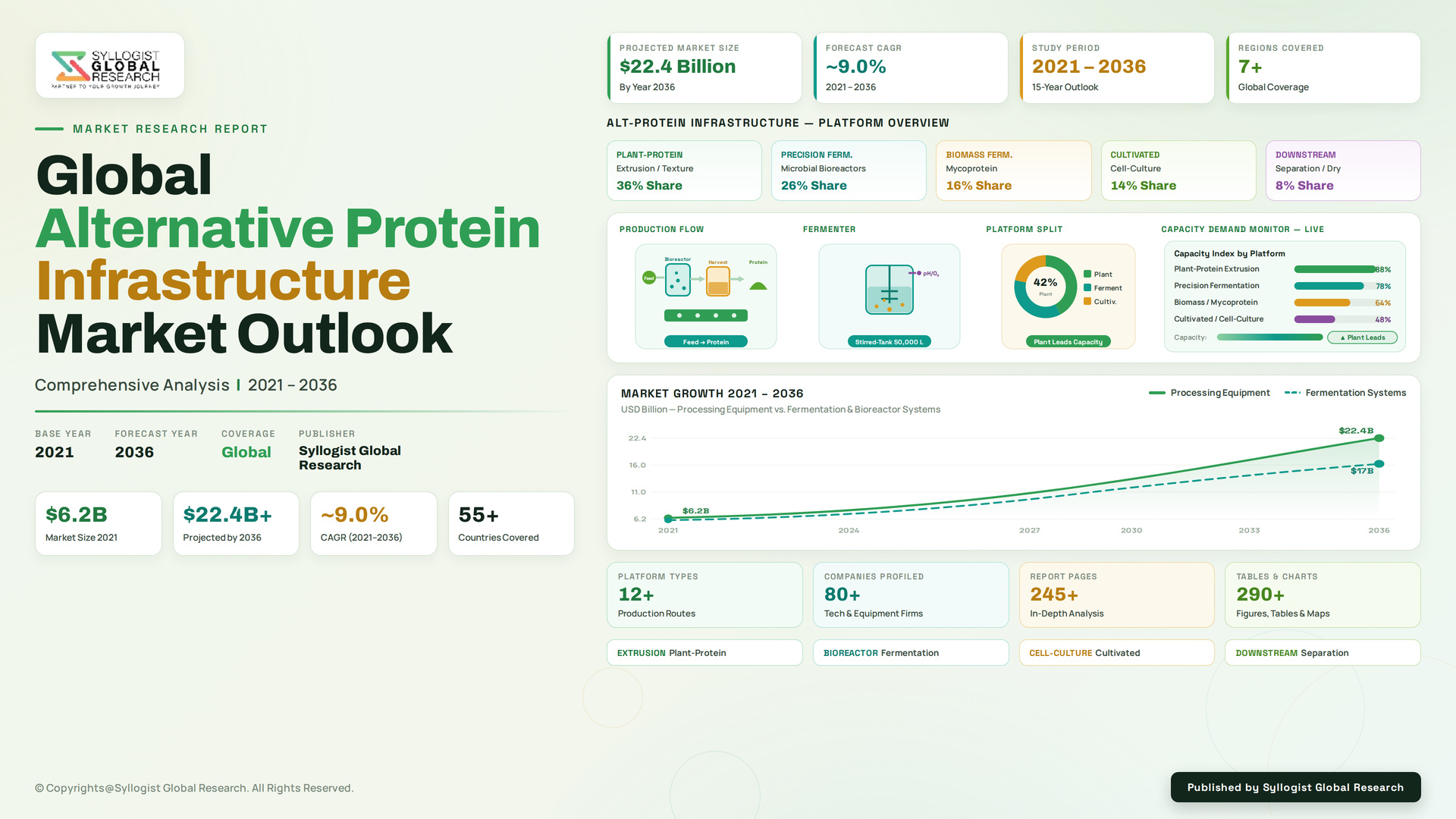
The global alternative protein infrastructure market is entering a structurally expansionary phase driven by accelerating regulatory approvals across cultivated meat and precision-fermented dairy in Singapore, the United States, Israel, the United Kingdom, the Netherlands, and Australia, climate-driven food system decarbonization commitments, EU Green Deal Farm to Fork frameworks, the structural progression of alternative protein cost parity, and the institutional commitment of major food, retail, and foodservice operators to alternative protein product roadmaps. The market was valued at USD 5.84 billion in 2025 and is projected to reach USD 18.92 billion by 2034, advancing at a compound annual growth rate of 13.9% through the forecast period, supported by greenfield bioreactor capacity additions, extrusion line procurement, downstream processing investment, and emerging cultivated meat and precision fermentation facility build-outs across major demand geographies.
Plant-based protein extrusion and processing equipment remains the dominant infrastructure category accounting for nearly 58% of global revenue in 2025, anchored by Buhler Group, Clextral, Coperion, ANDRITZ Gouda, and GEA Group high-moisture extrusion systems supplying Beyond Meat, Impossible Foods, Oatly, MorningStar Farms, Quorn, Nestle Garden Gourmet, Unilever Vegetarian Butcher, and dense private-label retailer programs. Global high-moisture extrusion capacity exceeded 580,000 tonnes in 2025, with capacity additions targeting 1.2 million tonnes by 2030 supporting plant-based meat, dairy alternatives, and emerging hybrid product categories. Twin-screw extruders, wet texturizers, and high-moisture extrusion line capital costs typically range from USD 1.8 million to USD 14 million per line, with major capacity additions across Europe, North America, and Asia-Pacific anchoring durable equipment demand growth.
Precision fermentation and cultivated meat infrastructure has emerged as the highest growth segment, advancing at over 24.8% CAGR through 2034, supported by bioreactor capacity additions at Perfect Day, Motif FoodWorks, The EVERY Company, Onego Bio, Solar Foods, Believer Meats, UPSIDE Foods, GOOD Meat, Mosa Meat, Aleph Farms, BlueNalu, and Wildtype. Global precision fermentation bioreactor capacity exceeded 240,000 liters in 2025 and is projected to scale beyond 2.4 million liters by 2030, with leading operators progressing from 5,000 liter pilot scale through 50,000 to 250,000 liter commercial bioreactor procurement. Bioreactor capital costs typically range from USD 18 million to USD 145 million per facility, with Sartorius, Cytiva, Thermo Fisher, ABEC, Solaris Biotech, and Eppendorf positioned as the dominant equipment suppliers. Cultivated meat facility build-outs at GOOD Meat Singapore, UPSIDE Foods Emeryville, Believer Meats Wilson North Carolina, and Mosa Meat Maastricht are establishing the commercial template for first-generation industrial-scale cultivated meat production.
North America dominates the global alternative protein infrastructure market with approximately 38% revenue share in 2025, anchored by US FDA and USDA cultivated meat approvals for UPSIDE Foods and GOOD Meat in 2023, dense plant-based and precision fermentation startup ecosystems, alongside major corporate investments at Tyson Foods, ADM, Cargill, JBS, Bunge, and Mars. Europe represents the second largest regional market with nearly 32% share, anchored by EU Green Deal frameworks, EFSA Novel Food approvals, aggressive Dutch, German, French, Danish, and Israeli innovation ecosystems, and major Unilever, Nestle, Danone, Arla, and FrieslandCampina alternative protein investments. Asia-Pacific is the fastest growing regional market advancing at over 17.4% CAGR through 2034, supported by Singapore SFA cultivated meat regulatory leadership, Japanese precision fermentation programs at Daiz and DAIZ, Chinese alternative protein scaling at Joyvio Food, NotCo China, and emerging Korean, Australian, and Indian alternative protein ecosystem development.
Key Drivers
Regulatory Approvals for Cultivated Meat and Precision Fermentation Across Singapore, US, Israel, UK, and Netherlands Anchoring Commercial Scale-Up
Cultivated meat regulatory approvals at Singapore SFA in 2020, US FDA and USDA approvals for UPSIDE Foods and GOOD Meat in 2023, Israeli Ministry of Health approval for Aleph Farms in 2024, alongside emerging UK FSA, Dutch, Australian, and Korean pathways are anchoring durable commercial scale-up of cultivated meat production infrastructure. Precision fermentation approvals for Perfect Day, The EVERY Company, Motif FoodWorks, and Onego Bio across the US, EU, and Asia-Pacific are unlocking bioreactor procurement at Sartorius, Cytiva, Thermo Fisher, ABEC, Solaris Biotech, and Eppendorf through 2034.
Climate Commitments, EU Green Deal Frameworks, and Food System Decarbonization Driving Strategic Corporate Investment
Climate-driven food system decarbonization commitments, the EU Green Deal Farm to Fork strategy, COP28 declaration on sustainable agriculture endorsed by over 150 countries, and major retailer and foodservice commitments at Unilever, Nestle, Danone, McDonald’s, Tesco, Sainsbury’s, Walmart, and Carrefour to scale alternative protein portfolios are anchoring infrastructure procurement growth. Tyson Foods, ADM, Cargill, JBS, Bunge, Mars, and strategic investors have collectively committed over USD 24 billion through 2030, supporting greenfield facility build-out across plant-based, precision fermentation, and cultivated meat categories.
Cost Parity Progression and Bioreactor Scale-Up Economics Reinforcing Industrial-Scale Production Investment
Plant-based protein cost parity with conventional meat has compressed from a 4-times premium in 2018 to approximately 1.4 times by 2025, while precision fermented dairy proteins and cultivated meat are progressing toward cost parity through bioreactor scale-up, cell culture media cost optimization, and downstream processing efficiency gains. Industrial bioreactor scale-up from 5,000 liter pilot through 50,000 to 250,000 liter commercial scale is unlocking cost reductions of 38% to 72% per kilogram of protein produced, reinforcing capital allocation toward integrated facility build-out through 2034.
Key Challenges
Plant-Based Category Sales Decline, Consumer Adoption Plateau, and Capital Markets Pullback Constraining Investment
US retail plant-based meat category sales declined approximately 12% in 2023 and a further 9% in 2024 amid consumer adoption plateau, pricing premium concerns, ingredient transparency scrutiny, and rising skepticism around ultra-processed alternative protein products. Capital markets pullback affecting Beyond Meat, Oatly, and broader alternative protein valuations, alongside reduced venture capital deployment that fell approximately 42% in 2023 and 28% in 2024, is constraining infrastructure investment at smaller operators, while major incumbents are scaling back select initiatives, complicating equipment supplier revenues through 2034.
Cultivated Meat Scale-Up Cost Structures, Cell Culture Media Pricing, and Bioreactor CapEx Constraints Limiting Commercialization Pace
Cultivated meat scale-up economics remain materially challenging, with cell culture media costs ranging from 26 USD to 380 USD per liter at pilot scale, bioreactor capital costs of USD 18 million to USD 145 million per facility, and energy intensity that complicates unit economics at current commercial scale. Cell line development, media formulation, contamination control, and bioprocess engineering complexity are extending commercialization timelines, while cost parity remains structurally distant for most cell types, constraining capital deployment and equipment procurement through 2034.
Regulatory Restrictions, State-Level Bans, and Public Skepticism Reshaping Cultivated Meat Market Access Across Major Geographies
State-level cultivated meat bans in Florida and Alabama effective 2024 and 2025, alongside legislative proposals across multiple US states, Italian national restrictions, and regulatory caution in France, Romania, and Hungary, are introducing market access risk for cultivated meat operators and infrastructure suppliers. Public skepticism, conventional meat industry lobbying, labeling debates around terms such as meat, dairy, and milk, and politicization of alternative protein under broader food sovereignty and farmer welfare narratives are reshaping commercial scale-up timelines and complicating capital allocation across infrastructure investment decisions through 2034.
Market Segmentation
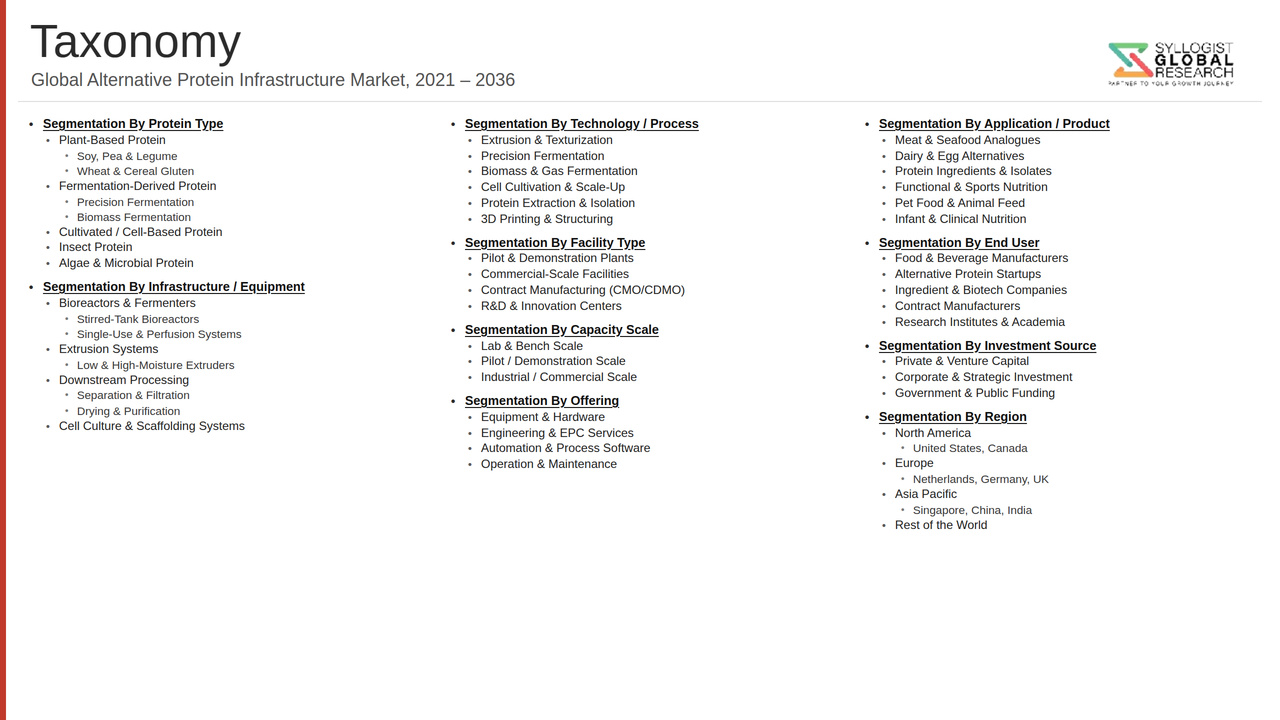
- Segmentation By Protein Type
- Plant-Based Protein
- Precision Fermentation
- Cultivated (Cell-Based) Meat and Seafood
- Insect-Based Protein
- Mycelial and Fungal Protein
- Algal Protein
- Gas-Fermented Protein (Microbial)
- Others
- Segmentation By Infrastructure Component
- Bioreactors and Fermentation Vessels
- High-Moisture Extrusion Lines
- Twin-Screw Extruders and Texturizers
- Cell-Culture Media Manufacturing Equipment
- Scaffolding and Tissue Engineering Systems
- Downstream Processing (Centrifuges, Filtration, Chromatography)
- Spray and Freeze Dryers
- Cleanrooms and Utilities
- Clean-in-Place and Sterilization Systems
- Automation, PAT, and Digital Twin Platforms
- Others
- Segmentation By Production Process
- Stainless Steel Stirred-Tank Fermentation
- Single-Use Bioreactor Fermentation
- Perfusion Bioreactor Cultivation
- Airlift Fermentation
- Gas Fermentation
- Solid-State Fermentation (Mycelium)
- High-Moisture Extrusion (HME)
- Dry and Wet Texturization
- Others
- Segmentation By Application
- Alternative Meat Products
- Dairy Alternatives
- Egg Alternatives
- Seafood Alternatives
- Functional Proteins and Specialty Ingredients
- Animal Feed and Pet Food
- Nutraceuticals and Sports Nutrition
- Others
- Segmentation By End User
- Alternative Protein Producers
- Traditional Food and Beverage Manufacturers
- Retailers and Private Label Brands
- Foodservice Operators
- Animal Feed and Pet Food Companies
- Pharmaceuticals and Nutraceuticals
- Contract Manufacturing Organizations (CMOs)
- Others
- Segmentation By Region
- North America
- Europe
- Asia-Pacific (Singapore, Japan, China, South Korea, Australia, India, Southeast Asia)
- Middle East and Africa (including Israel)
- Latin America
All market revenues are presented in USD
Historical Year: 2021-2024 | Base Year: 2025 | Estimated Year: 2026 | Forecast Period: 2027-2034
Key Questions this Study Will Answer
- What is the total market valuation of the Global Alternative Protein Infrastructure Market in 2025, projected through 2034, disaggregated by protein type, infrastructure component, production process, application, and end user, enabling equipment suppliers, alternative protein producers, food and beverage incumbents, and investors to identify the highest-growth opportunities and most durable revenue corridors across the alternative protein infrastructure value chain?
- How are cultivated meat regulatory approvals at Singapore SFA, US FDA and USDA approvals for UPSIDE Foods and GOOD Meat in 2023, Israeli approval for Aleph Farms in 2024, alongside emerging UK FSA, Dutch, Australian, and Korean approval pathways anchoring durable commercial scale-up of cultivated meat production infrastructure through 2034?
- Which infrastructure component categories including bioreactors, fermentation vessels, high-moisture extrusion lines, twin-screw extruders, cell-culture media manufacturing, scaffolding systems, downstream processing, dryers, cleanrooms, and automation platforms are generating the highest growth rates, and how is the supply landscape evolving across Sartorius, Thermo Fisher Scientific, Cytiva, Eppendorf, Solaris Biotech, ABEC, Bbraun, GEA Group, Buhler Group, Coperion, Clextral, ANDRITZ Gouda, Tetra Pak, Alfa Laval, Pall Corporation, and Merck Millipore?
- How is precision fermentation bioreactor capacity scaling from 240,000 liters in 2025 toward 2.4 million liters by 2030 across Perfect Day, Motif FoodWorks, The EVERY Company, Onego Bio, Solar Foods, Believer Meats, UPSIDE Foods, GOOD Meat, Mosa Meat, Aleph Farms, BlueNalu, and Wildtype reshaping equipment procurement and competitive positioning?
- How are climate-driven food system decarbonization commitments, EU Green Deal Farm to Fork strategy, COP28 sustainable agriculture declaration, and over USD 24 billion of strategic capital deployment at Tyson Foods, ADM, Cargill, JBS, Bunge, Mars, Unilever, Nestle, Danone, and incumbents reshaping alternative protein infrastructure investment priorities through 2034?
- How is US retail plant-based meat category sales decline of 12% in 2023 and 9% in 2024, capital markets pullback with venture capital deployment falling 42% in 2023 and 28% in 2024, and consumer adoption plateau reshaping infrastructure investment capacity at smaller alternative protein operators and incumbents through 2034?
- How are cultivated meat state-level bans in Florida and Alabama effective 2024 and 2025, Italian national restrictions, regulatory caution in France, Romania, and Hungary, conventional meat industry lobbying, and labeling debates reshaping cultivated meat market access and infrastructure investment economics across major geographies through 2034?
- Product Definition
- Research Methodology
- Research Design & Framework
- Overall Research Approach: Descriptive, Exploratory & Quantitative Mixed-Method Design
- Market Definition & Scope Boundaries: What is Included and Excluded
- Segmentation Framework
- Key Research Assumptions & Limitations
- Secondary Research
- Primary Research Design & Execution
- Data Triangulation & Validation
- Market Sizing & Forecasting Methodology
- Competitive Intelligence Methodology
- Quality Assurance & Peer Review
- Definitions, Abbreviations & Data Notes
- Research Design & Framework
- Executive Summary
- Market Snapshot & Headline Numbers
- Key Findings & Research Highlights
- Market Dynamics
- Regional Market Summary
- Competitive Landscape Snapshot
- Technology & Innovation Highlights
- Market Dynamics
- Drivers
- Restraints
- Opportunities
- Challenges
- Porter’s Five Forces Analysis
- PESTLE Analysis
- Market Trends & Developments
- Emerging Trends
- Technological Developments
- Regulatory & Policy Changes
- Supply Chain & Sourcing Trends
- Manufacturing & Process Trends
- Investment & Funding Activity
- Sustainability & ESG Trends
- Risk Assessment Framework
- Capital Intensity, Scale-Up & Capacity Utilisation Risk
- Feedstock Availability, Input Cost & Price Volatility Risk
- Regulatory Approval, Novel Food & Labelling Risk
- Consumer Acceptance, Demand Volatility & Price Parity Risk
- Technology Maturity, Yield & Process Reliability Risk
- Regulatory Framework & Standards
- Novel Food, Cultivated Meat & Precision Fermentation Approval Frameworks
- Food Safety, Labelling & Nomenclature Standards
- Bioprocess, GMP & Production Facility Compliance Standards
- Feedstock, Genetically Engineered Input & Biosafety Regulations
- Green Finance, Carbon Accounting, ESG Disclosure & Sustainable Procurement Standards
- Global Alternative Protein Infrastructure Market Outlook
- Market Size & Forecast by Value
- Market Size & Forecast by Volume (Installed Bioreactor Capacity, Kilo Litres)
- Market Size & Forecast by Infrastructure Type
- Bioreactors & Fermentation Vessels
- Cell Culture & Cultivation Systems
- Downstream Processing & Separation Equipment
- Extrusion & Texturisation Equipment
- Feedstock Preparation & Media Production Systems
- Cold Chain, Storage & Handling Infrastructure
- Process Control, Automation & Monitoring Systems
- Cleanroom, Utility & Facility Infrastructure
- Other Equipment & Integration Services
- Market Size & Forecast by Technology
- Precision Fermentation Technology
- Biomass Fermentation Technology
- Cultivated (Cell-Based) Meat Technology
- Plant Protein Extraction & Isolation Technology
- High-Moisture Extrusion & Texturisation Technology
- Cell Line Development & Media Optimisation Technology
- Bioprocess Automation, Digital Twin & AI Technology
- Downstream Purification & Formulation Technology
- Other Emerging & Hybrid Production Technologies
- Market Size & Forecast by Protein Source
- Plant-Based Protein
- Microbial & Fermentation-Derived Protein
- Cultivated (Cell-Based) Protein
- Insect-Based Protein
- Algae & Other Novel Protein Sources
- Market Size & Forecast by Facility Scale
- Large-Scale Commercial Production Facilities (Above 50,000 Litres Bioreactor Capacity)
- Medium-Scale & Demonstration Facilities (5,000 to 50,000 Litres Bioreactor Capacity)
- Pilot-Scale & Laboratory Facilities (Below 5,000 Litres Bioreactor Capacity)
- Market Size & Forecast by Application
- Meat & Seafood Alternatives
- Dairy & Egg Alternatives
- Functional Ingredients & Protein Isolates
- Pet Food & Animal Feed
- Nutraceuticals & Supplements
- Other Food & Industrial Applications
- Market Size & Forecast by End-User
- Alternative Protein Producers & Food Manufacturers
- Ingredient & Biotechnology Companies
- Contract Manufacturers & CDMOs
- Foodservice, Retail & Brand Owners
- Research Institutes & Other End-Users
- Market Size & Forecast by Sales Channel
- Direct Sales & OEM Supply
- EPC, System Integrator & Engineering Contractor Channel
- Distributors & Authorised Resellers
- Contract Manufacturing & Capacity-as-a-Service Channel
- North America Alternative Protein Infrastructure Market Outlook
- Market Size & Forecast
- By Value
- By Volume (Installed Bioreactor Capacity, Kilo Litres)
- By Infrastructure Type
- By Technology
- By Protein Source
- By Facility Scale
- By Application
- By End-User
- By Country
- By Sales Channel
- Europe Alternative Protein Infrastructure Market Outlook
- Market Size & Forecast
- By Value
- By Volume (Installed Bioreactor Capacity, Kilo Litres)
- By Infrastructure Type
- By Technology
- By Protein Source
- By Facility Scale
- By Application
- By End-User
- By Country
- By Sales Channel
- Asia-Pacific Alternative Protein Infrastructure Market Outlook
- Market Size & Forecast
- By Value
- By Volume (Installed Bioreactor Capacity, Kilo Litres)
- By Infrastructure Type
- By Technology
- By Protein Source
- By Facility Scale
- By Application
- By End-User
- By Country
- By Sales Channel
- Latin America Alternative Protein Infrastructure Market Outlook
- Market Size & Forecast
- By Value
- By Volume (Installed Bioreactor Capacity, Kilo Litres)
- By Infrastructure Type
- By Technology
- By Protein Source
- By Facility Scale
- By Application
- By End-User
- By Country
- By Sales Channel
- Middle East & Africa Alternative Protein Infrastructure Market Outlook
- Market Size & Forecast
- By Value
- By Volume (Installed Bioreactor Capacity, Kilo Litres)
- By Infrastructure Type
- By Technology
- By Protein Source
- By Facility Scale
- By Application
- By End-User
- By Country
- By Sales Channel
- Country-Wise* Alternative Protein Infrastructure Market Outlook
- Market Size & Forecast
- By Value
- By Volume (Installed Bioreactor Capacity, Kilo Litres)
- By Infrastructure Type
- By Technology
- By Protein Source
- By Facility Scale
- By Application
- By End-User
- By Country
- By Sales Channel
- *Countries Analyzed in the Syllogist Global Research Portfolio: United States, Canada, Mexico, Germany, France, United Kingdom, Netherlands, Spain, Italy, Norway, Sweden, China, Japan, India, Australia, South Korea, Singapore, Brazil, Chile, Saudi Arabia, UAE, Egypt, South Africa, Israel
- Technology Landscape & Innovation Analysis
- Precision Fermentation Technology Deep-Dive
- Biomass Fermentation & Mycoprotein Technology
- Cultivated (Cell-Based) Meat & Bioreactor Technology
- Plant Protein Extraction, Isolation & Fractionation Technology
- High-Moisture Extrusion & Texturisation Technology
- Cell Line, Media & Bioprocess Optimisation Technology
- Downstream Processing, Automation & Digital Twin Technology
- Patent & IP Landscape in Alternative Protein Infrastructure Technologies
- Value Chain & Supply Chain Analysis
- Feedstock, Media & Growth-Factor Input Supply Chain
- Bioreactor, Fermenter & Cultivation Equipment Supply Chain
- Downstream Processing, Separation & Extrusion Equipment Supply Chain
- Automation, Control & Cleanroom Infrastructure Supply Chain
- EPC Contractor, Engineering Firm & Facility Developer Procurement Landscape
- Producer, CDMO & Food Manufacturer Channel
- Co-Product, By-Stream Valorisation & Circular Economy
- Pricing Analysis
- Precision Fermentation Facility Capital and Operating Cost Analysis
- Cultivated Meat Bioreactor & Facility Cost Analysis
- Plant Protein Extraction & Extrusion Line Cost Analysis
- Feedstock, Media & Growth-Factor Cost Structure Analysis
- Contract Manufacturing & Capacity-as-a-Service Pricing Analysis
- Total Alternative Protein Economics: Cost-per-Kilogram and Price-Parity Optimisation Analysis
- Sustainability & Environmental Analysis
- Lifecycle Assessment (LCA) of Alternative Protein Production: Carbon Footprint, Land, Water & Energy Use vs. Conventional Protein
- Carbon Neutrality & Net Zero Contribution: Pathway to Low-Carbon and Renewable-Powered Protein Production
- Circular Economy & Resource Efficiency: Feedstock, Water and By-Stream Valorisation Contribution
- Environmental Compliance, Land-Use, Biodiversity & Water Impact Consideration in Production
- Regulatory-Driven Sustainability, SDG 2 (Zero Hunger) & SDG 13 (Climate Action) Alignment & Green Finance Eligibility
- Competitive Landscape
- Market Structure & Concentration
- Market Consolidation Level (Fragmented vs. Consolidated by Technology & Geography)
- Top 10 Players Market Share
- HHI (Herfindahl-Hirschman Index) Concentration Analysis
- Competitive Intensity Map by Infrastructure Type, Technology & Geography
- Player Classification
- Integrated Alternative Protein Infrastructure Companies
- Bioreactor & Fermentation Equipment Manufacturers
- Cultivated Meat Technology & Equipment Providers
- Plant Protein Processing & Extrusion Equipment Providers
- Precision Fermentation Technology Companies
- Contract Manufacturers, CDMOs & Capacity Providers
- Automation, Control & Bioprocess Software Providers
- Emerging & Niche Infrastructure Entrants
- Competitive Analysis Frameworks
- Market Share Analysis by Infrastructure Type, Technology & Region
- Company Profile
- Company Overview & Headquarters
- Alternative Protein Infrastructure Products & Technology Portfolio
- Key Customer Relationships & Reference Project Installations
- Manufacturing Footprint & Production Capacity
- Revenue (Alternative Protein Infrastructure Segment) & Backlog
- Technology Differentiators & IP
- Key Strategic Partnerships, JVs & M&A Activity
- Recent Developments (Capacity Expansion, Facility Launches, Funding Rounds)
- SWOT Analysis
- Strategic Focus Areas & Roadmap
- Competitive Positioning Map (Technology Capability vs. Market Penetration)
- Key Company Profiles
- Market Structure & Concentration
- Technology Landscape & Innovation Analysis
- Strategic Output
- Market Opportunity Matrix: By Infrastructure Type, Technology, Application, End-User & Geography
- White Space Opportunity Analysis
- Strategic Recommendations
- Product Portfolio & Technology Investment Strategy
- Manufacturing & Operational Excellence Strategy
- Geographic Expansion & Localisation Strategy
- Customer & End-User Engagement Strategy
- Partnership, M&A & Ecosystem Strategy
- Sustainability & Circular Economy Strategy
- Risk Mitigation & Future Roadmap
- Strategic Priority Matrix & Roadmap
- Near-term (2025-2028)
- Mid-term (2029-2032)
- Long-term (2033-2037)
- Strategic Output
- Market Size & Forecast
- Market Size & Forecast
- Market Size & Forecast
- Market Size & Forecast
- Market Size & Forecast
- Market Size & Forecast