Global Reverse Logistics Platforms Market By Platform Type, By Component, By Deployment, By Application, By End User, By Region, Competition, Forecast & Opportunities, 2021-2036F
Market Definition
The Global Reverse Logistics Platforms Market covers the design, development, supply, integration, software-as-a-service delivery, and managed service operation of digital platforms used to orchestrate the return, refurbishment, repair, resale, recycling, and final disposition of consumer and industrial goods across global commerce. The market encompasses returns management software, in-store return-to-vendor and ship-from-store platforms, returnless refund optimization engines, AI-enabled fraud detection, dynamic disposition routing, recommerce and resale platforms, certified pre-owned and refurbishment workflow tools, drop-off network management, return label generation, parcel routing optimization, warranty management, repair-as-a-service orchestration, recycling traceability platforms, and emerging extended producer responsibility (EPR) compliance solutions. Reverse logistics platforms are deployed by e-commerce retailers, omnichannel retailers, brand manufacturers, 3PL operators, electronics OEMs, automotive parts manufacturers, apparel and footwear brands, pharmaceutical operators, and emerging recommerce marketplaces, with workflows integrating with WMS, ERP, transportation management, payment processing, customer service, and downstream recycling and refurbishment partners. The supplier landscape spans specialized returns software vendors including Loop Returns, Returnly (Affirm), Happy Returns (PayPal/UPS), Narvar, ReverseLogix, Optoro, B-Stock Solutions, Returns Logic, AfterShip, Shippo, ShipBob, ParcelLab, Trove, Recurate, Yerdle, alongside platform-led marketplaces ThredUp, Poshmark, Vestiaire Collective, The RealReal, Back Market, Reebelo, Swappa, Refurbed, and integrated 3PL providers GXO Logistics, DHL Supply Chain, XPO Logistics, FedEx Supply Chain, UPS, and ID Logistics. Market dynamics are governed by accelerating e-commerce returns volumes, rising sustainability mandates, EU Right to Repair Directive, EPR frameworks, recommerce growth, AI-enabled fraud detection adoption, and the structural emergence of circular economy business models reshaping retail and brand economics.
Market Insights
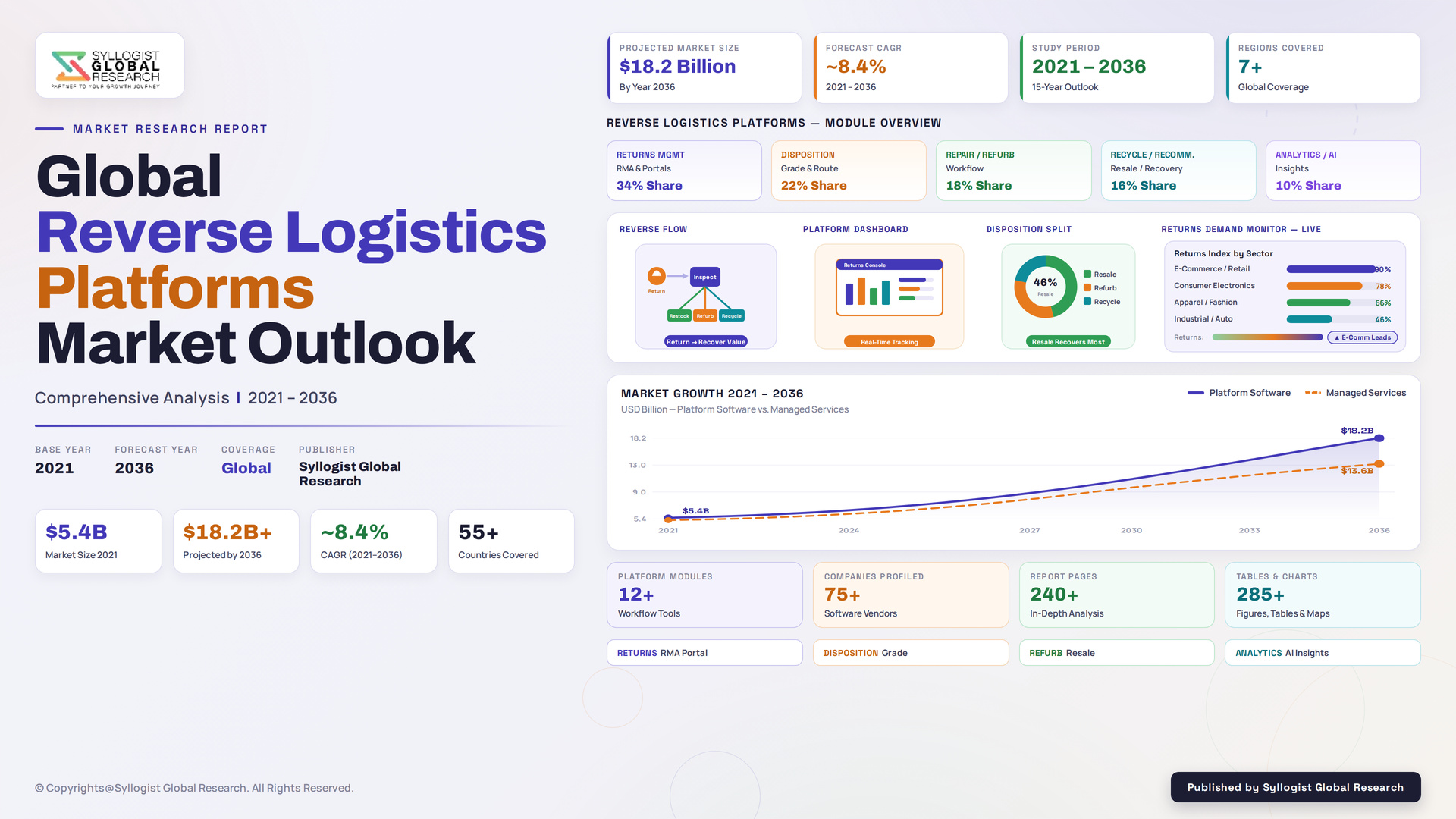
The global reverse logistics platforms market is entering a sustained high-growth phase driven by accelerating e-commerce returns volumes, structural sustainability mandates, the proliferation of recommerce and certified pre-owned business models, EU Right to Repair Directive and EPR framework implementation, AI-enabled fraud detection and returnless refund optimization, and the structural emergence of circular economy strategies as central pillars of retail and brand economics. The market was valued at USD 6.42 billion in 2025 and is projected to reach USD 17.84 billion by 2034, advancing at a compound annual growth rate of 12.0% through the forecast period, supported by greenfield platform procurement at e-commerce and omnichannel retailers, recommerce marketplace scaling, and emerging EPR compliance investment across consumer electronics, fashion, and packaging value chains.
E-commerce returns volumes have emerged as the dominant economic driver shaping platform procurement, with global return rates averaging 17% for online apparel, 12% for electronics, and 8% for general merchandise, compared with approximately 3% for in-store retail. Total returns volumes processed by US retailers exceeded USD 743 billion in 2024, with global returns volumes approaching USD 1.4 trillion annually and creating substantial reverse logistics infrastructure procurement demand at Amazon, Walmart, Target, Costco, Best Buy, Home Depot, Lowe’s, Macy’s, Nordstrom, H&M, Zara, Shein, Temu, Alibaba, JD.com, Mercado Libre, and dense supplier ecosystems. Loop Returns, Happy Returns under PayPal-UPS, Narvar, ReverseLogix, AfterShip, and Optoro collectively account for nearly 38% of global returns platform revenue, with emerging AI-native entrants accelerating share capture through dynamic disposition routing, fraud detection, and returnless refund optimization.
Recommerce and resale platforms have emerged as the fastest growing application segment, advancing at over 18.6% CAGR through 2034, supported by ThredUp, Poshmark, Vestiaire Collective, The RealReal, Back Market, Reebelo, Swappa, Refurbed, and brand-direct recommerce programs at Patagonia, Nike, Lululemon, Levi’s, Eileen Fisher, REI, Apple, Samsung, and Dell. Brand-direct recommerce growth is supported by Recurate, Trove, Yerdle, Archive, and Treet platforms enabling fashion, electronics, and outdoor brands to capture secondary market value while supporting sustainability commitments. The global resale apparel market alone is projected to exceed USD 76 billion by 2030, with certified pre-owned electronics, refurbished smartphones, and refurbished laptops contributing substantial incremental reverse logistics platform demand across major brand portfolios and dedicated recommerce operators.
North America dominates the global reverse logistics platforms market with approximately 42% revenue share in 2025, anchored by mature US e-commerce returns infrastructure, dense 3PL ecosystems at GXO Logistics, DHL Supply Chain, XPO Logistics, FedEx Supply Chain, UPS, and ID Logistics, and accelerating recommerce adoption at Amazon, Walmart, Target, Best Buy, REI, and dedicated marketplaces. Europe represents the second largest regional market with nearly 32% share, driven by EU Right to Repair Directive, Digital Product Passport regulations, EPR frameworks, and aggressive recommerce growth at Back Market, Refurbed, Vinted, and Zalando Pre-Owned. Asia-Pacific is the fastest growing regional market advancing at over 14.6% CAGR through 2034, supported by Chinese e-commerce returns scaling at Alibaba, JD.com, Pinduoduo, Douyin, Shein, Temu, alongside Japanese, South Korean, Australian, Indian, and Southeast Asian recommerce adoption and increasing EPR regulation across major Asian economies through 2034.
Key Drivers
E-Commerce Returns Volume Growth, Returnless Refund Optimization, and AI-Enabled Fraud Detection Driving Platform Procurement
Global e-commerce returns volumes approaching USD 1.4 trillion annually, with US retailers alone processing over USD 743 billion of returns in 2024 at average return rates of 17% for online apparel, 12% for electronics, and 8% for general merchandise, are anchoring durable reverse logistics platform procurement growth. AI-enabled returnless refund optimization, dynamic disposition routing, and fraud detection capabilities at Loop Returns, Happy Returns, Narvar, ReverseLogix, AfterShip, and Optoro are delivering operational savings of 12% to 28% across reverse logistics cost structures, reinforcing capital allocation toward integrated platform deployment through 2034.
Recommerce, Resale, and Certified Pre-Owned Adoption Across Fashion, Electronics, and Consumer Brands Driving Platform Expansion
Recommerce and resale platforms advancing at over 18.6% CAGR through 2034, supported by ThredUp, Poshmark, Vestiaire Collective, The RealReal, Back Market, Reebelo, Swappa, and Refurbed, alongside brand-direct recommerce at Patagonia, Nike, Lululemon, Levi’s, Eileen Fisher, REI, Apple, Samsung, and Dell, are anchoring durable platform procurement growth. The global resale apparel market is projected to exceed USD 76 billion by 2030, with certified pre-owned electronics, refurbished smartphones, and refurbished laptops contributing substantial incremental demand across Recurate, Trove, Yerdle, Archive, and Treet enabling brand-direct recommerce programs.
EU Right to Repair Directive, EPR Frameworks, and Digital Product Passport Regulations Reshaping Platform Investment Priorities
The EU Right to Repair Directive effective from 2026, Digital Product Passport regulations under the Ecodesign for Sustainable Products Regulation, Extended Producer Responsibility frameworks covering packaging, electronics, batteries, and textiles, alongside parallel programs in the UK, Japan, India, and Australia, are reshaping reverse logistics platform investment priorities. Brand and retailer compliance with traceability, repairability, recyclability, and recovered material reporting obligations is anchoring platform procurement growth across consumer electronics, fashion, automotive, and packaging value chains through 2034.
Key Challenges
Returns Fraud, Wardrobing, and Bracketing Behaviors Eroding Retail Margins and Complicating Platform Economics
Returns fraud including wardrobing, bracketing, empty box returns, and serial returner behaviors has emerged as a material challenge, with US retailers reporting fraud losses exceeding USD 103 billion annually, representing approximately 14% of total returns processed. Reverse logistics platform suppliers are investing heavily in AI-enabled fraud detection, customer behavior scoring, and returnless refund optimization, while tension between customer experience, retailer margin protection, and platform economics is constraining returns policy flexibility and complicating capital allocation across multiple retailer segments through 2034.
Integration Complexity, Legacy WMS and ERP Compatibility, and Total Cost of Ownership Constraints Limiting Adoption Pace
Reverse logistics platform deployment introduces material integration complexity across legacy WMS, ERP, transportation management, payment processing, customer service, and downstream recycling and refurbishment partner systems, with brownfield implementations facing data structure mismatches, change order escalations, and timeline extensions of 18% to 45% above original schedules. Total cost of ownership concerns, SaaS subscription pricing pressure, and limited demonstrable ROI at smaller retailers and mid-sized brands are constraining adoption pace, while skilled solution architect and systems integrator shortages introduce execution risk through 2034.
Cost-of-Returns Pressures, Returns Policy Tightening, and Customer Experience Tradeoffs Reshaping Operator Strategies
Rising cost-of-returns pressures with reverse logistics processing costs averaging USD 21 to USD 38 per return for apparel, electronics, and consumer goods are forcing retailers to tighten returns policies, introduce return fees at Zara, H&M, Uniqlo, JCPenney, Macy’s, and emerging followers, and experiment with returnless refund and keep-it policies. Customer experience tradeoffs, public backlash against tightening policies, social media scrutiny, and the risk that returns friction reduces conversion rates and customer lifetime value are introducing strategic complexity across the global retail sector through 2034.
Market Segmentation
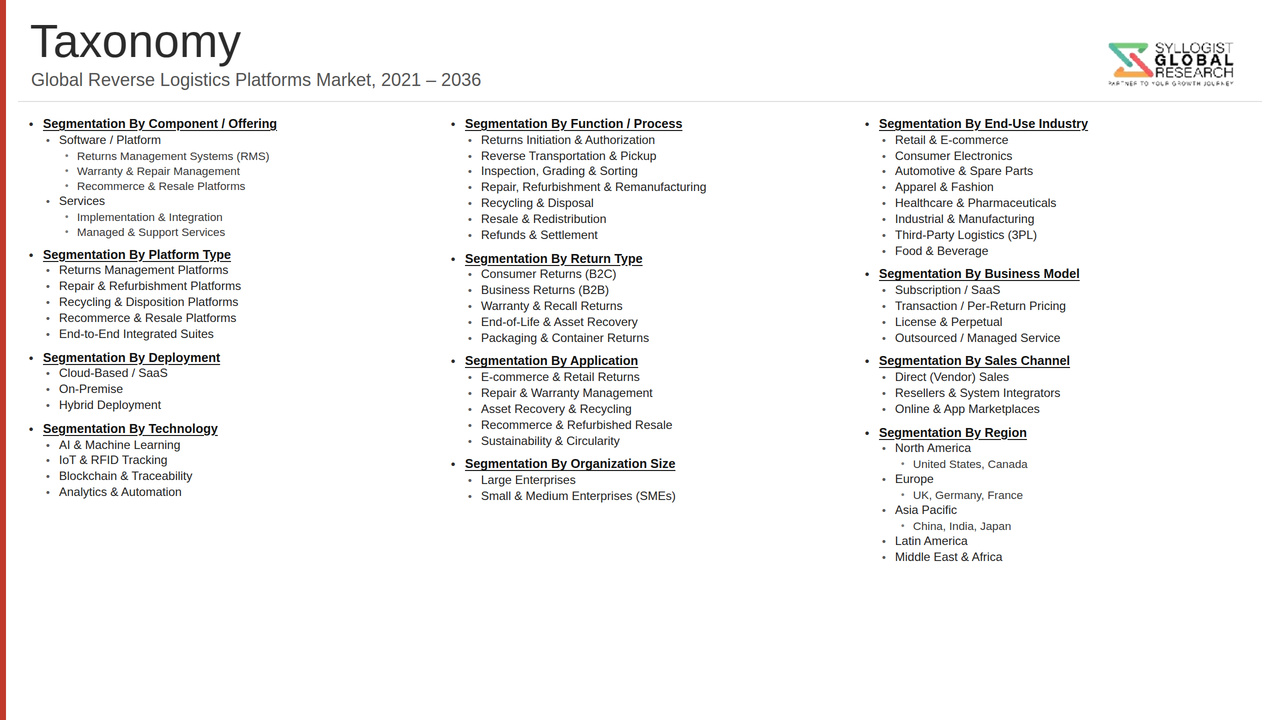
- Segmentation By Platform Type
- Returns Management Software
- Recommerce and Resale Marketplaces
- Brand-Direct Recommerce Platforms
- Refurbishment Workflow Tools
- Warranty and Repair Management
- Recycling Traceability and EPR Compliance Platforms
- Drop-Off Network and Return Label Management
- AI Fraud Detection and Returnless Refund Engines
- Others
- Segmentation By Component
- Software
- Services (Implementation, Consulting, Managed Services)
- Hardware (Returns Kiosks, Drop-Off Lockers, RFID, Mobile Devices)
- Others
- Segmentation By Deployment
- Cloud-Based (SaaS)
- On-Premise
- Hybrid
- Others
- Segmentation By Application
- E-Commerce Returns Management
- Omnichannel and In-Store Returns
- Recommerce and Resale
- Certified Pre-Owned and Refurbishment
- Warranty and Repair Orchestration
- Recycling and EPR Compliance
- Returns Fraud Detection
- Reverse Supply Chain Analytics
- Others
- Segmentation By End User
- E-Commerce and Omnichannel Retailers
- Apparel and Footwear Brands
- Consumer Electronics OEMs
- Automotive Parts and Aftermarket
- Pharmaceuticals and Healthcare
- Home Goods and Furniture
- Third-Party Logistics (3PL) Providers
- Recommerce Marketplaces
- Others
- Segmentation By Region
- North America
- Europe
- Asia-Pacific (China, India, Japan, South Korea, Australia, Southeast Asia)
- Latin America
- Middle East and Africa
All market revenues are presented in USD
Historical Year: 2021-2024 | Base Year: 2025 | Estimated Year: 2026 | Forecast Period: 2027-2034
Key Questions this Study Will Answer
- What is the total market valuation of the Global Reverse Logistics Platforms Market in 2025, projected through 2034, disaggregated by platform type, component, deployment, application, end user, and region, enabling platform suppliers, retailers, brands, 3PL providers, and investors to identify the highest-growth opportunities and most durable revenue corridors across the reverse logistics value chain?
- How are e-commerce returns volumes approaching USD 1.4 trillion annually with US retailers processing over USD 743 billion of returns in 2024 at 17% apparel, 12% electronics, and 8% general merchandise return rates reshaping platform procurement across Amazon, Walmart, Target, Costco, Best Buy, Home Depot, Lowe’s, Macy’s, Nordstrom, H&M, Zara, Shein, Temu, Alibaba, JD.com, and Mercado Libre through 2034?
- Which reverse logistics platform categories including returns management software, recommerce and resale marketplaces, brand-direct recommerce, refurbishment workflow tools, warranty and repair orchestration, recycling traceability, AI fraud detection, and returnless refund engines are generating the highest growth rates, and how is the supply landscape evolving across Loop Returns, Returnly, Happy Returns, Narvar, ReverseLogix, Optoro, B-Stock Solutions, Returns Logic, AfterShip, Shippo, ShipBob, ParcelLab, Trove, Recurate, and Yerdle?
- How is recommerce and resale platform growth advancing at over 18.6% CAGR through 2034 at ThredUp, Poshmark, Vestiaire Collective, The RealReal, Back Market, Reebelo, Swappa, and Refurbed, alongside brand-direct recommerce at Patagonia, Nike, Lululemon, Levi’s, Eileen Fisher, REI, Apple, Samsung, and Dell, reshaping platform procurement and competitive positioning through 2034?
- How are EU Right to Repair Directive effective from 2026, Digital Product Passport regulations under the Ecodesign for Sustainable Products Regulation, EPR frameworks covering packaging, electronics, batteries, and textiles, and parallel programs in the UK, Japan, India, and Australia reshaping reverse logistics platform investment priorities across consumer electronics, fashion, automotive, and packaging value chains?
- How are returns fraud losses exceeding USD 103 billion annually, wardrobing, bracketing, and serial returner behaviors reshaping platform investment priorities around AI-enabled fraud detection, customer behavior scoring, and returnless refund optimization across the global retail sector?
- How are cost-of-returns pressures with reverse logistics processing costs averaging USD 21 to USD 38 per return for apparel, electronics, and consumer goods reshaping returns policy strategies at Zara, H&M, Uniqlo, JCPenney, Macy’s, and emerging followers, and what platform deployment strategies are leading retailers and brands pursuing to balance customer experience and margin protection through 2034?
- Product Definition
- Research Methodology
- Research Design & Framework
- Overall Research Approach: Descriptive, Exploratory & Quantitative Mixed-Method Design
- Market Definition & Scope Boundaries: What is Included and Excluded
- Segmentation Framework
- Key Research Assumptions & Limitations
- Secondary Research
- Primary Research Design & Execution
- Data Triangulation & Validation
- Market Sizing & Forecasting Methodology
- Competitive Intelligence Methodology
- Quality Assurance & Peer Review
- Definitions, Abbreviations & Data Notes
- Research Design & Framework
- Executive Summary
- Market Snapshot & Headline Numbers
- Key Findings & Research Highlights
- Market Dynamics
- Regional Market Summary
- Competitive Landscape Snapshot
- Technology & Innovation Highlights
- Market Dynamics
- Drivers
- Restraints
- Opportunities
- Challenges
- Porter’s Five Forces Analysis
- PESTLE Analysis
- Market Trends & Developments
- Emerging Trends
- Technological Developments
- Regulatory & Policy Changes
- Supply Chain & Sourcing Trends
- Manufacturing & Process Trends
- Investment & Funding Activity
- Sustainability & ESG Trends
- Risk Assessment Framework
- Platform Adoption, Customer Retention & Subscription Churn Risk
- Data Security, Privacy & Platform Integration Risk
- Technology Obsolescence, Scalability & Vendor Lock-In Risk
- Logistics Network Dependence, Carrier & Third-Party Reliance Risk
- Economic Cyclicality, Return-Volume Volatility & Margin Pressure Risk
- Regulatory Framework & Standards
- Data Privacy, Consumer Protection & Cross-Border Data Standards (GDPR & Equivalent)
- E-Waste, Product Take-Back & Extended Producer Responsibility (EPR) Frameworks
- Returns, Warranty, Refund & Consumer Rights Regulations
- Platform Interoperability, API & Digital Commerce Standards
- Sustainability, Circular Economy & ESG Disclosure Standards
- Global Reverse Logistics Platforms Market Outlook
- Market Size & Forecast by Value
- Market Size & Forecast by Volume (Subscriptions & Transactions Processed)
- Market Size & Forecast by Offering
- Returns Management Software
- Warranty & Repair Management Software
- Asset Recovery & Remarketing Platforms
- Recycling & Disposition Management Software
- Reverse Order & Exchange Management Software
- Analytics, Reporting & Optimisation Modules
- Integration, API & Connectivity Services
- Managed & Professional Services
- Other Platform Components & Add-Ons
- Market Size & Forecast by Technology
- Cloud & SaaS Platform Technology
- Artificial Intelligence & Machine Learning Technology
- Predictive Analytics & Data Intelligence Technology
- Automation & Robotic Process Automation (RPA) Technology
- Internet of Things (IoT) & Asset Tracking Technology
- Blockchain & Traceability Technology
- API, Integration & Middleware Technology
- Mobile & Self-Service Portal Technology
- Other Emerging & Hybrid Platform Technologies
- Market Size & Forecast by Deployment Mode
- Cloud-Based Deployment
- On-Premise Deployment
- Hybrid Deployment
- Platform-as-a-Service (PaaS) Deployment
- Managed-Service Deployment
- Market Size & Forecast by Organisation Size
- Large Enterprises (Above 1,000 Employees)
- Mid-Sized Enterprises (100 to 1,000 Employees)
- Small Businesses & SMEs (Below 100 Employees)
- Market Size & Forecast by Application
- Product Returns & Exchange Management
- Warranty, Repair & Refurbishment Management
- Asset Recovery & Remarketing
- Recycling, Disposition & End-of-Life Management
- Recall & Reverse Order Management
- Other Reverse Logistics Applications
- Market Size & Forecast by End-Use Industry
- Retail & E-Commerce
- Consumer Electronics & High-Tech
- Automotive & Industrial Manufacturing
- Healthcare, Pharmaceutical & Medical Devices
- Third-Party Logistics (3PL) & Other End-Users
- Market Size & Forecast by Sales Channel
- Direct Sales & Subscription Licensing
- Channel Partners, Resellers & System Integrators
- Marketplace & App-Store Distribution
- Managed-Service & Outsourcing Channel
- North America Reverse Logistics Platforms Market Outlook
- Market Size & Forecast
- By Value
- By Volume (Subscriptions & Transactions Processed)
- By Offering
- By Technology
- By Deployment Mode
- By Organisation Size
- By Application
- By End-Use Industry
- By Country
- By Sales Channel
- Europe Reverse Logistics Platforms Market Outlook
- Market Size & Forecast
- By Value
- By Volume (Subscriptions & Transactions Processed)
- By Offering
- By Technology
- By Deployment Mode
- By Organisation Size
- By Application
- By End-Use Industry
- By Country
- By Sales Channel
- Asia-Pacific Reverse Logistics Platforms Market Outlook
- Market Size & Forecast
- By Value
- By Volume (Subscriptions & Transactions Processed)
- By Offering
- By Technology
- By Deployment Mode
- By Organisation Size
- By Application
- By End-Use Industry
- By Country
- By Sales Channel
- Latin America Reverse Logistics Platforms Market Outlook
- Market Size & Forecast
- By Value
- By Volume (Subscriptions & Transactions Processed)
- By Offering
- By Technology
- By Deployment Mode
- By Organisation Size
- By Application
- By End-Use Industry
- By Country
- By Sales Channel
- Middle East & Africa Reverse Logistics Platforms Market Outlook
- Market Size & Forecast
- By Value
- By Volume (Subscriptions & Transactions Processed)
- By Offering
- By Technology
- By Deployment Mode
- By Organisation Size
- By Application
- By End-Use Industry
- By Country
- By Sales Channel
- Country-Wise* Reverse Logistics Platforms Market Outlook
- Market Size & Forecast
- By Value
- By Volume (Subscriptions & Transactions Processed)
- By Offering
- By Technology
- By Deployment Mode
- By Organisation Size
- By Application
- By End-Use Industry
- By Country
- By Sales Channel
- *Countries Analyzed in the Syllogist Global Research Portfolio: United States, Canada, Mexico, Germany, France, United Kingdom, Netherlands, Spain, Italy, Norway, Sweden, China, Japan, India, Australia, South Korea, Singapore, Brazil, Chile, Saudi Arabia, UAE, Egypt, South Africa, Israel
- Technology Landscape & Innovation Analysis
- Cloud & SaaS Reverse Logistics Platform Architecture Deep-Dive
- Artificial Intelligence & Machine Learning for Returns Optimisation
- Predictive Analytics, Data Intelligence & Disposition Technology
- Automation, RPA & Warehouse Integration Technology
- IoT, Asset Tracking & Condition Monitoring Technology
- Blockchain, Traceability & Provenance Technology
- API, Integration, Middleware & Interoperability Technology
- Patent & IP Landscape in Reverse Logistics Platform Technologies
- Value Chain & Supply Chain Analysis
- Platform Development, Software & Cloud Infrastructure Landscape
- Data, Analytics & AI Capability Supply Chain
- Integration, API & Middleware Partner Landscape
- Carrier, 3PL & Logistics Network Partner Landscape
- Retailer, Brand & Enterprise Customer Procurement Landscape
- Refurbisher, Recycler & Remarketing Partner Channel
- Implementation, Support, Managed Service & Circular Economy
- Pricing Analysis
- Subscription & SaaS Licensing Pricing Analysis
- Transaction & Usage-Based Pricing Analysis
- Tiered & Module-Based Pricing Analysis
- Managed-Service & Outsourcing Contract Pricing Analysis
- Implementation, Integration & Professional Service Cost Analysis
- Total Platform Economics: Cost-per-Return-Processed and ROI / Recovery-Value Optimisation Analysis
- Sustainability & Environmental Analysis
- Circular Economy Contribution of Reverse Logistics Platforms: Reuse, Refurbishment and Recycling Enablement
- Carbon & Waste Reduction from Optimised Returns, Disposition and Network Routing
- Extended Producer Responsibility (EPR) & Product Take-Back Enablement Contribution
- Environmental Compliance, E-Waste Diversion & Landfill Reduction Consideration
- Regulatory-Driven Sustainability, SDG 12 (Responsible Consumption) & SDG 13 (Climate Action) Alignment & Green Finance Eligibility
- Competitive Landscape
- Market Structure & Concentration
- Market Consolidation Level (Fragmented vs. Consolidated by Offering & Geography)
- Top 10 Players Market Share
- HHI (Herfindahl-Hirschman Index) Concentration Analysis
- Competitive Intensity Map by Offering, Technology & Geography
- Player Classification
- Integrated Reverse Logistics Platform Companies
- Specialist Returns Management Software Providers
- Warranty & Repair Management Software Providers
- Asset Recovery & Remarketing Platform Providers
- Recycling & Disposition Management Software Providers
- Enterprise Supply Chain & ERP Platform Providers
- 3PL & Logistics-Integrated Platform Providers
- Emerging & Niche Platform Entrants
- Competitive Analysis Frameworks
- Market Share Analysis by Offering, Technology & Region
- Company Profile
- Company Overview & Headquarters
- Reverse Logistics Platform Products & Technology Portfolio
- Key Customer Relationships & Reference Deployments
- Manufacturing Footprint & Production Capacity
- Revenue (Reverse Logistics Platform Segment) & Backlog
- Technology Differentiators & IP
- Key Strategic Partnerships, JVs & M&A Activity
- Recent Developments (Customer Wins, Product Launches, Funding Rounds)
- SWOT Analysis
- Strategic Focus Areas & Roadmap
- Competitive Positioning Map (Technology Capability vs. Market Penetration)
- Key Company Profiles
- Market Structure & Concentration
- Technology Landscape & Innovation Analysis
- Strategic Output
- Market Opportunity Matrix: By Offering, Technology, Application, End-Use Industry & Geography
- White Space Opportunity Analysis
- Strategic Recommendations
- Product Portfolio & Technology Investment Strategy
- Manufacturing & Operational Excellence Strategy
- Geographic Expansion & Localisation Strategy
- Customer & End-User Engagement Strategy
- Partnership, M&A & Ecosystem Strategy
- Sustainability & Circular Economy Strategy
- Risk Mitigation & Future Roadmap
- Strategic Priority Matrix & Roadmap
- Near-term (2025-2028)
- Mid-term (2029-2032)
- Long-term (2033-2037)
- Strategic Output
- Market Size & Forecast
- Market Size & Forecast
- Market Size & Forecast
- Market Size & Forecast
- Market Size & Forecast
- Market Size & Forecast