Global Greenhouse Crop Inputs Market By Input Type, By Crop Type, By Greenhouse Type, By Application, By Distribution Channel, By Region, Competition, Forecast & Opportunities, 2021-2034F
Market Definition
The Global Greenhouse Crop Inputs Market covers the manufacturing, distribution, and end-use application of agricultural inputs engineered specifically for protected cultivation environments, including specialty fertilizers, water-soluble nutrient blends, controlled-release feeds, fertigation-compatible formulations, biostimulants, plant protection chemistry, biopesticides, predator insects, microbial control agents, growing media such as coco coir, perlite, peat, rockwool, and vermiculite, hybrid seeds bred for greenhouse architecture, plant growth regulators, and integrated nutrient management solutions. The market serves commercial greenhouse operators, polyhouse growers, hydroponic and soilless cultivation systems, vertical farms, aquaponic and aeroponic facilities, and protected horticulture businesses producing vegetables, fruits, ornamentals, floriculture crops, herbs, and medicinal plants across temperate, subtropical, and tropical climates. Greenhouse crop inputs are formulated to optimize yield density, water-use efficiency, nutrient delivery precision, and pest pressure management under controlled environmental conditions that differ materially from open-field agriculture, with emphasis on chelated micronutrients, electrical conductivity-compatible nutrient solutions, low-residue plant protection chemistry, and substrate compatibility. The scope includes inputs procured by smallholder polyhouse cooperatives in emerging economies, mid-scale commercial growers operating plastic and net-house structures, and high-tech glasshouse enterprises in advanced markets that integrate climate computers, automated fertigation systems, and precision dosing equipment with specialty input portfolios. The market additionally encompasses associated advisory services, agronomy support, and digital input management platforms increasingly bundled with input supply contracts.
Market Insights
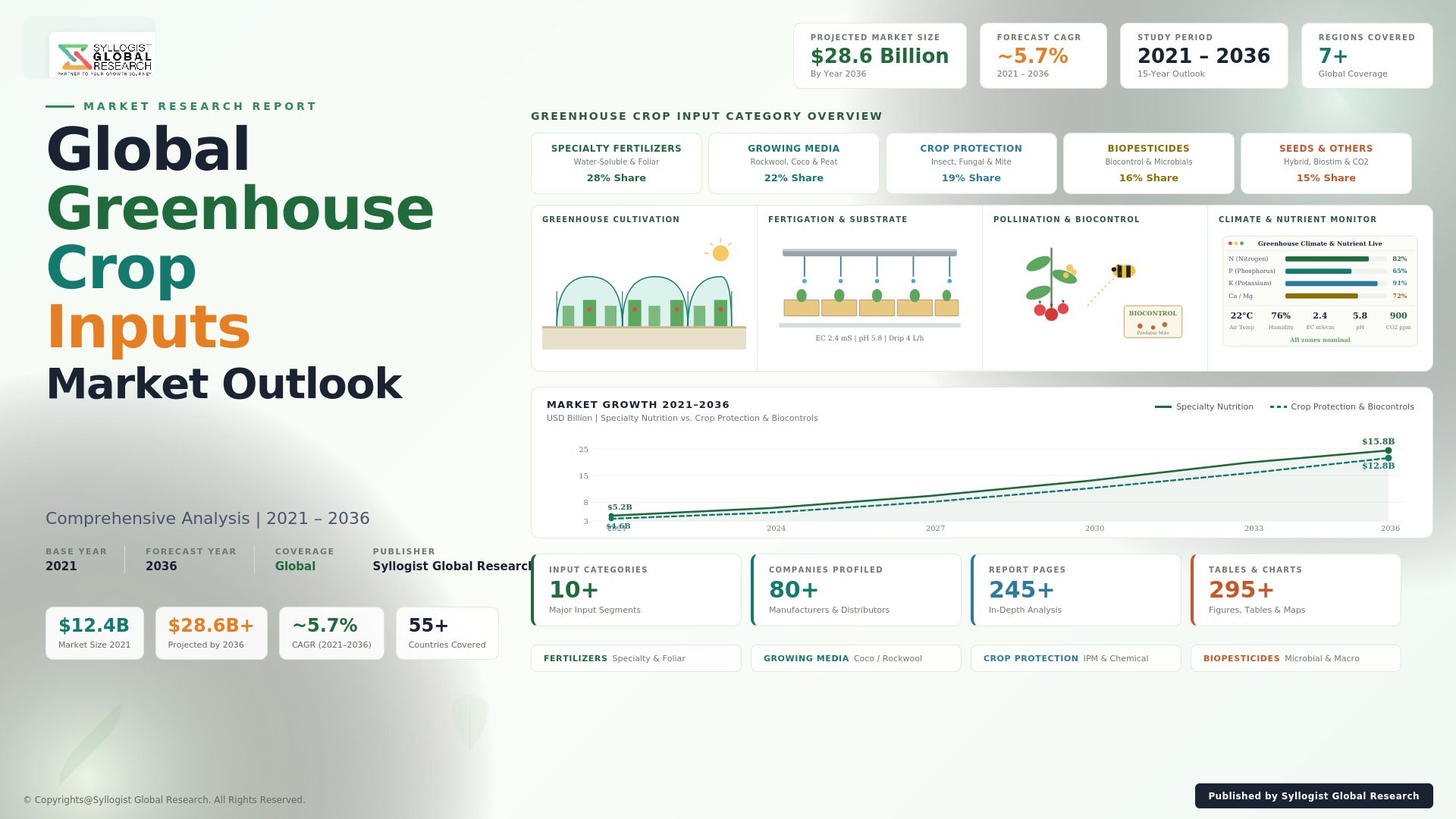
The global greenhouse crop inputs market reached USD 24.6 billion in 2025 and is projected to reach USD 41.8 billion by 2034, advancing at a compound annual growth rate of 6.1% across the forecast period. This expansion is anchored in accelerating adoption of protected cultivation across emerging economies, climate-driven shifts in cropping cycles, intensifying water scarcity reshaping irrigation economics, and a steady migration of high-value horticulture from open fields to climate-controlled greenhouse environments where input precision and yield density justify higher per-hectare expenditure on specialty nutrients, biological plant protection, and engineered growing media. The transition from generic agricultural inputs toward greenhouse-specific formulations is reshaping supplier portfolios across fertilizer, agrochemical, and seed companies globally.
Protected cultivation has emerged as a strategic response to land constraints, erratic rainfall, and rising consumer demand for pesticide-residue-free produce, with greenhouse acreage expanding most rapidly across China, the Netherlands, Spain, Mexico, India, and Turkey. Specialty water-soluble fertilizers and fertigation-compatible nutrient blends now command rising share within the greenhouse input mix, displacing conventional granular fertilizers as growers prioritize precise nutrient ratios delivered through drip irrigation. Biostimulants based on humic acids, seaweed extracts, microbial inoculants, and amino acid formulations are transitioning from optional supplements to mainstream input categories, with growers reporting measurable improvements in fruit set uniformity, post-harvest shelf life, and tolerance to abiotic stress under high-density greenhouse production cycles.
The plant protection segment within greenhouse inputs is undergoing rapid restructuring as biopesticides, predator insects, and microbial control agents progressively replace conventional chemical pesticides in response to retailer residue limits, pollinator protection requirements, and integrated pest management mandates governing greenhouse exports to European Union and North American destinations. Growing media diversification continues to redefine the substrate landscape, with coco coir surpassing peat in newly built commercial greenhouses across tropical and subtropical regions, while rockwool maintains dominance in advanced hydroponic tomato and cucumber operations across Northern Europe. Hybrid seed development tailored to greenhouse architecture, including disease-resistant tomato, bell pepper, cucumber, and leafy green varieties optimized for high-wire trellising and continuous harvest cycles, is generating premium-priced seed segments with attractive margin profiles for breeders.
Asia-Pacific is positioned as the fastest-growing regional market through 2034, supported by aggressive greenhouse expansion programs in China, India, South Korea, Japan, and Vietnam, where government subsidies, smallholder cooperative models, and rising urban demand for fresh produce are accelerating protected agriculture adoption. Europe remains the most technologically advanced regional market, anchored by the Netherlands, Spain, Italy, and France, where high-tech glasshouse operations integrate climate computers, fertigation automation, and precision dosing systems with specialty inputs sourced from established horticulture supply chains. North America is expanding greenhouse capacity rapidly across Mexico, Canada, and the United States, particularly in large-format vegetable greenhouses serving regional retail supply chains, while the Middle East is investing heavily in desert-adapted greenhouse infrastructure to anchor domestic food security across the Gulf states.
Key Drivers
Climate Volatility and Year-Round Production Imperatives Driving Sustained Migration of High-Value Horticulture into Protected Cultivation Environments
The intensification of climate volatility, irregular monsoon patterns, and extreme temperature events affecting open-field agriculture is driving sustained migration of high-value horticulture into greenhouse environments where controlled climate conditions deliver predictable yields and enable year-round production cycles. Growers increasingly justify the premium pricing of specialty greenhouse inputs by the consistency of returns delivered through protected cultivation, generating durable demand for water-soluble fertilizers, engineered growing media, biostimulants, and biological plant protection products tailored to enclosed environments and high-density cropping systems.
Government Subsidy Programs and Smallholder Cooperative Adoption Expanding the Addressable Greenhouse Footprint Across Emerging Economies
Public sector support across India, China, Turkey, Saudi Arabia, and several African economies includes capital subsidies, technology grants, and concessional financing for polyhouse and net-house construction, expanding the addressable greenhouse footprint and accelerating uptake of compatible input systems. Smallholder cooperative models in particular are unlocking economies of scale in input procurement, with bulk purchase of fertigation-grade fertilizers, hybrid seeds, and biopesticides becoming standard practice within organized cluster developments and contract farming arrangements.
Retailer-Driven Residue Limits and Export Compliance Standards Accelerating the Shift from Conventional Pesticides Toward Biological Plant Protection Solutions
Major retail chains in Europe, North America, and East Asia are enforcing increasingly stringent maximum residue limits on greenhouse-grown produce, compelling growers to substitute conventional pesticides with biopesticides, predator insects, and microbial control agents. Export-oriented greenhouse operations across Mexico, Spain, Morocco, and Turkey are reformulating input programs around residue-compliant chemistry, generating durable growth in low-residue plant protection products, integrated pest management solutions, and certified biological inputs aligned with destination-market regulatory frameworks.
Key Challenges
Input Cost Volatility, Energy-Linked Pricing, and Margin Compression Affecting Grower Procurement Behavior Across the Greenhouse Operator Base
Greenhouse crop input pricing remains exposed to upstream energy and natural gas market volatility, with nitrogen fertilizer, ammonia-derived inputs, and rockwool substrate costs reflecting feedstock price swings that compress grower margins and complicate season-ahead procurement planning. Periods of elevated input costs disproportionately affect smaller greenhouse operators lacking forward purchasing capability, occasionally triggering temporary substitution toward lower-grade alternatives that erode yield quality, product consistency, and the long-term performance economics of premium specialty input formulations.
Regulatory Complexity Around Plant Protection Chemistry, Active Ingredient Withdrawals, and Fragmented Biopesticide Registration Timelines Across Major Markets
The progressive withdrawal of conventional pesticide active ingredients across the European Union, restrictions on neonicotinoid use in pollinator-sensitive applications, and divergent national-level registration timelines for biopesticide products create regulatory complexity that complicates supplier portfolio management, slows new product launch cycles, and forces growers to navigate fragmented compliance frameworks across export destinations and domestic horticulture markets simultaneously.
Skilled Labor Shortages, Agronomy Training Gaps, and Technical Adoption Barriers Limiting Penetration of Premium Input Formulations Across Emerging Greenhouse Markets
The deployment of advanced fertigation systems, precision dosing equipment, and integrated pest management protocols requires technical proficiency that remains scarce across greenhouse operations in emerging markets, where smallholder growers often lack training in nutrient solution management, electrical conductivity and pH calibration, and biological control program design. The resulting underutilization of premium input formulations limits market penetration of higher-value specialty products and constrains realization of the yield potential possible under modern protected cultivation systems.
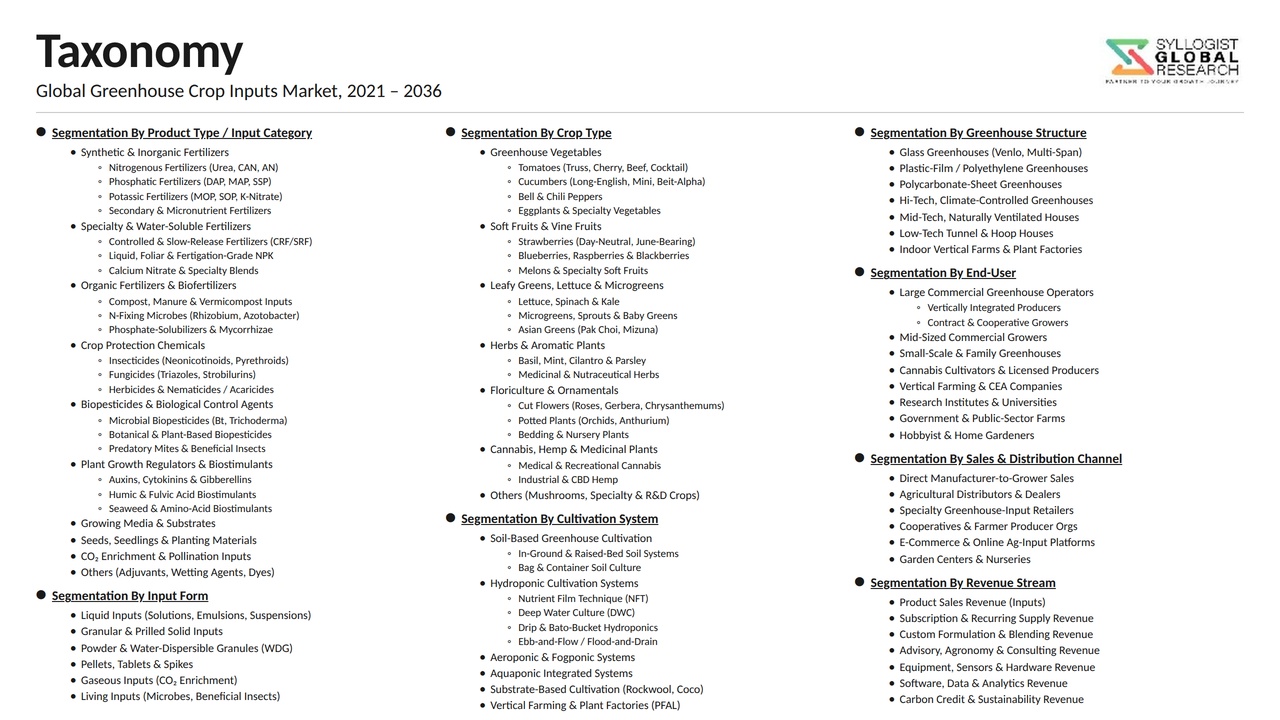
Market Segmentation
- Segmentation By Input Type
- Fertilizers (Water-Soluble, Controlled-Release, Liquid Concentrates)
- Plant Protection Products (Biopesticides, Conventional Pesticides, Predator Insects)
- Growing Media (Coco Coir, Peat, Perlite, Rockwool, Vermiculite)
- Seeds (Hybrid, Open-Pollinated, Treated and Pelleted)
- Biostimulants (Humic Acids, Seaweed Extracts, Microbial Inoculants, Amino Acid Formulations)
- Plant Growth Regulators
- Others
- Segmentation By Crop Type
- Vegetables (Tomato, Cucumber, Pepper, Leafy Greens, Eggplant)
- Fruits (Strawberry, Berries, Melons)
- Ornamentals and Floriculture
- Herbs and Medicinal Plants
- Nursery and Propagation Crops
- Others
- Segmentation By Greenhouse Type
- Glass Greenhouses
- Plastic Polyhouses and Polytunnels
- Net Houses and Shade Houses
- Vertical Farms and Indoor Cultivation Facilities
- Hydroponic and Aeroponic Systems
- Others
- Segmentation By Application
- Soil-Based Cultivation
- Hydroponic Systems
- Aeroponic Systems
- Aquaponic Systems
- Substrate-Based Cultivation
- Others
- Segmentation By Distribution Channel
- Direct Sales to Commercial Growers
- Agricultural Distributors and Dealers
- Online and E-Commerce Platforms
- Cooperative Networks and Farmer Producer Organizations
- Specialty Horticulture Retailers
- Others
- Segmentation By Region
- North America
- Europe
- Asia-Pacific
- Middle East and Africa
- Latin America
All market revenues are presented in USD.
Historical Year: 2021-2024 | Base Year: 2025 | Estimated Year: 2026 | Forecast Period: 2027-2034
Key Questions this Study Will Answer
- What is the total global market valuation of the Greenhouse Crop Inputs Market in 2025, projected through 2034, disaggregated by input type, crop type, and greenhouse type, enabling input manufacturers, distributors, investors, and procurement planners to identify the highest-growth segments and most durable revenue opportunities across the protected cultivation landscape?
- How are major regional markets including the Netherlands, Spain, China, India, Mexico, and Turkey allocating greenhouse expansion investment across high-tech glasshouse, plastic polyhouse, and net-house infrastructure, and which national programs are defining the technical and procurement benchmarks shaping global greenhouse input market architecture through 2034?
- Which greenhouse input categories, including water-soluble fertilizers, biostimulants, biopesticides, growing media, and hybrid seeds, are generating the highest growth rates through 2034, and what formulation, registration, and supply chain capabilities are most critical to securing leadership positions in each segment across regional markets?
- How are retailer-enforced maximum residue limits, integrated pest management mandates, and pollinator protection regulations across the European Union, North America, and East Asia reshaping greenhouse plant protection input portfolios, and what biopesticide and predator insect categories are scaling fastest to fill the resulting demand?
- What are the most significant cost, regulatory, and technical adoption barriers affecting greenhouse input penetration across emerging markets, and how are leading suppliers structuring agronomy advisory services, training programs, and digital input management platforms to overcome these constraints?
- How is the competitive landscape structured among multinational fertilizer and agrochemical companies, specialty greenhouse input firms, biological control producers, and growing media manufacturers, and what merger, acquisition, and partnership strategies are reshaping the supplier base across regional markets through 2034?
- Which greenhouse crop segments, including high-value vegetables, soft fruits, floriculture, and medicinal herbs, are expected to generate the most substantial incremental input demand through 2034, and what crop-specific formulation, varietal development, and substrate compatibility considerations are driving supplier strategy in each category?
- Product Definition
- Research Methodology
- Research Design & Framework
- Overall Research Approach: Descriptive, Exploratory & Quantitative Mixed-Method Design
- Market Definition & Scope Boundaries: What is Included and Excluded
- Segmentation Framework
- Key Research Assumptions & Limitations
- Secondary Research
- Primary Research Design & Execution
- Data Triangulation & Validation
- Market Sizing & Forecasting Methodology
- Competitive Intelligence Methodology
- Quality Assurance & Peer Review
- Definitions, Abbreviations & Data Notes
- Research Design & Framework
- Executive Summary
- Market Snapshot & Headline Numbers
- Key Findings & Research Highlights
- Market Dynamics
- Regional Market Summary
- Competitive Landscape Snapshot
- Technology & Innovation Highlights
- Market Dynamics
- Drivers
- Restraints
- Opportunities
- Challenges
- Porter’s Five Forces Analysis
- PESTLE Analysis
- Market Trends & Developments
- Emerging Trends
- Technological Developments
- Regulatory & Policy Changes
- Supply Chain & Sourcing Trends
- Manufacturing & Process Trends
- Investment & Funding Activity
- Sustainability & ESG Trends
- Risk Assessment Framework
- Raw Material, Fertilizer Feedstock & Energy Price Volatility Risk
- Pesticide Re-Registration, MRL Tightening & Biological Input Approval Risk
- Substrate Sourcing, Peat Phase-Out & Sustainable Growing Media Supply Risk
- Climate, Greenhouse Heating, Lighting & Energy Cost Risk
- Pest, Disease Outbreak, Resistance Development & Crop Loss Risk
- Regulatory Framework & Standards
- Pesticide Registration, EU Sustainable Use Directive & MRL Frameworks for Greenhouse Crops
- Fertilizer Composition, Nutrient Labeling & Specialty Plant Nutrition Regulations
- Peat Phase-Out, Sustainable Substrate & Growing Media Certification Standards
- A.P., MPS, Rainforest Alliance & Greenhouse Sustainability Certification Frameworks
- Worker Safety, Re-Entry Interval & Greenhouse Worker Protection Regulations
- Global Greenhouse Crop Inputs Market Outlook
- Market Size & Forecast by Value
- Market Size & Forecast by Volume (Tonnes and Million Cubic Metres of Substrate)
- Market Size & Forecast by Input Type
- Specialty Fertilizers (Water-Soluble, Liquid, Controlled-Release & Foliar)
- Substrates & Growing Media (Rockwool, Coco Coir, Peat, Perlite & Wood Fiber)
- Crop Protection Chemicals (Insecticides, Fungicides, Acaricides & Nematicides)
- Biopesticides & Biocontrol Agents (Macrobials, Microbials & Biochemicals)
- Greenhouse Seeds (Hybrid, Grafted Rootstock & Open-Pollinated)
- Biostimulants & Plant Health Inputs (Humic, Seaweed, Amino Acid & Microbial)
- Plant Growth Regulators for Greenhouse Use
- Commercial Pollination Services & Pollinator Inputs (Bumblebee & Honeybee)
- CO2 Enrichment Supply (Liquid CO2, Combustion CO2 & Recovered CO2)
- Disinfection, Sanitation & Greenhouse Hygiene Inputs
- Market Size & Forecast by Crop Type
- Tomato, Cucumber, Pepper & Eggplant
- Lettuce, Leafy Greens & Microgreens
- Strawberry, Soft Fruit & Berry Crops
- Cut Flowers, Potted Plants & Bedding Plants (Floriculture)
- Herbs, Aromatic Plants & Specialty Crops
- Cannabis & Medicinal Plants
- Nursery, Young Plant & Propagation Stock
- Market Size & Forecast by Cultivation System
- Hydroponic Systems (NFT, DWC, Drip & Ebb-and-Flow)
- Aeroponic & Aquaponic Systems
- Substrate-Based Cultivation (Slab, Bag & Pot Culture)
- Soil-Based Greenhouse Cultivation
- Vertical & Indoor Farming Systems
- Market Size & Forecast by Greenhouse Structure
- Glass Greenhouses (Venlo, Cabrio & High-Tech)
- Plastic Film & Multi-Span Tunnels
- Polycarbonate & Rigid-Plastic Greenhouses
- Net Houses, Shade Houses & Low-Tech Structures
- Indoor & Vertical Farms (Plant Factories with Artificial Lighting)
- Market Size & Forecast by End-User
- Large-Scale Commercial Greenhouse Operators
- Mid-Sized Specialty & Family-Owned Growers
- Floriculture & Ornamental Producers
- Vertical Farming & Indoor Agriculture Operators
- Research Institutes, Universities & Demonstration Facilities
- Cooperatives, Grower Associations & Contract Producers
- Market Size & Forecast by Sales Channel
- Direct Manufacturer-to-Grower Supply
- Specialist Greenhouse Input Distributor & Dealer Network
- Cooperative Procurement & Grower Association Channel
- Online & Digital Procurement Platforms
- Greenhouse Construction & Turnkey Project Bundled Supply
- North America Greenhouse Crop Inputs Market Outlook
- Market Size & Forecast
- By Value
- By Volume (Tonnes and Million Cubic Metres of Substrate)
- By Input Type
- By Crop Type
- By Cultivation System
- By Greenhouse Structure
- By End-User
- By Country
- By Sales Channel
- Market Size & Forecast
- Europe Greenhouse Crop Inputs Market Outlook
- Market Size & Forecast
- By Value
- By Volume (Tonnes and Million Cubic Metres of Substrate)
- By Input Type
- By Crop Type
- By Cultivation System
- By Greenhouse Structure
- By End-User
- By Country
- By Sales Channel
- Market Size & Forecast
- Asia-Pacific Greenhouse Crop Inputs Market Outlook
- Market Size & Forecast
- By Value
- By Volume (Tonnes and Million Cubic Metres of Substrate)
- By Input Type
- By Crop Type
- By Cultivation System
- By Greenhouse Structure
- By End-User
- By Country
- By Sales Channel
- Market Size & Forecast
- Latin America Greenhouse Crop Inputs Market Outlook
- Market Size & Forecast
- By Value
- By Volume (Tonnes and Million Cubic Metres of Substrate)
- By Input Type
- By Crop Type
- By Cultivation System
- By Greenhouse Structure
- By End-User
- By Country
- By Sales Channel
- Market Size & Forecast
- Middle East & Africa Greenhouse Crop Inputs Market Outlook
- Market Size & Forecast
- By Value
- By Volume (Tonnes and Million Cubic Metres of Substrate)
- By Input Type
- By Crop Type
- By Cultivation System
- By Greenhouse Structure
- By End-User
- By Country
- By Sales Channel
- Market Size & Forecast
- Country-Wise* Greenhouse Crop Inputs Market Outlook
- Market Size & Forecast
- By Value
- By Volume (Tonnes and Million Cubic Metres of Substrate)
- By Input Type
- By Crop Type
- By Cultivation System
- By Greenhouse Structure
- By End-User
- By Country
- By Sales Channel
- Market Size & Forecast
- *Countries Analyzed in the Syllogist Global Research Portfolio: United States, Canada, Mexico, Germany, France, United Kingdom, Netherlands, Spain, Italy, Norway, Sweden, China, Japan, India, Australia, South Korea, Singapore, Brazil, Chile, Saudi Arabia, UAE, Egypt, South Africa, Israel
- Technology Landscape & Innovation Analysis
- Specialty Fertilizer & Controlled-Release Nutrient Technology Deep-Dive
- Sustainable Substrate, Coco Coir Processing & Wood Fiber Technology
- Biopesticide, Microbial & Macrobial Mass-Rearing Technology
- Greenhouse Seed Breeding, Grafting & Resistance Trait Technology
- Precision Fertigation, Nutrient Recipe & Closed-Loop Recirculation Technology
- Biostimulant Formulation, Encapsulation & Delivery Technology
- IPM, Climate-Driven Pest Forecasting & Digital Crop Advisory Technology
- Patent & IP Landscape in Greenhouse Crop Input Technologies
- Value Chain & Supply Chain Analysis
- Fertilizer Raw Material, Specialty Salt & Chelate Supply Chain
- Substrate Raw Material (Coco Coir, Peat, Rockwool Stone, Perlite & Wood Chip) Supply Chain
- Pesticide Active Ingredient, Formulation & Adjuvant Supply Chain
- Biopesticide & Biocontrol Mass-Production, Cold-Chain & Distribution Supply Chain
- Greenhouse Seed Production, Pelleting, Priming & Distribution Supply Chain
- Distributor, Dealer & Grower Cooperative Channel
- Packaging, Logistics & Cold-Chain for Greenhouse Crop Inputs
- Pricing Analysis
- Specialty Fertilizer Pricing & Nutrient Cost-Per-Hectare Analysis
- Substrate & Growing Media Pricing (per Cubic Metre and per Slab) Analysis
- Crop Protection & Biopesticide Cost-Per-Application Analysis
- Greenhouse Seed Pricing (per 1,000 Seeds and per Hectare) Analysis
- Bumblebee Pollination Service & Hive-Hour Pricing Analysis
- Total Input Cost Per Square Metre and Per Crop Cycle Economic Analysis
- Sustainability & Environmental Analysis
- Lifecycle Assessment (LCA) of Greenhouse Crop Inputs: Carbon, Water & Substrate Footprint Across Cultivation Routes
- Peat Phase-Out, Renewable Substrate & Circular Growing Media Pathways
- Integrated Pest Management (IPM), Biocontrol Adoption & Pesticide Reduction Contribution
- Nutrient Use Efficiency, Closed-Loop Fertigation & Eutrophication Mitigation
- Regulatory-Driven Sustainability, EU Farm-to-Fork & SDG 2 (Zero Hunger) and SDG 12 (Responsible Production) Alignment
- Competitive Landscape
- Market Structure & Concentration
- Market Consolidation Level (Fragmented vs. Consolidated by Input Type & Geography)
- Top 10 Players Market Share
- HHI (Herfindahl-Hirschman Index) Concentration Analysis
- Competitive Intensity Map by Input Type, Crop & Geography
- Player Classification
- Multinational Specialty Fertilizer & Plant Nutrition Companies
- Substrate & Growing Media Manufacturers (Rockwool, Coco, Peat & Wood Fiber)
- Crop Protection Multinationals with Greenhouse Portfolios
- Biopesticide, Biocontrol & Beneficial Insect Specialist Companies
- Greenhouse Seed & Vegetable Breeding Companies
- Biostimulant & Plant Health Specialist Companies
- Commercial Pollination Service Providers
- CO2 Supply & Industrial Gas Companies for Greenhouses
- Distributors, Cooperatives & Greenhouse Input Specialists
- Competitive Analysis Frameworks
- Market Share Analysis by Input Type, Crop & Region
- Company Profile
- Company Overview & Headquarters
- Greenhouse Crop Inputs Products & Portfolio
- Key Customer Relationships & Reference Grower Accounts
- Manufacturing Footprint & Production Capacity
- Revenue (Greenhouse Crop Inputs Segment) & Backlog
- Technology Differentiators & IP
- Key Strategic Partnerships, JVs & M&A Activity
- Recent Developments (Contract Wins, Capacity Expansion, Product Launches)
- SWOT Analysis
- Strategic Focus Areas & Roadmap
- Competitive Positioning Map (Portfolio Breadth vs. Market Penetration)
- Key Company Profiles
- Market Structure & Concentration
- Technology Landscape & Innovation Analysis
- Strategic Output
- Market Opportunity Matrix: By Input Type, Crop, Cultivation System, End-User & Geography
- White Space Opportunity Analysis
- Strategic Recommendations
- Product Portfolio & Technology Investment Strategy
- Manufacturing & Operational Excellence Strategy
- Geographic Expansion & Localisation Strategy
- Customer & End-User Engagement Strategy
- Partnership, M&A & Ecosystem Strategy
- Sustainability & Circular Economy Strategy
- Risk Mitigation & Future Roadmap
- Strategic Priority Matrix & Roadmap
- Near-term (2025-2028)
- Mid-term (2029-2032)
- Long-term (2033-2037)
- Strategic Output