Global Plant Growth Regulators Market By Product Type, By Crop Type, By Application, By Function, By Formulation, By End User, By Region, Competition, Forecast & Opportunities, 2021-2034F
Market Definition
The Global Plant Growth Regulators Market covers the manufacturing, formulation, distribution, and field-level application of synthetic and naturally derived plant hormones and chemical compounds that influence plant physiological processes including cell division, elongation, dormancy, flowering, fruit set, ripening, abscission, and senescence. The market spans five primary biochemical classes including auxins, cytokinins, gibberellins, ethylene-based compounds, and abscisic acid, alongside emerging biostimulant chemistries such as seaweed extracts, humic and fulvic acid concentrates, microbial elicitors, and amino acid based formulations that complement conventional hormone driven products. Plant growth regulators are deployed across cereals and grains, fruits and vegetables, oilseeds and pulses, ornamental horticulture, turf management, and forestry plantations to enhance crop yield, optimize fruit set and uniformity, manage canopy architecture, accelerate or delay maturation cycles, suppress excessive vegetative growth, improve abiotic stress tolerance, and extend post-harvest shelf life. The market includes water-dispersible granules, water-soluble granules, wettable powders, emulsifiable concentrates, and ready-to-use solutions distributed through agrochemical retail networks, cooperative marketing federations, e-commerce platforms, and direct-to-grower channels. End users comprise commercial farmers, contract growing operations, greenhouse and protected cultivation enterprises, vineyards, fruit orchards, plantation crop producers, ornamental nurseries, golf course operators, and forestry management organizations procuring plant growth regulators to address productivity gaps, climate-related stress, and quality specifications imposed by export markets and food retailer procurement frameworks. The market further captures research-grade compounds supplied to agricultural universities, biotechnology firms, seed development programs, and contract research organizations conducting field efficacy trials and next-generation product development across major crop systems globally.
Market Insights
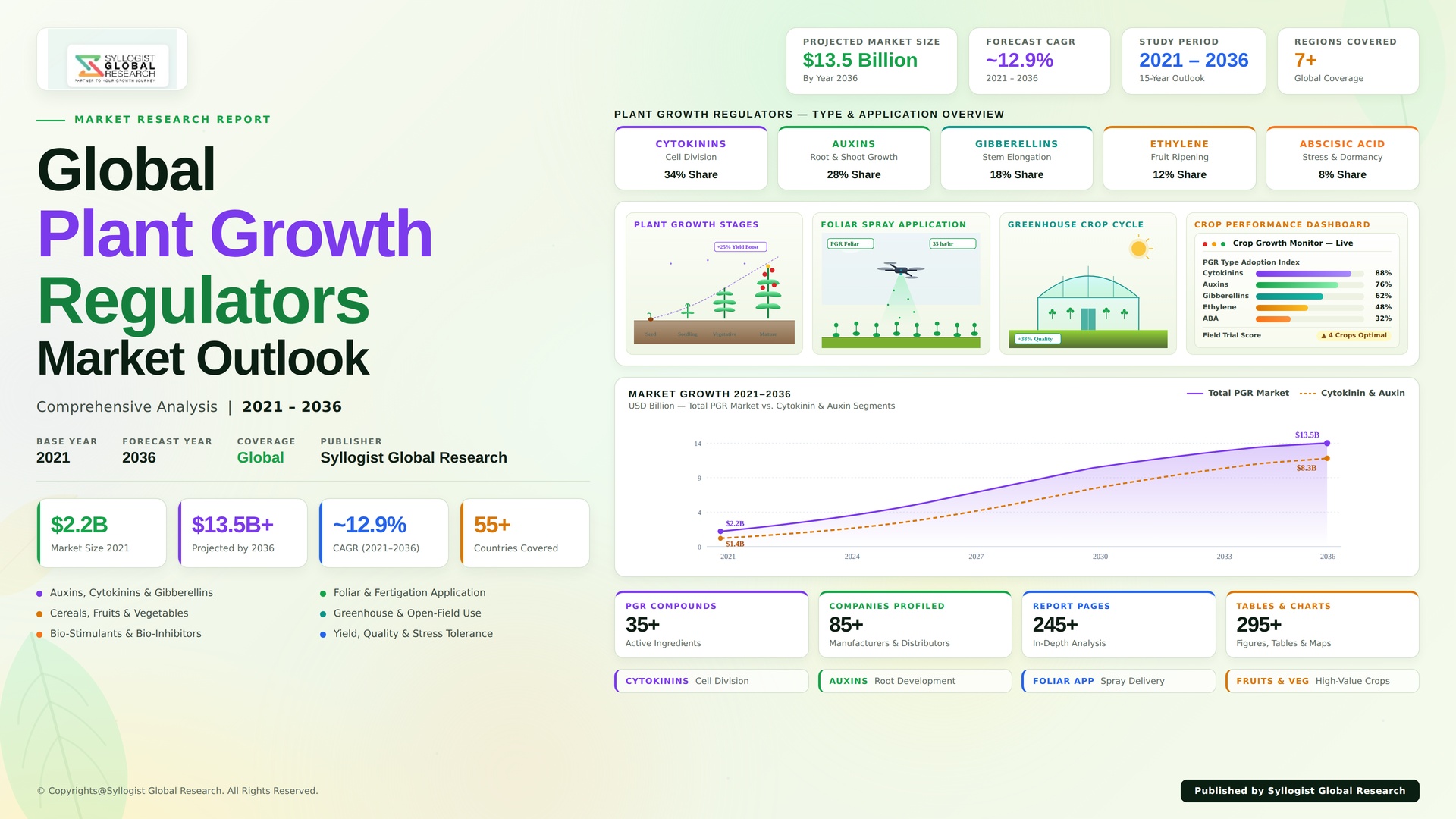
The global plant growth regulators market sits at the intersection of intensifying food security pressure, accelerating climate volatility, and a structural transition toward yield optimization chemistries that has elevated plant growth regulators from a specialty input into a mainstream agronomic tool deployed across both smallholder operations and large-scale commercial farming. The market was valued at approximately USD 5.21 billion in 2025 and is projected to reach USD 10.96 billion by 2034, advancing at a compound annual growth rate of 8.6% through the forecast period, supported by expanding adoption across high-value horticulture, sustained productivity pressure on cereal systems, and rapid scale-up of biostimulant-integrated plant growth regulator formulations. Cytokinins represent the dominant product category by revenue contribution given their utility in extending post-harvest shelf life, improving fruit set uniformity, and delaying leaf senescence, while gibberellins and auxins continue to capture meaningful share within fruit, vegetable, and viticulture systems where precision growth management directly translates into grade-out economics and export quality compliance.
The transition toward bio-based and biostimulant integrated plant growth regulator formulations represents one of the most consequential structural shifts reshaping the competitive landscape, with seaweed-derived cytokinin analogs, microbial elicitors, and humic-fulvic acid blended formulations registering above-average adoption growth as growers pursue residue-compliant agronomic programs aligned with EU maximum residue limits, organic certification protocols, and rising consumer preference for low-residue produce. Sales of biostimulant-anchored plant growth regulators expanded by approximately 31% in 2025, with combined applications delivering documented yield uplift of 17% across greenhouse tomato and cucumber operations and approximately 28% adoption growth on export vegetable lines targeting EU and Middle East destinations. Regulatory harmonization under EU Regulation 2019/1009 has streamlined biostimulant marketing across member states by replacing fragmented national authorizations with a unified CE marking pathway that compresses time to market for compliant formulations.
Asia-Pacific is projected to register the highest regional compound annual growth rate through 2034, with China expected to deliver a country-level CAGR of approximately 8.8% and India advancing at roughly 12.7%, supported by intensification of horticulture cultivation, expansion of greenhouse and polyhouse acreage, and government-led initiatives integrating plant growth regulator usage into precision farming advisories targeting smallholder productivity gaps. Europe maintains the largest regional revenue share, accounting for approximately 33% of global market value, anchored by premium fruit and vegetable export economies in Spain, Italy, France, and the Netherlands and the rapid uptake of bio-based formulations aligned with Farm to Fork strategy targets. North America contributes approximately 28% of total market demand, with the United States anchoring regional revenue through extensive auxin, gibberellin, and ethephon applications across cereals, citrus, grapes, apples, cotton, and high-value greenhouse vegetables, while Latin America gains share on the back of Brazilian soy, citrus, and sugarcane applications and Middle East and Africa advance through hydroponic, date palm, and protected cultivation expansion.
Fruits and vegetables together account for approximately 41% of plant growth regulator consumption volume globally, while cereals and grains contribute roughly 36% of application acreage, with residual demand distributed across oilseeds, pulses, ornamental horticulture, turf management, and forestry plantations. The competitive landscape remains moderately concentrated with global crop science leaders commanding aggregate share above 50% of the market, while specialized biostimulant innovators, regional formulation manufacturers, and biotechnology start-ups capture growing share through naturally derived chemistries, microbial-blended platforms, nano-formulation delivery systems, and digital agronomy integrations linking plant growth regulator applications to canopy sensing, weather analytics, and yield-prediction models within precision agriculture deployments. Strategic activity in 2024 and 2025 has intensified around partnerships between crop science majors and biostimulant innovators, joint research programs targeting drought resilience and lodging control, and distribution alliances expanding branded portfolio reach across India, Brazil, and Vietnam.
Key Drivers
Climate Volatility and Abiotic Stress Resilience Demand Anchoring Long-Term Plant Growth Regulator Procurement Growth
The increasing frequency of drought, heat waves, and erratic rainfall has elevated abscisic acid, cytokinin, and ethylene-based plant growth regulators from optional inputs into core resilience tools, with field studies confirming microbial-based formulations reducing plant water stress by 26% and extending root depth by 12%. Growers across drought-affected geographies are deploying stress-tolerance modifiers as a structural component of risk-managed cultivation programs, generating durable demand independent of commodity price cycles.
Rapid Expansion of High-Value Horticulture and Export Quality Standards Strengthening Premium Plant Growth Regulator Adoption
Global harvested area of fruits expanded to 68.1 million hectares and vegetables to 59.1 million hectares in 2023, with export-oriented producers increasingly adopting plant growth regulators to meet stringent grade-out specifications, residue compliance, and shelf-life requirements imposed by retailer procurement frameworks. Vineyard, citrus, apple, mango, and greenhouse vegetable segments are anchoring durable plant growth regulator procurement growth across Europe, Latin America, and Asia-Pacific.
Accelerated Commercialization of Bio-based and Biostimulant-Integrated Plant Growth Regulator Formulations Reshaping the Innovation Pipeline
The convergence of plant growth regulators with biostimulant chemistries including seaweed extracts, microbial elicitors, and humic-fulvic blends has unlocked new agronomic value propositions delivering 17% yield uplift in greenhouse trials and broad adoption growth in organic-aligned production systems. Companies allocating roughly 12% of research budgets to bio-based development report stronger profit resilience and faster regulatory clearance pathways under harmonized EU and pending US frameworks.
Key Challenges
Regulatory Fragmentation and Extended Product Approval Timelines Constraining New Plant Growth Regulator Launches
Plant growth regulators face divergent regulatory pathways across major markets, with US oversight split between EPA pesticide regulation and state-level fertilizer departments while the EU operates under Fertilising Products Regulation 2019/1009 with limited microbial genus approvals restricting formulation flexibility. Compliance costs, extensive efficacy trial data requirements, and ambiguous classification of dual-purpose biostimulant plant growth regulator products extend product launches by multiple years, particularly burdening small and mid-size formulators that lack enterprise-scale regulatory affairs capacity.
Application Sensitivity and Performance Variability Across Agro-climatic Conditions Eroding Grower Confidence in Repeat Procurement
Plant growth regulator efficacy is highly contingent on application timing, ambient temperature, humidity, soil moisture, and crop physiological stage, generating inconsistent field outcomes across regions and seasons that erode grower confidence and slow repeat purchase cycles. Narrow application windows for compounds such as gibberellic acid in grape clusters or ethephon in cereals create execution risk for growers lacking advisory infrastructure, constraining adoption among smallholders dependent on generic agronomy guidance.
Intensifying Generic Competition and Margin Erosion Across Mature Plant Growth Regulator Molecules Pressuring Branded Innovator Profitability
The plant growth regulators market remains highly fragmented with substantial generic supply from regional manufacturers in China, India, and Southeast Asia compressing pricing on legacy molecules including paclobutrazol, chlormequat chloride, mepiquat chloride, and ethephon. Branded innovators face structural margin pressure on commoditized chemistries, requiring sustained R&D allocation toward differentiated bio-based platforms, proprietary formulations, and digital agronomy bundles to defend pricing power among price-sensitive growers.
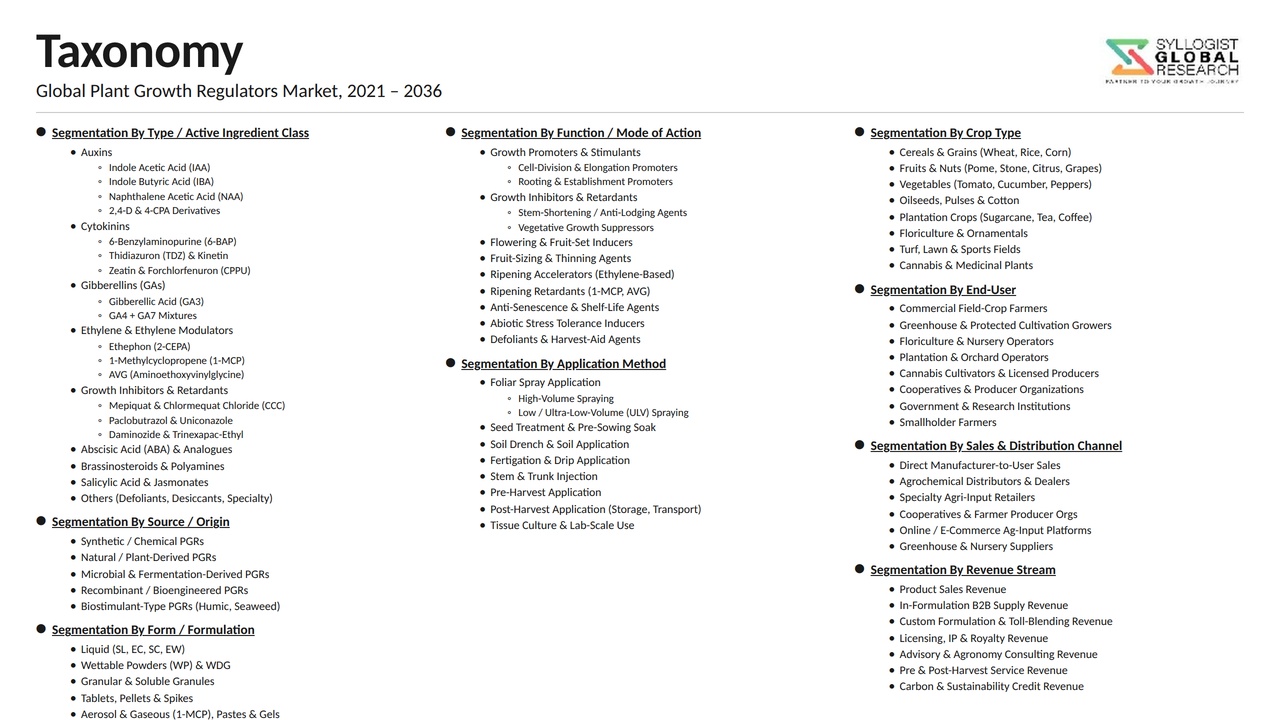
Market Segmentation
- Segmentation By Product Type
- Auxins
- Cytokinins
- Gibberellins
- Ethylene-based Compounds
- Abscisic Acid
- Biostimulant-blended Plant Growth Regulators
- Others
- Segmentation By Crop Type
- Cereals and Grains
- Fruits and Vegetables
- Oilseeds and Pulses
- Turf and Ornamentals
- Plantation Crops
- Others
- Segmentation By Application
- Foliar Spray
- Fertigation
- Seed Treatment
- Soil Treatment
- Others
- Segmentation By Function
- Plant Growth Promoters
- Plant Growth Inhibitors
- Plant Growth Retardants
- Segmentation By Formulation
- Water Dispersible and Water-Soluble Granules
- Wettable Powder
- Liquid Solutions and Emulsifiable Concentrates
- Others
- Segmentation By End User
- Commercial Farmers and Cooperatives
- Greenhouse and Protected Cultivation Operators
- Vineyards and Orchards
- Ornamental Nurseries and Floriculture
- Turf and Landscape Management
- Forestry and Plantation Operators
- Others
- Segmentation By Region
- North America
- Europe
- Asia-Pacific
- Middle East and Africa
- Latin America
All market revenues are presented in USD
Historical Year: 2021-2024 | Base Year: 2025 | Estimated Year: 2026 | Forecast Period: 2027-2034
Key Questions this Study Will Answer
- What is the total global market valuation of the Plant Growth Regulators Market in 2025, projected through 2034, disaggregated by product type, crop type, and formulation, enabling agrochemical manufacturers, biostimulant innovators, distributors, and procurement planners to identify highest-growth segments and most durable revenue opportunities across the global crop input landscape?
- How are cytokinins, auxins, gibberellins, ethylene-based compounds, and abscisic acid each expected to evolve in revenue contribution and adoption breadth through 2034, and which molecules including paclobutrazol, chlormequat chloride, mepiquat chloride, gibberellic acid, ethephon, and forchlorfenuron are positioned to deliver the strongest commercial returns across cereals, fruits, vegetables, and high-value horticulture systems?
- What regulatory, residue, and approval frameworks under EU Fertilising Products Regulation 2019/1009, US EPA pesticide oversight, the proposed Plant Biostimulant Act, India’s Fertiliser Control Order, and equivalent regimes are reshaping plant growth regulator launch timelines, label claim architecture, and product positioning across major commercial markets globally?
- Which crop systems including cereals, citrus, grape, apple, mango, banana, tomato, cucumber, cotton, sugarcane, and ornamental floriculture are generating the highest plant growth regulator demand growth through 2034, and what application protocols, formulation choices, and timing windows are most critical to grower outcomes and repeat-purchase economics in each category?
- How is the competitive landscape structured among global crop science majors, specialized biostimulant innovators, regional generic manufacturers, and biotechnology start-ups, and what partnership, acquisition, licensing, and distribution alliance strategies are enabling new entrants to compete against established branded portfolios across India, China, Brazil, and other emerging horticulture markets?
- What is the structural impact of biostimulant convergence, including seaweed extracts, microbial elicitors, humic and fulvic blends, and amino acid based formulations, on plant growth regulator adoption patterns, pricing dynamics, residue-compliance positioning, and grower agronomic decision frameworks across organic, conventional, and protected cultivation systems?
- Which regional plant growth regulator markets, specifically Asia-Pacific, Europe, North America, Latin America, and Middle East and Africa, are expected to generate the most substantial incremental procurement through 2034, and what climate, regulatory, horticulture intensification, and export market access factors are driving capability investment priorities and supplier selection decisions in each regional market?
- Product Definition
- Research Methodology
- Research Design & Framework
- Overall Research Approach: Descriptive, Exploratory & Quantitative Mixed-Method Design
- Market Definition & Scope Boundaries: What is Included and Excluded
- Segmentation Framework
- Key Research Assumptions & Limitations
- Secondary Research
- Primary Research Design & Execution
- Data Triangulation & Validation
- Market Sizing & Forecasting Methodology
- Competitive Intelligence Methodology
- Quality Assurance & Peer Review
- Definitions, Abbreviations & Data Notes
- Executive Summary
- Market Snapshot & Headline Numbers
- Key Findings & Research Highlights
- Market Dynamics
- Regional Market Summary
- Competitive Landscape Snapshot
- Technology & Innovation Highlights
- Market Dynamics
- Drivers
- Restraints
- Opportunities
- Challenges
- Porter’s Five Forces Analysis
- PESTLE Analysis
- Market Trends & Developments
- Emerging Trends
- Technological Developments
- Regulatory & Policy Changes
- Supply Chain & Sourcing Trends
- Manufacturing & Process Trends
- Investment & Funding Activity
- Sustainability & ESG Trends
- Risk Assessment Framework
- Active Ingredient Toxicity, Residue & Crop Phytotoxicity Risk
- Regulatory Approval, Label Expansion & Re-Registration Risk
- Raw Material (Synthetic Intermediate & Microbial Feedstock) Price Volatility & Supply Risk
- Resistance Development, Efficacy Loss & Grower Adoption Risk
- Climate Variability, Crop Pattern Shift & Demand Forecasting Risk
- Regulatory Framework & Standards
- National Pesticide & Plant Growth Regulator Registration, Labelling & Maximum Residue Limit (MRL) Frameworks
- Biopesticide, Biostimulant & Natural Plant Growth Regulator Classification & Approval Pathways
- Crop Protection Stewardship, Integrated Pest Management & Good Agricultural Practice (GAP) Standards
- Environmental Safety, Pollinator Protection & Soil Health Impact Assessment Regulations
- Export Certification, Codex Alimentarius MRL Harmonisation & Sustainable Agriculture Procurement Standards
- Global Plant Growth Regulators Market Outlook
- Market Size & Forecast by Value
- Market Size & Forecast by Volume (Tonnes)
- Market Size & Forecast by Type
- Auxins (IAA, IBA, NAA & 2,4-D Derivatives)
- Cytokinins (Kinetin, Zeatin & 6-Benzylaminopurine)
- Gibberellins (GA3 & GA4+7)
- Ethylene Generators (Ethephon & Related Compounds)
- Abscisic Acid (ABA) & Stress-Tolerance Regulators
- Plant Growth Inhibitors & Retardants (Chlormequat, Mepiquat Chloride, Paclobutrazol & Trinexapac-Ethyl)
- Other Hormonal & Bio-Based Plant Growth Regulators
- Market Size & Forecast by Source
- Synthetic and Chemical-Based Plant Growth Regulators
- Natural and Bio-Based Plant Growth Regulators (Microbial, Plant Extract & Fermentation-Derived)
- Market Size & Forecast by Function
- Plant Growth Promoters
- Plant Growth Inhibitors & Retardants
- Market Size & Forecast by Formulation
- Liquid Formulations (Soluble Concentrate, Suspension Concentrate & Emulsifiable Concentrate)
- Solid Formulations (Wettable Powder, Soluble Granules & Tablets)
- Slow-Release & Encapsulated Formulations
- Market Size & Forecast by Application Mode
- Foliar Spray Application
- Soil Treatment & Drench Application
- Seed Treatment & Coating Application
- Fertigation & Drip Irrigation Application
- Market Size & Forecast by Crop Type
- Cereals & Grains (Wheat, Rice, Maize & Barley)
- Fruits & Vegetables (Pome, Stone, Citrus, Berries & Solanaceous Crops)
- Oilseeds & Pulses (Soybean, Cotton, Canola, Sunflower & Pulses)
- Turf, Ornamentals & Floriculture
- Plantation, Sugar & Beverage Crops (Sugarcane, Coffee, Tea, Cocoa, Banana & Pineapple)
- Other Crops & Specialty Horticulture
- Market Size & Forecast by End-User
- Smallholder & Subsistence Farmers
- Commercial & Plantation Growers
- Greenhouse & Protected Cultivation Operators
- Nursery, Floriculture & Turf Management Companies
- Agricultural Research Institutes & Public-Sector Buyers
- Market Size & Forecast by Sales Channel
- Direct Sales to Large Farms & Plantations
- Distributor, Dealer & Agro-Retailer Network
- Cooperative & Government Procurement Channel
- E-Commerce & Digital Agri-Input Platforms
- North America Plant Growth Regulators Market Outlook
- Market Size & Forecast
- By Value
- By Volume (Tonnes)
- By Type
- By Source
- By Function
- By Formulation
- By Application Mode
- By Crop Type
- By End-User
- By Country
- By Sales Channel
- Market Size & Forecast
- Europe Plant Growth Regulators Market Outlook
- Market Size & Forecast
- By Value
- By Volume (Tonnes)
- By Type
- By Source
- By Function
- By Formulation
- By Application Mode
- By Crop Type
- By End-User
- By Country
- By Sales Channel
- Market Size & Forecast
- Asia-Pacific Plant Growth Regulators Market Outlook
- Market Size & Forecast
- By Value
- By Volume (Tonnes)
- By Type
- By Source
- By Function
- By Formulation
- By Application Mode
- By Crop Type
- By End-User
- By Country
- By Sales Channel
- Market Size & Forecast
- Latin America Plant Growth Regulators Market Outlook
- Market Size & Forecast
- By Value
- By Volume (Tonnes)
- By Type
- By Source
- By Function
- By Formulation
- By Application Mode
- By Crop Type
- By End-User
- By Country
- By Sales Channel
- Market Size & Forecast
- Middle East & Africa Plant Growth Regulators Market Outlook
- Market Size & Forecast
- By Value
- By Volume (Tonnes)
- By Type
- By Source
- By Function
- By Formulation
- By Application Mode
- By Crop Type
- By End-User
- By Country
- By Sales Channel
- Market Size & Forecast
- *Countries Analyzed in the Syllogist Global Research Portfolio: United States, Canada, Mexico, Germany, France, United Kingdom, Netherlands, Spain, Italy, Norway, Sweden, China, Japan, India, Australia, South Korea, Singapore, Brazil, Chile, Saudi Arabia, UAE, Egypt, South Africa, Israel
- Country-Wise* Plant Growth Regulators Market Outlook
- Market Size & Forecast
- By Value
- By Volume (Tonnes)
- By Type
- By Source
- By Function
- By Formulation
- By Application Mode
- By Crop Type
- By End-User
- By Country
- By Sales Channel
- Synthetic Plant Growth Regulator Active Ingredient Discovery & Process Chemistry Technology Deep-Dive
- Microbial Fermentation, Plant Extract & Bio-Based Plant Growth Regulator Production Technology
- Advanced Formulation, Slow-Release & Nano-Encapsulation Delivery Technology
- Precision Application, Drone Spraying & Variable-Rate Plant Growth Regulator Application Technology
- Genomics, CRISPR & Hormone-Signalling Pathway Innovation in Plant Growth Regulation
- Digital Agriculture, AI-Based Crop Stage Modelling & Prescription Plant Growth Regulator Recommendation Platforms
- Combination Product, Tank-Mix Compatibility & Adjuvant Technology
- Patent & IP Landscape in Plant Growth Regulator Active Ingredients & Formulations
- Market Size & Forecast
- Value Chain & Supply Chain Analysis
- Active Ingredient Synthesis, Intermediate Manufacturing & Microbial Fermentation Supply Chain
- Formulation, Blending & Packaging Equipment & Service Supply Chain
- Adjuvant, Solvent, Surfactant & Inert Carrier Supply Chain for Plant Growth Regulators
- Application Equipment (Sprayer, Drone & Fertigation System) Supply Chain
- Distributor, Dealer & Agro-Retailer Procurement Landscape
- Grower, Cooperative & Plantation Offtake Channel
- Empty Container Management, Stewardship & Circular Packaging
- Pricing Analysis
- Synthetic Plant Growth Regulator Manufacturing Capital and Operating Cost Analysis
- Microbial & Bio-Based Plant Growth Regulator Production Cost & Cost-of-Goods Analysis
- Formulation, Filling & Packaging Cost Analysis
- Distribution Margin, Dealer Markup & Retail Price Realisation Analysis
- Plant Growth Regulator Application Cost Per Hectare & Grower Economics by Crop
- Total Plant Growth Regulator Programme Economics: Yield Uplift, ROI & Cost-Benefit Analysis Across Crop Systems
- Sustainability & Environmental Analysis
- Lifecycle Assessment (LCA) of Plant Growth Regulators: Carbon Footprint, Water Use & Eco-Toxicity Across Synthetic and Bio-Based Routes
- Reduced Chemical Load, Bio-Based Substitution & Pathway to Lower-Impact Plant Growth Regulator Programmes
- Plant Growth Regulator Role in Climate-Smart Agriculture, Yield Resilience & Food Security Contribution
- Environmental Compliance, Pollinator Protection, Soil Microbiome & Non-Target Organism Consideration
- Regulatory-Driven Sustainability, SDG 2 (Zero Hunger) & SDG 12 (Responsible Production) Alignment & Sustainable Agriculture Procurement Eligibility
- Competitive Landscape
- Market Structure & Concentration
- Market Consolidation Level (Fragmented vs. Consolidated by Type & Geography)
- Top 10 Players Market Share
- HHI (Herfindahl-Hirschman Index) Concentration Analysis
- Competitive Intensity Map by Type, Crop & Geography
- Player Classification
- Diversified Multinational Crop Protection & Agricultural Sciences Companies
- Specialist Plant Growth Regulator & Plant Hormone Active Ingredient Manufacturers
- Bio-Based, Microbial & Biostimulant Plant Growth Regulator Hybrid Companies
- Generic & Off-Patent Plant Growth Regulator Producers
- Formulation & Custom Blending Specialists
- Regional Agrochemical Companies with Plant Growth Regulator Portfolios
- Digital Agriculture & Precision Application Platform Providers
- Distributor, Cooperative & Private-Label Brand Owners
- Competitive Analysis Frameworks
- Market Share Analysis by Type, Crop & Region
- Company Profile
- Company Overview & Headquarters
- Plant Growth Regulator Products & Active Ingredient Portfolio
- Key Customer Relationships & Reference Crop Programmes
- Manufacturing Footprint & Production Capacity
- Revenue (Plant Growth Regulator Segment) & Order Book
- Product Differentiators & IP
- Key Strategic Partnerships, JVs & M&A Activity
- Recent Developments (Registration Wins, Capacity Expansion, Product Launches)
- SWOT Analysis
- Strategic Focus Areas & Roadmap
- Competitive Positioning Map (Product Capability vs. Market Penetration)
- Key Company Profiles
- Market Structure & Concentration
- Strategic Output
- Market Opportunity Matrix: By Type, Crop, Application Mode, End-User & Geography
- White Space Opportunity Analysis
- Strategic Recommendations
- Product Portfolio & Active Ingredient Investment Strategy
- Manufacturing & Operational Excellence Strategy
- Geographic Expansion & Localisation Strategy
- Customer & End-User Engagement Strategy
- Partnership, M&A & Ecosystem Strategy
- Sustainability & Circular Economy Strategy
- Risk Mitigation & Future Roadmap
- Strategic Priority Matrix & Roadmap
- Near-term (2026-2029)
- Mid-term (2030-2033)
- Long-term (2034-2038)