Global LNG Market By Production Technology, By Liquefaction Scale, By Application, By Storage and Transportation Mode, By End Use Sector, By Trade Route, By Region, Competition, Forecast & Opportunities, 2021-2036F
Market Definition
The Global LNG Market encompasses the full value chain of natural gas liquefaction, storage, shipping, regasification, and end use distribution, including the design, construction, and operation of onshore and floating liquefaction facilities, LNG carriers, floating storage and regasification units, onshore regasification terminals, LNG bunkering infrastructure, small-scale LNG distribution systems, and associated trading, offtake contracting, and price risk management activities, serving power generation, industrial, residential, commercial, and maritime transportation customers across importing and exporting nations globally.
Market Insights
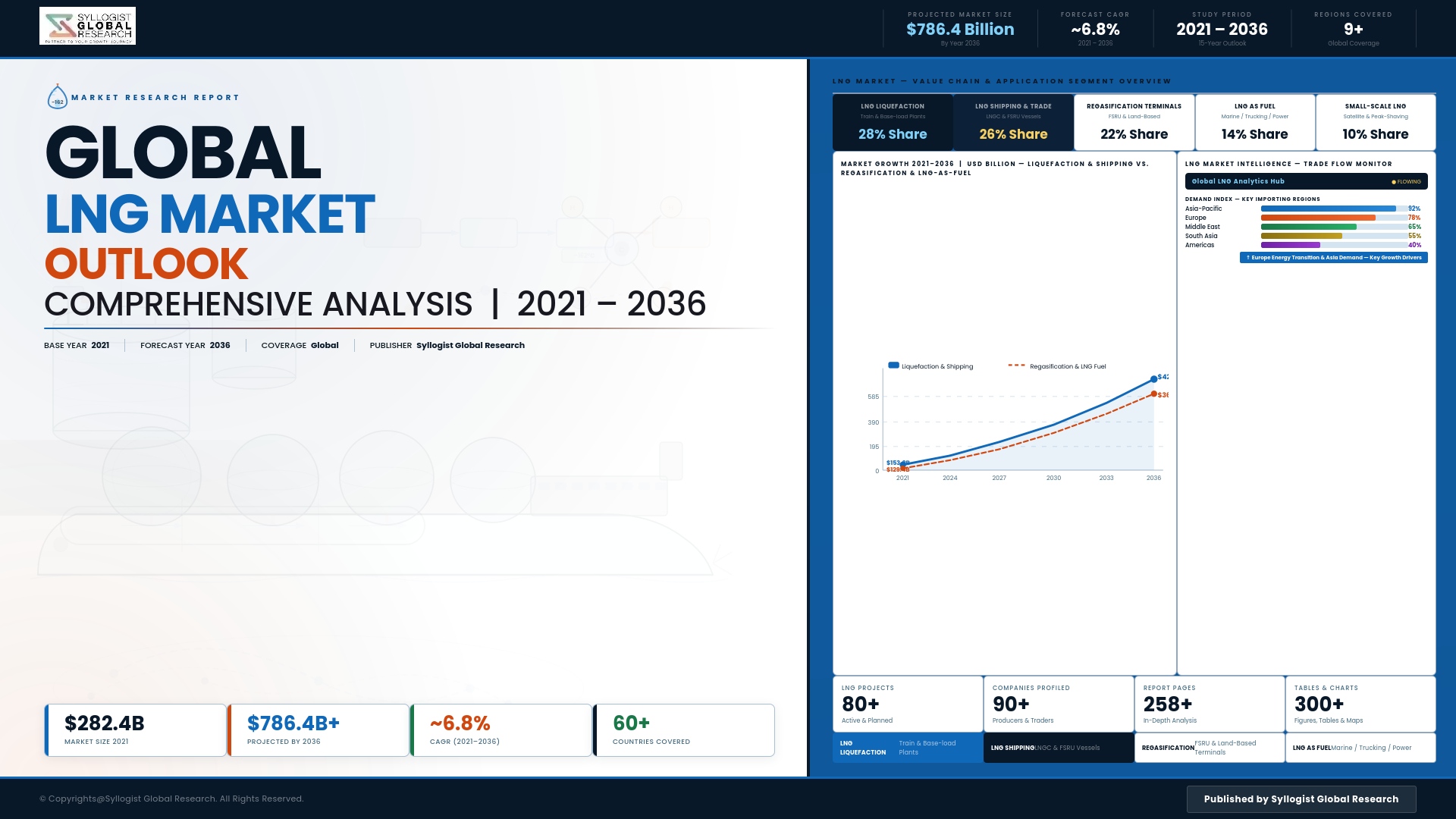
The global LNG market is navigating a period of structural realignment that is simultaneously expanding market scale, accelerating supply diversification, and intensifying the debate over LNG’s long-term role within decarbonizing energy systems, as geopolitical supply disruptions have fundamentally repositioned LNG from a supplemental balancing fuel to a primary energy security instrument for gas-importing nations whose historical dependence on pipeline natural gas has been exposed as a strategic vulnerability requiring urgent mitigation through portfolio diversification into flexible, globally traded LNG supply. The market was valued at approximately USD 312.8 billion in 2025 and is projected to advance at a compound annual growth rate of 5.9% through 2034, as a substantial wave of new liquefaction capacity from the United States, Qatar, Australia, and emerging producers in East Africa and the Middle East comes online to serve growing import demand from Asia-Pacific economies, European nations rebuilding post-pipeline energy security infrastructure, and developing economies seeking cleaner-burning natural gas alternatives to coal-based power generation.
The United States has emerged as the world’s largest LNG exporter, a position achieved through the rapid commercialization of shale gas resources that transformed the United States from a projected LNG importer to the dominant swing producer in the global LNG trade, with multiple liquefaction trains operating across the Gulf Coast and additional projects under construction and in late-stage development that will further expand American export capacity and reinforce the United States position as the global LNG market’s marginal price setter and supply balancing mechanism. The combination of Henry Hub gas price-linked liquefaction tolling contracts, destination flexibility provisions in United States LNG supply agreements, and the availability of short-term and spot market cargo volumes has made American LNG a uniquely flexible and competitively priced supply source that European and Asian buyers have incorporated into diversified LNG import portfolios as both a baseload supply component and a hedge against supply concentration risk in their overall natural gas procurement strategies.
Qatar’s North Field expansion program, which will increase Qatari LNG liquefaction capacity by approximately sixty percent from existing levels by the late 2020s, represents the largest single liquefaction capacity addition in LNG industry history and will reinforce Qatar’s position as the world’s lowest-cost LNG producer given its exceptional reservoir quality, established infrastructure, and integrated value chain economics that enable Qatari LNG to remain commercially competitive across a wide range of global gas price environments. The competitive tension between United States tolling model LNG and Qatari equity model LNG as the two dominant supply platforms is reshaping global LNG pricing frameworks, long-term contract structures, and buyer negotiating leverage in ways that are progressively shifting the balance of commercial power from producers toward buyers in the medium-term supply environment expected to develop as substantial new capacity additions come online simultaneously from multiple project sponsors across different producing regions. Floating liquefaction technology is enabling faster-to-market project development in stranded offshore and remote gas resource locations, with multiple floating LNG projects under construction and in development across Mozambique, Tanzania, and East Africa that will diversify the geographic supply base of the global LNG market beyond its traditional concentration in Australia, Qatar, and established pipeline exporters.
Asia-Pacific dominates global LNG import volumes, with Japan, South Korea, China, India, Taiwan, and rapidly growing Southeast Asian markets including Vietnam, the Philippines, Bangladesh, and Pakistan collectively accounting for the majority of global LNG trade by volume. China’s LNG import trajectory is the single most consequential demand variable in the global LNG market, as the combination of domestic gas demand growth, coal-to-gas switching policy, and the pace of renewable energy deployment that substitutes for gas-fired power generation collectively determine whether Chinese LNG import demand grows, plateaus, or declines across the medium-term horizon in ways that have cascading price and capacity utilization implications for global LNG supply chain economics. Europe has emerged as the second major LNG demand growth region, driven by the structural reduction in Russian pipeline gas imports following geopolitical disruption that has permanently elevated European LNG import infrastructure investment and long-term supply contract commitment across all major Western and Central European economies.
Key Drivers
Geopolitical Energy Security Imperatives and Pipeline Natural Gas Supply Vulnerability Compelling European and Asian Importers to Accelerate LNG Infrastructure Investment and Long-Term Contract Commitments
The structural disruption of pipeline natural gas supply relationships that had provided European energy systems with low-cost but geopolitically concentrated baseload gas supply has created a permanent reconfiguration of European natural gas procurement strategy toward LNG import diversification, driving a wave of floating storage and regasification unit installations, onshore LNG terminal expansion investments, and long-term LNG supply contract signings that are providing durable demand foundation for new liquefaction capacity investment across multiple producing regions simultaneously. Asian LNG importers facing their own supply security concerns from regional geopolitical tensions and commodity market volatility are similarly investing in LNG import infrastructure expansion and diversifying their long-term supply portfolios toward a broader mix of producing country origins, delivery points, and contract structures that reduce dependence on any single supply source or price linkage mechanism.
Coal-to-Gas Switching in Power Generation and Industrial Applications Across Developing Asia and Emerging Markets Sustaining LNG Demand Growth as a Cleaner Transition Fuel
Developing economies across South and Southeast Asia, South Asia, and parts of Africa and Latin America are prioritizing natural gas-fired power generation as a cleaner-burning alternative to coal that delivers substantial reductions in local air pollution and greenhouse gas emissions per unit of electricity generated while maintaining the dispatchable generation capacity and grid balancing flexibility that economies at earlier stages of renewable energy penetration require to maintain power system reliability. The combination of improving LNG import infrastructure access through floating storage and regasification unit deployments that reduce terminal investment requirements, falling LNG vessel charter costs, and growing spot market liquidity enabling smaller volume procurement without long-term contractual commitments is making LNG increasingly accessible to smaller and newer importing nations whose market entry would previously have been constrained by capital requirements and minimum volume obligations.
LNG as Marine Fuel Adoption and Small-Scale LNG Distribution Growth Creating New Demand Segments That Expand the LNG Market Beyond Traditional Power Generation and Industrial Applications
International Maritime Organization sulfur emission regulations mandating low-sulfur marine fuel use across global shipping have accelerated the adoption of LNG as a marine bunkering fuel among major shipping companies ordering dual-fuel vessel newbuilds and investing in LNG bunkering port infrastructure, creating a structurally new and growing LNG demand segment that is developing independently of the power generation and industrial gas consumption drivers that historically governed global LNG trade volumes. Small-scale LNG distribution systems serving remote industrial facilities, island communities, heavy transport fleets, and areas without pipeline gas access are registering growing adoption as satellite LNG supply chains, truck-delivered cryogenic LNG, and small regasification systems enable gas access in markets that the high capital requirements of conventional LNG import terminal infrastructure previously excluded from natural gas consumption, expanding the total addressable LNG market into a large and geographically distributed segment of small-volume but high-growth demand applications.
Key Challenges
LNG Price Volatility and the Structural Tension Between Long-Term Contract Security Requirements and Spot Market Exposure Risk Complicating LNG Project Financing and Buyer Portfolio Management
LNG project financing requires long-term offtake contracts providing sufficient revenue certainty to support the multi-billion dollar debt financing of liquefaction plant construction, yet the extreme spot price volatility experienced in global LNG markets during recent supply disruption periods has created buyer reluctance to commit to inflexible long-term volume and price mechanisms that could leave them locked into above-market contracted supply costs during periods of supply abundance and low spot prices. The resulting tension between producer requirements for long-term contracted revenue coverage and buyer preferences for portfolio flexibility and spot market access is creating extended commercial negotiation timelines, complex pricing formula structures, and incremental project sanction delays that slow the pace of new liquefaction capacity development relative to the supply volume projections embedded in demand-side infrastructure investment plans.
Carbon Intensity of LNG Supply Chain and Methane Emission Reduction Obligations Creating Environmental Compliance Investment Requirements and Long-Term Demand Displacement Risk
The LNG value chain from production through liquefaction, shipping, and regasification generates carbon dioxide emissions and methane leakage at each stage that are attracting intensifying regulatory scrutiny under emerging carbon border adjustment mechanisms, national methane emission reduction regulations, and corporate net zero procurement commitments that are motivating large industrial and utility LNG buyers to impose methane intensity certification requirements and carbon abatement co-investment obligations on LNG suppliers as conditions of long-term contract renewal. The growing deployment of renewable energy and battery storage as cost-competitive alternatives to gas-fired power generation in major LNG importing economies introduces a medium to long-term demand displacement risk that constrains the commercial asset life assumptions embedded in new liquefaction project investment economics and raises stranded asset risk concerns among LNG infrastructure investors.
LNG Shipping Capacity Constraints, Shipyard Orderbook Congestion, and Vessel Charter Rate Volatility Creating Supply Chain Bottlenecks That Limit Trading Flexibility and Elevate Project Logistics Costs
The global LNG shipping fleet is experiencing a capacity constraint driven by the simultaneous increase in LNG trade volumes, the lengthening of average voyage distances as American LNG supply displaces closer-origin supply in Asian and European import markets, and a shipyard orderbook that despite record LNG carrier ordering activity is constrained by finite shipbuilding berth availability at the limited number of yards capable of constructing large LNG membrane and moss type carriers, resulting in extended vessel delivery lead times and elevated new-build and charter market pricing that increases the shipping cost component of delivered LNG economics for importers and reduces the trading flexibility of LNG project operators managing cargo scheduling across multiple destination markets with varying seasonal demand profiles.
Market Segmentation
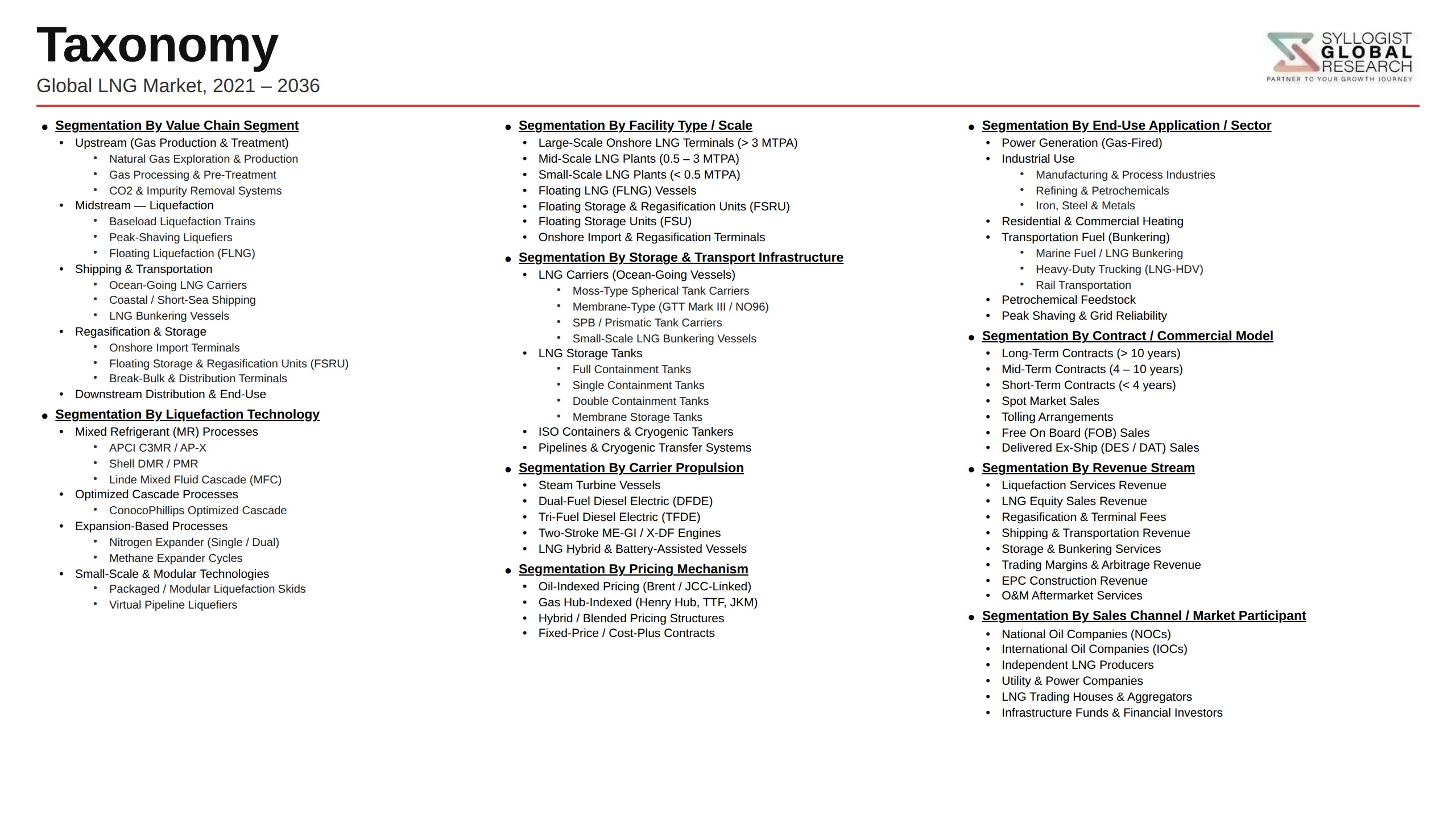
- Segmentation By Production Technology
- Onshore Base-Load Liquefaction Trains
- Floating Liquefaction (FLNG) Facilities
- Mid-Scale and Modular Liquefaction Plants
- Small-Scale Liquefaction Systems
- Peak-Shaving and Satellite Liquefaction Units
- Others
- Segmentation By Liquefaction Scale
- Large-Scale Base-Load Trains (Above 3 MTPA per Train)
- Mid-Scale Liquefaction (0.5 to 3 MTPA)
- Small-Scale Liquefaction (Below 0.5 MTPA)
- Segmentation By Application
- Power Generation and Electricity Supply
- Industrial Process Heat and Feedstock
- Residential and Commercial Gas Distribution
- Marine Bunkering and LNG as Ship Fuel
- Heavy Transport and LNG Vehicle Fuel
- Peaking and Gas Grid Balancing
- Others
- Segmentation By Storage and Transportation Mode
- LNG Carrier Vessel Shipping
- Floating Storage and Regasification Units
- Onshore LNG Storage Tanks
- LNG Tanker Truck Distribution
- ISO Container and Small-Scale LNG Logistics
- Others
- Segmentation By End Use Sector
- Power Utilities and Grid Operators
- Industrial and Heavy Manufacturing
- Gas Distribution Utilities
- Shipping and Maritime Operators
- Heavy Road Transport and Logistics
- Government and Strategic Reserves
- Others
- Segmentation By Trade Route
- Atlantic Basin Trade (US Gulf Coast to Europe)
- Pacific Basin Trade (Australia and Qatar to Asia)
- Middle East to Asia Trade Routes
- East Africa Emerging Export Routes
- Intra-Regional LNG Trade
- Others
- Segmentation By Region
- North America
- Europe
- Asia-Pacific
- Middle East and Africa
- Latin America
All market revenues are presented in USD
Historical Year: 2021-2024 | Base Year: 2025 | Estimated Year: 2026 | Forecast Period: 2027-2034
Key Questions this Study Will Answer
- What is the total global LNG market valuation in 2025, projected through 2034, segmented by production technology, application, and trade route, enabling LNG project developers, commodity traders, infrastructure investors, and importing nation energy agencies to identify the highest-growth supply and demand opportunities and most strategically significant commercial developments across the evolving global LNG trade landscape?
- How are United States export capacity expansion, Qatar North Field liquefaction additions, and emerging East African production projects reshaping global LNG supply competition dynamics, long-term contract pricing structures, and spot market liquidity, and what implications do these simultaneous capacity additions carry for delivered LNG costs and supply security for major importing nations in Europe and Asia-Pacific?
- What role is China’s LNG import trajectory, influenced by domestic gas demand growth, coal-to-gas switching policy pace, and renewable energy deployment displacing gas-fired generation, playing in determining global LNG market balance, spot price formation, and the commercial viability of new liquefaction capacity currently under consideration for final investment decision through 2034?
- How are methane emission reduction regulations, carbon border adjustment mechanisms, and corporate net zero procurement standards reshaping LNG supply chain environmental compliance investment requirements, supplier certification obligations, and the competitive positioning of low-carbon-intensity LNG producers relative to higher-emission supply sources in long-term contract negotiations with sustainability-focused utility and industrial buyers?
- What LNG shipping fleet capacity constraints, shipyard orderbook congestion, vessel delivery lead time extensions, and charter rate volatility risks are most significantly affecting LNG trading flexibility, delivered cargo economics, and project logistics planning for LNG exporters managing multi-destination cargo scheduling across Atlantic and Pacific basin trade routes through 2034?
- How are floating storage and regasification unit deployments, small-scale LNG distribution systems, and LNG bunkering infrastructure investments expanding LNG market access for smaller and emerging import nations in South and Southeast Asia, South Asia, and Africa, and what demand volumes and offtake contract structures are commercially viable for new market entry through small-scale LNG import infrastructure?
- What long-term demand displacement risks from accelerating renewable energy and battery storage deployment, carbon pricing trajectory escalation, and energy efficiency improvement programs in major LNG importing economies are constraining new liquefaction project investment economics, and how are project developers, financial investors, and energy policy agencies incorporating these risks into LNG infrastructure asset life and revenue projection assumptions?
- Product Definition
- Research Methodology
- Research Design & Framework
- Overall Research Approach: Descriptive, Exploratory & Quantitative Mixed-Method Design
- Market Definition & Scope Boundaries: What is Included and Excluded
- Segmentation Framework
- Key Research Assumptions & Limitations
- Secondary Research
- Primary Research Design & Execution
- Data Triangulation & Validation
- Market Sizing & Forecasting Methodology
- Competitive Intelligence Methodology
- Quality Assurance & Peer Review
- Definitions, Abbreviations & Data Notes
- Research Design & Framework
- Executive Summary
- Market Snapshot & Headline Numbers
- Key Findings & Research Highlights
- Market Dynamics
- Regional Market Summary
- Competitive Landscape Snapshot
- Technology & Innovation Highlights
- Market Dynamics
- Drivers
- Restraints
- Opportunities
- Challenges
- Porter’s Five Forces Analysis
- PESTLE Analysis
- Market Trends & Developments
- Emerging Trends
- Technological Developments
- Regulatory & Policy Changes
- Supply Chain & Sourcing Trends
- Manufacturing & Process Trends
- Investment & Funding Activity
- Sustainability & ESG Trends
- Risk Assessment Framework
- LNG Price Volatility, Spot Market Fluctuation & Long-Term Contract Pricing Risk
- Geopolitical Supply Disruption, Export Terminal Outage & Shipping Route Risk
- Energy Transition, Stranded Asset & Demand Erosion Risk from Renewable Energy Acceleration
- LNG Project Construction Delay, Cost Overrun & FID Cancellation Risk
- Methane Leakage, GHG Emissions Regulation & Carbon Cost Escalation Risk
- Shipping Capacity Constraint, LNG Carrier Orderbook Delay & Fleet Availability Risk
- Regulatory Framework & Standards
- LNG Export & Import Terminal Licensing, FERC, PHMSA & National Regulatory Approval Frameworks
- IMO LNG Bunkering Standards, IGF Code & LNG as Marine Fuel Safety & Operational Regulations
- LNG Quality & Specifications Standards: ISO 23306, Wobbe Index, Calorific Value & Interchangeability Requirements
- Methane Emissions Monitoring, Reporting & Verification (MRV) Standards & Fugitive Emission Regulations
- EU Gas Market Regulation, Gas Package Reform, REPowerEU & LNG Import Diversification Policy Frameworks
- LNG Trade Contracts, Destination Clause Reform, Cargo Diversion Rules & International Trade Law Frameworks
- Global LNG Market Outlook
- Market Size & Forecast by Value
- Market Size & Forecast by Volume (Million Tonnes per Annum, MTPA & bcm)
- Market Size & Forecast by Value Chain Segment
- Upstream Gas Production & Feed Gas Supply
- LNG Liquefaction & Export Terminal Infrastructure
- LNG Shipping & Marine Transportation
- LNG Regasification, Import Terminal & FSRU Infrastructure
- LNG Storage, Peak Shaving & Satellite Distribution
- LNG Trading, Portfolio Management & Marketing
- Small-Scale LNG Distribution & Last-Mile Delivery
- Market Size & Forecast by Liquefaction Technology
- Air Products APCI C3MR & AP-X Liquefaction Process
- Shell DMR (Dual Mixed Refrigerant) Liquefaction Process
- ConocoPhillips Optimised Cascade Process
- PRICO & Single Mixed Refrigerant (SMR) Liquefaction Process
- Modular & Mid-Scale LNG Liquefaction Technology
- Floating LNG (FLNG) Liquefaction Technology
- Market Size & Forecast by Terminal Type
- Onshore LNG Export Terminals & Liquefaction Trains
- Floating Liquefied Natural Gas (FLNG) Vessels & Platforms
- Onshore LNG Import & Regasification Terminals
- Floating Storage & Regasification Units (FSRUs)
- Floating Storage Units (FSUs) & Offshore LNG Transfer Infrastructure
- Small-Scale LNG Terminals, Satellite Stations & Virtual Pipeline Hubs
- Market Size & Forecast by LNG Carrier Type
- Conventional LNG Carriers (140,000 to 180,000 m3 Membrane & Moss)
- Q-Flex & Q-Max LNG Carriers (210,000 to 266,000 m3)
- Small-Scale LNG Carriers & Bunker Vessels (Below 30,000 m3)
- LNG-Fuelled LNG Carriers (DFDE, TFDE & XDF Propulsion)
- Market Size & Forecast by Contract Type
- Long-Term LNG Supply & Purchase Agreements (15 to 20+ Year Contracts)
- Medium-Term LNG Contracts (3 to 15 Years)
- Short-Term & Spot LNG Cargo Transactions
- LNG Portfolio & Tolling Arrangements
- Market Size & Forecast by Application
- Power Generation & Gas-Fired Power Plant Fuel Supply
- Industrial Feedstock & Fuel Supply
- Residential & Commercial Gas Distribution
- LNG as Marine Bunker Fuel (Shipping Decarbonisation)
- LNG as Road Transport & Heavy-Duty Vehicle Fuel
- Peak Shaving, Grid Balancing & Strategic Gas Reserve
- LNG-to-Power for Off-Grid & Developing Market Energy Access
- Market Size & Forecast by End-User
- National Gas Utilities & State-Owned Energy Companies
- Independent Power Producers (IPPs) & Gas-Fired Power Plant Operators
- Industrial & Petrochemical Companies
- Shipping Companies & Bunkering Operators
- LNG Trading Houses & Portfolio Players
- Road Transport Operators & Fleet Managers
- Emerging Market Government & Energy Access Programmes
- Market Size & Forecast by Pricing Mechanism
- Oil-Indexed LNG Pricing (Slope & S-Curve)
- Gas Hub-Indexed LNG Pricing (Henry Hub, TTF & NBP Linked)
- Hybrid & Mixed-Index LNG Pricing
- Fixed Price & Cost-of-Service LNG Pricing
- Asia-Pacific LNG Market Outlook
- Market Size & Forecast
- By Value
- By Volume (MTPA & bcm)
- By Value Chain Segment
- By Liquefaction Technology
- By Terminal Type
- By LNG Carrier Type
- By Contract Type
- By Application
- By End-User
- By Country
- By Pricing Mechanism
- Market Size & Forecast
- Europe LNG Market Outlook
- Market Size & Forecast
- By Value
- By Volume (MTPA & bcm)
- By Value Chain Segment
- By Liquefaction Technology
- By Terminal Type
- By LNG Carrier Type
- By Contract Type
- By Application
- By End-User
- By Country
- By Pricing Mechanism
- Market Size & Forecast
- North America LNG Market Outlook
- Market Size & Forecast
- By Value
- By Volume (MTPA & bcm)
- By Value Chain Segment
- By Liquefaction Technology
- By Terminal Type
- By LNG Carrier Type
- By Contract Type
- By Application
- By End-User
- By Country
- By Pricing Mechanism
- Market Size & Forecast
- Latin America LNG Market Outlook
- Market Size & Forecast
- By Value
- By Volume (MTPA & bcm)
- By Value Chain Segment
- By Liquefaction Technology
- By Terminal Type
- By LNG Carrier Type
- By Contract Type
- By Application
- By End-User
- By Country
- By Pricing Mechanism
- Market Size & Forecast
- Middle East & Africa LNG Market Outlook
- Market Size & Forecast
- By Value
- By Volume (MTPA & bcm)
- By Value Chain Segment
- By Liquefaction Technology
- By Terminal Type
- By LNG Carrier Type
- By Contract Type
- By Application
- By End-User
- By Country
- By Pricing Mechanism
- Market Size & Forecast
- Country-Wise* LNG Market Outlook
- Market Size & Forecast
- By Value
- By Volume (MTPA & bcm)
- By Value Chain Segment
- By Liquefaction Technology
- By Terminal Type
- By LNG Carrier Type
- By Contract Type
- By Application
- By End-User
- By Country
- By Pricing Mechanism
- *Countries Analyzed in the Syllogist Global Research Portfolio: United States, Canada, Mexico, Germany, France, United Kingdom, Netherlands, Spain, Italy, Belgium, Poland, Japan, China, South Korea, India, Australia, Singapore, Taiwan, Indonesia, Malaysia, Qatar, UAE, Oman, Egypt, Nigeria, Brazil, Chile, Argentina
- Market Size & Forecast
- Technology Landscape & Innovation Analysis
- Floating LNG (FLNG) Technology Deep-Dive: Prelude FLNG, Golar Hilli, PFLNG & Next-Generation FLNG Design Advances
- Modular & Mid-Scale LNG Technology: Modular Liquefaction Trains, Prefabricated Plant Design & Faster Deployment Economics
- FSRU Technology: Hull Design, High-Pressure Send-Out, Regasification Efficiency & Newbuild vs. Conversion Economics
- LNG Carrier Propulsion Technology: DFDE, TFDE, XDF, ME-GI & LNG Boil-Off Gas Utilisation Advances
- Small-Scale LNG Technology: Truck Loading, ISO Container, Coastal Bunker Vessel & Virtual Pipeline Distribution
- Methane Emission Measurement, Leak Detection & Reduction Technology Across the LNG Value Chain
- Digital Twin, AI-Optimised Liquefaction, Predictive Maintenance & LNG Terminal Automation Technology
- Patent & IP Landscape in LNG Technologies
- Value Chain & Supply Chain Analysis
- Upstream Gas Field Development, Well Completions & Feed Gas Treatment Supply Chain
- Liquefaction Equipment: Heat Exchangers, Compressors, Refrigerant Circuits & Cold Box Supply Chain
- LNG Storage Tank, Cryogenic Pipe & Insulation Material Supply Chain
- LNG Carrier Shipbuilding, Containment System & Marine Equipment Supply Chain
- Regasification Equipment, High-Pressure Pumps, Vaporisers & FSRU Component Supply Chain
- EPC Contractor, Project Developer & Technology Licensor Channel
- LNG Trading, Shipping Management, Brokerage & Cargo Optimisation Channel
- Gas Transmission, Distribution Network & End-User Delivery Channel
- Pricing Analysis
- Global LNG Price Benchmarking: JKM, TTF, NBP, Henry Hub & Regional Spot Price Analysis
- LNG Liquefaction Cost Analysis: Overnight Capex, Opex, Tolling Fee & Breakeven Price by Project Type
- LNG Shipping Cost Analysis: Freight Rate, Vessel Charter, Boil-Off & Route Economics
- LNG Regasification Cost Analysis: FSRU Lease Rate, Onshore Terminal Cost & Send-Out Tariff
- Full-Chain LNG Supply Cost: Landed Cost Analysis by Export Origin & Import Destination
- LNG Contract Pricing Structure: Slope Negotiation, Destination Flexibility Premium & DES vs. FOB Comparison
- Sustainability & Environmental Analysis
- Lifecycle GHG Emissions of LNG: Upstream Methane Leakage, Liquefaction Energy, Shipping & Combustion Emissions
- LNG vs. Coal Displacement: Net Climate Benefit, Carbon Intensity Comparison & Methane Leakage Break-Even Analysis
- LNG as Marine Fuel: IMO 2050 Decarbonisation Pathway, GHG Intensity vs. VLSFO & Transition Fuel Role
- Net Zero Pathways for LNG: Carbon Capture at Liquefaction, Biomethane Blending & Carbon-Neutral LNG Certification
- ESG Disclosure, Responsible LNG Sourcing Standards & Green Finance Eligibility for LNG Infrastructure
- Competitive Landscape
- Market Structure & Concentration
- Market Consolidation Level (Fragmented vs. Consolidated by Value Chain Segment & Geography)
- Top 10 Players Market Share
- HHI (Herfindahl-Hirschman Index) Concentration Analysis
- Competitive Intensity Map by Value Chain Segment, Application & Geography
- Player Classification
- Integrated LNG Majors & National Oil Companies with Liquefaction & Export Portfolios
- LNG Portfolio Players, Trading Houses & Marketing Companies
- LNG Shipping Companies & Fleet Operators
- FSRU Owners, Regasification Terminal Operators & Import Infrastructure Developers
- Small-Scale LNG Distributors, Virtual Pipeline Operators & Bunkering Providers
- LNG Technology Licensors & Equipment Manufacturers
- Competitive Analysis Frameworks
- Market Share Analysis by Value Chain Segment, Liquefaction Capacity & Region
- Company Profile
- Company Overview & Headquarters
- LNG Asset Portfolio, Liquefaction Capacity & Shipping Fleet
- Key Customer Relationships, Offtake Contracts & Reference Projects
- LNG Production, Export & Trading Volume
- Revenue (LNG Segment) & Project Backlog
- Technology Differentiators & IP
- Key Strategic Partnerships, JVs & M&A Activity
- Recent Developments (FID Announcements, Contract Wins, Capacity Expansion)
- SWOT Analysis
- Strategic Focus Areas & Roadmap
- Competitive Positioning Map (Portfolio Scale vs. Market Penetration)
- Key Company Profiles
- Market Structure & Concentration
- Technology Landscape & Innovation Analysis
- Strategic Output
- Market Opportunity Matrix: By Value Chain Segment, Terminal Type, Application, End-User & Geography
- White Space Opportunity Analysis
- Strategic Recommendations
- Portfolio Development & Liquefaction Capacity Investment Strategy
- Fleet Expansion, Shipping & Logistics Optimisation Strategy
- Geographic Expansion & New Import Market Entry Strategy
- Customer, Offtake Partner & Contract Structuring Strategy
- Partnership, M&A & LNG Ecosystem Strategy
- Sustainability, Methane Abatement & Carbon-Neutral LNG Strategy
- Risk Mitigation & Future Roadmap
- Strategic Priority Matrix & Roadmap
- Near-term (2025-2028)
- Mid-term (2029-2032)
- Long-term (2033-2037)
- Strategic Output