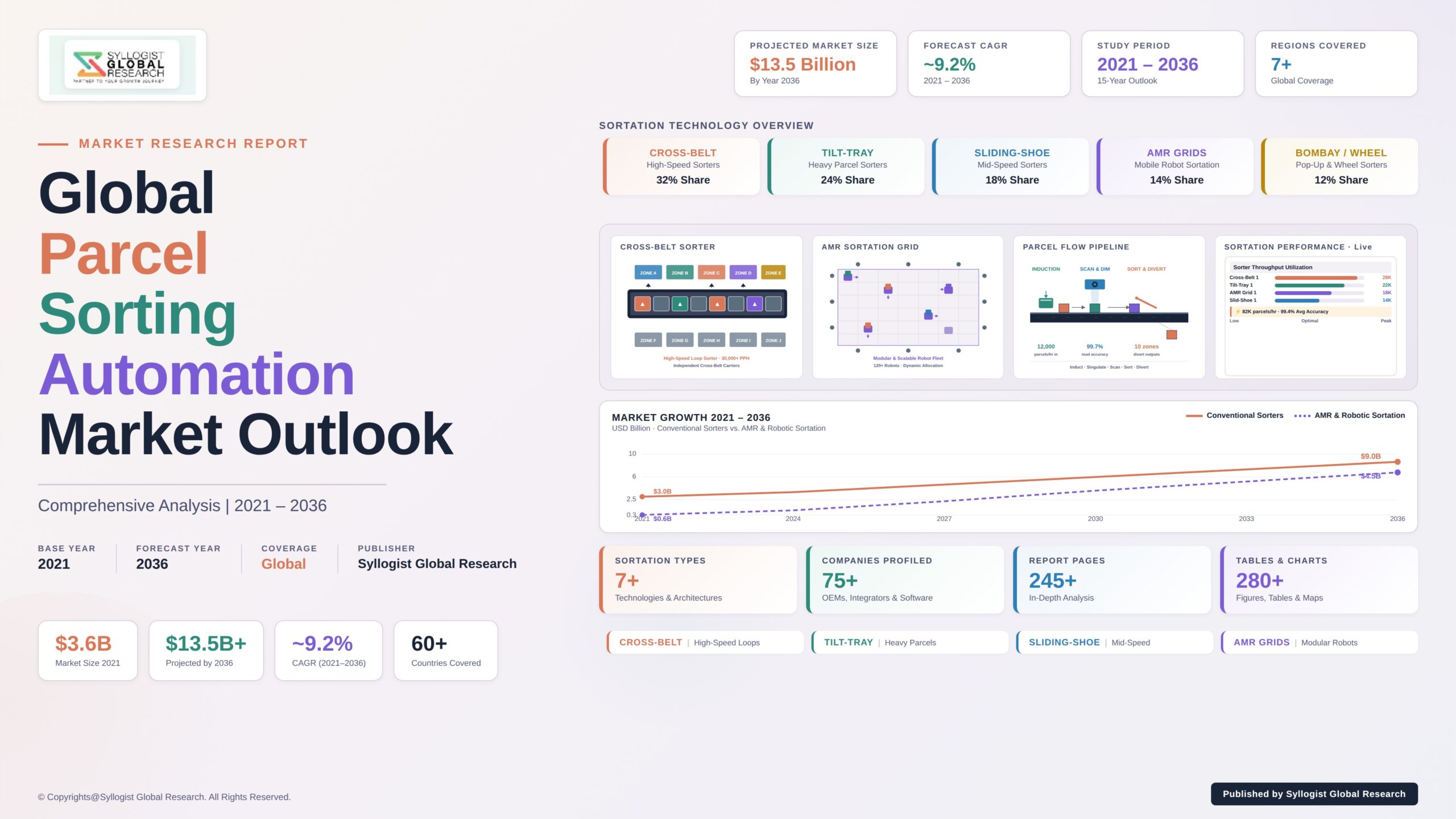
Global Parcel Sorting Automation Market By Sorting Technology, By Throughput Capacity, By Component, By Application, By Parcel Type, By Deployment Model, By End User, By Region, Competition, Forecast & Opportunities, 2021-2034F
Market Definition
Parcel sorting automation systems are integrated electromechanical and software platforms designed to automatically identify, classify, route, and dispatch packages, mail items, and small parcels across logistics hubs, distribution centers, postal processing facilities, and e-commerce fulfillment networks at high throughput rates with minimal manual intervention. The Global Parcel Sorting Automation Market encompasses the design, manufacturing, integration, deployment, and operation of cross-belt sorters, tilt-tray sorters, sliding-shoe sorters, narrow-belt sorters, bombay sorters, pop-up wheel sorters, autonomous mobile robot sortation cells, robotic induction and pick-and-place workstations, conveyor-integrated sortation systems, and associated software including warehouse control systems (WCS), warehouse execution systems (WES), barcode and dimensioning scanners, machine vision identification platforms, and artificial intelligence-driven sortation planning engines.
The parcel sorting automation market covers hardware, software, integration services, and aftermarket support including spare parts, predictive maintenance, software updates, retrofit modernization, and remote monitoring services. Market participants include sortation system original equipment manufacturers, robotics specialists, conveyor and material handling integrators, machine vision and barcode scanning suppliers, autonomous mobile robot (AMR) developers, warehouse control software providers, and systems integrators delivering end-to-end automated parcel sortation projects. End users span national postal operators, parcel and express courier companies, e-commerce fulfillment operators, third-party logistics providers, large retailers operating direct-to-consumer fulfillment networks, regional parcel carriers, and intra-airport baggage and parcel handling facilities. The parcel sorting automation market explicitly excludes manual sorting workstations, airline passenger baggage handling systems as a primary application, bulk material handling systems, and industrial part-picking robotics for manufacturing environments, focusing exclusively on automated parcel sortation across logistics, postal, and e-commerce operational contexts globally.
Market Insights
The global parcel sorting automation market is undergoing accelerated structural growth, shaped by the sustained expansion of e-commerce parcel volumes, intensifying labor cost pressure across logistics operations, the rapid scaling of same-day and next-day delivery service-level commitments by major retail and courier networks, and the maturing commercial deployment of robotics, machine vision, and artificial intelligence technologies enabling cost-effective automation at sortation hub scales previously dependent on large manual workforces. The parcel sorting automation market was valued at approximately USD 4.6 billion in 2025 and is projected to reach USD 11.2 billion by 2034, advancing at a compound annual growth rate of 10.3% through the forecast period, as parcel carriers, postal operators, e-commerce fulfillment operators, and third-party logistics providers scale automated sortation capacity to manage rising parcel throughput per facility and per shift.
The trajectory of the parcel sorting automation market is being reshaped by the commercial maturation of robotic induction workstations, autonomous mobile robot (AMR) sortation grids, six-sided machine vision dimensioning systems, and artificial intelligence-driven address recognition platforms that handle handwritten labels, damaged barcodes, and irregular package geometries with reading accuracy exceeding 99.5%. Robotic parcel induction stations have reached commercial scaling thresholds, with integrators delivering robotic depalletization, singulation, and induction cells operating at sustained rates above 1,500 parcels per hour per robotic arm, materially reducing dependence on manual induction labor that historically constituted over 35% of total parcel sortation workforce headcount. AMR-based sortation grids that replace fixed sliding-shoe and cross-belt sorters with modular fleets of mobile sortation robots are gaining strong commercial traction in mid-throughput regional sortation centers, where operational flexibility, scalability, and incremental capital deployment economics outperform monolithic fixed sortation infrastructure.
Cross-belt sorters represent the largest revenue-contributing technology segment within the parcel sorting automation market, propelled by high-throughput central sortation hub deployments operated by national postal authorities, integrators, and express courier networks requiring sustained sortation rates exceeding 10,000 parcels per hour with consistent reading accuracy across diverse parcel formats. Autonomous mobile robot sortation systems represent the fastest-growing technology segment within the parcel sorting automation market, driven by adoption among regional fulfillment centers, e-commerce returns processing facilities, and mid-tier parcel carriers requiring scalable automation aligned to evolving throughput requirements. E-commerce fulfillment is the largest application segment within the parcel sorting automation market, fueled by sustained double-digit e-commerce parcel volume growth across mature and emerging markets, while parcel and express courier applications represent the second largest application segment underpinned by sustained capital expenditure programs from major global integrators investing in next-generation regional sortation hub capacity.
Asia-Pacific is projected to record the highest regional compound annual growth rate through 2034 within the parcel sorting automation market, underpinned by accelerating e-commerce parcel volumes in China, India, Indonesia, Vietnam, and Southeast Asia, where rising organized e-commerce penetration, expanding domestic courier networks, and rapid sortation hub buildout are driving substantial automation procurement. China handles over 130 billion parcels annually and continues to lead global automated sortation hub deployment, with multiple integrators commissioning facilities exceeding 100,000 parcels per hour throughput capacity. North America represents the second largest regional position within the parcel sorting automation market, supported by major express courier capital programs, retail fulfillment network expansion, and labor cost pressure driving accelerated automation adoption. Europe occupies the third major regional market, shaped by mature postal operator automation, growing cross-border e-commerce parcel flows, and tightening labor regulation reinforcing automation procurement priorities across the parcel sorting automation market.
Key Drivers
Sustained E-Commerce Parcel Volume Growth, Returns Processing Capacity Expansion, and Multi-Channel Retail Fulfillment Driving Sortation Throughput Investment Mandates
The structural expansion of global e-commerce parcel volumes, expanding returns processing capacity requirements, and the rapid scaling of multi-channel retail fulfillment models requiring integrated automated sortation are generating durable procurement demand for sortation systems across regional fulfillment centers, central sortation hubs, and returns processing facilities within the parcel sorting automation market. Global parcel volumes are projected to exceed 250 billion shipments annually by 2027, with e-commerce parcel growth rates sustained above 8% to 10% across mature markets and exceeding 15% in select emerging economies. E-commerce returns volumes are scaling at over 12% annually, with major retailers commissioning dedicated returns processing facilities equipped with high-speed parcel sortation, dimensioning, condition assessment, and reverse logistics routing systems. Multi-channel retail fulfillment operators integrating store-fulfillment, dark store, and central distribution networks are commissioning modular automated sortation systems supporting parallel processing of marketplace, direct-to-consumer, and store replenishment parcel streams. Parcel sorting automation procurement is increasingly structured under multi-year framework agreements covering site rollout schedules, software platform standardization, and aftermarket service commitments, generating long-duration revenue commitments that anchor manufacturer production planning and integrator capacity scaling decisions across the parcel sorting automation market value chain.
Logistics Labor Cost Inflation, Sortation Workforce Scarcity, and Service-Level Compression Driving Automation Procurement Across Parcel Carrier Networks
Sustained logistics labor cost inflation, structural sortation workforce scarcity across major postal and parcel operating regions, and intensifying competitive pressure to compress next-day, same-day, and intra-day parcel delivery service-level commitments are collectively driving accelerated procurement of parcel sorting automation systems across global parcel carrier networks, e-commerce fulfillment operators, and national postal authorities. Logistics sector wages have risen by over 18% in North America and 12% to 15% in Western Europe between 2021 and 2025, materially elevating manual sortation operating cost baselines and reducing payback periods for automated sortation capital investments to under 3 years for high-throughput central hub deployments within the parcel sorting automation market. Sortation workforce scarcity manifests across both peak season seasonal hiring and structural year-round headcount targets, with parcel carriers reporting unfilled sortation positions averaging above 10% of authorized headcount across major operating regions during peak demand periods. Service-level compression by major e-commerce retailers and integrators mandates substantially shorter sortation hub processing windows than legacy operational models, generating procurement preference for high-throughput automation that consistently maintains accuracy and pace under compressed operational schedules.
Maturation of Robotics, Machine Vision, and AI-Driven Sortation Software Reducing Capital Cost and Expanding Application Envelope for Automated Sortation Systems
The commercial maturation of robotic induction workstations, six-sided machine vision dimensioning systems, autonomous mobile robot sortation grids, and artificial intelligence-driven address recognition platforms is materially reducing capital cost premiums associated with sortation automation while simultaneously expanding the application envelope to encompass irregular parcels, polybags, padded mailers, and damaged or non-standard package geometries that legacy fixed sortation infrastructure could not consistently process. Reading accuracy of AI-driven address and barcode recognition systems now consistently exceeds 99.5% across diverse parcel formats including handwritten labels and damaged barcodes, materially reducing manual exception handling labor requirements that historically constrained automation business cases for high-mix parcel streams. AMR sortation grids deliver flexible, modular automation capacity that scales incrementally to match throughput growth, providing capital deployment economics that fundamentally outperform monolithic fixed sortation infrastructure for regional fulfillment operators with evolving capacity requirements. Robotic singulation and induction workstations operating at sustained rates exceeding 1,500 parcels per hour are reducing manual induction labor headcount requirements at central sortation hubs while consistently improving label orientation, parcel separation, and downstream sortation accuracy within the parcel sorting automation market across both greenfield and brownfield deployment scenarios.
Key Challenges
High Capital Intensity, Extended Implementation Timelines, and Site-Specific Engineering Complexity Constraining Sortation Automation Procurement Decisions
Parcel sorting automation systems remain capital-intensive infrastructure investments, with full-scale central sortation hub automation projects typically requiring USD 30 million to USD 150 million in combined hardware, software, integration, and site preparation investments, generating procurement risk profiles that constrain adoption among mid-tier parcel carriers, regional postal operators, and smaller e-commerce fulfillment operators with constrained capital budgets. Implementation timelines for large central hub automation projects routinely extend across 18 to 30 months, including site engineering, equipment manufacturing lead times, civil works, installation, commissioning, and operational ramp-up phases, generating extended payback timelines and capital deployment uncertainty for operators planning fleet-wide automation rollouts within the parcel sorting automation market. Site-specific engineering complexity remains substantial, with sortation system design requiring detailed parcel flow modeling, throughput curve forecasting, peak surge sizing, future expansion provision, and integration with upstream and downstream conveyor, induction, and dispatch infrastructure unique to each facility. The combined effect of capital intensity, extended implementation timelines, and site-specific engineering complexity continues to constrain the pace at which mid-tier operators can scale sortation automation deployment across distributed sortation hub networks.
Irregular Parcel Handling Limitations, Damaged Label Processing, and Returns Stream Complexity Constraining Achievable Automation Rates in Mixed-Format Operating Environments
Parcel sorting automation systems continue to encounter operational limitations when processing irregular parcels including soft polybags, padded mailers, oversized items, and structurally non-uniform packages, alongside damaged labels, handwritten address blocks, and returns stream parcels with worn or partially obscured shipping markings. These edge-case parcel categories collectively account for between 12% and 25% of total parcel throughput across major sortation hubs and routinely require manual exception handling, partial re-induction, or specialist workstation processing that erodes the operational productivity gains motivating automation procurement decisions within the parcel sorting automation market. Returns processing facilities confront particularly elevated exception rates, with returns parcels presenting damaged outer packaging, removed shipping labels, and inconsistent dimensioning that current sortation algorithms address with reduced consistency relative to outbound parcel streams. Operators commissioning new sortation hubs must therefore size manual exception handling workstation capacity well above the automation system capability envelope, increasing overall facility headcount requirements and constraining the net labor cost reduction achievable through automation investment. The persistence of irregular parcel formats across e-commerce, returns, and cross-border parcel streams creates ongoing operational challenges that integrator engineering teams continue to address through machine vision algorithm refinement and specialist handling cell integration.
Integration Complexity Across Legacy Warehouse Control Systems, Cybersecurity Risks, and Cross-Border Carrier Software Standardization Challenges
The integration of new automated sortation systems with legacy warehouse control systems, warehouse management systems, transportation management systems, and carrier-specific scanning and labeling platforms remains operationally complex, generating extended commissioning timelines, software customization investments, and ongoing maintenance complexity that elevate total cost of ownership across the parcel sorting automation market. Cybersecurity exposure of networked sortation infrastructure has emerged as a material operational risk, with sortation hub control systems representing high-value targets for ransomware actors seeking to disrupt time-critical parcel flows during peak commercial periods, and several major parcel carriers have experienced operational disruption attributable to cybersecurity incidents affecting sortation control systems. Cross-border parcel flows require standardized data exchange between origin sortation hubs, transit hubs, customs processing systems, and destination delivery networks, but software platform standardization across major carrier networks remains inconsistent, generating integration overhead for international parcel flows that constrains operational scalability for cross-border express courier networks. The combined complexity of legacy systems integration, cybersecurity exposure, and cross-border software standardization gaps adds operational risk and integration cost to sortation automation procurement projects and continues to require dedicated information technology engineering investment alongside hardware capital deployment within the parcel sorting automation market.
Market Segmentation
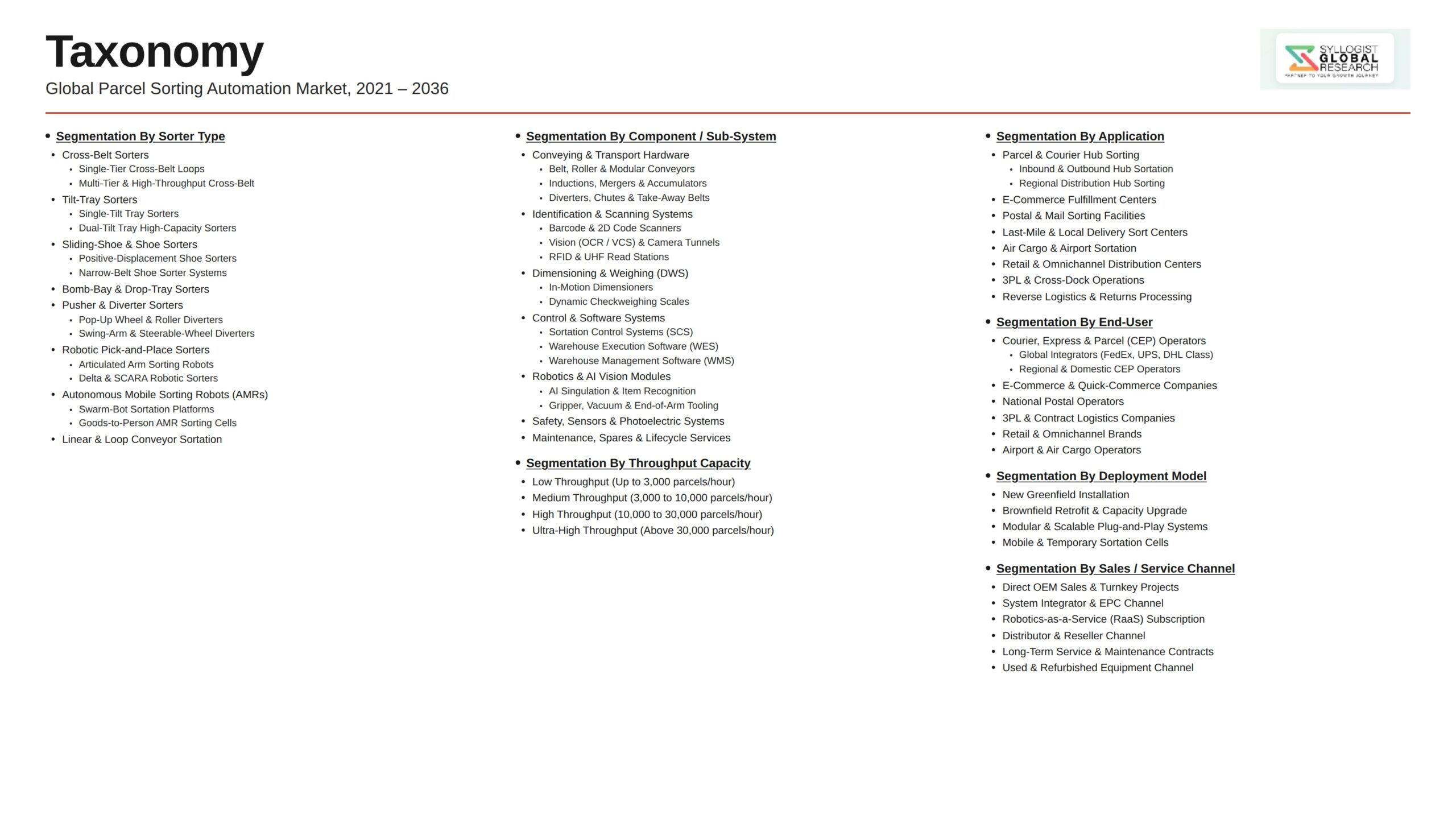
- Segmentation By Sorting Technology
- Cross-Belt Sorters
- Tilt-Tray Sorters
- Sliding-Shoe Sorters
- Narrow-Belt Sorters
- Bombay Sorters
- Pop-Up Wheel Sorters
- Autonomous Mobile Robot Sortation Systems
- Others
- Segmentation By Throughput Capacity
- Up to 5,000 Parcels per Hour
- 5,000 to 15,000 Parcels per Hour
- 15,000 to 30,000 Parcels per Hour
- Above 30,000 Parcels per Hour
- Segmentation By Component
- Hardware (Sortation Modules, Conveyors, Robotic Arms)
- Software (Warehouse Control Systems, Warehouse Execution Systems)
- Services (Integration, Maintenance, Software Updates)
- Segmentation By Application
- E-Commerce Fulfillment
- Parcel and Express Courier Operations
- Postal Sorting and Distribution
- Retail Distribution Centers
- Third-Party Logistics Operations
- Returns Processing Facilities
- Others
- Segmentation By Parcel Type
- Small Parcels
- Medium Parcels
- Large Parcels
- Polybags and Padded Mailers
- Irregular and Non-Conveyable Items
- Segmentation By Deployment Model
- New Greenfield Installations
- Brownfield Retrofit and Modernization
- Modular Scalable Deployments
- Segmentation By End User
- National Postal Operators
- Parcel and Express Courier Companies
- E-Commerce Fulfillment Operators
- Third-Party Logistics Providers
- Large Retailers with Direct-to-Consumer Fulfillment
- Regional Parcel Carriers
- Others
- Segmentation By Region
- North America
- Europe
- Asia-Pacific
- Middle East and Africa
- Latin America
All market revenues are presented in USD
Historical Year: 2021-2024 | Base Year: 2025 | Estimated Year: 2026 | Forecast Period: 2027-2034
Key Questions this Study Will Answer
- What is the total global market valuation of the Parcel Sorting Automation Market in 2025, projected through 2034, segmented by sorting technology, throughput capacity, component, and application, enabling sortation system manufacturers, integrators, operators, and investors to identify highest-growth segments and most durable revenue opportunities across the parcel sorting automation landscape?
- How are national postal operators, express courier companies, e-commerce fulfillment operators, and third-party logistics providers structuring procurement frameworks for sortation automation projects, and which operating models, including capital purchase, integrator-led turnkey delivery, and modular incremental deployment, are shaping commercial deployment economics within the parcel sorting automation market through 2034?
- What labor cost inflation dynamics, sortation workforce availability constraints, and service-level compression pressures are shaping the pace and geographic distribution of automation procurement across mature and emerging parcel carrier networks?
- Which sortation technologies, including cross-belt, tilt-tray, sliding-shoe, autonomous mobile robot grids, and robotic induction workstations, are gaining the strongest procurement traction across central hub, regional fulfillment, and returns processing applications, and what throughput, accuracy, and total cost of ownership metrics are shaping technology selection decisions?
- How is the competitive landscape structured among sortation system original equipment manufacturers, robotics specialists, machine vision providers, warehouse control software providers, and end-to-end systems integrators within the parcel sorting automation market, and what partnership, acquisition, and platform expansion strategies are enabling new entrants to compete against established sortation infrastructure suppliers?
- What artificial intelligence, machine vision, and robotic induction technology trajectories are reshaping address recognition accuracy, irregular parcel handling capability, and labor cost reduction potential within sortation hub operations globally?
- Which regional markets, including Asia-Pacific, Europe, and North America, are projected to generate the largest incremental parcel sorting automation procurement opportunities through 2034, and what e-commerce volume, labor regulation, capital deployment, and infrastructure factors are shaping capability investment priorities and supplier selection decisions in each regional parcel sorting automation market?
- Product Definition
- Research Methodology
- Research Design & Framework
- Overall Research Approach: Descriptive, Exploratory & Quantitative Mixed-Method Design
- Market Definition & Scope Boundaries: What is Included and Excluded
- Segmentation Framework
- Key Research Assumptions & Limitations
- Secondary Research
- Primary Research Design & Execution
- Data Triangulation & Validation
- Market Sizing & Forecasting Methodology
- Competitive Intelligence Methodology
- Quality Assurance & Peer Review
- Definitions, Abbreviations & Data Notes
- Executive Summary
- Market Snapshot & Headline Numbers
- Key Findings & Research Highlights
- Market Dynamics
- Regional Market Summary
- Competitive Landscape Snapshot
- Technology & Innovation Highlights
- Market Dynamics
- Drivers
- Restraints
- Opportunities
- Challenges
- Porter’s Five Forces Analysis
- PESTLE Analysis
- Market Trends & Developments
- Emerging Trends
- Technological Developments
- Regulatory & Policy Changes
- Supply Chain & Sourcing Trends
- Manufacturing & Process Trends
- Investment & Funding Activity
- Sustainability & ESG Trends
- Risk Assessment Framework
- Capital Intensity, Extended Implementation Timeline & Site-Specific Engineering Complexity Risk
- Irregular Parcel Handling Limitation, Edge-Case Performance & Manual Exception Handling Risk
- Cybersecurity Exposure, Ransomware Attack & Sortation Control System Integrity Risk
- Legacy WCS, WMS & TMS Integration Complexity and Cross-Border Carrier Software Standardisation Risk
- Parcel Volume Cycle Volatility, Peak Surge Sizing & Capacity Sizing Trade-Off Risk
- Regulatory Framework & Standards
- Postal & Express Courier Industry Standards (Universal Postal Union, IATA, ICAO Cargo Security Frameworks)
- Customs Pre-Clearance, Cross-Border Trade Documentation & Electronic Advance Data Standards
- Occupational Safety, Workplace Ergonomics & Robotic Equipment Safety Standards (ISO 10218, ANSI/RIA R15.06, OSHA)
- Data Privacy, Cybersecurity & Parcel Information Handling Compliance Standards
- Sustainability, Energy Efficiency & Sortation Equipment Procurement Standards
- Global Parcel Sorting Automation Market Outlook
- Market Size & Forecast by Value
- Market Size & Forecast by Volume (Sortation Throughput Capacity Installed in Million Parcels per Hour and Number of Active Sortation Facilities)
- Market Size & Forecast by Sorting Technology
- Cross-Belt Sorters
- Tilt-Tray Sorters
- Sliding-Shoe Sorters
- Narrow-Belt Sorters
- Bombay Sorters
- Pop-Up Wheel Sorters
- Autonomous Mobile Robot (AMR) Sortation Systems
- Others
- Market Size & Forecast by Throughput Capacity
- Up to 5,000 Parcels per Hour
- 5,000 to 15,000 Parcels per Hour
- 15,000 to 30,000 Parcels per Hour
- Above 30,000 Parcels per Hour
- Market Size & Forecast by Component
- Hardware (Sortation Modules, Conveyors, Robotic Arms)
- Software (Warehouse Control Systems, Warehouse Execution Systems)
- Services (Integration, Maintenance, Software Updates)
- Market Size & Forecast by Application
- E-Commerce Fulfillment
- Parcel and Express Courier Operations
- Postal Sorting and Distribution
- Retail Distribution Centers
- Third-Party Logistics Operations
- Returns Processing Facilities
- Others
- Market Size & Forecast by Parcel Type
- Small Parcels
- Medium Parcels
- Large Parcels
- Polybags and Padded Mailers
- Irregular and Non-Conveyable Items
- Market Size & Forecast by Deployment Model
- New Greenfield Installations
- Brownfield Retrofit and Modernisation
- Modular Scalable Deployments
- Market Size & Forecast by End-User
- National Postal Operators
- Parcel and Express Courier Companies
- E-Commerce Fulfillment Operators
- Third-Party Logistics Providers
- Large Retailers with Direct-to-Consumer Fulfillment
- Regional Parcel Carriers
- Others
- Market Size & Forecast by Sales Channel
- Direct OEM Equipment Supply & System Integration Contracts
- Engineering, Procurement & Construction (EPC) Turnkey Contracts
- Modular Scalable Equipment Procurement Channel
- Sortation-as-a-Service Operating Contracts
- Aftermarket Service, Maintenance & Software Update Contracts
- North America Parcel Sorting Automation Market Outlook
- Market Size & Forecast
- By Value
- By Volume (Sortation Throughput Capacity Installed in Million Parcels per Hour and Number of Active Sortation Facilities)
- By Sorting Technology
- By Throughput Capacity
- By Component
- By Application
- By Parcel Type
- By Deployment Model
- By End-User
- By Country
- By Sales Channel
- Europe Parcel Sorting Automation Market Outlook
- Market Size & Forecast
- By Value
- By Volume (Sortation Throughput Capacity Installed in Million Parcels per Hour and Number of Active Sortation Facilities)
- By Sorting Technology
- By Throughput Capacity
- By Component
- By Application
- By Parcel Type
- By Deployment Model
- By End-User
- By Country
- By Sales Channel
- Asia-Pacific Parcel Sorting Automation Market Outlook
- Market Size & Forecast
- By Value
- By Volume (Sortation Throughput Capacity Installed in Million Parcels per Hour and Number of Active Sortation Facilities)
- By Sorting Technology
- By Throughput Capacity
- By Component
- By Application
- By Parcel Type
- By Deployment Model
- By End-User
- By Country
- By Sales Channel
- Latin America Parcel Sorting Automation Market Outlook
- Market Size & Forecast
- By Value
- By Volume (Sortation Throughput Capacity Installed in Million Parcels per Hour and Number of Active Sortation Facilities)
- By Sorting Technology
- By Throughput Capacity
- By Component
- By Application
- By Parcel Type
- By Deployment Model
- By End-User
- By Country
- By Sales Channel
- Middle East & Africa Parcel Sorting Automation Market Outlook
- Market Size & Forecast
- By Value
- By Volume (Sortation Throughput Capacity Installed in Million Parcels per Hour and Number of Active Sortation Facilities)
- By Sorting Technology
- By Throughput Capacity
- By Component
- By Application
- By Parcel Type
- By Deployment Model
- By End-User
- By Country
- By Sales Channel
- Country-Wise* Parcel Sorting Automation Market Outlook
- Market Size & Forecast
- By Value
- By Volume (Sortation Throughput Capacity Installed in Million Parcels per Hour and Number of Active Sortation Facilities)
- By Sorting Technology
- By Throughput Capacity
- By Component
- By Application
- By Parcel Type
- By Deployment Model
- By End-User
- By Country
- By Sales Channel
- Market Size & Forecast
- Market Size & Forecast
- Market Size & Forecast
- Market Size & Forecast
- Market Size & Forecast
- Market Size & Forecast
*Countries Analysed in the Global Research Portfolio: United States, Canada, Mexico, Germany, France, United Kingdom, Netherlands, Spain, Italy, Norway, Sweden, China, Japan, India, Australia, South Korea, Singapore, Brazil, Chile, Saudi Arabia, UAE, Egypt, South Africa, Israel
- Technology Landscape & Innovation Analysis
- Cross-Belt, Tilt-Tray, Sliding-Shoe & Conventional Sortation Technology Deep-Dive
- Autonomous Mobile Robot (AMR) Sortation Grid & Modular Mobile Sortation Technology
- Robotic Induction, Singulation & Pick-and-Place Workstation Technology
- Machine Vision, AI Address Recognition & Six-Sided Dimensioning Technology
- Warehouse Control System (WCS), Warehouse Execution System (WES) & Sortation Software Integration Technology
- Real-Time Sortation Analytics, IoT Sensor Integration & Predictive Maintenance Technology
- Robotic Returns Processing, Reverse Logistics Automation & Irregular Parcel Handling Technology
- Patent & IP Landscape in Parcel Sorting Automation Technologies
- Value Chain & Supply Chain Analysis
- Sortation Hardware Manufacturing Supply Chain (Cross-Belt, Tilt-Tray, Sliding-Shoe, Conveyor Modules)
- Autonomous Mobile Robot & Mobile Robotics Manufacturing Supply Chain
- Robotic Arm, Vision System, LiDAR & Sensor Component Supply Chain
- Software Development Supply Chain (WCS, WES, AI Models, Address Recognition Platforms)
- Systems Integrator, EPC Contractor & Project Developer Procurement Landscape
- Postal Operator, Express Courier & E-Commerce Operator Channel
- Aftermarket Service, Spare Parts, Software Update & Long-Term Maintenance Network
- Pricing Analysis
- Cross-Belt, Tilt-Tray & Sliding-Shoe Sorter Pricing Analysis per Throughput Bracket
- Autonomous Mobile Robot Sortation Grid Capital and Per-Robot Pricing Analysis
- Robotic Induction Workstation, Machine Vision & Six-Sided Dimensioning System Pricing Analysis
- Warehouse Control Software, Warehouse Execution System & AI Address Recognition Software Licensing Analysis
- Sortation Hub Project Economics: Total Capital Cost per Throughput Capacity (USD per Parcel-Per-Hour Installed)
- Operating Cost Analysis: Per-Parcel Sortation Cost, Labour Reduction Economics & Maintenance Cost Benchmarks
- Total Cost of Ownership & Payback Period Analysis Across Sortation Technology Configurations
- Sustainability & Environmental Analysis
- Lifecycle Assessment (LCA) of Parcel Sorting Automation: Energy Consumption, Carbon Footprint & Material Use Across Technology Categories
- Energy Efficiency, Variable Frequency Drives & Regenerative Conveyor Technology Contribution to Sortation Hub Decarbonisation
- End-of-Life Sortation Equipment Recycling, Component Recovery & Circular Economy Performance Across Sortation Operators
- Carbon Emissions Reduction Through Sortation Efficiency, Reduced Re-Sortation & Optimised Cargo Routing
- Regulatory-Driven Sustainability, SDG 9 (Industry, Innovation and Infrastructure) & SDG 12 (Responsible Consumption) Alignment & Green Finance Eligibility
- Competitive Landscape
- Market Structure & Concentration
- Market Consolidation Level (Fragmented vs. Consolidated by Sorting Technology & Geography)
- Top 10 Players Market Share
- HHI (Herfindahl-Hirschman Index) Concentration Analysis
- Competitive Intensity Map by Sorting Technology, Application & Geography
- Player Classification
- Integrated Sortation System Original Equipment Manufacturers (OEMs)
- Specialist Cross-Belt, Tilt-Tray & Sliding-Shoe Sorter Manufacturers
- Autonomous Mobile Robot (AMR) Sortation Grid Specialists
- Robotic Induction, Singulation & Pick-and-Place Workstation Specialists
- Machine Vision, AI Address Recognition & Dimensioning System Providers
- Warehouse Control Software, WCS, WES & Integration Software Providers
- Conveyor & Material Handling System Integrators
- End-to-End Systems Integrators Specialising in Sortation Hub Delivery
- Competitive Analysis Frameworks
- Market Share Analysis by Sorting Technology, Application & Region
- Company Profile
- Company Overview & Headquarters
- Parcel Sorting Automation Products & Technology Portfolio
- Key Customer Relationships & Reference Sortation Hub Installations
- Manufacturing Footprint & Production Capacity
- Revenue (Parcel Sorting Automation Segment) & Order Backlog
- Technology Differentiators & IP
- Key Strategic Partnerships, JVs & M&A Activity
- Recent Developments (Contract Wins, Capacity Expansion, Product Launches)
- SWOT Analysis
- Strategic Focus Areas & Roadmap
- Competitive Positioning Map (Technology Capability vs. Market Penetration)
- Key Company Profiles
- Market Structure & Concentration
- Technology Landscape & Innovation Analysis
- Strategic Output
- Market Opportunity Matrix: By Sorting Technology, Application, End-User & Geography
- White Space Opportunity Analysis
- Strategic Recommendations
- Product Portfolio & Technology Investment Strategy
- Manufacturing & Operational Excellence Strategy
- Geographic Expansion & Localisation Strategy
- Customer & End-User Engagement Strategy
- Partnership, M&A & Ecosystem Strategy
- Sustainability & Circular Economy Strategy
- Risk Mitigation & Future Roadmap
- Strategic Priority Matrix & Roadmap
- Near-term (2025-2028)
- Mid-term (2029-2032)
- Long-term (2033-2037)