North America Warehouse Automation Market By Component, By System Type, By Function, By Warehouse Type, By End User, By Country, Competition, Forecast & Opportunities, 2021-2036F
Market Definition
The North America Warehouse Automation Market covers the design, manufacture, supply, integration, software development, installation, and aftermarket service of advanced robotic, conveyance, storage, and software systems used to automate the receipt, storage, retrieval, picking, packing, sorting, and shipping of goods across distribution centers, fulfillment centers, micro-fulfillment hubs, cold storage facilities, manufacturing plants, retail backrooms, and third-party logistics operations across the United States, Canada, and Mexico. The market encompasses hardware platforms including automated storage and retrieval systems (AS/RS), autonomous mobile robots (AMRs), automated guided vehicles (AGVs), goods-to-person systems, robotic piece-picking arms, conveyor and sortation systems, palletizers, depalletizers, automated case handling systems, shuttle systems, and emerging humanoid logistics robots, alongside software platforms covering warehouse management systems (WMS), warehouse execution systems (WES), warehouse control systems (WCS), labor management systems (LMS), digital twin platforms, AI-enabled orchestration software, and emerging fleet management platforms. The supplier landscape spans integrated automation providers including Honeywell Intelligrated, Dematic (KION Group), Daifuku, Vanderlande (Toyota Industries), Murata Machinery, Bastian Solutions, Witron, Knapp, SSI Schaefer, Swisslog, Kardex Remstar, AutoStore, alongside AMR and robotics specialists Symbotic, Locus Robotics, Fetch Robotics (Zebra Technologies), 6 River Systems (Ocado), GreyOrange, Geek+, Berkshire Grey, Boston Dynamics, Agility Robotics, Figure AI, Apptronik, and emerging software-led platforms Manhattan Associates, Blue Yonder, Korber Supply Chain, Softeon, and Tecsys. Market dynamics are governed by accelerating e-commerce fulfillment intensity, labor cost inflation, US reshoring under CHIPS Act and IRA frameworks, USMCA-driven Mexican manufacturing growth, and the rapid commercial emergence of AI-enabled and humanoid logistics robotics.
Market Insights
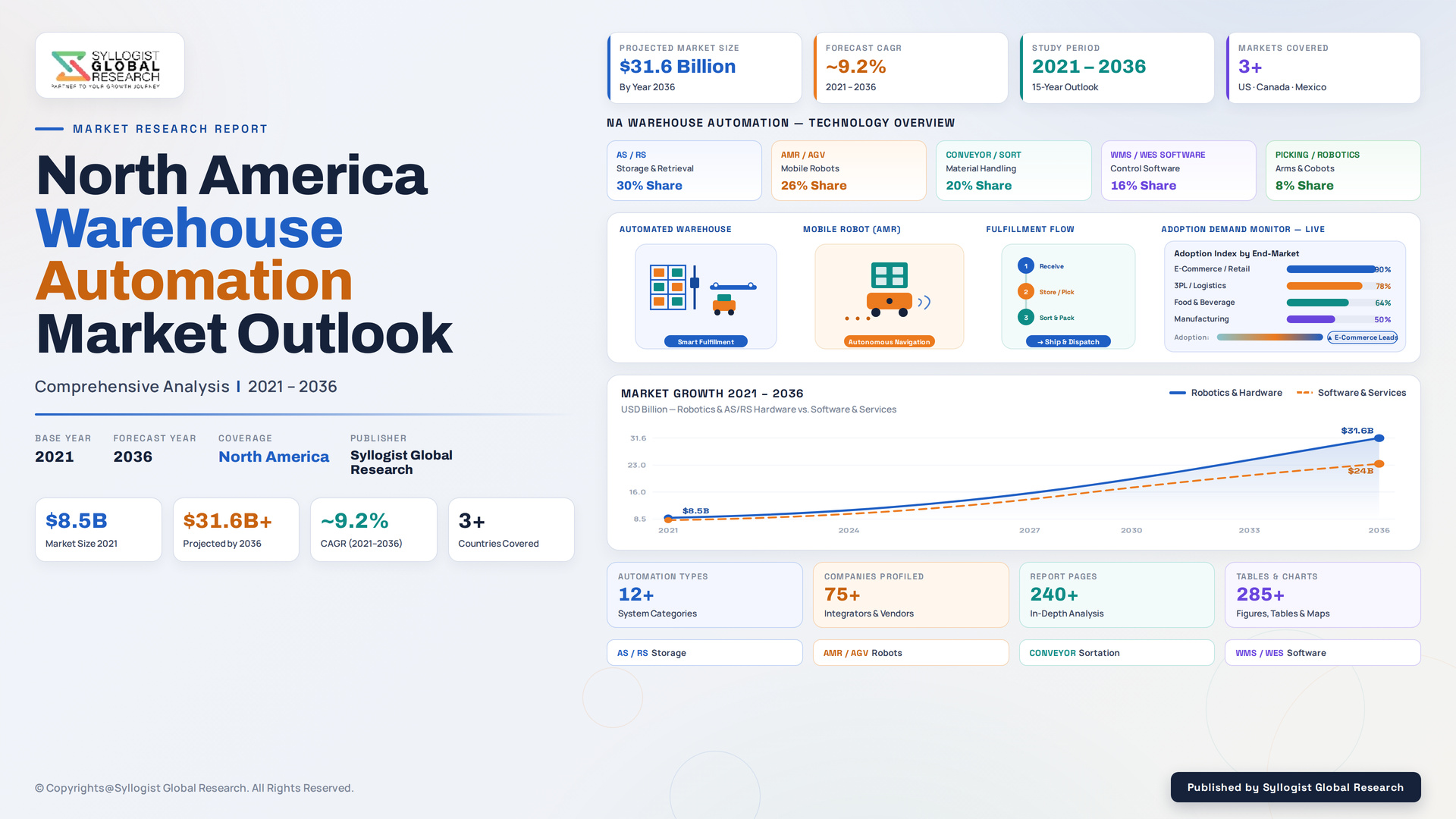
The North America warehouse automation market is entering a sustained high-growth phase driven by accelerating e-commerce fulfillment intensity, structural labor cost inflation, US reshoring under CHIPS Act, Inflation Reduction Act, and Bipartisan Infrastructure Law frameworks, USMCA-driven Mexican manufacturing expansion, and the rapid commercial emergence of AI-enabled autonomous mobile robotics and humanoid logistics platforms. The market was valued at USD 18.4 billion in 2025 and is projected to reach USD 46.8 billion by 2034, advancing at a compound annual growth rate of 10.9% through the forecast period, supported by greenfield distribution center automation procurement, brownfield warehouse retrofit programs, micro-fulfillment hub proliferation, and emerging humanoid robotics pilot deployments across major end-user industries.
E-commerce and omnichannel retail fulfillment remains the dominant end-user segment accounting for nearly 42% of regional warehouse automation revenue in 2025, anchored by Amazon, Walmart, Target, Costco, Home Depot, Lowe’s, Kroger, Albertsons, Best Buy, Macy’s, and a deep tier of pure-play e-commerce operators investing heavily in next-generation fulfillment networks. Amazon alone operates over 1,100 fulfillment, sortation, and delivery facilities across North America and accounts for approximately 18% of regional warehouse automation procurement, with Kiva-derived AMR fleets exceeding 750,000 units deployed across global operations and rising. Walmart is advancing aggressive Symbotic-based automated case handling rollouts at 42 regional distribution centers, alongside Alphabot micro-fulfillment deployments serving online grocery, while Kroger has deployed Ocado-powered customer fulfillment centers in eight US metros to support online grocery scaling.
Autonomous mobile robots have emerged as the fastest growing component category, advancing at over 18.6% CAGR through 2034, supported by sub-USD-50,000 robot price points enabling broader adoption across mid-sized 3PL operators, retailers, and manufacturers. Locus Robotics, Fetch Robotics under Zebra Technologies, 6 River Systems under Ocado, GreyOrange, Geek+, Berkshire Grey, and emerging entrants are collectively shipping over 84,000 AMR units annually across the North American market, while humanoid logistics robotics from Agility Robotics Digit, Figure AI, Apptronik Apollo, Boston Dynamics Atlas, and Tesla Optimus are entering commercial pilots at GXO Logistics, Amazon, Mercedes-Benz manufacturing facilities, BMW Spartanburg, and emerging early adopters, signaling a structural step-change in workforce automation that is expected to materially reshape labor economics across distribution and manufacturing through 2034.
The United States dominates the regional warehouse automation market with approximately 86% revenue share in 2025, anchored by dense e-commerce fulfillment infrastructure, advanced 3PL operations at GXO Logistics, DHL Supply Chain, XPO Logistics, FedEx Supply Chain, Penske Logistics, and Ryder System, and accelerating reshoring investment under CHIPS Act and IRA frameworks. Mexico is the fastest growing market advancing at over 14.8% CAGR through 2034, supported by USMCA-driven manufacturing relocation, nearshoring at automotive Tier 1 suppliers including Continental, Bosch, Magna, ZF Friedrichshafen, and Valeo, alongside electronics manufacturing at Foxconn, Quanta, and Pegatron, and consumer goods production across Monterrey, Saltillo, Guadalajara, Bajio, and Mexico City corridors. Canada represents a premium technology market with approximately 9% share, anchored by Toronto, Vancouver, Calgary, and Montreal distribution corridors serving Canadian Tire, Loblaws, Sobeys, Metro, Empire Company, and Hudson’s Bay e-commerce expansion alongside emerging cold storage automation investment in Alberta and Quebec.
Key Drivers
E-Commerce Fulfillment Intensity and Same-Day Delivery Economics Driving Sustained Warehouse Automation Procurement
Accelerating e-commerce penetration across North America, projected to advance from approximately 22% of total retail sales in 2025 to nearly 32% by 2030, alongside same-day and next-day delivery commitments at Amazon, Walmart, Target, Costco, Home Depot, Lowe’s, and Best Buy, is anchoring durable warehouse automation procurement growth. Micro-fulfillment hub proliferation under Ocado, Symbotic Alphabot, Fabric, AutoStore, and Takeoff Technologies deployments at Kroger, Albertsons, Walmart, and Whole Foods is generating substantial incremental equipment demand, while same-day economics require automation intensity that materially exceeds historical benchmarks.
Labor Cost Inflation, Workforce Shortages, and Reshoring Driving Capital Substitution Toward Automation Across Industries
Structural labor cost inflation with US warehouse hourly wages advancing from approximately 16 USD per hour in 2020 to over 22 USD per hour in 2025, alongside persistent workforce shortages across the warehousing, manufacturing, and 3PL sectors, is anchoring durable capital substitution toward warehouse automation. Reshoring investment under the CHIPS Act, Inflation Reduction Act, and Bipartisan Infrastructure Law totaling over USD 760 billion through 2030 is simultaneously generating greenfield distribution center and manufacturing automation demand across semiconductor, EV, battery, solar, and aerospace value chains.
AI-Enabled Robotics, Humanoid Logistics Platforms, and Software Orchestration Driving Step-Change Adoption Economics
Commercial emergence of humanoid logistics robotics from Agility Robotics Digit, Figure AI, Apptronik Apollo, Boston Dynamics Atlas, and Tesla Optimus at GXO Logistics, Amazon, Mercedes-Benz, and BMW Spartanburg pilots is signaling a structural step-change in workforce automation economics. AI-enabled software orchestration platforms from Manhattan Associates, Blue Yonder, Korber Supply Chain, Symbotic, and emerging AI-native entrants are simultaneously delivering productivity gains of 25% to 45% across pick, pack, ship, and inventory management workflows, reinforcing capital allocation toward integrated automation programs through 2034.
Key Challenges
High Capital Intensity, Long Payback Periods, and Financing Constraints Limiting Adoption Across Smaller 3PL Operators and Retailers
Integrated warehouse automation systems remain materially capital intensive, with greenfield distribution center automation programs typically requiring USD 28 million to USD 240 million of capital deployment per facility, alongside payback periods extending from 4 to 9 years depending on labor displacement, throughput uplift, and software integration complexity. Smaller 3PL operators, regional retailers, and mid-sized manufacturers frequently lack the capital allocation flexibility, project financing capability, and operational sophistication to deploy comprehensive automation, while equipment lead times extending from 12 to 28 months introduce execution risk through 2034.
Integration Complexity, Legacy WMS Compatibility, and Skilled Workforce Shortages Constraining Project Deployment Pace
Warehouse automation deployment introduces material integration complexity across legacy WMS, ERP, transportation management, yard management, and order management platforms, with brownfield retrofit programs facing data structure mismatches, change order escalations, and integration timeline extensions of 25% to 60% above original schedules. Skilled solution architect, systems integrator, controls engineer, and robotics technician shortages across major US, Canadian, and Mexican markets are extending project commissioning timelines, while aftermarket service capacity, spare parts supply chain resilience, and training program gaps remain critical execution bottlenecks across both greenfield and brownfield deployments.
Cybersecurity Risks, Robotics Safety Compliance, and Workforce Transition Concerns Reshaping Regulatory and Operational Risk Profiles
Smart warehouse deployments incorporating AI-enabled robotics, cloud-connected fleet management, and AMR fleet coordination introduce cybersecurity risks, ransomware exposure, and data sovereignty concerns that are reshaping operator risk profiles. CISA critical infrastructure cybersecurity guidance, ANSI R15.08 robotics safety standards, OSHA workplace safety frameworks, and emerging humanoid robot guidelines are escalating compliance burdens, while workforce transition concerns, union dynamics at Amazon, FedEx, and UPS, and political scrutiny on automation-driven employment effects are introducing operational and reputational risk through 2034.
Market Segmentation
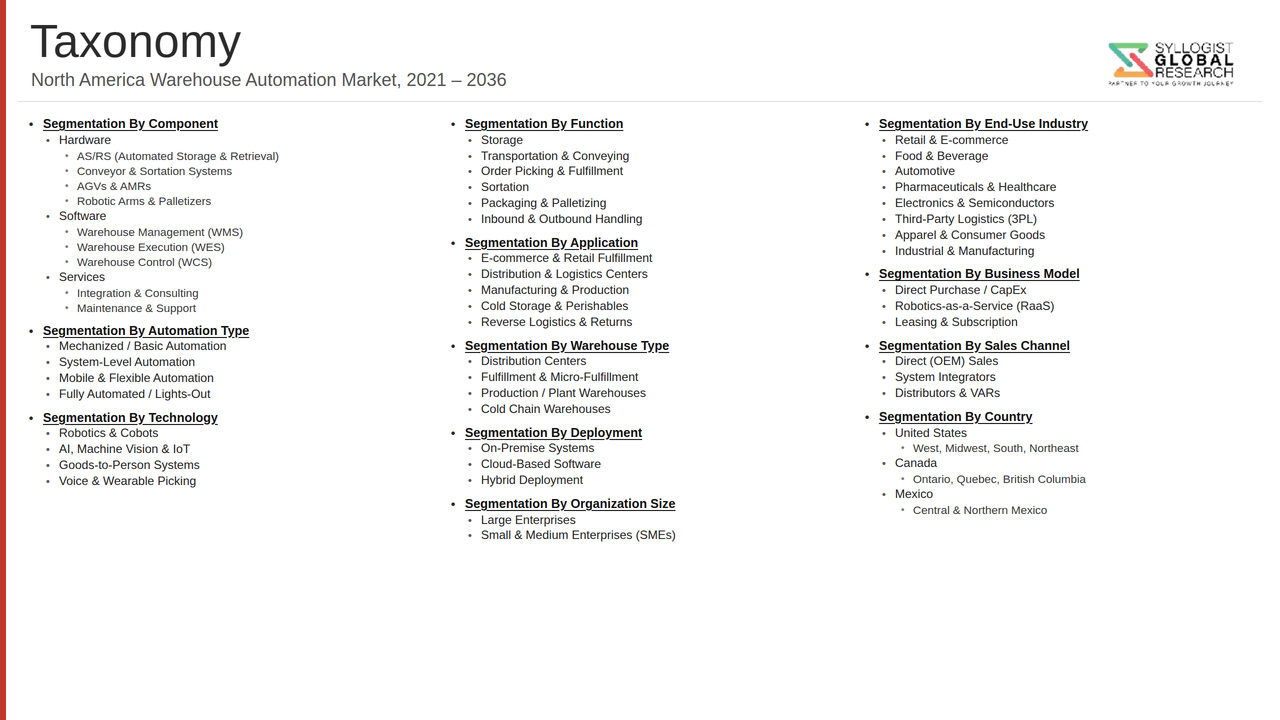
- Segmentation By Component
- Hardware
- Software
- Services (Integration, Consulting, Aftermarket)
- Others
- Segmentation By System Type
- Automated Storage and Retrieval Systems (AS/RS)
- Autonomous Mobile Robots (AMRs)
- Automated Guided Vehicles (AGVs)
- Goods-to-Person Systems
- Robotic Piece-Picking and Articulated Arms
- Conveyor and Sortation Systems
- Palletizers and Depalletizers
- Shuttle Systems
- Humanoid Logistics Robotics
- Warehouse Management Software (WMS, WES, WCS)
- Others
- Segmentation By Function
- Receiving and Putaway
- Storage
- Order Picking and Packing
- Sortation
- Shipping and Loading
- Inventory Management
- Returns Processing and Reverse Logistics
- Yard and Dock Management
- Others
- Segmentation By Warehouse Type
- Distribution Centers
- E-Commerce Fulfillment Centers
- Micro-Fulfillment Hubs
- Cold Storage and Refrigerated Warehouses
- Manufacturing Plant Warehouses
- Retail Backrooms
- Third-Party Logistics (3PL) Facilities
- Others
- Segmentation By End User
- E-Commerce and Retail
- Automotive and Transportation
- Food and Beverage
- Pharmaceuticals and Healthcare
- Consumer Electronics
- Apparel and Footwear
- Industrial Manufacturing
- Aerospace and Defense
- Third-Party Logistics (3PL)
- Others
- Segmentation By Country
- United States
- Canada
- Mexico
All market revenues are presented in USD
Historical Year: 2021-2024 | Base Year: 2025 | Estimated Year: 2026 | Forecast Period: 2027-2034
Key Questions this Study Will Answer
- What is the total market valuation of the North America Warehouse Automation Market in 2025, projected through 2034, disaggregated by component, system type, function, warehouse type, end user, and country, enabling automation suppliers, retailers, 3PL operators, manufacturers, and investors to identify the highest-growth opportunities and most durable revenue corridors across the warehouse automation value chain?
- How is e-commerce fulfillment intensity, same-day and next-day delivery economics, and micro-fulfillment hub proliferation reshaping warehouse automation procurement across Amazon, Walmart, Target, Costco, Home Depot, Lowe’s, Kroger, Albertsons, Best Buy, Macy’s, and Whole Foods through 2034?
- Which warehouse automation system categories including AS/RS, AMRs, AGVs, goods-to-person systems, robotic piece-picking arms, conveyor and sortation, palletizers, shuttle systems, humanoid logistics robotics, and warehouse management software are generating the highest growth rates, and how is the supply landscape evolving across Honeywell Intelligrated, Dematic, Daifuku, Vanderlande, Murata Machinery, Bastian Solutions, Witron, Knapp, SSI Schaefer, Swisslog, Kardex Remstar, AutoStore, Symbotic, Locus Robotics, Fetch Robotics, 6 River Systems, GreyOrange, Geek+, and Berkshire Grey?
- How are labor cost inflation with US warehouse hourly wages advancing from approximately 16 USD in 2020 to over 22 USD in 2025, workforce shortages across warehousing and manufacturing, and reshoring under CHIPS Act, IRA, and BIL frameworks driving capital substitution toward warehouse automation across the regional value chain?
- How is commercial emergence of humanoid logistics robotics including Agility Robotics Digit, Figure AI, Apptronik Apollo, Boston Dynamics Atlas, and Tesla Optimus at GXO Logistics, Amazon, Mercedes-Benz, and BMW Spartanburg pilots reshaping workforce automation economics, and what scaling trajectory exists for humanoid platforms through 2034?
- How is USMCA-driven Mexican manufacturing expansion, nearshoring at automotive Tier 1 suppliers, electronics manufacturing, and consumer goods production across Monterrey, Saltillo, Guadalajara, Bajio, and Mexico City corridors driving the highest regional CAGR through 2034?
- How is the competitive landscape structured among integrated automation providers Honeywell Intelligrated, Dematic, Daifuku, Vanderlande, Murata Machinery, Bastian Solutions, Witron, Knapp, SSI Schaefer, Swisslog, AutoStore, and Symbotic, AMR specialists Locus Robotics, Fetch Robotics, 6 River Systems, GreyOrange, Geek+, Berkshire Grey, humanoid robotics entrants Boston Dynamics, Agility Robotics, Figure AI, and Apptronik, and software platforms Manhattan Associates, Blue Yonder, Korber Supply Chain, Softeon, and Tecsys, and what partnership, acquisition, and capacity expansion strategies are reshaping market share dynamics through 2034?
- Product Definition
- Research Methodology
- Research Design & Framework
- Overall Research Approach: Descriptive, Exploratory & Quantitative Mixed-Method Design
- Market Definition & Scope Boundaries: What is Included and Excluded
- Segmentation Framework
- Key Research Assumptions & Limitations
- Secondary Research
- Primary Research Design & Execution
- Data Triangulation & Validation
- Market Sizing & Forecasting Methodology
- Competitive Intelligence Methodology
- Quality Assurance & Peer Review
- Definitions, Abbreviations & Data Notes
- Research Design & Framework
- Executive Summary
- Market Snapshot & Headline Numbers
- Key Findings & Research Highlights
- Market Dynamics
- Regional Market Summary
- Competitive Landscape Snapshot
- Technology & Innovation Highlights
- Market Dynamics
- Drivers
- Restraints
- Opportunities
- Challenges
- Porter’s Five Forces Analysis
- PESTLE Analysis
- Market Trends & Developments
- Emerging Trends
- Technological Developments
- Regulatory & Policy Changes
- Supply Chain & Sourcing Trends
- Manufacturing & Process Trends
- Investment & Funding Activity
- Sustainability & ESG Trends
- Risk Assessment Framework
- High Capital Investment, ROI Uncertainty & Payback Period Risk
- Labor Market Dynamics, Workforce Displacement & Reskilling Risk
- Technology Integration, Legacy System Compatibility & Interoperability Risk
- Cybersecurity, Data Breach & Operational Continuity Risk
- Supply Chain Disruption, Component Availability & Vendor Lock-In Risk
- Regulatory Framework & Standards
- Workplace Safety, Robotics & Automated Equipment Standards (OSHA & ANSI/RIA)
- Material Handling Equipment Certification & Performance Standards
- Data Privacy, Cybersecurity & Industrial IoT Standards
- Labor, Employment & Workforce Transition Regulations
- Sustainability, Energy Efficiency & ESG Disclosure Standards
- North America Warehouse Automation Market Outlook
- Market Size & Forecast by Value
- Market Size & Forecast by Volume (Units & System Installations)
- Market Size & Forecast by Component
- Conveyor & Sortation Systems
- Automated Storage & Retrieval Systems (AS/RS)
- Automated Guided Vehicles (AGVs)
- Autonomous Mobile Robots (AMRs)
- Robotic Picking & Palletizing Systems
- Goods-to-Person (G2P) Systems
- Warehouse Management & Control Software
- Sensors, Scanners & Identification Systems
- Other Components & Integration Services
- Market Size & Forecast by Technology
- Robotics & Articulated Arm Technology
- Automated Guided Vehicle (AGV) Navigation Technology
- Autonomous Mobile Robot (AMR) & SLAM Technology
- Machine Vision & Barcode / RFID Identification Technology
- Artificial Intelligence & Machine Learning Technology
- Internet of Things (IoT) & Sensor Network Technology
- Warehouse Management & Execution Software Technology
- Digital Twin & Simulation Technology
- Other Emerging & Hybrid Automation Technologies
- Market Size & Forecast by System Type
- Mobile Robotics (AGV & AMR) Systems
- Fixed Automation (Conveyor & Sortation) Systems
- Automated Storage & Retrieval Systems (AS/RS)
- Robotic Systems (Picking, Palletizing & Packaging)
- Software & Warehouse Execution Systems
- Market Size & Forecast by Facility Scale
- Large-Scale Distribution & Fulfillment Centers (Above 100,000 Square Feet)
- Medium-Scale Warehouses (20,000 to 100,000 Square Feet)
- Small-Scale & Micro-Fulfillment Centers (Below 20,000 Square Feet)
- Market Size & Forecast by Application
- E-Commerce & Order Fulfillment
- Food & Beverage Warehousing
- Retail & Consumer Goods Distribution
- Pharmaceutical & Healthcare Warehousing
- Automotive & Industrial Parts Distribution
- Cold Chain & Other Warehousing Applications
- Market Size & Forecast by End-User
- E-Commerce & Retail Companies
- Third-Party Logistics (3PL) Providers
- Manufacturing & Industrial Companies
- Food, Beverage & Grocery Companies
- Healthcare, Pharmaceutical & Other End-Users
- Market Size & Forecast by Sales Channel
- Direct Sales & OEM Supply
- System Integrators & Solution Providers
- Distributors & Value-Added Resellers
- Robotics-as-a-Service (RaaS) & Subscription Channel
- United States Warehouse Automation Market Outlook
- Market Size & Forecast
- By Value
- By Volume (Units & System Installations)
- By Component
- By Technology
- By System Type
- By Facility Scale
- By Application
- By End-User
- By Country
- By Sales Channel
- Canada Warehouse Automation Market Outlook
- Market Size & Forecast
- By Value
- By Volume (Units & System Installations)
- By Component
- By Technology
- By System Type
- By Facility Scale
- By Application
- By End-User
- By Country
- By Sales Channel
- Mexico Warehouse Automation Market Outlook
- Market Size & Forecast
- By Value
- By Volume (Units & System Installations)
- By Component
- By Technology
- By System Type
- By Facility Scale
- By Application
- By End-User
- By Country
- By Sales Channel
- *Countries Analyzed in the Syllogist North America Research Portfolio: United States, Canada, Mexico
- Technology Landscape & Innovation Analysis
- Autonomous Mobile Robot (AMR) & Navigation Technology Deep-Dive
- Automated Guided Vehicle (AGV) Technology
- Automated Storage & Retrieval System (AS/RS) Technology
- Robotic Picking, Palletizing & Manipulation Technology
- Machine Vision, Barcode & RFID Identification Technology
- AI, Machine Learning & Warehouse Orchestration Technology
- Warehouse Management, Control & Execution Software Technology
- Patent & IP Landscape in Warehouse Automation Technologies
- Value Chain & Supply Chain Analysis
- Robotics, Actuator & Mechanical Component Manufacturing Supply Chain
- Sensor, Vision & Identification Component Supply Chain
- Controller, Electronics & Power System Supply Chain
- Software, Platform & Cloud Service Landscape
- System Integrator & Solution Provider Procurement Landscape
- Warehouse Operator, 3PL & End-User Channel
- Installation, Maintenance, Service & Circular Economy
- Pricing Analysis
- Automated Storage & Retrieval System (AS/RS) Capital Cost Analysis
- Mobile Robot (AGV & AMR) System Cost Analysis
- Conveyor & Sortation System Cost Analysis
- Robotic Picking & Palletizing System Cost Analysis
- Software, Platform & Robotics-as-a-Service Subscription Pricing Analysis
- Total Warehouse Automation Economics: Cost-per-Throughput and ROI / Payback Optimisation Analysis
- Sustainability & Environmental Analysis
- Lifecycle Assessment (LCA) of Warehouse Automation: Energy Intensity, Carbon Footprint & Material Use Across System Types
- Energy Efficiency & Net Zero Contribution: Pathway to Low-Carbon and Renewable-Powered Warehouses
- Circular Economy & Equipment Reuse: Refurbishment, Component Recovery and E-Waste Contribution
- Environmental Compliance, Energy Consumption & Facility Footprint Consideration in Operations
- Regulatory-Driven Sustainability, SDG 9 (Industry & Innovation) & SDG 12 (Responsible Consumption) Alignment & Green Finance Eligibility
- Competitive Landscape
- Market Structure & Concentration
- Market Consolidation Level (Fragmented vs. Consolidated by System Type & Geography)
- Top 10 Players Market Share
- HHI (Herfindahl-Hirschman Index) Concentration Analysis
- Competitive Intensity Map by System Type, Technology & Geography
- Player Classification
- Integrated Warehouse Automation Solution Companies
- Specialist Mobile Robot (AGV & AMR) Providers
- Automated Storage & Retrieval System (AS/RS) Manufacturers
- Conveyor & Sortation System Providers
- Robotic Picking & Palletizing Technology Providers
- Warehouse Management & Software Platform Providers
- System Integrators & Solution Providers
- Robotics-as-a-Service & Emerging Entrants
- Competitive Analysis Frameworks
- Market Share Analysis by System Type, Technology & Region
- Company Profile
- Company Overview & Headquarters
- Warehouse Automation Products & Technology Portfolio
- Key Customer Relationships & Reference Deployments
- Manufacturing Footprint & Production Capacity
- Revenue (Warehouse Automation Segment) & Backlog
- Technology Differentiators & IP
- Key Strategic Partnerships, JVs & M&A Activity
- Recent Developments (Contract Wins, Capacity Expansion, Product Launches)
- SWOT Analysis
- Strategic Focus Areas & Roadmap
- Competitive Positioning Map (Technology Capability vs. Market Penetration)
- Key Company Profiles
- Market Structure & Concentration
- Technology Landscape & Innovation Analysis
- Strategic Output
- Market Opportunity Matrix: By System Type, Technology, Application, End-User & Geography
- White Space Opportunity Analysis
- Strategic Recommendations
- Product Portfolio & Technology Investment Strategy
- Manufacturing & Operational Excellence Strategy
- Geographic Expansion & Localisation Strategy
- Customer & End-User Engagement Strategy
- Partnership, M&A & Ecosystem Strategy
- Sustainability & Circular Economy Strategy
- Risk Mitigation & Future Roadmap
- Strategic Priority Matrix & Roadmap
- Near-term (2025-2028)
- Mid-term (2029-2032)
- Long-term (2033-2037)
- Strategic Output
- Market Size & Forecast
- Market Size & Forecast
- Market Size & Forecast