
Market Definition
Solid State Transformers (SSTs), also known as Power Electronic Transformers (PETs), are advanced multi-stage power conversion systems that utilize high-frequency switching and semiconductor technology to perform the traditional functions of a transformer, voltage transformation and isolation, while providing enhanced control capabilities. Unlike conventional copper-and-iron transformers that operate at grid frequencies (50/60 Hz), SSTs operate at high frequencies (typically 10 kHz to 100 kHz), significantly reducing the footprint and weight of the magnetic core.
A typical SST assembly integrates AC-DC rectification, high-frequency DC-DC conversion (isolation stage), and DC-AC inversion modules. Performance is defined by high power density, bi-directional power flow, reactive power compensation, and “fault isolation” capabilities that prevent disturbances on the load side from affecting the grid (and vice-versa). SSTs are governed by emerging power electronic standards and grid codes that prioritize power quality and dynamic response.
SSTs represent a paradigm shift in grid architecture: while they carry a higher initial CapEx than traditional transformers, they serve as “Energy Routers” that solve the fundamental challenges of modern grids, such as EV fast-charging integration, renewable energy volatility, and DC-distribution compatibility.
Market Insights
The global SST market is moving from the “Pilot and R&D” phase into commercial industrial deployment. While traditional transformers remain the backbone of the bulk power grid, SSTs are capturing high-value “bottleneck” applications where traditional iron-core technology fails to meet modern requirements. The fastest-moving demand pockets are linked to Ultra-Fast EV Charging (UFC), offshore wind/solar farm stabilization, and high-speed rail (traction) where weight and space are at a premium.
The market is currently dominated by major power electronic OEMs and specialized technology firms. Competitive advantage is defined by topology efficiency (minimizing conversion losses) and the successful integration of Silicon Carbide (SiC) and Gallium Nitride (GaN) semiconductors. As the grid transitions toward a decentralized, DC-coupled model, the SST is evolving from a niche component to the central intelligence hub of the Smart Grid 2.0.
Key Drivers
Integration of Distributed Energy Resources (DERs)
As solar and wind penetration increases, grids face bidirectional power flows and frequency instability. SSTs allow for seamless integration of asynchronous AC or DC sources, providing real-time voltage regulation and harmonic filtering that traditional transformers cannot perform.
Rapid Expansion of EV Charging Infrastructure
Multi-megawatt EV charging hubs require massive power draws. SSTs enable “Direct-to-Grid” DC fast charging, eliminating multiple conversion stages, reducing substation footprints in urban areas, and protecting the local distribution grid from the peaks of high-speed charging.
Railway Electrification and Traction Innovation
In the rail sector, reducing the weight of on-board transformers is critical for energy efficiency and speed. SSTs offer a high power-to-weight ratio, making them the preferred choice for next-generation high-speed locomotives and light-rail systems.
DC Microgrids and Data Center Efficiency
Modern data centers and industrial plants are increasingly moving toward 380V DC distribution to reduce conversion losses. SSTs serve as the ideal interface between the AC utility grid and DC internal networks, offering superior power quality and modular scalability.
Key Challenges
High Initial Capital Expenditure (CapEx)
SSTs currently cost significantly more than traditional oil-immersed or dry-type transformers. While the Total Cost of Ownership (TCO) is lower due to efficiency and reduced footprint, the high upfront price remains a barrier for risk-averse public utilities.
Thermal Management and Reliability Concerns
Power electronics generate concentrated heat. Unlike passive traditional transformers, SSTs require sophisticated active cooling and thermal management systems. Ensuring the 20–30 year lifespan expected in utility environments remains a primary engineering challenge.
Semiconductor Supply Chain Dependency
SST production is highly dependent on the availability of Wide-Bandgap (WBG) semiconductors (SiC/GaN). Global shortages or price volatility in the semiconductor market can lead to extended lead times and margin compression for SST manufacturers.
Lack of Standardized Grid Protocols
While traditional transformers have century-old standards (IEC/IEEE), SST standards for protection, testing, and grid interaction are still evolving. This creates “Technology Transition Risk” for early adopters who fear future incompatibility with changing grid codes.
Complexity and Specialized Maintenance
Maintaining an SST requires expertise in power electronics and software, rather than traditional electrical mechanical skills. This necessitates a shift in the service workforce and creates a “Skills Gap” for utilities and industrial end-users.
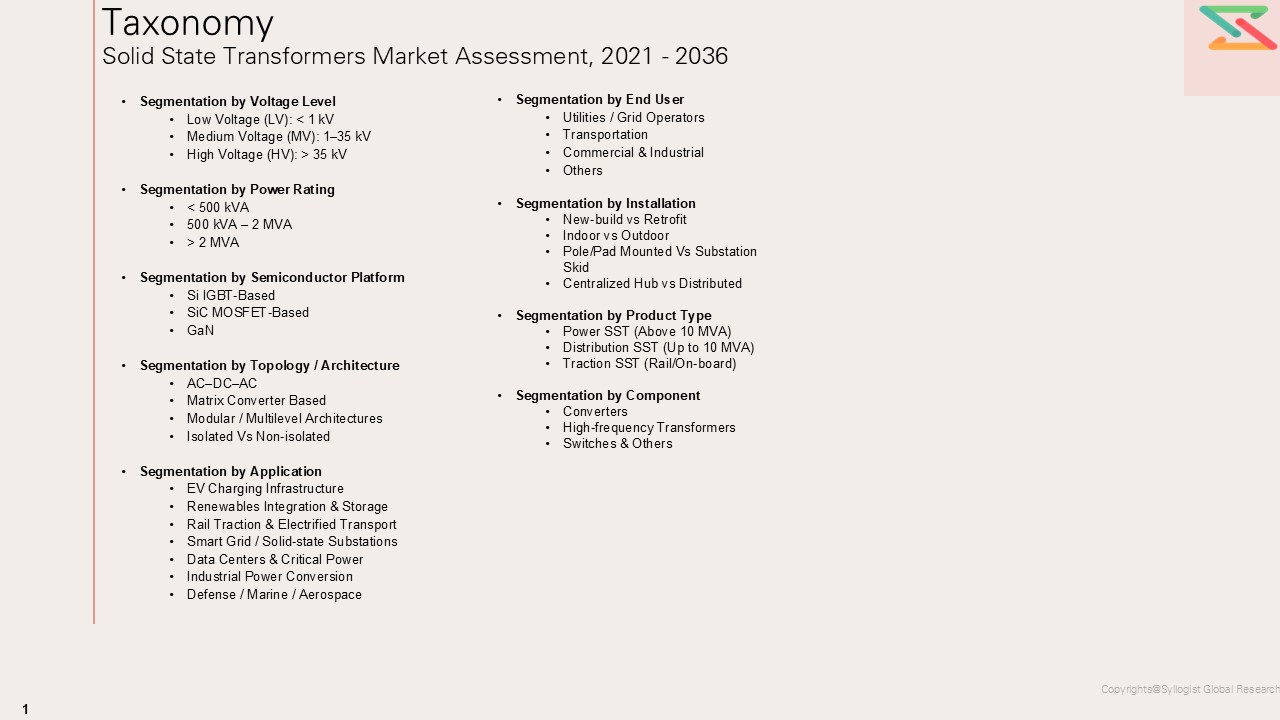
Market Segmentation
- Segmentation by Voltage Level
- Low Voltage (LV): < 1 kV
- Medium Voltage (MV): 1–35 kV
- High Voltage (HV): > 35 kV
- Segmentation by Power Rating
- < 500 kVA
- 500 kVA – 2 MVA
- > 2 MVA
- Segmentation by Semiconductor Platform
- Si IGBT-Based
- SiC MOSFET-Based
- GaN
- Segmentation by Topology / Architecture
- AC–DC–AC
- Matrix Converter Based
- Modular / Multilevel Architectures
- Isolated Vs Non-isolated
- Segmentation by Application
- EV Charging Infrastructure
- Renewables Integration & Storage
- Rail Traction & Electrified Transport
- Smart Grid / Solid-state Substations
- Data Centers & Critical Power
- Industrial Power Conversion
- Defense / Marine / Aerospace
- Segmentation by End User
- Utilities / Grid Operators
- Transportation
- Commercial & Industrial
- Others
- Segmentation by Installation
- New-build vs Retrofit
- Indoor vs Outdoor
- Pole/Pad Mounted Vs Substation Skid
- Centralized Hub vs Distributed
- Segmentation by Product Type
- Power SST (Above 10 MVA)
- Distribution SST (Up to 10 MVA)
- Traction SST (Rail/On-board)
- Segmentation by Component
- Converters
- High-frequency Transformers
- Switches & Others
All market revenues are presented in USD, with production volumes expressed in units.
Historical Year: 2021–2024 | Base Year: 2025 | Estimated Year: 2026 | Forecast Period: 2027–2036
Key Questions this Study Will Answer
- What are the critical market metrics and forward-looking projections for the Global Solid State Transformer (SST) Market, including revenue size, MVA capacity shipments, and performance segmentation across voltage levels (LV/MV/HV), conversion stages (AC-AC, AC-DC, DC-DC), and cooling technologies?
- How do supply–demand fundamentals vary across key regions, and what role do semiconductor supply chains, local power electronic manufacturing capacity, and procurement structures (Renewable Developers vs. EV CPO vs. Utility vs. Rail) play in shaping regional market competitiveness?
- In what ways are raw material and component price volatility (Silicon Carbide/GaN wafers, high-frequency magnetic cores, advanced thermal management materials), energy density requirements, and evolving grid codes (Bi-directional power flow, IEEE/IEC standards, harmonic distortion limits) influencing cost structures, pricing, and supplier profitability?
- Who are the leading global and regional SST manufacturers and startups, and how do they benchmark across topology depth (Modular Multilevel Converters, Dual Active Bridge), semiconductor integration, efficiency ratings, footprint/weight optimization, and portfolio breadth across Smart Grids, EV Fast Charging, and Traction?
- What strategic insights emerge from primary discussions with Distribution System Operators (DSOs), renewable IPPs, Data Center developers, EV infrastructure providers, and power semiconductor OEMs regarding pilot project pipelines, specification evolution (SiC-based, IoT-enabled, bi-directional), lead times for custom builds, and key purchase criteria (Efficiency vs. Initial CapEx)?
- Market Foundations & Dynamics
- Product Overview
- Research Methodology
- Executive Summary
- Market Dynamics (Drivers, Restraints, Opportunities, Challenges, Porter’s Five Forces Analysis, PESTLE Analysis)
- Market Ecosystem & Value Chain
- Overview of Value Chain Participants
- Flow of Value and Material Through the Chain
- Value Addition and Margins at Each Stage
- Market Trends & Developments
- Emerging Feedstock Trends
- Feedstock Availability
- Technological Advancements
- Demand–Supply Gaps
- Investment Hotspots
- Unmet Needs and White Market Spaces
- Risk Assessment Framework
- Political / Geopolitical Risk
- Feedstock Supply Risk
- Environmental and Regulatory Risk
- Financial / Market Risk
- Regulatory Framework & Standards
- Global Policy and Mandate Overview
- Transportation and Storage Regulations
- Sustainability and GHG Reduction Standards
- Environmental & Liability Considerations
- Technology Landscape
- Overview of Technologies
- Cost Optimization Technologies
- Future Outlook
- Global Solid State Transformers Market Outlook
- Market Size & Forecast by Value
- Market Size & Forecast by Volume
- Market Size & Forecast by Voltage Level
- Low Voltage (LV): < 1 kV
- Medium Voltage (MV): 1–35 kV
- High Voltage (HV): > 35 kV
- Market Size & Forecast by Power Rating
- < 500 kVA
- 500 kVA – 2 MVA
- > 2 MVA
- Market Size & Forecast by Semiconductor Platform
- Si IGBT-Based
- SiC MOSFET-Based
- GaN
- Market Size & Forecast by Topology / Architecture
- AC–DC–AC
- Matrix Converter Based
- Modular / Multilevel Architectures
- Isolated Vs Non-isolated
- Market Size & Forecast by Application
- EV Charging Infrastructure
- Renewables Integration & Storage
- Rail Traction & Electrified Transport
- Smart Grid / Solid-state Substations
- Data Centers & Critical Power
- Industrial Power Conversion
- Defense / Marine / Aerospace
- Market Size & Forecast by End User
- Utilities / Grid Operators
- Transportation
- Commercial & Industrial
- Others
- Market Size & Forecast by Installation
- New-build vs Retrofit
- Indoor vs Outdoor
- Pole/Pad Mounted Vs Substation Skid
- Centralized Hub vs Distributed
- Market Size & Forecast by Product Type
- Power SST (Above 10 MVA)
- Distribution SST (Up to 10 MVA)
- Traction SST (Rail/On-board)
- Market Size & Forecast by Component
- Converters
- High-frequency Transformers
- Switches & Others
- Asia-Pacific Solid State Transformers Market Outlook
- Market Size & Forecast by Value & Volume
- Market Size & Forecast by Voltage Level
- Market Size & Forecast by Power Rating
- Market Size & Forecast by Semiconductor Platform
- Market Size & Forecast by Topology / Architecture
- Market Size & Forecast by Application
- Market Size & Forecast by Installation
- Market Size & Forecast by Product Type
- Market Size & Forecast by Components
- Europe Solid State Transformers Market Outlook
- Market Size & Forecast by Value & Volume
- Market Size & Forecast by Voltage Level
- Market Size & Forecast by Power Rating
- Market Size & Forecast by Semiconductor Platform
- Market Size & Forecast by Topology / Architecture
- Market Size & Forecast by Application
- Market Size & Forecast by Installation
- Market Size & Forecast by Product Type
- Market Size & Forecast by Components
- North America Solid State Transformers Market Outlook
- Market Size & Forecast by Value & Volume
- Market Size & Forecast by Voltage Level
- Market Size & Forecast by Power Rating
- Market Size & Forecast by Semiconductor Platform
- Market Size & Forecast by Topology / Architecture
- Market Size & Forecast by Application
- Market Size & Forecast by Installation
- Market Size & Forecast by Product Type
- Market Size & Forecast by Components
- Latin America Solid State Transformers Market Outlook
- Market Size & Forecast by Value & Volume
- Market Size & Forecast by Voltage Level
- Market Size & Forecast by Power Rating
- Market Size & Forecast by Semiconductor Platform
- Market Size & Forecast by Topology / Architecture
- Market Size & Forecast by Application
- Market Size & Forecast by Installation
- Market Size & Forecast by Product Type
- Market Size & Forecast by Components
- Middle East & Africa Solid State Transformers Market Outlook
- Market Size & Forecast by Value & Volume
- Market Size & Forecast by Voltage Level
- Market Size & Forecast by Power Rating
- Market Size & Forecast by Semiconductor Platform
- Market Size & Forecast by Topology / Architecture
- Market Size & Forecast by Application
- Market Size & Forecast by Installation
- Market Size & Forecast by Product Type
- Market Size & Forecast by Components
- Country wise Solid State Transformers Market Outlook
- Market Size & Forecast by Value & Volume
- Market Size & Forecast by Voltage Level
- Market Size & Forecast by Power Rating
- Market Size & Forecast by Semiconductor Platform
- Market Size & Forecast by Topology / Architecture
- Market Size & Forecast by Application
- Market Size & Forecast by Installation
- Market Size & Forecast by Product Type
- Market Size & Forecast by Components
Countries Analyzed in the Syllogist Global Research Portfolio: China, United States, Germany, India, Japan, South Korea, United Kingdom, France, Norway, Canada, Sweden, Australia, The Netherlands, Italy, Spain, Denmark, Switzerland, Brazil, Saudi Arabia, UAE, Mexico, Indonesia, Turkey, Singapore, Vietnam, Poland, Russia, South Africa, Argentina, Thailand, Malaysia, Chile, Finalnd, Austria, Belgium
- Pricing Analysis
- Overview of Pricing Structures
- Average Selling Price Trends Type and End Use
- Cost Benchmark
- Historical Price Evolution
- Forecast Pricing Curve
- Factors Influencing Price:
- Regional Pricing Differentiation
- Competition Outlook
- Market Concentration and Fragmentation Level
- Company Market Shares (Top 10 Producers)
- Competitive Strategies
- Benchmarking Matrix
- Recent Developments: Partnerships, M&A, and Policy-Driven Expansions
- Cost Structure & Margin Analysis
- Average Cost per Liter
- Profitability and Margin Distribution Along the Value Chain
- Sensitivity Analysis: How Feedstock Price and Policy Incentives Impact Margin
- Cost Reduction Opportunities through Process Optimization
- Business Models & Strategic Insights
- Sales & Distribution Channel Analysis
- Overview of Go-to-Market Channels
- Channel Share by Region
- Distribution Strategies by Leading Players
- Strategic Recommendations & Roadmap
- Competitors’ Strategic Initiatives
- Future Outlook (Next 5–10 Years, Emerging Players, Success Factors)
- Strategic Recommendations
- Technology Advancements to Watch
- Market Acceleration Roadmap
- Short-Term
- Mid-Term
- Long-Term
- Tailored Recommendations for:
- Producers
- Feedstock Suppliers
- Policymakers / Regulators
- Investors
- Recommendations on Key Success Factors
- Feedstock Security
- Technology Partnerships
- Policy Alignment
- Supply Chain Integration
- Investor Confidence