Global Small Modular Reactor (SMR) Market By Reactor Type, By Coolant Technology, By Capacity Range, By Application, By End User, By Region, Competition, Forecast & Opportunities, 2021-2036F
Market Definition
The Global Small Modular Reactor Market encompasses the design, engineering, licensing, manufacturing, construction, and operation of factory-fabricated nuclear fission reactors with an electrical output capacity of up to 300 megawatts electric per unit, including light water, molten salt, gas-cooled, liquid metal-cooled, and microreactor designs, deployed for baseload electricity generation, industrial process heat supply, district heating, hydrogen production, desalination, and remote and off-grid power applications by utilities, industrial operators, defense establishments, and government energy agencies globally.
Market Insights
The global small modular reactor market is approaching its most consequential commercial inflection point since the concept emerged from national laboratory research programs, as a growing number of SMR designs advance through nuclear regulatory licensing processes in multiple jurisdictions, first-of-a-kind construction programs progress toward commercial operation, and governments across the United States, United Kingdom, Canada, France, South Korea, Poland, and Romania commit to SMR deployment as a foundational pillar of their long-term decarbonized energy system architectures. The market was valued at approximately USD 7.8 billion in 2025 and is projected to expand at a compound annual growth rate of 36.4% through 2034, driven by the recognition among energy policymakers that firm, dispatchable, low-carbon baseload generation capacity is an indispensable complement to variable renewable energy sources in decarbonized grids, and that SMRs represent a more capital-accessible, site-flexible, and supply chain manufacturable pathway to new nuclear capacity than the gigawatt-scale conventional nuclear plants whose construction cost overruns and schedule delays have undermined investor confidence in large-scale nuclear new build programs across Western markets.
The light water SMR designs progressing most rapidly through regulatory licensing and early commercial deployment represent evolutionary refinements of proven pressurized and boiling water reactor technology, incorporating passive safety systems that eliminate the need for active emergency cooling intervention in accident scenarios, factory-fabricated modular component manufacturing that targets cost reduction through learning curve economics and supply chain optimization, and below-grade reactor building configurations that enhance physical security and reduce the structural requirements for external hazard protection. These incremental technology innovation strategies are enabling light water SMR developers to leverage existing regulatory frameworks, workforce competency bases, and fuel cycle infrastructure developed for conventional light water reactor operation, reducing the licensing timeline, regulatory uncertainty, and first-of-a-kind engineering risk that would otherwise constrain deployment timelines for more novel SMR technology concepts.
The advanced non-light water SMR segment, encompassing molten salt reactors, high-temperature gas-cooled reactors, liquid metal-cooled fast reactors, and microreactors, is attracting substantial venture investment, government research funding, and strategic interest from industrial corporations seeking high-temperature process heat supply for decarbonizing energy-intensive industrial processes including hydrogen production, steel manufacturing, cement production, and chemical synthesis that cannot be efficiently electrified with current technology. High-temperature gas-cooled SMRs operating at outlet temperatures above 700 degrees Celsius can deliver industrial process heat at temperatures directly applicable to steam methane reforming for clean hydrogen production and high-temperature chemical processes, positioning these designs as a uniquely capable decarbonization tool for hard-to-abate industrial sectors whose carbon reduction options through electrification alone are constrained by current technology performance boundaries. Microreactors with electrical outputs below 20 megawatts are attracting dedicated development investment for remote community power, Arctic and island grid applications, military forward operating base energy supply, and data center power provision, where the combination of very long refueling intervals, autonomous operation capability, and compact transportable form factors addresses capability gaps that neither utility-scale nuclear nor renewable alternatives can serve.
North America leads the global SMR market in terms of design diversity, regulatory advancement, and early commercial deployment activity, anchored by the United States Nuclear Regulatory Commission licensing programs for multiple SMR designs, Canadian Nuclear Safety Commission vendor design review processes, and active federal government financial support through the Department of Energy advanced nuclear programs. Europe represents the second most significant regional SMR market, driven by United Kingdom government commitment to a domestic SMR deployment program, French state-backed SMR development investment, and Central and Eastern European government interest in SMR deployment as a strategy for reducing dependence on Russian energy imports while meeting net zero carbon commitments. Asia-Pacific is the fastest-growing regional market, anchored by China’s operational high-temperature gas-cooled reactor demonstration units and planned commercial SMR programs, South Korea’s advanced SMR design development, and India’s indigenous advanced heavy water reactor and thorium fuel cycle programs.
Key Drivers
Decarbonized Grid Stability Imperatives and the Growing Recognition of Firm Baseload Nuclear Power as an Indispensable Complement to Variable Renewable Energy in Net Zero Energy Systems
The progressive decarbonization of electricity systems through accelerating deployment of wind and solar generation is simultaneously increasing the system value of firm, dispatchable, weather-independent low-carbon power sources that can provide reliable output during extended periods of low renewable generation, creating a structural role for SMR-provided baseload and load-following nuclear generation that grid modeling studies across multiple jurisdictions consistently identify as a cost-effective contributor to achieving deep decarbonization targets while maintaining grid reliability standards. Government energy system planning frameworks in the United States, United Kingdom, France, Japan, South Korea, Poland, and Canada have explicitly incorporated SMR capacity into national net zero energy scenarios, converting policy support into licensing prioritization, site reservation programs, and financial de-risking instruments that provide the market foundation for commercial SMR investment.
Industrial Decarbonization and Clean Hydrogen Production Demand Creating High-Value Applications for High-Temperature SMR Process Heat That Electrification Alternatives Cannot Cost-Effectively Serve
Energy-intensive industrial sectors including steel production, cement manufacturing, chemical synthesis, ammonia production, and petroleum refining require continuous high-temperature process heat at temperatures and load factors that are technically challenging and economically unfavorable to supply through electrification with current technology, creating a compelling application space for high-temperature gas-cooled and molten salt SMRs capable of delivering industrial heat at commercially relevant temperatures and capacity factors. The growing policy and corporate commitment to clean hydrogen as a decarbonization vector for industry, heavy transport, and grid balancing is generating strong demand pull for nuclear-powered hydrogen production using high-temperature electrolysis or thermochemical water splitting processes that achieve superior efficiency at the elevated operating temperatures achievable with advanced SMR designs, positioning nuclear hydrogen as a cost-competitive clean hydrogen production pathway at scale.
Factory Fabrication Economics and Modular Construction Methodology Targeting Transformative Capital Cost Reduction That Could Make New Nuclear Economically Competitive With Other Low-Carbon Generation Technologies
The central economic proposition of SMR development is that replacing the bespoke, site-constructed, one-of-a-kind approach of conventional large nuclear plants with factory-fabricated, standardized, modular reactor units produced on manufacturing production lines will drive capital cost reductions through learning curve improvements, supply chain optimization, quality control consistency, and reduced construction labor requirements that could ultimately achieve levelized cost of electricity targets competitive with other low-carbon generation technologies at commercial deployment volumes. While this manufacturing cost reduction thesis has not yet been validated at commercial scale, the significant government and private investment in first-of-a-kind SMR construction programs underway across multiple countries is generating the real-world construction cost and schedule performance data that will determine whether the factory fabrication cost reduction hypothesis is achievable and at what deployment volume the economic inflection point is reached.
Key Challenges
Extended and Costly Nuclear Regulatory Licensing Processes Creating Multi-Year Development Timeline Uncertainty and Substantial Pre-Revenue Investment Requirements for SMR Technology Developers
Nuclear regulatory licensing for new reactor designs requires comprehensive safety analysis report submissions, multi-year technical review processes by national nuclear regulatory authorities, probabilistic risk assessment validation, environmental impact assessment, and public consultation procedures that collectively impose development timelines and pre-licensing engineering investment requirements that can extend the period from initial design submission to first power generation to fifteen years or more for novel reactor concepts without established regulatory precedent, creating substantial investor capital at risk and financing uncertainty that limits the pool of private capital willing to fund SMR development programs to near-term commercial revenue without government financial de-risking support through loan guarantees, production tax credits, contracts for difference, or direct equity co-investment.
First-of-a-Kind Construction Cost and Schedule Risk Creating Financing Challenges and Investor Confidence Barriers That Could Undermine the Commercial Viability of Early SMR Deployment Programs
The history of recent large-scale nuclear new build projects in Western markets is marked by severe construction cost overruns and schedule delays attributable to workforce capability gaps, supply chain immaturity, regulatory hold points, and first-of-a-kind engineering challenges that inflated final capital costs well beyond initial project estimates, and there is a significant risk that early SMR construction programs will encounter analogous first-of-a-kind construction challenges before the factory fabrication learning curve and workforce competency development deliver the cost and schedule performance improvements that SMR economics depend upon. Financing institutions and private investors are applying deep contingency assumptions and risk premiums to SMR project valuations that materially increase the cost of capital and may make early projects unfinanceable without government balance sheet support.
Nuclear Fuel Supply Chain Development, Spent Fuel Management Obligations, and Public Acceptance Constraints Complicating SMR Siting, Licensing, and Operational Planning Across Deployment Markets
Several advanced SMR designs require high-assay low-enriched uranium fuel enriched to levels between five and twenty percent uranium-235, which is not currently produced at commercial scale by the existing civil nuclear fuel cycle industry and requires new enrichment capacity investment with its own licensing, non-proliferation safeguards, and supply security considerations that add further development lead time and cost to the overall SMR deployment program. Spent nuclear fuel interim storage requirements and the absence of operational deep geological repository capacity in most SMR deployment countries creates a liability management uncertainty that complicates SMR project financing, and persistent public and local community opposition to nuclear facility siting continues to impose planning and permitting risks that can extend project development timelines and in some cases prevent project advancement regardless of technical and economic merit.
Market Segmentation
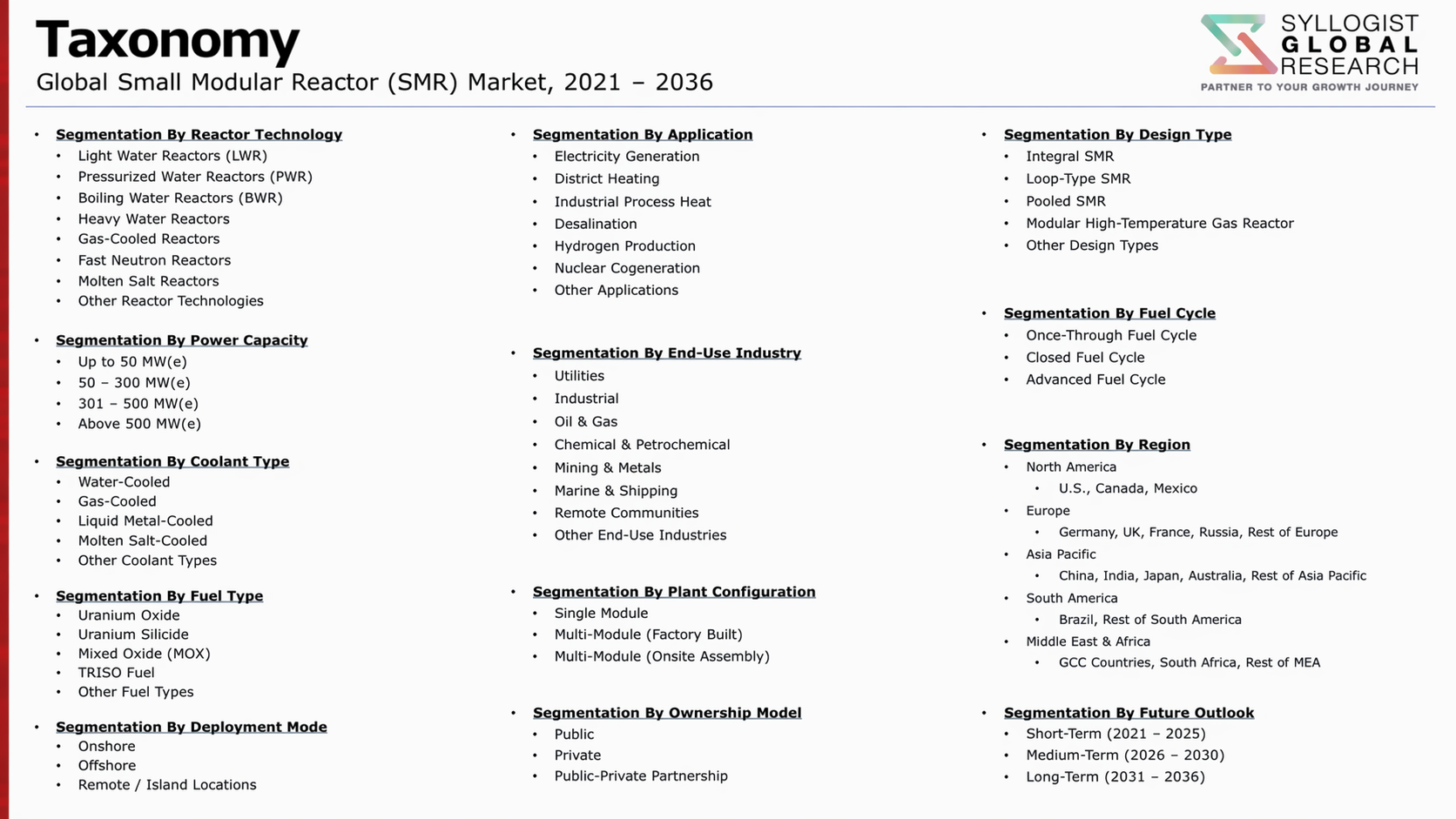
- Segmentation By Reactor Type
- Pressurized Water Small Modular Reactors
- Boiling Water Small Modular Reactors
- High-Temperature Gas-Cooled Reactors
- Molten Salt Reactors
- Liquid Metal-Cooled Fast Reactors
- Microreactors (Below 20 MWe)
- Others
- Segmentation By Coolant Technology
- Light Water Coolant
- Molten Salt Coolant
- Gas Coolant (Helium and Carbon Dioxide)
- Liquid Metal Coolant (Sodium and Lead)
- Others
- Segmentation By Capacity Range
- Microreactors (Below 20 MWe)
- Small Reactors (20 to 100 MWe)
- Medium Modular Reactors (100 to 300 MWe)
- Segmentation By Application
- Grid-Connected Baseload Electricity Generation
- Industrial Process Heat Supply
- Clean Hydrogen and Synthetic Fuel Production
- Desalination and Water Purification
- District Heating and Combined Heat and Power
- Remote and Off-Grid Power Supply
- Military and Defense Forward Base Power
- Others
- Segmentation By End User
- Electric Power Utilities and Grid Operators
- Industrial and Heavy Manufacturing Corporations
- Government and Defense Establishments
- Mining and Remote Resource Extraction Operators
- Data Center and Technology Infrastructure Operators
- Developing Economy and Island Nation Governments
- Others
- Segmentation By Region
- North America
- Europe
- Asia-Pacific
- Middle East and Africa
- Latin America
All market revenues are presented in USD
Historical Year: 2021-2024 | Base Year: 2025 | Estimated Year: 2026 | Forecast Period: 2027-2034
Key Questions this Study Will Answer
- What is the total global SMR market valuation in 2025, projected through 2034, segmented by reactor type, application, and end user, enabling reactor developers, energy investors, utility procurement planners, and government energy agencies to identify the highest-value deployment opportunities and most commercially viable near-term market segments across the global SMR development and deployment landscape?
- Which SMR reactor technology designs, specifically light water pressurized water, high-temperature gas-cooled, molten salt, and microreactor concepts, are most advanced in regulatory licensing processes across key deployment markets, and what are the realistic commercial operation timelines, first-of-a-kind construction cost ranges, and levelized cost of electricity projections for each technology platform at initial and nth-of-a-kind deployment?
- How are national government policy frameworks, financial de-risking instruments including loan guarantees and contracts for difference, production tax credit structures, and sovereign nuclear new build procurement programs shaping the investment economics and commercial deployment timelines of SMR projects in the United States, United Kingdom, Canada, France, Poland, South Korea, and other priority markets?
- What industrial decarbonization, clean hydrogen production, and high-temperature process heat applications represent the most commercially compelling non-electricity SMR use cases, and which advanced SMR technology platforms are most technically suited to serve these industrial energy applications at competitive cost and reliability levels relative to electrification, green hydrogen, and other decarbonization pathway alternatives?
- How is the competitive landscape structured among established nuclear original equipment manufacturers, specialized SMR developer startups, and state-owned nuclear enterprises pursuing commercial SMR deployment, and what technology licensing, utility partnership, government co-investment, export credit agency support, and supply chain localization strategies are enabling leading developers to advance their programs toward commercial financial close?
- What nuclear fuel supply chain development requirements, spent fuel management obligations, high-assay low-enriched uranium production capacity constraints, and non-proliferation safeguards compliance considerations are creating dependency risks and development timeline extensions for advanced SMR programs, and what supply chain investment, fuel enrichment capacity programs, and international fuel supply agreements are being pursued to address these constraints?
- Which regional markets, specifically North America, Europe, and Asia-Pacific, are generating the most significant near-term SMR licensing activity, construction commitments, and policy support frameworks, and what geopolitical energy security imperatives, industrial decarbonization obligations, grid reliability requirements, and nuclear technology export ambitions are shaping national SMR investment priorities and international deployment partnership strategies in each region?
- Product Definition
- Research Methodology
- Research Design & Framework
- Overall Research Approach: Descriptive, Exploratory & Quantitative Mixed-Method Design
- Market Definition & Scope Boundaries: What is Included and Excluded
- Segmentation Framework
- Key Research Assumptions & Limitations
- Secondary Research
- Primary Research Design & Execution
- Data Triangulation & Validation
- Market Sizing & Forecasting Methodology
- Competitive Intelligence Methodology
- Quality Assurance & Peer Review
- Definitions, Abbreviations & Data Notes
- Research Design & Framework
- Executive Summary
- Market Snapshot & Headline Numbers
- Key Findings & Research Highlights
- Market Dynamics
- Regional Market Summary
- Competitive Landscape Snapshot
- Technology & Innovation Highlights
- Market Dynamics
- Drivers
- Restraints
- Opportunities
- Challenges
- Porter’s Five Forces Analysis
- PESTLE Analysis
- Market Trends & Developments
- Emerging Trends
- Technological Developments
- Regulatory & Policy Changes
- Supply Chain & Sourcing Trends
- Manufacturing & Process Trends
- Investment & Funding Activity
- Sustainability & ESG Trends
- Risk Assessment Framework
- Nuclear Licensing, Regulatory Approval Timeline & Permitting Delay Risk
- Construction Cost Overrun, Schedule Delay & First-of-a-Kind (FOAK) Project Execution Risk
- Nuclear Fuel Supply Chain, HALEU Availability & Uranium Enrichment Dependency Risk
- Public Acceptance, Anti-Nuclear Sentiment & Social Licence to Operate Risk
- Radioactive Waste Management, Spent Fuel Disposal & Long-Term Liability Risk
- Geopolitical Risk, Nuclear Non-Proliferation Treaty (NPT) Compliance & Technology Export Restriction Risk
- Regulatory Framework & Standards
- Nuclear Regulatory Authority Licensing Frameworks: NRC (US), ONR (UK), CNL (Canada), ASN (France) & IAEA Safety Standards
- IAEA Small Modular Reactor Safety Design Criteria, Defence-in-Depth Requirements & Passive Safety System Standards
- High-Assay Low-Enriched Uranium (HALEU) Fuel Standards, Enrichment Limits & Non-Proliferation Safeguards
- Nuclear Waste Classification, Interim Storage, Transportation & Long-Term Repository Regulatory Frameworks
- Environmental Impact Assessment, Siting Criteria & Cooling Water Discharge Standards for SMR Facilities
- Nuclear Technology Export Controls, 123 Agreements & International Nuclear Cooperation Frameworks
- Global Small Modular Reactor (SMR) Market Outlook
- Market Size & Forecast by Value
- Market Size & Forecast by Volume (Number of Units & Installed Capacity, GWe)
- Market Size & Forecast by Reactor Technology
- Light Water Reactor (LWR) SMRs (Pressurised Water & Boiling Water)
- Pressurised Heavy Water Reactor (PHWR) SMRs
- High-Temperature Gas-Cooled Reactor (HTGR) SMRs
- Molten Salt Reactor (MSR) SMRs
- Fast Neutron & Sodium-Cooled Fast Reactor (SFR) SMRs
- Lead-Cooled Fast Reactor (LFR) SMRs
- Micro Modular Reactors (MMRs) & Very Small Modular Reactors
- Marine & Floating Nuclear Power Plant SMRs
- Market Size & Forecast by Capacity Range
- Micro Reactors (Below 10 MWe)
- Very Small Modular Reactors (10 MWe to 50 MWe)
- Small Modular Reactors (50 MWe to 300 MWe)
- Upper-Range SMRs (300 MWe to 1,000 MWe)
- Market Size & Forecast by Fuel Type
- Low-Enriched Uranium (LEU) Fuel (Below 5% U-235 Enrichment)
- High-Assay Low-Enriched Uranium (HALEU) Fuel (5% to 20% U-235 Enrichment)
- Thorium-Based Fuel Cycles
- Mixed Oxide (MOX) & Recycled Nuclear Fuel
- Market Size & Forecast by Coolant Type
- Light Water Cooled SMRs
- Heavy Water Cooled SMRs
- Gas Cooled (Helium & CO2) SMRs
- Liquid Metal Cooled (Sodium, Lead & Lead-Bismuth) SMRs
- Molten Salt Cooled SMRs
- Market Size & Forecast by Deployment Mode
- Land-Based Fixed Site SMR Plants
- Floating & Marine-Based SMR Plants
- Underground & Subterranean SMR Installations
- Factory-Fabricated & Transportable SMR Units
- Market Size & Forecast by Application
- Grid-Connected Baseload Electricity Generation
- Industrial Process Heat & High-Temperature Heat Supply
- Green Hydrogen Production via Nuclear-Powered Electrolysis & Thermochemical Cycles
- Desalination & Clean Water Production
- District Heating & Cogeneration
- Remote, Off-Grid & Island Power Supply
- Defence, Military Base & Naval Propulsion Power
- Data Centre & AI Computing Facility Dedicated Power Supply
- Market Size & Forecast by End-User
- National Electricity Utilities & State-Owned Power Companies
- Independent Power Producers (IPPs) & Nuclear Project Developers
- Industrial & Mining Companies Requiring Process Heat & Power
- Government, Defence & Strategic Energy Security Agencies
- Technology & Data Centre Companies Seeking Clean Firm Power
- Developing Nations & Remote Community Energy Authorities
- Market Size & Forecast by Sales & Procurement Channel
- Government-to-Government (G2G) Nuclear Cooperation & Intergovernmental Agreement Channel
- EPC & Turnkey Nuclear Project Contract Channel
- Build-Own-Operate (BOO) & Nuclear Power Purchase Agreement (NPPA) Channel
- Lease, Power Services & Nuclear-Energy-as-a-Service Channel
- North America Small Modular Reactor (SMR) Market Outlook
- Market Size & Forecast
- By Value
- By Volume (Number of Units & Installed Capacity, GWe)
- By Reactor Technology
- By Capacity Range
- By Fuel Type
- By Coolant Type
- By Deployment Mode
- By Application
- By End-User
- By Country
- By Sales & Procurement Channel
- Market Size & Forecast
- Europe Small Modular Reactor (SMR) Market Outlook
- Market Size & Forecast
- By Value
- By Volume (Number of Units & Installed Capacity, GWe)
- By Reactor Technology
- By Capacity Range
- By Fuel Type
- By Coolant Type
- By Deployment Mode
- By Application
- By End-User
- By Country
- By Sales & Procurement Channel
- Market Size & Forecast
- Asia-Pacific Small Modular Reactor (SMR) Market Outlook
- Market Size & Forecast
- By Value
- By Volume (Number of Units & Installed Capacity, GWe)
- By Reactor Technology
- By Capacity Range
- By Fuel Type
- By Coolant Type
- By Deployment Mode
- By Application
- By End-User
- By Country
- By Sales & Procurement Channel
- Market Size & Forecast
- Latin America Small Modular Reactor (SMR) Market Outlook
- Market Size & Forecast
- By Value
- By Volume (Number of Units & Installed Capacity, GWe)
- By Reactor Technology
- By Capacity Range
- By Fuel Type
- By Coolant Type
- By Deployment Mode
- By Application
- By End-User
- By Country
- By Sales & Procurement Channel
- Market Size & Forecast
- Middle East & Africa Small Modular Reactor (SMR) Market Outlook
- Market Size & Forecast
- By Value
- By Volume (Number of Units & Installed Capacity, GWe)
- By Reactor Technology
- By Capacity Range
- By Fuel Type
- By Coolant Type
- By Deployment Mode
- By Application
- By End-User
- By Country
- By Sales & Procurement Channel
- Market Size & Forecast
- Country-Wise* Small Modular Reactor (SMR) Market Outlook
- Market Size & Forecast
- By Value
- By Volume (Number of Units & Installed Capacity, GWe)
- By Reactor Technology
- By Capacity Range
- By Fuel Type
- By Coolant Type
- By Deployment Mode
- By Application
- By End-User
- By Country
- By Sales & Procurement Channel
- Market Size & Forecast
- *Countries Analyzed in the Syllogist Global Research Portfolio: United States, Canada, United Kingdom, France, Poland, Czech Republic, Romania, Sweden, Finland, Russia, China, Japan, South Korea, India, Australia, Indonesia, Brazil, Argentina, Saudi Arabia, UAE, South Africa, Kenya
- Technology Landscape & Innovation Analysis
- Light Water SMR Technology Deep-Dive: NuScale VOYGR, GE-Hitachi BWRX-300, Rolls-Royce SMR & Holtec SMR-300 Design Comparison
- High-Temperature Gas-Cooled Reactor (HTGR) Technology: X-Energy Xe-100, USNC MMR & JAEA HTTR Design & Application
- Molten Salt Reactor (MSR) Technology: Terrestrial Energy IMSR, Moltex Energy SSR & TerraPower Molten Chloride Reactor
- Sodium-Cooled Fast Reactor (SFR) & Lead-Cooled Fast Reactor (LFR) SMR Technology & Advanced Fuel Cycle Integration
- Micro Modular Reactor (MMR) Technology: Westinghouse eVinci, Ultra Safe Nuclear MMR & Oklo Aurora for Remote & Defence Applications
- Factory Fabrication, Modular Construction & Series Production Technology for SMR Cost Reduction
- Passive Safety System, Inherent Safety Design & Severe Accident Mitigation Technology in Advanced SMRs
- Patent & IP Landscape in Small Modular Reactor Technologies
- Value Chain & Supply Chain Analysis
- Uranium Mining, Conversion, Enrichment & HALEU Fuel Fabrication Supply Chain
- Nuclear-Grade Steel, Zirconium Alloy, Specialty Metal & Forging Supply Chain for SMR Components
- Reactor Pressure Vessel, Steam Generator, Pump & Primary Circuit Component Manufacturing Supply Chain
- Instrumentation, Control Systems, Reactor Protection & Digital I&C Supply Chain
- Turbine, Generator, Power Conversion & Balance-of-Plant Equipment Supply Chain
- Nuclear Construction, Civil Engineering & Site Preparation Contractor Supply Chain
- Nuclear Fuel Supply, Reloading Services & Spent Fuel Management Channel
- Operations & Maintenance (O&M), Outage Management & Decommissioning Service Channel
- Pricing Analysis
- SMR Capital Cost (Overnight Cost & All-In EPC Cost) Analysis by Reactor Technology & Capacity Range
- Levelised Cost of Electricity (LCOE) Analysis: SMR vs. Large Nuclear, Gas CCGT, Offshore Wind & Solar Plus Storage
- First-of-a-Kind (FOAK) vs. Nth-of-a-Kind (NOAK) Cost Reduction Pathway & Learning Rate Analysis
- Nuclear Fuel Cycle Cost Analysis: Uranium, Enrichment, Fabrication & Back-End Waste Disposal
- Operations & Maintenance (O&M) Cost, Capacity Factor & Lifetime Cost of Ownership Analysis
- SMR Project Finance Structure: Debt, Equity, Government Loan Guarantees & Contract-for-Difference (CfD) Analysis
- Sustainability & Environmental Analysis
- Lifecycle Assessment (LCA) of SMRs: Carbon Footprint, Land Use, Water Consumption & Full-Chain GHG Emissions
- SMR Contribution to Net Zero & Deep Decarbonisation: Role as Firm Low-Carbon Baseload & Industrial Heat Provider
- Radioactive Waste Generation, Volume Minimisation, Waste Classification & Long-Term Repository Requirement Analysis
- Thermal Discharge, Aquatic Ecosystem Impact & Closed-Cycle Cooling Technology for SMR Siting
- EU Taxonomy Green Finance Classification, ESG Eligibility & Sustainable Finance Framework for Nuclear & SMR Projects
- Competitive Landscape
- Market Structure & Concentration
- Market Consolidation Level (Fragmented vs. Consolidated by Reactor Technology & Geography)
- Top 10 Players Market Share
- HHI (Herfindahl-Hirschman Index) Concentration Analysis
- Competitive Intensity Map by Reactor Technology, Application & Geography
- Player Classification
- Established Nuclear OEMs & Large-Scale Reactor Vendors Developing SMR Products
- Dedicated SMR & Advanced Nuclear Startups
- National & Government-Backed Nuclear Energy Companies
- Micro Modular Reactor (MMR) & Remote Power Focused Developers
- Molten Salt, Fast Reactor & Generation IV Advanced Technology Developers
- Nuclear EPC Contractors, Civil Engineering & Balance-of-Plant Specialists
- Competitive Analysis Frameworks
- Market Share Analysis by Reactor Technology, Capacity Range & Region
- Company Profile
- Company Overview & Headquarters
- SMR Products, Reactor Design Portfolio & Technology Maturity Level
- Key Customer Relationships & Reference Project Commitments
- Manufacturing Footprint & Module Fabrication Capability
- Revenue (SMR Segment) & Funding Raised
- Technology Differentiators & IP
- Key Strategic Partnerships, JVs & M&A Activity
- Recent Developments (Licensing Milestones, Contract Wins, Design Advances)
- SWOT Analysis
- Strategic Focus Areas & Roadmap
- Competitive Positioning Map (Technology Maturity vs. Market Penetration)
- Key Company Profiles
- Market Structure & Concentration
- Technology Landscape & Innovation Analysis
- Strategic Output
- Market Opportunity Matrix: By Reactor Technology, Capacity Range, Application, End-User & Geography
- White Space Opportunity Analysis
- Strategic Recommendations
- Product Portfolio & Technology Investment Strategy
- Manufacturing, Modular Fabrication & Series Production Strategy
- Geographic Expansion & Market Entry Strategy
- Customer, Utility & Government Engagement Strategy
- Partnership, M&A & Nuclear Ecosystem Strategy
- Regulatory Engagement, Licensing Acceleration & Public Acceptance Strategy
- Sustainability, Waste Management & ESG Strategy
- Risk Mitigation & Future Roadmap
- Strategic Priority Matrix & Roadmap
- Near-term (2025-2028)
- Mid-term (2029-2032)
- Long-term (2033-2037)
- Strategic Output