Market Definition
The Global Energy Transition Investment Outlook Market encompasses the aggregate capital flows, financial instruments, institutional frameworks, policy mechanisms, and commercial investment activities directed toward the systemic transformation of global energy production, distribution, storage, consumption, and efficiency from a fossil fuel-dominated architecture toward a low-carbon, renewable-powered, and digitally integrated energy system aligned with the climate objectives of the Paris Agreement and national net-zero emissions commitments. Energy transition investment is defined broadly to include direct asset investment in renewable electricity generation comprising solar photovoltaic, onshore and offshore wind, geothermal, and run-of-river hydropower, investment in energy storage technologies including utility-scale battery energy storage, pumped hydropower, compressed air, and emerging long-duration storage technologies, grid infrastructure modernization and expansion covering transmission and distribution upgrades, offshore and onshore grid connections for renewable projects, and cross-border interconnectors, investment in electrification of end-use sectors including electric vehicles and charging infrastructure, heat pumps, industrial electrification, and green hydrogen production, investment in carbon capture utilization and storage, sustainable fuels including green hydrogen, green ammonia, and sustainable aviation fuel, nuclear new build and small modular reactors, and the financing of energy efficiency improvements across buildings, industry, and transport. The market encompasses the full spectrum of financing instruments and investor types mobilizing capital toward energy transition assets, including project finance, corporate balance sheet investment, infrastructure equity funds, green bonds and sustainability-linked bonds, blended finance and concessional capital from multilateral development banks, government grant and loan programs, carbon market revenues, power purchase agreements providing bankable long-term revenue certainty, and the emerging voluntary carbon credit and renewable energy certificate markets that support transition investment in developing economy contexts where merchant market revenues are insufficient to attract commercial capital at the required scale and cost. Key participants include project developers, institutional asset managers, development finance institutions, commercial banks, corporate strategic investors, energy utilities, sovereign wealth funds, and policy bodies.
Market Insights
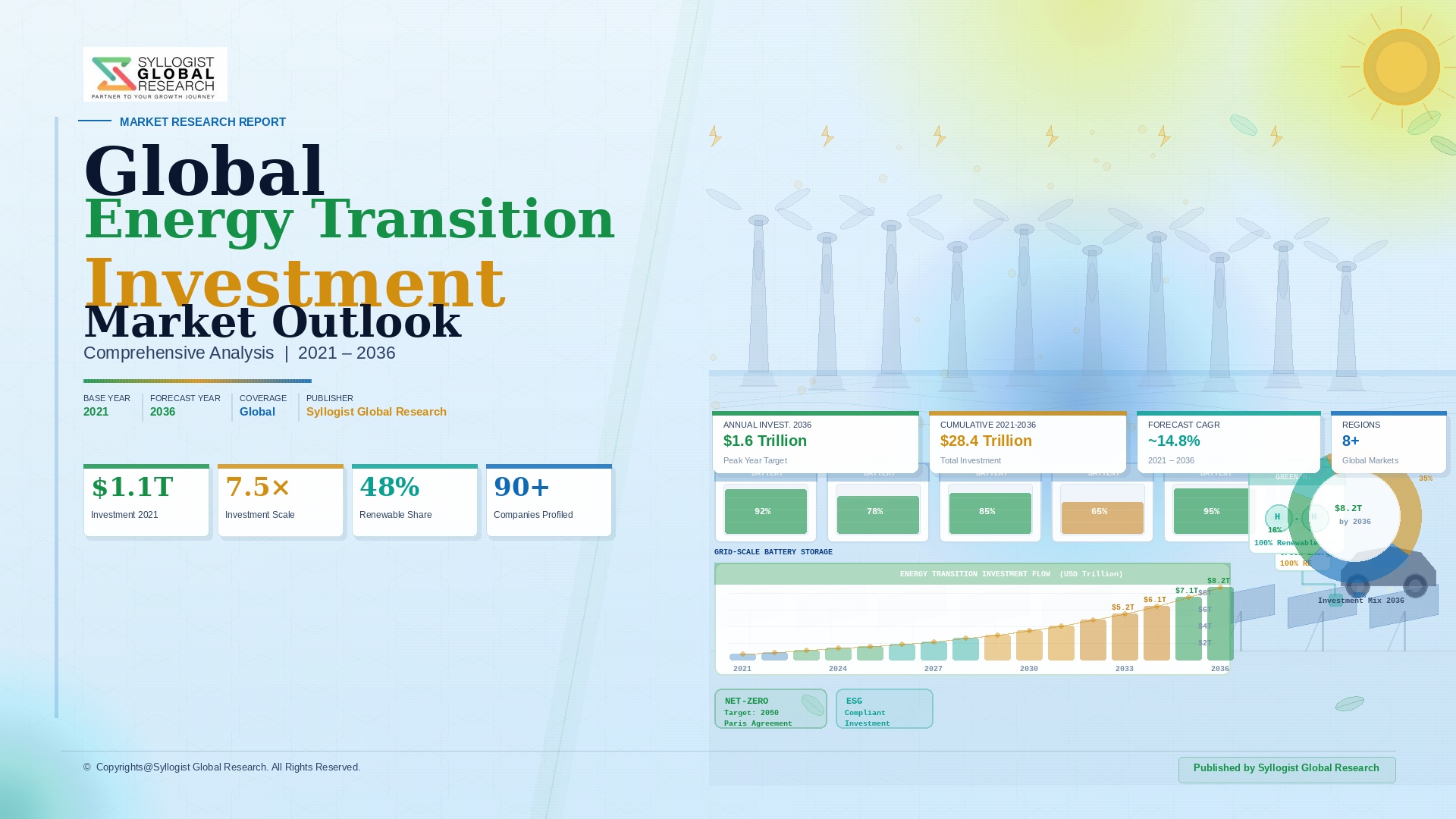
Global energy transition investment reached approximately USD 1.77 trillion in 2025, surpassing fossil fuel supply investment of approximately USD 1.05 trillion for the third consecutive year and marking a decisive structural shift in global energy capital allocation that is expected to widen further through the forecast period as policy frameworks, technology cost competitiveness, and institutional capital deployment strategies increasingly favor low-carbon assets over new fossil fuel development. By 2034, annual global energy transition investment is projected to reach approximately USD 4.2 trillion, reflecting the acceleration of investment commitments required to maintain alignment with 1.5-degree Celsius warming pathways under the Paris Agreement, which demand cumulative clean energy investment of approximately USD 32 trillion between 2025 and 2034 across power generation, grids, storage, end-use electrification, and industrial decarbonization. Solar photovoltaic investment constituted the single largest technology category at approximately USD 420 billion in 2025, driven by continued levelized cost of electricity reduction reaching record competitive auction results below USD 0.02 per kilowatt-hour in the highest-irradiance markets, while offshore wind investment reached approximately USD 210 billion supported by long-term contract frameworks in the United Kingdom, Germany, the Netherlands, Taiwan, South Korea, and Australia, and electric vehicle and charging infrastructure investment reached approximately USD 380 billion as automotive original equipment manufacturer electrification capital programs scale alongside public and private charging network deployment. The geographic distribution of energy transition investment is expanding beyond its historical concentration in the European Union, United States, and China, with India, Southeast Asia, the Middle East, and Latin America collectively accounting for approximately USD 380 billion of investment in 2025 as cost-competitive renewable energy economics, growing energy demand, and access to international climate finance create commercially viable investment environments in markets that were previously limited to concessional finance deployment.
The power sector remains the largest recipient of energy transition investment, capturing approximately USD 780 billion or 44% of total investment in 2025, encompassing renewable electricity generation, transmission and distribution grid infrastructure, and energy storage deployment, with the power sector’s investment share reflecting its role as the foundational enabler of broader economy-wide decarbonization through the electrification of transport, heating, industrial processes, and hydrogen production that collectively depend on an expanded, reliable, and clean electricity system. Grid infrastructure investment is emerging as the most critical and undersupplied component of the power sector investment portfolio, with the International Energy Agency estimating that annual global grid investment needs to nearly double from approximately USD 310 billion in 2023 to approximately USD 600 billion by 2030 to connect the renewable generation additions required to meet national clean energy targets, avoid curtailment of existing and planned renewable capacity, and enable the flexibility resources and demand response capabilities required to manage high-variable-renewable power systems reliably. The energy storage investment segment reached approximately USD 95 billion globally in 2025 and is growing at approximately 28.4% annually, driven by utility-scale battery energy storage procurement across the United States, China, United Kingdom, Australia, and Germany at battery system costs declining below USD 150 per kilowatt-hour for four-hour duration lithium iron phosphate systems, enabling grid operators and power developers to deploy storage at costs that are increasingly competitive with peaking gas plant alternatives for capacity, frequency regulation, and voltage support ancillary services across power systems with high renewable penetration requiring flexible balancing resources.
The developing economy and emerging market energy transition investment landscape represents both the most commercially significant gap relative to Paris Agreement investment requirements and the most consequential opportunity for sustainable development impact, with the International Energy Agency estimating that emerging and developing economies excluding China require annual clean energy investment of approximately USD 1.0 trillion by 2030 to maintain alignment with net-zero emissions scenarios, compared to actual investment flows of approximately USD 340 billion in 2025, identifying a financing gap of approximately USD 660 billion per year that is the central challenge of global climate finance policy and the most important commercial investment opportunity in the energy transition for institutions and investors capable of deploying capital at scale in higher-risk developing market contexts. Blended finance structures combining concessional first-loss capital from multilateral development banks and climate funds including the Green Climate Fund, Climate Investment Funds, and bilateral development finance institutions with commercial equity and debt financing from institutional investors are progressively demonstrating commercial viability in closing the financing gap for renewable energy projects in sub-Saharan Africa, South and Southeast Asia, and Latin America, with the Just Energy Transition Partnerships negotiated with South Africa, Indonesia, Vietnam, India, and Senegal mobilizing commitments of USD 8.5 billion, USD 20 billion, USD 15.5 billion, USD 8.5 billion, and USD 2.7 billion respectively for energy sector decarbonization supported by international public finance. The green bond and sustainability-linked bond market reached approximately USD 1.1 trillion in cumulative energy transition-related issuance by the end of 2025, providing long-term fixed-income instruments that match the investment horizon requirements of pension funds and insurance companies whose liability structures align with the fifteen-to-thirty-year cash flow profiles of operating renewable energy assets, creating a capital market channel that is progressively expanding the institutional investor base for energy transition financing beyond the infrastructure equity funds and project finance banks that dominated early market development.
The green hydrogen and industrial decarbonization investment segment is emerging as the next frontier of energy transition capital deployment following the commercial maturation of power sector renewable investment, with green hydrogen project announcements globally reaching a pipeline of approximately USD 680 billion in total capital commitment as of 2025, though actual final investment decisions remain concentrated in a small number of large projects in Australia, the Middle East, Chile, and Northern Europe whose economics depend on achieving green hydrogen production costs below USD 2.0 per kilogram through declining electrolyzer capital costs, low-cost renewable electricity procurement, and policy support mechanisms including the United States Inflation Reduction Act clean hydrogen production tax credit of USD 3.0 per kilogram and European hydrogen bank auction subsidies. Industrial decarbonization investment, targeting the hard-to-abate emissions from steel, cement, aluminum, chemicals, and shipping that account for approximately 30% of global greenhouse gas emissions and cannot be cost-effectively addressed through direct electrification alone, reached approximately USD 85 billion in 2025 and is growing at approximately 22.6% annually as carbon pricing frameworks, corporate net-zero commitments under the Science Based Targets initiative, and mandatory climate disclosure requirements under the International Sustainability Standards Board framework collectively increase the financial cost of continued high-emission industrial operations while improving the investment case for green hydrogen, carbon capture and storage, and process electrification industrial decarbonization pathways. Corporate power purchase agreements, in which industrial and commercial electricity consumers directly contract renewable energy developers for long-term supply at fixed prices, reached a global total of approximately 380 gigawatts of cumulative contracted capacity by the end of 2025, with hyperscale technology companies, industrial manufacturers, and financial institutions collectively accounting for the majority of contracted capacity and providing the long-term revenue certainty that enables project finance for renewable energy projects without reliance on government feed-in tariff or auction contract support mechanisms.
Key Drivers
Landmark Climate Policy Frameworks, Carbon Pricing Escalation, and Mandatory Sustainability Disclosure Requirements Creating Structural Investment Mandates and Financial Incentives at Unprecedented Scale
The global energy transition investment landscape is being fundamentally reshaped by a wave of landmark policy interventions whose combined financial scale, investment mandate scope, and long-term commitment horizon are without precedent in the history of energy infrastructure investment, creating legally binding and commercially quantifiable demand for clean energy assets that is mobilizing trillions of dollars of capital from institutional investors who previously lacked the regulatory certainty required to justify large-scale energy transition portfolio construction. The United States Inflation Reduction Act, enacted in August 2022 with an estimated USD 369 billion in climate and clean energy provisions including production tax credits for clean electricity generation, clean hydrogen, advanced manufacturing, and electric vehicles that are uncapped and available for ten years, has mobilized an estimated USD 3.0 trillion in announced clean energy investment across the United States economy through 2030 according to Treasury Department analyses, establishing the most commercially consequential clean energy policy instrument in history whose investment multiplier effect is transforming the United States into the world’s largest single-country destination for energy transition capital deployment. The European Union’s REPowerEU plan, Fit for 55 package, and EUR 210 billion energy investment program through 2027, combined with the Carbon Border Adjustment Mechanism that extends EU Emissions Trading System carbon pricing to imported goods, is creating a carbon cost environment in Europe that is both accelerating domestic clean energy investment and compelling global supply chain decarbonization by corporations exporting to EU markets, generating a regulatory investment pull that extends beyond European borders to trading partners in Asia, Latin America, and Africa whose exporters must demonstrate compliance with EU carbon cost frameworks to maintain market access.
Remarkable Technology Cost Deflation Across Solar, Wind, Battery Storage, and Electrolyzers Delivering Commercial Competitiveness That Removes the Green Premium From the Majority of Energy Transition Technologies
The extraordinary cost reduction trajectory achieved across the core energy transition technology portfolio over the past decade has fundamentally transformed the investment case for clean energy from a policy-subsidized activity requiring government support to maintain viability into a commercially self-sustaining investment class that in the majority of markets and applications delivers superior financial returns relative to equivalent fossil fuel alternatives on a pure levelized cost basis without requiring carbon pricing or subsidy support, creating a commercially driven investment dynamic that operates independently of political commitment to climate policy and sustains investment momentum even in periods of policy uncertainty or political transition. Solar photovoltaic module costs declined by approximately 90% between 2010 and 2025 from approximately USD 1.80 per watt to below USD 0.15 per watt, enabling competitive solar electricity generation at below USD 0.02 per kilowatt-hour in optimal resource locations and below USD 0.04 per kilowatt-hour in most major markets globally, levelized costs that are below the operating cost alone of existing coal-fired power generation in many markets and well below the cost of new natural gas generation in carbon-priced environments. Lithium-ion battery pack costs declined from approximately USD 1,200 per kilowatt-hour in 2010 to approximately USD 139 per kilowatt-hour in 2025 for utility-scale applications, enabling four-hour duration grid storage at system costs approaching USD 280 per kilowatt-hour that are competitive with peaking gas plants for capacity provision, while electrolyzer capital costs declined from approximately USD 1,400 per kilowatt in 2020 to approximately USD 720 per kilowatt in 2025 and are projected to reach approximately USD 280 per kilowatt by 2032, creating a credible pathway for green hydrogen production costs below USD 1.5 per kilogram in optimal locations by the early 2030s.
Institutional Capital Mobilization, ESG Integration, and Net-Zero Asset Management Commitments Channeling Trillions of Dollars of Pension, Insurance, and Sovereign Wealth Capital Toward Clean Energy Assets
The energy transition investment market is experiencing a structural expansion of its institutional investor base as pension funds, insurance companies, sovereign wealth funds, and endowments with aggregate assets under management exceeding USD 120 trillion globally progressively integrate climate risk assessment, net-zero portfolio alignment commitments, and energy transition investment mandates into their asset allocation frameworks, creating a sustained and growing demand for investable clean energy assets across equity, debt, infrastructure, and private markets that is providing the long-term patient capital essential to financing the multi-decade energy transition at the scale required by climate stabilization scenarios. The Net-Zero Asset Owner Alliance, comprising institutional investors with over USD 9.5 trillion in assets under management who have committed to net-zero portfolio alignment by 2050 with interim targets for 2025 and 2030, is translating corporate sustainability commitments into specific investment allocation requirements that increase capital deployment into clean energy assets and reduce exposure to fossil fuel-intensive holdings, creating a financially material demand stream for energy transition investment opportunities that institutional capital allocators actively compete to access at scale. Green bond issuance for energy transition purposes reached approximately USD 580 billion in 2025, providing fixed-income instruments with clearly defined use-of-proceeds frameworks for renewable energy, energy efficiency, clean transportation, and sustainable water management that match the investment horizon and risk-return requirements of institutional fixed-income allocators, while infrastructure equity funds focused on renewable energy and energy transition assets reached approximately USD 240 billion in committed capital under management globally in 2025, providing a rapidly growing asset management industry dedicated to originating, structuring, and managing energy transition infrastructure investments at institutional scale.
Key Challenges
Critical Infrastructure Permitting Bottlenecks, Grid Connection Queue Backlogs, and Land Use Constraints Preventing Timely Deployment of Committed Energy Transition Capital
The single most operationally acute constraint on the global energy transition investment deployment rate is not the availability of capital or the commercial attractiveness of clean energy assets but rather the regulatory, permitting, and grid connection infrastructure bottlenecks that prevent committed investment from being translated into operational capacity within the timelines required to meet national clean energy targets, with grid connection queue backlogs in the United States, United Kingdom, Germany, and Australia collectively representing over 3,000 gigawatts of renewable energy and storage capacity whose developers have committed capital and completed development work but cannot achieve commercial operation pending grid connection approval and network reinforcement delivery. The United States alone has a transmission interconnection queue of approximately 2,600 gigawatts of primarily renewable energy and storage projects as of 2025, while average interconnection study timelines have extended from approximately two years in 2010 to over five years in 2025, meaning that projects entering the queue today face a development timeline that is fundamentally incompatible with meeting 2030 clean energy targets regardless of the financial resources available to project sponsors. Permitting reform is being addressed through the Federal Permitting Improvement Steering Council, the Energy Act of 2020, and subsequent executive and legislative actions, but the structural challenge of coordinating environmental review, landowner consultation, cultural heritage assessment, and multi-agency approval processes across large geographical footprints of transmission and generation infrastructure has proven resistant to rapid administrative reform, creating a systemic capacity deployment bottleneck whose resolution requires fundamental reform of permitting law and process that is politically complex to achieve at the speed demanded by the climate investment timeline.
Developing Economy Financing Gap, High Cost of Capital in Emerging Markets, and Inadequate Domestic Capital Market Depth Preventing Energy Transition Investment Scaling Where It Is Most Needed
The global energy transition financing gap is geographically concentrated in developing and emerging economies outside China where the combination of higher perceived sovereign and project risk, shallow domestic capital markets, currency exposure and convertibility risk, limited domestic institutional investor base, and inadequate creditworthy offtaker capacity for long-term power purchase agreements creates a cost of capital for clean energy investment of approximately 10% to 20% compared to 4% to 8% in advanced economies, generating levelized cost of electricity differentials that prevent renewable energy projects from achieving commercial viability on merchant or quasi-merchant terms even where solar and wind resource quality is excellent. Sub-Saharan Africa, South Asia, and Southeast Asia collectively represent approximately 40% of global population and a rapidly growing share of energy demand growth, but attracted only approximately USD 30 billion of energy transition investment in 2025 against an estimated annual requirement of USD 250 billion to maintain 1.5-degree Celsius pathway alignment, identifying a financing gap of over USD 220 billion annually in the regions where climate-aligned energy investment generates the highest developmental and emissions reduction impact per dollar deployed. The Just Energy Transition Partnership model, which channels international public finance at concessional terms to reduce the cost of capital for clean energy investment in developing economies while supporting workforce transition and energy access co-benefits, represents the most promising institutional framework for bridging the developing economy financing gap, but the pace of implementation and the scale of capital mobilized through existing partnerships remain substantially below the USD 660 billion annual gap identified in Paris Agreement-aligned investment scenarios, requiring both increased donor contribution to blended finance facilities and structural reform of multilateral development bank capital deployment capacity.
Supply Chain Constraints, Critical Mineral Concentration Risk, and Manufacturing Capacity Limitations for Key Energy Transition Technology Components Creating Deployment Bottlenecks
The scaling of energy transition investment to the trillions of dollars per year required by climate stabilization scenarios is constrained by the physical supply chain limitations of the technology manufacturing and critical mineral supply chains that produce the solar modules, wind turbine components, battery cells, electrolyzers, electric vehicle drivetrains, heat pumps, and transmission cables required to convert financial investment commitments into deployed energy transition capacity, with supply chain constraints in copper, lithium, cobalt, nickel, rare earth elements, and silicon carbide capable of creating component shortages that delay project completion timelines and increase equipment costs in ways that degrade project investment returns and reduce the pace of capacity deployment relative to capital availability. Copper demand for energy transition applications including wind turbines, solar photovoltaic systems, electric vehicles, charging infrastructure, and grid transmission expansion is projected to increase from approximately 6.5 million metric tons in 2025 to approximately 11.4 million metric tons by 2034, against a global primary copper mine production capacity of approximately 22 million metric tons per year that leaves limited headroom for energy transition demand growth without significant new mine development whose long permitting and construction timelines create a structural supply constraint risk during the period of peak energy transition investment acceleration. The geographic concentration of critical mineral processing in China, which accounts for approximately 60% to 90% of global processing capacity for lithium, cobalt, rare earth elements, and silicon anode material depending on specific mineral, creates supply chain vulnerability for energy transition technology manufacturers in Europe, North America, and Japan seeking to qualify non-Chinese supply sources for critical minerals that cannot be rapidly diversified given the capital intensity and five-to-ten-year development timelines of alternative processing capacity in Australia, Canada, Chile, and Africa.
Market Segmentation
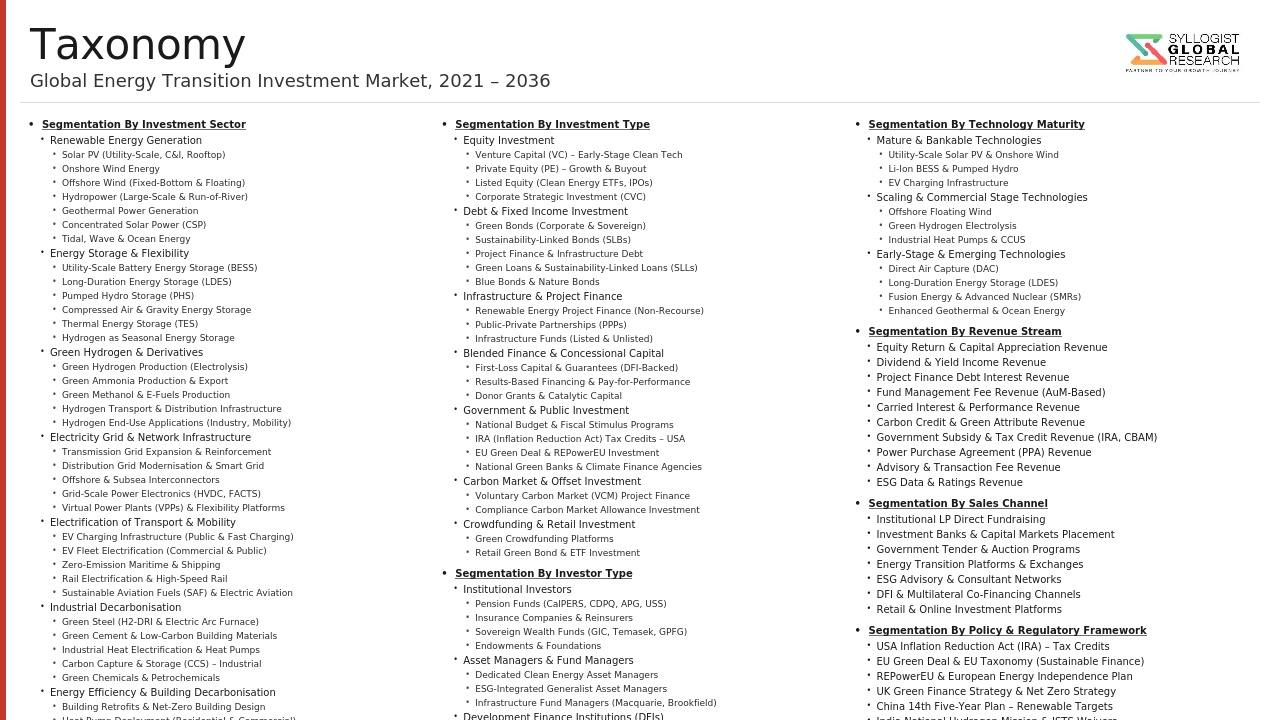
- Segmentation By Technology Sector
- Solar Photovoltaic (Utility-Scale, Commercial, and Distributed)
- Onshore Wind Energy
- Offshore Wind Energy (Fixed-Bottom and Floating)
- Battery Energy Storage Systems (Grid-Scale and Behind-the-Meter)
- Electric Vehicles and Charging Infrastructure
- Green Hydrogen Production and Infrastructure
- Transmission, Distribution, and Grid Modernization
- Energy Efficiency (Buildings, Industry, and Appliances)
- Heat Pumps and Building Electrification
- Carbon Capture, Utilization, and Storage (CCUS)
- Nuclear New Build and Small Modular Reactors (SMRs)
- Sustainable Aviation Fuel (SAF) and Green Shipping Fuels
- Industrial Decarbonization (Steel, Cement, Chemicals, and Aluminum)
- Others
- Segmentation By Investment Instrument
- Project Finance Debt
- Infrastructure Equity and Direct Asset Investment
- Green Bonds and Climate Bonds
- Sustainability-Linked Bonds and Loans
- Corporate Balance Sheet and Strategic Investment
- Blended Finance and Concessional Capital
- Venture Capital and Growth Equity
- Government Grants and Loan Programs
- Carbon Market and Renewable Energy Certificate Revenue
- Others
- Segmentation By Investor Type
- Institutional Investors (Pension Funds and Insurance Companies)
- Infrastructure Equity Funds and Asset Managers
- Commercial Banks and Project Finance Lenders
- Multilateral Development Banks and Development Finance Institutions
- Corporate Strategic Investors and Energy Utilities
- Sovereign Wealth Funds
- Venture Capital and Private Equity Firms
- Retail and Impact Investors
- Others
- Segmentation By End-Use Sector Receiving Investment
- Power Generation and Electricity Supply
- Transportation and Mobility
- Buildings and Real Estate
- Industry and Manufacturing
- Hydrogen and Synthetic Fuels Production
- Agriculture and Land Use
- Others
- Segmentation By Project Stage
- Early-Stage Development and Feasibility
- Pre-Construction and Permitting
- Construction and Commissioning
- Operating and Refinancing
- Repowering and Life Extension
- Others
- Segmentation By Region
- North America
- Europe
- Asia-Pacific
- Middle East and Africa
- Latin America
All investment values are presented in USD
Historical Year: 2021-2024 | Base Year: 2025 | Estimated Year: 2026 | Forecast Period: 2027-2034
Key Questions this Study Will Answer
- What is the total annual global energy transition investment in the base year 2025, and what is the projected investment trajectory and compound annual growth rate through 2034, disaggregated by technology sector including solar photovoltaic, onshore and offshore wind, battery storage, electric vehicles, green hydrogen, grid infrastructure, energy efficiency, carbon capture and storage, and nuclear, by investment instrument including project finance, green bonds, sustainability-linked loans, blended finance, and corporate balance sheet investment, and by investor type including institutional investors, infrastructure funds, commercial banks, multilateral development banks, sovereign wealth funds, and corporate strategic investors, to enable project developers, institutional capital allocators, climate finance institutions, energy policy planners, and corporate sustainability strategists to quantify capital deployment requirements, identify financing gaps, and prioritize investment program design across technology and geographic segments through 2034?
- How are the United States Inflation Reduction Act clean energy investment tax credits and production tax credits, the European Union REPowerEU investment program and Carbon Border Adjustment Mechanism, China’s clean energy industrial policy commitments, and India’s Production Linked Incentive scheme and renewable energy capacity auction programs collectively shaping the geographic distribution of energy transition capital deployment globally, and what are the estimated total investment volumes mobilized by each policy framework over its implementation horizon, what technology sectors and project types capture the largest capital flows under each mechanism, and how are these policy incentive structures interacting with each other to influence cross-border investment flows, technology manufacturing location decisions, and the competitive positioning of energy transition technology industries across major economies through 2034?
- What is the magnitude, geographic distribution, root cause analysis, and projected resolution timeline of the developing economy energy transition financing gap, estimated at approximately USD 660 billion annually between actual investment flows of USD 340 billion and required investment of USD 1.0 trillion per year in emerging and developing economies outside China, and how are blended finance structures, Just Energy Transition Partnerships with South Africa, Indonesia, Vietnam, India, and Senegal, multilateral development bank capital deployment reform, green bond market development in emerging economies, and domestic institutional investor mobilization programs contributing to closing this gap, and what investment and policy innovations are demonstrating the most scalable impact in attracting commercial capital to clean energy projects in higher-risk developing market contexts?
- How are permitting reform, transmission interconnection queue reform, land use planning, and grid infrastructure investment programs in the United States, United Kingdom, Germany, and Australia addressing the 3,000-plus gigawatts of renewable energy and storage capacity backlog that is preventing committed energy transition investment from reaching operational deployment, and what are the projected timelines for resolution of transmission interconnection bottlenecks under reform scenarios being implemented through the Federal Energy Regulatory Commission Order 2023 in the United States, the British Energy Security Strategy reforms in the United Kingdom, and equivalent grid connection reform processes in Europe and Asia-Pacific, and what residual permitting and grid constraint risks will continue to delay energy transition capital deployment velocity below Paris Agreement-aligned scenarios through 2034?
- What are the supply chain bottleneck risks, critical mineral demand projections, mining and processing capacity investment requirements, and geographic diversification strategies for copper, lithium, cobalt, nickel, rare earth elements, and silicon carbide that could constrain the physical deployment of energy transition investment across solar, wind, battery storage, electric vehicle, electrolyzer, and transmission infrastructure technology categories through 2034, and how are energy transition technology manufacturers, project developers, institutional investors, and governments in the United States, European Union, Australia, and Canada structuring offtake agreements, equity stakes in mining and processing projects, strategic mineral stockpile programs, and recycled material sourcing strategies to ensure adequate critical mineral supply availability at commercially competitive prices for the energy transition investment programs currently advancing toward final investment decision and construction commencement?
- Scope Definition
- Research Methodology
- Research Design & Framework
- Overall Research Approach: Descriptive, Exploratory & Quantitative Mixed-Method Design
- Investment Universe Definition & Scope Boundaries: What is Included and Excluded
- Segmentation Framework
- Key Research Assumptions & Limitations
- Secondary Research
- Primary Research Design & Execution
- Data Triangulation & Validation
- Investment Sizing & Forecasting Methodology
- Competitive Intelligence Methodology
- Quality Assurance & Peer Review
- Definitions, Abbreviations & Data Notes
- Research Design & Framework
- Executive Summary
- Investment Snapshot & Headline Numbers
- Key Findings & Research Highlights
- Investment Climate & Market Dynamics
- Regional Investment Summary
- Investor Landscape Snapshot
- Technology & Asset Class Investment Highlights
- Investment Market Dynamics
- Investment Drivers
- Investment Restraints
- Investment Opportunities
- Investment Challenges
- Porter’s Five Forces Analysis
- PESTLE Analysis
- Investment Trends & Developments
- Emerging Investment Trends
- Financial Instrument & Structure Developments
- Regulatory & Policy Changes Affecting Investment Flows
- Capital Market & Fundraising Trends
- Deal Structure & Transaction Trends
- Notable Investment Activity & Transaction Highlights
- ESG, Climate Disclosure & Sustainable Finance Trends
- Investment Risk Assessment Framework
- Policy, Regulatory & Subsidy Discontinuity Risk
- Technology Maturity, Performance & Merchant Revenue Risk
- Macroeconomic, Interest Rate, Inflation & Currency Risk
- Geopolitical, Supply Chain & Energy Security Risk Impacting Investment Returns
- ESG Greenwashing, Disclosure Inadequacy & Stranded Asset Risk
- Regulatory & Policy Framework
- National Energy Transition Policy, Net Zero Legislation & Climate Finance Mobilisation Frameworks (IRA, EU Green Deal, UK Net Zero, India Energy Mission)
- Green Taxonomy, Sustainable Finance Disclosure Regulation (SFDR), EU Taxonomy & National Green Classification Frameworks Directing Capital Flows
- Carbon Pricing, Emissions Trading Scheme (ETS) Policy & Carbon Border Adjustment Mechanism (CBAM) Impact on Energy Transition Investment Economics
- Development Finance, Multilateral Climate Fund (GCF, GEF, CTF), Blended Finance Policy & MDB Capital Adequacy Reforms for Transition Finance Mobilisation
- TCFD, ISSB (IFRS S2), SEC Climate Disclosure Rule & National Climate-Related Financial Risk Reporting Standards for Institutional Investors & Corporates
- Global Energy Transition Investment Outlook
- Total Energy Transition Investment Volume & Forecast by Value (USD Billion)
- Total Energy Transition Investment Volume & Forecast by Deal Count
- Investment Volume & Forecast by Asset Class / Financial Instrument
- Green Bonds & Climate Bonds (Sovereign, Corporate & Municipal Issuance)
- Sustainability-Linked Bonds (SLBs) & Sustainability-Linked Loans (SLLs)
- Project Finance & Infrastructure Debt (Senior, Mezzanine & Subordinated)
- Private Equity & Infrastructure Equity Funds (Closed-End & Open-End)
- Venture Capital & Growth Equity (Early-Stage, Series A-D & Growth Rounds)
- Public Equity (Listed Clean Energy, YieldCo & Clean Infrastructure)
- Blended Finance & Concessional Capital (DFI First-Loss, Guarantees & Technical Assistance)
- Voluntary Carbon Market & Article 6 International Carbon Credit Investment
- Government Grant, Subsidy, Production Tax Credit & Capital Allowance-Backed Investment
- Investment Volume & Forecast by Energy Transition Technology Sector
- Solar Photovoltaic (PV): Utility-Scale, Commercial & Industrial (C&I) and Distributed Generation
- Onshore Wind Energy: New Build, Repowering & Hybrid Wind-Solar Projects
- Offshore Wind Energy: Fixed-Bottom & Floating Offshore Wind
- Battery Energy Storage Systems (BESS): Utility-Scale, Behind-the-Meter & Grid-Scale
- Green Hydrogen, Electrolyser Manufacturing & Green Ammonia Production
- Electric Vehicle (EV) Manufacturing, Charging Infrastructure & Battery Supply Chain
- Power Grid Modernisation, Smart Grid, Transmission & Distribution Infrastructure
- Energy Efficiency: Building Retrofitting, Industrial Decarbonisation & Heat Pumps
- Carbon Capture, Utilisation & Storage (CCUS) & Direct Air Capture (DAC)
- Nuclear New Build, Small Modular Reactor (SMR) & Nuclear Life Extension
- Sustainable Aviation Fuel (SAF), Green Shipping & Alternative Marine Fuel
- Bioenergy, Biomethane & Waste-to-Energy
- Investment Volume & Forecast by Investor Type
- Institutional Investors: Pension Funds, Sovereign Wealth Funds & Insurance Companies
- Commercial Banks & Project Finance Lending Institutions
- Development Finance Institutions (DFIs) & Multilateral Development Banks (MDBs)
- Private Equity & Specialist Infrastructure Fund Managers
- Venture Capital & Corporate Venture Capital (CVC) Funds
- Government, National Development Bank & Green Bank Investment Programmes
- Corporate Strategic Investors, Energy Major & Industrial Conglomerate Investment Arms
- Retail, Impact & ESG-Focused Investment Platforms & Funds
- Investment Volume & Forecast by Investment Stage
- Early-Stage: R&D, Seed, Concept & Prototype Funding
- Development & Pre-Construction: Permitting, Development Capital & Equity Raise
- Construction & Commissioning Finance
- Operational & Revenue-Generating Asset Investment (Primary & Secondary Market)
- Refinancing, Recapitalisation & Secondary Market Asset Transaction
- Investment Volume & Forecast by Deal Type
- Greenfield Project Investment & Development Finance
- Brownfield Acquisition, Asset Purchase & Platform Build-Out
- Corporate M&A, Strategic Acquisition & Sector Consolidation
- Minority Equity Stake, Co-Investment & Club Deal
- Bond Issuance, Debt Refinancing & Capital Markets Placement
- IPO, Secondary Listing & YieldCo Formation
- Investment Volume & Forecast by Market Maturity
- Developed Markets (OECD: North America, Europe, Japan, Australia)
- Emerging Markets & Developing Economies (EMDEs: Asia Ex-Japan, Latin America, MENA)
- Frontier Markets, Least Developed Countries (LDCs) & Just Energy Transition Partnership (JETP) Nations
- Investment Volume & Forecast by Receiving Sector
- Power Generation & Electricity Utilities
- Transport & Mobility (EV, Rail, Aviation & Shipping)
- Industry & Hard-to-Abate Manufacturing
- Buildings, Real Estate & Urban Infrastructure
- Agriculture, Food Systems & Nature-Based Solutions
- Carbon Markets, Offset Projects & Climate Solutions Finance
- Investment Volume & Forecast by Placement & Distribution Channel
- Direct Bilateral Investment & Co-Investment Agreement
- Public Capital Market (Bond & Equity Exchange Listing)
- Private Placement, Fund LP Structure & Club Deal
- Platform, Marketplace & Digital Green Finance Channel
- North America Energy Transition Investment Outlook
- Investment Volume & Forecast
- By Investment Value (USD Billion)
- By Deal Count
- By Asset Class / Financial Instrument
- By Energy Transition Technology Sector
- By Investor Type
- By Investment Stage
- By Deal Type
- By Market Maturity
- By Country
- By Receiving Sector
- Investment Volume & Forecast
- Europe Energy Transition Investment Outlook
- Investment Volume & Forecast
- By Investment Value (USD Billion)
- By Deal Count
- By Asset Class / Financial Instrument
- By Energy Transition Technology Sector
- By Investor Type
- By Investment Stage
- By Deal Type
- By Market Maturity
- By Country
- By Receiving Sector
- Investment Volume & Forecast
- Asia-Pacific Energy Transition Investment Outlook
- Investment Volume & Forecast
- By Investment Value (USD Billion)
- By Deal Count
- By Asset Class / Financial Instrument
- By Energy Transition Technology Sector
- By Investor Type
- By Investment Stage
- By Deal Type
- By Market Maturity
- By Country
- By Receiving Sector
- Investment Volume & Forecast
- Latin America Energy Transition Investment Outlook
- Investment Volume & Forecast
- By Investment Value (USD Billion)
- By Deal Count
- By Asset Class / Financial Instrument
- By Energy Transition Technology Sector
- By Investor Type
- By Investment Stage
- By Deal Type
- By Market Maturity
- By Country
- By Receiving Sector
- Investment Volume & Forecast
- Middle East & Africa Energy Transition Investment Outlook
- Investment Volume & Forecast
- By Investment Value (USD Billion)
- By Deal Count
- By Asset Class / Financial Instrument
- By Energy Transition Technology Sector
- By Investor Type
- By Investment Stage
- By Deal Type
- By Market Maturity
- By Country
- By Receiving Sector
- Investment Volume & Forecast
- Country-Wise* Energy Transition Investment Outlook
- Investment Volume & Forecast
- By Investment Value (USD Billion)
- By Deal Count
- By Asset Class / Financial Instrument
- By Energy Transition Technology Sector
- By Investor Type
- By Investment Stage
- By Deal Type
- By Market Maturity
- By Country
- By Receiving Sector
- Investment Volume & Forecast
*Countries Analyzed in the Syllogist Global Research Portfolio: United States, Canada, Germany, France, United Kingdom, Spain, Italy, Netherlands, Sweden, Norway, China, Japan, South Korea, India, Australia, Brazil, Chile, Mexico, South Africa, Saudi Arabia, UAE, Indonesia, Vietnam
- Investment Analytics & Innovation Landscape
- Green Bond, Climate Bond & Sustainable Debt Market Intelligence: Issuance Volume, Use-of-Proceeds Tracking & Impact Reporting Framework Deep-Dive
- Energy Transition Private Equity, Venture Capital & Growth Equity Deal Flow Analysis
- Project Finance Structuring, Infrastructure Debt Pricing & Bankability Analysis for Energy Transition Assets
- Carbon Market Investment: Voluntary Carbon Credit Pricing, Article 6 Bilateral Agreement & Compliance Market Dynamics
- Blended Finance Architecture, DFI Instrument Design & Concessional Capital Mobilisation Multiplier Analysis
- ESG Integration, Climate Risk Scenario Analysis (NGFS), TCFD Alignment & Portfolio Decarbonisation Pathway
- Digital Green Finance Platform, Climate FinTech & AI-Driven Energy Transition Investment Analytics
- Patent & IP Landscape in Green Finance Structuring & Climate Investment Analytics
- Investment Ecosystem & Value Chain Analysis
- Capital Formation & Fund Origination: LP Fundraising, Anchor Investor Strategy & Fund Structuring
- Deal Origination, Pipeline Development & Investment Screening
- Due Diligence: Technical, Financial, ESG, Legal & Regulatory Assessment
- Transaction Structuring, Financial Close & Capital Deployment
- Asset Management, Portfolio Monitoring, ESG Reporting & Value Creation
- Exit Strategy: Secondary Sale, Refinancing, IPO & Dividend Recapitalisation
- Advisory, Legal, Rating Agency, Verification & Third-Party Ecosystem
- Investment Return & Valuation Analysis
- Project IRR, Equity Return & Blended Return Analysis by Technology Sector & Geography
- Levered vs. Unlevered Return Analysis: Impact of Debt Structure, Tenor & Cost of Capital on Energy Transition Project Economics
- Green Bond Yield, Green Premium (Greenium) & Cost of Capital Differential Analysis
- Venture Capital & Private Equity Multiple on Invested Capital (MOIC) & IRR Benchmarking for Clean Technology Portfolios
- LCOE, LCOS & Levelised Cost of Hydrogen (LCOH) vs. Investment Threshold & Merchant Revenue Risk Analysis
- Valuation Methodology: DCF, Comparable Transaction, NAV & Infrastructure Multiple Approach for Energy Transition Assets
- Sustainability, Impact & Climate Alignment Analysis
- Paris Agreement Alignment & 1.5 Degree Celsius Investment Portfolio Assessment: Science-Based Targets (SBTi), Net Zero Asset Owner Alliance & GFANZ Framework
- Climate Impact Measurement: GHG Abatement per Dollar Invested, Carbon Avoided & Additionality Assessment for Energy Transition Investments
- Social Co-Benefits & Just Transition Impact: Job Creation, Energy Access, Community Benefit & Inclusive Finance Metrics
- Nature, Biodiversity & Land Use Impact: TNFD Alignment, Ecosystem Services Valuation & Nature-Positive Investment Framework
- Regulatory-Driven Impact Reporting: EU SFDR PAI, UK SDR, SEC Climate Rule, ISSB S2 & Emerging National Mandatory Climate Disclosure Standards
- Investor & Competitive Landscape
- Market Structure & Concentration
- Investment Market Consolidation Level by Asset Class, Technology Sector & Geography
- Top 10 Investors & Fund Managers by Deployed Capital & AUM in Energy Transition
- HHI (Herfindahl-Hirschman Index) Concentration Analysis by Investor Type & Sector
- Competitive Intensity Map by Financial Instrument, Technology Sector & Geography
- Investor Classification
- Global Diversified Asset Managers & Infrastructure Fund Managers with Energy Transition Mandates
- Specialist Clean Energy & Infrastructure Private Equity & Debt Fund Managers
- Development Finance Institutions (DFIs) & Multilateral Development Banks (MDBs)
- Commercial & Investment Banks with Leading Green Finance & Project Finance Franchises
- Venture Capital & Growth Equity Firms Focused on Clean Technology & Climate Tech
- Corporate Strategic Investors: Energy Major, Utility & Industrial Company Investment Arms
- Government Green Bank, National Development Finance Institution & Sovereign Climate Fund
- ESG Rating Agency, Climate Risk Analytics Provider & Sustainable Finance Advisory Firm
- Competitive Analysis Frameworks
- Market Share Analysis by AUM, Deployed Capital, Asset Class & Geography
- Investor & Firm Profile
- Firm Overview & Headquarters
- Energy Transition Investment Mandate, Strategy & Focus Sectors
- Key Portfolio Companies, Fund Investments & Reference Transactions
- AUM, Fund Size & Energy Transition Capital Deployed
- Revenue, Management Fee, Carried Interest & Financial Performance
- Investment Differentiators, Proprietary Deal Flow & Value-Add Capability
- Key Strategic Partnerships, Co-Investment Relationships & M&A Activity
- Recent Developments (New Fund Close, Notable Deals, ESG Commitments)
- SWOT Analysis
- Strategic Focus Areas & Investment Roadmap
- Competitive Positioning Map (Capital Deployed vs. Technology Sector Breadth)
- Key Investor & Firm Profiles
- Market Structure & Concentration
- Investment Analytics & Innovation Landscape
- Strategic Output
- Investment Opportunity Matrix: By Asset Class, Technology Sector, Investor Type, Market Maturity & Geography
- White Space & Underfunded Sector Opportunity Analysis
- Strategic Output
- Strategic Recommendations
- Investment Portfolio & Asset Allocation Strategy
- Fund Structuring, Instrument Innovation & Capital Mobilisation Strategy
- Geographic Expansion & Emerging Market Entry Strategy
- LP, Anchor Investor & Co-Investment Partner Engagement Strategy
- Partnership, M&A & Platform Build-Out Strategy
- Impact, ESG Integration & Climate Alignment Strategy
- Risk Mitigation & Downside Protection Roadmap
- Strategic Priority Matrix & Roadmap
- Near-term (2025-2028)
- Mid-term (2029-2032)
- Long-term (2033-2037)