Global Offshore Drilling Equipment Market By Equipment Type, By Water Depth, By Rig Type, By Application, By Technology, By End User, By Region, Competition, Forecast & Opportunities, 2021-2036F
Market Definition
The Global Offshore Drilling Equipment Market encompasses the design, manufacture, supply, and servicing of mechanical, hydraulic, and electronic systems deployed on jack-up rigs, semi-submersible platforms, drillships, and fixed offshore structures for the exploration, appraisal, and development drilling of subsea oil and natural gas reservoirs, including drilling risers, blowout preventers, rotary drilling systems, top drives, mud pumps, drill bits, wellhead systems, subsea control systems, and associated handling and lifting equipment procured by offshore drilling contractors and oil and gas operators globally.
Market Insights
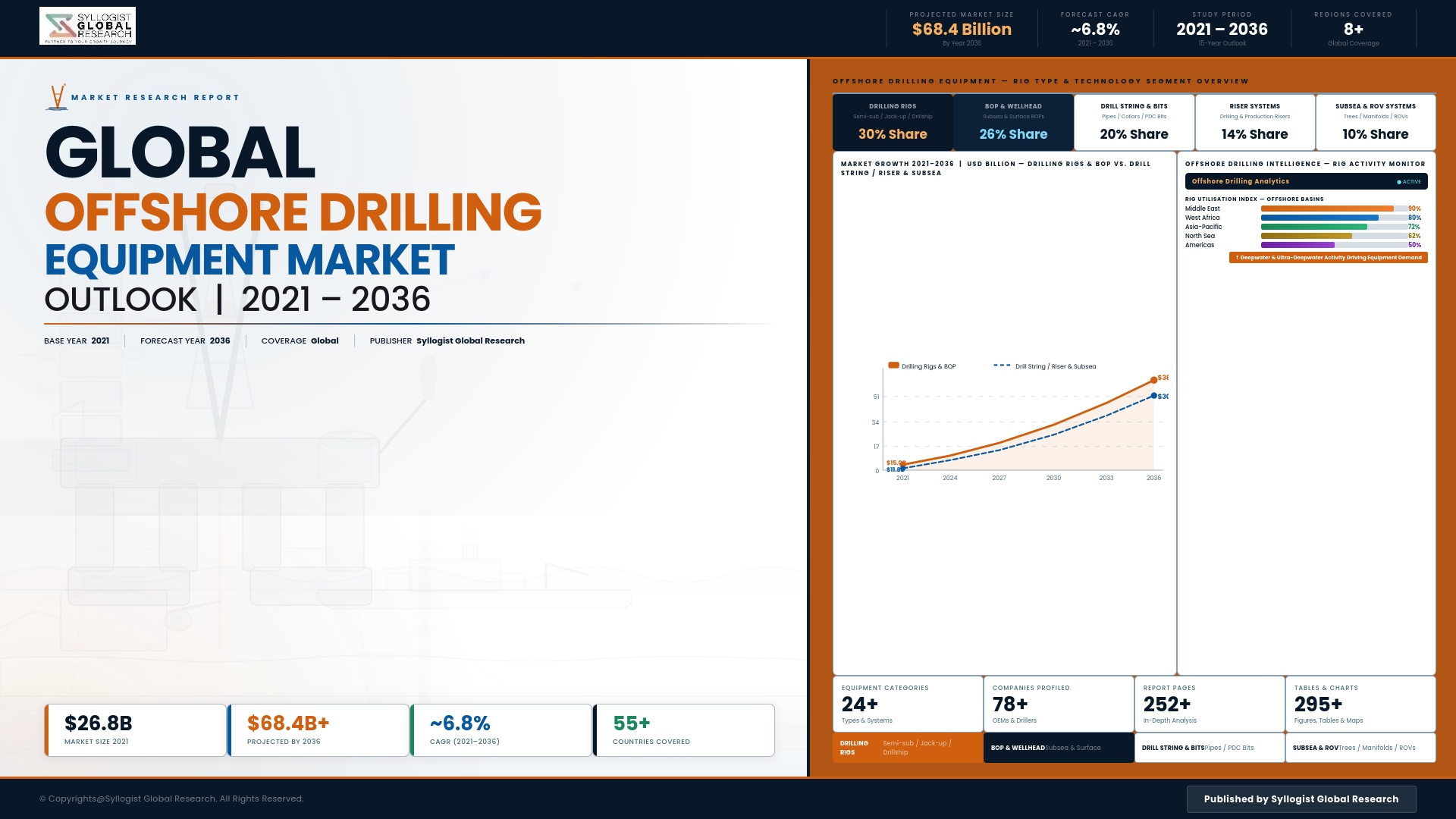
The global offshore drilling equipment market is experiencing a sustained recovery cycle underpinned by elevated oil price levels, growing global energy demand, the strategic imperative of oil and gas majors to replenish production reserves following years of capital expenditure restraint, and the recognition that deepwater and ultra-deepwater offshore fields will remain essential components of global oil and gas supply portfolios throughout the energy transition period regardless of longer-term demand trajectory. The market was valued at approximately USD 43.7 billion in 2025 and is projected to advance at a compound annual growth rate of 5.4% through 2034, as offshore drilling activity recovers across all major basins, floating rig dayrates sustain the elevated levels required to incentivize newbuild investment, and operators allocate growing fractions of exploration and production capital budgets to high-value deepwater and ultra-deepwater prospects in Guyana, Brazil, West Africa, the eastern Mediterranean, and Southeast Asia that offer the large reservoir volumes and competitive production economics required to justify the elevated well costs of deepwater development programs.
Blowout preventer systems represent the highest unit value component category within the offshore drilling equipment market, reflecting the safety-critical function of blowout prevention in containing well control events that represent the most severe operational risk in offshore drilling, the regulatory requirement for multiple independent barrier elements in well control system design following the Macondo well incident, and the ongoing investment by both drilling contractors and oil and gas operators in blowout preventer upgrade programs that replace aging equipment with modern systems incorporating enhanced pressure ratings, redundant shear and seal capability, and digital health monitoring instrumentation. The deepwater and ultra-deepwater segment is driving the most significant equipment technology advancement demand within the market, as wells drilled in water depths exceeding one thousand and three thousand meters respectively require drilling equipment capable of managing riser tensioning requirements, mud weight windows, wellbore stability challenges, and subsea wellhead and tree installation operations that impose technical specifications substantially beyond those governing shallow water continental shelf drilling.
The digital transformation of offshore drilling operations is advancing rapidly, with drilling equipment manufacturers integrating real-time sensor networks, automated drilling control systems, drilling performance optimization algorithms, and remote operations monitoring capabilities into top drive systems, mud pumps, and rig control architecture that enable drilling contractors to improve penetration rates, reduce nonproductive time, and execute complex well programs with greater operational consistency and reduced crew dependence than conventional manually supervised drilling operations. Managed pressure drilling equipment, which enables precise control of bottomhole pressure throughout the drilling process, is registering growing adoption across deepwater and high-pressure high-temperature applications where conventional drilling window management is insufficient to address the narrow pore pressure and fracture gradient margins characteristic of complex reservoir geology. Automated pipe handling systems and robotic drill floor equipment are gaining adoption on modern drillships and semi-submersibles where they deliver crew safety improvements, operating efficiency gains, and labor cost reductions that directly support the dayrate economics and operational performance metrics that determine drilling contractor competitiveness in rig contract award processes.
The Americas region, anchored by offshore drilling activity in Brazil’s pre-salt provinces, the deepwater Gulf of Mexico, and the emerging Stabroek block development program offshore Guyana, represents the most active and highest-investment offshore drilling market globally, with Petrobras, ExxonMobil, and Shell operating large multi-rig drilling programs requiring continuous equipment supply and maintenance services across ultra-deepwater formations that define the technical frontier of the global drilling equipment market. West Africa, encompassing offshore Nigeria, Angola, Senegal, Namibia, and South Africa, is registering accelerating drilling activity driven by significant new deepwater exploration success and the development of major subsea production systems that require extensive drilling equipment deployment and wellhead installation programs. The Middle East maintains substantial offshore drilling activity across the Arabian Gulf and Red Sea, with national oil companies sustaining active jack-up rig fleets for shallow water carbonate reservoir development and production maintenance programs that generate reliable long-cycle equipment procurement demand.
Key Drivers
Deepwater and Ultra-Deepwater Exploration Activity Expansion Driving High-Specification Equipment Demand as Operators Target Large-Volume Offshore Prospects Across Emerging and Frontier Basins
The global deepwater exploration and production investment cycle is in a sustained upswing driven by the exceptional discovered resource volumes in pre-salt Brazil, offshore Guyana, Namibia’s Orange Basin, and East African deepwater blocks, the competitive production economics of high-productivity deepwater wells at current oil price levels, and the strategic imperative of international oil companies to replenish long-term production reserves with large-volume discovered resources that only deepwater geological settings can deliver at the scale required to sustain major company production portfolios. The technical demands of ultra-deepwater operations at two thousand to four thousand meter water depths require drilling equipment upgrades in blowout preventer pressure ratings, riser management capability, subsea wellhead and tree design, and managed pressure drilling systems that generate high-value equipment procurement investment independent of rig dayrate economics.
Offshore Rig Fleet Modernization and High-Specification Drillship Demand Creating Equipment Upgrade and Newbuild Outfitting Investment Cycles for Drilling Contractors Competing for Premium Contracts
The significant attrition of older, lower-specification drilling rigs from the active global fleet during the prolonged downturn period has created a supply-demand balance for high-specification deepwater drillships and semi-submersibles that is sustaining elevated dayrates capable of supporting both equipment upgrade investment on existing rigs and newbuild drillship construction orders at major Korean and Chinese shipyards, generating substantial outfitting equipment procurement for top drives, blowout preventers, mud systems, and handling equipment from drilling equipment manufacturers competing for preferred supplier positions on newbuild programs. Drilling contractors operating modern seventh-generation drillships require advanced automation, digital control, and operational efficiency equipment packages that differentiate their rig capabilities in competitive tender processes for complex deepwater well programs and justify premium dayrate premiums over older lower-specification competing assets.
National Oil Company Offshore Production Maintenance and Enhanced Recovery Programs Sustaining Robust Jack-Up and Platform Drilling Equipment Demand Across Middle Eastern and Asian Shelf Provinces
Middle Eastern national oil companies including Saudi Aramco, Abu Dhabi National Oil Company, Kuwait Oil Company, and Qatar Energy are sustaining large active jack-up rig fleets engaged in production maintenance drilling, infill well programs, and enhanced recovery operations across the Arabian Gulf carbonate shelf provinces that require continuous equipment supply, maintenance services, and periodic upgrade investment to sustain production at the levels required to meet national hydrocarbon export commitments and sovereign revenue objectives. Asian offshore operators in India, Malaysia, Vietnam, Indonesia, and China are similarly sustaining or expanding jack-up and shallow water drilling programs targeting incremental production from established offshore fields and development of near-field exploration discoveries that represent commercially attractive lower-risk drilling targets relative to frontier deepwater exploration campaigns.
Key Challenges
Oil Price Cyclicality and Offshore Capital Expenditure Volatility Creating Structural Revenue Uncertainty and Investment Planning Challenges for Drilling Equipment Manufacturers and Service Providers
The offshore drilling equipment market remains fundamentally exposed to the capital expenditure cycles of oil and gas operators, which are directly governed by oil price trajectories, corporate balance sheet conditions, and investor return on capital expectations, creating periods of sharp procurement contraction during oil price downturns that have historically devastated drilling equipment order books, driven drilling contractor fleet utilization below economic break-even levels, and forced drilling equipment manufacturers and service companies through severe revenue compression and workforce restructuring cycles. The lingering impact of the 2014 to 2020 offshore drilling downturn, during which extensive rig cold stacking and retirement eliminated demand for equipment maintenance and created structural overcapacity across multiple rig classes, continues to influence the investment risk appetite and capital discipline of drilling equipment buyers.
Highly Skilled Workforce Scarcity in Offshore Drilling Operations, Equipment Maintenance, and Subsea Engineering Constraining Drilling Program Execution Quality and Equipment Serviceability
The offshore drilling industry confronts a structural workforce scarcity challenge arising from the large-scale redundancies of experienced drilling engineers, rig technicians, and subsea equipment specialists that occurred during the 2014 to 2020 industry downturn, many of whom permanently exited the offshore sector for onshore careers and have not been replaced by a sufficient new generation of trained offshore drilling professionals to meet the requirements of the current activity recovery cycle. This talent deficit is constraining the pace at which drilling programs can be executed, limiting the operational efficiency achievable on technically complex deepwater wells, extending equipment maintenance turnaround times, and increasing safety incident rates associated with the deployment of less experienced crews on high-hazard offshore drilling operations.
Regulatory Compliance Cost Escalation, Well Control Equipment Certification Requirements, and Environmental Liability Exposure Elevating Operational Expenditure and Project Development Risk Across Offshore Drilling Programs
Enhanced offshore drilling safety regulations implemented across the United States Gulf of Mexico, United Kingdom North Sea, Norway, Australia, and other major jurisdictions following the Macondo well incident have imposed substantial additional compliance costs on offshore drilling operations, including mandatory third-party blowout preventer certification and recertification programs, enhanced well control equipment testing frequency requirements, independent well examination schemes, and drilling contractor safety management system audit and verification obligations that collectively add significant cost to offshore drilling operations without directly contributing to productive drilling time. Environmental liability frameworks governing well blowout response, oil spill cleanup obligations, and natural resource damage assessment are simultaneously elevating the insurance and financial assurance requirements that drilling contractors and operators must maintain to receive regulatory approval for offshore drilling permit applications.
Market Segmentation
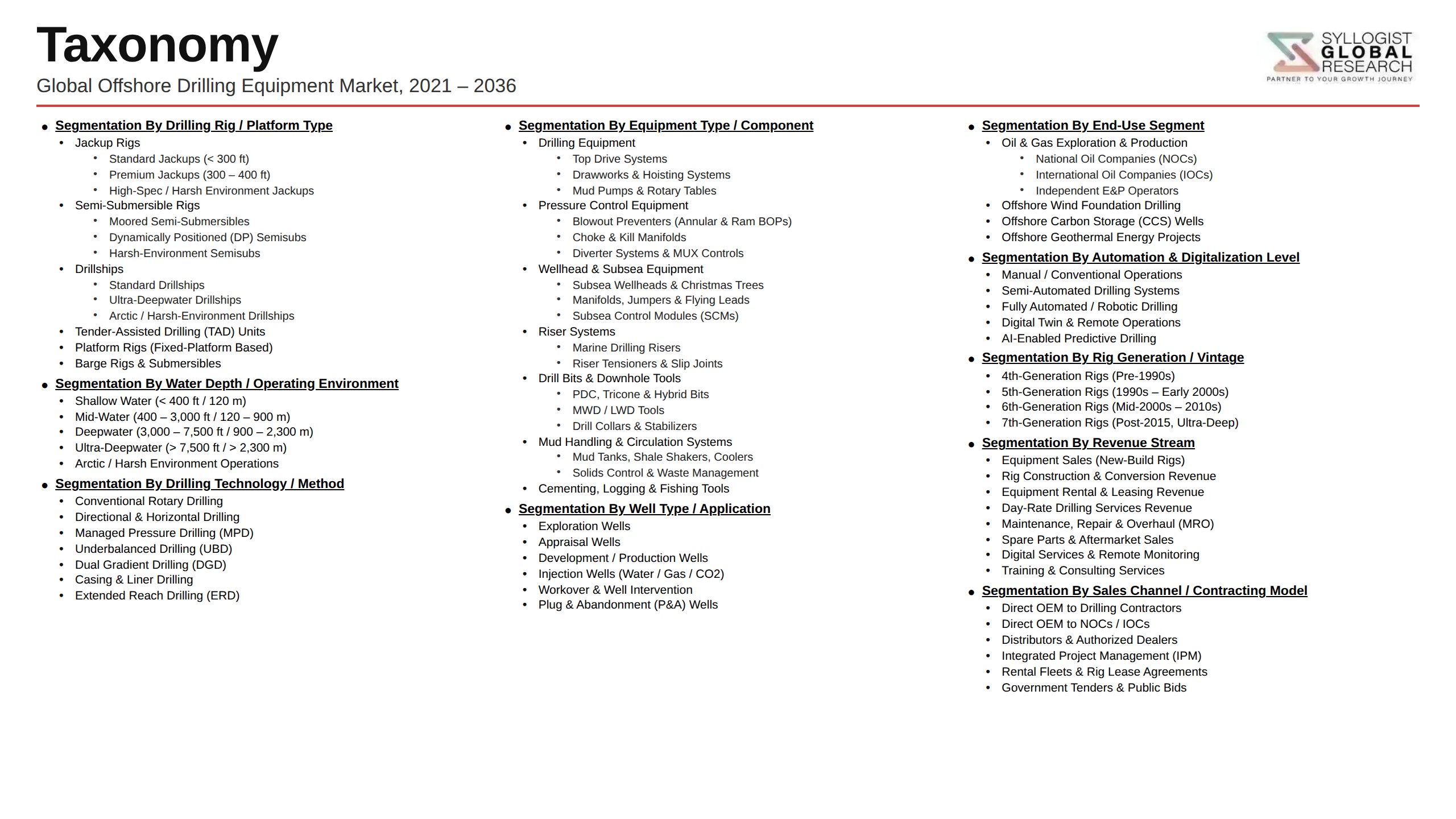
- Segmentation By Equipment Type
- Blowout Preventer Systems and Well Control Equipment
- Top Drive Systems and Rotary Drilling Equipment
- Mud Pumps and Circulation Systems
- Drill Bits and Downhole Drilling Tools
- Drilling Risers and Marine Riser Systems
- Subsea Wellhead and Christmas Tree Systems
- Pipe Handling and Automated Drill Floor Equipment
- Others
- Segmentation By Water Depth
- Shallow Water (Below 300 Meters)
- Deepwater (300 to 1500 Meters)
- Ultra-Deepwater (1500 to 3000 Meters)
- Frontier Deep Water (Above 3000 Meters)
- Segmentation By Rig Type
- Jack-Up Drilling Rigs
- Semi-Submersible Drilling Platforms
- Drillships
- Fixed Platform Drilling Systems
- Tender-Assisted Drilling Units
- Others
- Segmentation By Application
- Exploration and Appraisal Drilling
- Development and Production Drilling
- Production Maintenance and Workover Drilling
- Decommissioning and Well Abandonment
- Others
- Segmentation By Technology
- Conventional Rotary Drilling Systems
- Managed Pressure Drilling Equipment
- Automated and Robotic Drilling Systems
- Digital Well Control and Monitoring Platforms
- Directional Drilling and Measurement-While-Drilling Systems
- Others
- Segmentation By End User
- International Oil and Gas Companies
- National Oil Companies
- Independent Offshore Drilling Contractors
- Offshore Engineering, Procurement, and Construction Contractors
- Others
- Segmentation By Region
- North America
- Europe
- Asia-Pacific
- Middle East and Africa
- Latin America
All market revenues are presented in USD
Historical Year: 2021-2024 | Base Year: 2025 | Estimated Year: 2026 | Forecast Period: 2027-2034
Key Questions this Study Will Answer
- What is the total global offshore drilling equipment market valuation in 2025, projected through 2034, segmented by equipment type, water depth, and rig type, enabling drilling equipment manufacturers, rig contractors, and oilfield service investors to identify the highest-value equipment categories and most commercially significant offshore drilling activity growth opportunities across the global market?
- How are deepwater and ultra-deepwater drilling activity expansions in pre-salt Brazil, offshore Guyana, Namibia, West Africa, and East Africa reshaping the technical specification requirements for blowout preventer pressure ratings, riser management capability, managed pressure drilling systems, and subsea wellhead equipment, and which equipment categories are generating the highest investment intensity per well drilled in frontier deepwater basins?
- What is the current state of global floating rig supply and demand balance across seventh-generation drillships and high-specification semi-submersibles, and how are sustained elevated dayrate levels, rig contract term extensions, and newbuild construction orders at Korean and Chinese shipyards shaping equipment outfitting procurement volumes and preferred supplier selection decisions through 2034?
- How is the competitive landscape structured among global drilling equipment original equipment manufacturers, subsea equipment specialists, and digital drilling technology platform developers, and what technology differentiation, service capability integration, digital automation system development, and strategic partnerships with drilling contractors and national oil companies are enabling leading equipment suppliers to capture premium market positions?
- What offshore drilling safety regulatory requirements, blowout preventer certification and recertification obligations, independent well examination scheme compliance costs, and environmental liability insurance and financial assurance mandates are most significantly elevating operational expenditure for offshore drilling programs, and how are drilling contractors and equipment suppliers developing compliance-efficient solutions that satisfy regulatory requirements at lower total cost?
- How are digital drilling automation, real-time drilling performance optimization, managed pressure drilling system adoption, and remote operations monitoring capabilities reshaping competitive differentiation among drilling equipment suppliers, and what productivity improvements, nonproductive time reductions, and well cost savings are operators achieving through advanced drilling technology deployment that are driving equipment specification upgrade decisions?
- Which regional offshore drilling markets, specifically the Americas, the Middle East, West Africa, and Asia-Pacific, are expected to generate the most significant incremental drilling equipment procurement growth through 2034, and what combinations of deepwater exploration maturity, national oil company production programs, jack-up fleet utilization levels, and frontier basin exploration activity are defining equipment demand trajectories in each region?
- Product Definition
- Research Methodology
- Research Design & Framework
- Overall Research Approach: Descriptive, Exploratory & Quantitative Mixed-Method Design
- Market Definition & Scope Boundaries: What is Included and Excluded
- Segmentation Framework
- Key Research Assumptions & Limitations
- Secondary Research
- Primary Research Design & Execution
- Data Triangulation & Validation
- Market Sizing & Forecasting Methodology
- Competitive Intelligence Methodology
- Quality Assurance & Peer Review
- Definitions, Abbreviations & Data Notes
- Research Design & Framework
- Executive Summary
- Market Snapshot & Headline Numbers
- Key Findings & Research Highlights
- Market Dynamics
- Regional Market Summary
- Competitive Landscape Snapshot
- Technology & Innovation Highlights
- Market Dynamics
- Drivers
- Restraints
- Opportunities
- Challenges
- Porter’s Five Forces Analysis
- PESTLE Analysis
- Market Trends & Developments
- Emerging Trends
- Technological Developments
- Regulatory & Policy Changes
- Supply Chain & Sourcing Trends
- Manufacturing & Process Trends
- Investment & Funding Activity
- Sustainability & ESG Trends
- Risk Assessment Framework
- Oil Price Volatility, Upstream Capex Cycle & Drilling Activity Demand Risk
- Well Control Failure, Blowout & Major Offshore Accident Liability Risk
- Harsh Environment, Extreme Weather & Deepwater Operational Safety Risk
- Energy Transition, Stranded Asset & Long-Term Offshore Investment Uncertainty Risk
- Supply Chain Concentration, Specialist Component Lead Time & Rig Reactivation Cost Risk
- Geopolitical Instability, Sanctioned Region Access & Offshore Block Licence Uncertainty Risk
- Regulatory Framework & Standards
- Well Control & Blowout Preventer (BOP) Standards: API 16A, API 16C, ISO 13533 & BSEE/OPEP Regulatory Requirements
- Offshore Drilling Safety: IMO MODU Code, NOPSEMA, OPEP & National Offshore Regulator Safety Case Requirements
- Rig Classification, Structural Integrity & Classification Society Standards: DNV, Lloyd’s Register, ABS & Bureau Veritas
- Environmental Discharge, Cuttings Management & Offshore Drilling Waste Disposal Regulatory Standards
- Greenhouse Gas Emission Reporting, Flaring Restrictions & Offshore Decarbonisation Regulatory Frameworks
- Local Content Requirements, Offshore Procurement Rules & National Regulatory Frameworks by Jurisdiction
- Global Offshore Drilling Equipment Market Outlook
- Market Size & Forecast by Value
- Market Size & Forecast by Volume (Units Shipped & Equipment Sets)
- Market Size & Forecast by Equipment Category
- Blowout Preventers (BOPs) & Well Control Systems
- Drilling Risers, Marine Drilling Risers & Flexible Risers
- Drill Strings, Drill Pipes, Drill Collars & Heavyweight Drill Pipe (HWDP)
- Rotary Drilling Equipment: Top Drive Systems, Rotary Tables & Kelly Systems
- Drawworks, Crown Blocks, Travelling Blocks & Hoisting Systems
- Mud Pumps, Cementing Units & Drilling Fluid Circulation Systems
- Subsea Wellhead Systems, Wellhead Connectors & Christmas Trees
- Drill Bits (PDC, Roller Cone & Diamond Drill Bits)
- Downhole Tools: MWD/LWD, Motors, Reamers & Rotary Steerable Systems (RSS)
- Offshore Rig Instrumentation, Monitoring & Automation Systems
- Offshore Cranes, Lifting, Handling & Deck Equipment
- Market Size & Forecast by Rig Type
- Jackup Rigs
- Semi-Submersible Rigs
- Drillships
- Tender-Assisted Drilling (TAD) Barges
- Platform Drilling Rigs & Fixed Platform Installations
- Market Size & Forecast by Water Depth
- Shallow Water (Below 300m)
- Mid-Water (300m to 1,500m)
- Deepwater (1,500m to 3,000m)
- Ultra-Deepwater (Above 3,000m)
- Market Size & Forecast by Application
- Exploration Drilling
- Appraisal & Development Drilling
- Production Drilling & Well Completion
- Workover, Well Intervention & Plug & Abandonment (P&A)
- Geothermal Offshore Drilling
- Market Size & Forecast by Activity Type
- New Equipment Manufacturing & Supply
- Equipment Refurbishment, Upgrade & Life Extension
- Rental & Leasing of Drilling Equipment
- Aftermarket Spare Parts, Repair & Maintenance Services
- Market Size & Forecast by End-User
- International Oil Companies (IOCs)
- National Oil Companies (NOCs)
- Independent E&P Companies
- Offshore Drilling Contractors & Rig Owners
- Oilfield Services Companies
- Market Size & Forecast by Sales Channel
- Direct OEM & Equipment Manufacturer Sales
- Integrated Oilfield Services & Equipment Package Channel
- Distributor, Trading & Aftermarket Parts Channel
- Rental, Leasing & Equipment-as-a-Service Channel
- Government & National Oil Company Procurement Channel
- North America Offshore Drilling Equipment Market Outlook
- Market Size & Forecast
- By Value
- By Volume (Units Shipped & Equipment Sets)
- By Equipment Category
- By Rig Type
- By Water Depth
- By Application
- By Activity Type
- By End-User
- By Country
- By Sales Channel
- Market Size & Forecast
- Europe & North Sea Offshore Drilling Equipment Market Outlook
- Market Size & Forecast
- By Value
- By Volume (Units Shipped & Equipment Sets)
- By Equipment Category
- By Rig Type
- By Water Depth
- By Application
- By Activity Type
- By End-User
- By Country
- By Sales Channel
- Market Size & Forecast
- Asia-Pacific Offshore Drilling Equipment Market Outlook
- Market Size & Forecast
- By Value
- By Volume (Units Shipped & Equipment Sets)
- By Equipment Category
- By Rig Type
- By Water Depth
- By Application
- By Activity Type
- By End-User
- By Country
- By Sales Channel
- Market Size & Forecast
- Latin America Offshore Drilling Equipment Market Outlook
- Market Size & Forecast
- By Value
- By Volume (Units Shipped & Equipment Sets)
- By Equipment Category
- By Rig Type
- By Water Depth
- By Application
- By Activity Type
- By End-User
- By Country
- By Sales Channel
- Market Size & Forecast
- Middle East & Africa Offshore Drilling Equipment Market Outlook
- Market Size & Forecast
- By Value
- By Volume (Units Shipped & Equipment Sets)
- By Equipment Category
- By Rig Type
- By Water Depth
- By Application
- By Activity Type
- By End-User
- By Country
- By Sales Channel
- Market Size & Forecast
- Country-Wise* Offshore Drilling Equipment Market Outlook
- Market Size & Forecast
- By Value
- By Volume (Units Shipped & Equipment Sets)
- By Equipment Category
- By Rig Type
- By Water Depth
- By Application
- By Activity Type
- By End-User
- By Country
- By Sales Channel
- Market Size & Forecast
- *Countries Analyzed in the Syllogist Global Research Portfolio: United States, Canada, Mexico, United Kingdom, Norway, Netherlands, Australia, China, India, Malaysia, Indonesia, Singapore, Brazil, Guyana, Trinidad & Tobago, Saudi Arabia, UAE, Kuwait, Qatar, Iraq, Nigeria, Angola, Egypt, Mozambique
- Technology Landscape & Innovation Analysis
- BOP Technology Deep-Dive: Dual-Ram, Casing Shear, 20,000 PSI Ultra-HPHT BOP & Enhanced Well Control System Design
- Rotary Steerable System (RSS) & Automated Directional Drilling Technology: Closed-Loop Automation & AI-Guided Trajectory Control
- PDC Drill Bit Technology: Cutter Geometry, Thermally Stable Polycrystalline (TSP), Impregnated & Ultra-HPHT Drill Bit Advances
- Managed Pressure Drilling (MPD) & Dual-Gradient Drilling Technology for Deepwater & Ultra-HPHT Well Challenges
- Top Drive Automation, Mechanised Pipe Handling & Integrated Rig Control System Technology
- MWD/LWD Real-Time Data Transmission, Formation Evaluation & Geosteering Technology Advances
- Digital Rig Technology: Integrated Operations Centre, AI Drilling Optimisation, Predictive Maintenance & Remote Monitoring
- Patent & IP Landscape in Offshore Drilling Equipment Technologies
- Value Chain & Supply Chain Analysis
- Specialty Steel, Forged Components, Castings & Raw Material Supply Chain for Drilling Equipment
- BOP Stacks, Wellhead, Subsea Tree & Pressure Control Equipment Manufacturing Supply Chain
- Drill String, Drill Pipe, Premium Connections & Tubular Goods Supply Chain
- Top Drive, Drawworks, Mud Pump & Mechanical Equipment Manufacturing Supply Chain
- Downhole Tools, MWD/LWD, RSS & Electronics Manufacturing Supply Chain
- Rig Integration, Systems Testing, Commissioning & OEM Channel
- Aftermarket Service, Inspection, Repair, Overhaul (MRO) & Spare Parts Supply Chain
- Pricing Analysis
- Offshore Drilling Equipment Unit Price Analysis by Equipment Category & Specification
- BOP Stack & Well Control System Capital Cost Analysis by Pressure Rating & Water Depth
- Top Drive, Drawworks & Rig Mechanical System Pricing Analysis
- Downhole Tool Rental Rate, Day Rate & Performance-Based Pricing Analysis
- Aftermarket Parts, Inspection & Overhaul Cost Structure Analysis
- Rig Equipment Package Total Installed Cost & Life-of-Field Equipment Cost Analysis
- Sustainability & Environmental Analysis
- Offshore Drilling GHG Emissions: Rig Power Consumption, Flaring, Venting & Diesel Engine Emission Reduction Strategies
- Well Fluid Management, Synthetic Drilling Fluid Toxicity & Zero-Discharge Cuttings Treatment Technology
- Offshore Rig Electrification, Hybrid Power Systems & Shore Power Solutions for Emission Reduction
- Plug & Abandonment (P&A) Well Integrity, Decommissioning Standards & Liability Management
- ESG Reporting, Responsible Sourcing & Supply Chain Due Diligence for Offshore Drilling Equipment Manufacturers
- Competitive Landscape
- Market Structure & Concentration
- Market Consolidation Level (Fragmented vs. Consolidated by Equipment Category & Geography)
- Top 10 Players Market Share
- HHI (Herfindahl-Hirschman Index) Concentration Analysis
- Competitive Intensity Map by Equipment Category, Rig Type & Geography
- Player Classification
- Integrated Oilfield Equipment & Technology Companies (Full Portfolio)
- Specialist BOP, Wellhead & Pressure Control Equipment Manufacturers
- Specialist Drill Bit & Downhole Tool Manufacturers
- Drill String, Drill Pipe & Tubular Goods Manufacturers
- Top Drive, Drawworks & Rig Mechanical System Manufacturers
- MWD/LWD, RSS & Digital Drilling Technology Providers
- Competitive Analysis Frameworks
- Market Share Analysis by Equipment Category, Rig Type & Region
- Company Profile
- Company Overview & Headquarters
- Offshore Drilling Equipment Products & Technology Portfolio
- Key Customer Relationships & Reference Project Installations
- Manufacturing Footprint & Production Capacity
- Revenue (Offshore Drilling Equipment Segment) & Order Backlog
- Technology Differentiators & IP
- Key Strategic Partnerships, JVs & M&A Activity
- Recent Developments (Contract Wins, Product Launches, Capacity Expansion)
- SWOT Analysis
- Strategic Focus Areas & Roadmap
- Competitive Positioning Map (Technology Capability vs. Market Penetration)
- Key Company Profiles
- Market Structure & Concentration
- Technology Landscape & Innovation Analysis
- Strategic Output
- Market Opportunity Matrix: By Equipment Category, Rig Type, Water Depth, Application, End-User & Geography
- White Space Opportunity Analysis
- Strategic Recommendations
- Product Portfolio & Technology Investment Strategy
- Manufacturing & Operational Excellence Strategy
- Geographic Expansion & Localisation Strategy
- Customer & End-User Engagement Strategy
- Partnership, M&A & Ecosystem Strategy
- Sustainability & Decarbonisation Strategy
- Risk Mitigation & Future Roadmap
- Strategic Priority Matrix & Roadmap
- Near-term (2025-2028)
- Mid-term (2029-2032)
- Long-term (2033-2037)
- Strategic Output