Global Polyethylene Market By Product Type, By Production Technology, By Application, By End Use Industry, By Grade, By Region, Competition, Forecast & Opportunities, 2021-2036F
Market Definition
The Global Polyethylene Market encompasses the production, processing, and commercial distribution of high-density polyethylene, low-density polyethylene, linear low-density polyethylene, ultra-high molecular weight polyethylene, and metallocene polyethylene resins produced through ethylene polymerization via Ziegler-Natta, chromium oxide, and metallocene catalyst systems, serving packaging, pipe and fittings, geomembranes, agricultural film, automotive, medical devices, wire and cable, and industrial container applications across consumer goods, construction, agriculture, infrastructure, healthcare, and industrial end use markets globally.
Market Insights
The global polyethylene market occupies a foundational position within the global petrochemical industry as the world’s single highest-volume thermoplastic polymer, and its growth trajectory reflects the complex interplay of structural demand expansion in developing economies, progressive market maturation and sustainability-driven consumption moderation in developed markets, intensifying competitive pressure from North American and Middle Eastern low-cost producers, and the accelerating emergence of recycled and bio-based polyethylene alternatives that are beginning to reshape the supply mix of certain premium consumer packaging applications. The market was valued at approximately USD 162.3 billion in 2025 and is projected to advance at a compound annual growth rate of 4.1% through 2034, as rising per capita polyethylene consumption in Asia, Africa, the Middle East, and Latin America driven by packaged food adoption, agricultural film usage, infrastructure pipe system development, and consumer goods manufacturing expansion more than offsets the volume moderation visible in European and North American markets where plastic packaging regulation, mandatory recycled content requirements, and brand owner sustainability commitments are constraining virgin resin demand growth.
High-density polyethylene maintains the largest volume share within the global polyethylene market, reflecting its versatile performance across blow-molded bottles and containers, injection-molded caps and closures, large-part rotational molding, pipe and conduit extrusion, and geomembrane sheet applications where its combination of stiffness, chemical resistance, and processing ease at competitive cost make it the material of choice across multiple high-volume application categories. Linear low-density polyethylene is the most dynamically growing polyethylene grade, driven by its dominant position in stretch wrap, agricultural mulch film, heavy-duty sacks, and flexible food packaging applications where its superior tear resistance and puncture performance relative to low-density polyethylene enables film thickness reduction and material savings that simultaneously reduce packaging material cost and environmental footprint, creating compelling commercial and sustainability justification for continued linear low-density polyethylene adoption in packaging applications transitioning from heavier gauge alternatives. Metallocene-catalyzed polyethylene grades are gaining meaningful market share in premium flexible packaging, medical device packaging, and personal care applications where the precise molecular architecture achievable with single-site metallocene catalyst systems delivers the exceptional clarity, seal strength, and mechanical property combinations that brand owners and product designers specify for differentiated consumer packaging and performance-critical medical applications.
The competitive economics of global polyethylene production continue to be dominated by the structural feedstock cost advantage of United States ethane cracker-based producers, whose access to shale gas-derived ethane at prices substantially below equivalent naphtha feedstock costs delivers polyethylene production economics that generate persistently competitive export pricing in Asian and European markets, pressuring the operating margins of naphtha-based polyethylene producers in those regions and accelerating capacity rationalization among high-cost legacy producers unable to achieve returns on invested capital at prevailing market prices. Middle Eastern ethane and associated gas-based polyethylene producers maintain similarly advantaged production cost positions and have significantly expanded their specialty grade product portfolios and downstream application development capabilities over the past decade, progressively moving from commodity high-density polyethylene and linear low-density polyethylene production toward performance-differentiated metallocene grades and engineering polyethylene applications where polymer specifications and application knowledge create more defensible margins than pure commodity resin competition.
Asia-Pacific dominates the global polyethylene market by consumption volume, with China representing the single largest national polyethylene consumption market globally, driven by the scale of its flexible packaging, agricultural film, pipe system, and blow-molded container manufacturing industries that collectively consume volumes exceeding the entire polyethylene consumption of North America and Europe combined. North America is the dominant polyethylene export region, with United States Gulf Coast producers generating surplus ethylene and polyethylene capacity that is exported across Asia, Latin America, and Europe, establishing American producers as structurally important swing suppliers whose export volumes and pricing significantly influence global polyethylene market balances. Europe represents the most regulated polyethylene market, where packaging legislation, extended producer responsibility frameworks, and mandatory recycled content requirements are progressively reshaping the grade mix, application distribution, and supply chain sustainability profile of polyethylene consumption.
Key Drivers
Developing Economy Packaged Food, Agricultural Film, and Infrastructure Pipe Demand Sustaining Volume Growth That Offsets Regulatory Moderation in Mature Market Polyethylene Consumption
Rising disposable income, rapid urbanization, and the formalization of retail food distribution across South and Southeast Asia, sub-Saharan Africa, the Middle East, and Latin America are driving robust growth in polyethylene consumption for flexible food packaging, stand-up pouches, stretch wrap, and rigid container formats that are progressively replacing informal bulk food distribution and lower-performing alternative materials as consumer preferences and food safety expectations evolve in line with rising living standards. Agricultural film consumption for greenhouse covering, mulch film, silage wrap, and fumigation sheeting is simultaneously growing rapidly in regions expanding high-value horticultural production, with Asia-Pacific and the Middle East registering particularly high agricultural film demand growth supported by government agricultural productivity investment programs and water scarcity-driven adoption of protected cultivation systems.
North American Ethane Cost Advantage and Continued Shale Gas Productivity Sustaining Competitive Export Economics That Shape Global Polyethylene Trade Flows and Regional Producer Margins
The ongoing productivity improvement of United States shale gas operations, which continues delivering abundant associated ethane at structural cost discounts to crude oil-equivalent energy parity, is sustaining the manufacturing cost advantage of United States Gulf Coast polyethylene producers at levels that generate export-competitive pricing across Asian and European destination markets, incentivizing continued new ethane cracker and polyethylene plant investment on the Gulf Coast and enabling American producers to supply growing developing market demand at prices that incumbent domestic producers in price-sensitive markets cannot cost-effectively match. This feedstock advantage is reinforcing the ongoing restructuring of global polyethylene production geography toward advantaged-feedstock locations and away from high-cost naphtha-based production in regions lacking structural natural gas liquid cost advantages.
Performance-Enhanced Metallocene and Advanced Polyethylene Grades Enabling Film Downgauging, Material Substitution, and New Application Development That Expands Market Value Beyond Volume Growth
The commercial expansion of metallocene-catalyzed polyethylene grades delivering superior optical clarity, low-temperature seal initiation, enhanced tear and puncture resistance, and tighter molecular weight distribution enables film converters and packaging manufacturers to reduce film gauge while maintaining or improving functional performance, creating material savings and cost reduction benefits for downstream converters that accelerate adoption of premium metallocene grades relative to conventional Ziegler-Natta linear low-density polyethylene in flexible packaging, specialty film, and medical packaging applications. Advanced high-density polyethylene pipe grades engineered for elevated pressure ratings, improved slow crack growth resistance, and extended service life in water, gas, and industrial fluid distribution applications are enabling polyethylene pipe systems to displace metal pipe in increasingly demanding pressure and corrosive environment applications.
Key Challenges
Global Polyethylene Capacity Oversupply Cycle and Structural Margin Compression Creating Challenging Return on Investment Conditions for New Capacity Investments and Existing Producer Operations
The large wave of ethane cracker and polyethylene capacity additions commissioned on the United States Gulf Coast and in China between 2018 and 2024, combined with continued Middle Eastern capacity additions and significant new Chinese coal-to-olefins capacity, has created a global polyethylene supply surplus that has compressed commodity resin margins across all major grades to levels below the cash cost of high-cost producers and well below the returns required to justify new greenfield capacity investment at prevailing polymer pricing levels. This overcapacity cycle is extending rationalization pressure on European and Asian naphtha-based producers, delaying final investment decisions on announced new capacity projects, and creating a challenging commercial environment for polyethylene producers globally that is likely to persist until demand growth absorbs the existing capacity surplus.
Single-Use Plastic Regulation, Packaging Sustainability Mandates, and Mandatory Recycled Content Requirements Creating Structural Demand Displacement for Virgin Polyethylene in Regulated Markets
The progressive tightening of single-use plastic regulation under the European Union Single Use Plastics Directive, extended producer responsibility frameworks, plastic packaging taxes, and mandatory recycled content requirements in European Union member states, the United Kingdom, and an expanding set of national jurisdictions is creating structural demand displacement for virgin polyethylene in regulated packaging applications, as brand owners and packaging converters invest in mechanical and chemical recycling infrastructure to source recycled polyethylene content meeting minimum recycled material inclusion obligations that reduce their dependence on virgin resin procurement. The uncertainty over the pace and geographic scope of future plastic regulation expansion is simultaneously creating investment planning complexity for polyethylene capacity developers whose project economics assume multi-decade virgin resin demand growth in currently unregulated markets.
Bio-Based Polyethylene Scaling Challenges and Chemical Recycling Cost Competitiveness Gaps Slowing the Sustainability Transition of Polyethylene Supply Chains in Premium Market Segments
Bio-based polyethylene produced from sugarcane bioethanol-derived ethylene commands a significant price premium over conventional petroleum-derived polyethylene that limits its market penetration to sustainability-motivated premium consumer packaging applications where brand owners are willing to absorb higher raw material costs to support renewable content claims, and the scaling of bio-based polyethylene production capacity to volumes capable of addressing meaningful fractions of total polyethylene demand is constrained by feedstock land use competition, water and agricultural input requirements, and the investment economics of bioethanol dehydration at scale. Chemically recycled polyethylene from plastic waste pyrolysis faces persistent cost competitiveness gaps relative to virgin resin pricing at current crude oil and natural gas prices, limiting its commercial adoption to applications where regulatory mandates or voluntary recycled content commitments justify the premium cost rather than market economics alone.
Market Segmentation
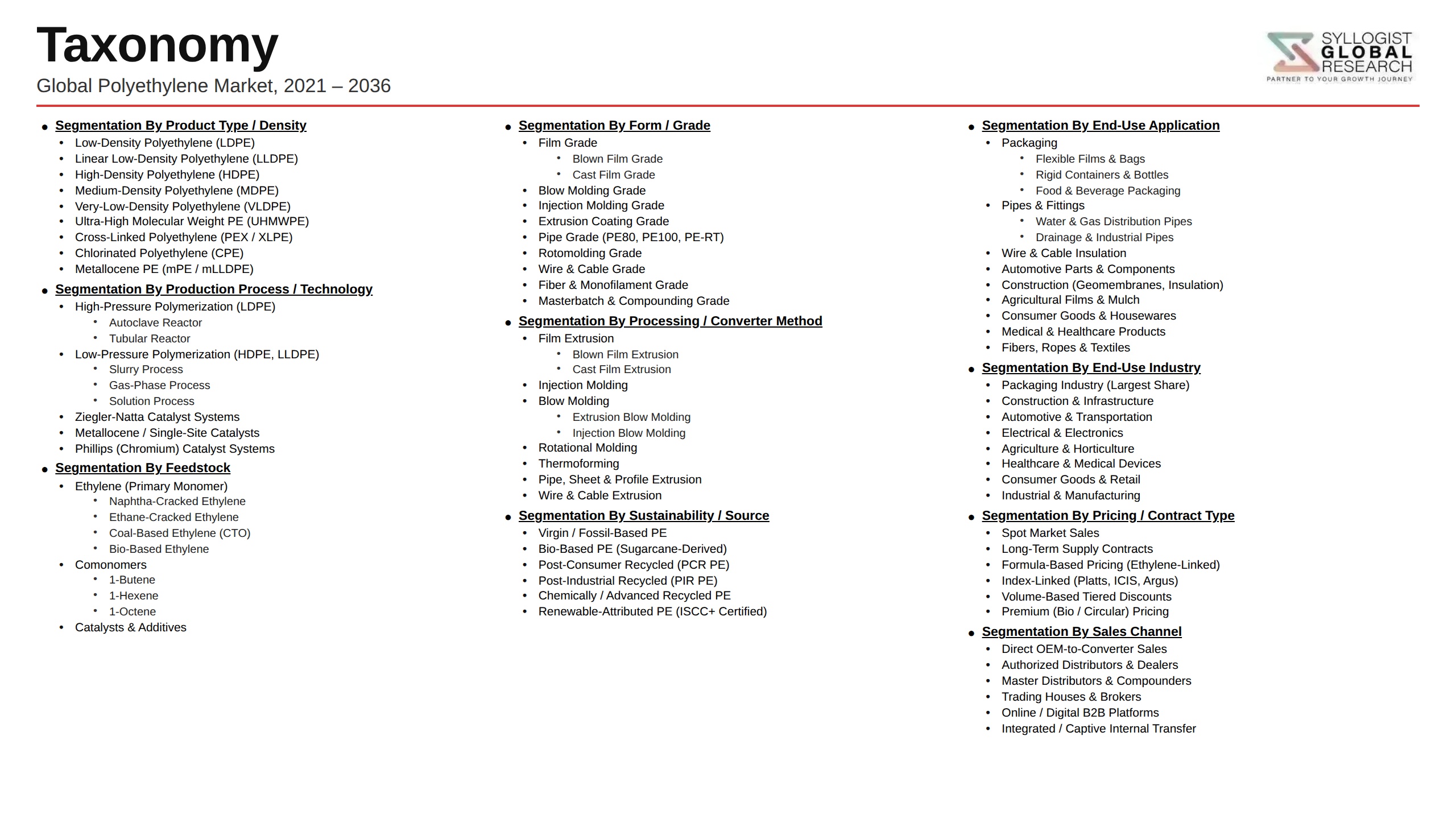
- Segmentation By Product Type
- High-Density Polyethylene (HDPE)
- Low-Density Polyethylene (LDPE)
- Linear Low-Density Polyethylene (LLDPE)
- Ultra-High Molecular Weight Polyethylene (UHMWPE)
- Metallocene Polyethylene (mPE)
- Medium-Density Polyethylene (MDPE)
- Others
- Segmentation By Production Technology
- Gas Phase Polymerization
- Slurry Loop Polymerization
- Solution Polymerization
- High-Pressure Tubular and Autoclave Processes
- Others
- Segmentation By Application
- Flexible Packaging Films and Bags
- Rigid Bottles, Containers, and Caps
- Pipe, Conduit, and Geomembrane Systems
- Agricultural and Greenhouse Films
- Wire and Cable Insulation and Jacketing
- Industrial and Household Molded Products
- Medical Device and Pharmaceutical Packaging
- Others
- Segmentation By End Use Industry
- Food and Beverage Packaging
- Construction and Infrastructure
- Agriculture and Horticulture
- Consumer Goods and Retail
- Healthcare and Medical
- Automotive and Transportation
- Electrical and Electronics
- Others
- Segmentation By Grade
- Virgin Petroleum-Based Polyethylene
- Bio-Based and Renewable Polyethylene
- Mechanically Recycled Polyethylene
- Chemically Recycled Polyethylene
- Compounded and Specialty Grades
- Segmentation By Region
- North America
- Europe
- Asia-Pacific
- Middle East and Africa
- Latin America
All market revenues are presented in USD
Historical Year: 2021-2024 | Base Year: 2025 | Estimated Year: 2026 | Forecast Period: 2027-2034
Key Questions this Study Will Answer
- What is the total global polyethylene market valuation in 2025, projected through 2034, segmented by product type, application, and end use industry, enabling resin producers, packaging converters, and petrochemical investors to identify the highest-growth grade categories and most commercially significant application expansion opportunities across the global polyethylene market through the forecast period?
- How is the current global polyethylene capacity oversupply cycle, resulting from simultaneous United States Gulf Coast, Chinese, and Middle Eastern capacity additions, affecting commodity resin margins, producer utilization rates, and new project investment decisions, and what demand growth timeline and capacity rationalization dynamics are most likely to restore commercially sustainable polyethylene market margin conditions?
- Which polyethylene grades, specifically metallocene linear low-density, advanced HDPE pipe grades, ultra-high molecular weight polyethylene for engineering applications, and compounded specialty grades, are generating the most favorable demand growth and margin performance relative to commodity film and blow-molding grades, and what application development, technical service investment, and converter partnership strategies are enabling producers to shift portfolio mix toward higher-value differentiated grades?
- How are mandatory recycled content requirements, extended producer responsibility frameworks, plastic packaging taxes, and single-use plastic restrictions in Europe, the United Kingdom, and expanding global jurisdictions reshaping virgin polyethylene demand volumes, brand owner procurement strategies, and the investment economics of mechanical and chemical recycling capacity for post-consumer polyethylene waste streams through 2034?
- How is the competitive landscape structured among North American ethane cracker-based producers, Middle Eastern integrated producers, and Asian naphtha-based manufacturers competing for global polyethylene market share, and what cost position management, specialty grade development, logistics optimization, and customer technical service capability strategies are enabling each producer group to sustain commercial positions under persistent margin pressure?
- What scaling barriers, feedstock economics, land use constraints, and price premium sustainability limitations are constraining the commercial expansion of bio-based polyethylene production beyond niche premium packaging applications, and what cost reduction pathways, policy support frameworks, and certified sustainability premium market developments would be required to enable bio-based polyethylene to achieve commercially significant market penetration through 2034?
- Which regional polyethylene consumption markets, specifically Asia-Pacific, Africa, and Latin America, are expected to generate the highest incremental volume growth through 2034, and what combinations of packaged food adoption, agricultural film demand, infrastructure pipe system development, and consumer goods manufacturing expansion are defining the per capita consumption growth trajectories and grade mix evolution in each high-growth regional market?
- Product Definition
- Research Methodology
- Research Design & Framework
- Overall Research Approach: Descriptive, Exploratory & Quantitative Mixed-Method Design
- Market Definition & Scope Boundaries: What is Included and Excluded
- Segmentation Framework
- Key Research Assumptions & Limitations
- Secondary Research
- Primary Research Design & Execution
- Data Triangulation & Validation
- Market Sizing & Forecasting Methodology
- Competitive Intelligence Methodology
- Quality Assurance & Peer Review
- Definitions, Abbreviations & Data Notes
- Research Design & Framework
- Executive Summary
- Market Snapshot & Headline Numbers
- Key Findings & Research Highlights
- Market Dynamics
- Regional Market Summary
- Competitive Landscape Snapshot
- Technology & Innovation Highlights
- Market Dynamics
- Drivers
- Restraints
- Opportunities
- Challenges
- Porter’s Five Forces Analysis
- PESTLE Analysis
- Market Trends & Developments
- Emerging Trends
- Technological Developments
- Regulatory & Policy Changes
- Supply Chain & Sourcing Trends
- Manufacturing & Process Trends
- Investment & Funding Activity
- Sustainability & ESG Trends
- Risk Assessment Framework
- Ethylene Feedstock Price Volatility, Cracker Margin Fluctuation & Cost Squeeze Risk
- Capacity Oversupply, Demand Growth Shortfall & Prolonged Margin Compression Risk
- Plastics Regulation, Single-Use Plastics Ban & Extended Producer Responsibility (EPR) Demand Erosion Risk
- Geopolitical Trade Disruption, Tariff Escalation & Supply Chain Rerouting Risk
- Substitution Risk from Recycled PE, Bio-Based PE & Alternative Packaging Materials
- Energy Transition, Carbon Cost Escalation & Decarbonisation Capital Expenditure Risk
- Regulatory Framework & Standards
- EU Single-Use Plastics Directive, Packaging & Packaging Waste Regulation (PPWR) & PE Recyclability Standards
- FDA 21 CFR, EU Regulation 10/2011 & Global Food Contact PE Material Safety Standards
- Extended Producer Responsibility (EPR), Plastic Packaging Tax & National Recycled Content Mandate Frameworks
- REACH, RoHS & Restricted Substance Standards for PE Additives, Colorants & Stabilisers
- ISO 1872, ASTM D4976 & PE Resin Classification, Property Testing & Quality Standards
- UN Global Plastics Treaty Negotiations, Binding Instrument Framework & PE Industry Implications
- Global Polyethylene Market Outlook
- Market Size & Forecast by Value
- Market Size & Forecast by Volume (Million Tonnes per Annum, MTPA)
- Market Size & Forecast by PE Type
- High-Density Polyethylene (HDPE)
- Low-Density Polyethylene (LDPE)
- Linear Low-Density Polyethylene (LLDPE)
- Ultra-High Molecular Weight Polyethylene (UHMWPE)
- High-Performance Polyethylene (HPPE) & Metallocene PE (mPE)
- Very Low-Density Polyethylene (VLDPE) & Polyethylene Elastomers
- Bimodal & Multimodal HDPE
- Cross-Linked Polyethylene (PEX)
- Market Size & Forecast by Production Technology
- Gas-Phase Polymerisation Technology (Unipol, Innovene G & Spherilene)
- Slurry Loop Reactor Technology (Borstar, Hostalen & Chevron Phillips MarTECH)
- High-Pressure Tubular & Autoclave LDPE Technology
- Solution Polymerisation Technology
- Metallocene & Single-Site Catalyst Technology
- Multi-Reactor & Bimodal Process Technology
- Market Size & Forecast by Processing Method
- Film Extrusion (Blown Film & Cast Film)
- Injection Moulding
- Blow Moulding (Extrusion Blow & Injection Blow)
- Pipe & Profile Extrusion
- Rotational Moulding
- Wire & Cable Coating & Extrusion
- Thermoforming & Sheet Extrusion
- Market Size & Forecast by Application
- Packaging Films: Food, Retail, Industrial & Agricultural Films
- Rigid Packaging: Bottles, Containers, Caps & Closures
- Pipe & Fittings: Water, Gas, Irrigation & Industrial Pipes
- Wire & Cable Insulation & Jacketing
- Geomembranes, Liners & Construction Applications
- Automotive, Industrial & Engineering Components
- Consumer Goods, Housewares & Toys
- Medical & Healthcare Applications
- Agriculture (Mulch Films, Silage Films & Greenhouse Films)
- Market Size & Forecast by End-User Industry
- Packaging & Flexible Packaging Industry
- Building, Construction & Infrastructure
- Automotive & Transportation
- Agriculture & Horticulture
- Healthcare & Medical Devices
- Electrical & Electronics
- Consumer Products & Retail
- Market Size & Forecast by Sales Channel
- Direct Producer-to-Converter Bilateral Contract Channel
- Commodity Trader, Distributor & Spot Market Channel
- Compounding & Masterbatch Intermediary Channel
- Online & Digital Procurement Platform Channel
- North America Polyethylene Market Outlook
- Market Size & Forecast
- By Value
- By Volume (MTPA)
- By PE Type
- By Production Technology
- By Processing Method
- By Application
- By End-User Industry
- By Country
- By Sales Channel
- Market Size & Forecast
- Europe Polyethylene Market Outlook
- Market Size & Forecast
- By Value
- By Volume (MTPA)
- By PE Type
- By Production Technology
- By Processing Method
- By Application
- By End-User Industry
- By Country
- By Sales Channel
- Market Size & Forecast
- Asia-Pacific Polyethylene Market Outlook
- Market Size & Forecast
- By Value
- By Volume (MTPA)
- By PE Type
- By Production Technology
- By Processing Method
- By Application
- By End-User Industry
- By Country
- By Sales Channel
- Market Size & Forecast
- Latin America Polyethylene Market Outlook
- Market Size & Forecast
- By Value
- By Volume (MTPA)
- By PE Type
- By Production Technology
- By Processing Method
- By Application
- By End-User Industry
- By Country
- By Sales Channel
- Market Size & Forecast
- Middle East & Africa Polyethylene Market Outlook
- Market Size & Forecast
- By Value
- By Volume (MTPA)
- By PE Type
- By Production Technology
- By Processing Method
- By Application
- By End-User Industry
- By Country
- By Sales Channel
- Market Size & Forecast
- Country-Wise* Polyethylene Market Outlook
- Market Size & Forecast
- By Value
- By Volume (MTPA)
- By PE Type
- By Production Technology
- By Processing Method
- By Application
- By End-User Industry
- By Country
- By Sales Channel
- Market Size & Forecast
- *Countries Analyzed in the Syllogist Global Research Portfolio: United States, Canada, Mexico, Germany, France, United Kingdom, Netherlands, Belgium, Spain, Italy, Poland, China, Japan, South Korea, India, Singapore, Thailand, Taiwan, Malaysia, Indonesia, Brazil, Argentina, Saudi Arabia, UAE, Iran, Qatar, South Africa, Egypt
- Technology Landscape & Innovation Analysis
- Advanced HDPE Bimodal & Multimodal Technology Deep-Dive: Borstar, Hostalen ACP & Chevron Phillips MarTECH Loop Reactor Advances
- Metallocene & Single-Site Catalyst Technology: mLLDPE, mHDPE & Advanced Polyethylene Elastomers for Performance Films
- UHMWPE Technology: Gel-Spinning, Compression Moulding & Application in Armour, Medical Implants & Industrial Wear Components
- Mechanically Recycled & Chemically Recycled Polyethylene: Pyrolysis, Dissolution & Mechanical Recycling Process Technology
- Bio-Based Polyethylene Technology: Green Ethylene from Sugarcane Ethanol, Bio-Naphtha & Biomass Feedstock Routes
- Functional & Barrier PE Films: Multilayer Coextrusion, EVOH Barrier, Tie Layer & Active Packaging Technology
- Digital Twin, APC & AI-Based Polymerisation Reactor Optimisation Technology for PE Plant Operations
- Patent & IP Landscape in Polyethylene Production & Processing Technologies
- Value Chain & Supply Chain Analysis
- Ethylene Feedstock, Naphtha Cracker & Ethane Cracker Supply Chain
- Catalyst, Co-Catalyst, Activator & Specialty Chemical Supply Chain for PE Polymerisation
- Additive Package: Antioxidants, UV Stabilisers, Slip Agents & Nucleating Agent Supply Chain
- PE Resin Pellet Production, Compounding, Colouring & Packaging Supply Chain
- Bulk Rail, Container & Flexibag PE Resin Logistics & Distribution Supply Chain
- Film Extruder, Injection Moulder, Blow Moulder & Converter Supply Chain
- Packaging Converter, Brand Owner, Retailer & Recycler Channel
- Pricing Analysis
- Global PE Benchmark Price Analysis: HDPE Film CFR, LDPE Film CFR & LLDPE Film CFR by Region
- Ethylene-to-PE Conversion Margin & Variable Cost Analysis by PE Type & Region
- HDPE vs. LDPE vs. LLDPE Price Spread & Premium/Discount Analysis
- Specialty PE Premium Pricing: Metallocene, UHMWPE & High-Performance Grade Analysis
- Recycled PE & Bio-Based PE Price Premium vs. Virgin PE Benchmark Analysis
- Price Cycle Analysis: Historical PE Margin Cycles, Capacity Wave Impacts & Crude Oil Linkage
- Sustainability & Environmental Analysis
- Lifecycle Assessment (LCA) of Polyethylene: Carbon Footprint, Energy Intensity & End-of-Life Impact by PE Type & Application
- PE Recyclability, Mono-Material Packaging Design & Closed-Loop Mechanical Recycling Performance
- Chemical Recycling of PE: Pyrolysis, Gasification & Dissolution Technology Performance, Scale-Up & Economics
- Bio-Based Polyethylene: Sugarcane Green Ethylene, Lifecycle GHG Advantage & Sustainable Feedstock Certification
- EU Plastics Regulation, Recycled Content Targets, EPR Schemes & Impact on PE Demand & Design-for-Recyclability
- Competitive Landscape
- Market Structure & Concentration
- Market Consolidation Level (Fragmented vs. Consolidated by PE Type & Geography)
- Top 10 Players Market Share
- HHI (Herfindahl-Hirschman Index) Concentration Analysis
- Competitive Intensity Map by PE Type, Application & Geography
- Player Classification
- Integrated Refinery-Cracker-Polyethylene Majors & National Petrochemical Companies
- Dedicated Polyethylene Producer & Merchant Resin Suppliers
- Specialty & High-Performance PE Producers (UHMWPE, mPE & Elastomers)
- Bio-Based & Recycled Polyethylene Producers
- PE Compounding, Masterbatch & Functional Film Specialists
- Competitive Analysis Frameworks
- Market Share Analysis by PE Type, Application & Region
- Company Profile
- Company Overview & Headquarters
- Polyethylene Products, Grade Portfolio & Technology Platform
- Key Customer Relationships & Offtake Agreements
- Manufacturing Footprint, PE Production Capacity & Nameplate Volume
- Revenue (Polyethylene Segment) & Order Backlog
- Technology Differentiators & IP
- Key Strategic Partnerships, JVs & M&A Activity
- Recent Developments (Capacity Expansions, Grade Launches, Sustainability Initiatives)
- SWOT Analysis
- Strategic Focus Areas & Roadmap
- Competitive Positioning Map (Feedstock Cost Advantage vs. Grade Portfolio Breadth)
- Key Company Profiles
- Market Structure & Concentration
- Technology Landscape & Innovation Analysis
- Strategic Output
- Market Opportunity Matrix: By PE Type, Processing Method, Application, End-User & Geography
- White Space Opportunity Analysis
- Strategic Recommendations
- Product Portfolio, Grade Development & Technology Investment Strategy
- Capacity Expansion, Feedstock Integration & Manufacturing Excellence Strategy
- Geographic Expansion & New Market Penetration Strategy
- Customer, Converter & Brand Owner Engagement Strategy
- Partnership, M&A & Petrochemical Ecosystem Strategy
- Sustainability, Circular Economy & Recycled Content Strategy
- Risk Mitigation & Future Roadmap
- Strategic Priority Matrix & Roadmap
- Near-term (2025-2028)
- Mid-term (2029-2032)
- Long-term (2033-2037)
- Strategic Output