Global Agricultural Adjuvants Market By Function, By Type, By Application, By Crop Type, By Formulation, By End User, By Region, Competition, Forecast & Opportunities, 2021-2034F
Market Definition
The Global Agricultural Adjuvants Market encompasses the development, formulation, distribution, and field-level application of inert chemical and biologically derived compounds added to agrochemical spray solutions to enhance the performance, efficiency, and on-target delivery of herbicides, insecticides, fungicides, plant growth regulators, foliar fertilizers, and biological crop protection products. The market spans two principal functional categories including activator adjuvants comprising surfactants, oil-based adjuvants such as crop oil concentrates and methylated seed oils, and organosilicone wetting agents, alongside utility adjuvants including water conditioners, buffering and acidifying agents, drift reducing agents, antifoam compounds, compatibility agents, and deposition aids that optimize tank-mix stability, droplet behavior, and post-application retention on target foliage. Agricultural adjuvants are deployed across cereals and grains, oilseeds and pulses, fruits and vegetables, plantation crops, ornamental horticulture, and turf management systems where they improve active ingredient absorption, reduce spray drift, manage hard water antagonism, and enable lower application rates of crop protection chemistries. The market includes both in-can adjuvants pre-formulated with proprietary agrochemical products and tank-mix adjuvants applied at the point of spraying, distributed through agrochemical retailers, cooperative networks, custom spray applicators, e-commerce platforms, and direct-to-grower channels. End users include commercial farmers, contract spray applicators, custom blender operations, agronomic advisory services, integrated pest management programs, plantation companies, vineyards, fruit orchards, greenhouse cultivators, golf course operators, and forestry organizations procuring agricultural adjuvants to address evolving herbicide resistance, regulatory drift restrictions, sustainability targets, and quality specifications imposed by export markets and food retailer procurement frameworks across major agricultural geographies globally.
Market Insights
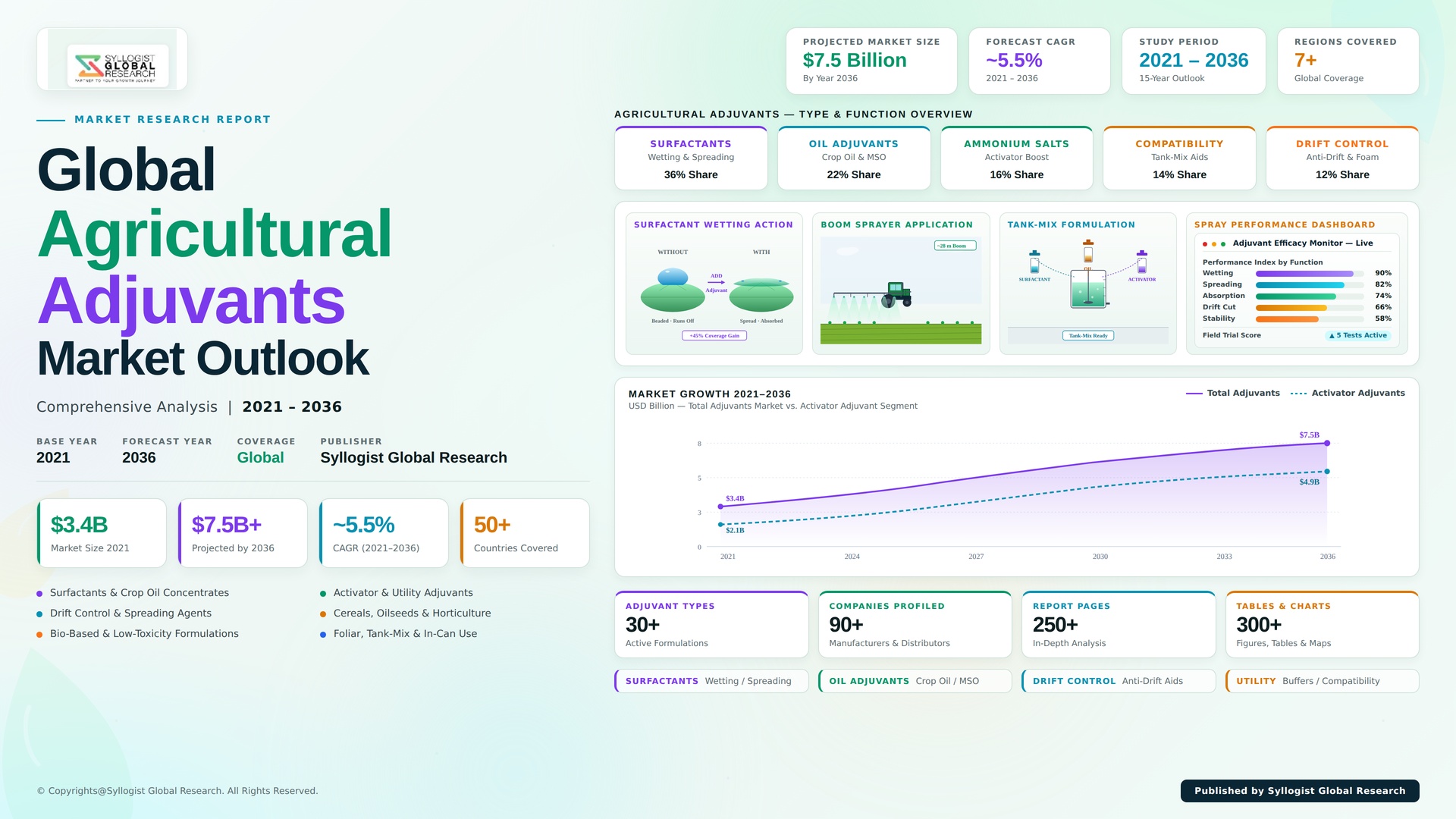
The global agricultural adjuvants market sits at the convergence of intensifying weed resistance pressure, increasingly stringent spray drift regulations, and a structural shift toward sustainable agronomic programs that have elevated agricultural adjuvants from auxiliary tank-mix additives into essential performance multipliers across commercial farming systems globally. The market was valued at approximately USD 4.27 billion in 2025 and is projected to reach USD 7.18 billion by 2034, advancing at a compound annual growth rate of 5.96% through the forecast period, supported by expanding tank-mix complexity, rising adjuvant-enabled herbicide programs targeting glyphosate-resistant weed populations, and rapid scale-up of bio-based and low-toxicity adjuvant chemistries across major agricultural geographies. Activator adjuvants represent the dominant functional category, accounting for approximately 78% of revenue contribution given their role in enhancing pesticide solubility, leaf cuticle penetration, and active ingredient absorption, while utility adjuvants including drift reducing agents and water conditioners are the fastest-growing sub-segment driven by anti-drift regulatory mandates and hard water antagonism management.
The transition toward bio-based, low-toxicity, and pollinator-safe adjuvant chemistries represents one of the most consequential structural shifts reshaping the competitive landscape, with sodium alginate, sugar-based surfactants, methylated seed oils derived from canola and soybean, and lecithin-based formulations registering above-average adoption growth as growers pursue residue-compliant programs aligned with EU maximum residue limits, EPA pollinator protection requirements, and rising consumer preference for environmentally responsible food production. Tightening regulatory scrutiny over inert ingredient disclosure under EPA Pesticide Registration Improvement Act provisions, REACH compliance mandates in Europe, and pollinator toxicity guidelines is reshaping product portfolios toward third-party verified low-impact chemistries, while voluntary sustainability certifications and equivalent frameworks are emerging as procurement preferences across multinational food companies and seed producers driving purchase decisions further upstream into adjuvant selection.
North America commands the largest regional revenue share, contributing approximately 44.52% of global market value in 2025, anchored by extensive adjuvant-supported herbicide programs across United States soybean, corn, cotton, and wheat acreage and Canadian canola and pulse cropping systems, with the United States agricultural adjuvants market projected to advance toward USD 2.51 billion by 2032 supported by precision application technology adoption and dicamba and 2,4-D tank-mix protocol intensification. Asia-Pacific is projected to register substantial growth through 2034, with China expected to deliver a country-level CAGR of approximately 7.12%, supported by horticulture intensification, greenhouse expansion, and government-led modernization programs integrating spray quality optimization into smallholder advisory frameworks. Europe is anticipated to advance at approximately 4.49% CAGR, anchored by Germany, France, Spain, Italy, and Poland where Farm to Fork strategy targets, integrated pest management adoption, and stringent residue tolerances are reshaping adjuvant procurement priorities.
Herbicide adjuvants represent the dominant application category, generating approximately USD 2.36 billion in 2025 revenue given the centrality of glyphosate, dicamba, 2,4-D, glufosinate, and acetolactate synthase inhibitor chemistries across major row crops, while insecticide and fungicide adjuvants are gaining share through formulation innovation targeting reduced application volumes and improved canopy penetration in dense crops including soybean, cotton, vegetables, and orchards. The competitive landscape remains moderately fragmented with global specialty chemical and crop science leaders commanding aggregate share above 50% of the market, while regional formulation specialists, custom blender operators, and biotechnology-focused start-ups capture growing share through naturally derived chemistries, drift-reducing polymer platforms, and digital agronomy integrations linking adjuvant selection to weather analytics, droplet sensing, and weed-resistance mapping within precision agriculture deployments. Strategic activity in 2024 and 2025 has intensified around partnerships between specialty surfactant manufacturers and crop science majors, joint research programs targeting pollinator-safe drift reducing agents, and distribution alliances expanding adjuvant portfolio reach across India, Brazil, and Argentina.
Key Drivers
Accelerating Herbicide Resistance Management Driving Multi-Mode-of-Action Tank Mix Programs and Adjuvant Procurement Growth
The accelerating spread of glyphosate-resistant Palmer amaranth, waterhemp, and ryegrass populations across major row-crop geographies has compelled growers to deploy multi-mode-of-action tank mixes incorporating dicamba, 2,4-D choline, glufosinate, and pre-emergence residual chemistries, each dependent on activator and utility adjuvants for leaf coverage, hard water mitigation, and absorption performance. With at least 34 glyphosate-resistant weed species documented globally, adjuvant-enhanced spray programs have become essential to sustainable weed control economics across soybean, cotton, corn, and wheat acreage.
Spray Drift Regulatory Mandates Institutionalizing Drift Reducing Agent Usage Across Major Agricultural Markets
Increasingly stringent regulations on volatile herbicides including dicamba and 2,4-D have institutionalized mandatory drift reducing agent usage across major agricultural markets, with EPA-approved tank-mix partner lists, anti-drift nozzle mandates, and buffer zone requirements driving sustained procurement of drift control polymers, deposition aids, and droplet-management adjuvants across United States, Canadian, Australian, and European farming systems.
Sustainability Targets and Active Ingredient Reduction Mandates Generating Durable Demand for Bio-based and Pollinator-Safe Adjuvants
Adjuvant-enabled efficacy improvements allow growers to reduce pesticide application rates by 20% to 30% in many programs, aligning with EU Farm to Fork pesticide reduction targets, EPA pollinator protection guidance, and corporate sustainability commitments from food retailers and seed producers, generating durable demand for low-toxicity surfactants, bio-based polymers, and pollinator-safe drift control formulations across both row crop and high-value horticulture systems.
Key Challenges
Regulatory Scrutiny on Inert Ingredients and Co-formulant Disclosure Extending Reformulation Cycles for Legacy Adjuvant Chemistries
Agricultural adjuvants face intensifying regulatory examination under EPA Pesticide Registration Improvement Act provisions, EU Plant Protection Products Regulation 1107/2009 co-formulant lists, and REACH compliance frameworks that increasingly mandate disclosure of previously confidential inert ingredients, restrict alkylphenol ethoxylate surfactants, and impose toxicity testing on adjuvant formulations historically exempt from registration, driving substantial reformulation investment and extending product approval timelines for legacy chemistries.
Surfactant Feedstock Volatility and Petrochemical Dependence Compressing Formulation Margins Across the Adjuvant Supply Chain
The agricultural adjuvants industry depends heavily on petrochemical-derived surfactants including ethoxylated alcohols, alkyl polyglucosides, and organosilicones whose pricing and availability fluctuate with crude oil markets, ethylene oxide capacity, and trade tensions, while bio-based feedstock alternatives including methylated seed oils and sugar-based glycolipids face commodity volatility tied to canola, soybean, and palm oil pricing dynamics that compress formulation margins and complicate long-term supply contracting.
Tank-Mix Compatibility Complexity and Application Variability Constraining Repeat Procurement Among Smallholder Growers
The proliferation of stacked-tolerance crop genetics, multi-active-ingredient herbicide programs, and combined fertilizer-pesticide-biological tank mixes generates extensive compatibility complexity for growers and applicators, with pH antagonism, hard water mineral interference, and surfactant incompatibility producing inconsistent field outcomes that require dedicated water conditioning, buffering, and antifoam solutions, complicating procurement decisions for smallholders lacking dedicated advisory infrastructure.
Market Segmentation
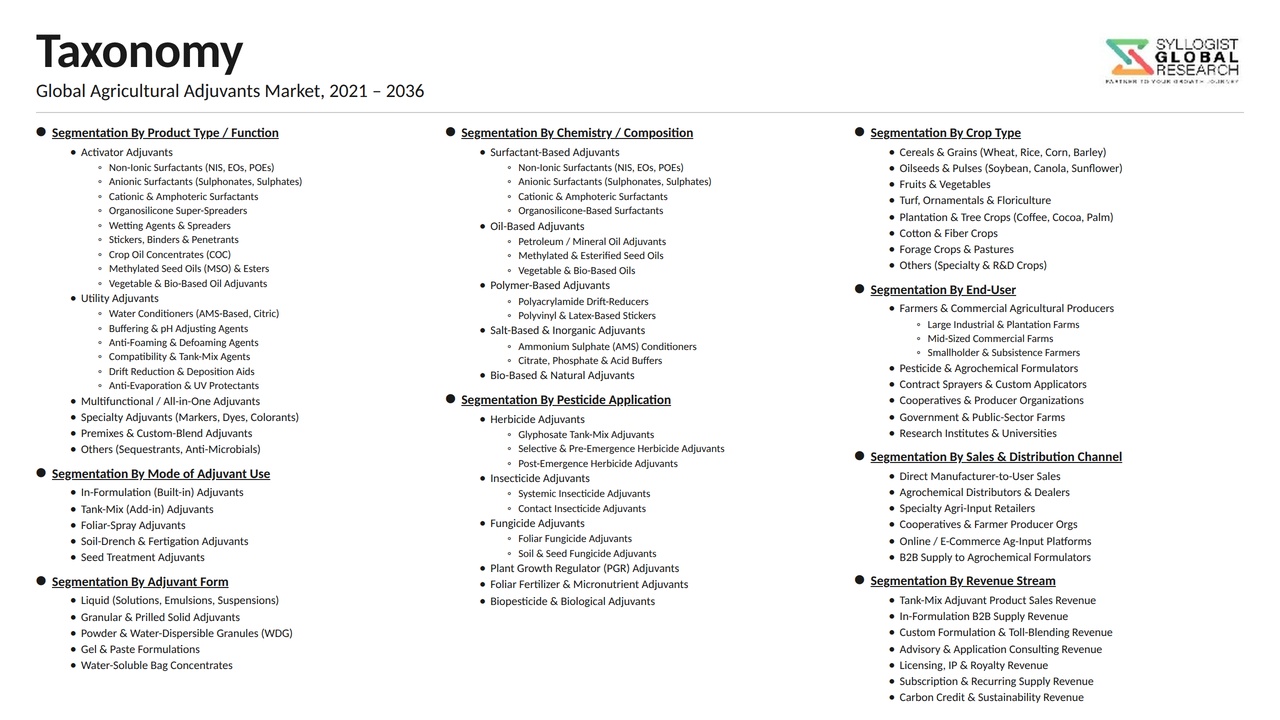
- Segmentation By Function
- Activator Adjuvants
- Utility Adjuvants
- Segmentation By Type
- Surfactants (Nonionic, Anionic, Cationic, Amphoteric)
- Oil-based Adjuvants (Crop Oil Concentrates, Methylated Seed Oils)
- Water Conditioners
- Drift Reducing Agents
- Buffering and Acidifying Agents
- Compatibility Agents
- Antifoam and Defoaming Agents
- Deposition Aids
- Others
- Segmentation By Application
- Herbicide Adjuvants
- Insecticide Adjuvants
- Fungicide Adjuvants
- Plant Growth Regulator Adjuvants
- Foliar Fertilizer Adjuvants
- Others
- Segmentation By Crop Type
- Cereals and Grains
- Oilseeds and Pulses
- Fruits and Vegetables
- Plantation Crops
- Turf and Ornamentals
- Others
- Segmentation By Formulation
- In-can Adjuvants
- Tank-mix Adjuvants
- Segmentation By End User
- Commercial Farmers and Cooperatives
- Custom Spray Applicators and Contract Operators
- Plantation and Estate Operations
- Vineyards and Orchards
- Greenhouse and Protected Cultivation
- Turf and Landscape Management
- Forestry and Plantation Operators
- Others
- Segmentation By Region
- North America
- Europe
- Asia-Pacific
- Middle East and Africa
- Latin America
All market revenues are presented in USD
Historical Year: 2021-2024 | Base Year: 2025 | Estimated Year: 2026 | Forecast Period: 2027-2034
Key Questions this Study Will Answer
- What is the total global market valuation of the Agricultural Adjuvants Market in 2025, projected through 2034, disaggregated by function, type, application, and crop type, enabling specialty chemical manufacturers, crop science majors, distributors, custom spray applicators, and procurement planners to identify highest-growth segments and most durable revenue opportunities across the global crop input landscape?
- How are activator adjuvants including nonionic and organosilicone surfactants, crop oil concentrates, and methylated seed oils, alongside utility adjuvants including water conditioners, drift reducing agents, buffering agents, and compatibility agents, expected to evolve in revenue contribution and adoption breadth across cereals, oilseeds, fruits, vegetables, and plantation crops through 2034?
- What regulatory frameworks under EPA Pesticide Registration Improvement Act provisions, EU Plant Protection Products Regulation 1107/2009 co-formulant lists, REACH compliance, EU Farm to Fork pesticide reduction targets, anti-drift nozzle mandates, and pollinator protection guidelines are reshaping adjuvant launch timelines, label claim architecture, and inert ingredient disclosure requirements across major commercial markets?
- Which application segments including herbicide, insecticide, fungicide, plant growth regulator, and foliar fertilizer adjuvants are generating the highest growth rates through 2034, and what surfactant chemistries, drift reducing polymers, and tank-mix compatibility solutions are most critical to grower outcomes and repeat-purchase economics across glyphosate-resistant weed control, dicamba programs, and 2,4-D protocol deployments?
- How is the competitive landscape structured among global specialty chemical leaders, crop science majors, regional formulation specialists, custom blender operators, and biotechnology-focused start-ups, and what partnership, acquisition, licensing, and distribution alliance strategies are enabling new entrants to compete in pollinator-safe, bio-based, and drift-reducing adjuvant categories across India, Brazil, Argentina, and other emerging markets?
- What is the structural impact of bio-based and naturally derived adjuvant chemistries including sodium alginate, sugar-based surfactants, lecithin formulations, and seaweed-derived polymers on adjuvant adoption patterns, pricing dynamics, sustainability positioning, and grower agronomic decision frameworks across organic, conventional, and integrated pest management cultivation systems?
- Which regional agricultural adjuvants markets, specifically North America, Europe, Asia-Pacific, Latin America, and Middle East and Africa, are expected to generate the most substantial incremental procurement through 2034, and what climate, regulatory, herbicide resistance, precision agriculture adoption, and export market access factors are driving capability investment priorities and supplier selection decisions in each regional market?
- Product Definition
- Research Methodology
- Research Design & Framework
- Overall Research Approach: Descriptive, Exploratory & Quantitative Mixed-Method Design
- Market Definition & Scope Boundaries: What is Included and Excluded
- Segmentation Framework
- Key Research Assumptions & Limitations
- Secondary Research
- Primary Research Design & Execution
- Data Triangulation & Validation
- Market Sizing & Forecasting Methodology
- Competitive Intelligence Methodology
- Quality Assurance & Peer Review
- Definitions, Abbreviations & Data Notes
- Executive Summary
- Market Snapshot & Headline Numbers
- Key Findings & Research Highlights
- Market Dynamics
- Regional Market Summary
- Competitive Landscape Snapshot
- Technology & Innovation Highlights
- Market Dynamics
- Drivers
- Restraints
- Opportunities
- Challenges
- Porter’s Five Forces Analysis
- PESTLE Analysis
- Market Trends & Developments
- Emerging Trends
- Technological Developments
- Regulatory & Policy Changes
- Supply Chain & Sourcing Trends
- Manufacturing & Process Trends
- Investment & Funding Activity
- Sustainability & ESG Trends
- Risk Assessment Framework
- Active Ingredient Compatibility, Phytotoxicity & Crop Damage Risk
- Surfactant Toxicity, Aquatic Eco-Toxicity & Pollinator Exposure Risk
- Raw Material (Surfactant Feedstock, Oil & Petrochemical Intermediate) Price Volatility & Supply Risk
- Spray Drift, Off-Target Movement & Bystander Exposure Risk
- Regulatory Reclassification, Reformulation & Inert Ingredient Disclosure Risk
- Regulatory Framework & Standards
- National Agricultural Adjuvant Registration, Co-Formulant Approval & Inert Ingredient Disclosure Frameworks
- Tank-Mix Adjuvant Labelling, Compatibility & Pesticide Co-Application Standards
- Stewardship, Spray Drift Reduction Technology (DRT) & Pesticide Application Equipment Standards
- Environmental Safety, Aquatic Toxicity, Biodegradability & Pollinator Protection Regulations
- Bio-Based, Renewable Surfactant & Sustainable Adjuvant Procurement Standards
- Global Agricultural Adjuvants Market Outlook
- Market Size & Forecast by Value
- Market Size & Forecast by Volume (Tonnes)
- Market Size & Forecast by Type
- Activator Adjuvants
- Utility Adjuvants
- Other Adjuvants
- Market Size & Forecast by Function
- Surfactants (Non-Ionic, Anionic, Cationic & Amphoteric)
- Oil Adjuvants (Crop Oil Concentrate, Methylated Seed Oil, Vegetable Oil & Mineral Oil)
- Compatibility Agents
- Buffering & Acidifying Agents
- Antifoam Agents
- Drift Control & Deposition Agents
- Water Conditioners & Hard-Water Antagonists
- Spreader & Sticker Agents
- Other Utility Adjuvants
- Market Size & Forecast by Source
- Synthetic and Petroleum-Based Adjuvants
- Natural and Bio-Based Adjuvants (Plant-Derived, Bio-Surfactant & Vegetable Oil)
- Market Size & Forecast by Application Type
- Herbicide Adjuvants
- Insecticide Adjuvants
- Fungicide Adjuvants
- Plant Growth Regulator & Other Agrochemical Adjuvants
- Market Size & Forecast by Formulation
- Liquid Adjuvants (Soluble Concentrate, Emulsifiable Concentrate & Suspension Concentrate)
- Powder & Granular Adjuvants (Wettable Powder, Soluble Granules & Tablets)
- Microencapsulated & Slow-Release Adjuvants
- Market Size & Forecast by Mode of Adjuvancy
- In-Can / Built-In Adjuvants (Pre-Formulated by Agrochemical Manufacturers)
- Tank-Mix Adjuvants (Added by End-User at Application)
- Market Size & Forecast by Crop Type
- Cereals & Grains (Wheat, Rice, Maize & Barley)
- Oilseeds & Pulses (Soybean, Cotton, Canola, Sunflower & Pulses)
- Fruits & Vegetables (Pome, Stone, Citrus, Berries & Solanaceous Crops)
- Turf, Ornamentals & Floriculture
- Plantation, Sugar & Beverage Crops (Sugarcane, Coffee, Tea, Cocoa, Banana & Pineapple)
- Other Crops & Specialty Horticulture
- Market Size & Forecast by End-User
- Agrochemical Formulators & Manufacturers
- Smallholder & Subsistence Farmers
- Commercial & Plantation Growers
- Custom Applicators & Aerial Spray Operators
- Cooperatives & Government Procurement Agencies
- Market Size & Forecast by Sales Channel
- Direct Sales to Agrochemical Formulators
- Distributor, Dealer & Agro-Retailer Network
- Cooperative & Government Procurement Channel
- E-Commerce & Digital Agri-Input Platforms
- North America Agricultural Adjuvants Market Outlook
- Market Size & Forecast
- By Value
- By Volume (Tonnes)
- By Type
- By Function
- By Source
- By Application Type
- By Formulation
- By Mode of Adjuvancy
- By Crop Type
- By End-User
- By Country
- By Sales Channel
- Market Size & Forecast
- Europe Agricultural Adjuvants Market Outlook
- Market Size & Forecast
- By Value
- By Volume (Tonnes)
- By Type
- By Function
- By Source
- By Application Type
- By Formulation
- By Mode of Adjuvancy
- By Crop Type
- By End-User
- By Country
- By Sales Channel
- Market Size & Forecast
- Asia-Pacific Agricultural Adjuvants Market Outlook
- Market Size & Forecast
- By Value
- By Volume (Tonnes)
- By Type
- By Function
- By Source
- By Application Type
- By Formulation
- By Mode of Adjuvancy
- By Crop Type
- By End-User
- By Country
- By Sales Channel
- Market Size & Forecast
- Latin America Agricultural Adjuvants Market Outlook
- Market Size & Forecast
- By Value
- By Volume (Tonnes)
- By Type
- By Function
- By Source
- By Application Type
- By Formulation
- By Mode of Adjuvancy
- By Crop Type
- By End-User
- By Country
- By Sales Channel
- Market Size & Forecast
- Middle East & Africa Agricultural Adjuvants Market Outlook
- Market Size & Forecast
- By Value
- By Volume (Tonnes)
- By Type
- By Function
- By Source
- By Application Type
- By Formulation
- By Mode of Adjuvancy
- By Crop Type
- By End-User
- By Country
- By Sales Channel
- Market Size & Forecast
- Country-Wise* Agricultural Adjuvants Market Outlook
- Market Size & Forecast
- By Value
- By Volume (Tonnes)
- By Type
- By Function
- By Source
- By Application Type
- By Formulation
- By Mode of Adjuvancy
- By Crop Type
- By End-User
- By Country
- By Sales Channel
- Market Size & Forecast
- *Countries Analyzed in the Syllogist Global Research Portfolio: United States, Canada, Mexico, Germany, France, United Kingdom, Netherlands, Spain, Italy, Norway, Sweden, China, Japan, India, Australia, South Korea, Singapore, Brazil, Chile, Saudi Arabia, UAE, Egypt, South Africa, Israel
- Technology Landscape & Innovation Analysis
- Surfactant Chemistry, Alkoxylation & Non-Ionic / Anionic Surfactant Technology Deep-Dive
- Methylated Seed Oil, Crop Oil Concentrate & Bio-Based Oil Adjuvant Production Technology
- Drift Reduction Technology (DRT), Deposition Aid & Spray Pattern Optimisation
- Water Conditioner, Hard-Water Antagonism & Buffering Adjuvant Chemistry
- Bio-Surfactant Fermentation, Rhamnolipid & Sophorolipid Production Technology
- Compatibility Agent, Microencapsulation & Multifunctional Adjuvant Innovation
- Precision Application, Drone Spraying & Adjuvant-Optimised Nozzle Technology
- Patent & IP Landscape in Agricultural Adjuvant Chemistries & Formulations
- Value Chain & Supply Chain Analysis
- Surfactant Feedstock (Ethylene Oxide, Fatty Alcohol & Tallow Derivative) Manufacturing Supply Chain
- Vegetable Oil, Methylated Seed Oil & Mineral Oil Refining Supply Chain
- Bio-Surfactant Fermentation, Microbial Strain & Renewable Feedstock Supply Chain
- Blending, Formulation & Packaging Equipment & Service Supply Chain
- Agrochemical Formulator In-Can Adjuvant Procurement Landscape
- Distributor, Dealer & Tank-Mix Adjuvant Channel
- Empty Container Management, Stewardship & Circular Packaging
- Pricing Analysis
- Petroleum-Based Surfactant Manufacturing Capital and Operating Cost Analysis
- Vegetable Oil & Methylated Seed Oil Refining Cost Analysis
- Bio-Surfactant Fermentation Cost & Cost-of-Goods Analysis
- Blending, Filling & Packaging Cost Analysis
- Distribution Margin, Dealer Markup & Retail Price Realisation Analysis
- Tank-Mix Adjuvant Cost Per Hectare & Grower Economics by Crop
- Total Adjuvant Programme Economics: Pesticide Efficacy Uplift, Dose Reduction & ROI Analysis
- Sustainability & Environmental Analysis
- Lifecycle Assessment (LCA) of Agricultural Adjuvants: Carbon Footprint, Eco-Toxicity & Biodegradability Across Synthetic and Bio-Based Routes
- Bio-Surfactant Substitution, Renewable Feedstock & Pathway to Lower-Impact Adjuvant Programmes
- Adjuvant Role in Pesticide Dose Reduction, Drift Mitigation & Sustainable Crop Protection Contribution
- Environmental Compliance, Pollinator Protection, Aquatic Toxicity & Non-Target Organism Consideration
- Regulatory-Driven Sustainability, SDG 2 (Zero Hunger) & SDG 12 (Responsible Production) Alignment & Sustainable Agriculture Procurement Eligibility
- Competitive Landscape
- Market Structure & Concentration
- Market Consolidation Level (Fragmented vs. Consolidated by Type & Geography)
- Top 10 Players Market Share
- HHI (Herfindahl-Hirschman Index) Concentration Analysis
- Competitive Intensity Map by Type, Crop & Geography
- Player Classification
- Diversified Specialty Chemicals & Surfactant Companies
- Specialist Agricultural Adjuvant Formulators
- Bio-Based & Bio-Surfactant Adjuvant Innovators
- Vegetable Oil & Methylated Seed Oil Producers
- Diversified Crop Protection Companies with In-Can Adjuvant Capability
- Regional Adjuvant Formulators with Tank-Mix Portfolios
- Drift Control & Spray-Application Technology Providers
- Distributor, Cooperative & Private-Label Brand Owners
- Competitive Analysis Frameworks
- Market Share Analysis by Type, Crop & Region
- Company Profile
- Company Overview & Headquarters
- Agricultural Adjuvant Products & Active Chemistry Portfolio
- Key Customer Relationships & Reference Crop Programmes
- Manufacturing Footprint & Production Capacity
- Revenue (Agricultural Adjuvant Segment) & Order Book
- Product Differentiators & IP
- Key Strategic Partnerships, JVs & M&A Activity
- Recent Developments (Registration Wins, Capacity Expansion, Product Launches)
- SWOT Analysis
- Strategic Focus Areas & Roadmap
- Competitive Positioning Map (Product Capability vs. Market Penetration)
- Key Company Profiles
- Market Structure & Concentration
- Strategic Output
- Market Opportunity Matrix: By Type, Function, Crop, Mode of Adjuvancy, End-User & Geography
- White Space Opportunity Analysis
- Strategic Recommendations
- Product Portfolio & Active Chemistry Investment Strategy
- Manufacturing & Operational Excellence Strategy
- Geographic Expansion & Localisation Strategy
- Customer & End-User Engagement Strategy
- Partnership, M&A & Ecosystem Strategy
- Sustainability & Circular Economy Strategy
- Risk Mitigation & Future Roadmap
- Strategic Priority Matrix & Roadmap
- Near-term (2026-2029)
- Mid-term (2030-2033)
- Long-term (2034-2038)