Global Soil Testing Services Market By Service Type, By Test Type, By Technology, By Site, By Application, By End User, By Region, Competition, Forecast & Opportunities, 2021-2034F
Market Definition
The Global Soil Testing Services Market encompasses the provision of sampling, laboratory analytical, on-site diagnostic, advisory, and digital reporting services that evaluate the physical, chemical, biological, and contamination characteristics of soil across agricultural, construction, environmental, mining, and forestry applications. The market spans chemical analysis services covering soil pH, macronutrients including nitrogen, phosphorus, and potassium, micronutrients, salinity, organic carbon, cation exchange capacity, and heavy metal contamination, alongside physical testing services including soil texture, bulk density, compaction, moisture content, infiltration rate, and shear strength, biological assessment services covering microbial diversity, soil respiration, mycorrhizal activity, and enzymatic profiling, and residual contamination testing for pesticide residues, hydrocarbons, and industrial pollutants. Soil testing services are delivered through accredited central laboratories operating ISO 17025 quality systems, mobile field units, portable spectroscopy and IoT-enabled handheld analyzers, satellite and drone-based remote sensing platforms, and smartphone application enabled grower workflows that integrate sampling, geo-tagged reporting, and agronomic recommendation generation. The market includes end users across commercial farmers and cooperatives, plantation operators, vineyards and orchards, contract agronomic advisors, fertilizer manufacturers seeking site-specific nutrient blending data, construction and infrastructure firms requiring geotechnical suitability assessments, environmental consultancies supporting site remediation and contaminated land redevelopment, mining operators evaluating tailings and overburden, government agriculture departments operating subsidized soil health card programs, public sector research institutions, and food and beverage producers verifying upstream supply chain soil quality compliance. The market also captures supply contracts with testing equipment providers, advisory software platforms, sampling logistics operators, and certification bodies enabling soil testing services to deliver actionable, traceable, and quality-assured outputs to downstream stakeholders globally.
Market Insights
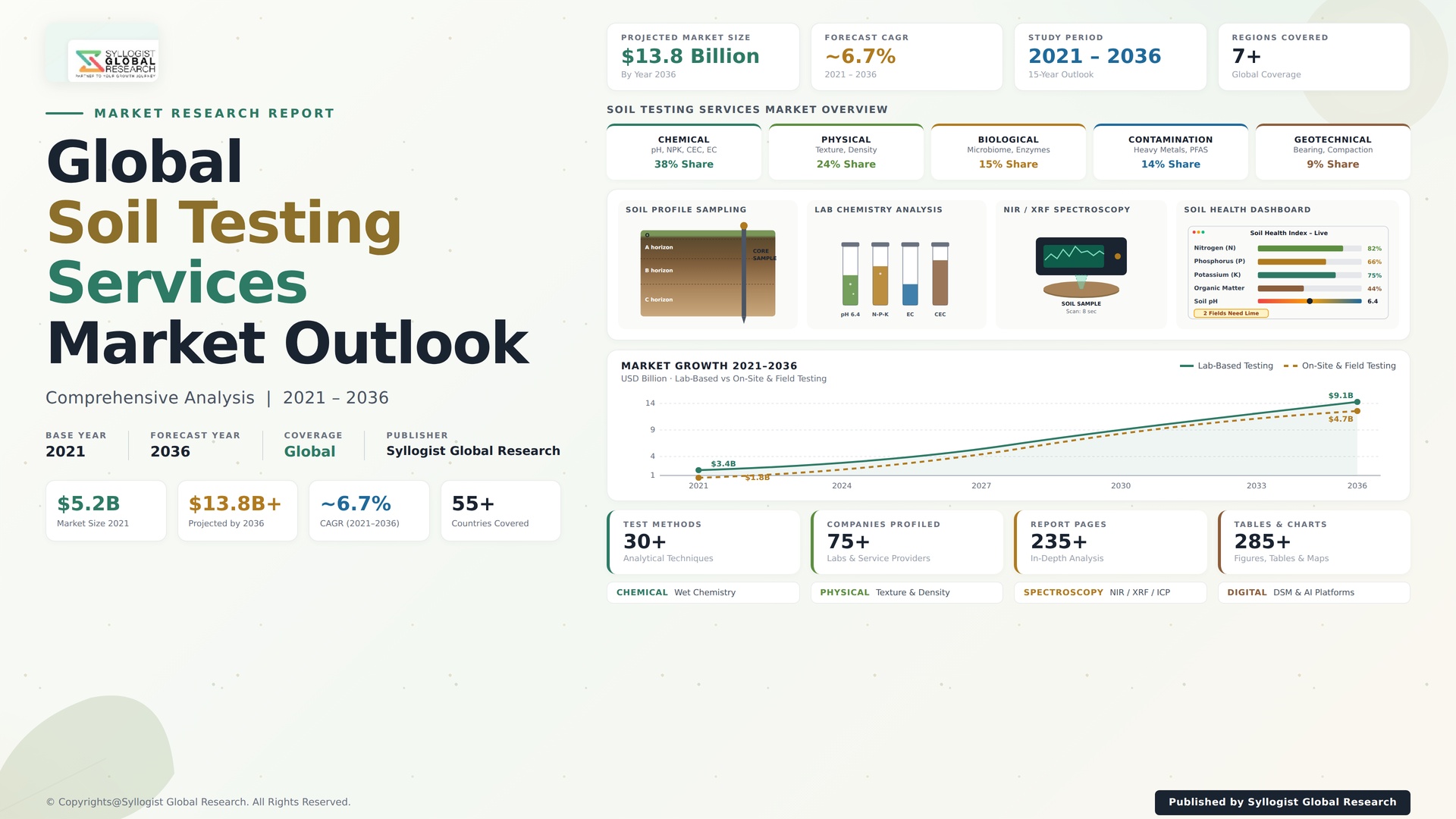
The global soil testing services market sits at the intersection of intensifying agricultural productivity pressure, expanding regulatory mandates governing contaminated land, and a structural transition toward data-driven precision agronomy that has elevated soil testing services from a once-yearly compliance activity into a recurring, multi-touch input shaping fertilizer procurement and sustainability reporting across major farming systems globally. The market was valued at approximately USD 4.34 billion in 2025 and is projected to reach USD 6.69 billion by 2034, advancing at a compound annual growth rate of 4.9% through the forecast period, supported by expanding adoption of soil health card schemes across emerging agricultural geographies, accelerating uptake of rapid on-site diagnostic technologies, and rising integration of soil testing services with precision agriculture platforms and variable rate fertilizer prescription systems. Chemical analysis services represent the dominant test-type category, accounting for approximately 64% of total revenue contribution given their centrality to nutrient management, pH correction, and salinity remediation decisions, while biological soil health assessments covering microbial activity, organic carbon, and mycorrhizal indicators are emerging as the fastest-growing analytical sub-category.
The transition from conventional centralized laboratory testing toward rapid, on-site, and digitally integrated soil diagnostic models represents one of the most consequential structural shifts reshaping the competitive landscape, with portable near-infrared spectrometers, handheld digital sensors, IoT-enabled field probes, and smartphone-application linked sampling kits registering above-average adoption growth as growers and agronomic advisors pursue real-time nutrient management decisions. Conventional laboratory methods continue to dominate aggregate revenue contribution accounting for approximately 61% of testing activity given their accreditation rigor, parameter breadth, and regulatory acceptance, while rapid testing platforms are advancing at a compound annual growth rate of approximately 10.4%, supported by integration with GPS-based grid sampling, drone-mounted remote sensing, AI-driven nutrient interpretation engines, and laboratory automation systems that compress historical multi-week turnaround timelines into actionable in-field recommendations within hours.
North America accounts for approximately 31.2% of global soil testing services revenue, anchored by dense laboratory infrastructure across United States Cooperative Extension networks, private agronomy advisory chains, and food safety mandates under the Food and Drug Administration risk-based agricultural water assessment framework, alongside Canadian fertility-testing volumes tied to canola, pulse, and wheat acreage management. Asia-Pacific is projected to register the highest regional compound annual growth rate of approximately 7.1%, driven by India’s flagship Soil Health Card scheme, expanding county-level testing programs in China, Japan’s premium horticulture standards, and large-scale soil testing initiatives across Indonesia, Vietnam, and the Philippines, with notable industry activity including the launch of soil testing centers known as Mitti Jaanch Kendras across Uttar Pradesh, Bihar, and West Bengal in May 2025. Europe contributes a sizable revenue share anchored by Common Agricultural Policy soil monitoring requirements and EU Soil Strategy 2030 commitments.
Agriculture represents the dominant application end use, with farmers accounting for approximately 38% of total soil testing demand and the agriculture segment expected to advance at the fastest CAGR of around 5.3% across the forecast period, while construction and geotechnical applications continue contributing meaningful volumes through pre-construction site assessments, foundation suitability evaluations, and environmental compliance reporting for urban infrastructure projects. The competitive landscape remains moderately concentrated with global testing, inspection, and certification leaders commanding aggregate share above 50% of the market, supported by recent strategic activity including the July 2025 acquisition of Nutrilab Agro by Eurofins Scientific and the October 2024 acquisition of the Bureau Veritas food testing business by Mérieux NutriSciences, while regional independent laboratories, agritech start-ups offering app-based sampling, and public sector institutions capture growing share through community-based soil health programs, mobile testing units, and integrated digital advisory platforms across India, Brazil, and other emerging soil testing markets.
Key Drivers
Government-Led Soil Health Card Schemes and Subsidized Testing Programs Generating Durable Recurring Service Demand Across Emerging Agricultural Economies
The expansion of government-led soil health card schemes, subsidized testing voucher programs, and public soil monitoring initiatives across India, China, Indonesia, Brazil, Kenya, and other emerging economies is generating sustained recurring testing volumes independent of commercial pricing dynamics, with India’s Soil Health Card scheme alone covering hundreds of millions of farmer holdings and creating durable downstream revenue for accredited laboratories, mobile testing units, and certified sampling operators across multiple cropping cycles annually.
Precision Agriculture Adoption and Variable Rate Fertilizer Prescription Institutionalizing Soil Testing as a Recurring Input Across Commercial Farming
The growing adoption of GPS-guided field sampling, grid-based testing protocols, variable rate fertilizer applicators, and farm management software platforms is institutionalizing soil testing services as a recurring data input rather than a one-off compliance activity, with fertilizer manufacturers and global agronomy advisory chains leveraging soil testing outputs to develop site-specific nutrient blends and reduce input waste across cereals, oilseeds, fruits, vegetables, and plantation crop systems.
Construction, Geotechnical, and Environmental Compliance Mandates Driving Sustained Non-Agricultural Soil Testing Service Procurement
Stringent geotechnical assessment requirements under building codes, contaminated land redevelopment frameworks, and EU Soil Strategy 2030 commitments are driving sustained non-agricultural soil testing demand from construction firms, urban infrastructure developers, mining operators, and environmental consultancies, with FDA risk-based agricultural water assessment provisions further reinforcing routine soil contamination testing across United States fresh produce and specialty crop production systems.
Key Challenges
Smallholder Access Barriers and Sample Logistics Complexity Constraining Service Penetration Across Fragmented Farming Geographies
A substantial share of global agricultural soil testing demand resides in smallholder geographies across South Asia, Sub-Saharan Africa, and Southeast Asia where remote field locations, limited cold-chain sampling logistics, fragmented farm sizes, and weak laboratory accreditation infrastructure constrain reliable commercial soil testing service delivery, depressing per-acre testing penetration and complicating commercial scale-up despite high underlying demand for soil health intelligence.
Standardization Gaps and Interpretation Inconsistency Across Laboratories Eroding Grower Confidence and Cross-Region Service Comparability
Soil testing methodologies, parameter calibration approaches, nutrient extraction protocols, and recommendation interpretation frameworks vary substantially across laboratories, geographies, and crop systems, with limited harmonization between Mehlich, Bray, Olsen, and ammonium acetate extraction methods generating inconsistent results for the same field samples and undermining grower confidence in switching providers, complicating multi-region service delivery for testing chains operating across diverse regulatory environments.
Skilled Talent Scarcity and Laboratory Cost Inflation Pressuring Mid-Sized Regional Soil Testing Service Providers
Soil testing services face structural cost pressure from rising prices of accredited soil scientists, ICP-MS and chromatography reagents, ISO 17025 compliance maintenance, and skilled sample preparation technicians, while concurrent demand for AI-enabled interpretation, IoT integration, and digital reporting capacity is widening the technical talent gap, particularly across mid-sized regional laboratories that lack the capital intensity of global testing, inspection, and certification leaders to absorb compounding cost pressure.
Market Segmentation
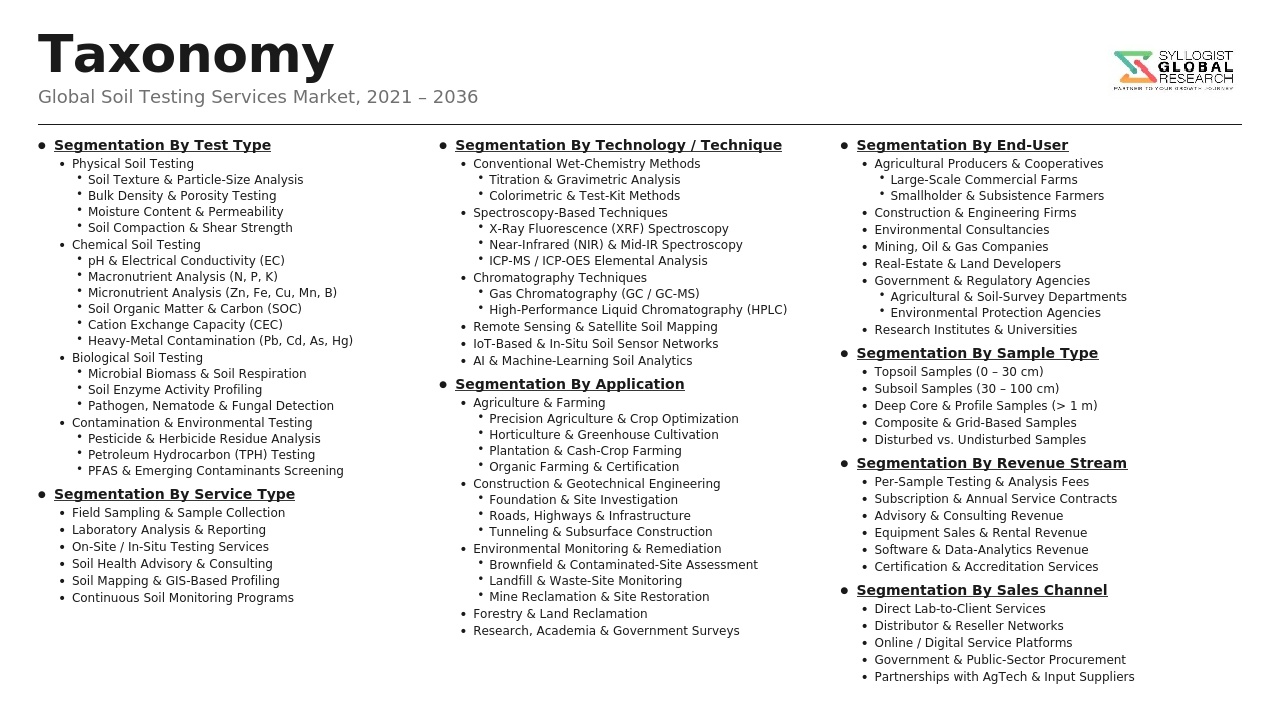
- Segmentation By Service Type
- Sampling and Sample Collection Services
- Laboratory Analytical Services
- On-site and Field Testing Services
- Soil Health Assessment and Advisory Services
- Digital Reporting and Data Management Services
- Others
- Segmentation By Test Type
- Chemical Analysis (pH, Macronutrients, Micronutrients, Salinity, Heavy Metals)
- Physical Analysis (Texture, Compaction, Moisture, Bulk Density, Shear Strength)
- Biological Analysis (Microbial Activity, Organic Matter, Mycorrhizal Profiling)
- Residual and Contamination Testing (Pesticide Residues, Hydrocarbons, Industrial Pollutants)
- Others
- Segmentation By Technology
- Conventional Wet Chemistry and Spectrometry
- Rapid Testing (Near-Infrared, Portable Spectroscopy, Handheld Sensors)
- IoT-enabled and Sensor-based Field Testing
- Remote Sensing and Drone-assisted Sampling
- Others
- Segmentation By Site
- Laboratory-based Testing
- On-site and Field Testing
- Segmentation By Application
- Agriculture and Crop Production
- Construction and Geotechnical
- Environmental Monitoring and Site Remediation
- Mining and Tailings Assessment
- Forestry and Plantation
- Research and Academic
- Others
- Segmentation By End User
- Commercial Farmers and Cooperatives
- Fertilizer Manufacturers and Agronomy Advisory Chains
- Plantation, Vineyard, and Orchard Operators
- Construction and Infrastructure Firms
- Environmental Consultancies and Remediation Specialists
- Mining Operators
- Government Agriculture Departments and Public Sector Institutions
- Food and Beverage Producers and Supply Chain Auditors
- Others
- Segmentation By Crop Type
- Cereals and Grains
- Oilseeds and Pulses
- Fruits and Vegetables
- Plantation Crops
- Turf and Ornamentals
- Others
- Segmentation By Region
- North America
- Europe
- Asia-Pacific
- Middle East and Africa
- Latin America
All market revenues are presented in USD
Historical Year: 2021-2024 | Base Year: 2025 | Estimated Year: 2026 | Forecast Period: 2027-2034
Key Questions this Study Will Answer
- What is the total global market valuation of the Soil Testing Services Market in 2025, projected through 2034, disaggregated by service type, test type, technology, and application, enabling testing and certification leaders, agritech start-ups, fertilizer manufacturers, government agriculture departments, and procurement planners to identify highest-growth segments and most durable revenue opportunities across agricultural, construction, environmental, and mining service categories?
- How are chemical, physical, biological, and contamination testing services expected to evolve in revenue contribution and adoption breadth across cereals, oilseeds, fruits and vegetables, plantation crops, turf and ornamentals, and non-agricultural soil testing applications through 2034, and which test parameters including soil pH, macronutrients, micronutrients, organic carbon, microbial activity, salinity, and heavy metals are positioned to deliver the strongest commercial returns?
- What regulatory frameworks under the Food and Drug Administration risk-based agricultural water assessment, EU Soil Strategy 2030, Common Agricultural Policy soil monitoring requirements, India’s Soil Health Card scheme, ISO 17025 accreditation standards, and equivalent regimes are reshaping soil testing services launch timelines, accreditation requirements, and reporting architecture across major commercial markets?
- Which technology categories including conventional wet chemistry, near-infrared portable spectroscopy, handheld digital sensors, IoT-enabled field probes, drone-based remote sensing, and AI-driven interpretation platforms are generating the highest soil testing services growth through 2034, and what integration patterns with farm management software, variable rate fertilizer applicators, and digital advisory ecosystems are most critical to grower outcomes and repeat-purchase economics?
- How is the competitive landscape structured among global testing, inspection, and certification leaders, regional independent laboratories, agritech start-ups, fertilizer manufacturer captive testing arms, and public sector institutions, and what acquisition, partnership, mobile testing, and digital advisory strategies are enabling new entrants to compete in soil testing services across India, Brazil, Kenya, Indonesia, Vietnam, and other emerging soil testing markets?
- What is the structural impact of biological soil health assessment, microbial profiling, organic carbon quantification, and mycorrhizal indicator testing on soil testing services adoption patterns, pricing dynamics, sustainability reporting alignment, and grower agronomic decision frameworks across regenerative agriculture, organic certification, carbon farming, and integrated nutrient management programs?
- Which regional soil testing services markets, specifically North America, Europe, Asia-Pacific, Latin America, and Middle East and Africa, are expected to generate the most substantial incremental procurement through 2034, and what climate, regulatory, government soil health program, precision agriculture adoption, and infrastructure spending factors are driving capability investment priorities and supplier selection decisions in each regional market?
- Product Definition
- Research Methodology
- Research Design & Framework
- Overall Research Approach: Descriptive, Exploratory & Quantitative Mixed-Method Design
- Market Definition & Scope Boundaries: What is Included and Excluded
- Segmentation Framework
- Key Research Assumptions & Limitations
- Secondary Research
- Primary Research Design & Execution
- Data Triangulation & Validation
- Market Sizing & Forecasting Methodology
- Competitive Intelligence Methodology
- Quality Assurance & Peer Review
- Definitions, Abbreviations & Data Notes
- Research Design & Framework
- Executive Summary
- Market Snapshot & Headline Numbers
- Key Findings & Research Highlights
- Market Dynamics
- Regional Market Summary
- Competitive Landscape Snapshot
- Technology & Innovation Highlights
- Market Dynamics
- Drivers
- Restraints
- Opportunities
- Challenges
- Porter’s Five Forces Analysis
- PESTLE Analysis
- Market Trends & Developments
- Emerging Trends
- Technological Developments
- Regulatory & Policy Changes
- Supply Chain & Sourcing Trends
- Service Delivery & Process Trends
- Investment & Funding Activity
- Sustainability & ESG Trends
- Risk Assessment Framework
- Sample Integrity, Contamination & Chain-of-Custody Risk
- Regulatory Compliance, Accreditation & Standardisation Risk
- Data Accuracy, Methodology Variability & Reporting Risk
- Technology Adoption, Digitalisation & Cybersecurity Risk
- Skilled Labour, Laboratory Capacity & Service Delivery Risk
- Regulatory Framework & Standards
- Agricultural Soil Testing, Nutrient Management & Fertiliser Recommendation Standards (USDA, FAO, NRCS & National Equivalents)
- Environmental Soil Contamination, Brownfield & Remediation Standards (EPA, EU & ISO 18400 Series)
- Geotechnical & Construction Soil Investigation Standards (ASTM D-Series, BS, Eurocode 7 & ISO 17892)
- Laboratory Accreditation, Method Validation & Quality Management Standards (ISO/IEC 17025, ISO 11464 & GLP)
- Farm Data Privacy, Soil Data Ownership & Open Soil Data Disclosure Standards
- Global Soil Testing Services Market Outlook
- Market Size & Forecast by Value
- Market Size & Forecast by Volume (Number of Samples Tested, Million Samples)
- Market Size & Forecast by Service Type
- Physical Soil Testing Services (Texture, Moisture, Density, Particle Size & Permeability)
- Chemical Soil Testing Services (pH, Electrical Conductivity, Macronutrients, Micronutrients, CEC & Salinity)
- Biological & Microbial Soil Testing Services (Soil Health, Microbial Biomass & Enzyme Activity)
- Soil Contamination & Environmental Testing Services (Heavy Metals, Pesticides, Hydrocarbons & PFAS)
- Mineralogical & Geochemical Soil Characterisation Services
- Geotechnical Soil Investigation Services (Bearing Capacity, Compaction, Triaxial & Atterberg Limits)
- Soil Sampling, Mapping & Digital Soil Mapping (DSM) Services
- On-Site & Portable Soil Testing Services
- Consulting, Interpretation & Soil Health Advisory Services
- Market Size & Forecast by Technology
- Conventional Wet Chemistry & Laboratory Analytical Methods
- Spectroscopy-Based Soil Testing (NIR, MIR, XRF, LIBS & Hyperspectral)
- Inductively Coupled Plasma (ICP-OES & ICP-MS) & Atomic Absorption Spectroscopy
- Electrochemical Sensors, Ion-Selective Electrodes & Field Probes
- Molecular & DNA-Based Soil Microbiome Analysis (qPCR, Metagenomics & NGS)
- Remote Sensing, Satellite Imagery, UAV & Proximal Soil Sensing
- Digital Soil Mapping, GIS & AI-Based Soil Property Prediction Platforms
- Mobile App, IoT-Connected & Cloud-Based Soil Data Management Platforms
- Market Size & Forecast by Sample Type
- Surface & Topsoil Samples (0 to 30 cm)
- Subsoil & Profile Samples (Below 30 cm)
- Composite & Grid-Based Sampling
- Disturbed & Undisturbed Geotechnical Cores
- Contaminated Site & Brownfield Samples
- Market Size & Forecast by Service Mode
- Laboratory-Based Centralised Testing Service
- On-Site & Field-Based Mobile Testing Service
- Hybrid Field-to-Laboratory Workflow Service
- Subscription & Mail-In Self-Sampling Service
- Market Size & Forecast by Application
- Agriculture, Precision Farming & Nutrient Management
- Horticulture, Turf, Greenhouse & Specialty Crop Production
- Forestry, Plantation & Land Reclamation
- Construction, Infrastructure & Geotechnical Engineering
- Environmental Monitoring, Brownfield Redevelopment & Remediation
- Mining, Oil & Gas Site Characterisation & Closure
- Real Estate, Pre-Purchase Due Diligence & Property Transfer
- Research, Academic & Government Soil Survey
- Market Size & Forecast by End-User
- Farmers, Agricultural Cooperatives & Agribusiness
- Government, Regulatory & Soil Survey Agencies
- Construction, Engineering & Infrastructure Developers
- Environmental Consultants & Remediation Service Providers
- Mining, Oil & Gas Operators
- Research Institutions, Universities & Public Laboratories
- Market Size & Forecast by Sales Channel
- Direct Laboratory Service Contract & Walk-In Submission
- Mail-In & Subscription-Based Soil Testing Kit
- Agronomy Advisor, Distributor & Crop Input Retailer Partnership
- Online Platform, Mobile App & Digital Soil Testing Marketplace
- Tendered Public-Sector & Government Soil Survey Contract
- North America Soil Testing Services Market Outlook
- Market Size & Forecast
- By Value
- By Volume (Number of Samples Tested, Million Samples)
- By Service Type
- By Technology
- By Sample Type
- By Service Mode
- By Application
- By End-User
- By Country
- By Sales Channel
- Market Size & Forecast
- Europe Soil Testing Services Market Outlook
- Market Size & Forecast
- By Value
- By Volume (Number of Samples Tested, Million Samples)
- By Service Type
- By Technology
- By Sample Type
- By Service Mode
- By Application
- By End-User
- By Country
- By Sales Channel
- Market Size & Forecast
- Asia-Pacific Soil Testing Services Market Outlook
- Market Size & Forecast
- By Value
- By Volume (Number of Samples Tested, Million Samples)
- By Service Type
- By Technology
- By Sample Type
- By Service Mode
- By Application
- By End-User
- By Country
- By Sales Channel
- Market Size & Forecast
- Latin America Soil Testing Services Market Outlook
- Market Size & Forecast
- By Value
- By Volume (Number of Samples Tested, Million Samples)
- By Service Type
- By Technology
- By Sample Type
- By Service Mode
- By Application
- By End-User
- By Country
- By Sales Channel
- Market Size & Forecast
- Middle East & Africa Soil Testing Services Market Outlook
- Market Size & Forecast
- By Value
- By Volume (Number of Samples Tested, Million Samples)
- By Service Type
- By Technology
- By Sample Type
- By Service Mode
- By Application
- By End-User
- By Country
- By Sales Channel
- Market Size & Forecast
- Country-Wise* Soil Testing Services Market Outlook
- Market Size & Forecast
- By Value
- By Volume (Number of Samples Tested, Million Samples)
- By Service Type
- By Technology
- By Sample Type
- By Service Mode
- By Application
- By End-User
- By Country
- By Sales Channel
- Market Size & Forecast
- *Countries Analyzed in the Syllogist Global Research Portfolio: United States, Canada, Mexico, Germany, France, United Kingdom, Netherlands, Spain, Italy, Norway, Sweden, China, Japan, India, Australia, South Korea, Singapore, Brazil, Chile, Saudi Arabia, UAE, Egypt, South Africa, Israel
- Technology Landscape & Innovation Analysis
- Conventional Wet Chemistry & Laboratory Analytical Methods Technology Deep-Dive
- Spectroscopy-Based Soil Testing (NIR, MIR, XRF & LIBS) Technology
- Inductively Coupled Plasma (ICP-OES & ICP-MS) & Atomic Spectroscopy Technology
- Electrochemical Sensor, Ion-Selective Electrode & Field-Based Portable Soil Testing Technology
- Molecular, DNA & Soil Microbiome Analysis (qPCR, Metagenomics & NGS) Technology
- Remote Sensing, Satellite, UAV & Proximal Soil Sensing Technology
- Digital Soil Mapping, GIS & AI-Based Soil Property Prediction Platform Technology
- Patent & IP Landscape in Soil Testing Service Technologies
- Value Chain & Supply Chain Analysis
- Soil Sampling Equipment, Auger, Coring Tool & Probe Manufacturing Supply Chain
- Laboratory Analytical Instrument (Spectrometer, ICP, Wet Chemistry Bench) Supply Chain
- Reagent, Consumable & Certified Reference Material Supply Chain
- Sample Logistics, Cold-Chain & Chain-of-Custody Service Network
- Independent Laboratory, Academic & Captive In-House Lab Service Provider Landscape
- Agronomy Advisor, Crop Input Retailer & Government Extension Channel
- Data Reporting, Interpretation & Decision-Support Software Provider
- Pricing Analysis
- Routine Agricultural Soil Test Package Pricing & Margin Analysis
- Environmental Contamination & Heavy Metal Soil Testing Pricing Analysis
- Geotechnical Soil Investigation & Site Characterisation Pricing Analysis
- Spectroscopy & Advanced Instrumentation Soil Testing Pricing Analysis
- Subscription-Based Soil Testing Kit & Digital Platform Pricing Analysis
- Total Soil Testing Service Economics: Cost-Per-Sample, Turnaround Time & Service Bundle Pricing Optimisation Analysis
- Sustainability & Environmental Analysis
- Lifecycle Assessment (LCA) of Soil Testing Services: Reagent Use, Laboratory Waste Generation & Carbon Footprint Across Method Routes
- Soil Health, Carbon Sequestration & Regenerative Agriculture Contribution: Pathway to Soil-Carbon Quantification & MRV (Measurement, Reporting & Verification)
- Soil-Water-Food Nexus: Integrated Soil Fertility, Water Use Efficiency & Food Security Contribution of Soil Testing Services
- Environmental Compliance, Brownfield Remediation & Sustainable Land Use Consideration in Soil Testing
- Regulatory-Driven Sustainability, SDG 2 (Zero Hunger) & SDG 15 (Life on Land) Alignment & Green Finance Eligibility
- Competitive Landscape
- Market Structure & Concentration
- Market Consolidation Level (Fragmented vs. Consolidated by Service Type & Geography)
- Top 10 Players Market Share
- HHI (Herfindahl-Hirschman Index) Concentration Analysis
- Competitive Intensity Map by Service Type, Technology & Geography
- Player Classification
- Global Multi-Disciplinary Testing, Inspection & Certification (TIC) Companies
- Specialist Agricultural & Soil Health Laboratory Service Providers
- Geotechnical & Construction Soil Investigation Specialists
- Environmental Testing & Remediation Laboratory Networks
- Spectroscopy & Sensor-Based Rapid Soil Testing Technology Providers
- Digital Soil Mapping, AI & Software-as-a-Service Platform Providers
- Government, Public-Sector & Academic Soil Survey Laboratories
- Subscription-Based & Direct-to-Farmer Soil Testing Kit Providers
- Competitive Analysis Frameworks
- Market Share Analysis by Service Type, Technology & Region
- Company Profile
- Company Overview & Headquarters
- Soil Testing Service Portfolio & Method Capability
- Key Customer Relationships & Reference Contract Wins
- Laboratory Footprint & Sample Throughput Capacity
- Revenue (Soil Testing Segment) & Backlog
- Technology Differentiators & IP
- Key Strategic Partnerships, JVs & M&A Activity
- Recent Developments (Contract Wins, Capacity Expansion, Service Launches)
- SWOT Analysis
- Strategic Focus Areas & Roadmap
- Competitive Positioning Map (Technology Capability vs. Market Penetration)
- Key Company Profiles
- Market Structure & Concentration
- Technology Landscape & Innovation Analysis
- Strategic Output
- Market Opportunity Matrix: By Service Type, Technology, Application, End-User & Geography
- White Space Opportunity Analysis
- Strategic Recommendations
- Service Portfolio & Technology Investment Strategy
- Laboratory Operations & Service Delivery Excellence Strategy
- Geographic Expansion & Localisation Strategy
- Customer & End-User Engagement Strategy
- Partnership, M&A & Ecosystem Strategy
- Sustainability & Circular Economy Strategy
- Risk Mitigation & Future Roadmap
- Strategic Priority Matrix & Roadmap
- Near-term (2025 to 2028)
- Mid-term (2029 to 2032)
- Long-term (2033 to 2037)
- Strategic Output