Global Industrial Enzymes Market By Enzyme Type, By Source, By Application, By Formulation, By Reaction Type, By Function, By End User, By Region, Competition, Forecast & Opportunities, 2021-2034F
Market Definition
Industrial enzymes are biological catalysts produced through fermentation of microorganisms including bacteria, fungi, and yeast that accelerate chemical reactions in industrial processes under milder operating conditions than conventional chemical catalysts, enabling more sustainable, cost-efficient, and selective manufacturing across food and beverage processing, detergent formulation, biofuel production, animal feed manufacturing, textile finishing, pulp and paper processing, leather treatment, pharmaceutical synthesis, and personal care product manufacturing. The Global Industrial Enzymes Market encompasses the development, fermentation-based production, formulation, distribution, and application of carbohydrases (including amylases, cellulases, lactases, and pectinases), proteases, lipases, polymerases, phytases, nucleases, and specialty enzymes deployed across regulated and non-regulated industrial processing applications globally.
The industrial enzymes market includes liquid, granular, microencapsulated, and immobilized enzyme formulations engineered for thermal stability, pH tolerance, substrate specificity, and process-fit performance across high-temperature, alkaline, acidic, and solvent-containing reaction environments. Market participants include established enzyme producers, precision fermentation specialists, formulation companies, contract development and manufacturing organizations, ingredient distributors, and end-user industries spanning food processing, detergent and household care, ethanol and biofuel production, feed milling, textile processing, pulp and paper manufacturing, pharmaceutical contract manufacturing, and personal care production. The industrial enzymes market also covers value-added services including process optimization consulting, enzyme application engineering, custom formulation development, technical service support, and regulatory dossier preparation. The scope explicitly excludes diagnostic enzymes used in clinical laboratory testing, research-only enzymes supplied in microgram quantities to academic laboratories, and bulk fermentation feedstock ingredients sold without enzymatic functionality, focusing exclusively on industrial-scale enzymes engineered for process catalysis applications globally.
Market Insights
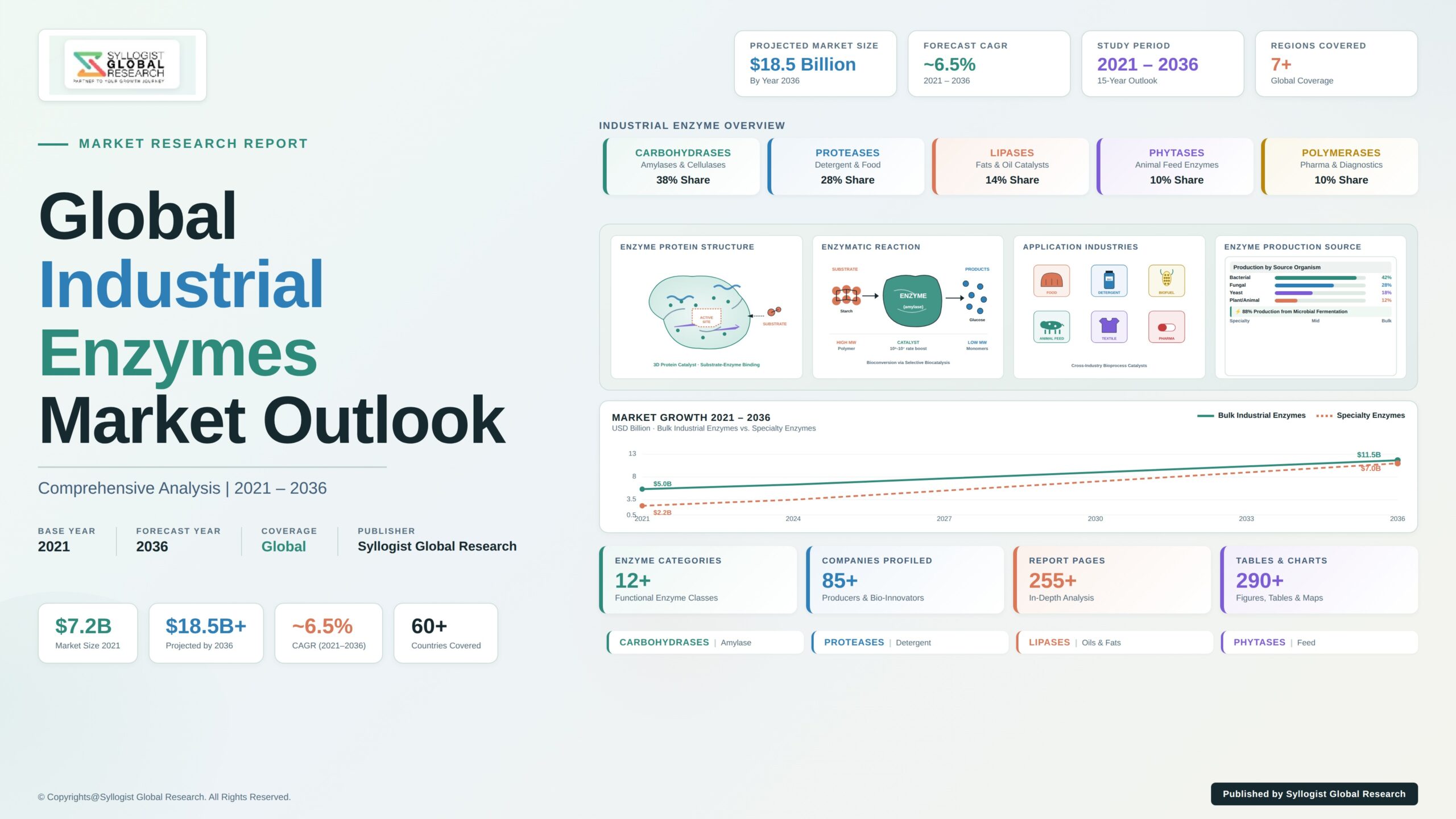
The global industrial enzymes market is entering an accelerated structural growth phase, shaped by intensifying sustainability mandates across manufacturing operations, the displacement of chemical catalysts by enzymatic alternatives in food, detergent, and biofuel applications, the rapid maturation of precision fermentation enabling cost-efficient production of high-specificity industrial enzymes, accelerating consumer preference for clean-label food and personal care formulations, and tightening regulatory frameworks promoting biocatalytic processes that reduce emissions, water consumption, and chemical waste. The industrial enzymes market was valued at approximately USD 8.7 billion in 2025 and is projected to reach USD 17.6 billion by 2034, advancing at a compound annual growth rate of 8.1% through the forecast period, as food and beverage processors, detergent formulators, biofuel producers, feed millers, and specialty industrial operators scale enzyme procurement to meet sustainability, cost optimization, and product quality objectives across mature and emerging operating regions.
The industrial enzymes market trajectory is being reshaped by the commercial maturation of protein engineering platforms, AI-driven enzyme discovery and rational design, precision fermentation production at industrial scale, and the deployment of computationally designed enzyme variants delivering substantially higher turnover rates, thermal stability, and substrate specificity than naturally occurring enzymes. Machine learning-driven enzyme engineering platforms have compressed development timelines for novel industrial enzyme variants from over 36 months to under 12 months across leading developers, enabling rapid response to customer-specific process requirements and accelerating commercialization of next-generation enzyme products within the industrial enzymes market. Precision fermentation production capacity scaled by over 35% between 2021 and 2025 globally, with production facilities increasingly deploying continuous fermentation systems, downstream purification automation, and digital process control architectures that materially reduce per-unit production costs and expand the commercial economics envelope for high-volume industrial enzymes applications.
Carbohydrases represent the largest enzyme type segment within the industrial enzymes market, propelled by sustained demand from food and beverage processing, ethanol production, baking, and starch processing applications that consume substantial volumes of amylases, cellulases, lactases, pectinases, and xylanases at industrial scale. Proteases represent the second largest enzyme type segment within the industrial enzymes market, supported by detergent formulation demand, food processing applications, leather treatment, and emerging pharmaceutical synthesis use cases. Food and beverage processing represents the largest application segment within the industrial enzymes market, fueled by sustained demand from baking, dairy processing, brewing, juice clarification, meat processing, and starch conversion applications. Biofuel and bioethanol production represents the fastest-growing application segment within the industrial enzymes market, driven by national biofuel blending mandates, second-generation cellulosic ethanol commercialization, and biodiesel production expansion across mature and emerging biofuel operating regions globally.
Asia-Pacific represents the largest regional market within the industrial enzymes market, anchored by substantial enzyme consumption across food processing, animal feed manufacturing, textile production, leather processing, and biofuel production in China, India, Indonesia, Thailand, and Vietnam, supported by rising disposable incomes, organized food processing growth, and expanding domestic enzyme production capacity. China hosts the largest concentration of industrial enzymes consumption globally and continues to expand domestic fermentation production capacity supporting both domestic consumption and growing enzyme exports. North America represents the second largest regional position within the industrial enzymes market, supported by mature food and beverage processing, established ethanol production capacity, sustained detergent formulation innovation, and accelerating precision fermentation investment from venture-funded biotechnology developers. Europe occupies the third major regional position within the industrial enzymes market, shaped by stringent sustainability regulation, advanced food processing infrastructure, mature detergent formulation expertise, and the European Union Green Deal driving biocatalysis adoption across regulated industrial sectors.
Key Drivers
Intensifying Manufacturing Sustainability Mandates, Carbon Reduction Commitments, and Biocatalysis Displacement of Chemical Catalysts Driving Sustained Industrial Enzymes Procurement
The intensification of manufacturing sustainability mandates, expanding corporate carbon reduction commitments, and accelerating displacement of conventional chemical catalysts by biocatalytic enzyme alternatives across food processing, detergent formulation, textile finishing, pulp and paper manufacturing, and pharmaceutical synthesis are generating durable procurement demand for industrial enzymes across mature and emerging operating regions globally. Manufacturing operations using enzymatic biocatalysis routinely achieve 30% to 60% reductions in energy consumption, 20% to 50% reductions in chemical reagent requirements, and substantial water consumption reductions relative to equivalent chemical catalysis processes, generating compelling economic and sustainability rationale for industrial enzymes adoption. Corporate net-zero commitments from major consumer goods manufacturers, food processors, and chemical companies are reinforcing procurement preference for enzymatic biocatalysis across product formulation and manufacturing process design decisions. The European Union Green Deal, California Air Resources Board sustainability frameworks, and corporate Scope 1 and Scope 3 emissions reporting requirements are accelerating enzymatic biocatalysis adoption across regulated manufacturing sectors, generating sustained procurement growth for the industrial enzymes market. End-user industries are structuring multi-year industrial enzymes procurement frameworks aligning supply commitments with sustainability targets and manufacturing capacity expansion timelines, generating long-duration revenue commitments that anchor enzyme producer fermentation capacity scaling decisions across the industrial enzymes market value chain.
Biofuel Production Expansion, Bioethanol Blending Mandates, and Cellulosic Biofuel Commercialization Driving Carbohydrase and Cellulase Enzyme Procurement
The structural expansion of biofuel production capacity, accelerating national bioethanol blending mandates, and commercialization of second-generation cellulosic biofuel processes are driving sustained procurement of carbohydrases, cellulases, and specialty enzymes within the industrial enzymes market across major bioethanol and biodiesel operating regions globally. Global ethanol production volumes exceeded 30 billion gallons in 2025, with the United States, Brazil, China, India, and the European Union accounting for the bulk of production capacity supported by national biofuel blending mandates that drive sustained enzymatic feedstock conversion. The Indian Ethanol Blended Petrol program targeting 20% ethanol blending by 2025 has accelerated industrial enzymes procurement for ethanol production from sugarcane, corn, and rice feedstocks. Second-generation cellulosic ethanol commercialization in Brazil, the United States, and select European Union member states is generating sustained demand for specialty cellulases, hemicellulases, and accessory enzymes engineered for biomass conversion applications within the industrial enzymes market. Biofuel producers are structuring multi-year industrial enzymes supply agreements with fermentation producers, generating production capacity commitments that anchor enzyme manufacturer investment decisions and reinforce continued capacity scaling across the industrial enzymes market value chain in support of sustained biofuel volume growth across mature and emerging operating regions.
Clean-Label Consumer Preferences, Functional Food Innovation, and Animal Feed Optimization Driving Specialty Enzyme Procurement Across Food and Feed Industries
Growing consumer preferences for clean-label food formulations, accelerating functional food and beverage innovation, and intensifying animal feed optimization mandates targeting feed conversion efficiency and reduced environmental impact are driving sustained procurement of specialty enzymes within the industrial enzymes market across food processing, beverage manufacturing, and feed milling operating regions. Consumer demand for clean-label, additive-free food formulations is generating procurement preference for enzymatic alternatives to synthetic emulsifiers, preservatives, and process aids across baking, dairy, brewing, and juice processing applications, with over 60% of major food processors reporting active substitution programs replacing chemical ingredients with enzymatic alternatives. Functional food and beverage innovation, including lactose-free dairy, low-sugar beverages, plant-based dairy alternatives, and high-protein formulations, is driving sustained demand for specialty enzymes including lactases, glucose oxidases, and protein-modifying enzymes within the industrial enzymes market. Animal feed enzyme procurement, particularly phytases, xylanases, beta-glucanases, and proteases, is scaling at sustained rates above 7% annually across major feed milling operating regions, propelled by feed cost optimization, phosphorus emission reduction mandates, and feed conversion efficiency targets that biocatalytic feed enzymes consistently deliver across poultry, swine, ruminant, and aquaculture feed formulations.
Key Challenges
High R&D Capital Intensity, Extended Enzyme Development Timelines, and Customer-Specific Process Validation Complexity Constraining New Product Commercialization
The industrial enzymes market continues to face material research and development capital intensity, extended development timelines for novel enzyme variants, and customer-specific process validation requirements that collectively constrain the pace at which new enzyme products can be commercialized across mature and emerging operating regions. Industrial enzyme development programs typically require USD 5 million to USD 25 million in cumulative research, fermentation scale-up, regulatory dossier preparation, and customer validation investment across development timelines extending 24 to 48 months from initial enzyme candidate identification to commercial launch within the industrial enzymes market. Customer-specific process validation requirements vary materially across food processing, detergent formulation, biofuel production, and animal feed manufacturing customers, requiring enzyme producers to support extensive application engineering, pilot-scale process trials, and full-scale commercial validation programs that extend commercialization timelines and elevate per-customer commercial development cost. Regulatory dossier preparation for food enzyme approvals across the United States Food and Drug Administration, European Food Safety Authority, and other major regulatory authorities adds further commercialization complexity, with approval timelines for novel food enzymes routinely extending 12 to 24 months beyond initial submission and complicating commercialization roadmap development for industrial enzymes producers seeking to enter regulated food, feed, and pharmaceutical applications.
Fermentation Capacity Constraints, Raw Material Cost Volatility, and Specialty Substrate Sourcing Complexity Affecting Industrial Enzymes Production Economics
Industrial enzymes producers face persistent fermentation capacity constraints, raw material cost volatility, and specialty substrate sourcing complexity that collectively affect production economics and supply reliability within the industrial enzymes market across global operating regions. Fermentation capacity expansion requires substantial capital deployment, with new industrial fermentation facilities typically requiring USD 100 million to USD 500 million in greenfield investment, generating multi-year commissioning timelines that constrain the pace at which the industrial enzymes market can scale production capacity to meet accelerating demand. Raw material cost volatility, including fluctuations in glucose, corn steep liquor, molasses, ammonia, and specialty nitrogen source pricing, generates persistent margin pressure for industrial enzymes producers, with sustained input cost increases of 15% to 30% between 2021 and 2024 affecting product gross margins and complicating long-term pricing commitments to industrial enzymes customers. Specialty substrate sourcing complexity for specific enzyme variants requiring nonstandard fermentation feedstocks adds further supply chain risk, with certain enzymes requiring proprietary or geographically constrained substrates that limit production scaling options and elevate supply reliability risk. The combined effect of fermentation capacity constraints, raw material cost volatility, and specialty substrate sourcing complexity continues to constrain the pace at which industrial enzymes producers can scale production volume and optimize per-unit production economics within the industrial enzymes market.
Regulatory Approval Complexity, Genetically Modified Microorganism Acceptance Variability, and Cross-Border Enzyme Trade Compliance Burdens
The industrial enzymes market continues to face material regulatory approval complexity, sustained variability in consumer and regulatory acceptance of genetically modified microorganism (GMM) production hosts across geographic markets, and substantial cross-border trade compliance burdens that collectively constrain commercial scaling and elevate market access cost. Food enzyme approvals across the United States Food and Drug Administration Generally Recognized as Safe (GRAS) framework, European Food Safety Authority pre-market authorization, China National Health Commission food additive registration, and Japan Ministry of Health Labour and Welfare registration require distinct dossier formats, supporting study packages, and approval timelines that materially elevate market access costs and regulatory complexity for industrial enzymes producers seeking global commercialization within the industrial enzymes market. Consumer and regulatory acceptance of GMM production hosts varies substantially across geographic markets, with European Union, Japanese, and select Asia-Pacific markets imposing more stringent labeling, traceability, and consumer disclosure requirements than North American markets, generating production sourcing complexity for industrial enzymes producers serving multinational customers requiring globally aligned regulatory compliance. Cross-border industrial enzymes trade compliance, including customs classification under Harmonized System codes, certificate of analysis requirements, and country-of-origin documentation, adds further administrative burden complicating multinational supply commitments and elevating per-shipment trade compliance cost across the industrial enzymes market value chain.
Market Segmentation
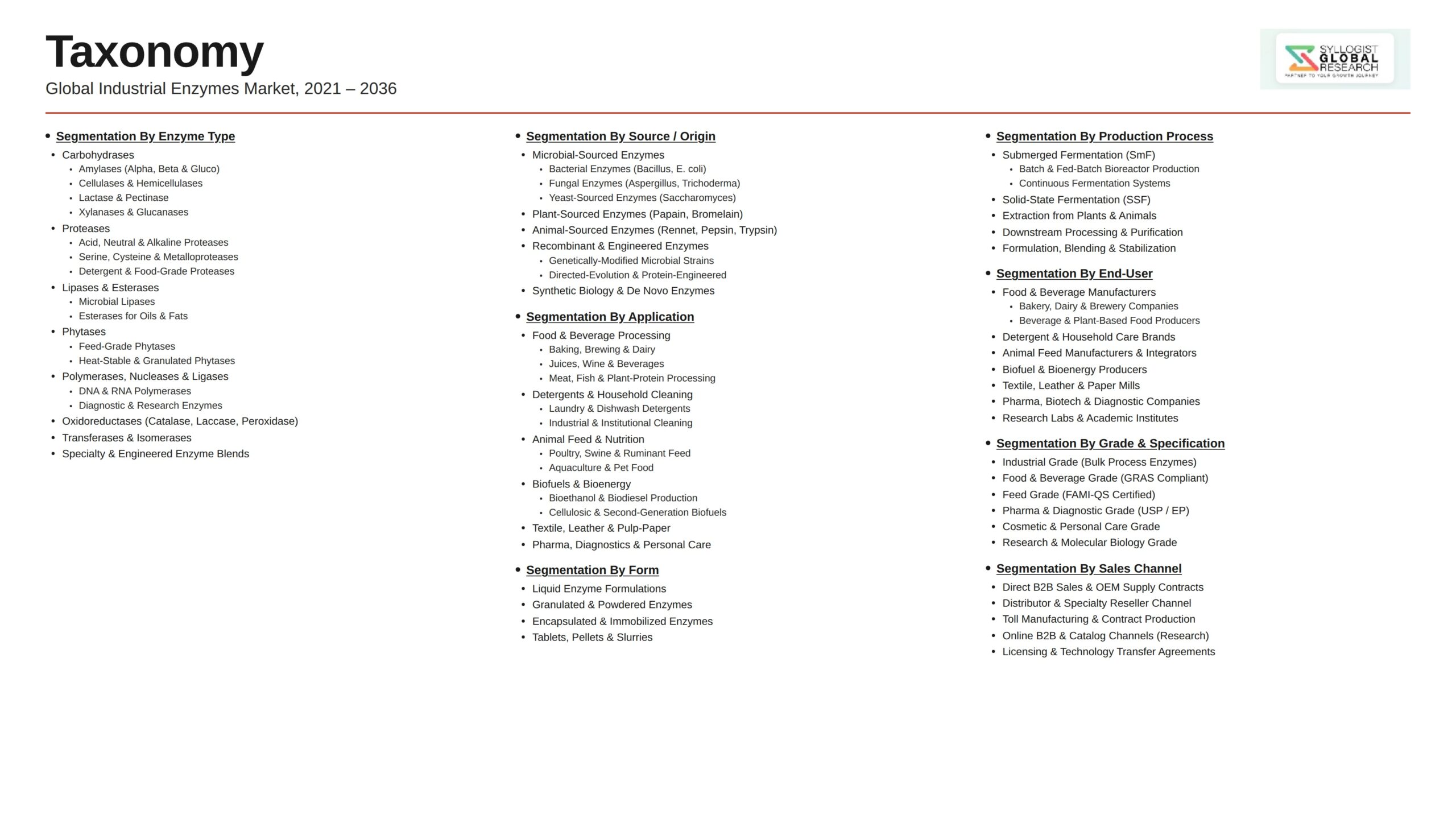
- Segmentation By Enzyme Type
- Carbohydrases (Amylases, Cellulases, Lactases, Pectinases, Xylanases)
- Proteases
- Lipases
- Polymerases and Nucleases
- Phytases
- Catalases and Oxidases
- Specialty and Other Enzymes
- Segmentation By Source
- Microbial (Bacteria, Fungi, Yeast)
- Plant-Derived
- Animal-Derived
- Segmentation By Application
- Food and Beverage Processing
- Detergents and Household Care
- Biofuel and Bioethanol Production
- Animal Feed and Nutrition
- Textile and Leather Processing
- Pulp and Paper Manufacturing
- Pharmaceutical and Nutraceutical Synthesis
- Personal Care and Cosmetics
- Diagnostic and Research (Industrial Scale)
- Others
- Segmentation By Formulation
- Liquid Enzymes
- Granular and Powder Enzymes
- Microencapsulated Enzymes
- Immobilized Enzymes
- Others
- Segmentation By Reaction Type
- Hydrolysis
- Oxidation and Reduction
- Isomerization
- Transferase Reactions
- Polymerization and Depolymerization
- Others
- Segmentation By Function
- Substrate Conversion
- Specificity and Selectivity Enhancement
- Process Stabilization
- Cleaning and Stain Removal
- Quality Improvement and Yield Optimization
- Segmentation By End User
- Food and Beverage Processors
- Detergent and Household Care Manufacturers
- Biofuel and Bioethanol Producers
- Feed Milling Operators
- Textile and Leather Processors
- Pulp and Paper Manufacturers
- Pharmaceutical and Nutraceutical Operators
- Personal Care Product Manufacturers
- Others
- Segmentation By Region
- North America
- Europe
- Asia-Pacific
- Middle East and Africa
- Latin America
All market revenues are presented in USD
Historical Year: 2021-2024 | Base Year: 2025 | Estimated Year: 2026 | Forecast Period: 2027-2034
Key Questions this Study Will Answer
- What is the total global market valuation of the Industrial Enzymes Market in 2025, projected through 2034, segmented by enzyme type, source, application, and formulation, enabling enzyme producers, formulators, distributors, and industrial procurement teams to identify highest-growth segments and most durable revenue opportunities across the industrial enzymes landscape?
- How are food and beverage processors, detergent formulators, biofuel producers, feed millers, and specialty industrial operators structuring procurement frameworks for industrial enzymes, and which commercial models, including spot purchase, multi-year supply agreements, custom enzyme development partnerships, and licensed production arrangements, are shaping commercial deployment economics within the industrial enzymes market through 2034?
- What sustainability mandates, corporate carbon reduction commitments, and biocatalysis adoption dynamics are reshaping enzyme substitution timelines for chemical catalysts across food, detergent, textile, pulp and paper, and pharmaceutical manufacturing processes?
- Which enzyme types, including carbohydrases, proteases, lipases, phytases, polymerases, and specialty enzymes, are gaining the strongest procurement traction across food processing, biofuel, feed, detergent, and pharmaceutical applications, and what specificity, thermal stability, pH tolerance, and total cost of ownership metrics are shaping technology selection decisions?
- How is the competitive landscape structured among established enzyme producers, precision fermentation specialists, contract development and manufacturing organizations, and emerging biotechnology developers within the industrial enzymes market, and what partnership, acquisition, and platform expansion strategies are enabling new entrants to compete against incumbent enzyme producers?
- What protein engineering, AI-driven enzyme discovery, precision fermentation, and immobilized enzyme technology trajectories are reshaping enzyme performance benchmarks, customer application engineering, and per-unit production economics across the industrial enzymes market globally?
- Which regional markets, including Asia-Pacific, North America, and Europe, are projected to generate the largest incremental industrial enzymes procurement opportunities through 2034, and what regulatory, application diversity, sustainability mandate, and biotechnology investment factors are shaping capability investment priorities and supplier selection decisions in each regional industrial enzymes market?
- Product Definition
- Research Methodology
- Research Design & Framework
- Overall Research Approach: Descriptive, Exploratory & Quantitative Mixed-Method Design
- Market Definition & Scope Boundaries: What is Included and Excluded
- Segmentation Framework
- Key Research Assumptions & Limitations
- Secondary Research
- Primary Research Design & Execution
- Data Triangulation & Validation
- Market Sizing & Forecasting Methodology
- Competitive Intelligence Methodology
- Quality Assurance & Peer Review
- Definitions, Abbreviations & Data Notes
- Executive Summary
- Market Snapshot & Headline Numbers
- Key Findings & Research Highlights
- Market Dynamics
- Regional Market Summary
- Competitive Landscape Snapshot
- Technology & Innovation Highlights
- Market Dynamics
- Drivers
- Restraints
- Opportunities
- Challenges
- Porter’s Five Forces Analysis
- PESTLE Analysis
- Market Trends & Developments
- Emerging Trends
- Technological Developments
- Regulatory & Policy Changes
- Supply Chain & Sourcing Trends
- Manufacturing & Process Trends
- Investment & Funding Activity
- Sustainability & ESG Trends
- Risk Assessment Framework
- Raw Material Cost Volatility, Fermentation Feedstock & Specialty Substrate Sourcing Risk
- Regulatory Approval Complexity, Food Enzyme Dossier & GRAS Certification Timeline Risk
- Genetically Modified Microorganism (GMM) Acceptance Variability & Cross-Border Labelling Compliance Risk
- Customer-Specific Process Validation, Long Commercialisation Timeline & Application Engineering Risk
- Fermentation Capacity Constraint, Production Scale-Up & Supply Continuity Risk
- Regulatory Framework & Standards
- Food Enzyme Approval Frameworks (US FDA GRAS, EFSA Pre-Market Authorisation, China NHC, Japan MHLW)
- Genetically Modified Microorganism (GMM) Labelling, Traceability & Consumer Disclosure Regulations
- Feed Enzyme Approval & Animal Nutrition Compliance Standards (EFSA Feed Additive, AAFCO, FAMI-QS)
- Cosmetic, Personal Care & Pharmaceutical Enzyme Compliance Frameworks (REACH, FDA, ICH Guidelines)
- Sustainability, Biocatalysis Promotion & Green Chemistry Procurement Standards
- Global Industrial Enzymes Market Outlook
- Market Size & Forecast by Value
- Market Size & Forecast by Volume (Enzyme Consumption in Kilotonnes and Number of Active Fermentation Production Facilities)
- Market Size & Forecast by Enzyme Type
- Carbohydrases (Amylases, Cellulases, Lactases, Pectinases, Xylanases)
- Proteases
- Lipases
- Polymerases and Nucleases
- Phytases
- Catalases and Oxidases
- Specialty and Other Enzymes
- Market Size & Forecast by Source
- Microbial (Bacteria, Fungi, Yeast)
- Plant-Derived
- Animal-Derived
- Market Size & Forecast by Application
- Food and Beverage Processing
- Detergents and Household Care
- Biofuel and Bioethanol Production
- Animal Feed and Nutrition
- Textile and Leather Processing
- Pulp and Paper Manufacturing
- Pharmaceutical and Nutraceutical Synthesis
- Personal Care and Cosmetics
- Diagnostic and Research (Industrial Scale)
- Others
- Market Size & Forecast by Formulation
- Liquid Enzymes
- Granular and Powder Enzymes
- Microencapsulated Enzymes
- Immobilised Enzymes
- Others
- Market Size & Forecast by Reaction Type
- Hydrolysis
- Oxidation and Reduction
- Isomerisation
- Transferase Reactions
- Polymerisation and Depolymerisation
- Others
- Market Size & Forecast by Function
- Substrate Conversion
- Specificity and Selectivity Enhancement
- Process Stabilisation
- Cleaning and Stain Removal
- Quality Improvement and Yield Optimisation
- Market Size & Forecast by End-User
- Food and Beverage Processors
- Detergent and Household Care Manufacturers
- Biofuel and Bioethanol Producers
- Feed Milling Operators
- Textile and Leather Processors
- Pulp and Paper Manufacturers
- Pharmaceutical and Nutraceutical Operators
- Personal Care Product Manufacturers
- Others
- Market Size & Forecast by Sales Channel
- Direct Manufacturer-to-Customer Supply Contracts
- Specialty Ingredient Distributor & Trader Channel
- Custom Enzyme Development & Joint Development Partnerships
- Licensed Production & Contract Manufacturing Arrangements
- Aftermarket Application Engineering & Technical Service Contracts
- North America Industrial Enzymes Market Outlook
- Market Size & Forecast
- By Value
- By Volume (Enzyme Consumption in Kilotonnes and Number of Active Fermentation Production Facilities)
- By Enzyme Type
- By Source
- By Application
- By Formulation
- By Reaction Type
- By Function
- By End-User
- By Country
- By Sales Channel
- Market Size & Forecast
- Europe Industrial Enzymes Market Outlook
- Market Size & Forecast
- By Value
- By Volume (Enzyme Consumption in Kilotonnes and Number of Active Fermentation Production Facilities)
- By Enzyme Type
- By Source
- By Application
- By Formulation
- By Reaction Type
- By Function
- By End-User
- By Country
- By Sales Channel
- Market Size & Forecast
- Asia-Pacific Industrial Enzymes Market Outlook
- Market Size & Forecast
- By Value
- By Volume (Enzyme Consumption in Kilotonnes and Number of Active Fermentation Production Facilities)
- By Enzyme Type
- By Source
- By Application
- By Formulation
- By Reaction Type
- By Function
- By End-User
- By Country
- By Sales Channel
- Market Size & Forecast
- Latin America Industrial Enzymes Market Outlook
- Market Size & Forecast
- By Value
- By Volume (Enzyme Consumption in Kilotonnes and Number of Active Fermentation Production Facilities)
- By Enzyme Type
- By Source
- By Application
- By Formulation
- By Reaction Type
- By Function
- By End-User
- By Country
- By Sales Channel
- Market Size & Forecast
- Middle East & Africa Industrial Enzymes Market Outlook
- Market Size & Forecast
- By Value
- By Volume (Enzyme Consumption in Kilotonnes and Number of Active Fermentation Production Facilities)
- By Enzyme Type
- By Source
- By Application
- By Formulation
- By Reaction Type
- By Function
- By End-User
- By Country
- By Sales Channel
- Market Size & Forecast
- Country-Wise* Industrial Enzymes Market Outlook
- Market Size & Forecast
- By Value
- By Volume (Enzyme Consumption in Kilotonnes and Number of Active Fermentation Production Facilities)
- By Enzyme Type
- By Source
- By Application
- By Formulation
- By Reaction Type
- By Function
- By End-User
- By Country
- By Sales Channel
- Market Size & Forecast
*Countries Analysed in the Global Research Portfolio: United States, Canada, Mexico, Germany, France, United Kingdom, Netherlands, Spain, Italy, Norway, Sweden, China, Japan, India, Australia, South Korea, Singapore, Brazil, Chile, Saudi Arabia, UAE, Egypt, South Africa, Israel
- Technology Landscape & Innovation Analysis
- Precision Fermentation, Continuous Fermentation & Industrial-Scale Production Technology Deep-Dive
- Protein Engineering, Directed Evolution & Rational Enzyme Design Technology
- AI-Driven Enzyme Discovery, Machine Learning & Computational Protein Design Technology
- Immobilised Enzyme & Enzyme Reuse Technology
- Microencapsulation, Granulation & Liquid Enzyme Formulation Technology
- Thermostable, Solvent-Tolerant & Extremophile Enzyme Technology
- Downstream Processing, Purification & Enzyme Recovery Technology
- Patent & IP Landscape in Industrial Enzymes Technologies
- Value Chain & Supply Chain Analysis
- Fermentation Feedstock (Glucose, Corn Steep Liquor, Molasses) & Nitrogen Source Supply Chain
- Microbial Strain Development, Cell Line Engineering & Production Host Supply Chain
- Fermentation Equipment, Bioreactor & Downstream Processing Equipment Supply Chain
- Formulation Excipient, Granulation Carrier & Microencapsulation Material Supply Chain
- Distributor, Specialty Ingredient Trader & Regional Channel Partner Network
- End-User Industry (Food, Detergent, Biofuel, Feed, Textile, Pharma) Procurement Landscape
- Aftermarket, Application Engineering & Custom Formulation Service Network
- Pricing Analysis
- Carbohydrase Pricing Analysis (Amylase, Cellulase, Lactase, Pectinase, Xylanase)
- Protease Pricing Analysis Across Detergent, Food & Industrial Applications
- Lipase & Specialty Enzyme Pricing Analysis
- Phytase, Feed Enzyme & Animal Nutrition Enzyme Pricing Analysis
- Liquid, Granular, Microencapsulated & Immobilised Enzyme Formulation Pricing Analysis
- Per Activity Unit (AU) & Per Kilogram Enzyme Pricing Benchmark Analysis
- Total Cost of Enzyme Application: Dosage Economics, Process Yield & Customer Return on Investment Analysis
- Sustainability & Environmental Analysis
- Lifecycle Assessment (LCA) of Industrial Enzymes vs Chemical Catalyst Alternatives Across Food, Detergent, Textile & Pulp Applications
- Carbon Emission Reduction, Energy Saving & Water Consumption Reduction Through Enzymatic Biocatalysis
- Bio-Based Production, Renewable Feedstock Use & Circular Fermentation Performance
- End-of-Life Enzyme Biodegradability, Aquatic Toxicology & Environmental Persistence Performance
- Regulatory-Driven Sustainability, SDG 9 (Industry, Innovation and Infrastructure) & SDG 12 (Responsible Consumption) Alignment & Green Finance Eligibility
- Competitive Landscape
- Market Structure & Concentration
- Market Consolidation Level (Fragmented vs. Consolidated by Enzyme Type & Geography)
- Top 10 Players Market Share
- HHI (Herfindahl-Hirschman Index) Concentration Analysis
- Competitive Intensity Map by Enzyme Type, Application & Geography
- Player Classification
- Integrated Industrial Enzyme Producers (Established Global Players)
- Precision Fermentation Biotechnology Specialists
- Specialty Carbohydrase Producers
- Specialty Protease & Lipase Producers
- Feed Enzyme & Phytase Producers
- Detergent & Cleaning Enzyme Specialists
- Bio-Based Pharmaceutical & Nutraceutical Enzyme Producers
- Contract Development & Manufacturing Organisations (CDMOs)
- Competitive Analysis Frameworks
- Market Share Analysis by Enzyme Type, Application & Region
- Company Profile
- Company Overview & Headquarters
- Industrial Enzymes Products & Technology Portfolio
- Key Customer Relationships & Reference Customer Accounts
- Manufacturing Footprint & Fermentation Production Capacity
- Revenue (Industrial Enzymes Segment) & Order Backlog
- Technology Differentiators & IP
- Key Strategic Partnerships, JVs & M&A Activity
- Recent Developments (Contract Wins, Capacity Expansion, Product Launches)
- SWOT Analysis
- Strategic Focus Areas & Roadmap
- Competitive Positioning Map (Technology Capability vs. Market Penetration)
- Key Company Profiles
- Market Structure & Concentration
- Technology Landscape & Innovation Analysis
- Strategic Output
- Market Opportunity Matrix: By Enzyme Type, Application, Formulation, End-User & Geography
- White Space Opportunity Analysis
- Strategic Recommendations
- Product Portfolio & Enzyme Technology Investment Strategy
- Manufacturing & Operational Excellence Strategy
- Geographic Expansion & Localisation Strategy
- Customer & End-User Engagement Strategy
- Partnership, M&A & Ecosystem Strategy
- Sustainability & Circular Economy Strategy
- Risk Mitigation & Future Roadmap
- Strategic Priority Matrix & Roadmap
- Near-term (2025-2028)
- Mid-term (2029-2032)
- Long-term (2033-2037)