Global Pyridine Market By Type, By Production Process, By Application, By End User, By Region, Competition, Forecast & Opportunities, 2021-2034F
Market Definition
Pyridine is a basic heterocyclic aromatic organic compound with the chemical formula C5H5N, structurally similar to benzene with one methine group replaced by a nitrogen atom, serving as a foundational intermediate across agrochemicals, pharmaceuticals, and specialty chemicals. The Global Pyridine Market encompasses the production, supply, and consumption of pyridine and its core alkylated derivatives, including alpha picoline, beta picoline, gamma picoline, pyridine N-oxide, and 2-methyl-5-ethylpyridine, manufactured primarily through synthetic routes such as the Chichibabin reaction and catalytic ammonoxidation of methylpyridines. The global pyridine market covers pyridine used as a base, solvent, reagent, catalyst, and precursor in organic synthesis, and as an essential building block for herbicides, insecticides, fungicides, vitamins, active pharmaceutical ingredients, food additives, and denaturants across agricultural, pharmaceutical, chemical, and industrial value chains worldwide.
Market participants in the global pyridine market include synthetic pyridine producers, derivative and picoline manufacturers, agrochemical and pharmaceutical intermediate suppliers, and distributors serving crop protection, drug, and specialty chemical value chains. End users span agrochemical formulators, pharmaceutical and vitamin manufacturers, chemical processors, food and feed additive producers, and electronics and specialty chemical operators consuming pyridine and its derivatives. The global pyridine market excludes unrelated heterocyclic compounds without pyridine ring structures, standalone coal tar processing, and non-pyridine nitrogen chemistry, focusing exclusively on pyridine and its principal derivatives, the synthetic and coal-tar production routes, and the agrochemical, pharmaceutical, chemical, and food application value chains that determine pyridine supply, demand, and pricing across all major producing and consuming regions worldwide.
Market Insights
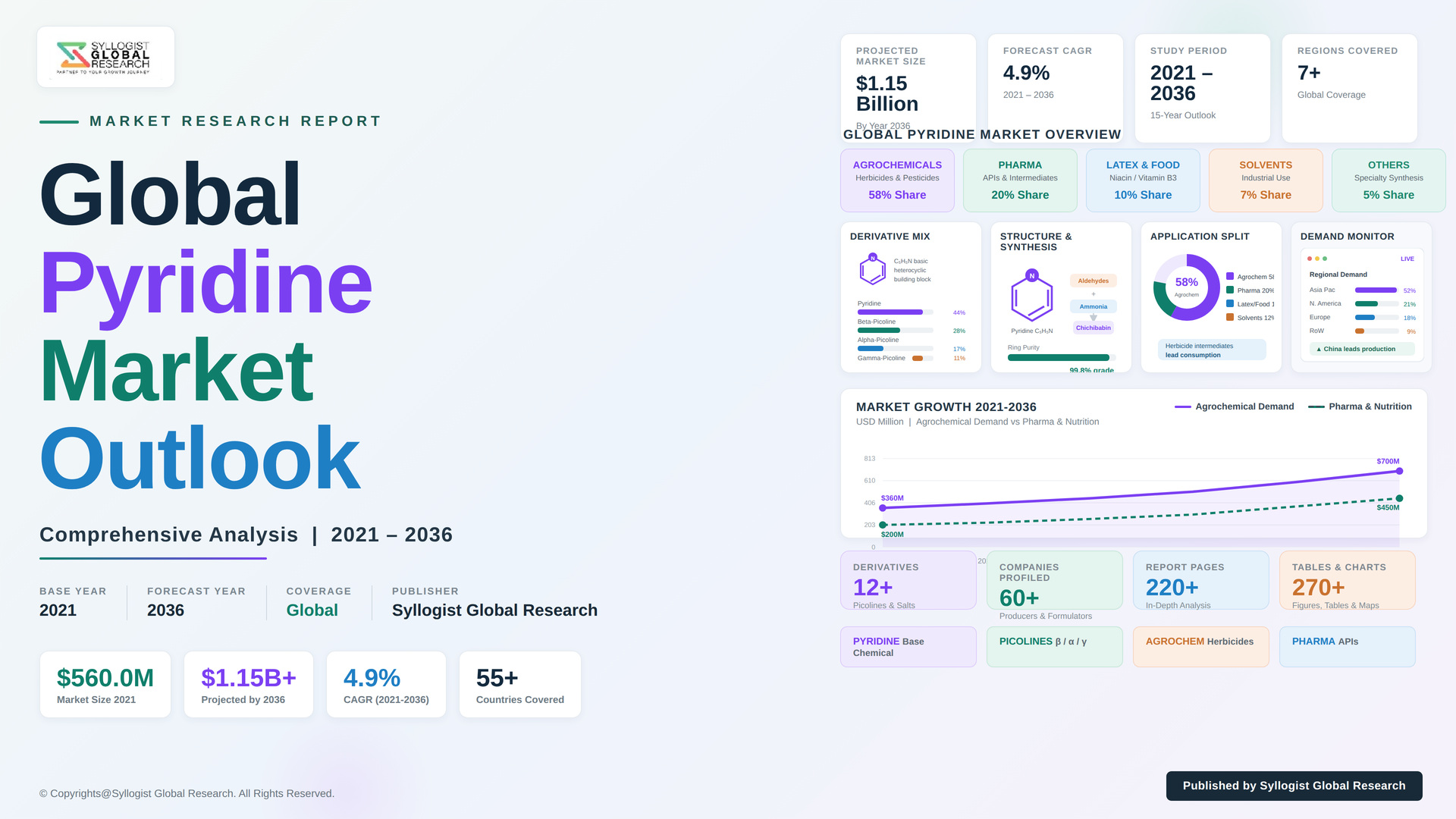
The global pyridine market is entering a steady expansion phase, shaped by rising agrochemical demand for crop protection, expanding pharmaceutical and vitamin synthesis, growing specialty chemical and solvent applications, and a structural shift toward sustainable and lower-toxicity production routes worldwide. The global pyridine market was valued at USD 762.5 million in 2025 and is projected to reach USD 1,215.8 million by 2034, advancing at a compound annual growth rate of 5.3% through the forecast period, as synthetic pyridine producers, picoline manufacturers, and derivative suppliers scale capacity across agrochemical, pharmaceutical, and chemical applications. Global pyridine production capacity exceeds 200,000 metric tonnes annually, with China accounting for over 60% of output, anchoring supply within the global pyridine market.
The global pyridine market structure is being reshaped by the dominance of synthetic pyridine, which accounts for approximately 95% of global pyridine production and represents the primary route for meeting rising demand within the global pyridine market. Advanced catalysts and reactor engineering are reducing energy consumption, with newer plants achieving energy cost reductions of 10% to 15% relative to older facilities, while co-located derivative plants leverage shared utilities to improve conversion economics within the global pyridine market. Producers are investing in greener synthetic routes, including continuous flow pyridine production, bio-catalytic synthesis, and waste valorization, to lower cost and environmental impact across the global pyridine market. Leading producers continue to expand catalytic synthesis and derivative integration capacity to strengthen supply reliability across the global pyridine market.
Agrochemicals represent the largest application segment within the global pyridine market, accounting for approximately 48% of pyridine usage, driven by the material’s role as a core intermediate in herbicides, insecticides, and fungicides including paraquat, picloram, triclopyr, chlorpyrifos, and imidacloprid. Pharmaceuticals represent a substantial and steadily growing application within the global pyridine market, supported by pyridine-based active pharmaceutical ingredients, vitamin B3 and vitamin B6 synthesis, and analgesic, antiviral, and anti-inflammatory drug production. Beta picoline represents a key derivative segment within the global pyridine market, propelled by its wide use in vitamin B3 and agrochemical synthesis, while the chemicals and solvent segment continues to grow as pyridine is used in chlorination, nucleophilic substitution, and specialty chemical reactions. The electronics application is emerging within the global pyridine market, supported by pyridine’s role as a ligand and surface modifier in semiconductor and printed circuit board manufacturing across the global pyridine market.
Asia-Pacific anchors the largest regional position within the global pyridine market, holding approximately 40% of demand in 2025, driven by a significant agricultural base, extensive agrochemical manufacturing, and expanding pharmaceutical production across China and India. China leads global pyridine production and consumption within the global pyridine market, supported by advanced catalytic synthesis facilities, low-cost feedstock integration, and large-scale derivative capacity, while India expands rapidly on agrochemical and generic active pharmaceutical ingredient production. North America holds a substantial position within the global pyridine market, anchored by pharmaceutical, specialty chemical, and agrochemical demand, with production concentrated in a limited number of facilities in Texas, while Europe is shifting toward imported intermediates as stringent REACH regulation drives the closure of several domestic synthesis plants, reshaping supply patterns across the global pyridine market.
Key Drivers
Rising Agrochemical Demand, Crop Protection Intensification, and Food Security Priorities Driving Pyridine Intermediate Consumption
Rising agrochemical demand, crop protection intensification, and global food security priorities are collectively driving intermediate consumption across the global pyridine market. Agrochemicals account for approximately 48% of pyridine usage, the largest application within the global pyridine market, reflecting pyridine’s role as a core intermediate in herbicides, insecticides, and fungicides. Pyridine and its derivatives are essential precursors in the synthesis of widely used crop protection products including paraquat, picloram, triclopyr, chlorpyrifos, and imidacloprid within the global pyridine market. The molecular architecture of pyridine enables high target specificity in pest control agents, reducing off-site toxicity while maintaining field efficacy across the global pyridine market. Global pesticide consumption reached approximately 4.1 million metric tonnes in 2022, with rising population, shrinking arable land, and climate-induced pest proliferation driving sustained agrochemical demand within the global pyridine market. Over 45 active ingredients in commercial use contain pyridine rings, reinforcing structural demand across crop protection formulations. Farmers’ growing awareness of pyridine-based crop protection, expanding agricultural intensification across emerging economies, and increased emphasis on yield optimization continue to drive pyridine intermediate consumption within the global pyridine market. Rising demand for effective, target-specific, and sustainable crop protection agents continues to anchor structural agrochemical demand across the global pyridine market worldwide.
Expanding Pharmaceutical Synthesis, Vitamin Production, and Active Pharmaceutical Ingredient Demand Driving High-Value Pyridine Consumption
Expanding pharmaceutical synthesis, rising vitamin production, and growing active pharmaceutical ingredient demand are collectively driving high-value consumption across the global pyridine market. Pyridine is an essential building block in the synthesis of vitamins, particularly vitamin B3 and vitamin B6, and in the manufacture of analgesic, antiviral, and anti-inflammatory pharmaceutical products within the global pyridine market. Pyridine-based active pharmaceutical ingredients and intermediates are central to a broad range of therapeutics, with regulators approving over 110 pyridine-containing drugs in recent years across the global pyridine market. Oncology therapeutics, many incorporating pyridine scaffolds, accounted for a significant share of new molecular entity approvals in recent years, reinforcing pharmaceutical demand within the global pyridine market. A growing and aging global population, rising demand for innovative medicines, and expanding generic active pharmaceutical ingredient production across India and Asia-Pacific continue to drive high-purity pyridine demand across the global pyridine market. Beta picoline serves as a key precursor for vitamin B3 synthesis, reinforcing derivative demand within the global pyridine market. Rising healthcare investment, expanding pharmaceutical research and development, and growing demand for high-purity pyridine derivatives continue to drive high-value pyridine consumption across the global pyridine market worldwide, supporting sustained premium demand across the value chain. Rising single-use device sterilization, nutraceutical demand, and immunity-focused vitamin consumption further reinforce pharmaceutical pyridine demand within the global pyridine market.
Growing Solvent and Specialty Chemical Applications, Food Additive Demand, and Sustainable Production Investment Driving Pyridine Market Expansion
Growing solvent and specialty chemical applications, rising food and feed additive demand, and increasing sustainable production investment are collectively driving expansion across the global pyridine market. Pyridine is widely used as a weak base and solvent in chemical reactions including chlorination, nucleophilic substitution, and the production of thionyl chloride and p-toluenesulfonyl chloride within the global pyridine market. Rising use of pyridine as a solvent and reagent in specialty chemicals, agrochemicals, and pharmaceuticals continues to expand demand across the global pyridine market. Pyridine derivatives are increasingly used in flavoring agents for food and beverages, delivering nutty and smoky profiles, and in animal feed additives such as niacin to improve livestock nutrient uptake within the global pyridine market. Rising demand for high-quality animal feed and functional food additives continues to broaden pyridine application within the global pyridine market. Producers are investing in sustainable production routes, including bio-catalytic synthesis, continuous flow production, and waste valorization, to lower cost and environmental impact across the global pyridine market. Leading producers are advancing technologies to reduce production cost and improve efficiency, reinforcing supply competitiveness. Expanding specialty chemical use, growing food and feed additive demand, and sustained investment in greener production continue to drive expansion across the global pyridine market worldwide.
Key Challenges
Stringent Regulation, Pyridine Toxicity Concerns, and Occupational Exposure Limits Constraining Pyridine Market Growth
Stringent regulation, pyridine toxicity concerns, and occupational exposure limits collectively constrain growth across the global pyridine market. Stringent government regulations pertaining to pyridine use and the health hazards associated with pyridine toxicity are limiting expansion within the global pyridine market. Occupational safety authorities set a Reportable Quantity value of 100 for pyridine and restrict the Acceptable Daily Intake to 0.002 mg/kg/day for inhalation exposure, reflecting strict handling requirements within the global pyridine market. Pyridine can cause chemical burns on skin contact, while its fumes can irritate the eyes and lungs, requiring rigorous safety, handling, and emissions controls across the global pyridine market. Chemical emissions limits and occupational exposure controls constrain new capacity expansion, raising compliance cost and complexity within the global pyridine market. Stringent REACH regulation in Europe has driven the closure of several domestic synthesis plants, shifting reliance toward imported intermediates and reshaping supply within the global pyridine market. Environmental restrictions limit production in some regions, with only a small number of primary manufacturing facilities operating in North America. Balancing regulatory compliance, worker safety, and emissions control against production economics generates persistent constraint for producers. The combined effect of stringent regulation, toxicity concerns, and occupational exposure limits continues to constrain growth across the global pyridine market worldwide.
Raw Material Price Volatility, Paraquat Ban Impact, and Beta Picoline Cost Fluctuation Constraining Producer Margins
Raw material price volatility, the impact of paraquat bans, and beta picoline cost fluctuation collectively constrain producer margins across the global pyridine market. Pyridine and its derivatives exhibit highly variable pricing, with feedstock cost swings directly affecting production economics within the global pyridine market. The paraquat ban across multiple countries has significantly affected pyridine production and, in turn, beta picoline, reducing output and elevating cost within the global pyridine market. Lower production, rising raw material prices, and increasing production cost have driven beta picoline price increases, with leading producers announcing pyridine and derivative price increases across the global pyridine market. Paraquat has been banned in dozens of countries, including major markets, and remains listed among highly hazardous pesticides, reducing demand for a key pyridine-derived herbicide within the global pyridine market. Pyridine production depends on feedstocks such as ammonia, methanol, formaldehyde, and acetaldehyde, exposing producers to petrochemical and energy price volatility across the global pyridine market. Producers must offset feedstock and regulatory-driven cost pressure through efficiency gains, derivative integration, and diversified sourcing to preserve margins. The combined effect of raw material price volatility, paraquat ban impact, and beta picoline cost fluctuation continues to constrain producer margins and pricing stability across the global pyridine market worldwide.
Substitution Threats, Alternative Scaffolds, and High-Cost Fluorinated Grade Barriers Constraining Pyridine Demand
Substitution threats, competing alternative scaffolds, and high-cost fluorinated grade barriers collectively constrain demand across the global pyridine market. Research into non-pyridine scaffolds for pharmaceutical use is expanding, with pyrazine-based compounds showing superior blood-brain barrier penetration in neurological drug candidates, presenting substitution risk within the global pyridine market. In agrochemicals, triazine derivatives have captured a share of the herbicide market previously dominated by pyridine analogs, eroding pyridine demand within certain crop protection formulations across the global pyridine market. Research and development spending on pyridine alternatives has increased materially in recent years, signaling a strategic shift among major chemical firms within the global pyridine market. The development of high-performance fluorinated pyridines, though promising, has been hampered by high production cost and regulatory scrutiny, allowing cheaper alternatives to gain ground within the global pyridine market. Tightening regulatory constraints on certain pyridine-based agrochemicals in mature markets further shift demand toward alternative chemistries across the global pyridine market. Producers must continually innovate on cost, performance, and sustainability to defend pyridine against competing scaffolds within the global pyridine market. The combined effect of substitution threats, alternative scaffolds, and high-cost fluorinated grade barriers continues to constrain pyridine demand across the global pyridine market worldwide. Longer qualification timelines for reformulated products and buyer caution around regulatory exposure further slow pyridine adoption in certain segments within the global pyridine market.
Market Segmentation
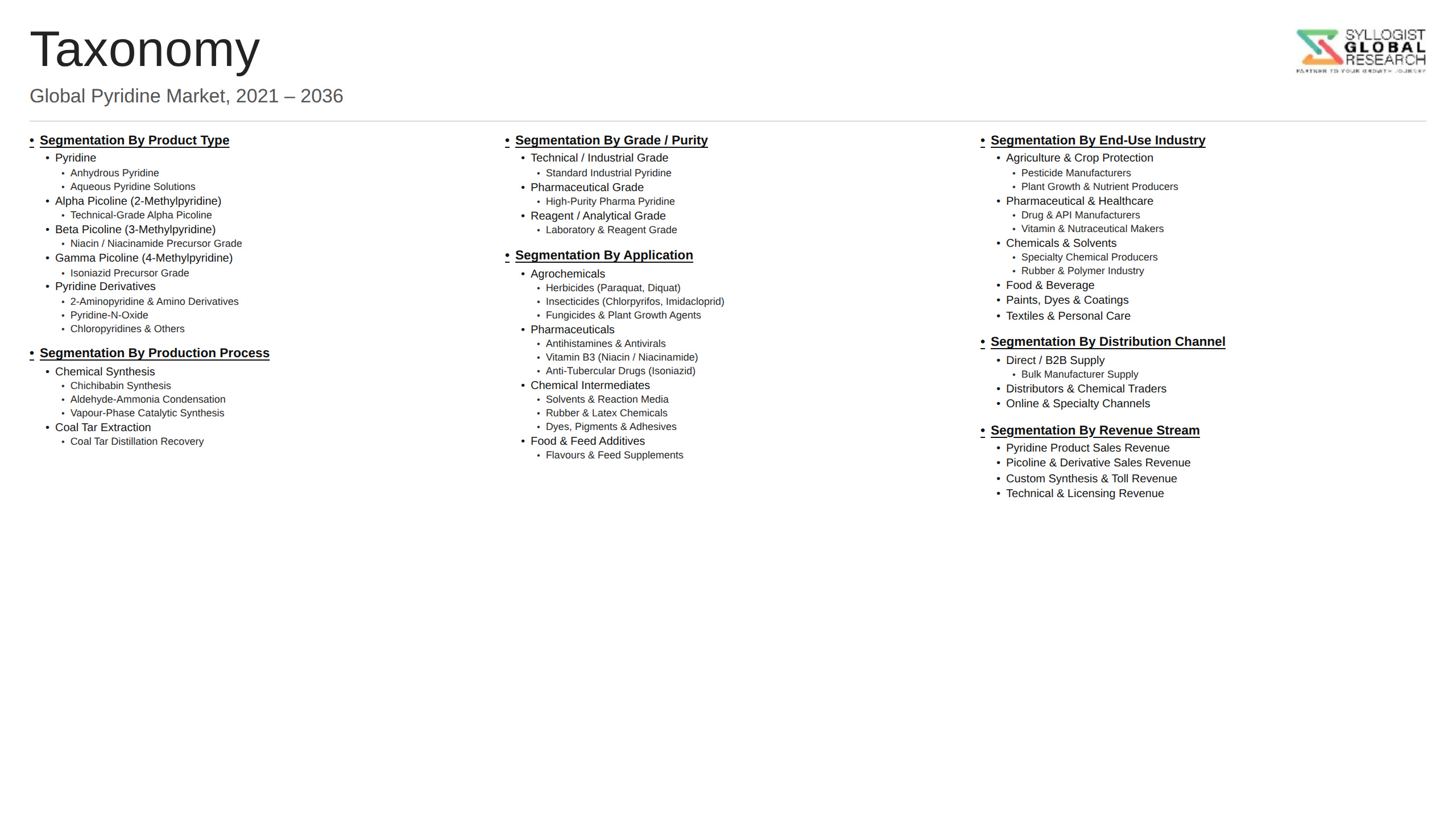
- Segmentation By Type
- Pyridine
- Alpha Picoline
- Beta Picoline
- Gamma Picoline
- Pyridine N-Oxide
- 2-Methyl-5-Ethylpyridine (MEP)
- Others
- Segmentation By Production Process
- Synthetic (Chichibabin and Catalytic Ammonoxidation)
- Coal Tar Extraction
- Segmentation By Application
- Agrochemicals
- Pharmaceuticals
- Chemicals and Solvents
- Food and Feed Additives
- Electronics
- Others
- Segmentation By End User
- Agrochemical Formulators
- Pharmaceutical and Vitamin Manufacturers
- Chemical Processors
- Food and Feed Additive Producers
- Electronics and Specialty Chemical Operators
- Others
- Segmentation By Region
- Asia-Pacific
- North America
- Europe
- Middle East and Africa
- Latin America
All market revenues are presented in USD
Historical Year: 2021-2024 | Base Year: 2025 | Estimated Year: 2026 | Forecast Period: 2027-2034
Key Questions this Study Will Answer
- What is the total global market valuation of the Global Pyridine Market in 2025, projected through 2034, segmented by type, production process, application, and end user, enabling synthetic pyridine producers, derivative manufacturers, agrochemical and pharmaceutical suppliers, and investors to identify highest-growth segments and most durable revenue opportunities across the global pyridine market?
- How are synthetic pyridine producers, picoline manufacturers, and derivative suppliers structuring capacity investment across the Chichibabin, catalytic ammonoxidation, and coal tar routes, and which production and integration models are shaping pyridine production economics within the global pyridine market through 2034?
- What agrochemical demand, crop protection intensification, pharmaceutical synthesis, and vitamin production dynamics are shaping the pace and geographic distribution of pyridine consumption across mature and emerging economies in the global pyridine market?
- Which type categories, including pyridine, alpha picoline, beta picoline, gamma picoline, and pyridine N-oxide, are gaining the strongest demand traction across agrochemical, pharmaceutical, chemical, and food applications, and what purity, cost, and sustainability metrics are shaping derivative selection within the global pyridine market?
- How is the competitive landscape structured among synthetic pyridine producers, derivative manufacturers, agrochemical intermediate suppliers, and specialty chemical operators within the global pyridine market, and what capacity expansion, derivative integration, and sustainable production strategies are enabling participants to compete across commodity and specialty pyridine segments?
- What regulatory pressure, pyridine toxicity, raw material price volatility, paraquat ban impact, and substitution dynamics are reshaping pyridine production economics, margin structure, and demand across the global pyridine market?
- Which regional markets, including Asia-Pacific, North America, and Europe, are projected to generate the largest incremental pyridine capacity and demand through 2034, and what agricultural base, pharmaceutical investment, feedstock access, and regulatory factors are shaping investment priorities and supplier selection in each regional global pyridine market?
- Product Definition
- Research Methodology
- Research Design & Framework
- Overall Research Approach: Descriptive, Exploratory & Quantitative Mixed-Method Design
- Market Definition & Scope Boundaries: What is Included and Excluded
- Segmentation Framework
- Key Research Assumptions & Limitations
- Secondary Research
- Primary Research Design & Execution
- Data Triangulation & Validation
- Market Sizing & Forecasting Methodology
- Competitive Intelligence Methodology
- Quality Assurance & Peer Review
- Definitions, Abbreviations & Data Notes
- Executive Summary
- Market Snapshot & Headline Numbers
- Key Findings & Research Highlights
- Market Dynamics
- Regional Market Summary
- Competitive Landscape Snapshot
- Technology & Innovation Highlights
- Market Dynamics
- Drivers
- Restraints
- Opportunities
- Challenges
- Porter’s Five Forces Analysis
- PESTLE Analysis
- Market Trends & Developments
- Emerging Trends
- Technological Developments
- Regulatory & Policy Changes
- Supply Chain & Sourcing Trends
- Manufacturing & Process Trends
- Investment & Funding Activity
- Sustainability & ESG Trends
- Risk Assessment Framework
- Feedstock (Acetaldehyde, Ammonia, Formaldehyde) Price Volatility & Cost Escalation Risk
- Agrochemical Demand Cyclicality, Herbicide Regulation & Volume Volatility Risk
- Supply Concentration, China Dependence & Import Reliance Risk
- Environmental, Effluent & Hazardous Chemical Compliance Risk
- Paraquat Ban, Pesticide Restriction & Downstream Demand Risk
- Regulatory Framework & Standards
- REACH, TSCA Chemical Registration & Hazardous Substance Compliance Standards
- Pharmaceutical Grade, GMP & Intermediate Quality Standards
- Agrochemical, Pesticide Registration & Active Ingredient Regulations
- Effluent, Emission & Environmental Discharge Regulations
- Cross-Border Trade, Anti-Dumping Duty & Import-Export Frameworks
- Global Pyridine Market Outlook
- Market Size & Forecast by Value
- Market Size & Forecast by Volume (Pyridine Consumed in Kilo Tonnes per Year and Nameplate Production Capacity in Kilo Tonnes per Year)
- Market Size & Forecast by Type
- Pyridine
- Alpha-Picoline (2-Methylpyridine)
- Beta-Picoline (3-Methylpyridine)
- Gamma-Picoline (4-Methylpyridine)
- 2-Aminopyridine
- Piperidine
- 2,6-Lutidine
- Others
- Market Size & Forecast by Production Process
- Chichibabin Synthesis (Synthetic)
- Coal Tar Extraction
- Dealkylation
- Others
- Market Size & Forecast by Grade
- Industrial Grade
- Pharmaceutical Grade
- Reagent Grade
- Others
- Market Size & Forecast by Application
- Agrochemicals (Herbicides, Pesticides)
- Pharmaceuticals
- Vitamins (Niacin, Niacinamide)
- Solvents
- Rubber Chemicals
- Food and Flavours
- Latex Products
- Others
- Market Size & Forecast by End-Use Industry
- Agriculture and Agrochemicals
- Pharmaceuticals and Healthcare
- Chemicals
- Food and Beverage
- Rubber and Latex
- Personal Care
- Others
- Market Size & Forecast by Function
- Intermediate
- Solvent
- Reagent
- Catalyst
- Others
- Market Size & Forecast by Purity
- High Purity (Above 99%)
- Standard Grade
- Technical Grade
- Others
- Market Size & Forecast by Sales Channel
- Direct Long-Term Supply Contract
- Distributor and Trader Channel
- Merchant Spot Market
- Online and Retail Channel
- Others
- North America Pyridine Market Outlook
- Market Size & Forecast
- By Value
- By Volume (Pyridine Consumed in Kilo Tonnes per Year and Nameplate Production Capacity in Kilo Tonnes per Year)
- By Type
- By Production Process
- By Grade
- By Application
- By End-Use Industry
- By Function
- By Purity
- By Country
- By Sales Channel
- Europe Pyridine Market Outlook
- Market Size & Forecast
- By Value
- By Volume (Pyridine Consumed in Kilo Tonnes per Year and Nameplate Production Capacity in Kilo Tonnes per Year)
- By Type
- By Production Process
- By Grade
- By Application
- By End-Use Industry
- By Function
- By Purity
- By Country
- By Sales Channel
- Asia-Pacific Pyridine Market Outlook
- Market Size & Forecast
- By Value
- By Volume (Pyridine Consumed in Kilo Tonnes per Year and Nameplate Production Capacity in Kilo Tonnes per Year)
- By Type
- By Production Process
- By Grade
- By Application
- By End-Use Industry
- By Function
- By Purity
- By Country
- By Sales Channel
- Latin America Pyridine Market Outlook
- Market Size & Forecast
- By Value
- By Volume (Pyridine Consumed in Kilo Tonnes per Year and Nameplate Production Capacity in Kilo Tonnes per Year)
- By Type
- By Production Process
- By Grade
- By Application
- By End-Use Industry
- By Function
- By Purity
- By Country
- By Sales Channel
- Middle East & Africa Pyridine Market Outlook
- Market Size & Forecast
- By Value
- By Volume (Pyridine Consumed in Kilo Tonnes per Year and Nameplate Production Capacity in Kilo Tonnes per Year)
- By Type
- By Production Process
- By Grade
- By Application
- By End-Use Industry
- By Function
- By Purity
- By Country
- By Sales Channel
- Country-Wise* Pyridine Market Outlook
- Market Size & Forecast
- By Value
- By Volume (Pyridine Consumed in Kilo Tonnes per Year and Nameplate Production Capacity in Kilo Tonnes per Year)
- By Type
- By Production Process
- By Grade
- By Application
- By End-Use Industry
- By Function
- By Purity
- By Country
- By Sales Channel
- Market Size & Forecast
- Market Size & Forecast
- Market Size & Forecast
- Market Size & Forecast
- Market Size & Forecast
- Market Size & Forecast
*Countries Analysed in the Global Research Portfolio: United States, Canada, Mexico, Germany, France, United Kingdom, Netherlands, Spain, Italy, Norway, Sweden, China, Japan, India, Australia, South Korea, Singapore, Brazil, Chile, Saudi Arabia, UAE, Egypt, South Africa, Israel
- Technology Landscape & Innovation Analysis
- Chichibabin Synthesis & Vapour-Phase Pyridine Production Technology Deep-Dive
- Picoline (Alpha, Beta, Gamma) Selective Synthesis Technology
- Coal Tar Extraction & Recovery Technology
- Catalytic Ammoxidation & Continuous Process Technology
- Green Chemistry, Bio-Based & Sustainable Pyridine Technology
- Purification, Distillation & High-Purity Grade Technology
- Effluent Treatment, By-Product & Waste Valorisation Technology
- Patent & IP Landscape in Pyridine Technologies
- Value Chain & Supply Chain Analysis
- Acetaldehyde, Ammonia & Feedstock Supply Chain
- Pyridine and Picoline Synthesis & Production Supply Chain
- Purification, Distillation & Grade Separation Supply Chain
- Agrochemical (Herbicide, Pesticide) Producer Channel
- Pharmaceutical and Vitamin Producer Channel
- Distributor, Trader & Merchant Network
- Effluent, By-Product & Waste Management Network
- Pricing Analysis
- Pyridine Pricing Across Grade & Contract Tiers
- Beta-Picoline (Niacin Feedstock) Pricing Economics
- Alpha and Gamma Picoline Pricing Differentials
- Pharmaceutical vs Industrial Grade Pricing Analysis
- Feedstock-Linked Pricing & Cost Pass-Through Analysis
- China vs Domestic Supply Pricing Correlation Analysis
- Regional Pricing Benchmarks & Value-in-Use Pricing Models
- Sustainability & Environmental Analysis
- Lifecycle Assessment (LCA) of Pyridine Across Feedstock & Production
- Effluent, Wastewater & Hazardous By-Product Management Performance
- Green Chemistry, Atom Economy & Waste Reduction Performance
- Bio-Based, Renewable Feedstock & Sustainable Route Performance
- Regulatory-Driven Sustainability, SDG 9 (Industry, Innovation) & SDG 12 (Responsible Consumption) Alignment & Green Finance Eligibility
- Competitive Landscape
- Market Structure & Concentration
- Market Consolidation Level (Fragmented vs. Consolidated by Type & Geography)
- Top 10 Players Market Share
- HHI (Herfindahl-Hirschman Index) Concentration Analysis
- Competitive Intensity Map by Type, Application & Geography
- Player Classification
- Integrated Pyridine and Derivative Producers
- Agrochemical Intermediate Producers
- Pharmaceutical Intermediate and Vitamin Producers
- Coal Tar and Extraction-Based Producers
- Fine and Specialty Chemical Producers
- National and State-Owned Chemical Enterprises
- Regional and Independent Producers
- Distributors and Traders
- Competitive Analysis Frameworks
- Market Share Analysis by Type, Application & Region
- Company Profile
- Company Overview & Headquarters
- Pyridine and Derivative Product Portfolio
- Key Customer Relationships & Reference Downstream Accounts
- Production Footprint & Nameplate Capacity Coverage
- Revenue (Pyridine Segment) & Order Backlog
- Technology Differentiators & IP
- Key Strategic Partnerships, JVs & M&A Activity
- Recent Developments (Capacity Additions, Contract Wins, Product Launches)
- SWOT Analysis
- Strategic Focus Areas & Roadmap
- Competitive Positioning Map (Technology Capability vs. Market Penetration)
- Key Company Profiles
- Market Structure & Concentration
- Technology Landscape & Innovation Analysis
- Strategic Output
- Market Opportunity Matrix: By Type, Grade, Application, End-Use Industry & Geography
- White Space Opportunity Analysis
- Strategic Recommendations
- Product Portfolio & Derivative Innovation Strategy
- Manufacturing Excellence & Capacity Expansion Strategy
- Geographic Expansion & Feedstock Localisation Strategy
- Customer & Downstream Account Engagement Strategy
- Partnership, M&A & Ecosystem Strategy
- Sustainability & Green Chemistry Strategy
- Risk Mitigation & Future Roadmap
- Strategic Priority Matrix & Roadmap
- Near-term (2025-2028)
- Mid-term (2029-2032)
- Long-term (2033-2037)