Global Soda Ash Market By Source, By Grade, By Application, By End User, By Region, Competition, Forecast & Opportunities, 2021-2034F
Market Definition
Soda ash, chemically known as sodium carbonate with the formula Na2CO3, is an odorless, white, alkaline inorganic chemical that serves as a foundational raw material across glass manufacturing, detergents, chemicals, and metallurgical processing worldwide. The Global Soda Ash Market encompasses the production, supply, and consumption of natural soda ash refined from trona ore and sodium carbonate-bearing brines, and synthetic soda ash produced through the Solvay and Hou ammonia-soda processes, supplied in dense and light grades. The global soda ash market covers sodium carbonate used as a fluxing agent to lower the melting temperature of silica in glass, as an alkalinity builder and water softener in soaps and detergents, and as a pH regulator and intermediate in chemicals, water treatment, alumina and mining, pulp and paper, textiles, and food processing value chains across all major producing and consuming regions worldwide.
Market participants in the global soda ash market include natural trona producers, synthetic Solvay and Hou process manufacturers, integrated glass and soda ash operators, and distributors serving glass, detergent, and chemical value chains. End users span flat, container, and specialty glass manufacturers, soap and detergent producers, chemical processors, alumina and mining operators, water treatment utilities, and pulp, paper, and textile manufacturers consuming soda ash. The global soda ash market excludes sodium bicarbonate produced independently of soda ash, caustic soda, and unrelated sodium salts, focusing exclusively on sodium carbonate produced through natural trona extraction and synthetic ammonia-soda routes, in dense and light grades, and the glass, detergent, chemical, and industrial application value chains that determine soda ash supply, demand, and pricing across all major producing and consuming regions worldwide.
Market Insights
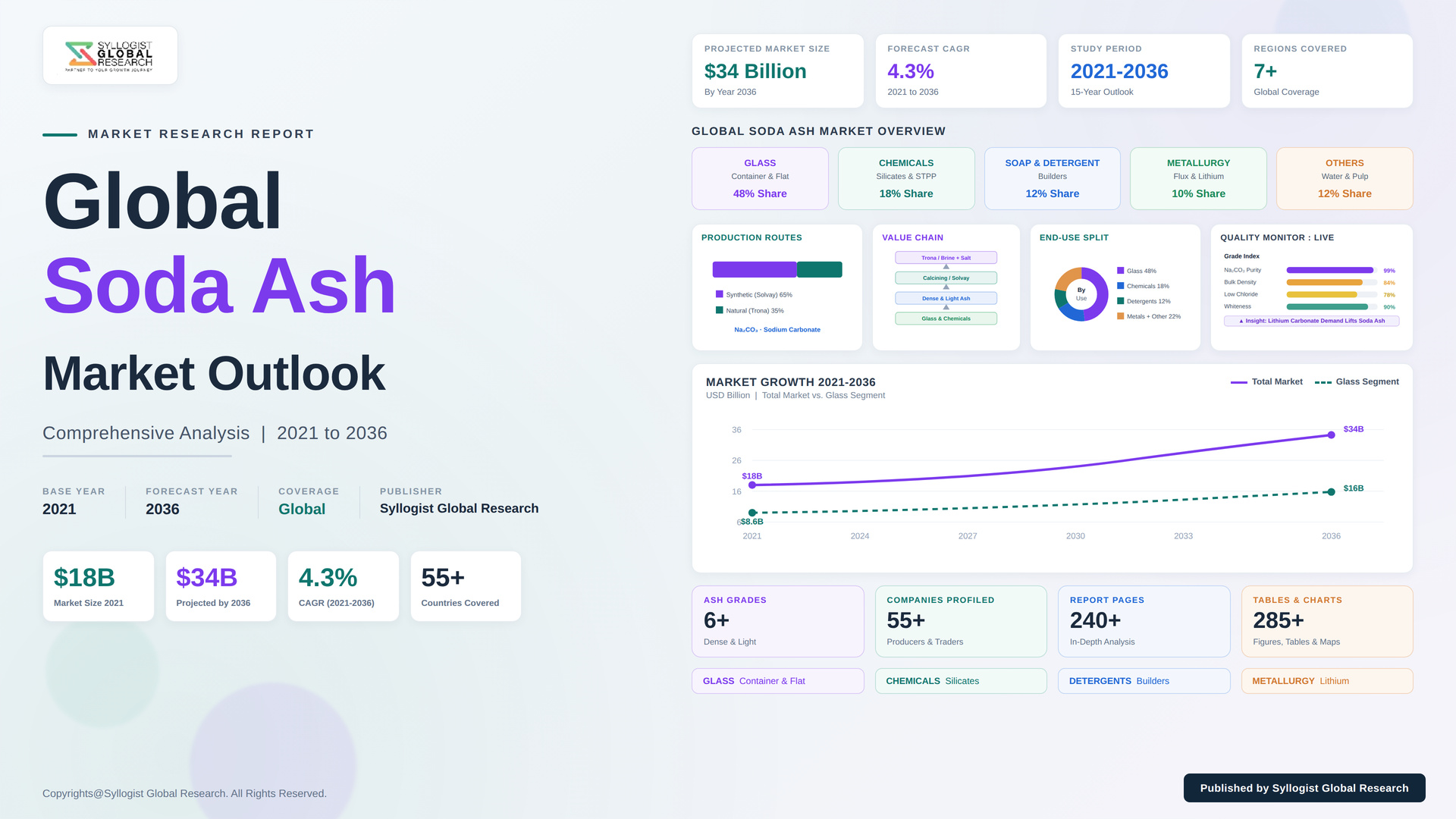
The global soda ash market is entering a steady expansion phase, shaped by sustained glass manufacturing demand, rising detergent and chemical consumption, accelerating solar glass and lithium extraction applications, and a structural shift toward lower-carbon natural trona production worldwide. The global soda ash market was valued at USD 21.3 billion in 2025 and is projected to reach USD 31.8 billion by 2034, advancing at a compound annual growth rate of 4.5% through the forecast period, as natural trona producers, synthetic Solvay process manufacturers, and integrated operators scale capacity across glass, detergent, and chemical applications. Global soda ash consumption exceeds 71 million tonnes annually, with demand anchored by glass manufacturing and steady industrial chemicals consumption within the global soda ash market.
The global soda ash market structure is being reshaped by the divergence between natural and synthetic production, with natural trona-based soda ash offering approximately 37% lower greenhouse gas emissions and lower energy and water use than the synthetic Solvay process. Synthetic soda ash retains the majority of global capacity, supported by the Solvay and Hou processes that deliver high purity and uniform particle sizes critical for specialty glass and chemical intermediates within the global soda ash market. Natural soda ash is the fastest-growing source segment within the global soda ash market, propelled by cost advantage, ESG procurement mandates, and vast trona reserves in the Green River Basin of Wyoming that can sustain global demand for centuries. Producers are investing in low-carbon capacity, including a carbon-neutral soda ash plant under development in NEOM, Saudi Arabia, and electrified kilns targeting 50% emission cuts within the global soda ash market.
Glass manufacturing represents the largest application segment within the global soda ash market, accounting for approximately 51% of consumption, driven by flat glass for construction and automotive, container glass for food and beverage packaging, and specialty glass including borosilicate and solar glass. Soaps and detergents represent the fastest-growing application within the global soda ash market, supported by rising household and industrial cleaning demand, urbanization, and hygiene awareness across Asia-Pacific and Latin America. Dense soda ash represents the largest grade segment within the global soda ash market, favored for its granular, dust-free character suited to large-scale glass manufacturing, while light soda ash is the fastest-growing grade, driven by detergent and chemical feedstock applications. Water treatment, alumina and mining, and emerging solar glass, lithium carbonate precipitation, and sodium-ion battery applications are widening the downstream demand set within the global soda ash market, adding millions of tonnes of projected demand.
Asia-Pacific anchors the largest regional position within the global soda ash market, holding approximately 43% of consumption, driven by China’s dominant glass, detergent, and chemical manufacturing base, rapid urbanization, and large-scale infrastructure investment. China leads global soda ash consumption and production within the global soda ash market, though pricing volatility remains a factor, with Chinese prices falling nearly 40% year-on-year to around USD 178 per tonne by mid-2025 amid high capacity utilization and elevated inventories. North America holds a substantial position within the global soda ash market, anchored by the United States as the world’s largest natural trona producer from the Green River Basin, supplying low-carbon soda ash to domestic and export markets. Europe relies on synthetic Solvay process capacity and imports, while Turkey expands natural trona extraction, and the Middle East and Africa emerge as fast-growing regions supported by low-carbon capacity investment across the global soda ash market.
Key Drivers
Sustained Glass Manufacturing Demand, Construction and Automotive Growth, and Solar Glass Expansion Driving Soda Ash Consumption
Sustained glass manufacturing demand, construction and automotive growth, and accelerating solar glass expansion are collectively driving consumption across the global soda ash market. Glass manufacturing accounts for approximately 51% of soda ash consumption, the largest application within the global soda ash market, reflecting soda ash’s essential role as a fluxing agent that lowers the melting temperature of silica and reduces energy use in glass furnaces. Rising demand for flat glass in construction and automotive, container glass in food and beverage packaging, and specialty glass continues to anchor soda ash demand within the global soda ash market. Rapid urbanization, expanding energy-efficient building projects, and growing automotive glass penetration continue to drive glass demand across the global soda ash market. Rising solar photovoltaic deployment is creating above-average growth for flat and solar glass applications, expected to add millions of tonnes of soda ash demand by 2030 within the global soda ash market. Producers secure long-term supply contracts with glass manufacturers, including soda ash for solar panel flat glass, ensuring predictable demand aligned with renewable energy infrastructure growth. Rising glass-based packaging adoption driven by sustainability and recyclability goals, combined with construction and automotive recovery, continues to anchor structural glass-driven demand across the global soda ash market worldwide.
Rising Detergent and Chemical Demand, Urbanization, and Water Treatment Applications Driving Soda Ash Market Expansion
Rising detergent and chemical demand, accelerating urbanization, and expanding water treatment applications are collectively driving expansion across the global soda ash market. Soaps and detergents represent the fastest-growing application within the global soda ash market, supported by soda ash’s high alkalinity, which makes it an effective builder and water softener in powdered detergents and cleaning products. Rising household and industrial cleaning demand, expanding hygiene awareness, and rapid urbanization across Asia-Pacific and Latin America continue to drive detergent-led soda ash consumption within the global soda ash market. Soda ash remains an essential intermediate and pH regulator across chemical manufacturing, sodium silicate, and sodium bicarbonate production, anchoring stable industrial demand across the global soda ash market. Water treatment is emerging as a fast-growing application within the global soda ash market, as municipalities upgrade softening systems and industrial users pursue zero-liquid-discharge targets, driving soda ash use in pH control and water softening. Rising environmental conservation awareness and expanding water treatment infrastructure continue to broaden soda ash demand within the global soda ash market. Growing industrialization, expanding chemical processing, and rising cleaning and water treatment demand across emerging economies continue to drive expansion across the global soda ash market worldwide. Rising demand for float glass, packaging glass, and specialty chemicals across developing economies further reinforces detergent and chemical-linked soda ash consumption within the global soda ash market.
Natural Trona Advantage, Low-Carbon Production Investment, and Emerging Lithium and Battery Applications Driving Sustainable Soda Ash Growth
Natural trona advantage, accelerating low-carbon production investment, and emerging lithium and battery applications are collectively driving sustainable growth across the global soda ash market. Natural trona-based soda ash offers approximately 37% lower greenhouse gas emissions, lower energy consumption, and lower water use than the synthetic Solvay process, making it the fastest-growing source within the global soda ash market. Vast trona reserves in the Green River Basin of Wyoming can sustain global demand for centuries, underpinning supply security and attracting import-dependent buyers within the global soda ash market. Rising demand for low-carbon soda ash among industrial buyers seeking to reduce Scope-3 emissions is enabling premium pricing and driving capacity investment across the global soda ash market. Producers are investing in low-carbon production, including a carbon-neutral soda ash plant under development in NEOM, Saudi Arabia, electrified kilns targeting 50% emission cuts, and low-carbon evaporative crystallization units within the global soda ash market. Emerging applications, including lithium carbonate precipitation, direct lithium extraction, and sodium-ion batteries, are widening the downstream demand set across the global soda ash market. Growing ESG procurement mandates, expanding trona extraction investment in Turkey and Malaysia, and rising battery-linked demand continue to drive sustainable soda ash growth across the global soda ash market worldwide.
Key Challenges
Energy-Intensive Synthetic Production, Carbon Emissions, and Tightening Environmental Regulation Constraining Soda Ash Producer Economics
Energy-intensive synthetic production, high carbon emissions, and tightening environmental regulation collectively constrain producer economics across the global soda ash market. Soda ash production, particularly via the synthetic Solvay process, is energy and water intensive with high carbon dioxide emissions, generating substantial cost and compliance pressure within the global soda ash market. Tightening environmental regulations and carbon pricing raise operating expenses and require significant capital investment in emission-control technologies across the global soda ash market. Synthetic plants in particular face higher breakeven costs without process improvements, disadvantaging synthetic producers relative to lower-emission natural trona operations within the global soda ash market. Regulatory restrictions on synthetic soda ash production in developed markets across North America and Europe are constraining capacity and reshaping supply within the global soda ash market. Carbon levies, emissions trading costs, and Scope-3 reduction expectations from downstream buyers elevate production cost for conventional synthetic assets requiring retrofit within the global soda ash market. Producers must invest in electrification, carbon capture, and cleaner processes to preserve competitiveness against rising environmental cost. The combined effect of energy-intensive synthetic production, carbon emissions, and tightening environmental regulation continues to constrain producer economics across the global soda ash market worldwide. Rising compliance and retrofit costs may also deter new synthetic capacity in regulated markets, tightening supply within the global soda ash market.
Price Volatility, Chinese Overcapacity, and Inventory Pressure Constraining Soda Ash Market Stability
Price volatility, Chinese overcapacity, and inventory pressure collectively constrain stability across the global soda ash market. The global soda ash market has faced significant pricing volatility, with notable regional differences driven by shifting supply-demand balances within the global soda ash market. In China, soda ash prices dropped nearly 40% year-on-year to around USD 178 per tonne by mid-2025 due to high production capacity utilization, elevated inventories, and sluggish demand within the global soda ash market. Chinese production patterns and capacity additions create short-term market volatility that pressures global pricing and producer margins across the global soda ash market. Elevated inventories and softening downstream demand in key markets amplify price competition and margin pressure within the global soda ash market. Producers concentrated in higher-cost synthetic capacity remain particularly exposed to price troughs, while low-cost natural trona operations sustain margins within the global soda ash market. Demand cyclicality across construction, automotive, and container glass end markets propagates through soda ash volumes, generating revenue variability that challenges planning within the global soda ash market. The combined effect of price volatility, Chinese overcapacity, and inventory pressure continues to constrain market stability and margin predictability across the global soda ash market worldwide. Export price competition from low-cost Chinese volumes further pressures producers in higher-cost regions within the global soda ash market.
Substitute Materials, Recycled Glass Adoption, and Feedstock and Logistics Cost Pressure Constraining Soda Ash Demand
Substitute materials, rising recycled glass adoption, and feedstock and logistics cost pressure collectively constrain demand across the global soda ash market. The availability of substitutes and alternative materials in certain applications limits soda ash demand growth in cost-sensitive segments within the global soda ash market. Rising adoption of recycled glass, or cullet, in glass manufacturing reduces the volume of virgin soda ash required per tonne of glass, constraining demand within the global soda ash market as sustainability goals drive higher recycled content. Energy cost volatility, logistics expenses, and regional production economics materially influence soda ash pricing and delivered cost across the global soda ash market. Bulk logistics complexity, long-distance export routes, and freight cost swings pressure delivered economics for import-dependent buyers within the global soda ash market. Feedstock, energy, and reagent cost fluctuations affecting synthetic production add cost uncertainty across the global soda ash market. Producers must offset substitution and cost pressure through supply reliability, grade quality, and long-term industrial contracts to defend demand within the global soda ash market. The combined effect of substitute materials, recycled glass adoption, and feedstock and logistics cost pressure continues to constrain soda ash demand across the global soda ash market worldwide. Growing circular economy mandates promoting higher cullet ratios in glass production further temper virgin soda ash demand within the global soda ash market.
Market Segmentation
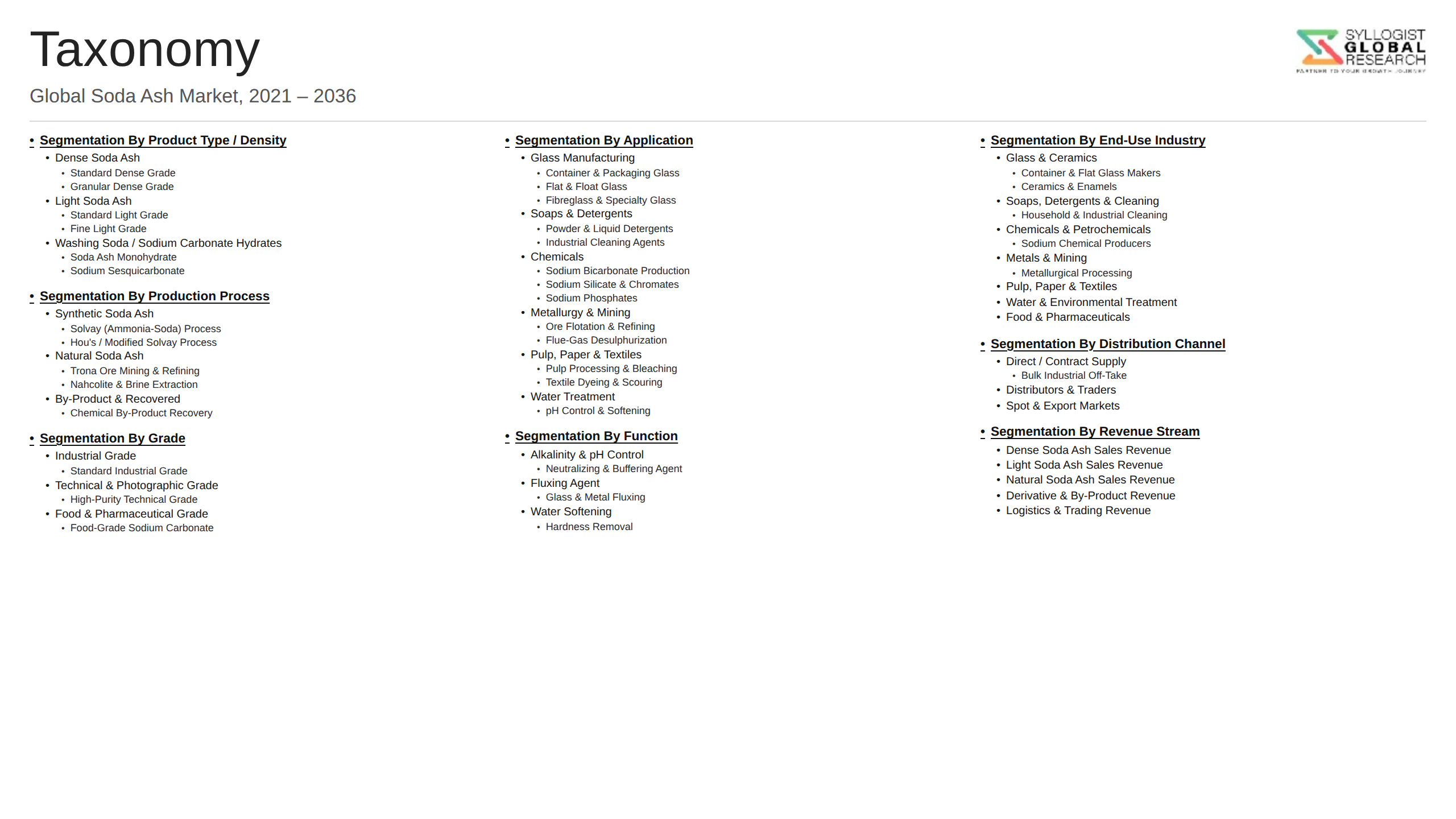
- Segmentation By Source
- Natural (Trona-Based)
- Synthetic (Solvay, Hou, Dual-Process)
- Segmentation By Grade
- Dense Soda Ash
- Light Soda Ash
- Segmentation By Application
- Glass Manufacturing
- Soaps and Detergents
- Chemicals
- Alumina and Mining
- Water Treatment
- Pulp and Paper
- Others
- Segmentation By End User
- Flat, Container, and Specialty Glass Manufacturers
- Soap and Detergent Producers
- Chemical Processors
- Alumina and Mining Operators
- Water Treatment Utilities
- Others
- Segmentation By Region
- Asia-Pacific
- North America
- Europe
- Middle East and Africa
- Latin America
All market revenues are presented in USD
Historical Year: 2021-2024 | Base Year: 2025 | Estimated Year: 2026 | Forecast Period: 2027-2034
Key Questions this Study Will Answer
- What is the total global market valuation of the Global Soda Ash Market in 2025, projected through 2034, segmented by source, grade, application, and end user, enabling natural trona producers, synthetic manufacturers, integrated operators, and investors to identify highest-growth segments and most durable revenue opportunities across the global soda ash market?
- How are natural trona producers, synthetic Solvay and Hou process manufacturers, and integrated operators structuring capacity investment across dense and light grades, and which production and integration models are shaping soda ash production economics within the global soda ash market through 2034?
- What glass manufacturing demand, detergent and chemical consumption, solar glass expansion, and water treatment dynamics are shaping the pace and geographic distribution of soda ash consumption across mature and emerging economies in the global soda ash market?
- Which source and grade categories, including natural trona, synthetic Solvay and Hou, and dense and light soda ash, are gaining the strongest demand traction across glass, detergent, chemical, and water treatment applications, and what cost, purity, and carbon metrics are shaping source and grade selection within the global soda ash market?
- How is the competitive landscape structured among natural trona producers, synthetic manufacturers, integrated glass and soda ash operators, and low-carbon innovators within the global soda ash market, and what capacity expansion, low-carbon investment, and long-term contract strategies are enabling participants to compete across natural and synthetic segments?
- What energy intensity, carbon emissions, environmental regulation, price volatility, Chinese overcapacity, and substitution dynamics are reshaping soda ash production economics, margin structure, and demand across the global soda ash market?
- Which regional markets, including Asia-Pacific, North America, Europe, and the Middle East and Africa, are projected to generate the largest incremental soda ash capacity and demand through 2034, and what trona reserves, glass and detergent demand, low-carbon investment, and export network factors are shaping investment priorities and supplier selection in each regional global soda ash market?
- Product Definition
- Research Methodology
- Research Design & Framework
- Overall Research Approach: Descriptive, Exploratory & Quantitative Mixed-Method Design
- Market Definition & Scope Boundaries: What is Included and Excluded
- Segmentation Framework
- Key Research Assumptions & Limitations
- Secondary Research
- Primary Research Design & Execution
- Data Triangulation & Validation
- Market Sizing & Forecasting Methodology
- Competitive Intelligence Methodology
- Quality Assurance & Peer Review
- Definitions, Abbreviations & Data Notes
- Executive Summary
- Market Snapshot & Headline Numbers
- Key Findings & Research Highlights
- Market Dynamics
- Regional Market Summary
- Competitive Landscape Snapshot
- Technology & Innovation Highlights
- Market Dynamics
- Drivers
- Restraints
- Opportunities
- Challenges
- Porter’s Five Forces Analysis
- PESTLE Analysis
- Market Trends & Developments
- Emerging Trends
- Technological Developments
- Regulatory & Policy Changes
- Supply Chain & Sourcing Trends
- Manufacturing & Process Trends
- Investment & Funding Activity
- Sustainability & ESG Trends
- Risk Assessment Framework
- Raw Material (Limestone, Salt, Trona) Price Volatility & Input Cost Escalation Risk
- Glass and Detergent Demand Cyclicality & Volume Volatility Risk
- Energy Cost Volatility, Solvay Process Intensity & Operating Cost Risk
- Overcapacity, Natural vs Synthetic Competition & Margin Compression Risk
- Carbon Cost, Emission Regulation & Decarbonisation Pressure Risk
- Regulatory Framework & Standards
- Hazardous Chemical, Handling & Transport (Bulk Solid) Standards
- Food-Grade, Pharmaceutical & Purity Specification Standards
- Emission Control, CO2 & Environmental Discharge Regulations
- Mining, Trona Extraction & Land Use Compliance Standards
- Cross-Border Trade, Anti-Dumping Duty & Import-Export Frameworks
- Global Soda Ash Market Outlook
- Market Size & Forecast by Value
- Market Size & Forecast by Volume (Soda Ash Consumed in Million Tonnes per Year and Nameplate Production Capacity in Million Tonnes per Year)
- Market Size & Forecast by Density
- Dense Soda Ash
- Light Soda Ash
- Granular Soda Ash
- Others
- Market Size & Forecast by Production Process
- Solvay Process (Synthetic)
- Hou Process (Modified Solvay)
- Natural (Trona-Based)
- Others
- Market Size & Forecast by Application
- Container and Flat Glass
- Detergents and Soaps
- Chemicals (Sodium Silicate, Bicarbonate)
- Metallurgy
- Water Treatment
- Pulp and Paper
- Food and Beverage
- Textiles
- Alumina Refining
- Others
- Market Size & Forecast by End-Use Industry
- Glass
- Detergents and Cleaning
- Chemicals
- Metallurgy and Mining
- Water Treatment
- Pulp and Paper
- Food and Beverage
- Others
- Market Size & Forecast by Grade
- Industrial Grade
- Technical Grade
- Food and Pharmaceutical Grade
- Others
- Market Size & Forecast by Source
- Synthetic
- Natural
- Others
- Market Size & Forecast by Packaging
- Bulk and Tanker
- Bags
- Big Bags (FIBC)
- Others
- Market Size & Forecast by Sales Channel
- Direct Long-Term Supply Contract
- Merchant Spot Market
- Distributor and Trader Channel
- Export Trade Channel
- Others
- North America Soda Ash Market Outlook
- Market Size & Forecast
- By Value
- By Volume (Soda Ash Consumed in Million Tonnes per Year and Nameplate Production Capacity in Million Tonnes per Year)
- By Density
- By Production Process
- By Application
- By End-Use Industry
- By Grade
- By Source
- By Packaging
- By Country
- By Sales Channel
- Europe Soda Ash Market Outlook
- Market Size & Forecast
- By Value
- By Volume (Soda Ash Consumed in Million Tonnes per Year and Nameplate Production Capacity in Million Tonnes per Year)
- By Density
- By Production Process
- By Application
- By End-Use Industry
- By Grade
- By Source
- By Packaging
- By Country
- By Sales Channel
- Asia-Pacific Soda Ash Market Outlook
- Market Size & Forecast
- By Value
- By Volume (Soda Ash Consumed in Million Tonnes per Year and Nameplate Production Capacity in Million Tonnes per Year)
- By Density
- By Production Process
- By Application
- By End-Use Industry
- By Grade
- By Source
- By Packaging
- By Country
- By Sales Channel
- Latin America Soda Ash Market Outlook
- Market Size & Forecast
- By Value
- By Volume (Soda Ash Consumed in Million Tonnes per Year and Nameplate Production Capacity in Million Tonnes per Year)
- By Density
- By Production Process
- By Application
- By End-Use Industry
- By Grade
- By Source
- By Packaging
- By Country
- By Sales Channel
- Middle East & Africa Soda Ash Market Outlook
- Market Size & Forecast
- By Value
- By Volume (Soda Ash Consumed in Million Tonnes per Year and Nameplate Production Capacity in Million Tonnes per Year)
- By Density
- By Production Process
- By Application
- By End-Use Industry
- By Grade
- By Source
- By Packaging
- By Country
- By Sales Channel
- Country-Wise* Soda Ash Market Outlook
- Market Size & Forecast
- By Value
- By Volume (Soda Ash Consumed in Million Tonnes per Year and Nameplate Production Capacity in Million Tonnes per Year)
- By Density
- By Production Process
- By Application
- By End-Use Industry
- By Grade
- By Source
- By Packaging
- By Country
- By Sales Channel
- Market Size & Forecast
- Market Size & Forecast
- Market Size & Forecast
- Market Size & Forecast
- Market Size & Forecast
- Market Size & Forecast
*Countries Analysed in the Global Research Portfolio: United States, Canada, Mexico, Germany, France, United Kingdom, Netherlands, Spain, Italy, Norway, Sweden, China, Japan, India, Australia, South Korea, Singapore, Brazil, Chile, Saudi Arabia, UAE, Egypt, South Africa, Israel
- Technology Landscape & Innovation Analysis
- Solvay Process & Ammonia-Soda Production Technology Deep-Dive
- Natural Trona Mining, Beneficiation & Monohydrate Process Technology
- Hou Process & Co-Production (Ammonium Chloride) Technology
- Energy Efficiency, Steam Integration & Process Optimisation Technology
- CO2 Capture, Emission Reduction & Low-Carbon Soda Ash Technology
- Dense and Light Grade Conversion & Densification Technology
- Effluent, Brine & Solid Waste Valorisation Technology
- Patent & IP Landscape in Soda Ash Technologies
- Value Chain & Supply Chain Analysis
- Limestone, Salt Brine & Trona Ore Feedstock Supply Chain
- Solvay and Natural Soda Ash Production Supply Chain
- Densification, Grade Conversion & Processing Supply Chain
- Glass, Detergent & Chemical Customer Channel
- Metallurgy, Water Treatment & Industrial Customer Channel
- Bulk Handling, Storage & Marine Logistics Network
- Merchant Trader, Distributor & Seaborne Export Network
- Pricing Analysis
- Dense Soda Ash Pricing Across Contract & Spot Market Tiers
- Light Soda Ash Pricing Differentials
- Natural vs Synthetic Soda Ash Cost of Production Analysis
- Energy and Raw Material Cost Pass-Through Analysis
- Food and Pharmaceutical Grade Premium Pricing Analysis
- CIF vs FOB Pricing, Seaborne Freight & Delivered Cost Analysis
- Regional Pricing Benchmarks & Value-in-Use Pricing Models
- Sustainability & Environmental Analysis
- Lifecycle Assessment (LCA) of Soda Ash Across Production Routes
- Carbon Intensity, CO2 Emission & Natural vs Synthetic Comparison
- Energy Efficiency, Steam Recovery & Emission Reduction Performance
- Brine Effluent, Solid Waste & Circular Economy Performance
- Regulatory-Driven Sustainability, SDG 9 (Industry, Innovation) & SDG 12 (Responsible Consumption) Alignment & Green Finance Eligibility
- Competitive Landscape
- Market Structure & Concentration
- Market Consolidation Level (Fragmented vs. Consolidated by Source & Geography)
- Top 10 Players Market Share
- HHI (Herfindahl-Hirschman Index) Concentration Analysis
- Competitive Intensity Map by Source, Application & Geography
- Player Classification
- Integrated Chemical and Soda Ash Producers
- Natural (Trona-Based) Soda Ash Producers
- Synthetic (Solvay) Soda Ash Producers
- Glass and Detergent Integrated Producers
- National and State-Owned Chemical Enterprises
- Regional and Independent Producers
- Merchant Traders and Distributors
- Downstream Derivative Producers
- Competitive Analysis Frameworks
- Market Share Analysis by Source, Application & Region
- Company Profile
- Company Overview & Headquarters
- Soda Ash Production Portfolio & Capacity
- Key Customer Relationships & Reference Offtake Accounts
- Production Footprint & Nameplate Capacity Coverage
- Revenue (Soda Ash Segment) & Offtake Contract Backlog
- Technology Differentiators & IP
- Key Strategic Partnerships, JVs & M&A Activity
- Recent Developments (Capacity Additions, Contract Wins, Project Launches)
- SWOT Analysis
- Strategic Focus Areas & Roadmap
- Competitive Positioning Map (Technology Capability vs. Market Penetration)
- Key Company Profiles
- Market Structure & Concentration
- Technology Landscape & Innovation Analysis
- Strategic Output
- Market Opportunity Matrix: By Density, Production Process, Application, End-Use Industry & Geography
- White Space Opportunity Analysis
- Strategic Recommendations
- Production Portfolio & Technology Investment Strategy
- Operational Excellence & Capacity Expansion Strategy
- Geographic Expansion & Export Market Strategy
- Customer & Offtake Account Engagement Strategy
- Partnership, M&A & Ecosystem Strategy
- Sustainability & Emission Reduction Strategy
- Risk Mitigation & Future Roadmap
- Strategic Priority Matrix & Roadmap
- Near-term (2025-2028)
- Mid-term (2029-2032)
- Long-term (2033-2037)