Global PET and PBT Market By Polymer Type, By Grade, By Source, By Processing Method, By Application, By End Use Industry, By Region, Competition, Forecast & Opportunities, 2021-2034F
Market Definition
Polyethylene terephthalate (PET) and polybutylene terephthalate (PBT) are thermoplastic polyesters produced by polycondensation of terephthalic acid with a glycol, PET using monoethylene glycol and PBT using 1,4-butanediol. PET is a semi-crystalline polyester valued for clarity, strength, moisture and gas barrier, and recyclability, while PBT is an engineering thermoplastic valued for dimensional stability, heat and chemical resistance, low moisture absorption, and electrical insulation. The global PET and PBT market covers the production, compounding, and supply of virgin, recycled, bio-based, and reinforced grades of both polyesters. Market participants include integrated petrochemical producers, resin manufacturers, compounders, recyclers, and distributors supplying converters and molders across packaging, textile, automotive, and electronics value chains.
The global PET and PBT market spans bottle-grade, film-grade, and fiber-grade PET alongside glass-fiber reinforced, mineral-filled, flame-retardant, and unreinforced PBT compounds. End users span food and beverage brands, packaging converters, textile and apparel manufacturers, automotive original equipment manufacturers and tier suppliers, electrical and electronics producers, and industrial component molders that depend on PET and PBT for performance, cost, and processability. The global PET and PBT market explicitly excludes other polyesters such as polytrimethylene terephthalate and polybutylene adipate terephthalate, non-polyester engineering plastics, and downstream converted products sold as finished goods, concentrating on the production and supply of PET and PBT resins and compounds as raw materials incorporated into packaging, fibers, films, and molded components across every producing and consuming geography worldwide.
Market Insights
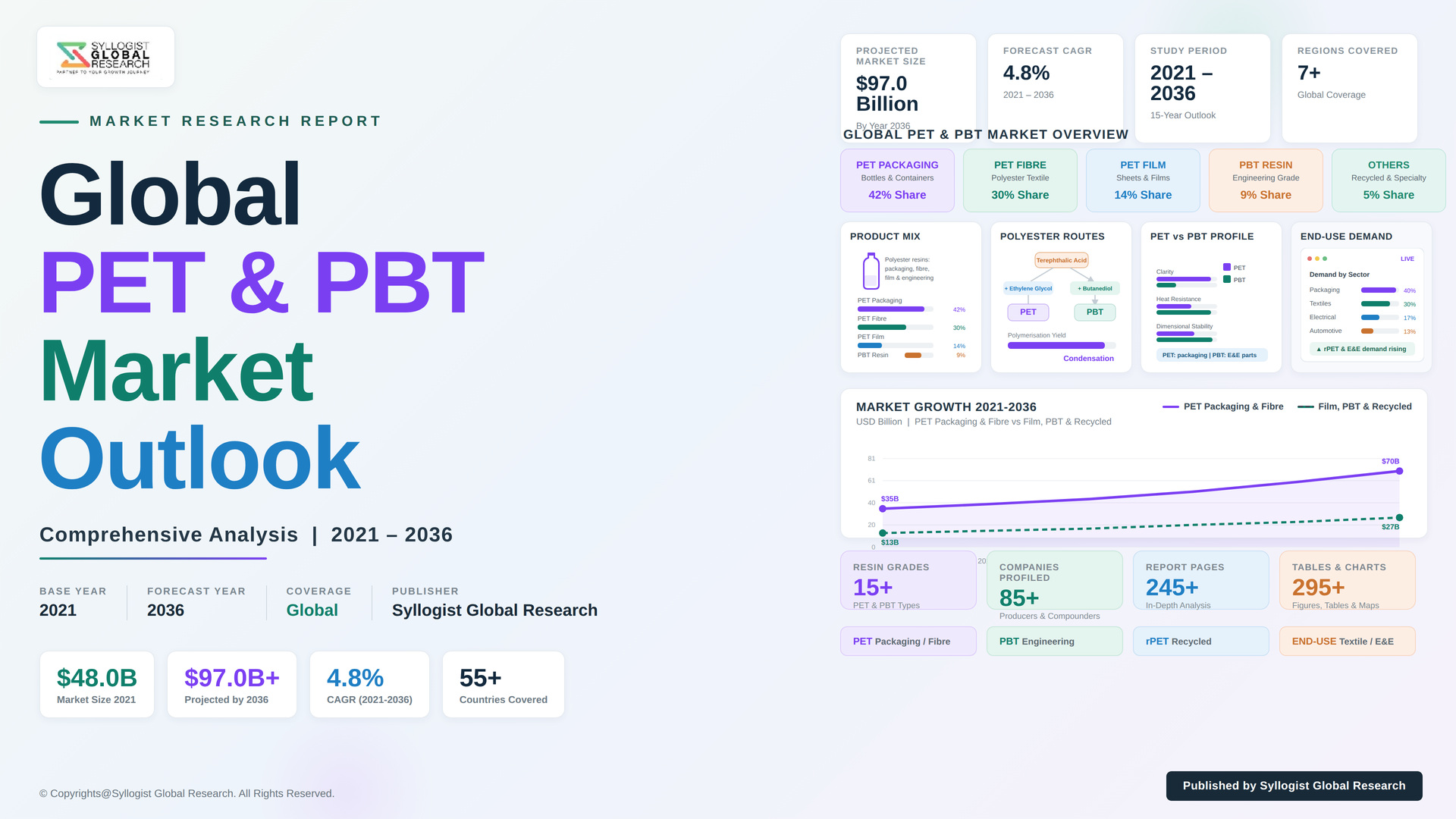
The global PET and PBT market is moving through a steady growth phase, propelled by rising demand for lightweight and recyclable packaging, expanding polyester fiber consumption, accelerating automotive lightweighting and electric vehicle production, and growing electrical and electronics miniaturization. The global PET and PBT market was valued at USD 42 billion in 2025 and is projected to reach USD 68 billion by 2034, advancing at a compound annual growth rate of 5.5% through the forecast period, as petrochemical producers, resin manufacturers, and compounders scale virgin, recycled, and reinforced grades across Asia-Pacific, North America, Europe, the Middle East, and Latin America. PET commands the larger share of the global PET and PBT market on the strength of packaging and fiber demand, while PBT contributes higher-value engineering plastic volume tied to automotive and electronics applications.
PET packaging and the shift toward recycled content are central dynamics shaping the global PET and PBT market, as beverage, food, personal care, and pharmaceutical brands rely on PET for lightweight, shatterproof, and transparent containers. Regulatory mandates requiring recycled content in bottles, extended producer responsibility schemes, deposit return systems, and plastic packaging taxes are accelerating demand for recycled PET across the global PET and PBT market. Major beverage companies have committed to recycled content targets, driving investment in mechanical and chemical recycling capacity that converts post-consumer PET back into food-grade resin. Chemical recycling technologies including glycolysis, methanolysis, and enzymatic depolymerization are scaling within the global PET and PBT market, enabling closed-loop supply and unlocking food-contact recycled resin from contaminated waste streams.
PBT demand within the global PET and PBT market is anchored by automotive and electrical and electronics applications, where its dimensional stability, heat resistance, and electrical insulation make it a preferred engineering thermoplastic. Automotive is the largest PBT end use, driven by connectors, sensors, ignition systems, and under-hood components, and electric vehicle production is expanding demand for flame-retardant and glass-fiber reinforced PBT in high-voltage connectors, battery components, and control units across the global PET and PBT market. Electrical and electronics is the second major PBT end use, supported by connectors, switches, and housings, with miniaturization increasing demand for precision-molded, high-flow PBT grades. Metal replacement and lightweighting continue to expand PBT adoption within the global PET and PBT market, as molders substitute reinforced polyester for heavier metal components.
Asia-Pacific represents the largest regional PET and PBT market, supported by massive packaging, textile, automotive, and electronics manufacturing across China, India, Japan, South Korea, and Southeast Asia, along with competitive feedstock access and large-scale resin production capacity. China leads the global PET and PBT market as both the largest producer and consumer, backed by integrated PTA, MEG, and BDO supply and extensive export networks. North America holds a substantial position in the global PET and PBT market, led by packaging, beverage, and automotive demand and expanding recycled PET infrastructure across the United States. Europe occupies a significant position in the global PET and PBT market, distinguished by strict packaging regulation, strong recycled content mandates, and advanced automotive and electronics manufacturing, while the Middle East and Latin America are emerging as growth regions supported by feedstock advantage and rising local demand.
Key Drivers
Rising Demand for Lightweight, Recyclable PET Packaging Across Food, Beverage, and Consumer Goods Applications
Rising demand for lightweight, recyclable, and cost-effective packaging is a central force driving the global PET and PBT market, as PET has become the material of choice for beverage bottles, food containers, and consumer goods packaging. PET offers clarity, strength, shatter resistance, and an excellent moisture and gas barrier at low weight, making it ideal for bottled water, carbonated soft drinks, juices, edible oils, personal care, and pharmaceutical packaging within the global PET and PBT market. Growing global consumption of bottled water and ready-to-drink beverages, expanding packaged food consumption, and the rapid growth of e-commerce that requires durable, lightweight packaging all reinforce PET demand across the global PET and PBT market. Lightweighting programmes that reduce resin per container lower cost and carbon footprint while sustaining unit growth, and PET’s full recyclability supports brand commitments to circular packaging. Rising urbanization, disposable income, and organized retail across emerging economies continue to expand packaged product consumption that depends on PET, tying baseline demand directly to food and beverage output. This combination of convenience, performance, cost, and recyclability positions packaging as the dominant and most durable source of demand across the global PET and PBT market. Even as sustainability reshapes packaging design, PET remains the preferred substrate for most rigid beverage and food formats, anchoring volume across the global PET and PBT market.
Automotive Lightweighting, Electric Vehicle Growth, and Metal Replacement Driving Reinforced PBT Demand
Automotive lightweighting, accelerating electric vehicle production, and metal replacement are powerful drivers expanding PBT demand across the global PET and PBT market. Automakers under pressure to improve fuel efficiency and meet emissions standards are replacing metal components with lightweight engineering thermoplastics, and PBT’s dimensional stability, heat resistance, and mechanical strength make it well suited for connectors, sensors, housings, and under-hood parts within the global PET and PBT market. Electric vehicle growth is a particularly strong catalyst, as electrified platforms require large numbers of high-voltage connectors, sensor housings, battery components, and control unit parts that demand flame-retardant and glass-fiber reinforced PBT grades across the global PET and PBT market. PBT’s electrical insulation, flame retardance, and reliability under thermal and mechanical stress make it a preferred material for safety-critical electrical components in vehicles. As global vehicle production shifts toward electrification and greater electronic content per vehicle, the volume of PBT required per platform continues to rise. Continuous development of reinforced, high-flow, and halogen-free PBT compounds broadens the addressable range of components, and metal replacement across automotive and industrial applications sustains durable, innovation-led PBT demand growth across the global PET and PBT market. As electric and electronic content per vehicle keeps climbing, PBT is positioned as one of the fastest-growing engineering polyester segments within the global PET and PBT market.
Expanding Polyester Fiber Consumption, Electrical and Electronics Miniaturization, and Recycled and Bio-Based Resin Adoption
Expanding polyester fiber consumption, electrical and electronics miniaturization, and the shift toward recycled and bio-based resins are broadening demand across the global PET and PBT market. PET is spun into polyester fiber that dominates global textile and apparel production and is increasingly used in technical and nonwoven textiles, tying a large share of PET demand to the fiber industry within the global PET and PBT market. Growth in apparel, home textiles, automotive textiles, and industrial fabrics sustains substantial fiber-grade PET consumption. In electrical and electronics, the miniaturization of connectors, switches, and components is increasing demand for precision-molded, high-flow PBT grades that maintain strength and insulation in tight geometries across the global PET and PBT market. The transition toward sustainability is a further growth vector, as recycled PET adoption accelerates under regulatory and brand commitments and bio-based PET derived from renewable feedstocks scales alongside conventional resin. Halogen-free and recyclable PBT variants are gaining traction as manufacturers respond to environmental and regulatory pressure. Together, fiber demand, electronics miniaturization, and sustainable resin adoption sustain diversified, long-duration demand growth across the global PET and PBT market. This breadth of demand across packaging, fiber, electronics, and sustainable grades makes the revenue base of the global PET and PBT market resilient to weakness in any single application.
Key Challenges
Feedstock Price Volatility, Crude Oil Linkage, and Structural Overcapacity Compressing Producer Margins
Feedstock price volatility, crude oil linkage, and periodic overcapacity present significant margin challenges across the global PET and PBT market, since both polyesters depend on petrochemical raw materials. PET is produced from purified terephthalic acid and monoethylene glycol, while PBT uses terephthalic acid and 1,4-butanediol, and the prices of these inputs track crude oil, naphtha, and energy markets that fluctuate with global supply, demand, and geopolitical events across the global PET and PBT market. When feedstock costs rise sharply, producers face margin compression if they cannot pass increases through to converters, and when they fall, pricing pressure follows through the value chain. Large capacity additions, particularly across Asia, periodically outpace demand growth, creating overcapacity that depresses resin prices and utilization rates within the global PET and PBT market. Integrated producers with captive feedstock enjoy cost advantages, intensifying competitive pressure on non-integrated resin makers. Managing this exposure to volatile feedstock costs, cyclical pricing, and structural overcapacity while protecting margins remains a persistent challenge that shapes production planning, integration strategy, and contract structure across the global PET and PBT market, particularly for producers without upstream feedstock security. Margin swings of this kind also discourage timely capacity investment, adding to the cyclicality that characterizes the global PET and PBT market.
Environmental Regulation, Single-Use Plastic Restrictions, and Material Substitution Pressure on Virgin PET
Environmental regulation, single-use plastic restrictions, and substitution pressure present a persistent challenge to virgin resin demand across the global PET and PBT market, particularly for packaging applications. Governments worldwide are phasing out or restricting certain single-use plastics, imposing plastic packaging taxes, mandating recycled content, and introducing extended producer responsibility obligations that raise the cost and complexity of virgin PET use within the global PET and PBT market. These measures push brand owners toward recycled content, alternative materials, and packaging redesign, potentially shifting demand away from virgin PET in some categories. Consumer and regulatory pressure to reduce plastic waste has elevated interest in substitute materials such as glass, aluminum, paper-based packaging, and bioplastics for certain applications, introducing competitive pressure across the global PET and PBT market. While PET’s recyclability positions it favourably relative to many plastics, the broader regulatory push against single-use packaging creates uncertainty over long-term virgin resin demand growth. Navigating divergent national regulations, meeting escalating recycled content targets, and defending PET against material substitution while maintaining performance and cost competitiveness is a continuous strategic challenge that shapes investment and product development across the global PET and PBT market. The pace and unpredictability of regulatory change make long-term capacity and formulation planning especially difficult across the global PET and PBT market.
Recycling Infrastructure Gaps, Feedstock Contamination, and PBT Hydrolysis and Weathering Limitations
Recycling infrastructure gaps, feedstock contamination, and material performance limitations present operational challenges across the global PET and PBT market. Although demand for recycled PET is rising rapidly, collection, sorting, and recycling infrastructure remains uneven across regions, and shortages of high-quality, food-grade recycled feedstock constrain the ability of producers to meet recycled content targets within the global PET and PBT market. Contamination, coloured and multilayer packaging, and mixed waste streams reduce recycling yields and complicate the production of clear, food-contact recycled resin, limiting supply and raising cost across the global PET and PBT market. Chemical recycling can address some of these limitations but remains capital-intensive and is still scaling toward commercial maturity. On the PBT side, the material’s sensitivity to hydrolysis in hot and humid conditions and its degradation under prolonged ultraviolet exposure limit certain outdoor and high-moisture applications unless stabilized or protected, constraining part of the addressable market within the global PET and PBT market. Balancing rising recycled content expectations against feedstock availability and quality, while managing the performance boundaries of both polyesters, remains a persistent challenge that shapes sourcing, formulation, and application development across the global PET and PBT market. Closing the gap between recycled content ambition and real feedstock availability is likely to remain one of the defining operational constraints across the global PET and PBT market.
Market Segmentation
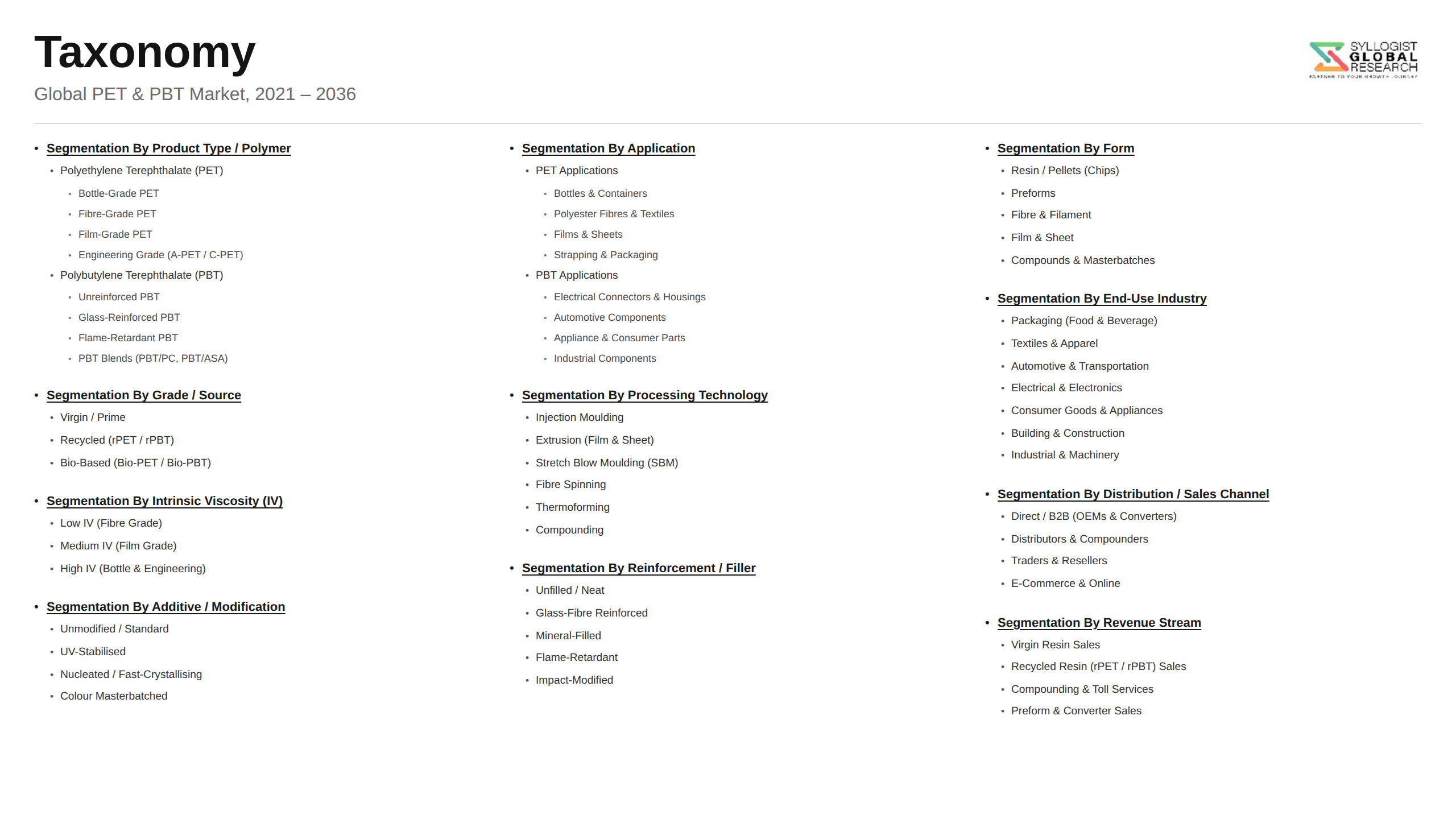
- Segmentation By Polymer Type
- Polyethylene Terephthalate (PET)
- Polybutylene Terephthalate (PBT)
- Segmentation By PET Grade
- Bottle Grade
- Film Grade
- Fiber Grade
- Segmentation By PBT Grade
- Glass-Fiber Reinforced
- Mineral Reinforced
- Flame-Retardant
- Unreinforced
- Segmentation By Source
- Virgin
- Recycled
- Bio-Based
- Segmentation By Processing Method
- Injection Molding
- Extrusion
- Blow Molding
- Others
- Segmentation By Application
- Rigid Packaging (Bottles and Containers)
- Films and Sheets
- Polyester Fibers and Textiles
- Automotive Components
- Electrical and Electronics
- Industrial and Consumer Goods
- Others
- Segmentation By End Use Industry
- Food and Beverage
- Textile and Apparel
- Automotive and Transportation
- Electrical and Electronics
- Consumer Goods
- Industrial
- Others
- Segmentation By Region
- North America
- Europe
- Asia-Pacific
- Middle East and Africa
- Latin America
All market revenues are presented in USD
Historical Year: 2021-2024 | Base Year: 2025 | Estimated Year: 2026 | Forecast Period: 2027-2034
Key Questions this Study Will Answer
- What is the total global market valuation of the global PET and PBT market in 2025, projected through 2034, segmented by polymer type, grade, source, processing method, application, and end use industry, enabling petrochemical producers, resin manufacturers, compounders, converters, and investors to identify the highest-growth segments and most durable revenue opportunities across the global PET and PBT market?
- How are integrated petrochemical producers, resin manufacturers, and recyclers structuring virgin, recycled, and bio-based capacity, feedstock integration, and recycling investment, and which production, sourcing, and contracting models are shaping delivered cost economics within the global PET and PBT market through 2034?
- What packaging demand, polyester fiber consumption, automotive lightweighting, electric vehicle growth, and electronics miniaturization dynamics are shaping the pace and geographic distribution of PET and PBT demand across mature and emerging markets?
- Which polymer types, grades, and sources, including virgin, recycled, and bio-based PET and reinforced and flame-retardant PBT, are gaining the strongest demand traction across packaging, fiber, automotive, and electronics applications, and what performance, cost, recyclability, and regulatory metrics are shaping buyer selection?
- How is the competitive structure of the global PET and PBT market organized among integrated petrochemical producers, resin manufacturers, compounders, and recyclers, and what capacity investment, acquisition, and recycling technology strategies are enabling new entrants to compete against established suppliers?
- What environmental regulation, single-use plastic restrictions, recycled content mandates, and feedstock cost trends are reshaping virgin and recycled resin demand, capacity investment, and product development timelines across major producing and consuming geographies within the global PET and PBT market?
- Which regional markets, including Asia-Pacific, North America, Europe, the Middle East and Africa, and Latin America, are projected to generate the largest incremental PET and PBT opportunities through 2034, and what feedstock access, manufacturing capacity, regulatory, and end-use demand factors are shaping capacity investment priorities and supplier selection in each regional PET and PBT market?
- Product Definition
- Research Methodology
- Research Design & Framework
- Overall Research Approach: Descriptive, Exploratory & Quantitative Mixed-Method Design
- Market Definition & Scope Boundaries: What is Included and Excluded
- Segmentation Framework
- Key Research Assumptions & Limitations
- Secondary Research
- Primary Research Design & Execution
- Data Triangulation & Validation
- Market Sizing & Forecasting Methodology
- Competitive Intelligence Methodology
- Quality Assurance & Peer Review
- Definitions, Abbreviations & Data Notes
- Executive Summary
- Market Snapshot & Headline Numbers
- Key Findings & Research Highlights
- Market Dynamics
- Regional Market Summary
- Competitive Landscape Snapshot
- Technology & Innovation Highlights
- Market Dynamics
- Drivers
- Restraints
- Opportunities
- Challenges
- Porter’s Five Forces Analysis
- PESTLE Analysis
- Market Trends & Developments
- Emerging Trends
- Technological Developments
- Regulatory & Policy Changes
- Supply Chain & Sourcing Trends
- Manufacturing & Process Trends
- Investment & Funding Activity
- Sustainability & ESG Trends
- Risk Assessment Framework
- Feedstock (PTA, MEG, BDO) Price Volatility & Resin Cost Escalation Risk
- Packaging Demand Cyclicality, Substitution & Volume Volatility Risk
- Recycled Content Mandate, Single-Use Plastic Regulation & Reformulation Risk
- Feedstock Supply Concentration & Petrochemical Dependence Risk
- Overcapacity, Asian Competition & Margin Compression Risk
- Regulatory Framework & Standards
- REACH, TSCA Chemical Registration & Hazardous Substance Compliance Standards
- Food-Contact, Bottle-Grade & Packaging Safety Approval Standards
- Recycled Content, Single-Use Plastic & Circular Economy Regulations
- Flame Retardancy, RoHS & Electrical Safety Compliance Regulations
- Automotive, UL & Industry-Specific Material Certification Frameworks
- Global PET & PBT Market Outlook
- Market Size & Forecast by Value
- Market Size & Forecast by Volume (PET and PBT Consumed in Kilo Tonnes per Year and Nameplate Production Capacity in Million Tonnes per Year)
- Market Size & Forecast by Resin Type
- Polyethylene Terephthalate (PET)
- Polybutylene Terephthalate (PBT)
- Others
- Market Size & Forecast by Grade
- Bottle Grade
- Fibre Grade
- Film Grade
- Engineering (Reinforced) Grade
- Others
- Market Size & Forecast by Form
- Amorphous
- Crystalline
- Glass-Fibre Reinforced
- Flame-Retardant
- Others
- Market Size & Forecast by Application
- Bottles and Containers
- Fibres and Textiles
- Films and Sheets
- Automotive Components
- Electrical and Electronic Connectors
- Consumer Appliances
- Industrial Components
- Strapping
- Engineering Parts
- Others
- Market Size & Forecast by End-Use Industry
- Packaging
- Textiles and Apparel
- Automotive and Transportation
- Electrical and Electronics
- Consumer Goods and Appliances
- Construction
- Industrial
- Others
- Market Size & Forecast by Processing Technology
- Injection Moulding
- Extrusion
- Blow Moulding (Stretch Blow)
- Thermoforming
- Fibre Spinning
- Others
- Market Size & Forecast by Source
- Virgin
- Recycled (rPET/rPBT)
- Bio-Based
- Others
- Market Size & Forecast by Sales Channel
- Direct Sales to OEMs and Converters
- Distributor and Compounder Channel
- Merchant and Trader Channel
- Online and Retail Channel
- Others
- North America PET & PBT Market Outlook
- Market Size & Forecast
- By Value
- By Volume (PET and PBT Consumed in Kilo Tonnes per Year and Nameplate Production Capacity in Million Tonnes per Year)
- By Resin Type
- By Grade
- By Form
- By Application
- By End-Use Industry
- By Processing Technology
- By Source
- By Country
- By Sales Channel
- Europe PET & PBT Market Outlook
- Market Size & Forecast
- By Value
- By Volume (PET and PBT Consumed in Kilo Tonnes per Year and Nameplate Production Capacity in Million Tonnes per Year)
- By Resin Type
- By Grade
- By Form
- By Application
- By End-Use Industry
- By Processing Technology
- By Source
- By Country
- By Sales Channel
- Asia-Pacific PET & PBT Market Outlook
- Market Size & Forecast
- By Value
- By Volume (PET and PBT Consumed in Kilo Tonnes per Year and Nameplate Production Capacity in Million Tonnes per Year)
- By Resin Type
- By Grade
- By Form
- By Application
- By End-Use Industry
- By Processing Technology
- By Source
- By Country
- By Sales Channel
- Latin America PET & PBT Market Outlook
- Market Size & Forecast
- By Value
- By Volume (PET and PBT Consumed in Kilo Tonnes per Year and Nameplate Production Capacity in Million Tonnes per Year)
- By Resin Type
- By Grade
- By Form
- By Application
- By End-Use Industry
- By Processing Technology
- By Source
- By Country
- By Sales Channel
- Middle East & Africa PET & PBT Market Outlook
- Market Size & Forecast
- By Value
- By Volume (PET and PBT Consumed in Kilo Tonnes per Year and Nameplate Production Capacity in Million Tonnes per Year)
- By Resin Type
- By Grade
- By Form
- By Application
- By End-Use Industry
- By Processing Technology
- By Source
- By Country
- By Sales Channel
- Country-Wise* PET & PBT Market Outlook
- Market Size & Forecast
- By Value
- By Volume (PET and PBT Consumed in Kilo Tonnes per Year and Nameplate Production Capacity in Million Tonnes per Year)
- By Resin Type
- By Grade
- By Form
- By Application
- By End-Use Industry
- By Processing Technology
- By Source
- By Country
- By Sales Channel
- Market Size & Forecast
- Market Size & Forecast
- Market Size & Forecast
- Market Size & Forecast
- Market Size & Forecast
- Market Size & Forecast
*Countries Analysed in the Global Research Portfolio: United States, Canada, Mexico, Germany, France, United Kingdom, Netherlands, Spain, Italy, Norway, Sweden, China, Japan, India, Australia, South Korea, Singapore, Brazil, Chile, Saudi Arabia, UAE, Egypt, South Africa, Israel
- Technology Landscape & Innovation Analysis
- Solid-State Polymerisation & Bottle-Grade PET Production Technology Deep-Dive
- Glass-Fibre Reinforced & Engineering PBT Compounding Technology
- Bio-Based, Bio-PET & Renewable Polyester Technology
- Chemical Recycling, Depolymerisation & rPET Technology
- Barrier, Multilayer & High-Performance Film Technology
- Flame-Retardant, Halogen-Free & High-Temperature Grade Technology
- Fibre Spinning, Texturising & Polyester Fibre Technology
- Patent & IP Landscape in PET and PBT Technologies
- Value Chain & Supply Chain Analysis
- PTA, MEG, BDO & Petrochemical Feedstock Supply Chain
- Base Resin Polymerisation & Production Supply Chain
- Compounding, Reinforcement & Grade Formulation Supply Chain
- Distributor, Compounder & Merchant Channel Network
- OEM and Converter Customer Channel (Packaging, Automotive, Textiles)
- Injection Moulding, Extrusion & Processing Network
- Recycled Feedstock (Bottle Bale) Collection & rPET Supply Network
- Pricing Analysis
- Bottle-Grade PET Pricing Across Contract & Spot Market Tiers
- Engineering PBT (Reinforced) Pricing Economics
- Fibre-Grade and Film-Grade Pricing Differentials
- Feedstock-Linked Pricing: PTA, MEG & BDO Cost Pass-Through Analysis
- Recycled (rPET) vs Virgin Resin Pricing & Sustainability Premium Analysis
- Regional Pricing Benchmarks Across North America, Europe & Asia
- Total Delivered Cost, Compounding Margin & Value-in-Use Pricing Models
- Sustainability & Environmental Analysis
- Lifecycle Assessment (LCA) of PET and PBT Across Production & Use
- Recycled Content, Bottle-to-Bottle & Circular Economy Performance
- Chemical Recycling, Depolymerisation & Closed-Loop Performance
- Bio-Based, Renewable Feedstock & Lightweighting Performance
- Regulatory-Driven Sustainability, SDG 12 (Responsible Consumption) & SDG 14 (Life Below Water) Alignment & Green Finance Eligibility
- Competitive Landscape
- Market Structure & Concentration
- Market Consolidation Level (Fragmented vs. Consolidated by Resin Type & Geography)
- Top 10 Players Market Share
- HHI (Herfindahl-Hirschman Index) Concentration Analysis
- Competitive Intensity Map by Resin Type, Application & Geography
- Player Classification
- Integrated Petrochemical and Polyester Producers
- Bottle-Grade PET Producers
- Engineering PBT and Compounding Producers
- Polyester Fibre Producers
- Bio-Based and Recycled Resin Producers
- Regional and Independent Producers
- Compounders and Formulators
- Distributors and Merchant Traders
- Competitive Analysis Frameworks
- Market Share Analysis by Resin Type, Application & Region
- Company Profile
- Company Overview & Headquarters
- PET and PBT Product Portfolio
- Key Customer Relationships & Reference OEM Accounts
- Production Footprint & Nameplate Capacity Coverage
- Revenue (PET and PBT Segment) & Order Backlog
- Technology Differentiators & IP
- Key Strategic Partnerships, JVs & M&A Activity
- Recent Developments (Capacity Additions, Product Launches, Contract Wins)
- SWOT Analysis
- Strategic Focus Areas & Roadmap
- Competitive Positioning Map (Technology Capability vs. Market Penetration)
- Key Company Profiles
- Market Structure & Concentration
- Technology Landscape & Innovation Analysis
- Strategic Output
- Market Opportunity Matrix: By Resin Type, Grade, Application, End-Use Industry & Geography
- White Space Opportunity Analysis
- Strategic Recommendations
- Product Portfolio & Grade Innovation Strategy
- Manufacturing Excellence & Capacity Expansion Strategy
- Geographic Expansion & Localisation Strategy
- Customer & OEM Account Engagement Strategy
- Partnership, M&A & Ecosystem Strategy
- Sustainability & Circular Economy Strategy
- Risk Mitigation & Future Roadmap
- Strategic Priority Matrix & Roadmap
- Near-term (2025-2028)
- Mid-term (2029-2032)
- Long-term (2033-2037)