Global Sulfuric Acid Market By Raw Material, By Production Process, By Concentration, By Grade, By Application, By End Use Industry, By Region, Competition, Forecast & Opportunities, 2021-2034F
Market Definition
Sulfuric acid is a strong, highly corrosive inorganic mineral acid with the chemical formula H2SO4, produced primarily through the contact process and the double contact double absorption process from elemental sulfur, base metal smelter off-gases, and pyrite ore. The Global Sulfuric Acid Market encompasses the manufacturing, supply, distribution, and end use of sulfuric acid across dilute, concentrated, battery, and fuming oleum forms, spanning standard commercial grade, battery grade, and electronic or ultra-pure grade product. The sulfuric acid market serves as a foundational input across phosphate fertilizer production, chemical manufacturing, metal processing and hydrometallurgical leaching, petroleum refining, lead-acid battery production, pulp and paper, textiles, and water treatment. Market participants include elemental sulfur producers, petroleum refineries and natural gas processors supplying recovered sulfur, base metal smelters generating by-product acid, captive fertilizer complexes, and merchant sulfuric acid producers and distributors serving downstream industries. End users span agriculture and fertilizer producers, chemical manufacturers, metals and mining operators, oil and gas refiners, automotive battery producers, and electronics and pharmaceutical manufacturers that require consistent sulfuric acid supply for processing, synthesis, and production. The global sulfuric acid market covers standard commercial grade acid used in bulk industrial applications and higher-specification ultra-pure grade acid used in semiconductor, electronics, and pharmaceutical applications. The sulfuric acid market explicitly excludes other mineral acids such as nitric, hydrochloric, and phosphoric acid, sulfur mining as a standalone activity, and downstream finished products such as fertilizers and batteries, focusing exclusively on sulfuric acid production, supply, and application across global industrial end-use sectors.
Market Insights
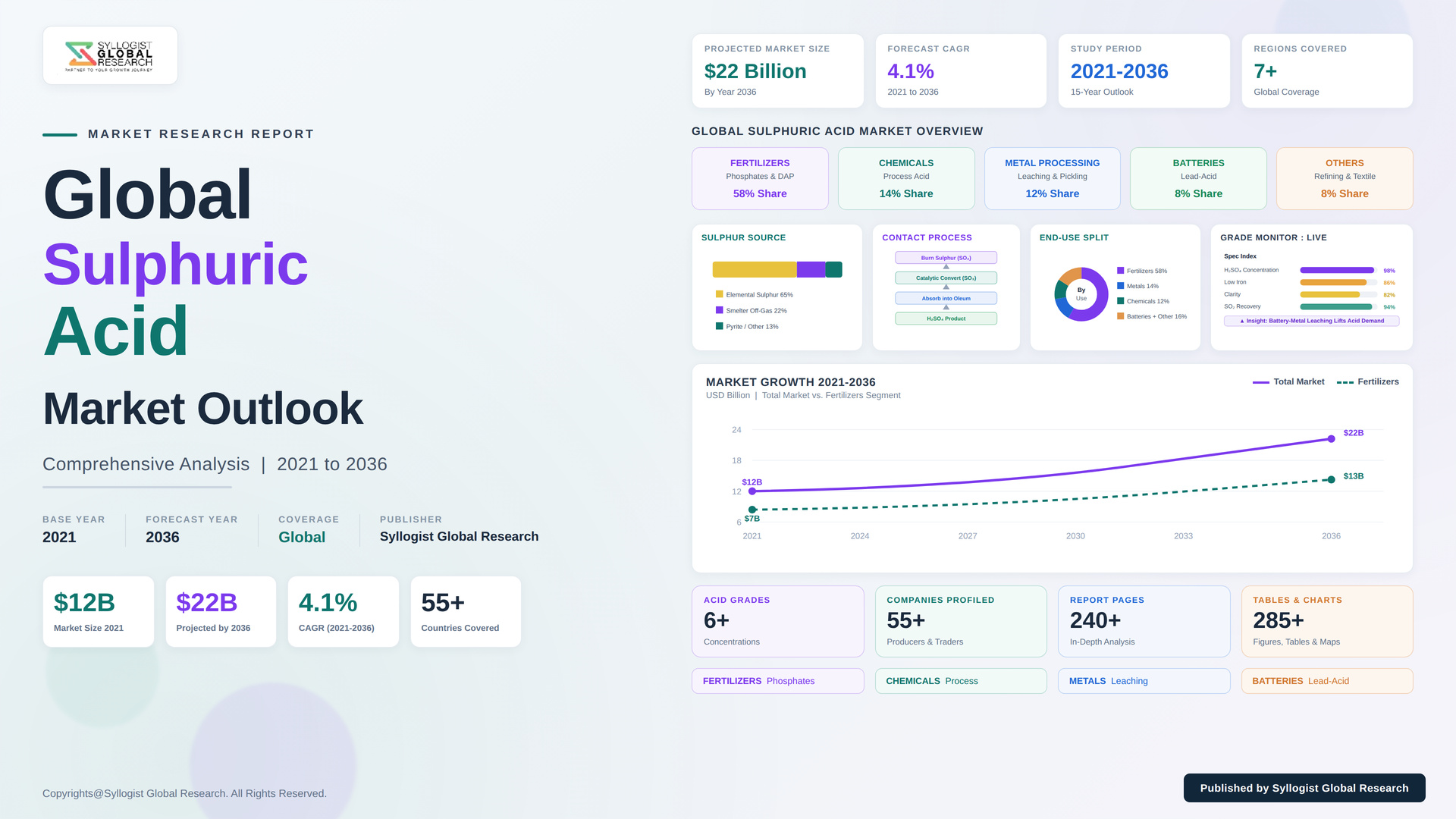
The global sulfuric acid market is entering a steady expansion phase, shaped by sustained phosphate fertilizer demand, expanding base metal mining and hydrometallurgical processing, growing chemical manufacturing activity, and rising sulfur recovery from refineries and smelters that enhances supply security. The sulfuric acid market was valued at USD 38.6 billion in 2025 and is projected to reach USD 57.4 billion by 2034, advancing at a compound annual growth rate of 4.5% through the forecast period, with global consumption reaching approximately 273 million tons in 2025, as fertilizer complexes, metals and mining operators, chemical manufacturers, and refiners scale sulfuric acid procurement across Asia-Pacific, North America, Europe, the Middle East and Africa, and Latin America. As one of the most-produced industrial chemicals worldwide, sulfuric acid retains a broad and resilient demand base across the global sulfuric acid market.
The sulfuric acid market trajectory is being reshaped by the dominant role of phosphate fertilizer production, which anchors the majority of global sulfuric acid consumption and ties demand closely to agricultural output and food security priorities within the global sulfuric acid market. Supply structure across the sulfuric acid market combines captive fertilizer complex production, by-product smelter acid recovered from base metal smelting, recovered sulfur from refineries, and merchant producers serving downstream industries. Tightening emission regulation is driving refineries and smelters to invest in sulfur capture and conversion units that reduce sulfur dioxide emissions while producing high-purity acid from industrial by-products, reinforcing the circular supply dynamics of the global sulfuric acid market. This by-product supply linkage means sulfuric acid availability is influenced by refinery and smelter operating rates, adding a distinctive supply dimension to the sulfuric acid market that shapes regional pricing and merchant availability.
Elemental sulfur represents the largest raw material segment within the sulfuric acid market, supported by its wide availability from oil refining and natural gas processing, cost-efficiency, and lower emissions relative to pyrite ore and base metal smelters across the global sulfuric acid market. The contact process dominates production within the sulfuric acid market on the basis of high efficiency, scalability, and established double contact double absorption technology. Fertilizers represent the largest application segment within the global sulfuric acid market, driven by phosphate fertilizer production that underpins global agricultural output, while chemical manufacturing and metal processing represent substantial and growing applications within the sulfuric acid market. Standard commercial grade acid holds the largest grade share of the sulfuric acid market, while electronic and ultra-pure grade is the fastest-growing grade segment, propelled by semiconductor, electronics, and pharmaceutical demand within the global sulfuric acid market. Metal processing and lead-acid battery applications are gaining procurement traction across the sulfuric acid market as base metal leaching and battery production expand.
Asia-Pacific represents the largest regional market within the sulfuric acid market, supported by extensive phosphate fertilizer production, large-scale chemical manufacturing, and mining activity across China and India, along with expanding refining capacity that supports sulfur availability across the global sulfuric acid market. China holds a leading position within the sulfuric acid market on the basis of its massive fertilizer production capacity, extensive chemical manufacturing, and large-scale mining operations. The Middle East and Africa represent a fast-growing region within the global sulfuric acid market, propelled by expanding mining and metal refining, phosphate resource development, and infrastructure investment. North America occupies a significant position within the sulfuric acid market, supported by petroleum refining, fertilizer production, chemical manufacturing, and automotive battery demand, while Europe holds a substantial position within the global sulfuric acid market, supported by chemical manufacturing, fertilizers, and pulp and paper activity under stringent environmental standards.
Key Drivers
Sustained Phosphate Fertilizer Demand, Global Food Security Priorities, and Rising Agricultural Output Driving Bulk Sulfuric Acid Consumption Across the Sulfuric Acid Market
Sustained phosphate fertilizer demand, intensifying global food security priorities, and rising agricultural output are generating durable bulk consumption within the global sulfuric acid market. Sulfuric acid is an essential input in the production of phosphate fertilizers including superphosphate and ammonium sulfate, and fertilizer production accounts for the majority of global sulfuric acid consumption across the sulfuric acid market. Growing world population, rising food demand, and the need to raise crop yields on constrained arable land are lifting phosphate fertilizer production and, in turn, sulfuric acid demand across the global sulfuric acid market. Government support for domestic fertilizer production to enhance food security, particularly across Asia-Pacific and the Middle East and Africa, is driving investment in integrated fertilizer complexes that consume large volumes of sulfuric acid within the sulfuric acid market. Captive sulfuric acid production co-located with phosphate fertilizer complexes anchors long-duration, high-volume demand that stabilizes the sulfuric acid market. Rising demand for pesticides and agricultural chemicals such as copper sulfate and zinc sulfate further supports sulfuric acid consumption across the global sulfuric acid market. The structural linkage between agriculture, phosphate fertilizers, and sulfuric acid converts food security priorities into recurring, volume-linked demand that underpins long-term growth across the sulfuric acid market worldwide.
Expanding Base Metal Mining, Hydrometallurgical Leaching, and Battery-Metal Demand Driving Metal Processing Consumption Across the Sulfuric Acid Market
Expanding base metal mining, growing reliance on hydrometallurgical leaching, and rising battery-metal demand are driving sustained metal processing consumption within the global sulfuric acid market. Sulfuric acid plays a critical role in hydrometallurgical leaching processes used to extract copper, zinc, nickel, cobalt, and other base metals, tying sulfuric acid demand directly to mining and metal refining activity across the sulfuric acid market. Rising demand for battery metals supporting electric vehicles and energy storage is expanding nickel and cobalt leaching operations that consume large volumes of sulfuric acid within the global sulfuric acid market. Countries with substantial mineral resources across the Middle East, Africa, and Latin America are ramping up base metal extraction and processing, generating incremental sulfuric acid demand across the sulfuric acid market. Base metal smelters also generate by-product sulfuric acid from sulfur dioxide capture, linking metal production to both demand and supply within the global sulfuric acid market. Expansion of copper and zinc leaching capacity, driven by declining ore grades that favor hydrometallurgical routes, is reinforcing structural sulfuric acid consumption across the sulfuric acid market. Growth in mining investment, metal refining capacity, and battery supply chains is scaling a durable industrial demand base that supports long-term growth across the global sulfuric acid market worldwide.
Diverse Industrial Applications, High-Purity Electronics and Pharmaceutical Demand, and Chemical Manufacturing Growth Driving Value Expansion Across the Sulfuric Acid Market
Diverse industrial applications, rising high-purity electronics and pharmaceutical demand, and sustained chemical manufacturing growth are driving value expansion within the global sulfuric acid market. Sulfuric acid serves as a versatile input across chemical synthesis, petroleum refining alkylation, detergents, pigments, dyes, explosives, and water treatment, supporting broad-based demand across the sulfuric acid market. Lead-acid battery production and recycling sustain consistent sulfuric acid demand, supported by the cost-effectiveness, recyclability, and established infrastructure of lead-acid batteries in automotive starting, lighting, ignition, and backup power applications within the global sulfuric acid market. Electronic and ultra-pure grade sulfuric acid is the fastest-growing grade within the sulfuric acid market, propelled by semiconductor fabrication, electronics manufacturing, and pharmaceutical production that require high-purity acid with tightly controlled specifications. Growth in chemical intermediates, specialty chemicals, and downstream processing is expanding sulfuric acid consumption across the global sulfuric acid market. Rising demand for water and wastewater treatment chemistries adds further application breadth within the sulfuric acid market. This combination of bulk industrial versatility and high-value specialty demand supports both volume and value growth, reinforcing the resilience of the global sulfuric acid market across economic cycles worldwide.
Key Challenges
Volatile Sulfur Feedstock and Energy Prices, By-Product Supply Linkage, and Regional Supply-Demand Imbalance Constraining Margins Across the Sulfuric Acid Market
Volatile sulfur feedstock and energy prices, the by-product nature of much sulfuric acid supply, and recurring regional supply-demand imbalance generate persistent margin and planning challenges across the global sulfuric acid market. Sulfur feedstock prices fluctuate with refinery and natural gas processing output and global sulfur supply, generating cost swings that are difficult to pass through fully in a price-sensitive bulk sulfuric acid market. A substantial share of sulfuric acid supply arises as a by-product of base metal smelting and refinery sulfur recovery, meaning acid availability is tied to smelter and refinery operating rates rather than sulfuric acid demand within the global sulfuric acid market. This by-product linkage can generate localized oversupply of smelter acid that depresses merchant pricing, or shortages when smelter and refinery output falls, complicating supply planning across the sulfuric acid market. Energy-intensive production ties operating cost to power and fuel prices, adding cost volatility across the global sulfuric acid market. Regional imbalances between captive, by-product, and merchant supply create uneven pricing and availability that challenge procurement planning within the sulfuric acid market. The low value-to-weight ratio of sulfuric acid further limits the geographic reach over which supply imbalances can be economically corrected, sustaining pricing and margin pressure across the global sulfuric acid market.
Stringent Environmental Regulation, Sulfur Dioxide and Acid Mist Emission Controls, and Hazardous Material Compliance Raising Operating Cost Across the Sulfuric Acid Market
Stringent environmental regulation, tightening controls on sulfur dioxide and sulfuric acid mist emissions, and demanding hazardous material compliance requirements are raising operating cost and constraining capacity expansion across the global sulfuric acid market. Sulfuric acid production facilities face rising regulatory requirements governing sulfur dioxide emissions, acid mist, and particulate matter, increasing compliance and abatement expenditure within the sulfuric acid market. Emission performance standards require investment in scrubbing, conversion, and capture technologies that raise capital and operating cost across the global sulfuric acid market. Environmental regulation governing waste disposal and effluent from production facilities further increases operating cost and complicates plant expansion within the sulfuric acid market. Sulfuric acid is a highly corrosive and hazardous substance, requiring strict handling, storage, and worker safety controls that add cost and operational complexity across the global sulfuric acid market. Permitting for new sulfuric acid capacity is lengthy and subject to environmental review, constraining the pace of capacity addition within the sulfuric acid market. Divergent environmental frameworks across regions complicate compliance for multinational producers operating across the global sulfuric acid market. Sustained regulatory tightening, while supporting cleaner production and sulfur recovery, continues to raise the ongoing cost of participation across the sulfuric acid market.
Transport, Storage, and Handling Complexity, Corrosive Hazard Risk, and Long-Term Substitution Pressures Constraining Growth Across the Sulfuric Acid Market
Transport, storage, and handling complexity, corrosive hazard risk, and emerging long-term substitution pressures generate persistent operational and demand challenges across the global sulfuric acid market. The highly corrosive and hazardous nature of sulfuric acid requires specialized acid-resistant tankers, storage tanks, and pipelines, along with strict safety protocols that raise logistics and infrastructure cost within the sulfuric acid market. The low value-to-weight ratio of bulk sulfuric acid makes long-distance transport economically unattractive, constraining the geographic reach of merchant supply across the global sulfuric acid market. Risk of spills, leaks, and exposure incidents during transport and handling generates regulatory, safety, and liability exposure within the sulfuric acid market. Storage of concentrated and fuming acid requires specialized containment and monitoring, adding cost and complexity across the global sulfuric acid market. Over the longer term, the shift toward electric vehicles and lithium-ion batteries introduces potential substitution risk for lead-acid battery-related sulfuric acid demand within the sulfuric acid market, while declining conventional refining in some regions may affect sulfur supply and alkylation-related demand. Regional oversupply of by-product acid can also pressure merchant producers across the global sulfuric acid market. These combined logistics, safety, and structural factors sustain operational challenges and long-range demand uncertainty across the sulfuric acid market.
Market Segmentation
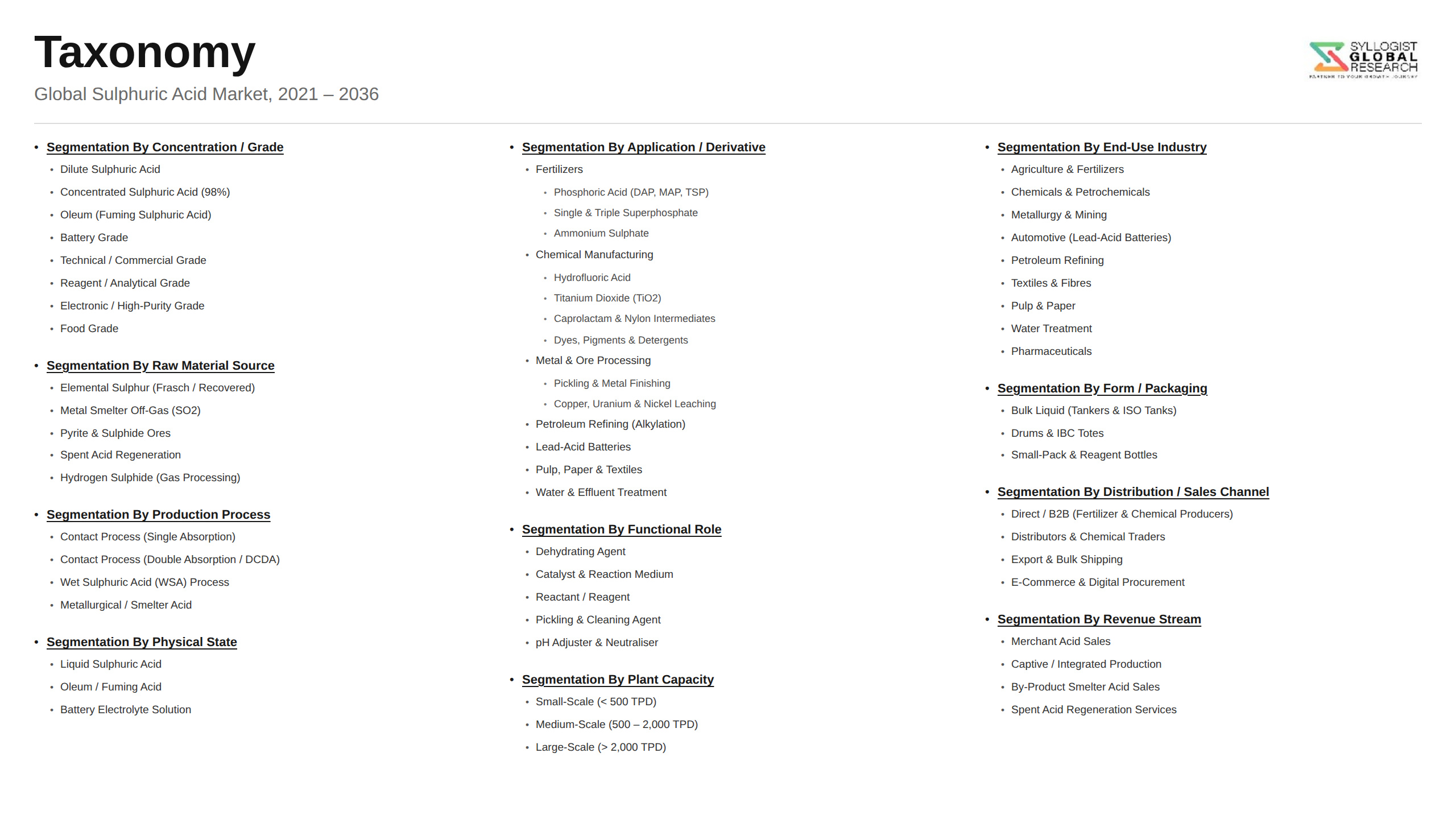
- Segmentation By Raw Material
- Elemental Sulfur
- Base Metal Smelters
- Pyrite Ore
- Others
- Segmentation By Production Process
- Contact Process
- Double Contact Double Absorption (DCDA)
- Others
- Segmentation By Concentration
- Dilute Sulfuric Acid
- Concentrated Sulfuric Acid
- Oleum (Fuming Sulfuric Acid)
- Segmentation By Grade
- Standard Commercial Grade
- Battery Grade
- Electronic and Ultra-Pure Grade
- Others
- Segmentation By Application
- Fertilizers
- Chemical Manufacturing
- Metal Processing
- Petroleum Refining
- Lead-Acid Batteries
- Pulp and Paper
- Textiles
- Water Treatment
- Others
- Segmentation By End Use Industry
- Agriculture
- Chemicals
- Metals and Mining
- Oil and Gas
- Automotive
- Pulp and Paper
- Textiles
- Electronics
- Others
- Segmentation By Region
- North America
- Europe
- Asia-Pacific
- Middle East and Africa
- Latin America
All market revenues are presented in USD
Historical Year: 2021-2024 | Base Year: 2025 | Estimated Year: 2026 | Forecast Period: 2027-2034
Key Questions this Study Will Answer
- What is the total global market valuation of the Sulfuric Acid Market in 2025, projected through 2034, segmented by raw material, production process, concentration, grade, application, and end use industry, enabling sulfuric acid producers, fertilizer complexes, metals and mining operators, and investors to identify the highest-growth segments and most durable revenue opportunities across the global sulfuric acid market?
- How are fertilizer complexes, chemical manufacturers, metals and mining operators, and refiners structuring sulfuric acid procurement, and which supply models, including captive production, by-product smelter acid, and merchant supply, are shaping the commercial and pricing dynamics of the sulfuric acid market through 2034?
- What phosphate fertilizer demand, base metal leaching, and sulfur recovery dynamics are shaping the pace and geographic distribution of sulfuric acid consumption and supply across agriculture, chemicals, metals, and refining end users in mature and emerging sulfuric acid markets?
- Which applications, including fertilizers, chemical manufacturing, metal processing, petroleum refining, and lead-acid batteries, are gaining the strongest consumption traction, and what grade, purity, cost, and supply security metrics are shaping sourcing decisions across the global sulfuric acid market?
- How is the competitive landscape structured among elemental sulfur producers, refineries and smelters supplying by-product acid, captive fertilizer producers, and merchant sulfuric acid producers within the sulfuric acid market, and what capacity expansion, integration, and sulfur recovery strategies are shaping supply positioning across the global sulfuric acid market?
- What emission regulation, sulfur recovery investment, circular sulfur, and high-purity acid adoption trends are reshaping production technology, supply security, and value migration across the global sulfuric acid market?
- Which regional markets, including Asia-Pacific, the Middle East and Africa, North America, Europe, and Latin America, are projected to generate the largest incremental sulfuric acid demand and supply through 2034, and what fertilizer production, mining activity, refining capacity, and environmental regulation factors are shaping demand growth and supplier positioning in each regional sulfuric acid market?
- Product Definition
- Research Methodology
- Research Design & Framework
- Overall Research Approach: Descriptive, Exploratory & Quantitative Mixed-Method Design
- Market Definition & Scope Boundaries: What is Included and Excluded
- Segmentation Framework
- Key Research Assumptions & Limitations
- Secondary Research
- Primary Research Design & Execution
- Data Triangulation & Validation
- Market Sizing & Forecasting Methodology
- Competitive Intelligence Methodology
- Quality Assurance & Peer Review
- Definitions, Abbreviations & Data Notes
- Executive Summary
- Market Snapshot & Headline Numbers
- Key Findings & Research Highlights
- Market Dynamics
- Regional Market Summary
- Competitive Landscape Snapshot
- Technology & Innovation Highlights
- Market Dynamics
- Drivers
- Restraints
- Opportunities
- Challenges
- Porter’s Five Forces Analysis
- PESTLE Analysis
- Market Trends & Developments
- Emerging Trends
- Technological Developments
- Regulatory & Policy Changes
- Supply Chain & Sourcing Trends
- Manufacturing & Process Trends
- Investment & Funding Activity
- Sustainability & ESG Trends
- Risk Assessment Framework
- Sulphur Feedstock Price Volatility & Production Cost Escalation Risk
- Fertilizer Demand Cyclicality, Farm Economics & Volume Volatility Risk
- Smelter By-Product Supply Fluctuation & Feedstock Availability Risk
- SO2 Emission, Environmental Regulation & Compliance Cost Risk
- Overcapacity, Merchant Market Imbalance & Margin Compression Risk
- Regulatory Framework & Standards
- Hazardous Chemical, Corrosive Substance & Transport (ADR/DOT) Standards
- SO2 Emission, Air Quality & Environmental Discharge Regulations
- Product Purity, Grade Specification & ISO Quality Standards
- Battery-Grade, Electronic-Grade & High-Purity Compliance Standards
- Cross-Border Trade, REACH & Import-Export Compliance Frameworks
- Global Sulphuric Acid Market Outlook
- Market Size & Forecast by Value
- Market Size & Forecast by Volume (Sulphuric Acid Consumed in Million Tonnes per Year and Nameplate Production Capacity in Million Tonnes per Year)
- Market Size & Forecast by Grade
- Dilute Sulphuric Acid
- Concentrated Sulphuric Acid (98%)
- Oleum (Fuming)
- Battery Grade
- Others
- Market Size & Forecast by Raw Material
- Elemental Sulphur
- Base Metal Smelter (SO2)
- Pyrite
- Spent Acid Regeneration
- Others
- Market Size & Forecast by Production Process
- Contact Process (Single Absorption)
- Contact Process (Double Absorption / DCDA)
- Wet Sulphuric Acid (WSA)
- Others
- Market Size & Forecast by Application
- Phosphate Fertilizers
- Chemical Manufacturing
- Metal Processing and Pickling
- Petroleum Refining (Alkylation)
- Pulp and Paper
- Textiles
- Water Treatment
- Batteries
- Pigments (Titanium Dioxide)
- Others
- Market Size & Forecast by End-Use Industry
- Fertilizers and Agriculture
- Chemicals
- Metallurgy and Mining
- Petroleum Refining
- Pulp and Paper
- Automotive (Batteries)
- Textiles
- Others
- Market Size & Forecast by Purity Grade
- Technical Grade
- Reagent Grade
- Electronic Grade
- Others
- Market Size & Forecast by Packaging
- Bulk and Tanker
- Drums
- IBC Totes
- Others
- Market Size & Forecast by Sales Channel
- Direct Long-Term Supply Contract
- Merchant Spot Market
- Distributor and Trader Channel
- Integrated Captive Consumption
- Others
- North America Sulphuric Acid Market Outlook
- Market Size & Forecast
- By Value
- By Volume (Sulphuric Acid Consumed in Million Tonnes per Year and Nameplate Production Capacity in Million Tonnes per Year)
- By Grade
- By Raw Material
- By Production Process
- By Application
- By End-Use Industry
- By Purity Grade
- By Packaging
- By Country
- By Sales Channel
- Europe Sulphuric Acid Market Outlook
- Market Size & Forecast
- By Value
- By Volume (Sulphuric Acid Consumed in Million Tonnes per Year and Nameplate Production Capacity in Million Tonnes per Year)
- By Grade
- By Raw Material
- By Production Process
- By Application
- By End-Use Industry
- By Purity Grade
- By Packaging
- By Country
- By Sales Channel
- Asia-Pacific Sulphuric Acid Market Outlook
- Market Size & Forecast
- By Value
- By Volume (Sulphuric Acid Consumed in Million Tonnes per Year and Nameplate Production Capacity in Million Tonnes per Year)
- By Grade
- By Raw Material
- By Production Process
- By Application
- By End-Use Industry
- By Purity Grade
- By Packaging
- By Country
- By Sales Channel
- Latin America Sulphuric Acid Market Outlook
- Market Size & Forecast
- By Value
- By Volume (Sulphuric Acid Consumed in Million Tonnes per Year and Nameplate Production Capacity in Million Tonnes per Year)
- By Grade
- By Raw Material
- By Production Process
- By Application
- By End-Use Industry
- By Purity Grade
- By Packaging
- By Country
- By Sales Channel
- Middle East & Africa Sulphuric Acid Market Outlook
- Market Size & Forecast
- By Value
- By Volume (Sulphuric Acid Consumed in Million Tonnes per Year and Nameplate Production Capacity in Million Tonnes per Year)
- By Grade
- By Raw Material
- By Production Process
- By Application
- By End-Use Industry
- By Purity Grade
- By Packaging
- By Country
- By Sales Channel
- Country-Wise* Sulphuric Acid Market Outlook
- Market Size & Forecast
- By Value
- By Volume (Sulphuric Acid Consumed in Million Tonnes per Year and Nameplate Production Capacity in Million Tonnes per Year)
- By Grade
- By Raw Material
- By Production Process
- By Application
- By End-Use Industry
- By Purity Grade
- By Packaging
- By Country
- By Sales Channel
- Market Size & Forecast
- Market Size & Forecast
- Market Size & Forecast
- Market Size & Forecast
- Market Size & Forecast
- Market Size & Forecast
*Countries Analysed in the Global Research Portfolio: United States, Canada, Mexico, Germany, France, United Kingdom, Netherlands, Spain, Italy, Norway, Sweden, China, Japan, India, Australia, South Korea, Singapore, Brazil, Chile, Saudi Arabia, UAE, Egypt, South Africa, Israel
- Technology Landscape & Innovation Analysis
- Contact Process, Sulphur Burning & Sulphuric Acid Production Technology Deep-Dive
- Double Absorption (DCDA) & Emission Reduction Technology
- Metallurgical (Smelter SO2) & By-Product Acid Recovery Technology
- Spent Acid Regeneration & Wet Sulphuric Acid (WSA) Technology
- Heat Recovery, Steam Co-Generation & Energy Integration Technology
- Catalyst (Vanadium Pentoxide) & Converter Optimisation Technology
- Oleum, Fuming Acid & High-Concentration Production Technology
- Patent & IP Landscape in Sulphuric Acid Technologies
- Value Chain & Supply Chain Analysis
- Elemental Sulphur, Pyrite & Smelter Feedstock Supply Chain
- Sulphur Burning, Contact Process & Acid Production Supply Chain
- Concentration, Oleum & Grade Separation Supply Chain
- Phosphate Fertilizer & Chemical Producer Channel
- Metallurgy, Refining & Industrial Customer Channel
- Bulk Handling, Storage & Corrosive Chemical Logistics Network
- Merchant Trader, Distributor & Regional Supply Network
- Pricing Analysis
- Merchant Sulphuric Acid Pricing Across Contract & Spot Market Tiers
- Sulphur Feedstock-Linked Pricing & Production Cost Economics
- Smelter By-Product vs Sulphur-Burned Acid Pricing Differentials
- Oleum and High-Concentration Grade Pricing Analysis
- Battery and Electronic Grade Premium Pricing Analysis
- CIF vs FOB Pricing, Freight & Delivered Cost Analysis
- Regional Pricing Benchmarks & Value-in-Use Pricing Models
- Sustainability & Environmental Analysis
- Lifecycle Assessment (LCA) of Sulphuric Acid Across Feedstock & Production
- SO2 Emission, Acid Mist & Air Quality Impact Assessment
- By-Product Recovery, Smelter Integration & Circular Economy Performance
- Heat Recovery, Steam Co-Generation & Energy Efficiency Performance
- Regulatory-Driven Sustainability, SDG 2 (Zero Hunger) & SDG 12 (Responsible Consumption) Alignment & Green Finance Eligibility
- Competitive Landscape
- Market Structure & Concentration
- Market Consolidation Level (Fragmented vs. Consolidated by Raw Material & Geography)
- Top 10 Players Market Share
- HHI (Herfindahl-Hirschman Index) Concentration Analysis
- Competitive Intensity Map by Raw Material, Application & Geography
- Player Classification
- Integrated Fertilizer and Sulphuric Acid Producers
- Sulphur-Burning Merchant Acid Producers
- Base Metal Smelters (By-Product Acid)
- Spent Acid Regeneration Producers
- Chemical and Refining Integrated Producers
- National and State-Owned Chemical Enterprises
- Regional and Independent Producers
- Merchant Traders and Distributors
- Competitive Analysis Frameworks
- Market Share Analysis by Raw Material, Application & Region
- Company Profile
- Company Overview & Headquarters
- Sulphuric Acid Production Portfolio & Capacity
- Key Customer Relationships & Reference Offtake Accounts
- Production Footprint & Nameplate Capacity Coverage
- Revenue (Sulphuric Acid Segment) & Offtake Contract Backlog
- Technology Differentiators & IP
- Key Strategic Partnerships, JVs & M&A Activity
- Recent Developments (Capacity Additions, Contract Wins, Project Launches)
- SWOT Analysis
- Strategic Focus Areas & Roadmap
- Competitive Positioning Map (Technology Capability vs. Market Penetration)
- Key Company Profiles
- Market Structure & Concentration
- Technology Landscape & Innovation Analysis
- Strategic Output
- Market Opportunity Matrix: By Grade, Raw Material, Application, End-Use Industry & Geography
- White Space Opportunity Analysis
- Strategic Recommendations
- Production Portfolio & Feedstock Diversification Strategy
- Operational Excellence & Capacity Expansion Strategy
- Geographic Expansion & Feedstock Localisation Strategy
- Customer & Offtake Account Engagement Strategy
- Partnership, M&A & Ecosystem Strategy
- Sustainability & Emission Reduction Strategy
- Risk Mitigation & Future Roadmap
- Strategic Priority Matrix & Roadmap
- Near-term (2025-2028)
- Mid-term (2029-2032)
- Long-term (2033-2037)