Global Petroleum Coke (Pet Coke) Market By Grade, By Type, By Application, By End User, By Region, Competition, Forecast & Opportunities, 2021-2034F
Market Definition
Petroleum coke, commonly referred to as pet coke, is a carbon-rich solid residue produced during the thermal cracking and delayed coking of heavy residual oil fractions inside petroleum refineries, delivering high fixed carbon content, elevated calorific value, and low ash characteristics that establish it as a competitively priced solid carbon feedstock and fuel across cement, power, aluminium, steel, and specialty chemical value chains. The Global Petroleum Coke (Pet Coke) Market encompasses the production, calcination, blending, trading, and consumption of fuel grade petroleum coke and calcined petroleum coke, spanning sponge coke, shot coke, needle coke, honeycomb coke, and catalyst coke grades supplied to cement kilns, coal-fired and captive power plants, aluminium anode manufacturers, steel and titanium dioxide producers, calcium carbide plants, and industrial process heating operations worldwide.
The petroleum coke market covers material sourced from refinery delayed cokers and dedicated calcining facilities, distributed through domestic supply agreements, seaborne export cargoes, and specialized trading channels that link surplus refining regions with import-dependent industrial demand centers. Market participants include integrated oil refiners, merchant calciners, petroleum coke traders, shipping and bulk terminal operators, and downstream industrial consumers that substitute pet coke for thermal coal, natural gas, and metallurgical carbon inputs. Fuel grade petroleum coke serves primarily as a solid fuel and kiln feedstock, while calcined petroleum coke functions as an essential carbon anode and recarburizer input within aluminium smelting and steelmaking. The Global Pet Coke Market explicitly excludes metallurgical coal, thermal coal, and biomass fuels, focusing exclusively on refinery-derived petroleum coke and its calcined derivatives, positioning the petroleum coke market as a critical carbon bridge between global refining output and carbon-intensive industrial manufacturing.
Market Insights
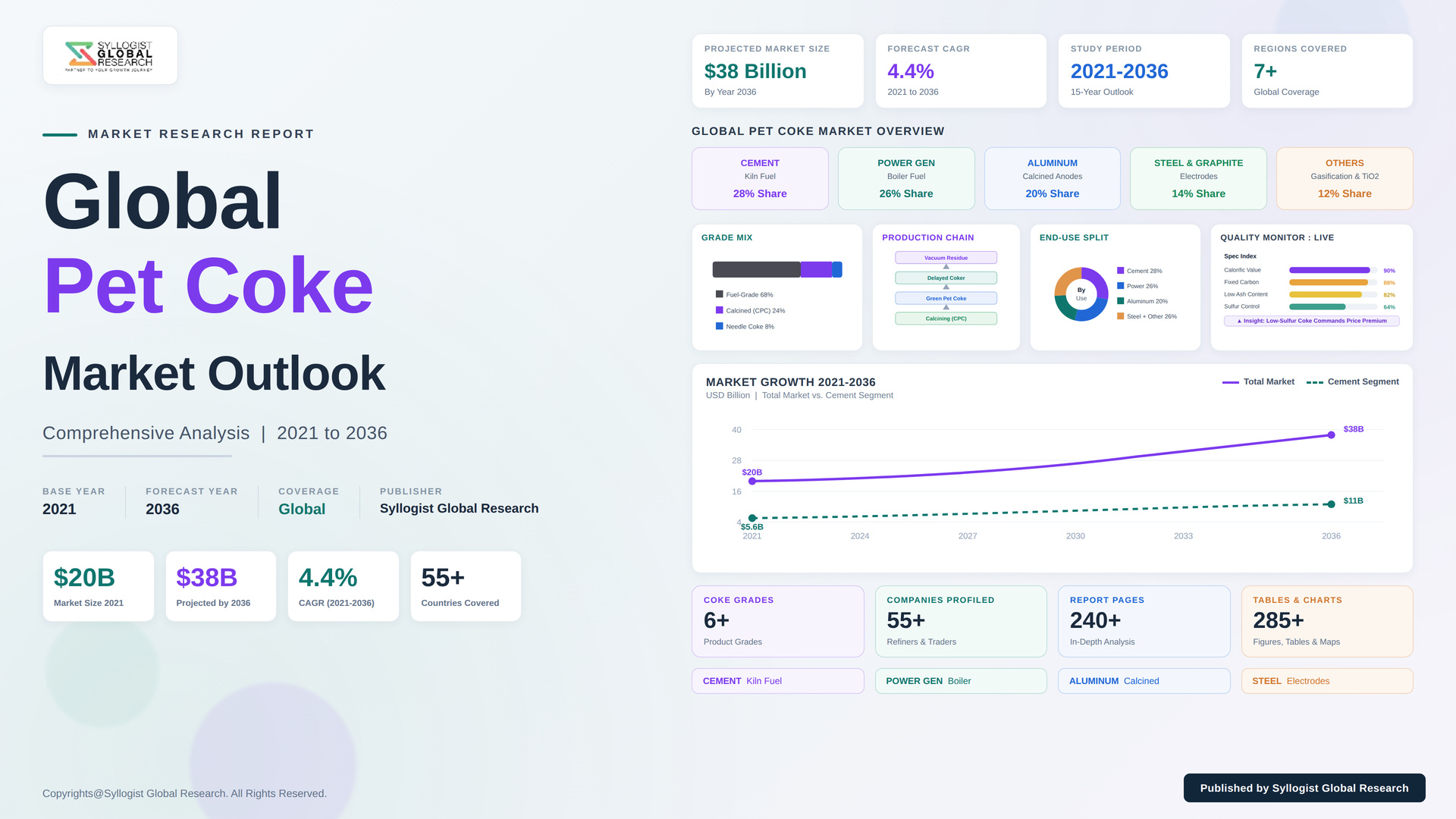
The global petroleum coke market is progressing through a durable expansion phase, shaped by resilient cement production growth across emerging economies, sustained aluminium anode demand, expanding refinery delayed coking capacity, and the persistent cost advantage of pet coke over competing solid fuels and metallurgical carbon feedstocks. The petroleum coke market was valued at approximately USD 22.4 billion in 2025 and is projected to reach USD 33.8 billion by 2034, advancing at a compound annual growth rate of 4.7% through the forecast period, as cement producers, power utilities, aluminium smelters, and calcining operators scale petroleum coke procurement across Asia-Pacific, North America, the Middle East, Europe, and Latin America. Fuel grade material continues to account for close to 78% of global pet coke volumes, while calcined petroleum coke commands a disproportionate share of market value owing to its premium role in carbon anode and graphite electrode manufacturing.
The pet coke market trajectory is being reshaped by the structural migration of surplus fuel grade petroleum coke from mature refining regions toward high-growth cement and industrial markets, with United States refineries functioning as the single largest source of exportable petroleum coke and Asian buyers absorbing the majority of that seaborne surplus. India remains the largest importer and consumer of fuel grade petroleum coke, drawing roughly 27% of internationally traded fuel grade tonnes into its cement and calcining sectors, while China continues to balance sizable domestic production against fluctuating import appetite for higher-quality anode grade material. Cement kilns represent the dominant demand pool within the petroleum coke market, favoring pet coke for its high calorific value exceeding 8,000 kilocalories per kilogram and its ability to displace more expensive coal within clinker production, cementing pet coke as the marginal solid fuel of choice across price-sensitive kiln operations.
Calcined petroleum coke represents the highest-value segment within the petroleum coke market, functioning as the primary raw material for prebaked carbon anodes consumed in the Hall-Heroult aluminium smelting process, where approximately 0.4 tonnes of calcined petroleum coke is required for every tonne of primary aluminium produced. Rising global primary aluminium output, propelled by electrification, lightweight transportation, and renewable infrastructure buildout, is translating directly into resilient calcined petroleum coke demand and periodic anode grade supply tightness across the pet coke market. Needle coke, the premium sub-grade of the petroleum coke market, is drawing accelerated strategic attention as graphite electrode producers and lithium-ion battery anode manufacturers compete for constrained supply, with battery-driven demand emerging as a structurally new growth axis that extends the petroleum coke market beyond its traditional cement, power, and aluminium base.
Asia-Pacific represents the largest regional market within the petroleum coke market, anchored by Indian and Chinese cement, aluminium, and calcining demand alongside expanding consumption across Southeast Asian and Middle Eastern industrial corridors that increasingly source imported fuel grade petroleum coke. North America holds the leading production and export position within the pet coke market, supported by deep delayed coking capacity across United States Gulf Coast refineries processing heavy sour crude slates that yield abundant petroleum coke. The Middle East is emerging as a fast-scaling participant in the petroleum coke market, propelled by integrated refining and aluminium smelting investments in the Gulf that are building regional calcining capacity, while Europe occupies a mature demand position and Latin America contributes steady cement-led petroleum coke consumption supported by Brazilian and Mexican industrial activity.
Key Drivers
Cement Sector Fuel Substitution and the Structural Cost Advantage of Pet Coke Over Thermal Coal Driving Sustained Kiln Demand
The cement industry remains the central demand engine of the global petroleum coke market, with kiln operators favoring fuel grade petroleum coke as the lowest landed cost solid fuel capable of sustaining clinker production economics under persistent margin pressure. Petroleum coke delivers a calorific value exceeding 8,000 kilocalories per kilogram, materially higher than most thermal coal grades, allowing cement producers to reduce specific fuel consumption per tonne of clinker while lowering blended thermal energy cost. Across price-sensitive markets in India, Southeast Asia, the Middle East, and Latin America, cement manufacturers have raised the pet coke share of their kiln fuel mix well above 60%, locking petroleum coke into the core of clinker cost structures. The cost differential between petroleum coke and imported thermal coal frequently exceeds 20% on a delivered energy basis, translating into compelling procurement savings that anchor long-duration off-take relationships between refiners, traders, and cement groups. Sustained cement capacity additions across emerging economies, driven by urbanization, housing, and infrastructure investment, are expanding the installed kiln base and generating durable incremental petroleum coke demand, reinforcing the position of the pet coke market as a structurally advantaged solid fuel supplier to the global cement value chain. As long as crude-derived petroleum coke retains its delivered energy discount to imported coal, cement groups are expected to defend and extend their pet coke intake, keeping the cement sector the decisive volume driver of the petroleum coke market throughout the forecast horizon.
Rising Primary Aluminium Output and Graphite Electrode Demand Sustaining Calcined and Needle Coke Consumption
Growth in primary aluminium production is a powerful and enduring driver of the calcined petroleum coke segment within the global petroleum coke market, because carbon anodes manufactured from calcined petroleum coke are consumed continuously in the electrolytic smelting of aluminium. Every tonne of primary aluminium requires close to 0.4 tonnes of calcined petroleum coke, creating a fixed and non-substitutable demand linkage that tightens with each expansion of global smelting capacity. Accelerating aluminium consumption across electric vehicles, renewable energy infrastructure, packaging, and lightweight construction is lifting primary metal output and, by extension, calcined petroleum coke and anode grade petroleum coke demand across the pet coke market. In parallel, needle coke, the premium petroleum coke sub-grade, is experiencing intensifying demand from graphite electrode producers serving electric arc furnace steelmaking and, increasingly, from lithium-ion battery anode manufacturers. This dual pull from electric arc steel and battery supply chains is elevating the strategic value of high-quality petroleum coke, tightening premium grade availability, and reinforcing calcined and needle coke as the highest-margin frontier of the petroleum coke market through the forecast period. Because anode grade and needle coke require low metal impurities and tightly controlled properties, only a limited share of global petroleum coke output qualifies for these premium applications, sustaining a persistent quality premium and encouraging targeted calcining investment across the pet coke market.
Expanding Refinery Delayed Coking Capacity and Heavier Crude Processing Enlarging Global Pet Coke Supply Availability
The continued buildout of refinery delayed coking capacity and the growing global appetite for processing heavy and sour crude slates are steadily enlarging petroleum coke supply availability, underpinning the volume base of the global petroleum coke market. Delayed coking upgrades heavy residual bottoms into higher-value transportation fuels while producing petroleum coke as an unavoidable solid byproduct, meaning refiners actively seek reliable off-take channels that convert this residue into monetizable pet coke sales. Refinery investments across the United States Gulf Coast, the Middle East, India, and China have expanded coking throughput, generating growing volumes of fuel grade and anode grade petroleum coke entering domestic and seaborne trade. Because heavy crude typically trades at a discount to lighter grades, refiners are economically incentivized to maximize coker utilization, sustaining a steady flow of petroleum coke into the market even through periods of soft demand. This supply-side momentum ensures competitively priced petroleum coke availability for cement, power, and calcining consumers, deepening the liquidity of the pet coke market and supporting the trade flows that connect surplus refining regions with carbon-intensive industrial demand centers worldwide. As refiners in Asia and the Middle East continue commissioning new coking units to capture value from heavy crude, the incremental petroleum coke supply entering global trade is expected to keep the pet coke market well supplied and price-competitive across the forecast period.
Key Challenges
Tightening Environmental Regulation, High Sulphur Content, and Petroleum Coke Import and Combustion Restrictions Constraining Demand
Tightening environmental regulation stands as the most significant structural challenge confronting the global petroleum coke market, driven by the high sulphur content and carbon intensity of fuel grade material. Fuel grade petroleum coke frequently carries sulphur content above 5%, generating sulphur dioxide and particulate emissions that expose combustion to increasingly stringent air quality standards across major consuming regions. Regulatory interventions, including periodic restrictions on petroleum coke imports and combustion in pollution-sensitive zones such as the Indian National Capital Region, have demonstrated how quickly policy can curtail petroleum coke demand within key markets. As emission norms tighten across cement, power, and calcining operations, consumers face rising pressure to install flue gas desulphurization, adopt blending limits, or shift toward lower-sulphur fuels, raising the effective cost of petroleum coke utilization. This regulatory overhang introduces persistent demand uncertainty into the pet coke market, complicating long-term procurement planning for refiners, traders, and industrial buyers, and constraining fuel grade petroleum coke penetration in jurisdictions where environmental enforcement is intensifying and public scrutiny of high-sulphur solid fuels continues to grow across the petroleum coke value chain. The resulting regulatory patchwork, in which some markets welcome petroleum coke imports while others restrict them, fragments demand and forces refiners and traders to continuously reroute cargoes toward jurisdictions with more permissive combustion and import frameworks.
Petroleum Coke Price Volatility Linked to Crude Oil Movements, Refining Margins, and Cyclical Supply-Demand Imbalances
Pronounced price volatility represents a persistent challenge within the global petroleum coke market, because pet coke pricing is tightly coupled to crude oil movements, refinery coking economics, and cyclical shifts in solid fuel supply and demand. Petroleum coke prices can swing by more than 40% across a single demand cycle, as tightening coal markets, aluminium production changes, and refinery run rates simultaneously reshape both supply and consumption. When thermal coal prices surge, cement and power buyers accelerate substitution toward petroleum coke, rapidly tightening availability and driving pet coke prices higher, while periods of weak industrial demand can leave refiners with surplus coke and depressed realizations. This volatility complicates budgeting and margin management for cement producers, power utilities, and calciners that rely on petroleum coke as a core input, and it discourages some consumers from deepening structural exposure to the pet coke market. For refiners, unpredictable petroleum coke realizations weaken the reliability of coker byproduct revenue, while for traders, sharp price reversals elevate inventory and cargo risk across the seaborne petroleum coke supply chain, dampening confidence in long-horizon commitments within the market. This structural sensitivity to crude cycles and cross-commodity substitution means petroleum coke pricing rarely settles into stable equilibrium, keeping procurement teams exposed to repeated cost shocks and reinforcing the need for flexible sourcing strategies across the global pet coke market.
Decarbonization Pressure, Energy Transition, and Long-Term Substitution Risk Threatening Fuel Grade Petroleum Coke Demand
Accelerating decarbonization and the broader energy transition pose a long-term structural challenge to the global petroleum coke market, particularly for the fuel grade segment consumed in cement and power applications. As cement producers pursue net-zero commitments, they are progressively substituting fossil kiln fuels with alternative fuels, biomass, refuse-derived fuel, and waste heat recovery, gradually eroding the addressable demand base for high-carbon petroleum coke. Carbon pricing mechanisms and emissions trading schemes expanding across Europe and other regions are raising the effective cost of combusting carbon-intensive fuels such as pet coke, weakening its cost advantage over lower-carbon alternatives. The long-run displacement of coal-fired power generation by renewables further narrows one of the traditional demand outlets for fuel grade petroleum coke. While calcined and needle coke demand tied to aluminium and battery supply chains remains comparatively insulated, the fuel grade petroleum coke market faces a gradual demand ceiling as climate policy hardens. This transition risk introduces strategic uncertainty for refiners and traders dependent on fuel grade off-take, requiring the petroleum coke market to increasingly orient toward higher-value calcined and specialty carbon applications to sustain durable growth. Over the longer horizon, the pace at which cement decarbonization technologies, alternative fuels, and carbon capture scale will determine how sharply fuel grade petroleum coke demand plateaus, making energy transition trajectory the single most consequential swing factor for the future shape of the petroleum coke market.
Market Segmentation
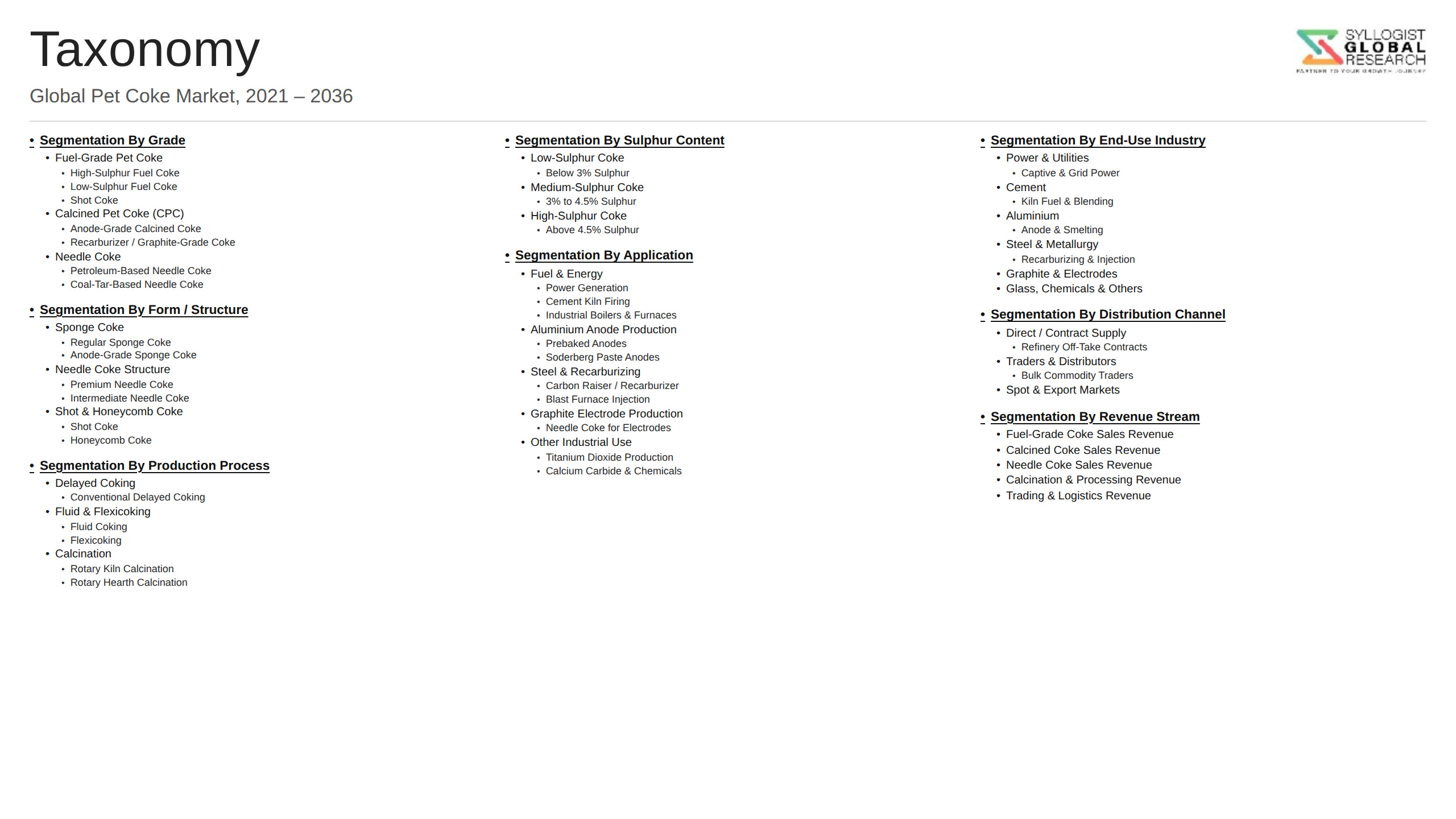
- Segmentation By Grade
- Fuel Grade Petroleum Coke
- Calcined Petroleum Coke
- Segmentation By Type
- Needle Coke
- Sponge Coke
- Shot Coke
- Honeycomb Coke
- Catalyst Coke
- Others
- Segmentation By Sulphur Content
- Low Sulphur Petroleum Coke
- Medium Sulphur Petroleum Coke
- High Sulphur Petroleum Coke
- Segmentation By Application
- Cement Kilns
- Power Generation
- Aluminium Anode and Smelting
- Steel and Recarburizing
- Titanium Dioxide and Pigments
- Calcium Carbide
- Glass and Brick Kilns
- Others
- Segmentation By End User
- Cement Industry
- Power Utilities
- Aluminium Smelters
- Steel Producers
- Chemical and Industrial Manufacturers
- Others
- Segmentation By Region
- North America
- Europe
- Asia-Pacific
- Middle East and Africa
- Latin America
All market revenues are presented in USD
Historical Year: 2021-2024 | Base Year: 2025 | Estimated Year: 2026 | Forecast Period: 2027-2034
Key Questions this Study Will Answer
- What is the total global market valuation of the Petroleum Coke (Pet Coke) Market in 2025, projected through 2034, segmented by grade, type, sulphur content, application, and end user, enabling refiners, calciners, traders, and industrial consumers to identify the highest-growth segments and most durable revenue opportunities across the petroleum coke landscape?
- How is the structural cost advantage of fuel grade petroleum coke over thermal coal shaping fuel substitution decisions, kiln fuel mix strategies, and long-term off-take relationships across cement, power, and industrial consumers within the global pet coke market through 2034?
- What primary aluminium output growth, graphite electrode demand, and emerging lithium-ion battery anode consumption dynamics are shaping the pace and value trajectory of calcined petroleum coke and needle coke demand across mature and emerging markets?
- How are refinery delayed coking capacity additions, heavy and sour crude processing trends, and seaborne trade flows reshaping petroleum coke supply availability, regional balances, and competitive pricing across the global pet coke market?
- What impact are tightening environmental regulations, high sulphur content restrictions, petroleum coke import and combustion bans, and carbon pricing mechanisms exerting on fuel grade petroleum coke demand and consumer procurement strategies through the forecast period?
- How is the competitive landscape structured among integrated oil refiners, merchant calciners, petroleum coke traders, terminal operators, and downstream industrial consumers, and what supply agreements, calcining investments, and trade partnerships are enabling participants to secure competitive positions within the petroleum coke market?
- Which regional markets, including Asia-Pacific, North America, the Middle East, Europe, and Latin America, are projected to generate the largest incremental petroleum coke demand and supply opportunities through 2034, and what cement output, aluminium capacity, refining investment, and regulatory factors are shaping procurement priorities and supplier selection in each regional pet coke market?
- Product Definition
- Research Methodology
- Research Design & Framework
- Overall Research Approach: Descriptive, Exploratory & Quantitative Mixed-Method Design
- Market Definition & Scope Boundaries: What is Included and Excluded
- Segmentation Framework
- Key Research Assumptions & Limitations
- Secondary Research
- Primary Research Design & Execution
- Data Triangulation & Validation
- Market Sizing & Forecasting Methodology
- Competitive Intelligence Methodology
- Quality Assurance & Peer Review
- Definitions, Abbreviations & Data Notes
- Executive Summary
- Market Snapshot & Headline Numbers
- Key Findings & Research Highlights
- Market Dynamics
- Regional Market Summary
- Competitive Landscape Snapshot
- Technology & Innovation Highlights
- Market Dynamics
- Drivers
- Restraints
- Opportunities
- Challenges
- Porter’s Five Forces Analysis
- PESTLE Analysis
- Market Trends & Developments
- Emerging Trends
- Technological Developments
- Regulatory & Policy Changes
- Supply Chain & Sourcing Trends
- Manufacturing & Process Trends
- Investment & Funding Activity
- Sustainability & ESG Trends
- Risk Assessment Framework
- Crude Oil, Refinery Feedstock & Coker Output Cost Escalation Risk
- Sulphur Emission, Environmental Regulation & Combustion Ban Risk
- Cement and Power Demand Cyclicality & Volume Volatility Risk
- Aluminium Anode Demand, Calcined Coke Supply & Feedstock Risk
- Decarbonisation Pressure, Coal Displacement & Demand Decline Risk
- Regulatory Framework & Standards
- Sulphur Content, Emission Control & Air Quality Compliance Standards
- Hazardous Material, Handling & Transport (Bulk Solid) Standards
- Import Restriction, Combustion Ban & Fuel-Grade Coke Regulations
- Anode-Grade Specification, Aluminium Industry & Quality Standards
- Cross-Border Trade, Carbon Border Adjustment & Import-Export Frameworks
- Global Pet Coke Market Outlook
- Market Size & Forecast by Value
- Market Size & Forecast by Volume (Pet Coke Consumed in Million Tonnes per Year and Nameplate Production Capacity in Million Tonnes per Year)
- Market Size & Forecast by Grade
- Fuel-Grade Pet Coke
- Calcined Pet Coke
- Needle Coke
- Anode-Grade Pet Coke
- Others
- Market Size & Forecast by Structure
- Sponge Coke
- Needle Coke
- Shot Coke
- Honeycomb Coke
- Others
- Market Size & Forecast by Sulphur Content
- Low-Sulphur
- Medium-Sulphur
- High-Sulphur
- Others
- Market Size & Forecast by Application
- Power Generation
- Cement Manufacturing
- Aluminium Smelting (Anode)
- Steel and Metallurgy
- Graphite Electrodes
- Titanium Dioxide
- Calcium Carbide
- Others
- Market Size & Forecast by End-Use Industry
- Power and Utilities
- Cement
- Aluminium
- Steel and Metallurgy
- Chemicals
- Glass and Ceramics
- Fertilizers
- Others
- Market Size & Forecast by Production Process
- Delayed Coking
- Fluid Coking
- Flexicoking
- Others
- Market Size & Forecast by Form
- Lump
- Granule
- Powder and Fines
- Others
- Market Size & Forecast by Sales Channel
- Direct Long-Term Supply Contract
- Merchant Spot Market
- Distributor and Trader Channel
- Export Trade Channel
- Others
- North America Pet Coke Market Outlook
- Market Size & Forecast
- By Value
- By Volume (Pet Coke Consumed in Million Tonnes per Year and Nameplate Production Capacity in Million Tonnes per Year)
- By Grade
- By Structure
- By Sulphur Content
- By Application
- By End-Use Industry
- By Production Process
- By Form
- By Country
- By Sales Channel
- Europe Pet Coke Market Outlook
- Market Size & Forecast
- By Value
- By Volume (Pet Coke Consumed in Million Tonnes per Year and Nameplate Production Capacity in Million Tonnes per Year)
- By Grade
- By Structure
- By Sulphur Content
- By Application
- By End-Use Industry
- By Production Process
- By Form
- By Country
- By Sales Channel
- Asia-Pacific Pet Coke Market Outlook
- Market Size & Forecast
- By Value
- By Volume (Pet Coke Consumed in Million Tonnes per Year and Nameplate Production Capacity in Million Tonnes per Year)
- By Grade
- By Structure
- By Sulphur Content
- By Application
- By End-Use Industry
- By Production Process
- By Form
- By Country
- By Sales Channel
- Latin America Pet Coke Market Outlook
- Market Size & Forecast
- By Value
- By Volume (Pet Coke Consumed in Million Tonnes per Year and Nameplate Production Capacity in Million Tonnes per Year)
- By Grade
- By Structure
- By Sulphur Content
- By Application
- By End-Use Industry
- By Production Process
- By Form
- By Country
- By Sales Channel
- Middle East & Africa Pet Coke Market Outlook
- Market Size & Forecast
- By Value
- By Volume (Pet Coke Consumed in Million Tonnes per Year and Nameplate Production Capacity in Million Tonnes per Year)
- By Grade
- By Structure
- By Sulphur Content
- By Application
- By End-Use Industry
- By Production Process
- By Form
- By Country
- By Sales Channel
- Country-Wise* Pet Coke Market Outlook
- Market Size & Forecast
- By Value
- By Volume (Pet Coke Consumed in Million Tonnes per Year and Nameplate Production Capacity in Million Tonnes per Year)
- By Grade
- By Structure
- By Sulphur Content
- By Application
- By End-Use Industry
- By Production Process
- By Form
- By Country
- By Sales Channel
- Market Size & Forecast
- Market Size & Forecast
- Market Size & Forecast
- Market Size & Forecast
- Market Size & Forecast
- Market Size & Forecast
*Countries Analysed in the Global Research Portfolio: United States, Canada, Mexico, Germany, France, United Kingdom, Netherlands, Spain, Italy, Norway, Sweden, China, Japan, India, Australia, South Korea, Singapore, Brazil, Chile, Saudi Arabia, UAE, Egypt, South Africa, Israel
- Technology Landscape & Innovation Analysis
- Delayed Coking & Refinery Coke Production Technology Deep-Dive
- Calcination, Rotary Kiln & Calcined Coke Technology
- Needle Coke & Graphite Electrode Feedstock Technology
- Desulphurisation, Low-Sulphur & Emission Reduction Technology
- Anode-Grade Coke Blending & Aluminium Smelting Feedstock Technology
- Co-Firing, Gasification & Alternative Utilisation Technology
- Carbon Capture & Low-Emission Coke Combustion Technology
- Patent & IP Landscape in Pet Coke Technologies
- Value Chain & Supply Chain Analysis
- Crude Oil, Refinery & Coker Feedstock Supply Chain
- Green (Raw) Coke Production & Refinery Supply Chain
- Calcination, Processing & Grade Upgrading Supply Chain
- Cement, Power & Industrial Customer Channel
- Aluminium, Steel & Metallurgical Customer Channel
- Bulk Handling, Storage & Marine Logistics Network
- Merchant Trader, Distributor & Seaborne Export Network
- Pricing Analysis
- Fuel-Grade Pet Coke Pricing Across Contract & Spot Market Tiers
- Calcined and Anode-Grade Coke Pricing Economics
- Needle Coke and Graphite Electrode Grade Pricing Analysis
- Low-Sulphur vs High-Sulphur Coke Pricing Differentials
- Crude Oil and Coal Substitution Pricing Correlation Analysis
- CIF vs FOB Pricing, Seaborne Freight & Delivered Cost Analysis
- Regional Pricing Benchmarks & Value-in-Use Pricing Models
- Sustainability & Environmental Analysis
- Lifecycle Assessment (LCA) of Pet Coke Across Production & Combustion
- Sulphur Emission, Particulate & Air Quality Impact Assessment
- Carbon Intensity, Coal Comparison & Decarbonisation Pathways
- Calcined Coke Recycling, Anode Reuse & Circular Economy Performance
- Regulatory-Driven Sustainability, Carbon Pricing, SDG 12 (Responsible Consumption) & SDG 13 (Climate Action) Alignment & Green Finance Eligibility
- Competitive Landscape
- Market Structure & Concentration
- Market Consolidation Level (Fragmented vs. Consolidated by Grade & Geography)
- Top 10 Players Market Share
- HHI (Herfindahl-Hirschman Index) Concentration Analysis
- Competitive Intensity Map by Grade, Application & Geography
- Player Classification
- Integrated Oil Refiners and Pet Coke Producers
- Fuel-Grade Pet Coke Producers
- Calcined and Anode-Grade Coke Producers
- Needle Coke and Graphite Electrode Specialists
- National Oil Company Refining Arms
- Regional and Independent Producers
- Merchant Traders and Distributors
- Calciners and Processors
- Competitive Analysis Frameworks
- Market Share Analysis by Grade, Application & Region
- Company Profile
- Company Overview & Headquarters
- Pet Coke Production Portfolio & Capacity
- Key Customer Relationships & Reference Offtake Accounts
- Production Footprint & Nameplate Capacity Coverage
- Revenue (Pet Coke Segment) & Offtake Contract Backlog
- Technology Differentiators & IP
- Key Strategic Partnerships, JVs & M&A Activity
- Recent Developments (Capacity Additions, Contract Wins, Project Launches)
- SWOT Analysis
- Strategic Focus Areas & Roadmap
- Competitive Positioning Map (Technology Capability vs. Market Penetration)
- Key Company Profiles
- Market Structure & Concentration
- Technology Landscape & Innovation Analysis
- Strategic Output
- Market Opportunity Matrix: By Grade, Structure, Application, End-Use Industry & Geography
- White Space Opportunity Analysis
- Strategic Recommendations
- Production Portfolio & Grade Upgrading Strategy
- Operational Excellence & Capacity Expansion Strategy
- Geographic Expansion & Export Market Strategy
- Customer & Offtake Account Engagement Strategy
- Partnership, M&A & Ecosystem Strategy
- Sustainability & Emission Reduction Strategy
- Risk Mitigation & Future Roadmap
- Strategic Priority Matrix & Roadmap
- Near-term (2025-2028)
- Mid-term (2029-2032)
- Long-term (2033-2037)