Global Fragrance Ingredients Market By Ingredient Type, By Source, By Application, By Form, By Olfactive Family, By Function, By End User Industry, By Region, Competition, Forecast & Opportunities, 2021-2034F
Market Definition
Fragrance ingredients are the natural and synthetic odorant raw materials that perfumers, formulators, and product developers combine into finished fragrance compositions used to scent fine fragrance products, personal care products, household care products, and functional consumer goods. The Global Fragrance Ingredients Market encompasses the cultivation, extraction, synthesis, distillation, biotechnology-based production, formulation, and distribution of essential oils, absolutes, concretes, resinoids, isolates, aroma chemicals, captive molecules, biotechnology-derived ingredients, and specialty olfactive raw materials used to construct fragrance accords across fine fragrance, personal care, household care, and functional perfumery applications globally.
The fragrance ingredients market includes natural raw materials sourced from flowers, woods, leaves, roots, fruits, seeds, and resins across global cultivation regions, alongside synthetic aroma chemicals produced through petrochemical synthesis, terpene chemistry, and emerging biotechnology platforms including precision fermentation and engineered microbial production. Market participants include established global fragrance ingredient producers, captive ingredient manufacturers integrated within fragrance houses, specialty chemical producers, natural ingredient extractors and traders, biotechnology developers, distributors, and end-user industries spanning fine fragrance houses, personal care formulators, household care manufacturers, candle and home care formulators, and functional fragrance applications including textile finishing and industrial deodorization. The fragrance ingredients market also covers value-added services including custom captive molecule synthesis, regulatory dossier preparation under International Fragrance Association (IFRA) standards, sustainability documentation, and allergen disclosure compliance support. The scope explicitly excludes finished fragrance compositions sold to end-user product manufacturers, flavor ingredients sold for food and beverage flavoring applications, and finished consumer fragrance products, focusing exclusively on raw material aromatic ingredients supplied to the global fragrance compounding industry.
Market Insights
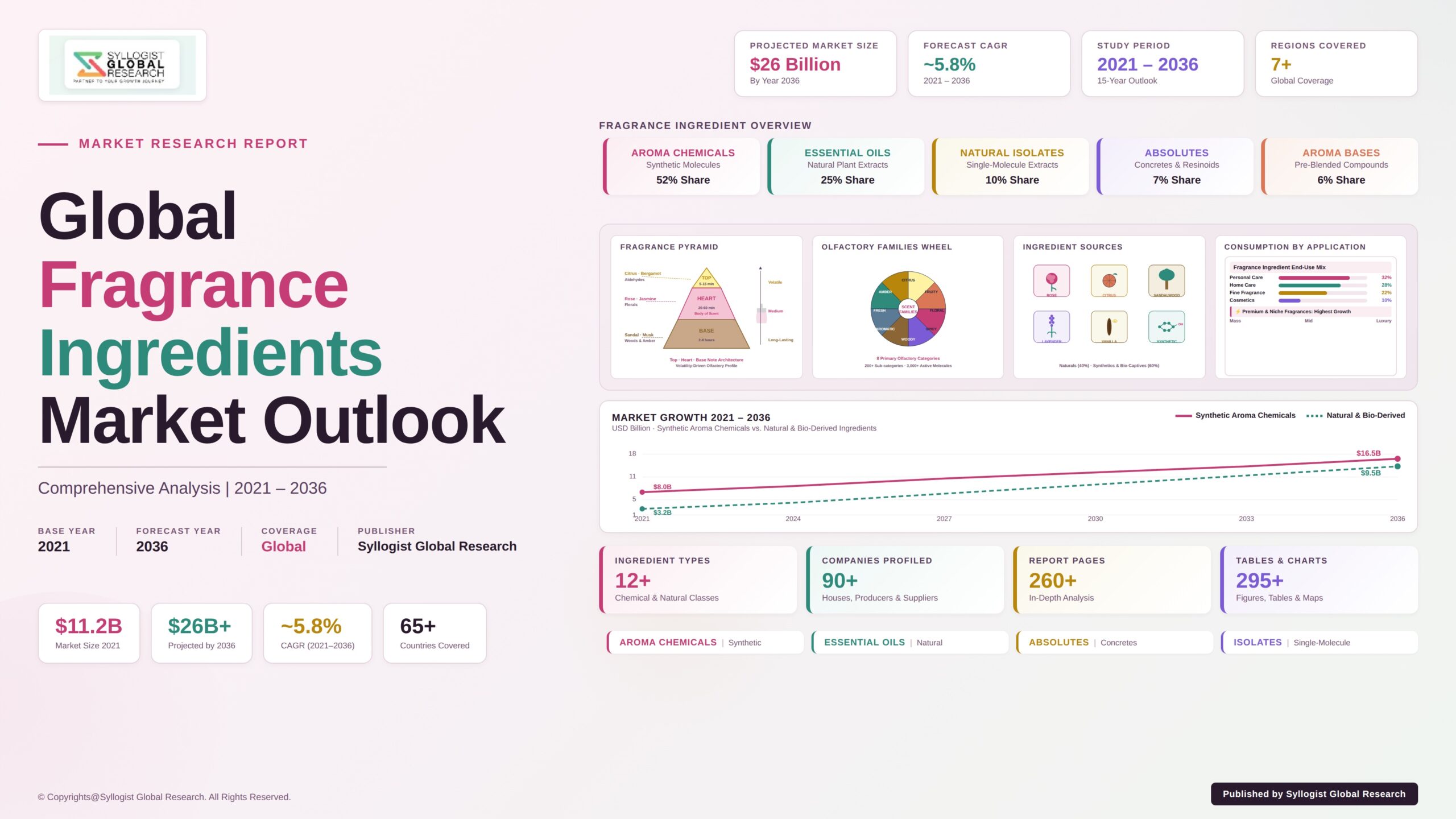
The global fragrance ingredients market is undergoing a structural growth phase, shaped by sustained premiumization of fine fragrance categories across mature consumer markets, accelerating personal care category expansion in Asia-Pacific and the Middle East, expanding household care fragrance consumption supported by laundry and dishwashing innovation, intensifying consumer preference for natural and biotechnology-derived ingredients, and tightening regulatory frameworks governing allergen labeling, restricted substance lists, and sustainable sourcing certification. The fragrance ingredients market was valued at approximately USD 14.6 billion in 2025 and is projected to reach USD 25.8 billion by 2034, advancing at a compound annual growth rate of 6.5% through the forecast period, as fine fragrance houses, personal care formulators, household care manufacturers, and functional fragrance customers scale ingredient procurement across mature and emerging consumer markets globally.
The fragrance ingredients market trajectory is being reshaped by the commercial maturation of precision fermentation-derived ingredients delivering nature-identical molecules through engineered microbial production, the structural premiumization toward certified sustainable naturals, the deployment of upcycled ingredients sourced from agricultural and food industry by-products, and the integration of artificial intelligence-driven olfactive design platforms accelerating perfumer collaboration and ingredient discovery cycles. Biotechnology-derived fragrance ingredients, including biotech-produced sandalwood, vanillin, patchouli, ambrox, and rose alcohols, have entered commercial scale production and accounted for over 8% of new ingredient launches across the fragrance ingredients market in 2024, growing at compound annual rates exceeding 18% as fragrance houses pursue carbon-reduction and supply-resilience objectives. Sustainable sourcing certification under programs including the Union for Ethical BioTrade (UEBT), Rainforest Alliance, and the Roundtable on Sustainable Palm Oil (RSPO) has become a default specification across over 65% of fine fragrance ingredient procurement decisions.
Synthetic aroma chemicals represent the largest ingredient type segment within the fragrance ingredients market, propelled by sustained demand from fine fragrance compounding, personal care formulation, and household care fragrance applications requiring consistent supply, controlled cost, and IFRA-compliant olfactive performance. Natural ingredients including essential oils, absolutes, and resinoids represent the second largest segment within the fragrance ingredients market and continue to expand at compound annual rates above the broader market growth rate, propelled by clean-label consumer preferences and premium fine fragrance positioning. Fine fragrance remains the largest application segment within the fragrance ingredients market in revenue terms, supported by sustained premium fine fragrance launches, prestige brand expansion in Asia-Pacific, and continued consumer demand for niche perfumery propositions. Personal care represents the fastest-growing application segment within the fragrance ingredients market, propelled by hair care, body care, deodorant, and color cosmetic fragrance innovation supporting category premiumization globally.
Asia-Pacific represents the largest regional market within the fragrance ingredients market, anchored by substantial ingredient consumption across personal care, household care, and fine fragrance applications in China, India, Japan, South Korea, and Southeast Asia, supported by sustained category growth, rising consumer disposable incomes, and expanding domestic fragrance compounding capacity. India hosts the largest concentration of natural fragrance ingredient cultivation globally, including sandalwood, jasmine sambac, tuberose, vetiver, and tropical floral cultivation supplying both domestic and global fragrance compounding markets. North America represents the second largest regional position within the fragrance ingredients market, supported by mature fine fragrance consumption, extensive household care innovation, and accelerating natural and biotechnology-derived ingredient procurement among consumer goods companies. Europe occupies the third major regional position within the fragrance ingredients market, anchored by established fine fragrance houses in France, Switzerland, and Italy, sustained personal care innovation, and stringent regulatory frameworks driving sustainability and allergen disclosure compliance across the fragrance ingredients market value chain globally.
Key Drivers
Fine Fragrance Premiumization, Niche Perfumery Expansion, and Personal Care Category Growth Driving Sustained Fragrance Ingredients Procurement
The sustained premiumization of fine fragrance categories, accelerating niche perfumery launches, and continued growth of personal care category fragrance consumption are collectively driving durable procurement demand for fragrance ingredients within the fragrance ingredients market across mature and emerging consumer markets globally. Global fine fragrance retail revenue scaled at compound annual rates exceeding 9% between 2021 and 2025, propelled by sustained premium and prestige brand launches, niche perfumery proposition expansion, and accelerating Middle Eastern, Asian, and Latin American fragrance consumption growth that materially exceeds historic market growth rates. Niche perfumery launches generate substantially higher per-unit ingredient procurement intensity relative to mass-market fine fragrance launches, with niche compositions typically incorporating 60 to 120 distinct fragrance ingredients per formula versus 30 to 60 for mass-market launches, generating elevated ingredient sourcing intensity within the fragrance ingredients market. Personal care category fragrance consumption is scaling sustainably across hair care, body care, deodorant, color cosmetics, and skin care applications, with consumer surveys consistently identifying fragrance as among the top 3 purchase decision drivers across personal care categories. Fragrance houses are structuring multi-year fragrance ingredients supply commitments aligning ingredient procurement with new product launch pipelines and brand portfolio expansion, generating durable revenue commitments that anchor specialty ingredient producer capacity scaling decisions across the fragrance ingredients market value chain globally.
Biotechnology-Derived Ingredient Commercialization, Sustainability Procurement Mandates, and Supply Resilience Investment Driving Specialty Ingredient Procurement
Accelerating commercialization of biotechnology-derived fragrance ingredients, expanding sustainability procurement mandates from major consumer goods companies, and intensifying supply resilience investment by fragrance houses seeking to reduce exposure to climate-sensitive natural ingredient supply chains are collectively driving sustained procurement of specialty ingredients within the fragrance ingredients market. Biotechnology-derived ingredients including biotech sandalwood, vanillin, patchouli, ambrox, rose alcohols, and specialty molecule analogs have entered commercial-scale production and offer fragrance houses nature-identical olfactive performance with reduced carbon intensity, controlled supply consistency, and decoupled exposure to climate-affected cultivation regions. Biotechnology-derived ingredients accounted for over 8% of new ingredient launches across the fragrance ingredients market in 2024 and continue to scale at compound annual rates exceeding 18%, propelled by carbon reduction commitments, supply resilience mandates, and consumer-facing brand positioning around innovation. Sustainability procurement mandates from major personal care, household care, and fine fragrance customers are reinforcing procurement preference for certified naturals under UEBT, Rainforest Alliance, and other sustainability frameworks, while supply chain resilience investment is generating sustained capital deployment toward biotechnology-derived alternatives to climate-vulnerable cultivation-based ingredients within the fragrance ingredients market value chain globally.
Household Care Fragrance Innovation, Air Care Category Expansion, and Functional Perfumery Application Growth Driving Volume Ingredient Procurement
Sustained innovation across laundry, dishwashing, surface care, and air care categories, accelerating air care market expansion supported by home wellness trends, and growing functional perfumery applications including textile finishing, personal hygiene, and odor control are collectively driving sustained volume procurement of fragrance ingredients within the fragrance ingredients market across mature and emerging consumer markets globally. Global household care category fragrance consumption scaled at compound annual rates exceeding 5% between 2021 and 2025, propelled by sustained laundry detergent premium launches, dishwashing innovation, surface care fragrance differentiation, and air care category expansion. Air care category retail revenue scaled at compound annual rates exceeding 7% between 2021 and 2025, supported by sustained home wellness consumer trends, candle category growth, reed diffuser expansion, and electronic air freshener procurement. Functional perfumery applications including textile fabric conditioner fragrance, personal hygiene odor masking, and industrial deodorization are expanding the application envelope for high-stability fragrance ingredients within the fragrance ingredients market. Major consumer goods companies are structuring multi-year fragrance ingredients supply commitments aligning ingredient procurement with category innovation pipelines and product portfolio expansion, generating durable revenue commitments across the fragrance ingredients market value chain.
Key Challenges
Natural Ingredient Supply Volatility, Climate-Driven Cultivation Risk, and Geopolitical Sourcing Concentration Affecting Fragrance Ingredient Producers
The fragrance ingredients market continues to face material natural ingredient supply volatility, sustained climate-driven cultivation risk affecting major essential oil and absolute production regions, and geographic sourcing concentration that collectively generate supply reliability challenges across fragrance ingredient producers and downstream fragrance houses globally. Natural fragrance ingredients including jasmine, rose, tuberose, sandalwood, vetiver, patchouli, and citrus oils experience material year-over-year supply variability driven by adverse weather events, drought conditions, pest outbreaks, and crop disease impacts on cultivation regions concentrated in specific geographies. Jasmine absolute cultivation concentrated in India and Egypt, rose absolute cultivation concentrated in Bulgaria and Turkey, sandalwood cultivation concentrated in Australia and India, and citrus oil cultivation concentrated in Brazil, Florida, and Italy all generate geographic sourcing concentration risks affecting fragrance ingredient supply reliability within the fragrance ingredients market. Climate-driven cultivation risk has driven 20% to 50% inter-annual price volatility for select natural fragrance ingredients between 2021 and 2025, generating sustained margin pressure for fragrance ingredient producers operating multi-year supply commitments and complicating long-term pricing commitments to downstream fragrance house customers. Geopolitical sourcing concerns affecting select natural ingredient supply chains add further procurement complexity that fragrance ingredient producers continue to address through supply chain diversification, captive cultivation investment, and biotechnology-derived alternative development within the fragrance ingredients market.
Tightening IFRA Restrictions, Allergen Labeling Requirements, and Regulatory Compliance Complexity Constraining Ingredient Application Breadth
The fragrance ingredients market continues to confront tightening International Fragrance Association (IFRA) standards governing ingredient usage levels, expanding European Union allergen labeling requirements, and sustained regulatory compliance complexity that collectively constrain ingredient application breadth and require ongoing reformulation investment across fragrance compounding operations globally. IFRA standards governing restricted, prohibited, and use-level-restricted ingredients have progressively tightened across successive amendments, with the 51st IFRA Amendment introducing additional restrictions affecting select aromatic chemicals widely used across fine fragrance, personal care, and household care formulations within the fragrance ingredients market. European Union regulation 1223/2009 on cosmetic products requires labeling of 26 fragrance allergens on cosmetic packaging, with expanded labeling requirements extending the list to 80 allergens following recent regulatory updates, generating reformulation investment to reduce labeled allergen content and complicating ingredient procurement decisions for personal care formulators. Regulatory compliance complexity governing IFRA standards, allergen labeling, REACH chemical registration, California Proposition 65 disclosure, and emerging Asia-Pacific cosmetic regulation frameworks requires fragrance ingredient producers to maintain region-specific regulatory dossiers, ingredient documentation, and customer technical support resources. The combined effect of IFRA restrictions, allergen labeling expansion, and regulatory compliance complexity continues to constrain ingredient application breadth and elevate ongoing reformulation investment within the fragrance ingredients market value chain.
Cost Pressure from Mass Market Customers, Margin Erosion in Commodity Aroma Chemicals, and Competitive Pressure from Vertically Integrated Fragrance Houses
The fragrance ingredients market continues to face sustained cost pressure from mass market consumer goods customers, persistent margin erosion across commodity aroma chemical segments, and competitive pressure from vertically integrated fragrance houses operating captive ingredient production capacity that collectively constrain commercial profitability and capital deployment decisions across independent fragrance ingredient producers globally. Mass market consumer goods customers including major laundry, dishwashing, and personal care manufacturers continue to drive procurement pricing negotiations toward sustained cost reduction targets, generating margin pressure for fragrance ingredient producers supplying high-volume commodity aroma chemicals to mass-market fragrance compounding programs within the fragrance ingredients market. Commodity aroma chemical segments including linalool, citronellol, eugenol, vanillin, and standard musks face sustained margin erosion driven by capacity additions in China and India, generating downward pricing pressure across volume aroma chemical product lines that constrains profitability for established producers. Competitive pressure from vertically integrated global fragrance houses operating captive ingredient production facilities adds further margin pressure, with vertically integrated producers benefiting from internal supply commitments that constrain addressable market opportunities available to independent fragrance ingredient producers within the fragrance ingredients market. Independent producers are responding through specialty chemistry investment, biotechnology platform development, and captive molecule innovation, but sustained competitive pressure continues to constrain volume aroma chemical margin economics.
Market Segmentation
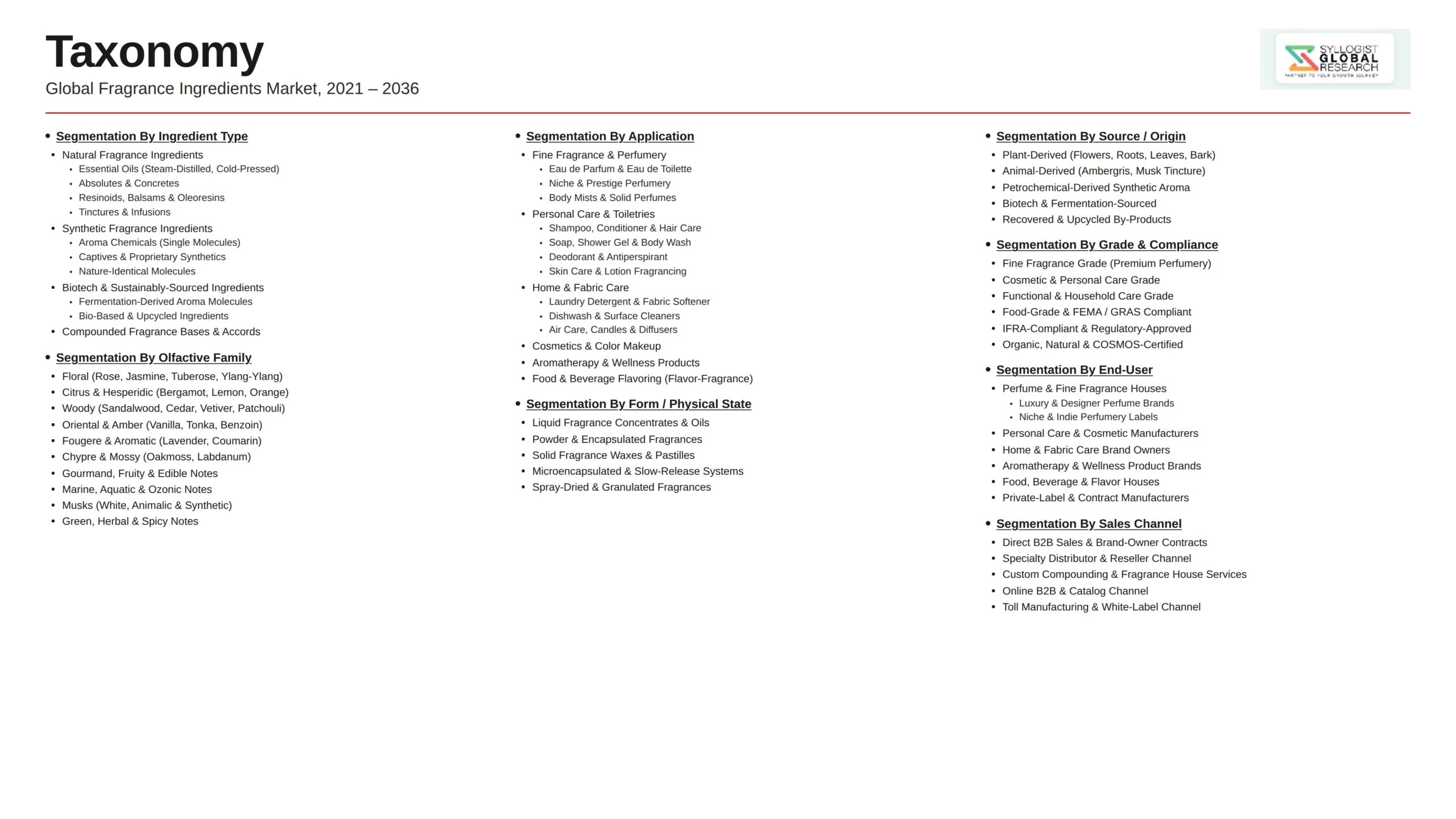
- Segmentation By Ingredient Type
- Natural Ingredients (Essential Oils, Absolutes, Resinoids, Concretes)
- Aroma Chemicals (Synthetic)
- Biotechnology-Derived Ingredients
- Isolates and Natural Derivatives
- Specialty Captives and Proprietary Molecules
- Others
- Segmentation By Source
- Plant-Derived (Floral, Wood, Leaf, Root, Fruit, Seed)
- Animal-Derived (Traditional, Largely Replaced by Synthetics)
- Synthetic Petrochemical-Derived
- Biotechnology Fermentation-Derived
- Upcycled and Circular Economy Sources
- Segmentation By Application
- Fine Fragrance and Niche Perfumery
- Personal Care (Hair Care, Body Care, Deodorants, Color Cosmetics)
- Household Care (Laundry, Dishwashing, Surface Care)
- Air Care (Candles, Diffusers, Sprays)
- Functional Perfumery (Textile, Industrial, Hygiene)
- Others
- Segmentation By Form
- Liquid
- Solid (Crystals, Powders)
- Pre-Blended Accords
- Encapsulated Forms
- Segmentation By Olfactive Family
- Floral
- Woody
- Citrus
- Oriental and Amber
- Fougere
- Chypre
- Aromatic and Aquatic
- Musk
- Others
- Segmentation By Function
- Top Notes (Volatile)
- Middle Notes (Heart)
- Base Notes (Fixatives)
- Modifiers and Enhancers
- Segmentation By End User Industry
- Fine Fragrance Houses
- Personal Care Manufacturers
- Household Care Manufacturers
- Candle and Home Care Formulators
- Functional Fragrance Operators
- Contract Compounding Manufacturers
- Others
- Segmentation By Region
- North America
- Europe
- Asia-Pacific
- Middle East and Africa
- Latin America
All market revenues are presented in USD
Historical Year: 2021-2024 | Base Year: 2025 | Estimated Year: 2026 | Forecast Period: 2027-2034
Key Questions this Study Will Answer
- What is the total global market valuation of the Fragrance Ingredients Market in 2025, projected through 2034, segmented by ingredient type, source, application, and olfactive family, enabling fragrance ingredient producers, fragrance houses, personal care formulators, and consumer goods procurement teams to identify highest-growth segments and most durable revenue opportunities across the fragrance ingredients landscape?
- How are fine fragrance houses, personal care formulators, household care manufacturers, and contract compounding operators structuring procurement frameworks for fragrance ingredients, and which commercial models, including spot purchase, multi-year supply agreements, captive ingredient sourcing, and joint development partnerships, are shaping commercial deployment economics within the fragrance ingredients market through 2034?
- What sustainability procurement mandates, biotechnology-derived ingredient commercialization, and supply resilience investment dynamics are reshaping ingredient substitution timelines for natural and synthetic fragrance ingredient technologies across mature and emerging consumer markets?
- Which ingredient types, including essential oils, absolutes, aroma chemicals, biotechnology-derived ingredients, and specialty captives, are gaining the strongest procurement traction across fine fragrance, personal care, household care, and air care applications, and what olfactive, regulatory compliance, and total cost of ownership metrics are shaping ingredient selection decisions?
- How is the competitive landscape structured among established global fragrance ingredient producers, captive ingredient manufacturers within fragrance houses, specialty chemical producers, biotechnology developers, and natural ingredient extractors within the fragrance ingredients market, and what partnership, acquisition, and platform expansion strategies are enabling new entrants to compete against incumbent ingredient producers?
- What IFRA standards, European Union allergen labeling requirements, sustainability certification frameworks, and ingredient regulatory compliance dynamics are reshaping reformulation timelines, ingredient documentation, and customer technical support requirements across the fragrance ingredients market globally?
- Which regional markets, including Asia-Pacific, North America, and Europe, are projected to generate the largest incremental fragrance ingredients procurement opportunities through 2034, and what consumer category, demographic, sustainability mandate, and biotechnology investment factors are shaping capability investment priorities and supplier selection decisions in each regional fragrance ingredients market?
- Product Definition
- Research Methodology
- Research Design & Framework
- Overall Research Approach: Descriptive, Exploratory & Quantitative Mixed-Method Design
- Market Definition & Scope Boundaries: What is Included and Excluded
- Segmentation Framework
- Key Research Assumptions & Limitations
- Secondary Research
- Primary Research Design & Execution
- Data Triangulation & Validation
- Market Sizing & Forecasting Methodology
- Competitive Intelligence Methodology
- Quality Assurance & Peer Review
- Definitions, Abbreviations & Data Notes
- Executive Summary
- Market Snapshot & Headline Numbers
- Key Findings & Research Highlights
- Market Dynamics
- Regional Market Summary
- Competitive Landscape Snapshot
- Technology & Innovation Highlights
- Market Dynamics
- Drivers
- Restraints
- Opportunities
- Challenges
- Porter’s Five Forces Analysis
- PESTLE Analysis
- Market Trends & Developments
- Emerging Trends
- Technological Developments
- Regulatory & Policy Changes
- Supply Chain & Sourcing Trends
- Manufacturing & Process Trends
- Investment & Funding Activity
- Sustainability & ESG Trends
- Risk Assessment Framework
- Raw Material Cost Volatility, Natural Botanical Sourcing & Crop Failure Risk
- IFRA Standards Tightening, Allergen Disclosure Mandates & Regulatory Reformulation Risk
- Customer Concentration, Fine Fragrance House Switching Cost & Long Brief-to-Launch Cycle Risk
- Counterfeit Captive Reproduction, Trade Secret Protection & Intellectual Property Enforcement Risk
- Sustainable Sourcing Verification, Ethical Botanical Procurement & Brand Reputational Risk
- Regulatory Framework & Standards
- International Fragrance Association (IFRA) Standards & Allergen Disclosure Requirements
- REACH Registration, CLP Classification & EU Chemical Authorisation Frameworks
- US FDA Cosmetic Ingredient Compliance & Modernization of Cosmetics Regulation Act (MoCRA) Standards
- Globally Harmonised System (GHS), Hazard Communication & Workplace Safety Compliance
- Sustainability, Traceability & ESG Certification Frameworks (Union for Ethical BioTrade, RSPO, Fairtrade, CITES)
- Global Fragrance Ingredients Market Outlook
- Market Size & Forecast by Value
- Market Size & Forecast by Volume (Fragrance Ingredient Consumption in Kilotonnes and Number of Active Manufacturing Facilities)
- Market Size & Forecast by Ingredient Type
- Aroma Chemicals (Synthetic)
- Essential Oils (Natural)
- Natural Extracts and Absolutes
- Resinoids and Balsams
- Isolates and Specialty Captives
- Others
- Market Size & Forecast by Source
- Synthetic
- Natural Botanical
- Natural Animal-Derived Alternatives (Synthetic Reproductions)
- Biotechnology-Derived (Biosynthetic and Fermentation-Produced)
- Market Size & Forecast by Chemistry
- Esters
- Aldehydes
- Ketones
- Terpenes and Terpenoids
- Alcohols
- Lactones
- Musks (Macrocyclic, Polycyclic, Nitro)
- Phenolics
- Acids and Anhydrides
- Others
- Market Size & Forecast by Olfactive Family
- Floral
- Citrus
- Woody
- Oriental and Amber
- Fougere
- Chypre
- Gourmand
- Aquatic and Ozonic
- Green and Herbal
- Musky
- Market Size & Forecast by Application
- Fine Fragrance and Personal Perfumery
- Personal Care and Toiletries
- Home Care and Detergents
- Air Care
- Cosmetics and Skincare
- Fabric Care
- Functional Fragrances (Aromatherapy, Wellness, Industrial)
- Others
- Market Size & Forecast by Form
- Liquid
- Solid (Crystals and Powders)
- Encapsulated
- Others
- Market Size & Forecast by Performance Tier
- Mass Market
- Premium
- Luxury and Prestige Captive Ingredients
- Market Size & Forecast by End-User
- Fine Fragrance Houses and Perfume Brands
- Personal Care and Cosmetics Manufacturers
- Home Care and Detergent Manufacturers
- Air Care Product Manufacturers
- Fabric Care Manufacturers
- Aromatherapy and Wellness Operators
- Others
- Market Size & Forecast by Sales Channel
- Direct Manufacturer-to-Customer Supply Contracts
- Specialty Distributor & Trader Channel
- Custom Compounding & Captive Development Partnerships
- Licensed Production & Contract Manufacturing Arrangements
- Aftermarket Application Engineering & Technical Service Contracts
- North America Fragrance Ingredients Market Outlook
- Market Size & Forecast
- By Value
- By Volume (Fragrance Ingredient Consumption in Kilotonnes and Number of Active Manufacturing Facilities)
- By Ingredient Type
- By Source
- By Chemistry
- By Olfactive Family
- By Application
- By Form
- By Performance Tier
- By End-User
- By Country
- By Sales Channel
- Market Size & Forecast
- Europe Fragrance Ingredients Market Outlook
- Market Size & Forecast
- By Value
- By Volume (Fragrance Ingredient Consumption in Kilotonnes and Number of Active Manufacturing Facilities)
- By Ingredient Type
- By Source
- By Chemistry
- By Olfactive Family
- By Application
- By Form
- By Performance Tier
- By End-User
- By Country
- By Sales Channel
- Market Size & Forecast
- Asia-Pacific Fragrance Ingredients Market Outlook
- Market Size & Forecast
- By Value
- By Volume (Fragrance Ingredient Consumption in Kilotonnes and Number of Active Manufacturing Facilities)
- By Ingredient Type
- By Source
- By Chemistry
- By Olfactive Family
- By Application
- By Form
- By Performance Tier
- By End-User
- By Country
- By Sales Channel
- Market Size & Forecast
- Latin America Fragrance Ingredients Market Outlook
- Market Size & Forecast
- By Value
- By Volume (Fragrance Ingredient Consumption in Kilotonnes and Number of Active Manufacturing Facilities)
- By Ingredient Type
- By Source
- By Chemistry
- By Olfactive Family
- By Application
- By Form
- By Performance Tier
- By End-User
- By Country
- By Sales Channel
- Market Size & Forecast
- Middle East & Africa Fragrance Ingredients Market Outlook
- Market Size & Forecast
- By Value
- By Volume (Fragrance Ingredient Consumption in Kilotonnes and Number of Active Manufacturing Facilities)
- By Ingredient Type
- By Source
- By Chemistry
- By Olfactive Family
- By Application
- By Form
- By Performance Tier
- By End-User
- By Country
- By Sales Channel
- Market Size & Forecast
- Country-Wise* Fragrance Ingredients Market Outlook
- Market Size & Forecast
- By Value
- By Volume (Fragrance Ingredient Consumption in Kilotonnes and Number of Active Manufacturing Facilities)
- By Ingredient Type
- By Source
- By Chemistry
- By Olfactive Family
- By Application
- By Form
- By Performance Tier
- By End-User
- By Country
- By Sales Channel
- Market Size & Forecast
*Countries Analysed in the Global Research Portfolio: United States, Canada, Mexico, Germany, France, United Kingdom, Netherlands, Spain, Italy, Norway, Sweden, China, Japan, India, Australia, South Korea, Singapore, Brazil, Chile, Saudi Arabia, UAE, Egypt, South Africa, Israel
- Technology Landscape & Innovation Analysis
- Biotechnology, Precision Fermentation & Synthetic Biology Fragrance Ingredient Technology Deep-Dive
- Captive Molecule Discovery, Trade Secret & Proprietary Ingredient Development Technology
- Headspace Capture, Living Flower Technology & In-Situ Botanical Sampling Technology
- Microencapsulation, Controlled Release & Burst-Profile Fragrance Delivery Technology
- AI-Driven Ingredient Discovery, Olfactory Modelling & Computational Perfumery Technology
- Sustainable Botanical Extraction, Supercritical CO2 & Green Solvent Technology
- Allergen-Free Reformulation, Schiff Base Stabilisation & IFRA-Compliant Substitution Technology
- Patent & IP Landscape in Fragrance Ingredients Technologies
- Value Chain & Supply Chain Analysis
- Petrochemical Feedstock & Aroma Chemical Intermediate Supply Chain
- Natural Botanical Farming, Wild Harvesting & Sustainable Sourcing Supply Chain
- Biotechnology Fermentation & Precision-Manufactured Ingredient Supply Chain
- Essential Oil Distillation, Extraction & Specialty Processing Supply Chain
- Captive Ingredient Development, Trade Secret & Proprietary Compound Supply Chain
- Distributor, Specialty Trader & Regional Channel Partner Network
- Fine Fragrance House, Personal Care & Home Care Customer Procurement Landscape
- Aftermarket Compounding, Application Service & Custom Formulation Network
- Pricing Analysis
- Aroma Chemical Pricing Analysis Across Esters, Aldehydes, Ketones & Specialty Synthetics
- Essential Oil & Natural Extract Pricing Analysis Across Common, Specialty & Single-Origin Grades
- Captive Ingredient & Proprietary Molecule Pricing Analysis
- Biotechnology-Derived Ingredient Pricing Analysis Across Precision Fermentation Grades
- Musk, Specialty Animalic Replacement & Premium Ingredient Pricing Analysis
- Per Kilogram Fragrance Ingredient Pricing Benchmark Across Mass, Premium & Prestige Tiers
- Total Cost of Fragrance Compounding: Dosage Economics, Brief Performance & Customer Return on Investment Analysis
- Sustainability & Environmental Analysis
- Lifecycle Assessment (LCA) of Fragrance Ingredients Across Petrochemical, Botanical and Biotechnology Production Pathways
- Carbon Footprint, Energy Intensity & Cradle-to-Gate Emissions Analysis Across Fragrance Ingredient Categories
- Sustainable Botanical Sourcing, Fair Trade Certification & Smallholder Farmer Welfare
- Biodiversity, Endangered Species (CITES) Compliance & Ethical Wild Harvesting
- Regulatory-Driven Sustainability, SDG 12 (Responsible Consumption) & SDG 15 (Life on Land) Alignment & Green Finance Eligibility
- Competitive Landscape
- Market Structure & Concentration
- Market Consolidation Level (Fragmented vs. Consolidated by Ingredient Type & Geography)
- Top 10 Players Market Share
- HHI (Herfindahl-Hirschman Index) Concentration Analysis
- Competitive Intensity Map by Ingredient Type, Application & Geography
- Player Classification
- Integrated Global Flavour & Fragrance Producers (Established Global Players)
- Specialty Aroma Chemical Producers
- Natural Botanical & Essential Oil Specialists
- Biotechnology & Precision Fermentation Fragrance Specialists
- Captive Ingredient Discovery & Proprietary Molecule Specialists
- Sustainable Sourcing & Ethically Certified Botanical Specialists
- Encapsulation, Controlled Release & Specialty Delivery System Specialists
- Regional Producers & Distribution-Focused Channel Specialists
- Competitive Analysis Frameworks
- Market Share Analysis by Ingredient Type, Application & Region
- Company Profile
- Company Overview & Headquarters
- Fragrance Ingredient Products & Technology Portfolio
- Key Customer Relationships & Reference Customer Accounts
- Manufacturing Footprint & Production Capacity
- Revenue (Fragrance Ingredients Segment) & Order Backlog
- Technology Differentiators & IP
- Key Strategic Partnerships, JVs & M&A Activity
- Recent Developments (Contract Wins, Capacity Expansion, Product Launches)
- SWOT Analysis
- Strategic Focus Areas & Roadmap
- Competitive Positioning Map (Technology Capability vs. Market Penetration)
- Key Company Profiles
- Market Structure & Concentration
- Technology Landscape & Innovation Analysis
- Strategic Output
- Market Opportunity Matrix: By Ingredient Type, Source, Application, End-User & Geography
- White Space Opportunity Analysis
- Strategic Recommendations
- Product Portfolio & Fragrance Ingredient Technology Investment Strategy
- Manufacturing & Operational Excellence Strategy
- Geographic Expansion & Localisation Strategy
- Customer & End-User Engagement Strategy
- Partnership, M&A & Ecosystem Strategy
- Sustainability & Circular Economy Strategy
- Risk Mitigation & Future Roadmap
- Strategic Priority Matrix & Roadmap
- Near-term (2025-2028)
- Mid-term (2029-2032)
- Long-term (2033-2037)