Global Mineral Assay and Testing Services Market By Service Type, By Sample Type, By Technique, By Mineral Type, By Sector, By End User, By Mode of Service, By Region, Competition, Forecast & Opportunities, 2021-2034F
Market Definition
The Global Mineral Assay and Testing Services Market encompasses the provision of specialised analytical laboratory services that determine the elemental composition, mineralogical characteristics, physical properties, and economic value of geological samples drawn from exploration drill core, channel and chip sampling, blast hole cuttings, run of mine ore, concentrates, tailings, smelter products, and refined metals. Service offerings include fire assay for precious metals, atomic absorption spectroscopy, inductively coupled plasma optical emission spectroscopy, inductively coupled plasma mass spectrometry, X-ray fluorescence, X-ray diffraction, scanning electron microscopy, automated mineralogy, leach and metallurgical testwork, particle size analysis, moisture and density determination, and geometallurgical characterisation for process design. End users include mining majors, mid tier and junior mining companies, exploration geologists, smelters, refiners, traders, government geological surveys, regulatory authorities, and financial institutions requiring independent verification of resource estimates and concentrate quality for trade settlement. Services are delivered through global laboratory networks operated by multinational testing firms, regional independent laboratories, captive mine site laboratories, mobile and on site units, and increasingly through hybrid digital platforms that combine automated sample preparation, robotic analysis, and cloud delivered results portals. The market also covers commercial certification services aligned with reserve reporting standards including the JORC Code, NI 43-101, SAMREC, and PERC, alongside ISO 17025 accredited methodology compliance, chain of custody protocols, and umpire assay services that resolve commercial disputes between buyers and sellers of mineral concentrates. The study scope captures global revenue dynamics, pricing per sample analytics, regional capacity expansion, technology shifts toward automation and digital laboratories, and competitive positioning of major testing networks alongside specialised boutique laboratories serving niche commodities such as lithium, rare earths, and platinum group metals.
Market Insights
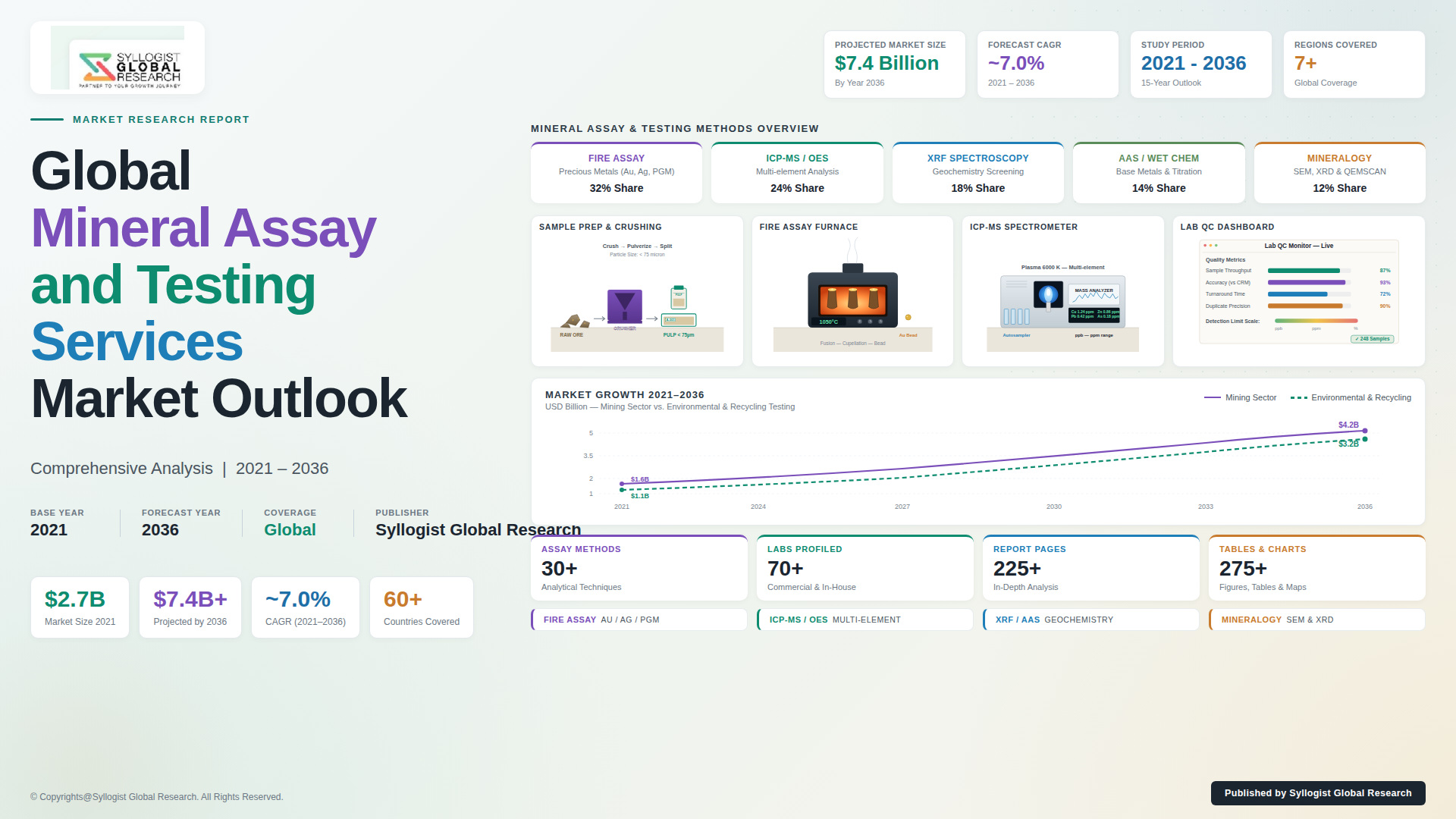
The global mineral assay and testing services market is advancing through a sustained growth phase shaped by record exploration spending, the proliferation of critical mineral projects driving battery and clean energy supply chains, and a measurable shift toward higher specification analytical methods to characterise increasingly complex orebodies. The market was valued at approximately USD 3.5 billion in 2025 and is projected to reach USD 5.8 billion by 2034, advancing at a compound annual growth rate of 5.8% through the forecast period, supported by global exploration budgets exceeding USD 13 billion annually, rising sample volumes per drill metre on complex deposits, and growing demand for advanced characterisation services including automated mineralogy, geometallurgy, and trace element analysis at parts per billion sensitivity. Mining operators are also increasing the frequency of grade control sampling on producing operations to tighten reconciliation between geological models, mill feed, and final product, supporting recurring testing revenue independent of exploration cycles.
Asia Pacific represents the largest regional market with a revenue share of approximately 36%, anchored by Australia’s globally leading commercial laboratory network, China’s vast domestic testing infrastructure, and rapidly expanding capacity across Indonesia, the Philippines, and India tied to nickel, copper, bauxite, coal, and iron ore production. North America accounts for close to 24% of revenue, supported by gold and copper exploration in Nevada, British Columbia, Ontario, and Mexico, alongside the emerging lithium and rare earth project pipeline. Latin America contributes around 22% of global revenue, anchored by Chile, Peru, Brazil, and Argentina, where copper, lithium, gold, and silver production sustain durable testing volumes. Africa is registering the fastest regional growth at a CAGR of 7.6%, driven by lithium projects in Zimbabwe and Namibia, copper expansion across the Democratic Republic of Congo and Zambia, gold development throughout West Africa, and rare earth exploration in Madagascar, Tanzania, and Burundi.
The structural transition toward automation, digital laboratories, and data integration is redefining competitive positioning across the mineral assay value chain. Robotic sample preparation, automated fire assay lines, and high throughput inductively coupled plasma instrumentation are reducing turnaround times from the traditional 7 to 14 days down to 48 to 72 hours, while delivering productivity gains of 30% to 45% per analyst on standard assay workloads. Cloud delivered laboratory information management systems with secure customer portals, automated chain of custody tracking, blockchain enabled traceability, and direct integration into client geological databases are emerging as core differentiators for sophisticated mining customers. Specialised geometallurgical services, automated mineralogy, and trace element fingerprinting are capturing premium margins as operators link mineralogical data to process recovery models, tailings management strategies, and ESG aligned product stewardship under tightening regulatory scrutiny.
The competitive landscape is moderately consolidated at the top, with the four largest commercial laboratory networks controlling close to 45% of global revenue, while a long tail of regional independent laboratories, captive mine site laboratories, and specialised boutique providers serve niche commodities and geographies. Leading networks are differentiating through laboratory footprint, accreditation depth, turnaround speed, digital service overlays, and bundled metallurgical and consulting offerings. Mining exploration accounts for around 38% of total service spending, production grade control and reconciliation contribute close to 32%, metallurgical and processing testwork accounts for 18%, and trade settlement, umpire, and certification services account for the remaining 12%. Lithium, copper, gold, nickel, cobalt, and rare earths together drive close to 70% of incremental revenue growth, while precious metals continue to underpin the largest absolute base of fire assay volumes globally and remain the most resilient revenue segment across commodity price cycles.
Key Drivers
Critical Mineral Exploration Boom and Energy Transition Commodity Demand Driving Sustained Growth in Sample Volumes and Premium Analytical Service Adoption
The global push toward electrification, renewable energy generation, and electric mobility is producing durable demand for copper, lithium, nickel, cobalt, manganese, graphite, and rare earth elements, with the International Energy Agency projecting that critical mineral demand will rise more than 3.5 times by 2040 under stated net zero pathways. Junior exploration spending has surged, drill programmes have multiplied, and assay volumes per project have climbed sharply as complex orebodies require higher sample density and broader multi element analytical packages. Each new critical mineral project typically generates 50,000 to 200,000 assay determinations during its exploration and feasibility phases, anchoring multi year recurring revenue streams for global laboratory networks and driving capacity expansion in lithium and rare earth specific testing capability.
ESG Disclosure, Regulatory Reporting, and Reserve Standards Driving Demand for Accredited Independent Testing and Auditable Chain of Custody Services
Public reserve reporting under the JORC Code, NI 43-101, SAMREC, and PERC frameworks, combined with sustainability disclosure obligations under TCFD, IFRS S2, and CSRD, requires mining companies to use ISO 17025 accredited laboratories with rigorous quality assurance and quality control programmes, certified reference materials, and traceable chain of custody documentation. Listed miners, project lenders, and offtake counterparties are tightening procurement standards, raising the bar for laboratory accreditation depth, and reinforcing the competitive position of established commercial networks with proven regulatory pedigree across multiple jurisdictions, audited methodology libraries, and a track record of competent person sign off compliance.
Smelter, Refinery, and Trade Settlement Volumes Driving Recurring Demand for Umpire Assay, Concentrate Certification, and Independent Quality Verification Services
Global trade in copper, gold, silver, lead, zinc, nickel, and lithium concentrates relies on independent assay results for commercial settlement, with each cargo typically requiring buyer, seller, and umpire determinations to resolve any payable metal disputes. Rising concentrate trade volumes, increased complexity of penalty elements such as arsenic, mercury, fluorine, and uranium, and growing concentrate flows from emerging producing regions including Africa, Central Asia, and South America are anchoring durable recurring revenue for accredited testing networks with port and refinery proximity, multi commodity capability, and established arbitration credibility among global trading houses.
Key Challenges
Skilled Analyst and Geochemist Shortage Limiting Capacity Expansion and Constraining Turnaround Times During Exploration Cycle Peaks
The mineral assay industry depends on highly skilled analytical chemists, geochemists, fire assayers, and laboratory technicians whose training pipelines have not kept pace with demand. University enrolment in analytical chemistry and geosciences has declined across major mining nations, while experienced fire assayers and inductively coupled plasma specialists command rising wages amid intensifying competition for talent. Skilled labour shortages translate into extended turnaround times during exploration cycle peaks, sample backlogs that frustrate mining customers, and constrained capacity to expand laboratory footprints into emerging mining jurisdictions where local skills depth remains limited, slowing geographic expansion roadmaps for global testing networks.
Sample Logistics, Cross Border Customs Complexity, and Hazardous Goods Regulations Compressing Margins on Remote Project Workflows
Mineral samples drawn from remote exploration projects across Africa, Latin America, Central Asia, and Arctic frontiers face significant logistical complexity, including chain of custody preservation, hazardous goods declarations, customs clearance, and import duties that can extend transit times by 7 to 21 days and add material cost per sample. Restrictions on transporting samples containing potential radioactive trace elements, certain rare earth concentrates, and lithium bearing minerals add further compliance burden, while currency volatility and freight cost spikes compress margins on fixed price contracts that typically run 12 to 24 months without renegotiation rights, forcing testing networks to absorb input cost inflation across the contract term.
Commodity Price Cyclicality and Exploration Budget Volatility Creating Demand Fluctuations and Pressuring Laboratory Capacity Utilisation
Mineral assay demand is structurally linked to commodity prices and junior exploration capital availability, both of which exhibit pronounced cyclicality. Sharp pullbacks in gold, copper, lithium, or nickel prices typically translate into rapid exploration budget cuts within 6 to 12 months, leading to underutilised laboratory capacity, fixed cost absorption pressure, and short term margin compression across regional networks. Laboratory operators must balance capacity expansion ahead of commodity cycle peaks against the risk of carrying excess capacity through downturns, a structural tension that limits aggressive capital deployment, slows greenfield laboratory openings, and constrains the addressable market opportunity during early stage exploration recovery phases.
Market Segmentation
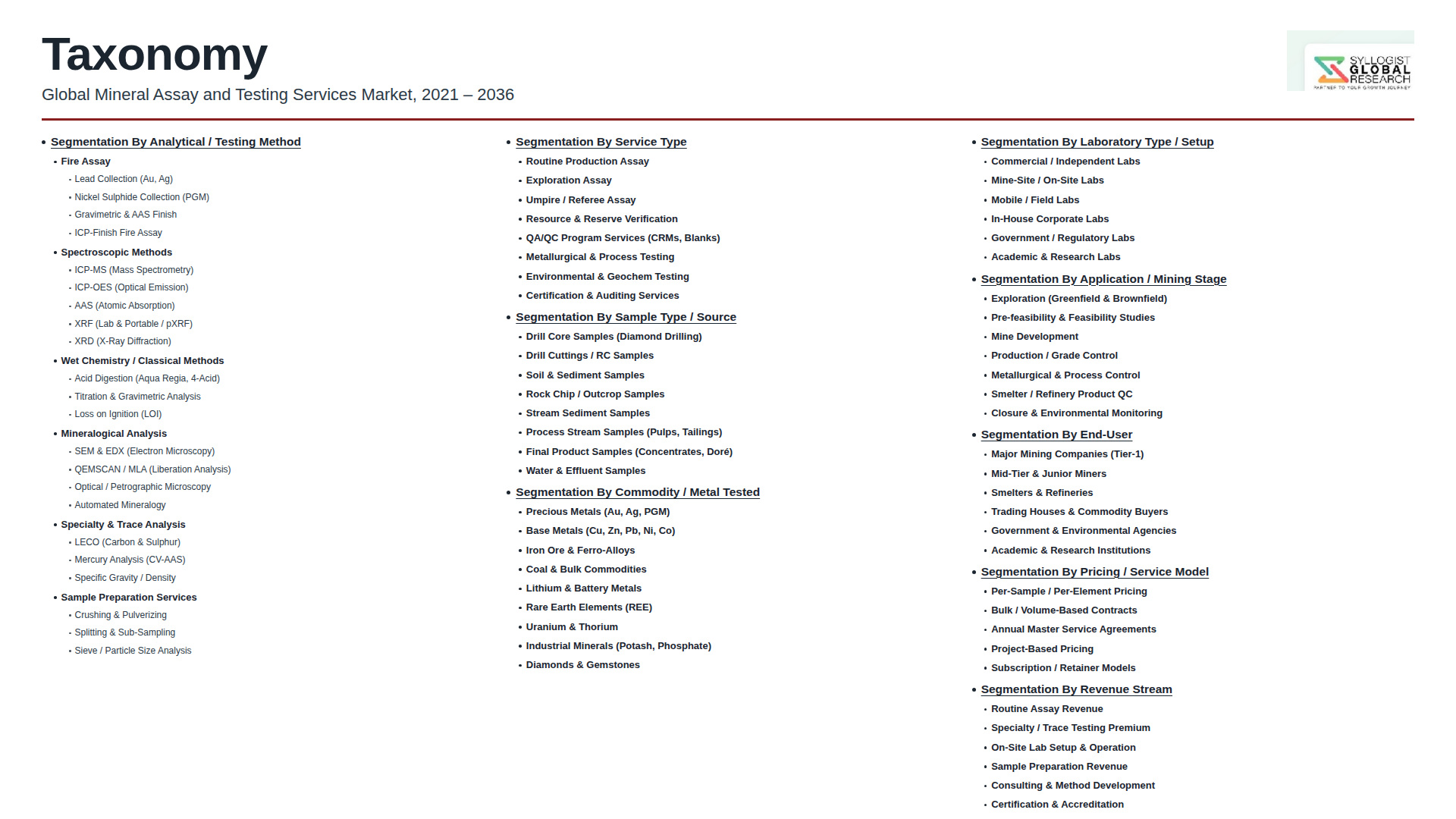
- Segmentation By Service Type
- Sample Preparation
- Chemical and Elemental Assay
- Mineralogical and Petrographic Analysis
- Physical Property Testing
- Metallurgical and Geometallurgical Testwork
- Certification and Umpire Services
- Others
- Segmentation By Sample Type
- Exploration Drill Core and Cuttings
- Channel and Chip Samples
- Run of Mine Ore and Production Samples
- Concentrates and Mill Products
- Tailings and Process Streams
- Refined Metals and Bullion
- Others
- Segmentation By Technique
- Fire Assay
- Atomic Absorption Spectroscopy (AAS)
- Inductively Coupled Plasma Optical Emission Spectroscopy (ICP-OES)
- Inductively Coupled Plasma Mass Spectrometry (ICP-MS)
- X-Ray Fluorescence (XRF)
- X-Ray Diffraction (XRD)
- Scanning Electron Microscopy (SEM) and Automated Mineralogy
- Leach and Cyanide Methods
- Others
- Segmentation By Mineral Type
- Precious Metals (Gold, Silver, Platinum Group Metals)
- Base Metals (Copper, Lead, Zinc, Nickel)
- Battery Minerals (Lithium, Cobalt, Manganese, Graphite)
- Rare Earth Elements
- Iron Ore and Ferroalloys
- Coal
- Industrial Minerals
- Others
- Segmentation By Sector
- Exploration
- Production Grade Control and Reconciliation
- Metallurgical and Process Optimisation
- Trade Settlement and Concentrate Certification
- Environmental and Tailings Monitoring
- Others
- Segmentation By End User
- Mining Majors and Multinational Operators
- Mid Tier Mining Companies
- Junior Explorers and Project Developers
- Smelters, Refiners, and Commodity Traders
- Government Geological Surveys and Regulatory Authorities
- Financial Institutions and Independent Engineers
- Others
- Segmentation By Mode of Service
- Centralised Commercial Laboratories
- Captive Mine Site Laboratories
- Mobile and On Site Units
- Hybrid Digital Laboratory Services
- Segmentation By Region
- North America
- Europe
- Asia Pacific
- Latin America
- Middle East and Africa
All market revenues are presented in USD
Historical Year: 2021-2024 | Base Year: 2025 | Estimated Year: 2026 | Forecast Period: 2027-2034
Key Questions this Study Will Answer
- What is the total global market valuation of the Mineral Assay and Testing Services Market in 2025, projected through 2034, disaggregated by service type, technique, mineral type, sector, and region, enabling laboratory networks, mining operators, and investors to identify the highest growth segments and most durable revenue opportunities across the global mineral testing value chain?
- How are Asia Pacific, North America, Latin America, and Africa evolving as mineral assay markets in response to differing commodity exposure, exploration spending cycles, regulatory frameworks, and laboratory infrastructure maturity, and which country level markets are defining the technical benchmarks and procurement standards for global testing network competition through 2034?
- Which analytical techniques including fire assay, ICP-OES, ICP-MS, XRF, XRD, SEM, and automated mineralogy are gaining the highest share of sample volumes and revenue, and how should laboratory networks sequence investments in instrumentation, automation, and analyst capacity to capture premium pricing on advanced characterisation services?
- How is the energy transition reshaping the mineral mix tested globally, and which commodities including lithium, copper, nickel, cobalt, rare earths, and graphite are generating the highest incremental sample volume growth, premium pricing power, and capacity expansion priorities for testing networks through the forecast period?
- What is the structure of the competitive landscape across multinational commercial laboratory networks, regional independent laboratories, captive mine site laboratories, and specialised boutique providers, and what partnership, acquisition, and capacity expansion strategies are reshaping market share, geographic footprint, and customer lock in dynamics?
- How are mining customer procurement behaviours, framework agreements, turnaround time expectations, and digital service preferences evolving, and what go to market motions covering direct sales, project specific tenders, framework contracts, and consulting led delivery are most effective in winning enterprise level testing mandates?
- Which regulatory developments under JORC, NI 43-101, SAMREC, PERC, ISO 17025, TCFD, IFRS S2, and CSRD frameworks are generating new accreditation, traceability, and reporting requirements for mineral assay services, and how should laboratory networks prioritise compliance investment and methodology library expansion to defend regulatory positioning?
- What automation, robotics, laboratory information management system, and digital chain of custody capabilities are emerging as competitive differentiators, and how are leading testing networks monetising digital service overlays alongside traditional per sample pricing through subscription portals and integrated client data services?
- How are commodity price cyclicality, exploration capital availability, and freight and logistics cost dynamics shaping laboratory capacity planning, capital deployment, and pricing strategies across global testing networks, and which operational levers are most effective in protecting margin through downturns and expanding share through cycle recoveries?
- Which strategic partnerships, joint ventures, mergers and acquisitions, technology licensing arrangements, and capacity expansions are reshaping the global mineral assay landscape, and what entry barriers, accreditation requirements, capital intensity, and customer relationship dynamics face new entrants seeking to scale globally in this specialised analytical services market?
- Product Definition
- Research Methodology
- Research Design & Framework
- Overall Research Approach: Descriptive, Exploratory & Quantitative Mixed-Method Design
- Market Definition & Scope Boundaries: What is Included and Excluded
- Segmentation Framework
- Key Research Assumptions & Limitations
- Secondary Research
- Primary Research Design & Execution
- Data Triangulation & Validation
- Market Sizing & Forecasting Methodology
- Competitive Intelligence Methodology
- Quality Assurance & Peer Review
- Definitions, Abbreviations & Data Notes
- Research Design & Framework
- Executive Summary
- Market Snapshot & Headline Numbers
- Key Findings & Research Highlights
- Market Dynamics
- Regional Market Summary
- Competitive Landscape Snapshot
- Technology & Innovation Highlights
- Market Dynamics
- Drivers
- Restraints
- Opportunities
- Challenges
- Porter’s Five Forces Analysis
- PESTLE Analysis
- Market Trends & Developments
- Emerging Trends
- Technological Developments
- Regulatory & Policy Changes
- Sample Logistics, Chain of Custody & Sourcing Trends
- Laboratory Operations & Process Trends
- Investment & Funding Activity
- Sustainability & ESG Trends
- Risk Assessment Framework
- Sample Integrity, Chain of Custody, QA/QC & Data Reliability Risk
- Commodity Price Volatility, Exploration Spending Cycle & Sample Throughput Risk
- Laboratory Accreditation, Regulatory & Cross-Jurisdictional Reporting Code Compliance Risk
- Hazardous Reagent Handling, Radiation, Health, Safety & Laboratory Operational Risk
- Technology Obsolescence, Automation Capex & Skilled Analyst Talent Risk
- Regulatory Framework & Standards
- ISO/IEC 17025 Laboratory Accreditation, National Accreditation Body Schemes & Proficiency Testing Standards
- Mineral Resource Reporting Codes (JORC, NI 43-101, SAMREC, PERC, CRIRSCO) & QA/QC Requirements for Assay Data
- Commodity Sampling, Trade Inspection & Certification Standards (ISO Sampling Standards, ASTM, OECD Guidelines)
- Occupational Health, Safety, Radiation Protection & Hazardous Reagent Handling Standards for Mineral Laboratories
- Environmental, Effluent Discharge, Cyanide Management & ESG Disclosure Standards for Mineral Testing Operations
- Global Mineral Assay and Testing Services Market Outlook
- Market Size & Forecast by Value
- Market Size & Forecast by Volume (Number of Samples Tested)
- Market Size & Forecast by Service Type
- Sample Preparation Services (Crushing, Pulverising, Splitting & Drying)
- Fire Assay & Precious Metals Determination Services
- Multi-Element Geochemical Analysis Services
- Mineralogical & Automated Mineralogy Analysis Services
- Geometallurgical & Metallurgical Testwork Services (Flotation, Leaching, Comminution)
- Coal Quality & Bulk Commodity Testing Services
- Environmental Geochemistry & Acid Rock Drainage (ARD) Testing Services
- Trade, Shipment Inspection & Commodity Certification Services
- Reference Material, Certified Standards & Proficiency Testing Services
- Specialty Services (Isotope, Radiogenic Dating, Critical Minerals & Trace Speciation Analysis)
- Market Size & Forecast by Analytical Technique
- Fire Assay & Classical Wet Chemistry
- ICP-OES & ICP-MS Spectrometry
- X-Ray Fluorescence (XRF, Including Portable & Handheld XRF)
- X-Ray Diffraction (XRD) & Automated Mineralogy (QEMSCAN, MLA, SEM-EDS)
- Atomic Absorption Spectroscopy (AAS) & LECO Carbon / Sulphur Analysis
- Laser-Induced Breakdown Spectroscopy (LIBS) & Optical Emission Techniques
- Robotic, Automated & High-Throughput Laboratory Systems
- Market Size & Forecast by Sample / Commodity Type
- Precious Metals (Gold, Silver, Platinum Group Metals)
- Base Metals (Copper, Lead, Zinc, Nickel)
- Iron Ore, Bauxite & Ferrous Commodities
- Coal & Lignite
- Battery Metals & Critical Minerals (Lithium, Cobalt, Rare Earths, Graphite)
- Industrial Minerals, Aggregates & Non-Metallic Minerals
- Uranium & Radioactive Materials
- Market Size & Forecast by Service Delivery Model
- Off-Site Commercial Central Laboratory
- On-Site & Mine-Site Captive Laboratory
- Mobile, Containerised & Portable Field Laboratory
- Long-Term Outsourcing & Build-Operate Contract Laboratory
- Market Size & Forecast by Application
- Mineral Exploration & Discovery
- Mineral Resource Definition, Estimation & Public Reporting
- Grade Control, Production Monitoring & Mine-Site Decision Support
- Metallurgical, Process Optimisation & Plant Performance Testing
- Trade, Shipment & Commodity Quality Certification
- Environmental Compliance, Closure & Tailings Characterisation
- R&D, Tailings Reprocessing & Critical Mineral Recovery Studies
- Market Size & Forecast by End-User
- Tier-1 Diversified Mining Majors
- Mid-Tier & Single-Commodity Mining Companies
- Junior Miners & Mineral Exploration Companies
- Commodity Traders, Smelters & Refineries
- Government Geological Surveys, Mining Ministries & Regulatory Agencies
- Academic, Research & Independent Scientific Institutions
- Market Size & Forecast by Sales Channel
- Direct Per-Sample Service Engagement
- Long-Term Master Service Agreement & Framework Contract
- Build-Operate-Transfer (BOT) & On-Site Laboratory Outsourcing Contract
- Reseller, Agent & Regional Sample Collection Channel
- North America Mineral Assay and Testing Services Market Outlook
- Market Size & Forecast
- By Value
- By Volume (Number of Samples Tested)
- By Service Type
- By Analytical Technique
- By Sample / Commodity Type
- By Service Delivery Model
- By Application
- By End-User
- By Country
- By Sales Channel
- Market Size & Forecast
- Europe Mineral Assay and Testing Services Market Outlook
- Market Size & Forecast
- By Value
- By Volume (Number of Samples Tested)
- By Service Type
- By Analytical Technique
- By Sample / Commodity Type
- By Service Delivery Model
- By Application
- By End-User
- By Country
- By Sales Channel
- Market Size & Forecast
- Asia-Pacific Mineral Assay and Testing Services Market Outlook
- Market Size & Forecast
- By Value
- By Volume (Number of Samples Tested)
- By Service Type
- By Analytical Technique
- By Sample / Commodity Type
- By Service Delivery Model
- By Application
- By End-User
- By Country
- By Sales Channel
- Market Size & Forecast
- Latin America Mineral Assay and Testing Services Market Outlook
- Market Size & Forecast
- By Value
- By Volume (Number of Samples Tested)
- By Service Type
- By Analytical Technique
- By Sample / Commodity Type
- By Service Delivery Model
- By Application
- By End-User
- By Country
- By Sales Channel
- Market Size & Forecast
- Middle East & Africa Mineral Assay and Testing Services Market Outlook
- Market Size & Forecast
- By Value
- By Volume (Number of Samples Tested)
- By Service Type
- By Analytical Technique
- By Sample / Commodity Type
- By Service Delivery Model
- By Application
- By End-User
- By Country
- By Sales Channel
- Market Size & Forecast
- Country-Wise* Mineral Assay and Testing Services Market Outlook
- Market Size & Forecast
- By Value
- By Volume (Number of Samples Tested)
- By Service Type
- By Analytical Technique
- By Sample / Commodity Type
- By Service Delivery Model
- By Application
- By End-User
- By Country
- By Sales Channel
- Market Size & Forecast
- *Countries Analyzed in the Syllogist Global Research Portfolio: United States, Canada, Mexico, Germany, France, United Kingdom, Netherlands, Spain, Italy, Norway, Sweden, China, Japan, India, Australia, South Korea, Singapore, Brazil, Chile, Saudi Arabia, UAE, Egypt, South Africa, Israel
- Technology Landscape & Innovation Analysis
- Fire Assay & Classical Wet Chemistry Technique Deep-Dive
- ICP-OES, ICP-MS & Trace-Level Multi-Element Analysis Technology
- XRF, XRD & Portable / Handheld Spectroscopy Technology for Mineral Analysis
- Automated Mineralogy (QEMSCAN, MLA, SEM-EDS) & Quantitative Mineral Characterisation Technology
- Robotic, Automated & High-Throughput Sample Preparation & Analytical Laboratory Technology
- Laboratory Information Management Systems (LIMS), Digital Data Integration & Cloud Analytics Technology
- Artificial Intelligence, Machine Learning & Predictive Geochemistry in Mineral Assay
- Patent & IP Landscape in Mineral Assay & Testing Technologies
- Value Chain & Supply Chain Analysis
- Independent Commercial Mineral Laboratory Operator Landscape
- On-Site & Mine-Site Captive Laboratory Service Provider Landscape
- Sample Preparation Equipment, Crusher, Pulveriser & Consumable Supply Chain
- Analytical Instrument OEM (ICP, XRF, XRD, SEM, AAS) Supply Chain
- Reference Material, Certified Reference Standards & Proficiency Testing Provider Channel
- LIMS, Laboratory Software, Digital Data Integration & Cloud Analytics Supply Chain
- Mining Company, Exploration Firm, Trader & Smelter Procurement Channel
- Pricing Analysis
- Fire Assay & Precious Metals Determination Per-Sample Pricing Analysis
- ICP, XRF & Multi-Element Geochemical Package Pricing Analysis
- Mineralogical, Automated Mineralogy & Metallurgical Testwork Service Pricing Analysis
- Sample Preparation, Logistics, Turnaround Time & Premium Service Pricing Structure
- On-Site Laboratory Setup, Operation & Build-Operate-Transfer Contract Pricing Analysis
- In-House Captive vs. Outsourced Commercial Laboratory Total Cost & Value Comparison
- Sustainability & Environmental Analysis
- Hazardous Reagent (Lead Flux, Cyanide, Strong Acid) Reduction & Green Chemistry Adoption in Mineral Laboratories
- Laboratory Effluent Treatment, Water Recycling, Solid Waste & Hazardous Residue Minimisation
- Energy Intensity, Carbon Footprint & Decarbonisation Pathways for Mineral Testing Laboratories
- Role of Trace Element & Isotope Analytics in ESG Reporting, Responsible Sourcing & Conflict-Mineral Verification
- Green Lab Certification, SDG 9 (Industry & Innovation) & SDG 12 (Responsible Production) Alignment
- Competitive Landscape
- Market Structure & Concentration
- Market Consolidation Level (Fragmented vs. Consolidated by Service Type & Geography)
- Top 10 Players Market Share
- HHI (Herfindahl-Hirschman Index) Concentration Analysis
- Competitive Intensity Map by Service Type, Analytical Technique & Geography
- Player Classification
- Global Multi-Service Testing, Inspection & Certification (TIC) Conglomerates
- Specialist Mineral Assay & Geochemical Laboratory Operators
- On-Site & Mine-Site Captive Laboratory Service Providers
- Regional & National Independent Mineral Testing Laboratories
- Coal, Bulk Commodity & Trade Inspection Specialists
- Specialty Metallurgical, Geometallurgical & Process Mineralogy Service Providers
- Analytical Instrument OEMs Offering Bundled Testing Services
- Reference Material, Certified Standards & Proficiency Testing Providers
- Competitive Analysis Frameworks
- Market Share Analysis by Service Type, Analytical Technique & Region
- Company Profile
- Company Overview & Headquarters
- Mineral Assay & Testing Service Portfolio
- Key Customer Relationships & Reference Project Engagements
- Laboratory Network Footprint & Sample Throughput Capacity
- Revenue (Mineral Assay & Testing Segment) & Order Book
- Technology Differentiators & IP
- Key Strategic Partnerships, JVs & M&A Activity
- Recent Developments (Contract Wins, Laboratory Expansions, Service Launches)
- SWOT Analysis
- Strategic Focus Areas & Roadmap
- Competitive Positioning Map (Service Capability vs. Market Penetration)
- Key Company Profiles
- Market Structure & Concentration
- Technology Landscape & Innovation Analysis
- Strategic Output
- Market Opportunity Matrix: By Service Type, Analytical Technique, Application, End-User & Geography
- White Space Opportunity Analysis
- Strategic Recommendations
- Service Portfolio & Analytical Technique Investment Strategy
- Laboratory Network & Operational Excellence Strategy
- Geographic Expansion & Localisation Strategy
- Customer & End-User Engagement Strategy
- Partnership, M&A & Ecosystem Strategy
- Sustainability & Green Laboratory Strategy
- Risk Mitigation & Future Roadmap
- Strategic Priority Matrix & Roadmap
- Near-term (2025-2028)
- Mid-term (2029-2032)
- Long-term (2033-2037)