Global Open Banking Platforms Market By Service Type, By Deployment, By Component, By Distribution Channel, By Application, By End User, By Region, Competition, Forecast & Opportunities, 2021-2036F
Market Definition
The Global Open Banking Platforms Market covers the design, development, supply, integration, software-as-a-service delivery, and managed service operation of API-driven banking infrastructure that enables regulated third-party access to customer-permissioned financial data and payment initiation services across retail banking, business banking, lending, wealth management, insurance, and emerging embedded finance applications. The market encompasses Account Information Service Provider (AISP) and Payment Initiation Service Provider (PISP) capabilities, API management platforms, consent management infrastructure, identity verification, transaction enrichment, categorization, affordability analytics, open data aggregation, variable recurring payments (VRP), embedded finance and Banking-as-a-Service (BaaS) platforms, alongside emerging open finance, open insurance, and open data ecosystem extensions. The supplier landscape spans pure-play open banking platform providers including Plaid, Tink (Visa), TrueLayer, Yapily, Token.io, GoCardless, Moneyhub, Bud, Salt Edge, Klarna Kosma, Finicity (Mastercard), MX, Akoya, Codat, Volt.io, Trustly, alongside enterprise platforms embedded within Mastercard Open Banking, Visa Direct, FIS Open Banking, Fiserv, Jack Henry, Temenos, Finastra, Mambu, Thought Machine, 10x Banking, Backbase, Tuum, alongside cloud-native infrastructure from Stripe, Adyen, Marqeta, Galileo (SoFi), Synapse, Treasury Prime, Unit, Bond, and emerging Latin American, African, and Asian entrants. Market dynamics are governed by PSD2 and forthcoming PSD3 and PSR1 in the European Union, UK Open Banking and forthcoming Smart Data frameworks, US CFPB Section 1033 Personal Financial Data Rights Rule, Brazilian Open Finance, Australian Consumer Data Right, Indian Account Aggregator framework, alongside accelerating embedded finance adoption, real-time payment rail expansion, and the structural emergence of open data ecosystems beyond banking.
Market Insights
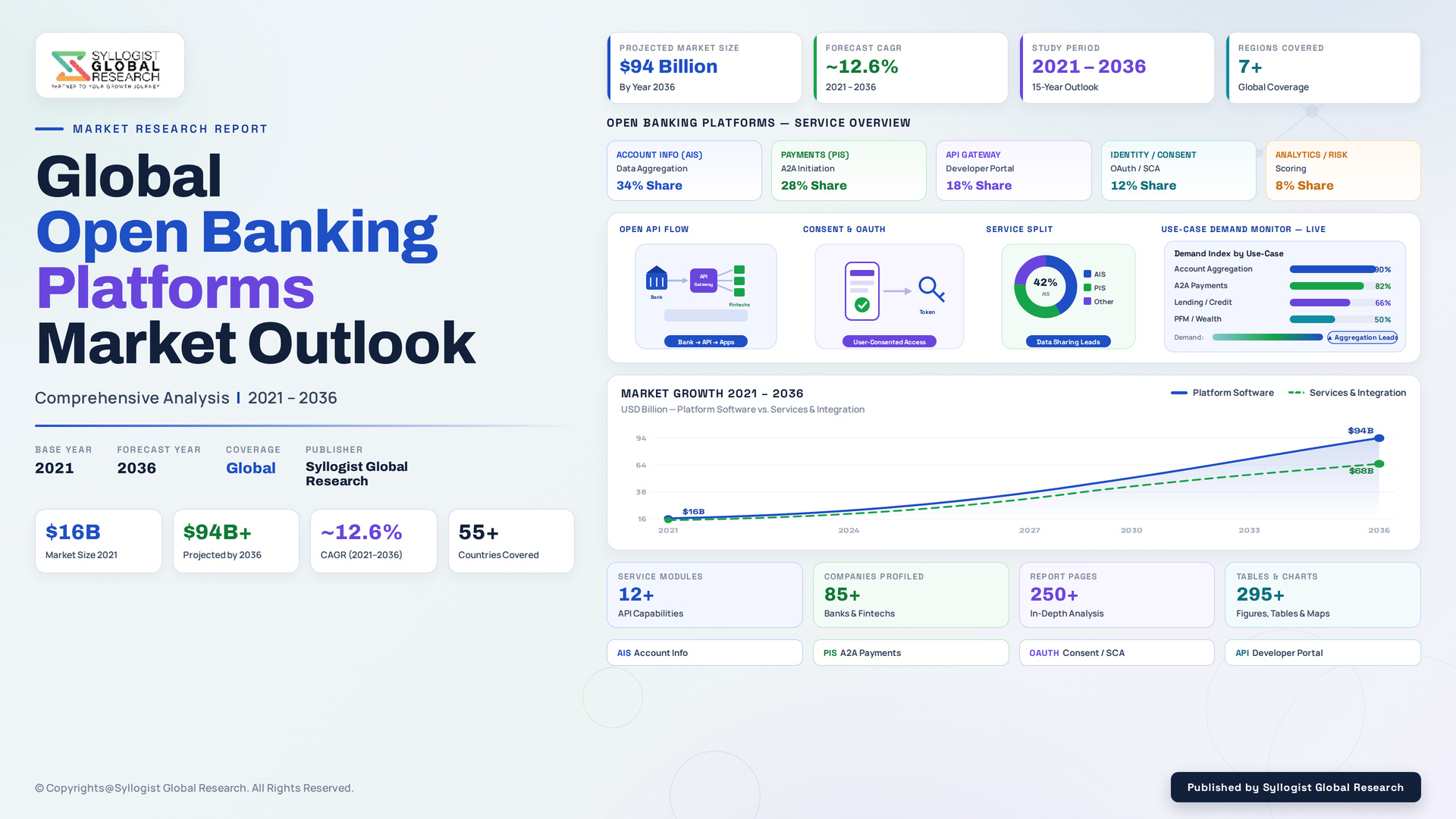
The global open banking platforms market is entering a sustained high-growth phase driven by accelerating regulatory mandates across major jurisdictions, structural adoption of embedded finance and Banking-as-a-Service across consumer and B2B applications, real-time payment rail expansion, the emergence of variable recurring payments and pay-by-bank alternatives to card payments, US CFPB Section 1033 implementation, and the structural extension of open banking frameworks toward open finance, open insurance, and emerging open data ecosystems. The market was valued at USD 28.4 billion in 2025 and is projected to reach USD 124.6 billion by 2034, advancing at a compound annual growth rate of 17.8% through the forecast period, supported by greenfield platform deployments at banks, fintech operators, retailers, and emerging embedded finance adopters across the global financial services value chain.
Europe and the United Kingdom collectively represent the largest regional market with approximately 42% revenue share in 2025, anchored by mature PSD2 implementation, UK Open Banking Implementation Entity standards, forthcoming PSD3 and PSR1 frameworks under European Commission proposals, and EU Financial Data Access Regulation (FIDA) advancing open finance beyond payment accounts toward investment, insurance, mortgage, pension, and consumer credit data. UK Open Banking transactions exceeded 22 million per month in 2025, with payment initiation volumes growing at over 64% year-over-year as Pay by Bank, Variable Recurring Payments, and commercial VRP rails scale across HMRC tax payments, utilities, telecoms, and digital wallet top-ups. North America is the fastest growing regional market advancing at over 24.6% CAGR through 2034, supported by US CFPB Section 1033 Personal Financial Data Rights Rule finalized in October 2024 mandating standardized API access across over 4,000 US financial institutions through 2030.
Embedded finance and Banking-as-a-Service applications have emerged as the highest-impact growth vector, advancing at over 24.4% CAGR through 2034, supported by Stripe, Adyen, Marqeta, Galileo, Unit, Treasury Prime, Bond, Synapse, and emerging entrants powering embedded payments, accounts, lending, and cards within consumer and B2B platforms including Shopify, Amazon, Walmart, Uber, DoorDash, Lyft, Toast, Square, Mindbody, ServiceTitan, and dense enterprise software portfolios. Variable Recurring Payments rollout in the UK across Pay by Bank for subscriptions, charity giving, and emerging commercial use cases is advancing at over 84% year-over-year growth, while pay-by-bank alternatives to card payments are gaining traction across retail, hospitality, ticketing, and digital wallet top-ups, supported by interchange fee compression, fraud reduction, and faster settlement economics.
Brazilian Open Finance has emerged as one of the most consequential emerging market deployments, with over 1,200 participating institutions and consent volumes exceeding 32 million by 2025, supported by Banco Central do Brasil leadership and aggressive Nubank, Itau, Bradesco, Santander Brasil, BTG Pactual, and Inter participation. Indian Account Aggregator framework under RBI leadership is similarly advancing, with consent volumes scaling rapidly across SBI, HDFC, ICICI, Axis, Kotak Mahindra, alongside fintech participation at Sahamati, Setu, OneMoney, CAMS Finserv, NESL Asset Data, and Perfios. Australian Consumer Data Right, Singapore SGFinDex, Hong Kong Open API, Saudi SAMA, UAE Open Finance, Nigerian Open Banking, and Mexican Open Finance frameworks are reinforcing global ecosystem expansion across major regional markets through 2034.
Key Drivers
Regulatory Mandates Across PSD3, US CFPB Section 1033, Brazilian Open Finance, and Asia-Pacific Frameworks Anchoring Platform Procurement
Accelerating regulatory mandates including forthcoming PSD3 and PSR1 in the European Union, EU Financial Data Access Regulation (FIDA), US CFPB Section 1033 Personal Financial Data Rights Rule finalized in October 2024, Brazilian Open Finance, Australian Consumer Data Right, Indian Account Aggregator, Singapore SGFinDex, Hong Kong Open API, Saudi SAMA Open Banking, UAE Open Finance, Nigerian Open Banking, and Mexican Open Finance frameworks are anchoring durable open banking platform procurement growth across over 12,000 regulated financial institutions globally through 2034.
Embedded Finance and Banking-as-a-Service Adoption Across Consumer and B2B Platforms Driving Platform Demand Expansion
Embedded finance and Banking-as-a-Service adoption advancing at over 24.4% CAGR through 2034 across Stripe, Adyen, Marqeta, Galileo, Unit, Treasury Prime, Bond, Synapse, and emerging entrants powering embedded payments, accounts, lending, and cards within consumer and B2B platforms including Shopify, Amazon, Walmart, Uber, DoorDash, Lyft, Toast, Square, Mindbody, ServiceTitan, and enterprise software portfolios are anchoring durable platform demand expansion. Vertical SaaS embedded finance opportunities across construction, real estate, healthcare, fitness, automotive aftermarket, and freight logistics are simultaneously broadening the demand base across global markets.
Variable Recurring Payments, Pay-by-Bank Rollout, and Real-Time Payment Rail Expansion Driving Premium Platform Adoption
Variable Recurring Payments rollout in the UK across Pay by Bank for subscriptions, charity giving, HMRC tax payments, utilities, telecoms, and digital wallet top-ups is advancing at over 84% year-over-year growth, while pay-by-bank alternatives to card payments are gaining traction across retail, hospitality, and ticketing, supported by interchange fee compression, fraud reduction, and faster settlement economics. Real-time payment rail expansion including FedNow in the US, SEPA Instant Credit Transfer in Europe, Brazilian PIX, Indian UPI, and Singapore PayNow is reinforcing platform procurement demand through 2034.
Key Challenges
Regulatory Fragmentation, Standards Divergence, and Cross-Border Interoperability Complexity Limiting Global Platform Scaling
Regulatory fragmentation across PSD2, forthcoming PSD3, UK Open Banking, US CFPB Section 1033, Brazilian Open Finance, Australian CDR, Indian Account Aggregator, Singapore SGFinDex, Hong Kong Open API, and emerging Saudi, UAE, Nigerian, and Mexican frameworks, alongside standards divergence between FAPI, Berlin Group NextGenPSD2, OBIE UK, FDX, and emerging national standards, is introducing cross-border interoperability complexity. Global platform providers are forced to maintain multiple parallel technical implementations, certification pathways, and compliance teams, complicating product roadmaps and elevating platform development costs through 2034.
Bank Resistance, Screen Scraping Tensions, and Data Quality Issues Constraining Reliable Platform Operations
Persistent tension between banks and third-party providers around screen scraping versus standardized API access, data quality variability across bank API implementations, intermittent API uptime and latency issues, and bank-side reluctance to invest in premium API endpoints beyond regulatory minimums are introducing operational complexity that complicates open banking platform reliability and user experience. CFPB Section 1033 implementation in the US is reshaping screen scraping dynamics, while ongoing disputes around data scope, refresh frequency, and consent expiry are reshaping bank-fintech commercial models through 2034.
Monetization Uncertainty, Consumer Awareness Gaps, and Use Case Adoption Challenges Constraining Revenue Realization
Open banking platform monetization remains structurally uncertain across many jurisdictions, with payment initiation pricing pressure relative to card interchange, account information service commoditization, and limited demonstrable revenue uplift at smaller fintech and enterprise adopters constraining capital allocation toward platform procurement. Consumer awareness of open banking remains structurally low, with UK consumer adoption at approximately 14% by 2025 and lower elsewhere, while use case adoption challenges across credit decisioning, account-to-account payments, personal finance management, and emerging open finance applications are extending the path to commercial scaling through 2034.
Market Segmentation
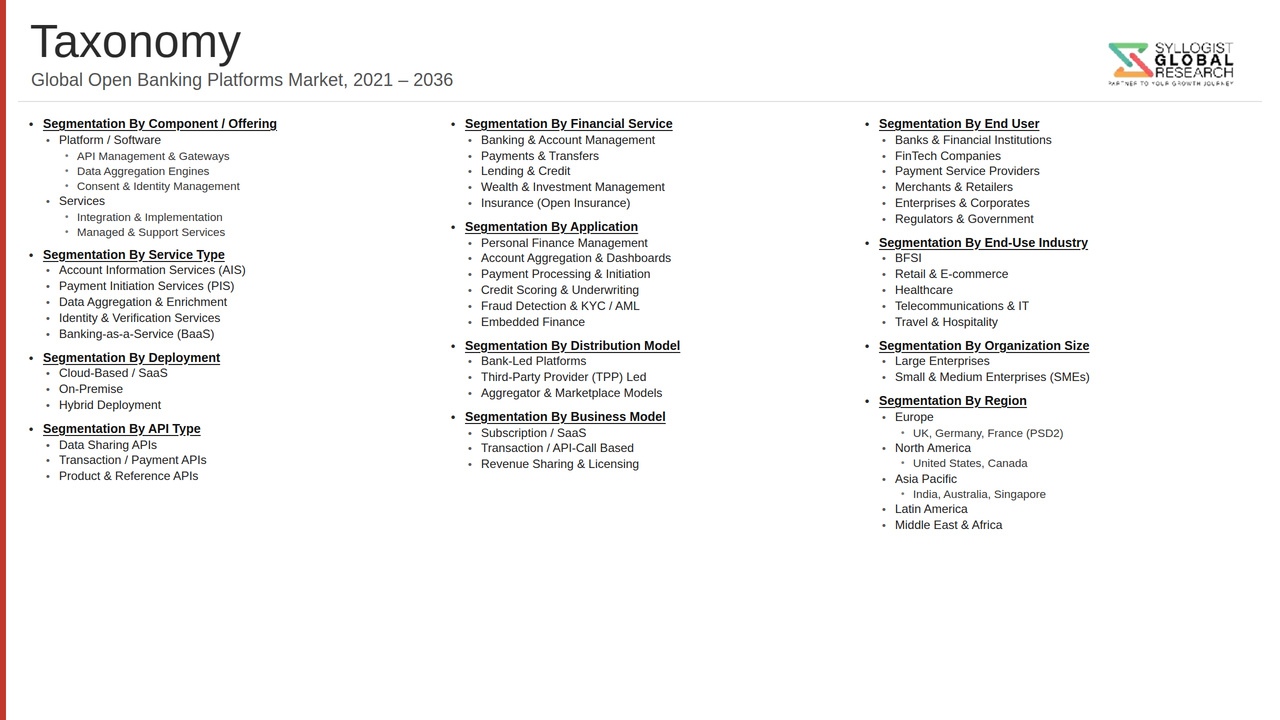
- Segmentation By Service Type
- Account Information Services (AIS)
- Payment Initiation Services (PIS)
- Variable Recurring Payments (VRP)
- Banking-as-a-Service (BaaS)
- Embedded Finance Platforms
- Open Finance and Open Data Aggregation
- Identity Verification and KYC
- Affordability and Credit Decisioning
- Others
- Segmentation By Deployment
- Cloud-Based (SaaS)
- On-Premise
- Hybrid
- API-First Cloud-Native
- Others
- Segmentation By Component
- Platform Software
- API Management and Gateway
- Consent and Preference Management
- Services (Implementation, Consulting, Managed Services)
- Identity and Authentication Modules
- Analytics and Transaction Enrichment
- Others
- Segmentation By Distribution Channel
- Banks and Credit Unions
- Fintech Providers
- Payment Service Providers
- Embedded Finance Operators
- Vertical SaaS Platforms
- Retailers and E-Commerce
- Others
- Segmentation By Application
- Account-to-Account Payments
- Subscription and Recurring Payments
- Lending and Credit Decisioning
- Personal Finance Management
- Wealth and Investment Aggregation
- SME Cash Flow and Accounting
- Insurance and InsurTech
- Identity Verification and Onboarding
- Embedded Banking and Card Issuing
- Others
- Segmentation By End User
- Retail Banks
- Commercial and Business Banks
- Fintech and Neobanks
- Wealth and Asset Managers
- Insurance Carriers
- Retailers and E-Commerce Platforms
- SaaS and Marketplace Operators
- Government and Public Sector
- Others
- Segmentation By Region
- Europe and United Kingdom
- North America
- Asia-Pacific (India, Singapore, Hong Kong, Australia, Japan, South Korea, Southeast Asia)
- Latin America (Brazil, Mexico, Colombia, Chile)
- Middle East and Africa (Saudi Arabia, UAE, Nigeria, South Africa)
All market revenues are presented in USD
Historical Year: 2021-2024 | Base Year: 2025 | Estimated Year: 2026 | Forecast Period: 2027-2034
Key Questions this Study Will Answer
- What is the total market valuation of the Global Open Banking Platforms Market in 2025, projected through 2034, disaggregated by service type, deployment, component, distribution channel, application, end user, and region, enabling platform suppliers, banks, fintech operators, embedded finance providers, retailers, and investors to identify the highest-growth opportunities and most durable revenue corridors across the open banking value chain?
- How are forthcoming PSD3 and PSR1 in the European Union, EU Financial Data Access Regulation (FIDA), UK Smart Data frameworks, US CFPB Section 1033 Personal Financial Data Rights Rule finalized in October 2024, Brazilian Open Finance, Australian Consumer Data Right, Indian Account Aggregator, Singapore SGFinDex, Hong Kong Open API, Saudi SAMA, UAE Open Finance, Nigerian Open Banking, and Mexican Open Finance frameworks reshaping platform procurement priorities across over 12,000 regulated financial institutions through 2034?
- Which platform service categories including Account Information Services, Payment Initiation Services, Variable Recurring Payments, Banking-as-a-Service, embedded finance, open finance and open data aggregation, identity verification, and affordability decisioning are generating the highest growth rates, and how is the supply landscape evolving across Plaid, Tink, TrueLayer, Yapily, Token.io, GoCardless, Moneyhub, Bud, Salt Edge, Klarna Kosma, Finicity, MX, Akoya, Codat, Volt.io, Trustly, Mastercard Open Banking, Visa Direct, FIS, Fiserv, Jack Henry, Temenos, Finastra, Mambu, Thought Machine, 10x Banking, Backbase, Tuum, Stripe, Adyen, Marqeta, Galileo, Synapse, Treasury Prime, Unit, and Bond?
- How is embedded finance and Banking-as-a-Service adoption advancing at over 24.4% CAGR through 2034 across Stripe, Adyen, Marqeta, Galileo, Unit, Treasury Prime, Bond, and Synapse powering embedded payments, accounts, lending, and cards within consumer and B2B platforms including Shopify, Amazon, Walmart, Uber, DoorDash, Lyft, Toast, Square, Mindbody, and ServiceTitan?
- How is Variable Recurring Payments rollout in the UK across Pay by Bank for subscriptions, charity giving, HMRC tax payments, utilities, telecoms, and digital wallet top-ups advancing at over 84% year-over-year, alongside real-time payment rail expansion including FedNow, SEPA Instant Credit Transfer, Brazilian PIX, Indian UPI, and Singapore PayNow reshaping platform procurement demand through 2034?
- How are regulatory fragmentation across PSD2, forthcoming PSD3, UK Open Banking, US CFPB Section 1033, Brazilian Open Finance, Australian CDR, and emerging frameworks, alongside standards divergence between FAPI, Berlin Group NextGenPSD2, OBIE UK, and FDX, introducing cross-border interoperability complexity that reshapes global platform provider product roadmaps through 2034?
- How are bank-fintech tensions around screen scraping versus standardized API access, data quality variability, consumer awareness gaps with UK consumer adoption at approximately 14% by 2025, and monetization uncertainty across payment initiation and account information services reshaping commercial models and platform investment economics across the global open banking sector through 2034?
- Product Definition
- Research Methodology
- Research Design & Framework
- Overall Research Approach: Descriptive, Exploratory & Quantitative Mixed-Method Design
- Market Definition & Scope Boundaries: What is Included and Excluded
- Segmentation Framework
- Key Research Assumptions & Limitations
- Secondary Research
- Primary Research Design & Execution
- Data Triangulation & Validation
- Market Sizing & Forecasting Methodology
- Competitive Intelligence Methodology
- Quality Assurance & Peer Review
- Definitions, Abbreviations & Data Notes
- Research Design & Framework
- Executive Summary
- Market Snapshot & Headline Numbers
- Key Findings & Research Highlights
- Market Dynamics
- Regional Market Summary
- Competitive Landscape Snapshot
- Technology & Innovation Highlights
- Market Dynamics
- Drivers
- Restraints
- Opportunities
- Challenges
- Porter’s Five Forces Analysis
- PESTLE Analysis
- Market Trends & Developments
- Emerging Trends
- Technological Developments
- Regulatory & Policy Changes
- Supply Chain & Sourcing Trends
- Manufacturing & Process Trends
- Investment & Funding Activity
- Sustainability & ESG Trends
- Risk Assessment Framework
- Data Privacy, Consent & Regulatory Compliance Risk
- API Security, Fraud & Cybersecurity Risk
- Regulatory Fragmentation & Cross-Jurisdiction Standard Divergence Risk
- Platform Adoption, Bank-Fintech Integration & Interoperability Risk
- Liability, Dispute Resolution & Third-Party Provider Reliance Risk
- Regulatory Framework & Standards
- Open Banking & Payment Services Mandate Frameworks (PSD2, PSD3 & Equivalent)
- Data Privacy, Consent & Consumer Protection Standards (GDPR & Equivalent)
- API, Security & Strong Customer Authentication (SCA) Standards
- Open Finance, Data Sharing & Cross-Border Interoperability Frameworks
- Cybersecurity, Data Governance & ESG Disclosure Standards
- Global Open Banking Platforms Market Outlook
- Market Size & Forecast by Value
- Market Size & Forecast by Volume (API Calls & Transactions Processed)
- Market Size & Forecast by Offering
- API Management & Gateway Platforms
- Account Information Service (AIS) Modules
- Payment Initiation Service (PIS) Modules
- Data Aggregation & Connectivity Modules
- Identity, Authentication & Consent Management Modules
- Analytics, Risk & Decisioning Modules
- Developer Portal & Sandbox Services
- Managed & Professional Services
- Other Platform Components & Add-Ons
- Market Size & Forecast by Technology
- API & Microservices Technology
- Artificial Intelligence & Machine Learning Technology
- Data Aggregation & Connectivity Technology
- Identity, Authentication & Consent Technology
- Cloud & SaaS Platform Technology
- Real-Time Payments & Processing Technology
- Blockchain & Distributed Ledger Technology
- Cybersecurity, Fraud & Risk Technology
- Other Emerging & Hybrid Platform Technologies
- Market Size & Forecast by Service Type
- Banking & Capital Markets Services
- Payments & Money Movement Services
- Lending & Credit Services
- Wealth, Insurance & Open Finance Services
- Other & Hybrid Open Banking Services
- Market Size & Forecast by Deployment Mode
- Cloud-Based Deployment
- On-Premise Deployment
- Hybrid Deployment
- Market Size & Forecast by Application
- Payments & Fund Transfers
- Account Aggregation & Personal Finance Management
- Lending, Credit Scoring & Underwriting
- Identity Verification & Fraud Prevention
- Wealth, Investment & Insurance Services
- Other Open Banking Applications
- Market Size & Forecast by End-User
- Banks & Traditional Financial Institutions
- Fintech Companies & Neobanks
- Payment Service Providers & Processors
- Third-Party Providers (TPPs) & Aggregators
- Merchants, Enterprises & Other End-Users
- Market Size & Forecast by Sales Channel
- Direct Sales & Subscription Licensing
- Channel Partners, Resellers & System Integrators
- API Marketplace & Cloud Platform Distribution
- Platform-as-a-Service & Embedded Channel
- North America Open Banking Platforms Market Outlook
- Market Size & Forecast
- By Value
- By Volume (API Calls & Transactions Processed)
- By Offering
- By Technology
- By Service Type
- By Deployment Mode
- By Application
- By End-User
- By Country
- By Sales Channel
- Europe Open Banking Platforms Market Outlook
- Market Size & Forecast
- By Value
- By Volume (API Calls & Transactions Processed)
- By Offering
- By Technology
- By Service Type
- By Deployment Mode
- By Application
- By End-User
- By Country
- By Sales Channel
- Asia-Pacific Open Banking Platforms Market Outlook
- Market Size & Forecast
- By Value
- By Volume (API Calls & Transactions Processed)
- By Offering
- By Technology
- By Service Type
- By Deployment Mode
- By Application
- By End-User
- By Country
- By Sales Channel
- Latin America Open Banking Platforms Market Outlook
- Market Size & Forecast
- By Value
- By Volume (API Calls & Transactions Processed)
- By Offering
- By Technology
- By Service Type
- By Deployment Mode
- By Application
- By End-User
- By Country
- By Sales Channel
- Middle East & Africa Open Banking Platforms Market Outlook
- Market Size & Forecast
- By Value
- By Volume (API Calls & Transactions Processed)
- By Offering
- By Technology
- By Service Type
- By Deployment Mode
- By Application
- By End-User
- By Country
- By Sales Channel
- Country-Wise* Open Banking Platforms Market Outlook
- Market Size & Forecast
- By Value
- By Volume (API Calls & Transactions Processed)
- By Offering
- By Technology
- By Service Type
- By Deployment Mode
- By Application
- By End-User
- By Country
- By Sales Channel
- *Countries Analyzed in the Syllogist Global Research Portfolio: United States, Canada, Mexico, Germany, France, United Kingdom, Netherlands, Spain, Italy, Norway, Sweden, China, Japan, India, Australia, South Korea, Singapore, Brazil, Chile, Saudi Arabia, UAE, Egypt, South Africa, Israel
- Technology Landscape & Innovation Analysis
- API Management, Gateway & Microservices Technology Deep-Dive
- Data Aggregation, Connectivity & Bank-Linking Technology
- Identity, Authentication, Consent & Strong Customer Authentication Technology
- Artificial Intelligence & Machine Learning for Risk & Decisioning
- Real-Time Payments & Money Movement Technology
- Cybersecurity, Fraud Prevention & API Security Technology
- Blockchain, Distributed Ledger & Open Finance Technology
- Patent & IP Landscape in Open Banking Platform Technologies
- Value Chain & Supply Chain Analysis
- Platform Development, Software & Cloud Infrastructure Landscape
- Bank, Data Source & Connectivity Provider Supply Chain
- API, Identity & Security Capability Supply Chain
- Integration, Middleware & Developer Tooling Partner Landscape
- System Integrator, Consulting & Implementation Partner Landscape
- Bank, Fintech & Enterprise Customer Procurement Landscape
- Support, Managed Service, Compliance & Data Governance
- Pricing Analysis
- Subscription & SaaS Licensing Pricing Analysis
- API Call & Transaction-Based Pricing Analysis
- Tiered & Module-Based Pricing Analysis
- Platform-as-a-Service & Embedded Finance Pricing Model Analysis
- Implementation, Integration & Professional Service Cost Analysis
- Total Platform Economics: Cost-per-Transaction and ROI / Monetisation Optimisation Analysis
- Sustainability & Environmental Analysis
- Data Center, Cloud Energy & Carbon Footprint Consideration of Open Banking Platforms
- Net Zero & Energy Efficiency Contribution: Pathway to Sustainable Cloud and Transaction Processing
- Financial Inclusion, Responsible Data & Ethical Finance Contribution
- Environmental Compliance, Data Minimisation & Resource Efficiency Consideration
- Regulatory-Driven Sustainability, SDG 8 (Decent Work & Economic Growth) & SDG 9 (Industry & Innovation) Alignment & Green Finance Eligibility
- Competitive Landscape
- Market Structure & Concentration
- Market Consolidation Level (Fragmented vs. Consolidated by Offering & Geography)
- Top 10 Players Market Share
- HHI (Herfindahl-Hirschman Index) Concentration Analysis
- Competitive Intensity Map by Offering, Technology & Geography
- Player Classification
- Integrated Open Banking Platform Companies
- API & Banking-as-a-Service (BaaS) Providers
- Data Aggregation & Connectivity Providers
- Payment Initiation & Money Movement Providers
- Identity, Authentication & Consent Providers
- Core Banking & Enterprise Software Providers
- System Integrators & Implementation Partners
- Emerging & Niche Open Banking Entrants
- Competitive Analysis Frameworks
- Market Share Analysis by Offering, Technology & Region
- Company Profile
- Company Overview & Headquarters
- Open Banking Platform Products & Technology Portfolio
- Key Customer Relationships & Reference Deployments
- Manufacturing Footprint & Production Capacity
- Revenue (Open Banking Platform Segment) & Backlog
- Technology Differentiators & IP
- Key Strategic Partnerships, JVs & M&A Activity
- Recent Developments (Customer Wins, Product Launches, Funding Rounds)
- SWOT Analysis
- Strategic Focus Areas & Roadmap
- Competitive Positioning Map (Technology Capability vs. Market Penetration)
- Key Company Profiles
- Market Structure & Concentration
- Technology Landscape & Innovation Analysis
- Strategic Output
- Market Opportunity Matrix: By Offering, Technology, Application, End-User & Geography
- White Space Opportunity Analysis
- Strategic Recommendations
- Product Portfolio & Technology Investment Strategy
- Manufacturing & Operational Excellence Strategy
- Geographic Expansion & Localisation Strategy
- Customer & End-User Engagement Strategy
- Partnership, M&A & Ecosystem Strategy
- Sustainability & Circular Economy Strategy
- Risk Mitigation & Future Roadmap
- Strategic Priority Matrix & Roadmap
- Near-term (2025-2028)
- Mid-term (2029-2032)
- Long-term (2033-2037)
- Strategic Output
- Market Size & Forecast
- Market Size & Forecast
- Market Size & Forecast
- Market Size & Forecast
- Market Size & Forecast
- Market Size & Forecast