Global Welding Equipment, Accessories, and Consumables Market By Equipment Type, By Consumable Type, By Accessory Type, By Welding Technology, By Automation Level, By End-Use Industry, By Distribution Channel, By Region, Competition, Forecast & Opportunities, 2021-2034F
Market Definition
The Global Welding Equipment, Accessories, and Consumables Market encompasses the design, manufacture, distribution, and aftermarket servicing of metal joining systems and associated supplies used to fuse, fabricate, and repair metallic structures across industrial, commercial, and infrastructure applications. The market includes welding equipment such as arc welding machines, oxy-fuel gas systems, resistance welding stations, laser welders, plasma cutters, and robotic welding cells; consumables comprising stick electrodes, flux-cored wires, solid wires, fluxes, brazing rods, and shielding gases including argon, carbon dioxide, helium, and gas mixtures; and accessories including welding torches, electrode holders, ground clamps, pressure regulators, gas flow meters, fume extraction systems, welding helmets, gloves, protective apparel, and digital weld monitoring instruments. End users span automotive original equipment manufacturers and tier suppliers, commercial and residential construction firms, shipbuilding and offshore fabrication yards, oil and gas pipeline contractors, aerospace and defense primes, power generation utilities, railway and rolling stock manufacturers, heavy equipment producers, and small-scale general fabrication workshops. The market also covers process technologies including shielded metal arc welding, gas metal arc welding, gas tungsten arc welding, submerged arc welding, flux-cored arc welding, resistance spot welding, friction stir welding, and laser hybrid welding configurations. Distribution channels include direct sales to industrial accounts, authorized distributor networks, e-commerce platforms, and aftermarket service providers offering calibration, repair, and consumables replenishment. The scope further includes integrated automation packages, collaborative welding cobot systems, digital weld monitoring platforms, and Industry 4.0 enabled equipment delivering real-time data analytics, predictive maintenance, and traceability functions for quality-critical manufacturing environments.
Market Insights
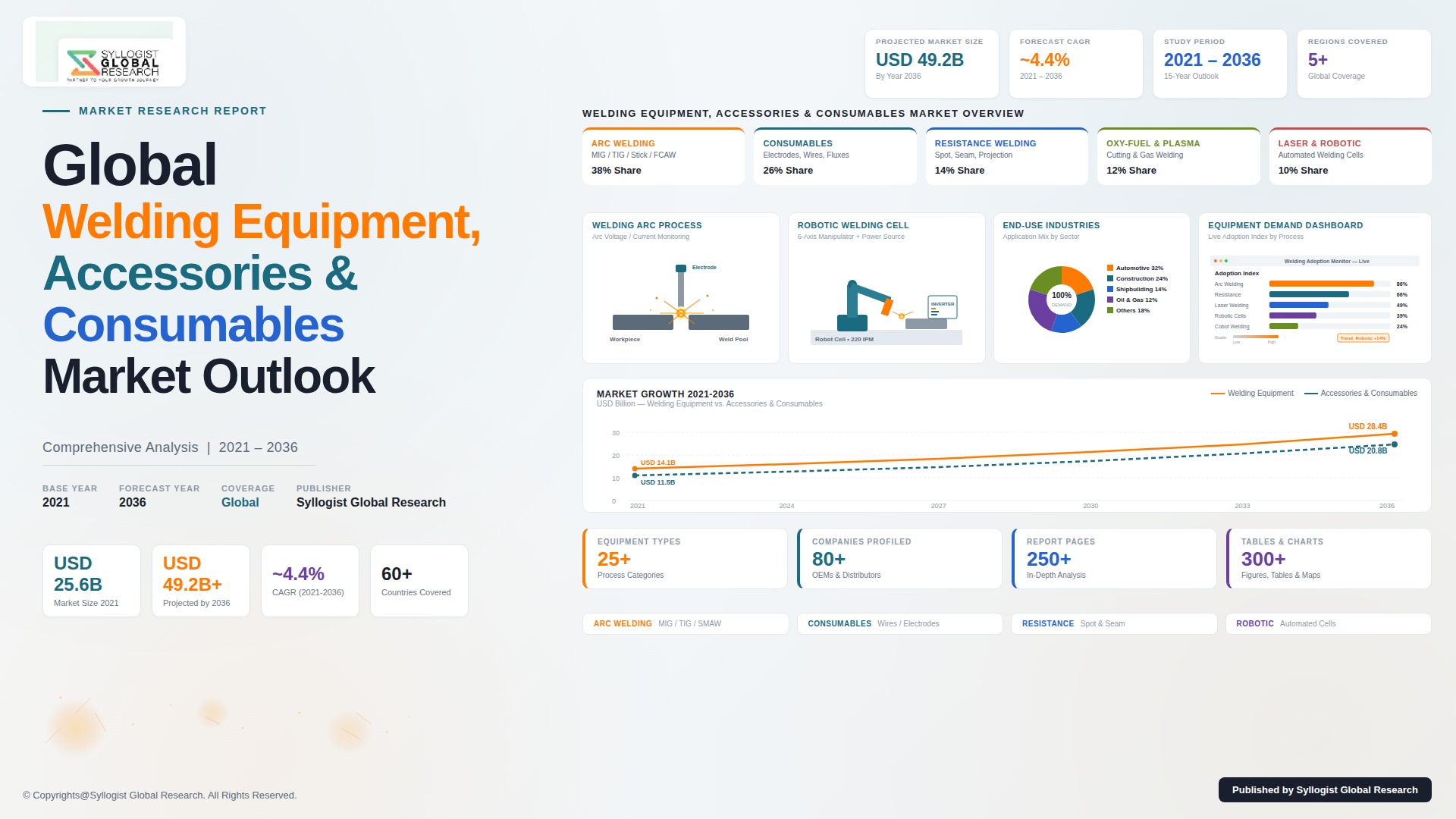
The global welding equipment, accessories, and consumables market is entering a phase of measured but durable expansion, supported by the simultaneous advance of industrial automation, the global energy transition, and renewed manufacturing investment across mature and emerging economies. The market was valued at approximately USD 30.4 billion in 2025 and is projected to reach USD 44.8 billion by 2034, advancing at a compound annual growth rate of 4.4% through the forecast period as fabrication-intensive sectors including automotive, construction, shipbuilding, oil and gas, and renewable energy expand capital deployment in welding capability. Equipment manufacturers are repositioning portfolios toward digitally enabled, energy-efficient, and inverter-based welding power sources, while consumable producers are scaling production of premium flux-cored wires, solid wires, and specialty filler metals optimized for advanced high-strength steels, aluminum alloys, and dissimilar material joints required in modern structural and mobility applications.
The automotive sector remains the single largest demand pool for welding equipment and consumables, accounting for a substantial share of global revenues and undergoing structural transformation as electric vehicle production scales across North America, Europe, and Asia-Pacific. Battery enclosure fabrication, gigacasting integration, and lightweight aluminum body construction are reshaping equipment requirements, with laser welding, friction stir welding, and adaptive resistance spot welding gaining share against legacy MIG and TIG processes for EV-specific joints. Construction and infrastructure spending across India, the United States, the Gulf Cooperation Council, and Southeast Asia is driving sustained demand for stick electrodes, flux-cored wires, and submerged arc welding systems used in steel structure fabrication, pipeline construction, and bridge assembly. Shipbuilding capacity expansion in South Korea, China, and Japan is also lifting demand for high-deposition welding consumables and automated panel line welding equipment supplying commercial vessel and naval programs.
Digital transformation is rapidly redefining the competitive landscape, with leading manufacturers integrating Internet of Things sensors, weld data analytics platforms, digital twins, and machine learning algorithms directly into welding power sources, wire feeders, and inspection systems. Real-time monitoring of arc voltage, current, wire feed speed, gas flow, and bead geometry enables predictive defect detection and automatic process adjustment, supporting compliance with stringent quality codes in aerospace, nuclear, and pressure vessel applications. Collaborative welding cobots have emerged as a high-growth equipment category, addressing skilled labor scarcity in small and medium fabrication shops by combining easy programming, modest capital requirements, and short payback periods. Robotic welding system installations are expanding at double-digit rates, supported by reshoring initiatives, the Make in India and Made in China 2025 industrial programs, and steady reductions in cobot acquisition costs that have widened addressable customer bases meaningfully across general fabrication workshops.
Asia-Pacific dominates the global welding equipment, accessories, and consumables market by absolute revenue and is also projected to record the highest regional compound annual growth rate through 2034, anchored by industrial expansion in China, India, South Korea, Japan, and Southeast Asia. China alone accounts for the largest single-country demand, supported by automotive production volumes, shipbuilding leadership, and continuous infrastructure modernization programs. North America represents the second largest regional market, with reshoring of semiconductor, battery, and heavy equipment manufacturing into the United States and Mexico unlocking substantial incremental capital investment in welding cells. Europe remains a high-value market characterized by premium equipment demand from German automotive original equipment manufacturers, Italian and Spanish industrial fabrication clusters, and Nordic shipbuilding yards. Latin America and the Middle East and Africa are emerging growth pockets, driven by oil and gas pipeline projects, mining infrastructure, and renewable energy deployment programs.
Key Drivers
Accelerating Industrial Automation, Robotic Welding Adoption, and Industry 4.0 Integration Driving Sustained Capital Investment in Advanced Welding Equipment
The accelerating deployment of robotic welding cells, collaborative welding cobots, and digitally enabled welding power sources is generating durable demand growth for welding equipment and integrated automation packages across the global manufacturing base, supported by Industry 4.0 modernization programs in major industrial economies. Global average robot density reached 162 units per 10,000 manufacturing workers in 2023, more than doubling since 2016, with welding cells representing one of the largest application categories for industrial robot installations across automotive, heavy equipment, metal fabrication, and aerospace facilities. Government programs including the Make in India initiative, Made in China 2025, the United States CHIPS and Inflation Reduction Acts, and the European Industrial Strategy are channeling substantial public and private capital toward manufacturing automation, with welding automation receiving direct allocations within reshoring and capacity expansion programs. Original equipment manufacturers are integrating IoT-enabled sensors, machine vision, adaptive control software, and digital twin simulation tools directly into welding power sources, allowing real-time arc monitoring, predictive maintenance, and closed-loop quality assurance. The cobot welding segment is expanding rapidly as small and medium fabricators adopt entry-level automation packages with programming times of hours rather than days, enabling sub-twelve-month return on investment cycles and broadening the addressable market for premium welding equipment vendors across general fabrication, automotive aftermarket, and metal job shop environments worldwide.
Expanding Electric Vehicle Production, Battery Manufacturing, and Renewable Energy Infrastructure Generating High-Value Demand for Specialty Welding Equipment and Consumables
The global energy transition, encompassing rapid electric vehicle adoption, gigafactory construction, and large-scale renewable energy deployment, is creating substantial new demand pools for specialty welding equipment and engineered consumables optimized for aluminum alloys, copper bus bars, ultra-high-strength steels, and dissimilar material joints that legacy welding processes cannot reliably deliver. Battery pack enclosure fabrication, busbar joining, and motor housing assembly require precision laser welding, friction stir welding, ultrasonic welding, and cold metal transfer welding equipment, generating premium price points and high-margin consumable consumption across the EV value chain. Wind turbine tower fabrication, solar mounting structure production, hydrogen pipeline construction, and small modular reactor component manufacturing are simultaneously expanding demand for high-deposition submerged arc welding equipment, flux-cored wires, and certified consumables qualified for renewable infrastructure service environments. Major automotive original equipment manufacturers including Volkswagen, Hyundai, Ford, Stellantis, and General Motors have announced multi-billion-dollar capital programs for EV production capacity expansion, with welding automation representing a substantial share of equipment budgets within new and retrofitted assembly plants. Oil and gas pipeline construction associated with liquefied natural gas export capacity expansion in the United States, Qatar, and Mozambique is also generating significant orderbook visibility for orbital welding systems and specialty pipeline welding consumables through the forecast period.
Sustained Infrastructure Investment, Manufacturing Reshoring, and Construction Spending in Emerging Economies Anchoring Long-Cycle Demand for Welding Equipment and Consumables
Government-led infrastructure spending programs, manufacturing reshoring initiatives in advanced economies, and rapid urbanization across emerging markets are establishing a long-cycle demand foundation for welding equipment and consumables that extends well beyond near-term economic fluctuations. The United States Infrastructure Investment and Jobs Act, India National Infrastructure Pipeline, China Belt and Road Initiative extensions, and European Green Deal infrastructure allocations collectively represent multi-trillion-dollar capital deployment across bridges, highways, railways, ports, water systems, and energy grid modernization projects, all of which require substantial welding fabrication capacity and consumable consumption. Manufacturing reshoring across the United States, Mexico, India, and select European Union member states is unlocking incremental capital expenditure on welding cells, fume extraction equipment, and qualified consumables required for new semiconductor fabrication facilities, battery gigafactories, automotive plants, and pharmaceutical production sites returning from offshore locations. Asia-Pacific construction activity, anchored by India, Indonesia, Vietnam, and the Philippines, continues to drive elevated stick electrode, flux-cored wire, and oxy-fuel cutting equipment volumes across structural steel fabrication, residential building, and commercial development applications. Defense and shipbuilding capacity expansion in South Korea, Japan, Australia, and the AUKUS partner states is also generating substantial procurement of automated welding systems and certified consumables qualified for naval and submarine hull fabrication standards.
Key Challenges
Persistent Skilled Welder Shortage, Aging Workforce Demographics, and Vocational Training Pipeline Constraints Limiting End-User Capacity to Absorb Equipment and Consumable Output
The structural shortage of certified, skilled welders across major industrial economies is constraining end-user capacity to deploy and operate welding equipment at full design throughput, indirectly compressing growth rates for both capital equipment and consumable categories despite robust underlying demand from infrastructure, automotive, and energy sectors. Industry projections indicate a shortfall of approximately 330,000 welding professionals in the United States by 2028, with more than 80,000 annual openings expected between 2025 and 2029 driven by retirements and growth simultaneously, while the average age of working welders has climbed to 55 years across the country. For every five experienced welders retiring, only two new entrants are joining the field, creating a self-reinforcing capacity gap that affects shipyards, pipeline contractors, structural steel fabricators, and automotive tier suppliers across North America and Europe. Vocational training enrollment remains insufficient to close the gap, with secondary school welding programs constrained by instructor shortages, equipment costs, and competing career pathways drawing potential candidates toward technology and service occupations. The shortage elevates labor costs, extends project timelines, and pushes end users toward automation as a partial substitute, yet automation deployment itself depends on skilled welding engineers and robotic programmers whose pipeline is similarly constrained, complicating equipment manufacturer go-to-market strategies and slowing throughput recovery for fabrication contractors operating against fixed-price project schedules.
Tightening Welding Fume Safety Regulations, Hexavalent Chromium Exposure Limits, and Occupational Health Compliance Costs Raising End-User Total Cost of Ownership
Welding operations expose workers to hazardous metal fumes, ultraviolet radiation, and respiratory contaminants including manganese, hexavalent chromium, nickel, and cadmium, generating an increasingly stringent regulatory environment that materially raises total cost of ownership for end users and influences equipment procurement decisions across welding-intensive industries. The Occupational Safety and Health Administration in the United States, the European Union Carcinogens and Mutagens Directive, and equivalent occupational health authorities across the United Kingdom, Canada, Australia, and major Asian economies have progressively tightened permissible exposure limits for welding fume constituents, with particular focus on hexavalent chromium and manganese given documented links to lung cancer, neurological disorders, and metal fume fever. Compliance requirements force end users to invest in source-capture fume extraction systems, downdraft tables, ambient air filtration installations, respiratory protection programs, exposure monitoring instruments, and worker training, materially raising ancillary costs alongside core welding equipment procurement. Welders are documented to face approximately 44% higher lung cancer incidence relative to non-welders, intensifying litigation risk for employers and accelerating capital deployment toward enclosed robotic welding cells that physically separate operators from fume sources. The compliance burden disproportionately affects small and medium fabrication shops with limited capital budgets, slowing equipment refresh cycles and complicating consumable transitions toward lower-fume formulations across cost-sensitive end-user segments.
Raw Material Price Volatility, Steel and Energy Cost Fluctuations, and Trade Policy Uncertainty Compressing Margins Across Welding Equipment and Consumable Value Chains
Welding consumable manufacturers depend on a narrow set of input commodities including steel wire rod, copper, nickel, manganese, silicon, rutile, and ilmenite, exposing the industry to material price volatility that compresses margins, complicates long-term contract pricing, and elevates working capital intensity across the consumables value chain. Steel wire rod prices have exhibited significant volatility through the 2024 to 2026 period as a function of Chinese export policy shifts, European energy cost dynamics, and shifting United States trade tariff regimes affecting imports from major producing countries. Shielding gas costs, particularly argon and helium, are similarly subject to industrial gas market dynamics influenced by semiconductor demand, healthcare consumption, and air separation unit availability across regional markets. The reciprocal tariff measures introduced by the United States administration in 2025 have introduced additional cost layers on imported welding equipment, accessories, and consumables from China, the European Union, Japan, and South Korea, materially altering competitive positioning for manufacturers without diversified manufacturing footprints. Energy-intensive welding power source manufacturing, particularly inverter-based premium equipment, faces electricity cost pressures across European production sites, while Asian manufacturers contend with copper and rare-earth magnet supply constraints. Foreign exchange volatility further complicates pricing strategy across emerging market revenue streams and forces consumable producers to maintain larger inventory buffers, raising overall capital intensity across the supply chain.
Market Segmentation
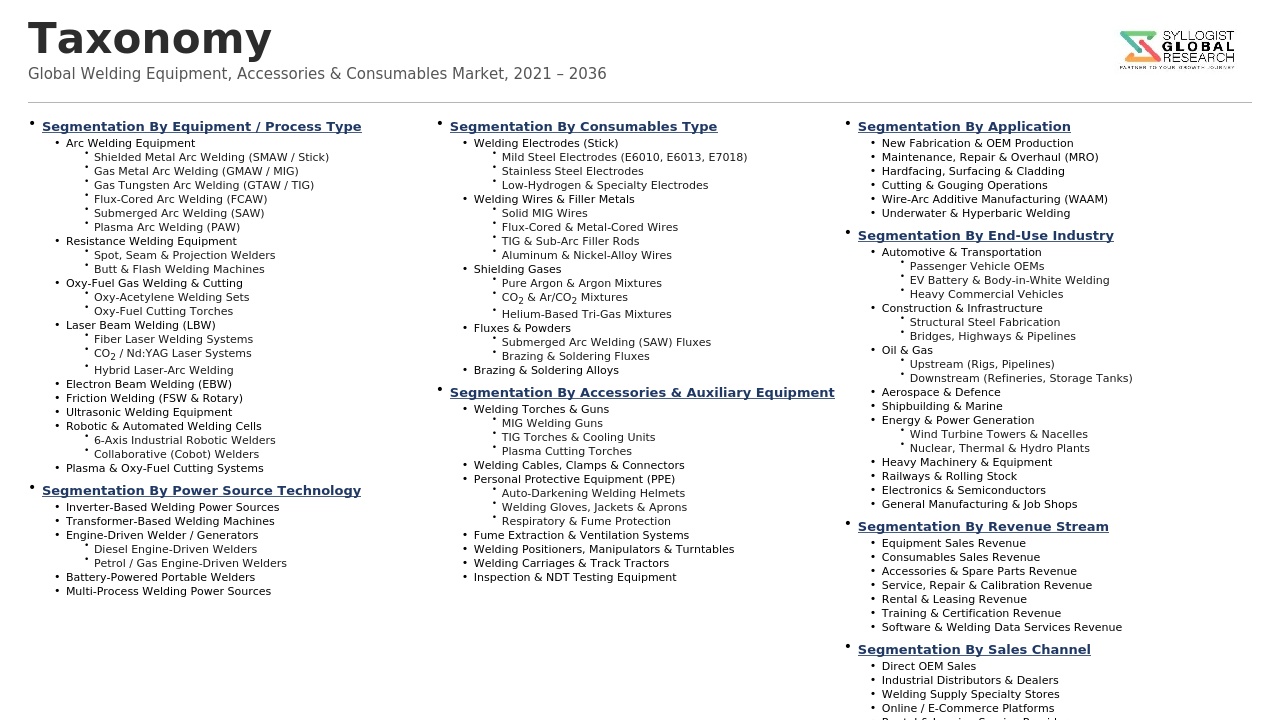
- Segmentation By Equipment Type
- Arc Welding Equipment (MIG/MAG, TIG, Stick, Flux-Cored Arc, Submerged Arc, Plasma Arc)
- Resistance Welding Equipment (Spot, Seam, Projection, Butt)
- Oxy-Fuel Gas Welding and Cutting Equipment
- Laser Welding Equipment
- Electron Beam Welding Equipment
- Friction Stir Welding Equipment
- Robotic and Automated Welding Cells
- Others
- Segmentation By Consumable Type
- Stick Electrodes
- Solid Wires
- Flux-Cored Wires
- Submerged Arc Welding Wires and Fluxes
- Tungsten Electrodes
- Brazing and Soldering Alloys
- Shielding Gases (Argon, Carbon Dioxide, Helium, Gas Mixtures)
- Others
- Segmentation By Accessory Type
- Welding Torches and Guns
- Electrode Holders and Ground Clamps
- Gas Regulators, Flow Meters, and Hoses
- Fume Extraction and Ventilation Systems
- Welding Helmets, Personal Protective Equipment, and Protective Apparel
- Digital Weld Monitoring and Inspection Instruments
- Welding Tables, Fixtures, and Positioners
- Others
- Segmentation By Welding Technology
- Arc Welding
- Resistance Welding
- Oxy-Fuel Welding
- Laser Welding
- Friction and Solid-State Welding
- Others
- Segmentation By Automation Level
- Manual Welding
- Semi-Automatic Welding
- Mechanized Welding
- Fully Automatic and Robotic Welding
- Collaborative Cobot Welding
- Segmentation By End-Use Industry
- Automotive and Transportation
- Construction and Infrastructure
- Shipbuilding and Marine
- Oil, Gas, and Petrochemicals
- Power Generation and Renewable Energy
- Aerospace and Defense
- Heavy Engineering and Industrial Machinery
- General Fabrication and Repair
- Others
- Segmentation By Distribution Channel
- Direct Sales to Industrial Accounts
- Authorized Distributors and Dealers
- Online and E-Commerce Platforms
- Aftermarket and Service Providers
- Segmentation By Region
- North America
- Europe
- Asia-Pacific
- Middle East and Africa
- Latin America
All market revenues are presented in USD
Historical Year: 2021-2024 | Base Year: 2025 | Estimated Year: 2026 | Forecast Period: 2027-2034
Key Questions this Study Will Answer
- What is the total global market valuation of the Welding Equipment, Accessories, and Consumables Market in 2025, projected through 2034, disaggregated by equipment type, consumable type, and end-use industry, enabling welding equipment manufacturers, consumable producers, distributors, and investors to identify the highest-growth segments and most durable revenue opportunities across the global metal fabrication landscape?
- How are robotic welding adoption, collaborative cobot deployment, and Industry 4.0 integration reshaping the competitive landscape for welding equipment vendors, and which automation suppliers, software platforms, and digital weld monitoring providers are emerging as preferred partners for automotive, heavy fabrication, and shipbuilding original equipment manufacturers?
- Which welding consumable categories, including stick electrodes, solid wires, flux-cored wires, submerged arc wires and fluxes, and shielding gases, are generating the strongest revenue growth through 2034, and what raw material strategies are leading consumable manufacturers deploying to manage steel wire rod, copper, and ferroalloy price volatility across the value chain?
- What operational, regulatory, and workforce pressures linked to skilled welder shortages, welding fume exposure limits, and hexavalent chromium compliance are influencing end-user capital allocation, and how are equipment manufacturers responding with enclosed robotic cells, advanced fume extraction systems, and lower-emission consumable formulations?
- How are electric vehicle production scaling, battery gigafactory construction, hydrogen infrastructure deployment, and offshore wind capacity expansion driving demand for specialty welding equipment including laser welding systems, friction stir welding cells, and high-deposition submerged arc welding lines, and which suppliers are best positioned to capture incremental orderbook?
- Which regional welding markets, specifically Asia-Pacific, North America, Europe, the Middle East and Africa, and Latin America, are expected to generate the most substantial incremental revenue through 2034, and what infrastructure spending, manufacturing reshoring, energy transition, and trade policy factors are driving capability investment priorities and supplier selection decisions in each regional market?
- How is the competitive landscape structured among integrated welding equipment and consumable producers including Lincoln Electric, ESAB, Illinois Tool Works, Air Liquide, Fronius, Kemppi, Kobe Steel, voestalpine Bohler Welding, Panasonic, and Daihen, and what acquisition, product launch, and digital ecosystem strategies are reshaping market share dynamics across the forecast horizon?
- Product Definition
- Research Methodology
- Research Design & Framework
- Overall Research Approach: Descriptive, Exploratory & Quantitative Mixed-Method Design
- Market Definition & Scope Boundaries: What is Included and Excluded
- Segmentation Framework
- Key Research Assumptions & Limitations
- Secondary Research
- Primary Research Design & Execution
- Data Triangulation & Validation
- Market Sizing & Forecasting Methodology
- Competitive Intelligence Methodology
- Quality Assurance & Peer Review
- Definitions, Abbreviations & Data Notes
- Research Design & Framework
- Executive Summary
- Market Snapshot & Headline Numbers
- Key Findings & Research Highlights
- Market Dynamics
- Regional Market Summary
- Competitive Landscape Snapshot
- Technology & Innovation Highlights
- Market Dynamics
- Drivers
- Restraints
- Opportunities
- Challenges
- Porter’s Five Forces Analysis
- PESTLE Analysis
- Market Trends & Developments
- Emerging Trends
- Technological Developments
- Regulatory & Policy Changes
- Supply Chain & Sourcing Trends
- Manufacturing & Process Trends
- Investment & Funding Activity
- Sustainability & ESG Trends
- Risk Assessment Framework
- Raw Material Price Volatility, Steel Wire Rod & Alloying Element Sourcing Risk
- Industrial Energy Cost, Electricity Pricing & Shielding Gas Supply Risk
- Workplace Safety, Welding Fume Exposure & Regulatory Compliance Risk
- Technology Disruption, Automation Adoption & Skilled Welder Shortage Risk
- End-User Industry Cyclicality, Capex Slowdown & Trade Tariff Risk
- Regulatory Framework & Standards
- International Welding Standards (ISO, AWS, ASME, EN) and Welder Certification Frameworks
- Workplace Health, Safety and Welding Fume Exposure Limit Regulations (OSHA, NIOSH, EU Directives)
- Pressure Vessel, Boiler and Structural Welding Codes (ASME BPVC, EN 13445, AWS D1.1)
- Environmental Regulations Governing Shielding Gases, Coatings and Hazardous Substances (REACH, RoHS)
- Trade Policies, Anti-Dumping Duties and Localisation Mandates Affecting Welding Equipment Supply
- Global Welding Equipment, Accessories, and Consumables Market Outlook
- Market Size & Forecast by Value
- Market Size & Forecast by Volume (Units Shipped and Consumables Tonnage)
- Market Size & Forecast by Product Type
- Welding Equipment (Arc, MIG/MAG, TIG, Plasma, Resistance, Submerged Arc, Laser, Electron Beam)
- Welding Accessories (Torches, Guns, Holders, Cables, Nozzles, Wire Feeders)
- Personal Protective Equipment (Helmets, Gloves, Aprons, Respirators)
- Welding Consumables (Stick Electrodes, Solid Wires, Flux-Cored Wires, SAW Wire & Flux, Brazing & Soldering Alloys)
- Shielding & Process Gases (Argon, CO2, Helium, Mixed Gases)
- Welding Automation & Robotic Systems
- Fume Extraction, Filtration & Workplace Safety Systems
- Welding Inspection, Testing & NDT Equipment
- Aftermarket, Spare Parts & Repair Services
- Market Size & Forecast by Welding Process / Technology
- Shielded Metal Arc Welding (SMAW / Stick)
- Gas Metal Arc Welding (GMAW / MIG / MAG)
- Gas Tungsten Arc Welding (GTAW / TIG)
- Flux-Cored Arc Welding (FCAW)
- Submerged Arc Welding (SAW)
- Resistance Spot & Seam Welding
- Plasma Arc Welding & Cutting
- Laser Beam Welding & Hybrid Laser-Arc Welding
- Electron Beam Welding & Friction Stir Welding
- Brazing, Soldering & Wire Arc Additive Manufacturing-Adjacent Joining
- Market Size & Forecast by Power Source
- Transformer-Based Welding Machines
- Inverter-Based Welding Machines
- Engine-Driven & Portable Welding Machines
- Multi-Process & Digital Programmable Welding Machines
- Market Size & Forecast by Automation Level
- Manual Welding Equipment
- Semi-Automatic Welding Systems
- Mechanised & Hard-Automation Welding Systems
- Robotic & Collaborative (Cobot) Welding Cells
- Market Size & Forecast by Application
- Construction & Infrastructure (Buildings, Bridges, Pipelines)
- Automotive & Transportation Manufacturing
- Shipbuilding & Marine Fabrication
- Aerospace & Defence Manufacturing
- Oil & Gas, Pipeline & Pressure Vessel Fabrication
- Energy, Power Generation & Renewables (Wind Tower, Solar Frame) Fabrication
- Heavy Machinery, Mining & Agricultural Equipment
- Railway, Rolling Stock & Mass Transit Fabrication
- General Metal Fabrication, Job Shops & MRO
- Market Size & Forecast by End-User
- OEM Manufacturers & Tier-1 Fabricators
- Construction Contractors & Infrastructure Builders
- Shipyards, Aerospace & Defence Manufacturers
- Oil, Gas, Power & Industrial Plant Operators
- Repair, Maintenance & Aftermarket Service Providers
- Vocational Training Institutes & Welder Education Centres
- Market Size & Forecast by Sales Channel
- Direct Sales & OEM Supply Contracts
- Industrial Distributor & Welding Supply Specialist Network
- Online & E-Commerce Channels
- Rental, Leasing & Service Contract Channels
- North America Welding Equipment, Accessories, and Consumables Market Outlook
- Market Size & Forecast
- By Value
- By Volume (Units Shipped and Consumables Tonnage)
- By Product Type
- By Welding Process / Technology
- By Power Source
- By Automation Level
- By Application
- By End-User
- By Country
- By Sales Channel
- Market Size & Forecast
- Europe Welding Equipment, Accessories, and Consumables Market Outlook
- Market Size & Forecast
- By Value
- By Volume (Units Shipped and Consumables Tonnage)
- By Product Type
- By Welding Process / Technology
- By Power Source
- By Automation Level
- By Application
- By End-User
- By Country
- By Sales Channel
- Market Size & Forecast
- Asia-Pacific Welding Equipment, Accessories, and Consumables Market Outlook
- Market Size & Forecast
- By Value
- By Volume (Units Shipped and Consumables Tonnage)
- By Product Type
- By Welding Process / Technology
- By Power Source
- By Automation Level
- By Application
- By End-User
- By Country
- By Sales Channel
- Market Size & Forecast
- Latin America Welding Equipment, Accessories, and Consumables Market Outlook
- Market Size & Forecast
- By Value
- By Volume (Units Shipped and Consumables Tonnage)
- By Product Type
- By Welding Process / Technology
- By Power Source
- By Automation Level
- By Application
- By End-User
- By Country
- By Sales Channel
- Market Size & Forecast
- Middle East & Africa Welding Equipment, Accessories, and Consumables Market Outlook
- Market Size & Forecast
- By Value
- By Volume (Units Shipped and Consumables Tonnage)
- By Product Type
- By Welding Process / Technology
- By Power Source
- By Automation Level
- By Application
- By End-User
- By Country
- By Sales Channel
- Market Size & Forecast
- Country-Wise* Welding Equipment, Accessories, and Consumables Market Outlook
- Market Size & Forecast
- By Value
- By Volume (Units Shipped and Consumables Tonnage)
- By Product Type
- By Welding Process / Technology
- By Power Source
- By Automation Level
- By Application
- By End-User
- By Country
- By Sales Channel
- Market Size & Forecast
*Countries Analyzed in the Syllogist Global Research Portfolio: United States, Canada, Mexico, Germany, France, United Kingdom, Italy, Spain, Sweden, Poland, China, Japan, India, South Korea, Australia, Indonesia, Vietnam, Brazil, Argentina, Saudi Arabia, UAE, Egypt, South Africa, Turkey
- Technology Landscape & Innovation Analysis
- Inverter, IGBT & Digital Power Source Technology Deep-Dive
- Robotic Welding, Cobots & Automation System Technology
- Laser, Electron Beam & Hybrid Laser-Arc Welding Technology
- Friction Stir Welding & Solid-State Joining Technology
- AI, Machine Vision & Adaptive Welding Process Control
- Welding Fume Extraction, Filtration & Workplace Safety Innovation
- Wire Arc Additive Manufacturing (WAAM) & Hybrid Manufacturing Convergence
- Patent & IP Landscape in Welding Equipment, Consumables & Automation Technologies
- Value Chain & Supply Chain Analysis
- Raw Material (Steel Wire Rod, Alloying Elements, Flux Minerals) Sourcing & Supply Chain
- Welding Equipment Manufacturing & Component (Power Electronics, Inverter, Cabling) Supply Chain
- Welding Consumables (Electrodes, Solid Wire, Flux-Cored Wire, SAW Flux) Manufacturing Supply Chain
- Industrial Gas Production, Liquefaction & Distribution Channel for Shielding Gases
- Distributor, Welding Supply House & Industrial Retail Channel Landscape
- OEM Fabricator, EPC Contractor & End-User Procurement Landscape
- Aftermarket, Service, Repair & Consumables Recycling Ecosystem
- Pricing Analysis
- Welding Equipment & Power Source Pricing Analysis by Process Type and Capacity
- Welding Consumables Pricing Analysis (Electrodes, Solid Wires, Flux-Cored Wires, SAW Flux, Brazing Alloys)
- Industrial & Shielding Gas Pricing Analysis (Argon, CO2, Helium, Pre-Mixed Gas Blends)
- Robotic Welding Cell Capex, System Integration Cost & Payback Period Analysis
- Total Cost of Ownership: Capex, Consumables, Labour & Energy across Welding Processes
- Aftermarket, Spare Parts & Service Contract Pricing Analysis
- Sustainability & Environmental Analysis
- Lifecycle Assessment (LCA) of Welding Processes: Carbon Footprint, Energy Intensity & Material Efficiency
- Welding Fume, VOC & Heavy Metal Emission Reduction Pathways and Capture Technologies
- Energy Efficiency & Inverter Technology Contribution to Decarbonisation of Welding Operations
- Resource Efficiency, Spatter Reduction & Welding Consumables Recycling Practices
- Regulatory-Driven Sustainability, ESG Reporting & Green Procurement in Welding Supply Chains
- Competitive Landscape
- Market Structure & Concentration
- Market Consolidation Level (Fragmented vs. Consolidated by Product Type & Geography)
- Top 10 Players Market Share
- HHI (Herfindahl-Hirschman Index) Concentration Analysis
- Competitive Intensity Map by Product Type, Welding Process & Geography
- Player Classification
- Integrated Welding Equipment & Consumables Manufacturers
- Specialist Welding Power Source & Inverter Manufacturers
- Welding Consumables (Electrodes, Wires, Fluxes) Manufacturers
- Industrial Gas Suppliers & Shielding Gas Specialists
- Robotic Welding Cell & Automation System Integrators
- Welding Accessories, PPE & Safety Equipment Specialists
- Laser, Electron Beam & Advanced Joining Technology Providers
- Welding Inspection, NDT & Quality Assurance Equipment Providers
- Competitive Analysis Frameworks
- Market Share Analysis by Product Type, Welding Process & Region
- Company Profile
- Company Overview & Headquarters
- Welding Equipment, Consumables & Accessories Portfolio
- Key Customer Relationships & Reference Industry Installations
- Manufacturing Footprint & Production Capacity
- Revenue (Welding Segment) & Backlog
- Technology Differentiators & IP
- Key Strategic Partnerships, JVs & M&A Activity
- Recent Developments (Contract Wins, Capacity Expansion, Product Launches)
- SWOT Analysis
- Strategic Focus Areas & Roadmap
- Competitive Positioning Map (Technology Capability vs. Market Penetration)
- Key Company Profiles
- Market Structure & Concentration
- Technology Landscape & Innovation Analysis
- Strategic Output
- Market Opportunity Matrix: By Product Type, Welding Process, Application, End-User & Geography
- White Space Opportunity Analysis
- Strategic Output
- Strategic Recommendations
- Product Portfolio & Technology Investment Strategy
- Manufacturing & Operational Excellence Strategy
- Geographic Expansion & Localisation Strategy
- Customer & End-User Engagement Strategy
- Partnership, M&A & Ecosystem Strategy
- Sustainability & Circular Economy Strategy
- Risk Mitigation & Future Roadmap
- Strategic Priority Matrix & Roadmap
- Near-term (2026-2029)
- Mid-term (2030-2033)
- Long-term (2034-2038)