Global Steel and Green Steel Market By Production Route, By Steel Type, By Raw Material, By Decarbonization Technology, By Application, By End User, By Region, Competition, Forecast & Opportunities, 2021-2034F
Market Definition
Steel is an iron carbon alloy produced through primary and secondary metallurgical routes and used as the structural backbone of construction, transport, energy, machinery, and manufacturing across the global economy. The Global Steel and Green Steel Market covers the production, processing, and supply of crude and finished steel through conventional blast furnace and basic oxygen furnace (BF-BOF) routes, scrap fed electric arc furnace (EAF) routes, direct reduced iron (DRI) routes, and the emerging low-carbon pathways that define green steel, including hydrogen direct reduced iron with electric arc furnace (H2 DRI-EAF), renewable powered EAF, biomass based reduction, and carbon capture utilization and storage (CCUS). Green steel within the Global Steel and Green Steel Market refers to steel manufactured with substantially reduced or near zero carbon emissions relative to coal based steelmaking, achieved by replacing coking coal with green hydrogen, recycled scrap, and renewable electricity. The Global Steel and Green Steel Market spans carbon steel, alloy steel, stainless steel, and tool steel, supplied as flat, long, and tubular products to building and construction, automotive and transport, machinery, energy and power, packaging, and shipbuilding end users. Market participants include integrated steel producers, mini-mill operators, DRI and hydrogen technology providers, scrap processors, renewable electricity and hydrogen suppliers, and engineering contractors delivering decarbonization retrofits. The Global Steel and Green Steel Market is shaped by carbon pricing, border adjustment mechanisms, green public procurement, and net zero commitments that are reordering capital allocation across the steel value chain. The Global Steel and Green Steel Market excludes downstream fabricated steel structures, ferroalloy mining, and standalone iron ore extraction not tied to steelmaking, focusing on crude and finished steel production and the transition toward low-carbon green steel manufacturing worldwide.
Market Insights
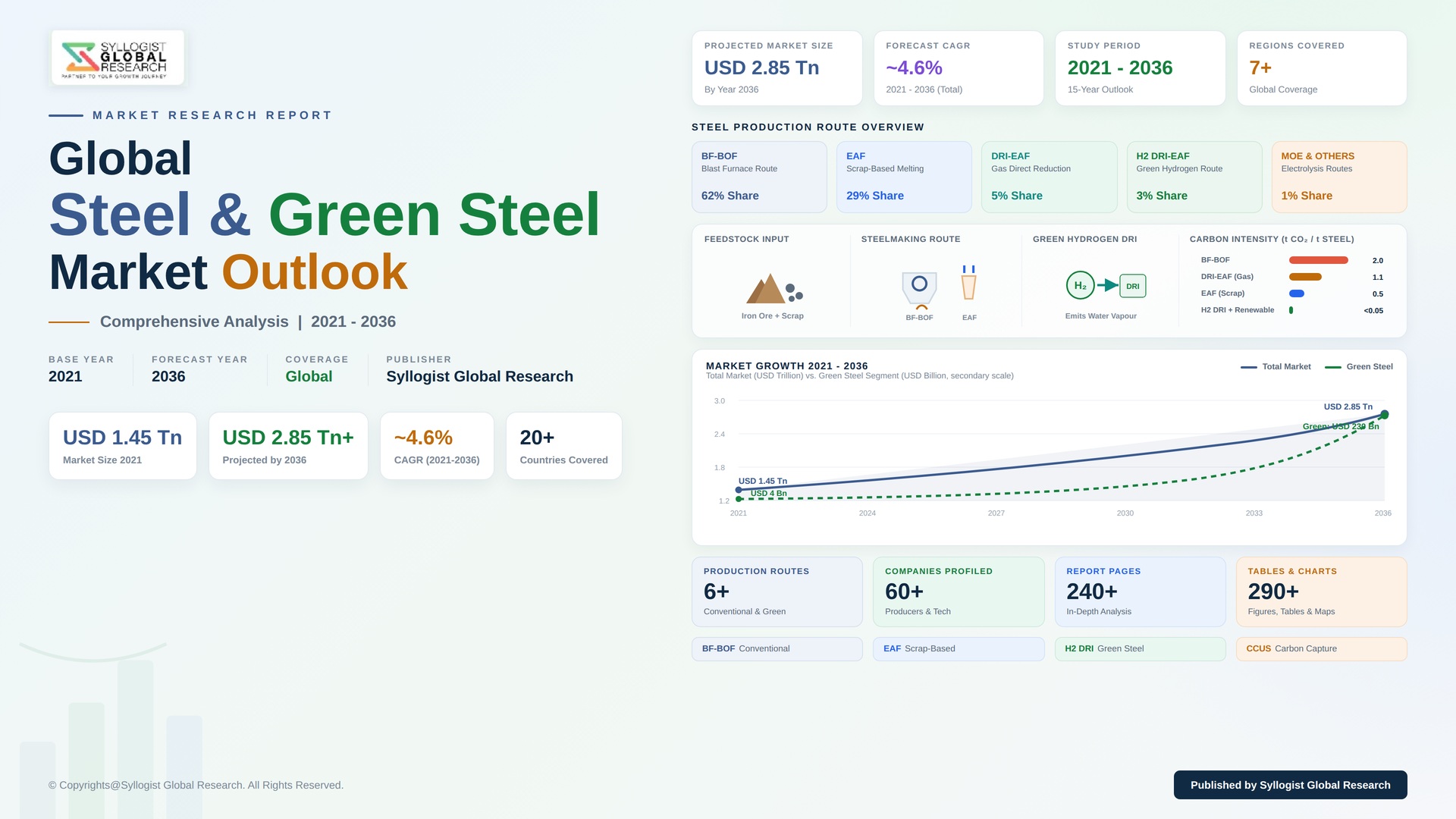
The Global Steel and Green Steel Market is moving through a decisive decarbonization transition, propelled by tightening emissions regulation, carbon border pricing, and corporate net zero commitments that are reshaping how steel is produced and procured worldwide. The Global Steel and Green Steel Market was valued at USD 1.74 trillion in 2025 and is projected to reach USD 2.61 trillion by 2034, advancing at a compound annual growth rate of 4.6% across the forecast period, supported by infrastructure spending, automotive demand, and renewable energy buildout. World crude steel production reached 1,849 million tonnes in 2025, of which China accounted for close to 52%, keeping Asia at the centre of global supply within the Global Steel and Green Steel Market. The steel sector contributes close to 8% of global carbon dioxide emissions, placing it among the hardest sectors to abate and the most exposed to decarbonization policy across the Global Steel and Green Steel Market.
Green steel is the fastest expanding segment within the Global Steel and Green Steel Market, growing from USD 5.9 billion in 2025 to a projected USD 158 billion by 2034 at a compound annual growth rate of 44.1% as hydrogen based and renewable powered routes move from pilot to commercial scale. Conventional BF-BOF steelmaking emits close to 2.0 tonnes of carbon dioxide per tonne of crude steel, while a scrap fed EAF on grid power emits close to 0.5 tonnes, and an EAF supplied with green hydrogen DRI and renewable electricity can fall below 0.05 tonnes per tonne within the Global Steel and Green Steel Market. This emissions gap is the central commercial driver of the Global Steel and Green Steel Market, since carbon pricing converts each avoided tonne into a measurable cost advantage for low-carbon producers.
Electric arc furnace steelmaking is the structural pivot of the Global Steel and Green Steel Market, accounting for close to 29% of global crude steel output in 2025 against close to 62% for the BF-BOF route, with EAF already exceeding 70% of production in the United States. Scrap based recycling sits at the heart of the low-carbon shift within the Global Steel and Green Steel Market, since melting recycled steel in an EAF cuts energy intensity by close to 75% against the iron ore blast furnace route, lowering both emissions and capital requirements. Hydrogen direct reduced iron is the most transformative route within the Global Steel and Green Steel Market, replacing coking coal with green hydrogen so that the reduction reaction emits water vapour rather than carbon dioxide, though electrolyser cost and hydrogen supply remain the gating constraints.
Asia-Pacific holds the largest volume share of the Global Steel and Green Steel Market, led by China and India, where JSW Steel, Tata Steel, China Baowu, Nippon Steel, and POSCO are pivoting toward EAF and hydrogen injection to meet national carbon peaking targets. Europe sets the policy benchmark for the Global Steel and Green Steel Market through the Carbon Border Adjustment Mechanism, which enters full operation in 2026, and the European Green Deal target to cut steel sector emissions by 55% by 2030, supporting projects such as the SSAB HYBRIT initiative and the Thyssenkrupp and Salzgitter hydrogen plants. North America is scaling scrap based EAF capacity within the Global Steel and Green Steel Market under federal procurement and industrial incentives, while India advanced its own decarbonization push by allocating funding for green hydrogen steel pilots under the National Green Hydrogen Mission. ArcelorMittal, Nucor, and emerging entrants such as Stegra are widening the competitive field across the Global Steel and Green Steel Market.
Key Drivers
Carbon Pricing, Border Adjustment Mechanisms, and Tightening Emissions Regulation
Carbon pricing, the European Carbon Border Adjustment Mechanism entering full operation in 2026, and tightening national emissions limits are pushing producers across the Global Steel and Green Steel Market toward low-carbon routes. As each tonne of avoided carbon dioxide carries a rising cost, BF-BOF operators face mounting exposure, strengthening the investment case for hydrogen DRI, renewable powered EAF, and CCUS retrofits across the Global Steel and Green Steel Market.
Green Public Procurement, Automotive Demand, and Net Zero Offtake Commitments
Green public procurement, automotive sector net zero pledges, and long-term offtake agreements are creating durable demand within the Global Steel and Green Steel Market. Automakers and infrastructure buyers are committing to certified low-carbon steel, giving producers the revenue visibility needed to commit capital to hydrogen based and renewable powered green steel capacity across the Global Steel and Green Steel Market.
Scrap Availability, Renewable Electricity Growth, and Falling Clean Energy Cost
Rising scrap availability, rapid renewable electricity growth, and falling clean energy cost are widening the feasible base of the Global Steel and Green Steel Market. Scrap fed EAF routes cut energy intensity by close to 75% against blast furnaces, and cheaper renewable power improves the economics of both EAF melting and green hydrogen production across the Global Steel and Green Steel Market.
Key Challenges
High Capital Intensity and Costly Green Hydrogen Infrastructure
The Global Steel and Green Steel Market faces steep capital intensity, since hydrogen DRI plants, electrolysers, and renewable supply contracts demand large upfront investment against well established and lower cost coal based assets. High electrolyser cost and immature green hydrogen supply lengthen payback periods and slow commercial commitment across the Global Steel and Green Steel Market, especially for producers in cost-driven markets.
Green Hydrogen Supply Gaps and Renewable Electricity Constraints
Limited green hydrogen volumes and constrained renewable electricity supply restrain the pace of decarbonization within the Global Steel and Green Steel Market. Many planned hydrogen DRI plants depend on hydrogen and clean power that are not yet available at industrial scale, creating execution risk and extending project timelines across the Global Steel and Green Steel Market.
Cost Premium of Green Steel and Carbon Leakage Pressure
Green steel still carries a cost premium over conventional steel, and price sensitive buyers slow adoption across the Global Steel and Green Steel Market. Uneven carbon policy between regions also raises carbon leakage risk, as production can shift toward jurisdictions with weaker emissions rules, complicating the level playing field within the Global Steel and Green Steel Market and the broader transition to low-carbon steel.
Market Segmentation
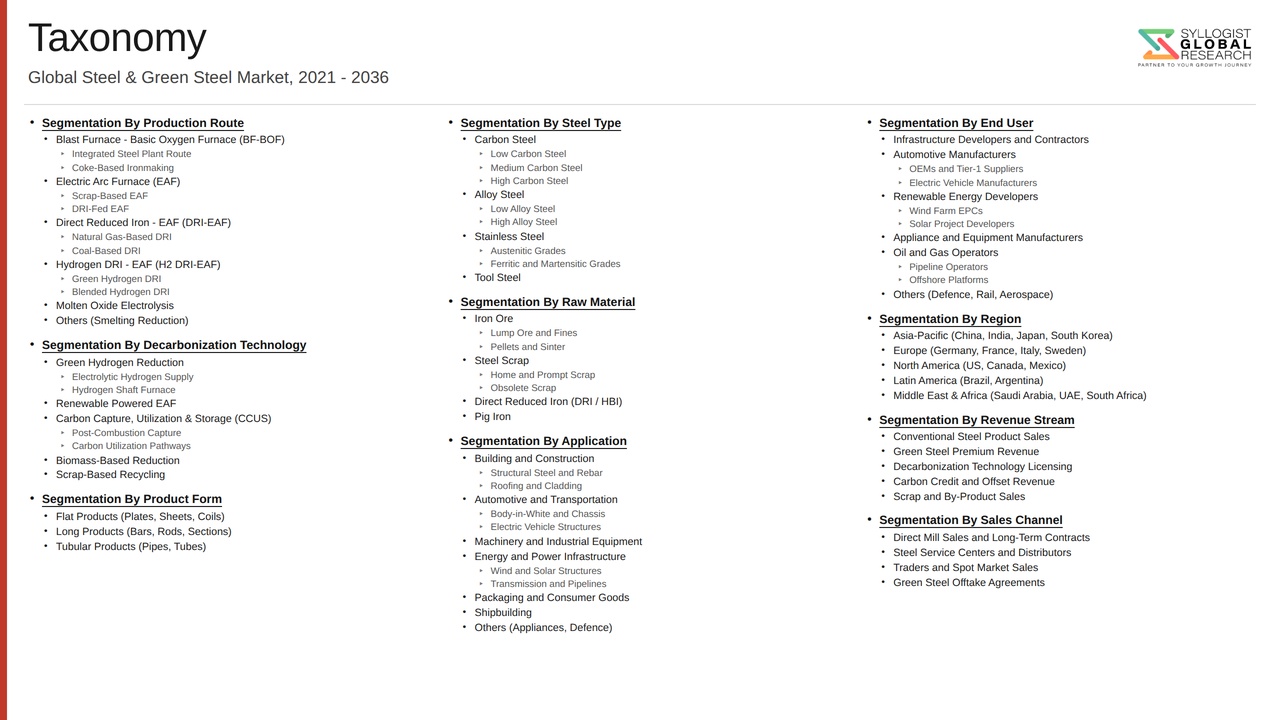
- Segmentation By Production Route
- Blast Furnace – Basic Oxygen Furnace (BF-BOF)
- Electric Arc Furnace (EAF)
- Direct Reduced Iron – Electric Arc Furnace (DRI-EAF)
- Hydrogen DRI – Electric Arc Furnace (H2 DRI-EAF)
- Molten Oxide Electrolysis
- Others
- Segmentation By Steel Type
- Carbon Steel
- Alloy Steel
- Stainless Steel
- Tool Steel
- Segmentation By Raw Material
- Iron Ore
- Steel Scrap
- Direct Reduced Iron
- Pig Iron
- Segmentation By Decarbonization Technology
- Green Hydrogen Reduction
- Renewable Powered EAF
- Carbon Capture Utilization and Storage (CCUS)
- Biomass Based Reduction
- Scrap Based Recycling
- Segmentation By Product Form
- Flat Products
- Long Products
- Tubular Products
- Segmentation By Application
- Building and Construction
- Automotive and Transportation
- Machinery and Industrial Equipment
- Energy and Power Infrastructure
- Packaging and Consumer Goods
- Shipbuilding
- Others
- Segmentation By End User
- Infrastructure Developers and Contractors
- Automotive Manufacturers
- Renewable Energy Developers
- Appliance and Equipment Manufacturers
- Oil and Gas Operators
- Others
- Segmentation By Region
- North America
- Europe
- Asia-Pacific
- Middle East and Africa
- Latin America
All market revenues are presented in USD
Historical Year: 2021-2024 | Base Year: 2025 | Estimated Year: 2026 | Forecast Period: 2027-2034
Key Questions this Study Will Answer
- What is the total valuation of the Global Steel and Green Steel Market in 2025, projected through 2034, segmented by production route, steel type, raw material, decarbonization technology, and application, enabling integrated steel producers, mini-mill operators, technology providers, and infrastructure investors to identify the highest growth segments and most durable revenue opportunities across the Global Steel and Green Steel Market?
- How are carbon pricing, the Carbon Border Adjustment Mechanism, the European Green Deal, and national net zero targets reshaping production route selection and capital allocation across the Global Steel and Green Steel Market through 2034?
- Which decarbonization technologies, including green hydrogen reduction, renewable powered EAF, CCUS, and scrap based recycling, are gaining the strongest commercial traction, and what cost, emissions, and scalability metrics are shaping technology selection within the Global Steel and Green Steel Market?
- How is the structural shift from BF-BOF toward electric arc furnace and hydrogen DRI routes altering raw material demand for iron ore, steel scrap, and direct reduced iron across the Global Steel and Green Steel Market?
- What role do green public procurement, automotive net zero commitments, and long-term offtake agreements play in creating durable demand and bankable revenue for green steel capacity within the Global Steel and Green Steel Market?
- How is the competitive landscape structured among integrated steel producers, mini-mill operators, hydrogen and DRI technology providers, and new low-carbon entrants within the Global Steel and Green Steel Market, and what partnership, acquisition, and capacity expansion strategies are reshaping competitive position?
- Which regional markets, including Asia-Pacific, Europe, North America, the Middle East and Africa, and Latin America, are projected to generate the largest incremental steel and green steel opportunities through 2034, and what policy, hydrogen availability, scrap supply, and infrastructure factors are shaping investment priorities in each regional Global Steel and Green Steel Market?
- Product Definition
- Research Methodology
- Research Design & Framework
- Overall Research Approach: Descriptive, Exploratory & Quantitative Mixed-Method Design
- Market Definition & Scope Boundaries: What is Included and Excluded
- Segmentation Framework
- Key Research Assumptions & Limitations
- Secondary Research
- Primary Research Design & Execution
- Data Triangulation & Validation
- Market Sizing & Forecasting Methodology
- Competitive Intelligence Methodology
- Quality Assurance & Peer Review
- Definitions, Abbreviations & Data Notes
- Executive Summary
- Market Snapshot & Headline Numbers
- Key Findings & Research Highlights
- Market Dynamics
- Regional Market Summary
- Competitive Landscape Snapshot
- Technology & Innovation Highlights
- Market Dynamics
- Drivers
- Restraints
- Opportunities
- Challenges
- Porter’s Five Forces Analysis
- PESTLE Analysis
- Market Trends & Developments
- Emerging Trends
- Technological Developments
- Regulatory & Policy Changes
- Supply Chain & Sourcing Trends
- Manufacturing & Process Trends
- Investment & Funding Activity
- Sustainability & ESG Trends
- Risk Assessment Framework
- Carbon Pricing Exposure, Border Adjustment Mechanism & Emissions Compliance Cost Risk
- Green Hydrogen Supply Gap, Renewable Electricity Availability & Project Execution Risk
- High Capital Intensity, Stranded Asset & Decarbonization Payback Risk
- Steel Price Volatility, Raw Material & Scrap Supply Disruption Risk
- Green Steel Cost Premium, Offtake Uncertainty & Carbon Leakage Risk
- Regulatory Framework & Standards
- Carbon Border Adjustment Mechanism (CBAM), Emissions Trading & Carbon Pricing Frameworks
- European Green Deal, Steel Sector Emission Reduction Targets & Net-Zero Standards
- Green Steel Definition, Low-Carbon Certification & Embodied Carbon Disclosure Standards
- Green Public Procurement, Buy Clean Mandates & Industrial Decarbonization Incentives
- National Green Hydrogen Missions, Scrap Recycling & Circular Economy Regulations
- Global Steel & Green Steel Market Outlook
- Market Size & Forecast by Value
- Market Size & Forecast by Volume (Crude Steel Production in Million Tonnes and Green Steel Output in Million Tonnes per Year)
- Market Size & Forecast by Production Route
- Blast Furnace – Basic Oxygen Furnace (BF-BOF)
- Electric Arc Furnace (EAF)
- Direct Reduced Iron – Electric Arc Furnace (DRI-EAF)
- Hydrogen DRI – Electric Arc Furnace (H2 DRI-EAF)
- Molten Oxide Electrolysis
- Others
- Market Size & Forecast by Steel Type
- Carbon Steel
- Alloy Steel
- Stainless Steel
- Tool Steel
- Market Size & Forecast by Raw Material
- Iron Ore
- Steel Scrap
- Direct Reduced Iron
- Pig Iron
- Market Size & Forecast by Decarbonization Technology
- Green Hydrogen Reduction
- Renewable Powered EAF
- Carbon Capture Utilization and Storage (CCUS)
- Biomass Based Reduction
- Scrap Based Recycling
- Market Size & Forecast by Product Form
- Flat Products
- Long Products
- Tubular Products
- Market Size & Forecast by Application
- Building and Construction
- Automotive and Transportation
- Machinery and Industrial Equipment
- Energy and Power Infrastructure
- Packaging and Consumer Goods
- Shipbuilding
- Others
- Market Size & Forecast by End User
- Infrastructure Developers and Contractors
- Automotive Manufacturers
- Renewable Energy Developers
- Appliance and Equipment Manufacturers
- Oil and Gas Operators
- Others
- North America Steel & Green Steel Market Outlook
- Market Size & Forecast
- By Value
- By Volume (Crude Steel Production in Million Tonnes and Green Steel Output in Million Tonnes per Year)
- By Production Route
- By Steel Type
- By Raw Material
- By Decarbonization Technology
- By Product Form
- By Application
- By End User
- By Country
- Market Size & Forecast
- Europe Steel & Green Steel Market Outlook
- Market Size & Forecast
- By Value
- By Volume (Crude Steel Production in Million Tonnes and Green Steel Output in Million Tonnes per Year)
- By Production Route
- By Steel Type
- By Raw Material
- By Decarbonization Technology
- By Product Form
- By Application
- By End User
- By Country
- Market Size & Forecast
- Asia-Pacific Steel & Green Steel Market Outlook
- Market Size & Forecast
- By Value
- By Volume (Crude Steel Production in Million Tonnes and Green Steel Output in Million Tonnes per Year)
- By Production Route
- By Steel Type
- By Raw Material
- By Decarbonization Technology
- By Product Form
- By Application
- By End User
- By Country
- Market Size & Forecast
- Latin America Steel & Green Steel Market Outlook
- Market Size & Forecast
- By Value
- By Volume (Crude Steel Production in Million Tonnes and Green Steel Output in Million Tonnes per Year)
- By Production Route
- By Steel Type
- By Raw Material
- By Decarbonization Technology
- By Product Form
- By Application
- By End User
- By Country
- Market Size & Forecast
- Middle East & Africa Steel & Green Steel Market Outlook
- Market Size & Forecast
- By Value
- By Volume (Crude Steel Production in Million Tonnes and Green Steel Output in Million Tonnes per Year)
- By Production Route
- By Steel Type
- By Raw Material
- By Decarbonization Technology
- By Product Form
- By Application
- By End User
- By Country
- Market Size & Forecast
- Country-Wise* Steel & Green Steel Market Outlook
- Market Size & Forecast
- By Value
- By Volume (Crude Steel Production in Million Tonnes and Green Steel Output in Million Tonnes per Year)
- By Production Route
- By Steel Type
- By Raw Material
- By Decarbonization Technology
- By Product Form
- By Application
- By End User
- By Country
- Market Size & Forecast
*Countries Analysed in the Global Research Portfolio: China, India, Japan, South Korea, United States, Canada, Mexico, Germany, France, United Kingdom, Italy, Spain, Sweden, Russia, Türkiye, Brazil, Saudi Arabia, UAE, South Africa, Australia
- Technology Landscape & Innovation Analysis
- Hydrogen Direct Reduced Iron (H2 DRI) Steelmaking Technology Deep-Dive
- Electric Arc Furnace, Scrap Melting & Renewable Powered Steelmaking Technology
- Carbon Capture, Utilization & Storage (CCUS) Integration Technology
- Molten Oxide Electrolysis & Breakthrough Zero-Carbon Steelmaking Technology
- Biomass-Assisted Reduction & Low-Carbon Blast Furnace Technology
- Green Hydrogen Electrolyser, Renewable Integration & Energy Supply Technology
- Digital Steelmaking, AI Process Control & Emissions Monitoring Technology
- Patent & IP Landscape in Green Steel Technologies
- Value Chain & Supply Chain Analysis
- Iron Ore, Coking Coal & Direct Reduced Iron Raw Material Supply Chain
- Steel Scrap Collection, Processing & Recycled Feedstock Supply Chain
- Green Hydrogen, Renewable Electricity & Clean Energy Supply Chain
- Steelmaking Equipment, DRI Plant & EAF Technology Supply Chain
- Steel Mill, Mini-Mill & Integrated Producer Manufacturing Network
- Downstream Customer Channel (Construction, Automotive, Energy, Packaging)
- Logistics, Trade & Cross-Border Steel Distribution Network
- Pricing Analysis
- Steel Pricing Across Flat, Long & Tubular Product Forms
- Pricing Across BF-BOF, EAF & Hydrogen DRI Production Routes
- Green Steel Price Premium & Low-Carbon Steel Cost Economics
- Raw Material Cost Analysis Across Iron Ore, Scrap & DRI
- Green Hydrogen & Renewable Electricity Cost Impact on Steelmaking
- Carbon Cost, Border Adjustment & Emissions Pricing Impact Analysis
- Capital Cost, Decarbonization Investment & Total Cost of Ownership Across Routes
- Sustainability & Environmental Analysis
- Lifecycle Assessment (LCA) of Steel Across BF-BOF, EAF & Hydrogen DRI Routes
- Carbon Intensity, Scope 1-2-3 Emissions & Net Climate Impact of Steelmaking
- Scrap Recycling, Circular Steel Economy & Resource Efficiency Performance
- Green Hydrogen, Renewable Electricity & Decarbonization Pathway Impact
- Regulatory-Driven Sustainability, SDG 9 (Industry and Innovation) & SDG 13 (Climate Action) Alignment
- Competitive Landscape
- Market Structure & Concentration
- Market Consolidation Level (Fragmented vs. Consolidated by Production Route & Geography)
- Top 10 Players Market Share
- HHI (Herfindahl-Hirschman Index) Concentration Analysis
- Competitive Intensity Map by Production Route, Steel Type & Geography
- Player Classification
- Integrated Steel Producers
- Electric Arc Furnace & Mini-Mill Operators
- Hydrogen DRI & Green Steel Producers
- Stainless & Specialty Steel Producers
- DRI & Steelmaking Technology Providers
- Scrap Processors & Recyclers
- Green Hydrogen & Renewable Energy Partners
- Competitive Analysis Frameworks
- Market Share Analysis by Production Route, Steel Type & Region
- Company Profile
- Company Overview & Headquarters
- Steel & Green Steel Product Portfolio
- Key Customer Relationships & Reference Accounts
- Operational Footprint & Production Capacity Coverage
- Revenue (Steel & Green Steel Segment) & Order Backlog
- Technology Differentiators & IP
- Key Strategic Partnerships, JVs & M&A Activity
- Recent Developments (Decarbonization Projects, Capacity Expansion, Product Launches)
- SWOT Analysis
- Strategic Focus Areas & Roadmap
- Competitive Positioning Map (Technology Capability vs. Market Penetration)
- Key Company Profiles
- Market Structure & Concentration
- Technology Landscape & Innovation Analysis
- Strategic Output
- Market Opportunity Matrix: By Production Route, Decarbonization Technology, Steel Type, End-User & Geography
- White Space Opportunity Analysis
- Strategic Recommendations
- Product Portfolio & Decarbonization Technology Investment Strategy
- Operational Excellence & Production Capacity Expansion Strategy
- Geographic Expansion & Localisation Strategy
- Customer & Offtake Account Engagement Strategy
- Partnership, M&A & Ecosystem Strategy
- Sustainability & Circular Economy Strategy
- Risk Mitigation & Future Roadmap
- Strategic Priority Matrix & Roadmap
- Near-term (2025-2028)
- Mid-term (2029-2032)
- Long-term (2033-2037)