Global Catalyst Market By Type, By Material, By Application, By End User, By Region, Competition, Forecast & Opportunities, 2021-2034F
Market Definition
Catalysts are substances that raise the rate of a chemical reaction and steer its selectivity without being consumed in the process, enabling faster, cleaner, and more energy-efficient conversion of feedstocks across refining, petrochemical, chemical synthesis, polymerization, and emission control operations. The Global Catalyst Market covers the formulation, manufacturing, regeneration, and supply of heterogeneous catalysts, homogeneous catalysts, and biocatalysts used to activate and control industrial reactions, including zeolite catalysts, supported precious metal catalysts, base metal catalysts, chemical compound catalysts, organometallic complexes, and enzyme systems deployed across fixed-bed, fluidized-bed, and slurry-phase reactor configurations. The catalyst market spans fluid catalytic cracking catalysts, hydrotreating and hydrocracking catalysts, reforming and isomerization catalysts, ammonia and methanol synthesis catalysts, polyolefin polymerization catalysts, oxidation and hydrogenation catalysts, and automotive and industrial emission control catalysts applied in three-way converters, diesel oxidation units, and selective catalytic reduction systems. Market participants include catalyst producers, precious metal refiners and recyclers, zeolite and support material suppliers, custom catalyst formulators, and licensors that pair proprietary catalysts with process technology packages. End users span petroleum refiners, petrochemical and chemical producers, fertilizer and ammonia manufacturers, polymer and plastics producers, automotive original equipment manufacturers, power and industrial emission control operators, and pharmaceutical and food processors. The catalyst market excludes laboratory reagent chemicals, adsorbents and desiccants that carry no catalytic function, and non-catalytic reactor internals, concentrating on active catalytic materials that govern the rate, yield, and selectivity of commercial chemical and refining reactions worldwide.
Market Insights
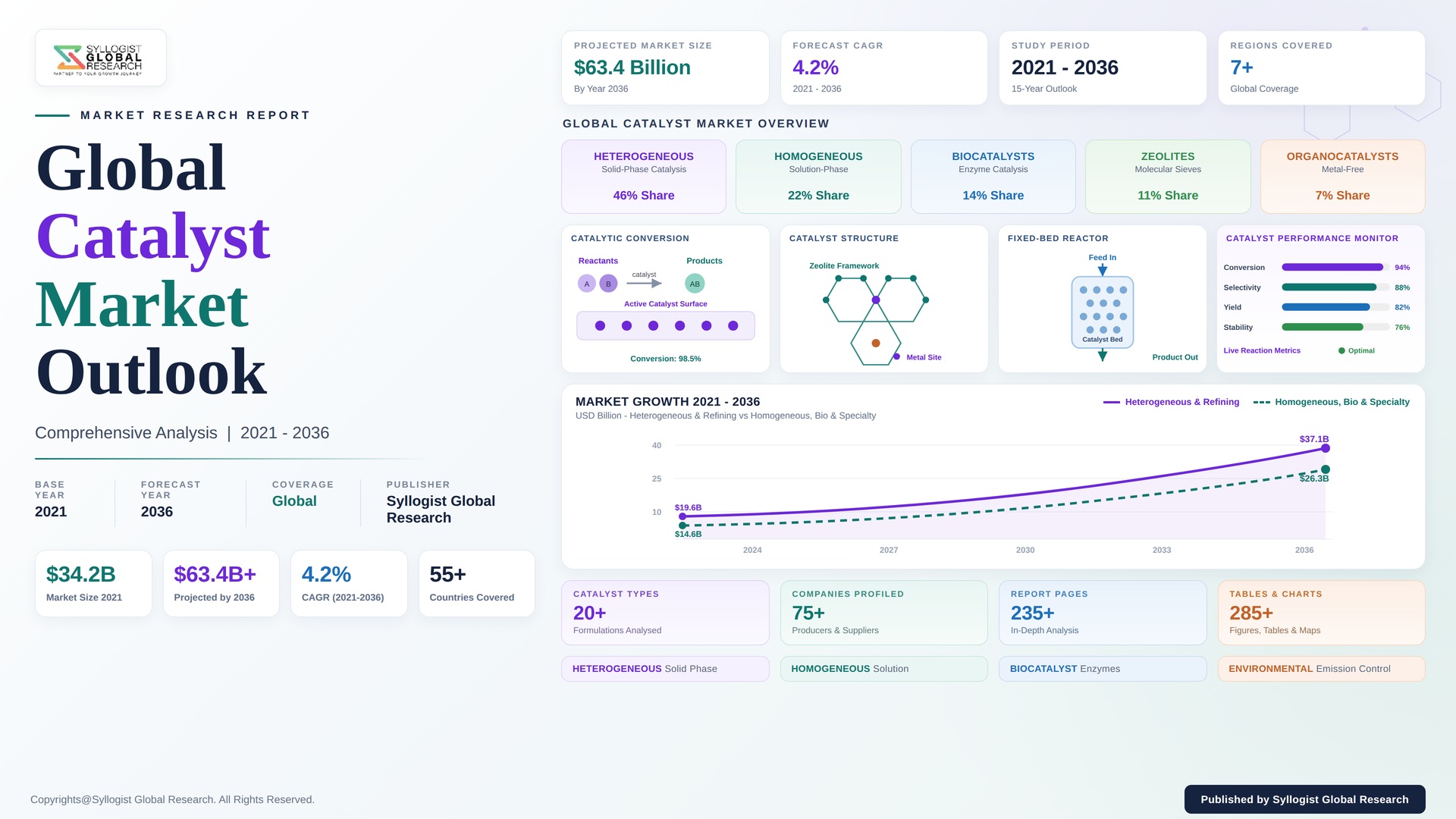
The global catalyst market is moving through a steady expansion phase, shaped by rising refined fuel and petrochemical demand across developing economies, tightening fuel quality and emission regulations, the buildout of integrated refining and petrochemical complexes in Asia and the Middle East, and accelerating adoption of process catalysts that lift yield, cut energy intensity, and reduce carbon output per unit of production. The global catalyst market was valued at USD 41.2 billion in 2025 and is projected to reach USD 63.4 billion by 2034, advancing at a compound annual growth rate of 4.9% through the forecast period, as refiners, petrochemical producers, fertilizer manufacturers, automotive original equipment manufacturers, and industrial emission control operators scale catalyst procurement across North America, Europe, Asia-Pacific, the Middle East, and Latin America.
The catalyst market trajectory is being reshaped by the commercial scaling of high-activity zeolite formulations, low-platinum-group-metal loadings in emission control catalysts, single-site metallocene polymerization catalysts, and bio-based enzyme catalysts that replace harsh reaction conditions with mild, selective biological routes. Refiners are shifting toward hydroprocessing catalysts engineered for ultra-low sulfur fuel production, with new hydrotreating formulations achieving sulfur removal above 99.7% while extending cycle life beyond 60 months at major conversion refineries. Emission control catalyst producers are cutting platinum group metal intensity by 28% per converter through advanced washcoat design and thrifting, protecting margins against volatile precious metal pricing while meeting progressively stricter tailpipe and industrial emission limits within the catalyst market.
Heterogeneous catalysts represent the largest revenue category within the global catalyst market, supported by their dominance across refining, petrochemical, ammonia, and emission control applications where fixed-bed and fluidized-bed reactors process very high feed volumes. Petroleum refining remains the single largest application within the catalyst market, sustained by fluid catalytic cracking and hydroprocessing catalyst replacement cycles across a global refining base exceeding 102 million barrels per day of capacity. Environmental and emission control catalysts form the fastest-growing application within the catalyst market, propelled by tightening vehicle emission standards, expanding selective catalytic reduction retrofits at power and industrial plants, and rising enforcement of nitrogen oxide and volatile organic compound limits, while biocatalysts are gaining strategic traction within the catalyst market driven by green chemistry adoption across pharmaceutical, specialty chemical, and food processing routes.
Asia-Pacific represents the largest regional market within the global catalyst market, supported by large-scale refining and petrochemical capacity commissioning across China, India, South Korea, and Southeast Asia, sustained fertilizer output, and rapid tightening of automotive and industrial emission norms. China alone accounts for more than 18 million barrels per day of refining capacity and continues to add integrated petrochemical complexes that raise catalyst consumption. North America occupies the second regional position within the catalyst market, propelled by shale-driven petrochemical feedstock advantage, ammonia and methanol capacity, and mature vehicle emission control demand. Europe represents the third regional market within the catalyst market, anchored by specialty chemical production, stringent emission enforcement, and strong biocatalyst adoption, while the Middle East forms the fourth regional position within the catalyst market, driven by gas-based petrochemical and fertilizer expansion at integrated complexes across Saudi Arabia, the United Arab Emirates, and Qatar.
Key Drivers
Rising Refined Fuel Demand, Cleaner Fuel Specifications, and Refining Capacity Additions Driving Sustained Hydroprocessing and Fluid Catalytic Cracking Catalyst Procurement
Rising transportation fuel demand across developing economies, the global shift toward cleaner fuel specifications, and continued refining capacity additions in Asia and the Middle East are generating durable procurement demand for hydroprocessing and fluid catalytic cracking catalysts across the catalyst market. Global refining capacity crossed 102 million barrels per day in 2025, and new conversion units are being commissioned with deep hydrocracking and residue upgrading configurations that consume high volumes of high-activity catalysts on tight replacement cycles. Fuel quality mandates requiring ultra-low sulfur gasoline and diesel below 10 parts per million have pushed refiners toward advanced hydrotreating catalysts, lifting catalyst intensity per barrel processed by 23% over the past decade. Fluid catalytic cracking units, which convert heavy fractions into gasoline and propylene, require continuous catalyst make-up to offset attrition and deactivation, generating a large and recurring replacement stream that anchors baseline demand within the catalyst market. Refiners are also reconfiguring assets toward petrochemical integration and maximum propylene output, a shift that raises consumption of specialty cracking additives and tailored catalyst systems. Together, sustained fuel demand, cleaner fuel rules, and capacity expansion secure a resilient, replacement-led revenue base for catalyst suppliers serving global refining operators across every major region, supporting steady multi-year catalyst demand visibility for producers planning long-cycle capacity investment.
Tightening Vehicle and Industrial Emission Regulations Driving Emission Control and Selective Catalytic Reduction Catalyst Demand Across Automotive and Industrial End Users
The progressive tightening of vehicle tailpipe standards, the expansion of industrial nitrogen oxide and volatile organic compound controls, and the retrofitting of selective catalytic reduction systems across power and process plants are driving sustained demand for emission control catalysts within the catalyst market. Successive emission frameworks such as Euro 7, Bharat Stage VI, China 6, and equivalent standards have raised the catalyst content and precious metal functionality required per vehicle, expanding value capture per three-way converter and diesel oxidation unit. Stationary emission control is scaling in parallel, with selective catalytic reduction retrofits at coal, gas, cement, and waste-to-energy plants lifting demand for vanadium-titanium and zeolite-based reduction catalysts. Global automotive production recovered to 92 million units in 2024, sustaining a large installed base that requires emission control catalysts on every combustion and hybrid vehicle produced. Industrial operators facing stricter permits are installing oxidation and reduction catalyst beds to meet tightening nitrogen oxide limits, adding a durable non-automotive demand layer to the catalyst market. Because emission control performance is legally mandated rather than discretionary, this demand is highly resilient to economic cycles, giving catalyst producers a regulation-backed growth stream that expands as enforcement widens across emerging markets and as heavy-duty and off-road segments adopt equivalent standards.
Petrochemical and Polymer Capacity Expansion, Fertilizer Output Growth, and Green Chemistry Adoption Driving Process and Bio-Based Catalyst Demand
The buildout of petrochemical and polymer capacity, sustained fertilizer output growth, and the adoption of green chemistry routes are collectively driving demand for polymerization, synthesis, and bio-based catalysts across the catalyst market. Integrated petrochemical complexes in Asia and the Middle East are commissioning steam crackers, propane dehydrogenation units, and polyolefin lines that consume large volumes of metallocene and Ziegler-Natta polymerization catalysts, with global polyethylene and polypropylene capacity expanding by 41 million tonnes between 2021 and 2025. Ammonia and methanol producers rely on iron, copper-zinc, and nickel synthesis catalysts that require periodic replacement, sustaining a steady process catalyst stream tied to fertilizer and chemical demand. Green chemistry and decarbonization goals are accelerating adoption of enzyme biocatalysts and selective homogeneous catalysts that operate at lower temperatures, reduce solvent use, and cut byproduct formation across pharmaceutical, specialty chemical, and food processing routes. Emerging low-carbon value chains, including blue and green ammonia, methanol-to-olefins, and carbon dioxide conversion, are creating new catalyst demand categories that extend the growth runway beyond conventional refining. This combination of capacity expansion, fertilizer output, and sustainability-driven route redesign broadens the addressable base of the catalyst market and supports diversified demand across established and emerging chemical value chains worldwide, broadening long-term catalyst demand beyond traditional refining and fuel-linked segments.
Key Challenges
Precious Metal Price Volatility and Concentrated Raw Material Supply Constraining Emission Control and Refining Catalyst Economics
Persistent volatility in platinum group metal prices, concentrated geographic supply of critical raw materials, and exposure to currency and mining disruption generate substantial cost and margin risk that constrains procurement and formulation decisions within the catalyst market. Emission control and reforming catalysts depend on platinum, palladium, and rhodium, whose prices can swing by 40% within a single year on the back of mining supply shocks, speculative positioning, and shifting automotive demand, making catalyst cost forecasting and inventory management difficult for both producers and end users. More than 70% of global platinum group metal supply originates from a small number of producing regions, concentrating supply risk and exposing the catalyst market to labor, power, and geopolitical disruptions at a limited set of mining operations. Rare earth and specialty metal inputs used in refining and environmental catalysts face parallel concentration risk, with a single country controlling a dominant share of processing capacity. These dynamics push catalyst producers toward aggressive metal thrifting, substitution research, and closed-loop recycling to protect margins, yet thrifting has technical limits before catalytic performance degrades. The combined effect of price volatility and concentrated supply raises working capital requirements, complicates long-term contract pricing, and constrains the pace at which producers can absorb demand growth without passing through significant and unpredictable raw material cost increases across the catalyst market.
Catalyst Deactivation, Spent Catalyst Handling, and Tightening Environmental Disposal Regulations Adding Lifecycle Cost and Compliance Complexity
Catalyst deactivation over operating cycles, the hazardous nature of spent catalyst material, and tightening environmental regulations governing handling, transport, and disposal add lifecycle cost and compliance complexity that constrains the catalyst market. Industrial catalysts lose activity through coking, sintering, poisoning, and fouling, forcing periodic regeneration or replacement that interrupts production and imposes downtime cost on refiners and chemical producers. Spent hydroprocessing and emission control catalysts often carry heavy metals, sulfur compounds, and residual hydrocarbons that classify them as hazardous waste, requiring specialized handling, transport, and either metal reclamation or controlled disposal under strict regulatory oversight. Global spent catalyst volumes now exceed 600 thousand tonnes per year, and tightening waste frameworks in Europe, North America, and Asia are raising the compliance burden and cost associated with reclamation and disposal. End users increasingly demand take-back, regeneration, and metal recovery services from suppliers, shifting part of the lifecycle cost and liability onto catalyst producers and compressing the effective value captured per catalyst charge. Meeting these obligations requires investment in regeneration facilities, reverse logistics, and metal recovery capability, raising the cost of participation and creating barriers for smaller suppliers within the catalyst market that lack the scale to operate compliant recovery and disposal networks across multiple regulatory jurisdictions.
Energy Transition Uncertainty, Peaking Conventional Fuel Demand, and Competition From Alternative Process Technologies Complicating Long-Term Catalyst Investment
Uncertainty over the pace of the energy transition, the projected peaking of conventional transportation fuel demand, and competition from alternative and electrified process technologies generate long-term demand forecasting complexity that complicates capital and formulation investment within the catalyst market. Rising electric vehicle adoption is expected to erode gasoline and diesel demand over the coming decades, threatening the long-term replacement base for fluid catalytic cracking, reforming, and automotive emission control catalysts that today form a large share of catalyst market revenue. Electric vehicle sales surpassed 17 million units globally in 2024, signaling a structural shift that will gradually reduce the internal combustion vehicle population and the emission control catalysts attached to it. Refiners weighing multi-decade catalyst and process investments face difficulty sizing future demand when fuel consumption trajectories diverge sharply across scenarios and regions. Competing technologies, including electrified chemical processes, membrane separation, and non-catalytic routes, add further uncertainty to catalyst demand in selected applications. While decarbonization also creates new catalyst opportunities in hydrogen, ammonia, and carbon conversion, the timing and scale of these markets remain uncertain, leaving producers to balance investment in declining legacy segments against emerging low-carbon categories whose commercial maturity and volume within the catalyst market remain difficult to forecast with confidence.
Market Segmentation
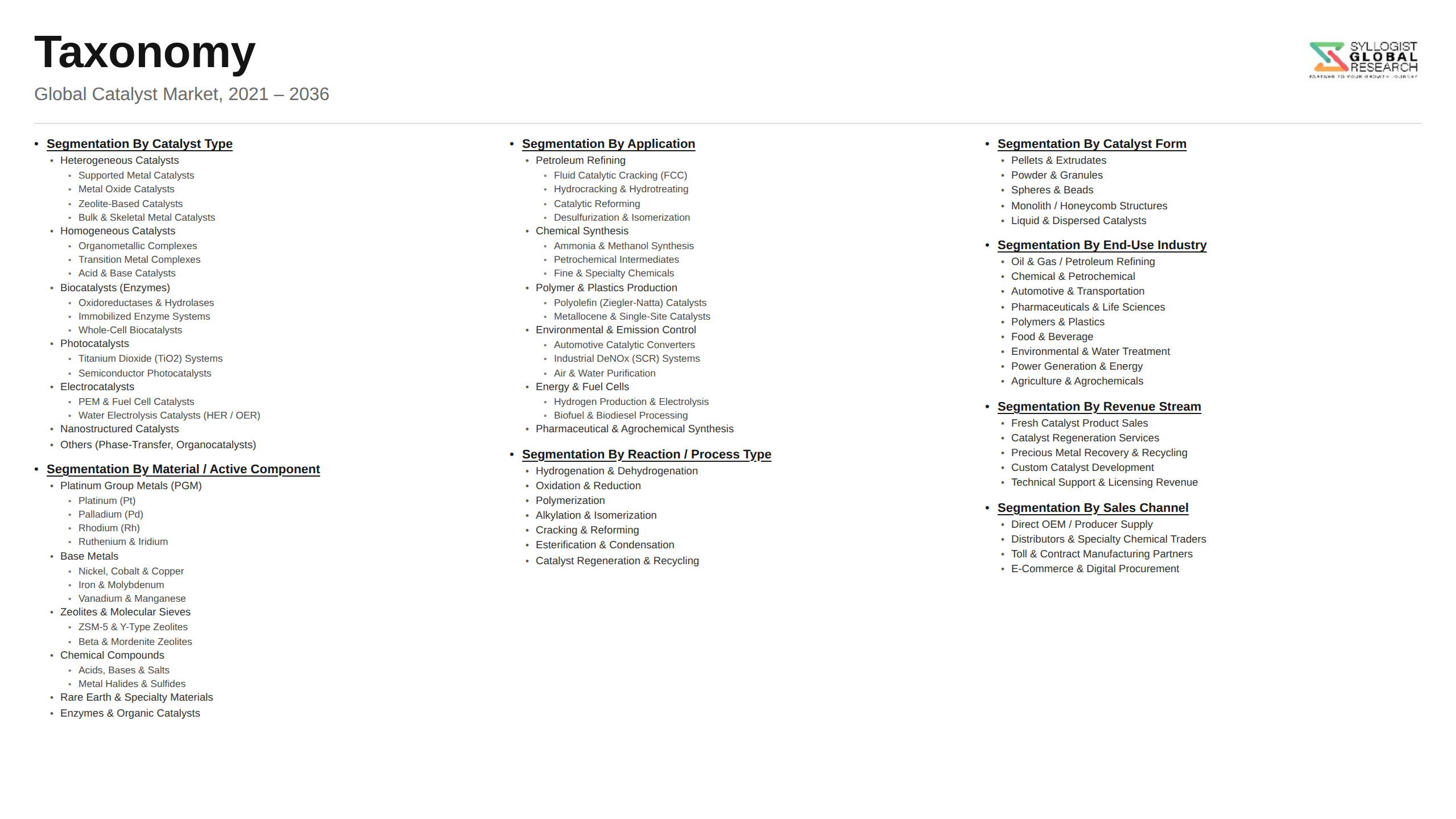
- Segmentation By Type
- Heterogeneous Catalysts
- Homogeneous Catalysts
- Biocatalysts (Enzymes)
- Segmentation By Material
- Zeolites
- Metals and Metal Oxides
- Chemical Compounds
- Organometallic Materials
- Enzymes
- Others
- Segmentation By Application
- Petroleum Refining
- Chemical Synthesis
- Polymer and Petrochemical Production
- Environmental and Emission Control
- Pharmaceuticals and Fine Chemicals
- Others
- Segmentation By Process
- Recycle (Regenerable) Catalysts
- Non-Recycle (Single-Use) Catalysts
- Segmentation By End User
- Oil and Gas and Refining
- Chemicals and Petrochemicals
- Automotive and Emission Control
- Fertilizers and Ammonia
- Pharmaceuticals
- Food and Beverage
- Others
- Segmentation By Region
- North America
- Europe
- Asia-Pacific
- Middle East and Africa
- Latin America
All market revenues are presented in USD
Historical Year: 2021-2024 | Base Year: 2025 | Estimated Year: 2026 | Forecast Period: 2027-2034
Key Questions this Study Will Answer
- What is the total global market valuation of the Catalyst Market in 2025, projected through 2034, segmented by type, material, application, and end user, enabling catalyst producers, refiners, petrochemical operators, and chemical industry investors to identify highest-growth segments and the most durable revenue opportunities across the global catalyst market?
- How are refiners, petrochemical producers, fertilizer manufacturers, and emission control operators structuring catalyst procurement, regeneration, and replacement cycles, and which commercial models, including direct purchase, catalyst leasing, and process-licensor bundled supply, are shaping deployment economics within the catalyst market through 2034?
- What refining capacity additions, cleaner fuel specifications, and emission regulation trends are shaping the pace and geographic distribution of hydroprocessing, fluid catalytic cracking, and emission control catalyst demand across mature and emerging markets within the catalyst market?
- Which catalyst technologies, including high-activity zeolites, low-platinum-group-metal emission control formulations, single-site polymerization catalysts, and enzyme biocatalysts, are gaining the strongest adoption across refining, petrochemical, environmental, and fine chemical applications, and what activity, selectivity, cycle life, and total cost of ownership metrics are shaping catalyst selection within the catalyst market?
- How is the competitive structure organized among catalyst producers, precious metal refiners and recyclers, zeolite and support suppliers, and process licensors within the catalyst market, and what partnership, acquisition, recycling, and capacity expansion strategies are enabling suppliers to defend and grow share across refining, petrochemical, and emission control segments?
- How are precious metal price volatility, concentrated raw material supply, spent catalyst regulation, and metal recovery economics reshaping catalyst formulation, thrifting, and lifecycle service strategies across the catalyst market?
- Which regional markets, including Asia-Pacific, North America, Europe, and the Middle East, are projected to generate the largest incremental catalyst demand through 2034, and what refining capacity, petrochemical investment, fertilizer output, emission enforcement, and energy transition factors are shaping investment priorities and supplier selection decisions in each regional catalyst market?
- Product Definition
- Research Methodology
- Research Design & Framework
- Overall Research Approach: Descriptive, Exploratory & Quantitative Mixed-Method Design
- Market Definition & Scope Boundaries: What is Included and Excluded
- Segmentation Framework
- Key Research Assumptions & Limitations
- Secondary Research
- Primary Research Design & Execution
- Data Triangulation & Validation
- Market Sizing & Forecasting Methodology
- Competitive Intelligence Methodology
- Quality Assurance & Peer Review
- Definitions, Abbreviations & Data Notes
- Executive Summary
- Market Snapshot & Headline Numbers
- Key Findings & Research Highlights
- Market Dynamics
- Regional Market Summary
- Competitive Landscape Snapshot
- Technology & Innovation Highlights
- Market Dynamics
- Drivers
- Restraints
- Opportunities
- Challenges
- Porter’s Five Forces Analysis
- PESTLE Analysis
- Market Trends & Developments
- Emerging Trends
- Technological Developments
- Regulatory & Policy Changes
- Supply Chain & Sourcing Trends
- Manufacturing & Process Trends
- Investment & Funding Activity
- Sustainability & ESG Trends
- Risk Assessment Framework
- Precious Metal Price Volatility, Platinum Group Metal Supply Concentration & Raw Material Cost Escalation Risk
- Catalyst Deactivation, Poisoning, Fouling & Shortened Cycle Life Performance Risk
- Environmental Compliance, Spent Catalyst Hazardous Waste Handling & Heavy Metal Disposal Liability Risk
- Feedstock Transition, Refinery Rationalisation & Declining Fossil-Fuel Demand Risk
- Technology Substitution, Process Electrification & Green Catalyst Displacement Risk
- Regulatory Framework & Standards
- REACH, TSCA Chemical Registration & Hazardous Substance Compliance Standards
- Spent Catalyst Classification, Basel Convention Transboundary Waste & Hazardous Waste Handling Regulations
- Emission Control Catalyst Standards, Euro 7, EPA Tier & Automotive Aftertreatment Compliance Frameworks
- Platinum Group Metal Recovery, Conflict Minerals & Responsible Sourcing Due-Diligence Standards
- Food-Contact, Pharmaceutical GMP & Enzyme Catalyst Purity and Quality Standards
- Global Catalyst Market Outlook
- Market Size & Forecast by Value
- Market Size & Forecast by Volume (Catalyst Volume Consumed in Kilo Tonnes per Year and Precious Metal Content in Tonnes per Year)
- Market Size & Forecast by Catalyst Type
- Heterogeneous Catalyst
- Homogeneous Catalyst
- Biocatalyst (Enzyme)
- Nanocatalyst
- Photocatalyst
- Others
- Market Size & Forecast by Material
- Precious Metal (Platinum, Palladium, Rhodium)
- Base Metal (Nickel, Copper, Iron, Cobalt)
- Zeolite
- Chemical Compound
- Enzyme
- Organometallic
- Others
- Market Size & Forecast by Form
- Pellet
- Sphere and Bead
- Powder
- Extrudate
- Honeycomb Monolith
- Others
- Market Size & Forecast by Application
- Petroleum Refining (Hydrotreating, Hydrocracking, FCC, Reforming)
- Chemical Synthesis
- Petrochemical Production
- Polymerisation and Polymer Production
- Environmental and Emission Control
- Fine and Specialty Chemical Synthesis
- Ammonia and Fertiliser Synthesis
- Hydrogen and Syngas Production
- Biofuel and Renewable Feedstock Conversion
- Others
- Market Size & Forecast by End-Use Industry
- Petroleum Refining
- Chemical
- Petrochemical
- Automotive (Emission Control)
- Pharmaceutical and Fine Chemical
- Food and Beverage
- Water and Wastewater Treatment
- Others
- Market Size & Forecast by Technology
- Zeolite Catalysis
- Metal-Organic Framework (MOF) Catalysis
- Nanocatalysis
- Enzyme and Biocatalysis
- Photocatalysis
- Electrocatalysis
- Others
- Market Size & Forecast by Manufacturing Process
- Impregnation
- Precipitation and Co-Precipitation
- Ion Exchange
- Sol-Gel
- Others
- Market Size & Forecast by Sales Channel
- Direct Long-Term Supply Contract
- Distributor and Trader Channel
- Licensor-Linked Technology Supply
- Toll and Custom Manufacturing
- Aftermarket Catalyst Regeneration and Reclaim Services
- North America Catalyst Market Outlook
- Market Size & Forecast
- By Value
- By Volume (Catalyst Volume Consumed in Kilo Tonnes per Year and Precious Metal Content in Tonnes per Year)
- By Catalyst Type
- By Material
- By Form
- By Application
- By End-Use Industry
- By Technology
- By Manufacturing Process
- By Country
- By Sales Channel
- Europe Catalyst Market Outlook
- Market Size & Forecast
- By Value
- By Volume (Catalyst Volume Consumed in Kilo Tonnes per Year and Precious Metal Content in Tonnes per Year)
- By Catalyst Type
- By Material
- By Form
- By Application
- By End-Use Industry
- By Technology
- By Manufacturing Process
- By Country
- By Sales Channel
- Asia-Pacific Catalyst Market Outlook
- Market Size & Forecast
- By Value
- By Volume (Catalyst Volume Consumed in Kilo Tonnes per Year and Precious Metal Content in Tonnes per Year)
- By Catalyst Type
- By Material
- By Form
- By Application
- By End-Use Industry
- By Technology
- By Manufacturing Process
- By Country
- By Sales Channel
- Latin America Catalyst Market Outlook
- Market Size & Forecast
- By Value
- By Volume (Catalyst Volume Consumed in Kilo Tonnes per Year and Precious Metal Content in Tonnes per Year)
- By Catalyst Type
- By Material
- By Form
- By Application
- By End-Use Industry
- By Technology
- By Manufacturing Process
- By Country
- By Sales Channel
- Middle East & Africa Catalyst Market Outlook
- Market Size & Forecast
- By Value
- By Volume (Catalyst Volume Consumed in Kilo Tonnes per Year and Precious Metal Content in Tonnes per Year)
- By Catalyst Type
- By Material
- By Form
- By Application
- By End-Use Industry
- By Technology
- By Manufacturing Process
- By Country
- By Sales Channel
- Country-Wise* Catalyst Market Outlook
- Market Size & Forecast
- By Value
- By Volume (Catalyst Volume Consumed in Kilo Tonnes per Year and Precious Metal Content in Tonnes per Year)
- By Catalyst Type
- By Material
- By Form
- By Application
- By End-Use Industry
- By Technology
- By Manufacturing Process
- By Country
- By Sales Channel
- Market Size & Forecast
- Market Size & Forecast
- Market Size & Forecast
- Market Size & Forecast
- Market Size & Forecast
- Market Size & Forecast
*Countries Analysed in the Global Research Portfolio: United States, Canada, Mexico, Germany, France, United Kingdom, Netherlands, Spain, Italy, Norway, Sweden, China, Japan, India, Australia, South Korea, Singapore, Brazil, Chile, Saudi Arabia, UAE, Egypt, South Africa, Israel
- Technology Landscape & Innovation Analysis
- Single-Atom and Nanostructured Catalyst Design & High-Surface-Area Support Technology Deep-Dive
- Zeolite, Molecular Sieve & Shape-Selective Catalysis Technology
- Metal-Organic Framework (MOF) & Advanced Porous Catalyst Technology
- Enzyme Engineering, Immobilisation & Industrial Biocatalysis Technology
- Photocatalysis, Electrocatalysis & Solar-Driven Conversion Technology
- Green Hydrogen, CO2 Conversion & Power-to-X Catalyst Technology
- AI and High-Throughput Screening for Accelerated Catalyst Discovery Technology
- Patent & IP Landscape in Catalyst Technologies
- Value Chain & Supply Chain Analysis
- Precious Metal, Base Metal & Rare Earth Raw Material Supply Chain
- Zeolite, Alumina, Silica & Ceramic Support Material Supply Chain
- Catalyst Manufacturing, Impregnation & Formulation Supply Chain
- Enzyme Fermentation, Purification & Immobilisation Supply Chain
- Catalyst Distributor, Licensor & Technology Provider Channel
- Industrial Customer Channel (Refinery, Petrochemical, Chemical, Automotive)
- Spent Catalyst Collection, Regeneration, Reclaim & Precious Metal Recovery Network
- Pricing Analysis
- Refining and Hydroprocessing Catalyst Pricing Across Hydrotreating, Hydrocracking & FCC Tiers
- Precious Metal Catalyst Pricing Linked to Platinum, Palladium & Rhodium Market Benchmarks
- Zeolite and Base Metal Catalyst Cost Economics & Per-Tonne Pricing Analysis
- Emission Control Catalyst Pricing Across Automotive, Diesel & Stationary Source Tiers
- Enzyme and Biocatalyst Pricing Across Industrial, Food & Pharmaceutical Grades
- Catalyst Regeneration, Reclaim & Precious Metal Recovery Value Economics
- Total Catalyst Cost of Ownership, Cycle Life, Reload Economics & Value-in-Use Pricing Models
- Sustainability & Environmental Analysis
- Lifecycle Assessment (LCA) of Catalysts Across Precious Metal, Base Metal & Enzyme Systems
- Precious Metal Recovery, Spent Catalyst Recycling & Circular Economy Performance
- Green Catalysis, Atom Economy & Waste Reduction in Chemical Manufacturing
- Catalyst-Enabled Decarbonisation: Hydrogen, CO2 Conversion & Emission Control Contribution
- Regulatory-Driven Sustainability, SDG 9 (Industry, Innovation) & SDG 12 (Responsible Consumption) Alignment & Green Finance Eligibility
- Competitive Landscape
- Market Structure & Concentration
- Market Consolidation Level (Fragmented vs. Consolidated by Catalyst Type & Geography)
- Top 10 Players Market Share
- HHI (Herfindahl-Hirschman Index) Concentration Analysis
- Competitive Intensity Map by Catalyst Type, Application & Geography
- Player Classification
- Integrated Refining and Petrochemical Catalyst Producers
- Specialty and Fine Chemical Catalyst Manufacturers
- Precious Metal and PGM Catalyst Specialists
- Zeolite and Molecular Sieve Producers
- Emission Control and Automotive Catalyst Manufacturers
- Industrial Enzyme and Biocatalyst Producers
- Catalyst Technology Licensors and Process Developers
- Spent Catalyst Recycling and Precious Metal Recovery Operators
- Competitive Analysis Frameworks
- Market Share Analysis by Catalyst Type, Application & Region
- Company Profile
- Company Overview & Headquarters
- Catalyst Product Portfolio
- Key Customer Relationships & Reference Industrial Accounts
- Manufacturing Footprint & Production Capacity Coverage
- Revenue (Catalyst Segment) & Order Backlog
- Technology Differentiators & IP
- Key Strategic Partnerships, JVs & M&A Activity
- Recent Developments (Contract Wins, Capacity Expansion, Product Launches)
- SWOT Analysis
- Strategic Focus Areas & Roadmap
- Competitive Positioning Map (Technology Capability vs. Market Penetration)
- Key Company Profiles
- Market Structure & Concentration
- Technology Landscape & Innovation Analysis
- Strategic Output
- Market Opportunity Matrix: By Catalyst Type, Material, Application, End-Use Industry & Geography
- White Space Opportunity Analysis
- Strategic Recommendations
- Product Portfolio & Technology Investment Strategy
- Manufacturing Excellence & Capacity Expansion Strategy
- Geographic Expansion & Localisation Strategy
- Customer & Industrial Account Engagement Strategy
- Partnership, M&A & Ecosystem Strategy
- Sustainability & Circular Economy Strategy
- Risk Mitigation & Future Roadmap
- Strategic Priority Matrix & Roadmap
- Near-term (2025-2028)
- Mid-term (2029-2032)
- Long-term (2033-2037)