Global Bauxite Mining Market By Mining Method, By Ore Grade, By Product Type, By Application, By End Use Industry, By Region, Competition, Forecast & Opportunities, 2021-2034F
Market Definition
Bauxite mining is the surface and underground extraction of bauxite ore, the principal aluminum-bearing sedimentary rock composed primarily of gibbsite, boehmite, and diaspore together with iron oxides, silica, and titania, which is processed into alumina and downstream primary aluminum. The global bauxite mining market covers the exploration, extraction, crushing, washing, beneficiation, calcination, drying, and logistics of metallurgical, refractory, chemical, abrasive, and cement grade bauxite supplied to alumina refineries, refractory producers, cement kilns, abrasive manufacturers, and specialty chemical plants worldwide. Market participants include integrated aluminum producers operating captive mines, independent bauxite miners, state-owned mining enterprises, calcined bauxite processors, and bulk commodity traders managing seaborne bauxite flows across major trade lanes.
The bauxite mining market spans open-pit lateritic and karst bauxite operations, associated haulage and port infrastructure, and value-added processing that converts run-of-mine ore into dried, sized, and calcined products for metallurgical and non-metallurgical use. End users span alumina and aluminum smelters, steel and foundry refractory suppliers, high-alumina cement producers, proppant and abrasive manufacturers, and industrial chemical operations that depend on consistent alumina content and low reactive silica. The bauxite mining market explicitly excludes downstream alumina refining economics, primary aluminum smelting capacity, aluminum semi-fabrication, and secondary aluminum recycling, concentrating on upstream ore extraction, beneficiation, calcination, and the seaborne and inland logistics that move bauxite from mine gate to refinery and industrial off-taker across every producing and importing geography.
Market Insights
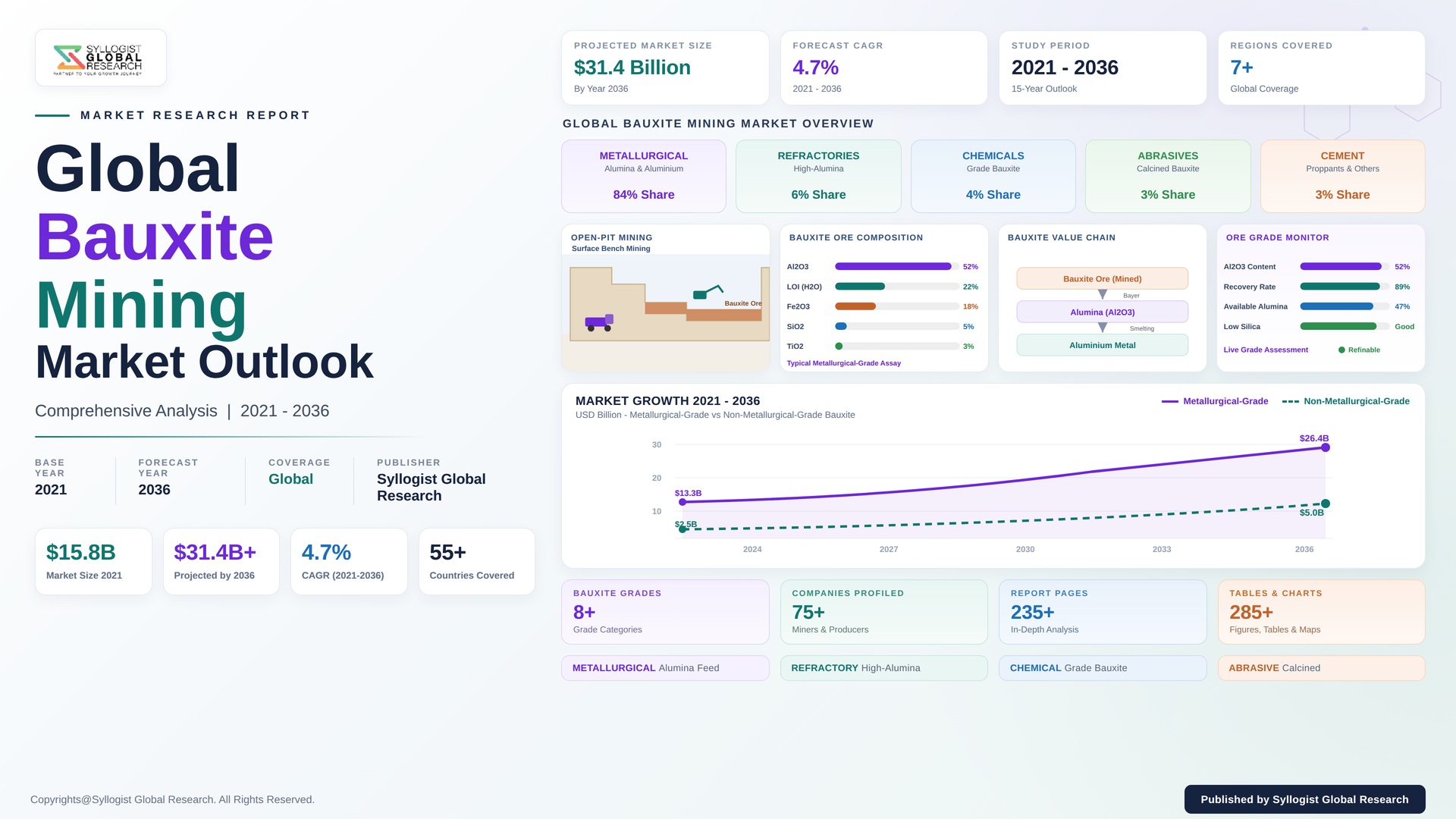
The global bauxite mining market is moving through a sustained growth phase, propelled by rising primary aluminum demand, accelerating electric vehicle and lightweighting programs, expanding renewable energy buildout, and steady consumption of refractory, cement, and abrasive grade bauxite across heavy industry. The bauxite mining market was valued at USD 18.6 billion in 2025 and is projected to reach USD 31.4 billion by 2034, advancing at a compound annual growth rate of 6.0% through the forecast period, as integrated aluminum producers, independent miners, and state-owned enterprises scale extraction capacity across Australia, Guinea, China, India, Brazil, and Indonesia. Aluminum smelting through the alumina pathway accounts for close to 85% of bauxite end use, tying bauxite mining market demand directly to global primary aluminum output and the aluminum intensity of construction, transportation, packaging, and electrical applications.
Supply concentration defines the structure of the bauxite mining market, with a small number of resource-rich geographies controlling the bulk of seaborne and captive supply. Australia remains the single largest producing nation, with the Weipa, Boddington, and Gove operations delivering more than 100 million tonnes annually, while Guinea has become the fastest-expanding frontier on the strength of high-grade Sangaredi and Boke deposits and reserves exceeding 40 billion tonnes. China stands as the dominant consuming geography within the bauxite mining market, importing rising volumes as high-grade domestic reserves across Shanxi, Guangxi, and Guizhou deplete and refiners pivot toward imported Guinean and Australian ore. This concentration of supply and demand across a limited set of nations shapes freight economics, contract structures, and strategic stockpiling behavior throughout the bauxite mining market.
Grade differentiation and vertical integration are reshaping procurement across the bauxite mining market. Metallurgical grade bauxite dominates volume at roughly 90% of extracted tonnage, feeding alumina refineries where consistent available alumina and low reactive silica govern refining energy intensity and caustic soda consumption. Refractory, abrasive, chemical, and cement grade bauxite command higher unit values within the bauxite mining market, supported by steel, cement, glass, and proppant demand that favors calcined product with high alumina content and thermal stability. Integrated aluminum producers are steadily expanding captive bauxite mining capacity to secure feedstock, reduce exposure to spot pricing, and insulate refineries from export policy volatility, a strategy that continues to consolidate ownership of premium reserves across the bauxite mining market.
Asia-Pacific represents the largest regional bauxite mining market, supported by Australian production, Chinese import demand, and rapidly scaling Indian output from Odisha, Jharkhand, and Chhattisgarh operated by national and private aluminum majors. The Middle East and Africa has emerged as a decisive growth pole within the bauxite mining market, led by Guinea, whose Boke corridor and dedicated rail and port infrastructure have transformed the country into a primary supplier to Chinese refiners. Latin America holds a substantial position in the bauxite mining market, with Brazil delivering roughly 35 million tonnes annually from the Trombetas and Juruti districts, supplying both domestic refineries and European off-takers. North America and Europe occupy smaller extraction positions within the bauxite mining market, though both regions retain strategic refractory, abrasive, and specialty calcined bauxite demand tied to steel, cement, and industrial manufacturing.
Key Drivers
Accelerating Primary Aluminum Demand, Electric Vehicle Lightweighting, and Renewable Energy Buildout Driving Structural Bauxite Consumption Growth
Structural growth in primary aluminum demand remains the central force driving the bauxite mining market, since alumina refining and aluminum smelting absorb close to 85% of extracted bauxite tonnage globally. Aluminum consumption is scaling across automotive lightweighting, electric vehicle body structures and battery enclosures, high-voltage transmission conductors, solar mounting systems, and packaging, each application increasing the volume of bauxite required upstream. Electric vehicle production growth alone is adding material aluminum intensity per unit, since battery-electric platforms typically carry higher aluminum content than conventional vehicles to offset battery mass, feeding directly into bauxite mining market demand. Renewable energy buildout compounds this pull, with solar module frames, mounting structures, inverters, and grid conductors all consuming primary aluminum sourced through the bauxite to alumina pathway. Global infrastructure spending across emerging economies, urban construction, and electrification programs further reinforces long-duration aluminum demand that the bauxite mining market must supply. Because secondary aluminum recycling cannot yet meet incremental demand at the required scale and purity for many applications, primary metal continues to command a durable share of consumption, sustaining bauxite extraction volumes. This alignment of transportation electrification, renewable energy scaling, and construction demand supports a multi-year growth trajectory for the bauxite mining market across every major producing and consuming geography worldwide.
Vertical Integration, Captive Mine Development, and Feedstock Security Programs by Integrated Aluminum Producers Expanding Bauxite Mining Investment
Feedstock security has become a defining priority across the bauxite mining market, driving integrated aluminum producers to expand captive mine ownership rather than rely on volatile spot supply. Alumina refineries are highly sensitive to bauxite grade, available alumina content, and reactive silica levels, and any disruption to consistent ore supply directly raises refining energy and caustic soda costs, motivating producers to control upstream extraction. Export policy shocks, including Indonesian ore export restrictions and periodic disruption in major supplying nations, have demonstrated the risk of dependence on third-party bauxite, accelerating investment in owned and long-term contracted reserves within the bauxite mining market. Producers are developing greenfield mines, acquiring stakes in high-grade deposits, and building dedicated haulage, rail, and port infrastructure to lock in decades of feedstock, particularly in Guinea, Australia, and Brazil. This vertical integration improves cost control, stabilizes refinery utilization, and reduces exposure to seaborne freight and price swings across the bauxite mining market. State-owned enterprises and national aluminum champions are pursuing parallel strategies, securing domestic reserves and negotiating cross-border supply agreements to guarantee volume. The cumulative effect is sustained capital deployment into new bauxite mining capacity, mine expansions, and associated logistics, consolidating ownership of premium reserves and reinforcing long-term investment momentum throughout the bauxite mining market value chain.
Non-Metallurgical Demand from Refractory, Cement, Abrasive, and Proppant Applications Sustaining High-Value Calcined Bauxite Procurement
Non-metallurgical demand provides a durable and higher-margin pillar within the bauxite mining market, extending consumption well beyond alumina refining. Refractory grade calcined bauxite is essential for high-alumina bricks and monolithic linings used in steel blast furnaces, basic oxygen furnaces, cement kilns, glass tanks, and ceramic operations, where thermal stability and high alumina content are critical. Global steel and cement output continues to expand across Asia, the Middle East, and other industrializing regions, sustaining steady procurement of calcined bauxite through the bauxite mining market. Cement producers rely on bauxite as an alumina source for high-alumina and calcium aluminate cement, while abrasive grade bauxite feeds brown fused alumina used in bonded and coated abrasives across metalworking, shipbuilding, and surface preparation. The oil and gas sector adds further pull, with high-strength ceramic proppants manufactured from bauxite supporting hydraulic fracturing operations that require crush-resistant particles at depth. Chemical grade bauxite supplies activated and specialty alumina used in catalysts, adsorbents, and water treatment, diversifying revenue streams across the bauxite mining market. Because these applications demand consistent high-alumina, low-impurity calcined product, they command premium unit values relative to metallurgical ore, incentivizing producers to develop and beneficiate high-grade deposits. This breadth of refractory, cement, abrasive, proppant, and chemical demand cushions the bauxite mining market against aluminum cycle volatility and supports sustained calcined bauxite investment.
Key Challenges
Resource Nationalism, Export Restrictions, and Escalating Royalty and Local Processing Mandates Constraining Bauxite Mining Supply Predictability
Resource nationalism has become one of the most significant constraints on the bauxite mining market, as producing nations increasingly assert control over strategic mineral reserves. Governments have introduced export restrictions, raw ore export bans designed to force domestic processing, higher royalty regimes, and local content and equity requirements that reshape project economics and delay investment decisions. Indonesian raw bauxite export restrictions, intended to compel domestic alumina refining, removed significant tonnage from seaborne supply and forced importers to reconfigure sourcing across the bauxite mining market. Guinea, the pivotal growth supplier, has periodically revised its mining code, tightened local processing expectations, and signaled intent to capture more value onshore, creating policy uncertainty for producers dependent on its high-grade reserves. Escalating royalty rates and windfall levies across several jurisdictions raise the effective tax burden on bauxite mining operations, compressing margins and lengthening payback periods. Local processing mandates that require in-country alumina refining add substantial capital and energy commitments that many miners are not positioned to fund, delaying export revenue. This combination of export controls, fiscal escalation, and processing requirements introduces material supply predictability risk into the bauxite mining market, complicating long-term feedstock planning for refiners and elevating the strategic premium on politically stable producing geographies.
Environmental Compliance, Tailings and Residue Liability, Land Rehabilitation, and Community Consent Pressures Raising Bauxite Mining Operating Costs
Environmental compliance and social license pressures represent a persistent and rising cost across the bauxite mining market, since bauxite extraction is land-intensive and connected to significant downstream residue liability. Open-pit bauxite mining clears large surface areas, requiring extensive land rehabilitation, topsoil management, and biodiversity offset commitments that regulators increasingly enforce as conditions of permitting. Although red mud residue is generated at the refining stage rather than the mine, growing scrutiny of the full bauxite value chain exposes producers to reputational and regulatory risk tied to residue storage, water management, and disposal across the bauxite mining market. Community consent has become a decisive factor, with indigenous land rights, resettlement obligations, and local benefit-sharing expectations capable of delaying or halting projects, particularly in Guinea, India, and parts of Latin America. Water usage, dust control, and haulage emissions attract regulatory conditions that raise operating costs and demand continuous monitoring. Rising expectations for renewable-powered operations, water recycling, and low-emission logistics add capital and operating burdens to the bauxite mining market as buyers and financiers increasingly favor responsibly sourced ore. Meeting these environmental and social obligations while maintaining cost competitiveness is a growing challenge, and failure to secure and retain social license can strand reserves, delay expansions, and materially disrupt supply continuity across the bauxite mining market.
Freight Cost Volatility, Ore Grade Depletion, and Long-Haul Logistics Dependence Generating Margin and Supply Continuity Risk
Freight economics and logistics dependence create structural margin and continuity risk across the bauxite mining market, because bauxite is a low-value, high-bulk commodity that must move long distances by sea from a handful of producing nations to concentrated refining hubs. The dominant Guinea to China and Australia to China trade lanes expose producers and refiners to dry bulk freight rate volatility, port congestion, and vessel availability, any of which can swing delivered ore costs materially within the bauxite mining market. Because bauxite carries low value per tonne relative to its shipping weight, freight can represent a large share of delivered cost, meaning freight spikes directly erode landed economics for importers and can render marginal cargoes uneconomic. Ore grade depletion adds a compounding pressure, as high-grade near-surface deposits in mature basins are progressively exhausted, forcing operators toward lower-grade or more remote reserves that raise strip ratios, beneficiation requirements, and haulage distances across the bauxite mining market. Long inland haulage from remote deposits to coastal ports demands heavy investment in rail, road, and barge infrastructure, and any disruption to these corridors interrupts export flow. Seasonal weather, including monsoon and wet-season shutdowns in tropical mining regions, further constrains continuous production and shipment, generating supply variability that complicates refinery scheduling and inventory planning throughout the bauxite mining market.
Market Segmentation
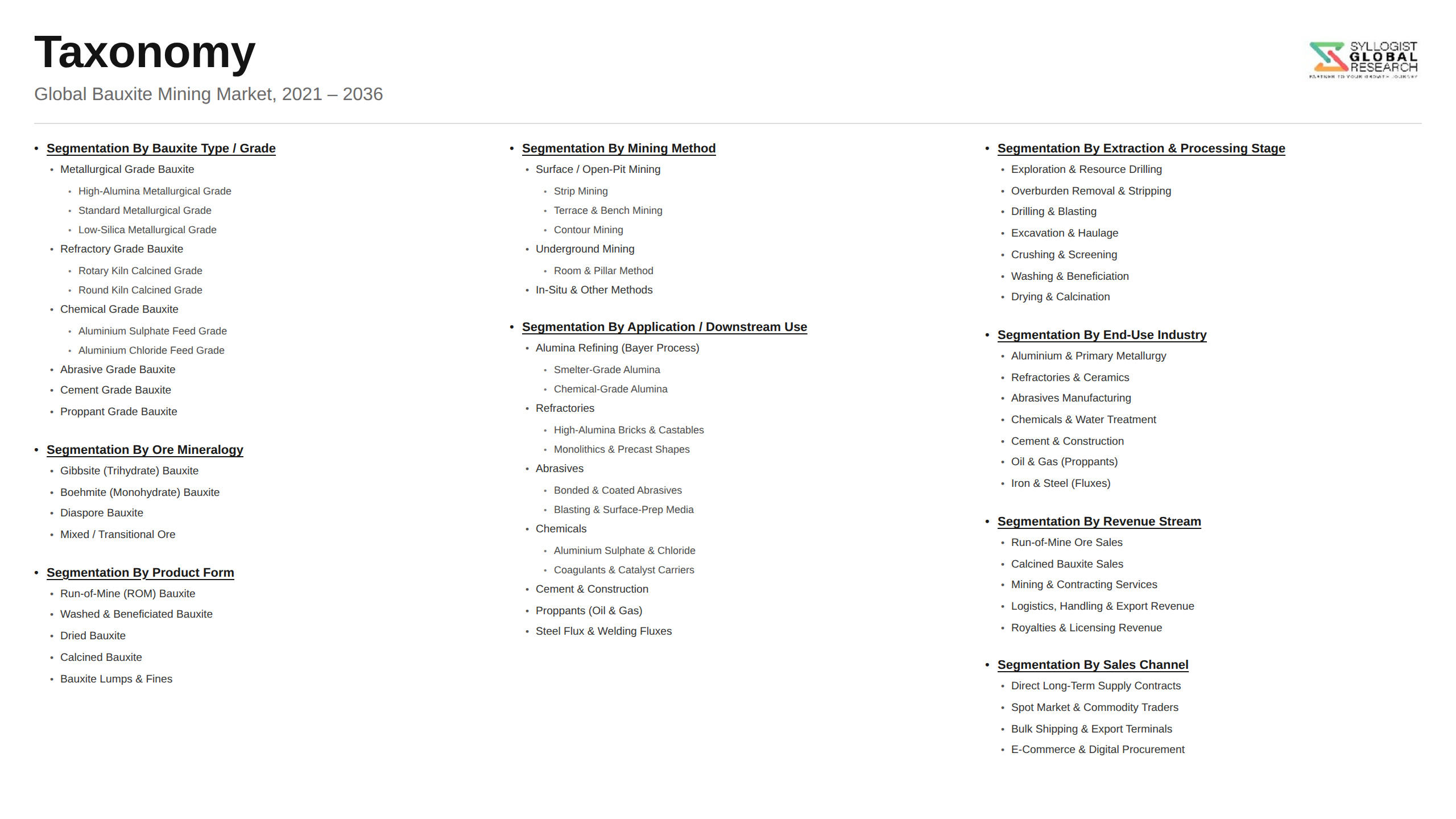
- Segmentation By Mining Method
- Surface Mining (Open-Pit)
- Underground Mining
- Segmentation By Ore Grade
- Metallurgical Grade
- Refractory Grade
- Chemical Grade
- Abrasive Grade
- Cement Grade
- Segmentation By Product Type
- Lump Bauxite
- Calcined Bauxite
- Granulated Bauxite
- Ground and Dried Bauxite
- Others
- Segmentation By Application
- Alumina and Aluminum Production
- Refractories
- Cement and Construction Materials
- Abrasives
- Proppants
- Chemicals
- Others
- Segmentation By End Use Industry
- Automotive and Transportation
- Construction and Infrastructure
- Aerospace and Defense
- Packaging
- Electrical and Electronics
- Steel and Foundry
- Others
- Segmentation By Region
- North America
- Europe
- Asia-Pacific
- Middle East and Africa
- Latin America
All market revenues are presented in USD
Historical Year: 2021-2024 | Base Year: 2025 | Estimated Year: 2026 | Forecast Period: 2027-2034
Key Questions this Study Will Answer
- What is the total global market valuation of the bauxite mining market in 2025, projected through 2034, segmented by mining method, ore grade, product type, application, and end use industry, enabling bauxite miners, integrated aluminum producers, refiners, and mining infrastructure investors to identify the highest-growth segments and most durable revenue opportunities across the bauxite mining market?
- How are integrated aluminum producers, independent miners, and state-owned enterprises structuring captive mine development, long-term offtake, and vertical integration strategies to secure bauxite feedstock, and which ownership and contracting models are shaping delivered cost economics within the bauxite mining market through 2034?
- What primary aluminum demand growth, electric vehicle lightweighting, renewable energy buildout, and non-metallurgical consumption dynamics are shaping the pace and geographic distribution of bauxite extraction investment across mature and emerging producing nations?
- Which ore grades and product types, including metallurgical, refractory, abrasive, chemical, and cement grade bauxite and calcined product, are gaining the strongest procurement traction across alumina, refractory, cement, abrasive, and proppant applications, and what alumina content, reactive silica, and total delivered cost metrics are shaping buyer selection?
- How is the competitive structure of the bauxite mining market organized among integrated aluminum majors, independent bauxite miners, state-owned enterprises, and calcined bauxite processors, and what acquisition, joint venture, and reserve development strategies are enabling new entrants to compete against established suppliers?
- What resource nationalism, export restriction, royalty escalation, and local processing mandate trends are reshaping supply predictability, project economics, and sourcing strategy across major producing geographies within the bauxite mining market?
- Which regional markets, including Asia-Pacific, the Middle East and Africa, Latin America, North America, and Europe, are projected to generate the largest incremental bauxite mining opportunities through 2034, and what reserve quality, freight economics, infrastructure investment, and policy factors are shaping supplier selection and capacity investment priorities in each regional bauxite mining market?
- Product Definition
- Research Methodology
- Research Design & Framework
- Overall Research Approach: Descriptive, Exploratory & Quantitative Mixed-Method Design
- Market Definition & Scope Boundaries: What is Included and Excluded
- Segmentation Framework
- Key Research Assumptions & Limitations
- Secondary Research
- Primary Research Design & Execution
- Data Triangulation & Validation
- Market Sizing & Forecasting Methodology
- Competitive Intelligence Methodology
- Quality Assurance & Peer Review
- Definitions, Abbreviations & Data Notes
- Executive Summary
- Market Snapshot & Headline Numbers
- Key Findings & Research Highlights
- Market Dynamics
- Regional Market Summary
- Competitive Landscape Snapshot
- Technology & Innovation Highlights
- Market Dynamics
- Drivers
- Restraints
- Opportunities
- Challenges
- Porter’s Five Forces Analysis
- PESTLE Analysis
- Market Trends & Developments
- Emerging Trends
- Technological Developments
- Regulatory & Policy Changes
- Supply Chain & Sourcing Trends
- Manufacturing & Process Trends
- Investment & Funding Activity
- Sustainability & ESG Trends
- Risk Assessment Framework
- Resource Nationalism, Export Restriction & Mining Royalty Escalation Risk
- Ore Grade Decline, Reserve Depletion & Rising Strip Ratio Cost Risk
- Environmental Compliance, Red Mud Tailings & Rehabilitation Liability Risk
- Community Relations, Land Rights & Social Licence to Operate Risk
- Freight Cost Volatility, Port Congestion & Seaborne Supply Chain Disruption Risk
- Regulatory Framework & Standards
- Mining Lease, Concession & Environmental Clearance Permitting Standards
- Tailings and Red Mud Management, Waste Storage & Dam Safety Regulations
- Export Control, Ore Export Ban & Mineral Beneficiation Policy
- Mine Rehabilitation, Closure Bond & Post-Mining Land Restoration Standards
- Indigenous Land Rights, Free Prior and Informed Consent & Community Benefit-Sharing Frameworks
- Global Bauxite Mining Market Outlook
- Market Size & Forecast by Value
- Market Size & Forecast by Volume (Bauxite Ore Mined in Million Tonnes per Year and Recoverable Alumina Content in Million Tonnes per Year)
- Market Size & Forecast by Ore Type
- Gibbsitic (Trihydrate) Bauxite
- Boehmitic (Monohydrate) Bauxite
- Diasporic (Monohydrate) Bauxite
- Mixed Bauxite
- Others
- Market Size & Forecast by Grade
- Metallurgical Grade
- Refractory Grade
- Abrasive Grade
- Chemical Grade
- Cement Grade
- Proppant Grade
- Others
- Market Size & Forecast by Mining Method
- Open-Pit (Surface) Mining
- Strip Mining
- Terrace Mining
- Contour Mining
- Others
- Market Size & Forecast by Product Form
- Run-of-Mine (Crude) Bauxite
- Washed and Beneficiated Bauxite
- Dried Bauxite
- Calcined Bauxite
- Others
- Market Size & Forecast by Application
- Alumina Refining
- Refractories
- Abrasives
- Cement and Construction
- Chemicals
- Proppants
- Others
- Market Size & Forecast by End-Use Industry
- Aluminium and Metallurgy
- Construction
- Automotive and Transportation
- Aerospace and Defense
- Packaging
- Electrical and Electronics
- Chemicals
- Others
- Market Size & Forecast by Transport Mode
- Rail
- Road Haulage
- Conveyor
- Barge and River
- Marine Vessel
- Others
- Market Size & Forecast by Sales Channel
- Long-Term Offtake Contract
- Merchant Spot Market
- Captive Integrated Supply
- Export Trade Channel
- Others
- North America Bauxite Mining Market Outlook
- Market Size & Forecast
- By Value
- By Volume (Bauxite Ore Mined in Million Tonnes per Year and Recoverable Alumina Content in Million Tonnes per Year)
- By Ore Type
- By Grade
- By Mining Method
- By Product Form
- By Application
- By End-Use Industry
- By Transport Mode
- By Country
- By Sales Channel
- Europe Bauxite Mining Market Outlook
- Market Size & Forecast
- By Value
- By Volume (Bauxite Ore Mined in Million Tonnes per Year and Recoverable Alumina Content in Million Tonnes per Year)
- By Ore Type
- By Grade
- By Mining Method
- By Product Form
- By Application
- By End-Use Industry
- By Transport Mode
- By Country
- By Sales Channel
- Asia-Pacific Bauxite Mining Market Outlook
- Market Size & Forecast
- By Value
- By Volume (Bauxite Ore Mined in Million Tonnes per Year and Recoverable Alumina Content in Million Tonnes per Year)
- By Ore Type
- By Grade
- By Mining Method
- By Product Form
- By Application
- By End-Use Industry
- By Transport Mode
- By Country
- By Sales Channel
- Latin America Bauxite Mining Market Outlook
- Market Size & Forecast
- By Value
- By Volume (Bauxite Ore Mined in Million Tonnes per Year and Recoverable Alumina Content in Million Tonnes per Year)
- By Ore Type
- By Grade
- By Mining Method
- By Product Form
- By Application
- By End-Use Industry
- By Transport Mode
- By Country
- By Sales Channel
- Middle East & Africa Bauxite Mining Market Outlook
- Market Size & Forecast
- By Value
- By Volume (Bauxite Ore Mined in Million Tonnes per Year and Recoverable Alumina Content in Million Tonnes per Year)
- By Ore Type
- By Grade
- By Mining Method
- By Product Form
- By Application
- By End-Use Industry
- By Transport Mode
- By Country
- By Sales Channel
- Country-Wise* Bauxite Mining Market Outlook
- Market Size & Forecast
- By Value
- By Volume (Bauxite Ore Mined in Million Tonnes per Year and Recoverable Alumina Content in Million Tonnes per Year)
- By Ore Type
- By Grade
- By Mining Method
- By Product Form
- By Application
- By End-Use Industry
- By Transport Mode
- By Country
- By Sales Channel
- Market Size & Forecast
- Market Size & Forecast
- Market Size & Forecast
- Market Size & Forecast
- Market Size & Forecast
- Market Size & Forecast
*Countries Analysed in the Global Research Portfolio: United States, Canada, Mexico, Germany, France, United Kingdom, Netherlands, Spain, Italy, Norway, Sweden, China, Japan, India, Australia, South Korea, Singapore, Brazil, Chile, Saudi Arabia, UAE, Egypt, South Africa, Israel
- Technology Landscape & Innovation Analysis
- Open-Pit Mine Planning, Blasting & Ore Extraction Technology Deep-Dive
- Bauxite Beneficiation, Washing & Ore Quality Upgrading Technology
- Ore Grade Sensing, XRF Sorting & Real-Time Quality Control Technology
- Autonomous Haulage, Fleet Management & Mine Automation Technology
- Red Mud Valorisation, Tailings Reprocessing & Residue Reuse Technology
- Drone Survey, Geospatial Mapping & Resource Estimation Technology
- Low-Carbon Mining, Electrified Fleet & Renewable-Powered Operations Technology
- Patent & IP Landscape in Bauxite Mining Technologies
- Value Chain & Supply Chain Analysis
- Bauxite Reserve, Exploration & Resource Development Supply Chain
- Mining, Drilling, Blasting & Ore Extraction Supply Chain
- Ore Beneficiation, Washing, Drying & Calcination Supply Chain
- Rail, Road, Conveyor & Port Terminal Logistics Network
- Alumina Refinery Customer Channel (Bayer Process Feedstock)
- Non-Metallurgical Customer Channel (Refractories, Abrasives, Cement, Chemicals)
- Merchant Trader, Distributor & Seaborne Export Network
- Pricing Analysis
- Metallurgical-Grade Bauxite Pricing Across Contract & Spot Market Tiers
- Refractory, Abrasive and Chemical-Grade Bauxite Pricing Differentials
- Regional Bauxite Pricing Across Guinea, Australia, China & India Benchmarks
- Alumina-Linked and Aluminium-Linked Bauxite Pricing Economics
- CIF vs FOB Pricing, Seaborne Freight & Delivered Cost Analysis
- Ore Grade, Alumina Content & Silica Penalty Pricing Adjustments
- Total Delivered Cost, Logistics Premium & Value-in-Use Pricing Models
- Sustainability & Environmental Analysis
- Lifecycle Assessment (LCA) of Bauxite Mining Across Extraction, Beneficiation & Transport
- Red Mud Tailings, Residue Management & Circular Economy Performance
- Land Disturbance, Biodiversity Impact & Mine Rehabilitation Performance
- Carbon Intensity, Electrified Fleet & Renewable-Powered Mining Decarbonisation
- Regulatory-Driven Sustainability, SDG 12 (Responsible Consumption) & SDG 15 (Life on Land) Alignment & Green Finance Eligibility
- Competitive Landscape
- Market Structure & Concentration
- Market Consolidation Level (Fragmented vs. Consolidated by Ore Grade & Geography)
- Top 10 Players Market Share
- HHI (Herfindahl-Hirschman Index) Concentration Analysis
- Competitive Intensity Map by Ore Grade, Application & Geography
- Player Classification
- Integrated Aluminium and Alumina Producers
- Pure-Play Bauxite Mining Companies
- Diversified Mining Majors
- National and State-Owned Mining Enterprises
- Merchant and Export-Focused Bauxite Miners
- Non-Metallurgical (Refractory and Abrasive) Grade Specialists
- Junior Miners and Exploration Companies
- Merchant Traders and Distributors
- Competitive Analysis Frameworks
- Market Share Analysis by Ore Grade, Application & Region
- Company Profile
- Company Overview & Headquarters
- Bauxite Mining Portfolio & Reserves
- Key Customer Relationships & Reference Refinery Accounts
- Operational Footprint & Mine Production Capacity Coverage
- Revenue (Bauxite Segment) & Offtake Contract Backlog
- Technology Differentiators & IP
- Key Strategic Partnerships, JVs & M&A Activity
- Recent Developments (Mine Expansions, Contract Wins, Project Launches)
- SWOT Analysis
- Strategic Focus Areas & Roadmap
- Competitive Positioning Map (Resource Base vs. Market Penetration)
- Key Company Profiles
- Market Structure & Concentration
- Technology Landscape & Innovation Analysis
- Strategic Output
- Market Opportunity Matrix: By Ore Grade, Mining Method, Application, End-Use Industry & Geography
- White Space Opportunity Analysis
- Strategic Recommendations
- Resource Portfolio & Technology Investment Strategy
- Operational Excellence & Mine Capacity Expansion Strategy
- Geographic Expansion & Resource Access Strategy
- Customer & Refinery Account Engagement Strategy
- Partnership, M&A & Ecosystem Strategy
- Sustainability & Circular Economy Strategy
- Risk Mitigation & Future Roadmap
- Strategic Priority Matrix & Roadmap
- Near-term (2025-2028)
- Mid-term (2029-2032)
- Long-term (2033-2037)