Global Mining Conveyor Systems Market By Conveyor Type, By System Type, By Drive Type, By Component, By Application, By Mined Material, By Region, Competition, Forecast & Opportunities, 2021-2034F
Market Definition
Mining conveyor systems are continuous mechanical material handling installations engineered to transport ore, coal, overburden, and processed minerals across surface and underground mining operations, moving bulk material from extraction faces and pits to crushers, stockpiles, processing plants, load-out stations, and rail or port infrastructure. The global mining conveyor systems market covers the design, manufacture, integration, installation, and servicing of belt conveyors, cable and steel-cord conveyors, bucket and sidewall conveyors, and pipe conveyors, together with the belts, idlers, pulleys, drives, motors, structures, take-up units, and control and monitoring systems that constitute a complete conveying line. Market participants include conveyor system original equipment manufacturers, belt and component suppliers, drive and automation providers, engineering integrators, and aftermarket service specialists.
The mining conveyor systems market spans in-pit conveyors serving continuous surface haulage, in-plant conveyors linking processing stages, overland conveyors carrying material across long distances between mine and plant, and pipe conveyors enclosing material for environmentally sensitive corridors. End users span coal producers, metal ore miners handling iron ore, copper, bauxite, and gold, non-metallic mineral operators, and integrated mining houses deploying in-pit crushing and conveying to replace truck haulage. The mining conveyor systems market explicitly excludes general industrial and warehouse conveyors, agricultural and food handling systems, port and terminal conveyors installed outside mine boundaries, and truck and rail haulage fleets, concentrating on continuous conveying infrastructure that moves mined material within and immediately adjacent to surface and underground mining sites across every producing geography.
Market Insights
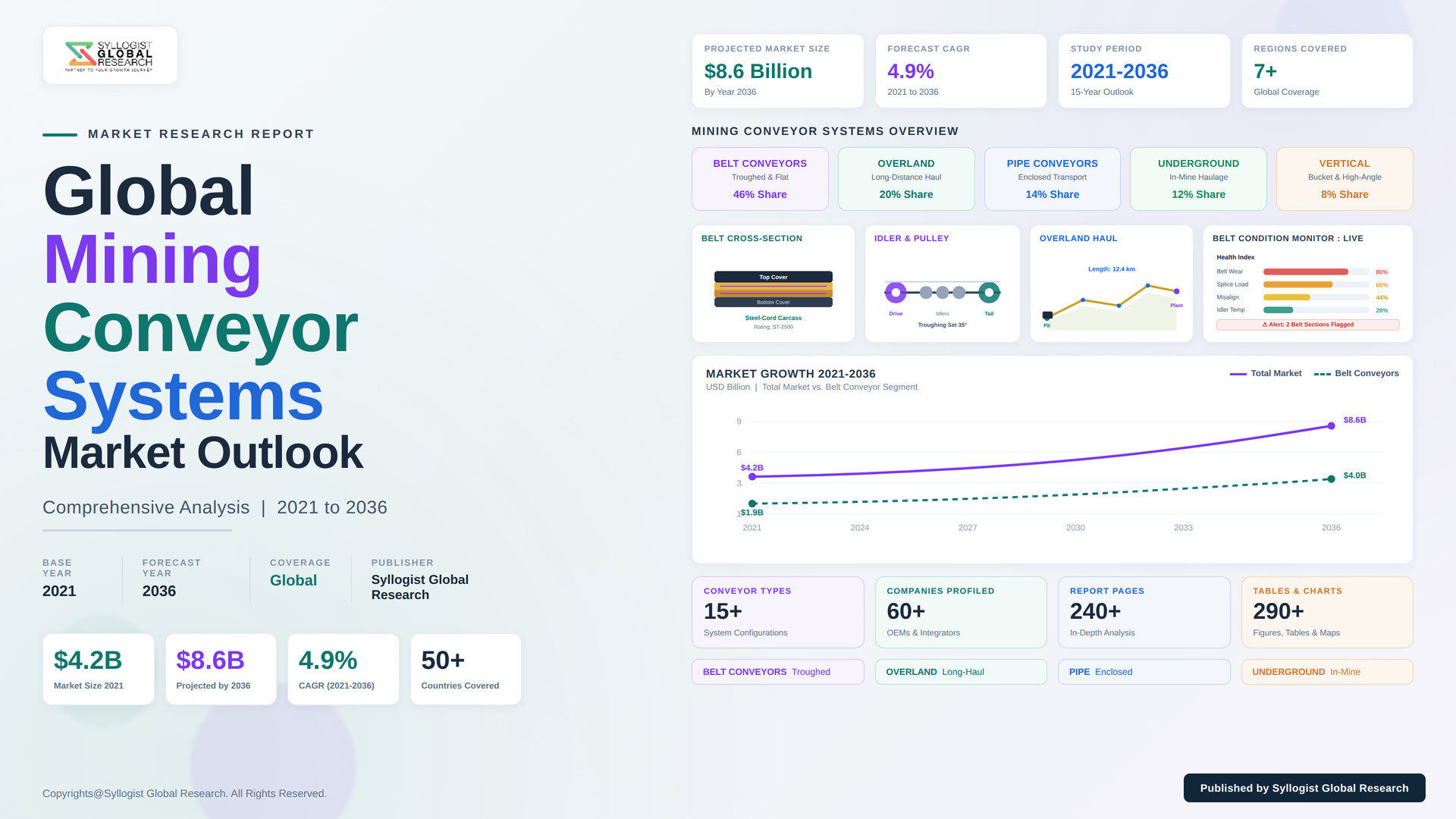
The global mining conveyor systems market is moving through a steady growth phase, propelled by rising demand for energy transition minerals, the shift from diesel truck haulage toward continuous conveying, deepening and more remote ore bodies, and mounting pressure to lower the cost, fuel consumption, and emissions of bulk material transport. The mining conveyor systems market was valued at USD 5.4 billion in 2025 and is projected to reach USD 8.9 billion by 2034, advancing at a compound annual growth rate of 5.7% through the forecast period, as coal producers, metal ore miners, and integrated mining houses expand conveying capacity across Asia-Pacific, North America, Latin America, Africa, and Australia. Accelerating demand for copper, lithium, nickel, iron ore, and rare earth minerals tied to electrification and renewable energy is expanding mine development and driving procurement of high-capacity conveyor systems across the mining conveyor systems market.
In-pit crushing and conveying and long-distance overland conveyors are reshaping the economics of bulk haulage across the mining conveyor systems market, as operators replace large diesel truck fleets with continuous electric conveying to cut fuel, tire, labor, and maintenance costs. Overland conveyors move ore and overburden across kilometers of difficult terrain with lower energy per tonne, reduced emissions, and higher availability than truck haulage, making them a preferred solution for large surface operations within the mining conveyor systems market. In-pit crushing and conveying systems bring the crusher to the mining face and convey material continuously out of deepening pits, eliminating long uphill truck cycles that dominate open-pit operating cost. This structural shift toward continuous conveying sustains durable demand and reshapes procurement priorities across the mining conveyor systems market.
Technology advancement is a defining feature of the mining conveyor systems market, led by gearless conveyor drives that remove gearboxes to deliver higher energy efficiency, lower maintenance, and reliable performance on long, steep, high-power installations. Gearless drive systems have captured a rising share of large-capacity conveyor procurement within the mining conveyor systems market, particularly for overland and high-lift applications. High-tensile steel-cord belts, improved idler and pulley design, and advanced belt splicing extend conveyor length, capacity, and service life across the mining conveyor systems market. Digitalization is accelerating in parallel, with condition monitoring, belt scanning, thermal imaging, and predictive maintenance analytics reducing unplanned downtime, while automation and remote operation align continuous conveying with autonomous and digitally managed mining operations throughout the mining conveyor systems market.
Asia-Pacific represents the largest regional mining conveyor systems market, supported by large-scale coal, iron ore, copper, and bauxite operations across China, India, Australia, and Indonesia, where high production volumes and long overland corridors drive sustained conveyor procurement. Latin America holds a substantial position in the mining conveyor systems market, led by copper and iron ore mining in Chile, Peru, and Brazil, where in-pit crushing and conveying and overland systems move material from high-altitude and remote deposits. North America occupies a significant position in the mining conveyor systems market, propelled by coal, copper, and critical mineral operations across the United States and Canada adopting automation and electrified conveying. The Middle East and Africa is emerging as a growth pole within the mining conveyor systems market, led by copper, gold, iron ore, and phosphate operations across South Africa, the Democratic Republic of Congo, Zambia, and Saudi Arabia investing in continuous haulage infrastructure.
Key Drivers
Accelerating Energy Transition Mineral Demand, Expanding Mine Development, and Rising Bulk Material Volumes Driving Conveyor System Procurement
Structural growth in demand for energy transition minerals is the central force driving the mining conveyor systems market, as electrification, battery manufacturing, grid expansion, and renewable energy scale global consumption of copper, lithium, nickel, cobalt, and rare earth elements. Meeting this demand requires new mine development, expansion of existing operations, and higher extraction volumes, each increasing the tonnage of ore and overburden that must be moved and therefore the conveying capacity required across the mining conveyor systems market. Copper demand alone is rising sharply because electric vehicles, charging infrastructure, and transmission networks are copper-intensive, prompting large greenfield and brownfield copper projects that specify high-capacity conveyor systems. Iron ore and coal volumes remain substantial in absolute terms, sustaining baseline conveyor demand across established mining regions within the mining conveyor systems market. As surface deposits deplete, operators are developing deeper and more remote ore bodies that lengthen haulage distances and favor continuous conveying over cyclical truck movement. Rising production volumes, longer transport corridors, and the drive to lift throughput per operation combine to expand procurement of belt, overland, and in-pit conveyor systems, positioning the mining conveyor systems market to benefit directly from the multi-decade materials demand created by the global energy transition.
Shift from Diesel Truck Haulage to In-Pit Crushing and Conveying and Overland Conveyors for Lower Cost, Fuel, and Emissions
The economic and operational advantages of continuous conveying over diesel truck haulage are driving rapid adoption of in-pit crushing and conveying and overland conveyors across the mining conveyor systems market. Truck haulage carries high and volatile costs tied to diesel fuel, tires, drivers, and maintenance, and truck cycle times lengthen as pits deepen, eroding productivity in large open-pit operations. In-pit crushing and conveying relocates crushing to the mining face and conveys material continuously out of the pit, removing long uphill truck hauls and delivering substantial reductions in operating cost, fuel burn, and labor exposure within the mining conveyor systems market. Overland conveyors move ore and waste across long distances between mine and processing plant at lower energy per tonne and higher availability than truck fleets, with the added benefit of reduced dust, noise, and site traffic across the mining conveyor systems market. Continuous conveying also scales throughput more predictably, supports autonomous and digitally managed operations, and lowers the safety risk associated with large mobile equipment fleets. As operators pursue lower unit costs and higher productivity, the migration from truck haulage toward in-pit and overland conveying continues to expand addressable demand and reshape procurement priorities across the mining conveyor systems market worldwide.
Mine Decarbonization, Electrification Mandates, and ESG Commitments Favoring Continuous Electric Conveying Over Diesel Fleets
Mine decarbonization commitments, tightening emissions regulation, and investor and customer expectations on environmental performance are steering procurement toward continuous electric conveying and away from diesel-powered haulage across the mining conveyor systems market. Diesel truck fleets are a major source of direct site emissions and diesel particulate exposure, and mining companies pursuing net-zero targets are prioritizing electrified material transport to cut carbon intensity per tonne moved. Conveyor systems, powered by grid or renewable electricity, offer a direct path to lower emissions, improved energy efficiency, and reduced fuel dependence, aligning the mining conveyor systems market with corporate decarbonization roadmaps. Underground operations gain additional benefit, since replacing diesel haulage with conveying reduces ventilation demand, diesel exhaust, and associated energy cost. Regulators and financiers increasingly condition permits and capital on demonstrable emission reduction, strengthening the business case for continuous conveying within the mining conveyor systems market. As electricity grids decarbonize and on-site renewable generation expands, the emissions advantage of electric conveying over diesel haulage widens further, reinforcing sustained investment in belt, overland, and in-pit conveyor systems. Miners increasingly present electrified conveying as evidence of credible transition planning to lenders, insurers, and downstream metal buyers demanding lower-carbon supply, which further embeds decarbonization as a durable growth driver across the mining conveyor systems market.
Key Challenges
High Capital Intensity, Long Installation and Commissioning Timelines, and Fixed-Route Inflexibility Constraining Conveyor Adoption
Mining conveyor systems remain capital-intensive fixed infrastructure, and the scale of upfront investment, extended installation timelines, and inherent route inflexibility constrain adoption across parts of the mining conveyor systems market. Large overland and in-pit conveying installations require substantial capital for structures, drives, belts, crushers, and civil works, generating procurement risk that can deter operators with constrained budgets or short mine lives. Installation and commissioning of long conveyor lines routinely extend across many months, including engineering, manufacturing lead times, civil construction, erection, and ramp-up, delaying the point at which savings over truck haulage are realized within the mining conveyor systems market. Unlike truck fleets, which can be redeployed and scaled flexibly, a conveyor follows a fixed route, and changes in pit geometry, mine plan, or ore body location can strand or require costly relocation of installed conveying infrastructure. This inflexibility makes conveying less attractive for operations with uncertain mine plans, rapidly changing faces, or short remaining reserve life. The combination of high capital intensity, long lead times, and fixed-route commitment continues to slow the pace at which some operators transition to continuous conveying, tempering near-term demand across segments of the mining conveyor systems market despite compelling long-run operating economics, and pushing some operators to retain flexible truck fleets for shorter-life or rapidly evolving mine plans.
Belt Wear, Component Failure, Maintenance Downtime, and Raw Material Price Volatility Raising Lifecycle Cost and Operational Risk
Conveyor reliability and lifecycle cost present persistent challenges across the mining conveyor systems market, since conveyors operate continuously in abrasive, high-load, and harsh mining environments that wear belts, idlers, pulleys, and drives. Belt damage from impact, tearing, misalignment, and abrasion is a leading cause of unplanned downtime, and a conveyor stoppage can halt an entire production line, making reliability critical to mine output within the mining conveyor systems market. Long steel-cord and textile belts represent a large share of system cost, and belt replacement is expensive and disruptive, requiring production shutdowns that operators seek to avoid. Idler, pulley, and drive maintenance across kilometers of conveying line demands significant labor, spare parts inventory, and monitoring, adding to total lifecycle cost across the mining conveyor systems market. Volatility in the prices of steel, rubber, and other raw materials feeds directly into the cost of belts, structures, and components, creating budgeting uncertainty for both manufacturers and mine operators. Managing wear, extending component life, and minimizing unplanned downtime while controlling spare parts and energy cost remains a continuous operational challenge that shapes procurement, service contracting, and total cost of ownership decisions across the mining conveyor systems market. Remote and high-altitude sites compound the difficulty, since long lead times for replacement belts and components can extend downtime and lift the cost of maintaining continuous availability across the mining conveyor systems market.
Commodity Price Cyclicality, Mining Capital Expenditure Volatility, and Project Deferral Generating Demand Uncertainty
Exposure to commodity price cycles and volatile mining capital expenditure introduces significant demand uncertainty across the mining conveyor systems market, since conveyor procurement is tied to mine development and expansion decisions that fluctuate with metal and coal prices. When commodity prices fall, mining companies defer, delay, or cancel capital projects, directly reducing orders for new conveyor systems and compressing revenue for equipment suppliers within the mining conveyor systems market. This cyclicality makes demand lumpy and difficult to forecast, complicating production planning, capacity investment, and workforce management for conveyor manufacturers and integrators. Coal demand uncertainty adds a structural dimension, as energy transition policy and a shifting power generation mix influence long-term coal mining investment that has historically represented a large share of conveyor demand across the mining conveyor systems market. At the same time, ore bodies are becoming deeper, lower in grade, and more remote, raising the engineering complexity and cost of conveying installations and lengthening project evaluation. The combination of price-driven capital expenditure volatility, coal transition uncertainty, and rising geological complexity generates persistent demand variability that challenges investment timing, order pipeline stability, and long-term planning across the mining conveyor systems market. Suppliers increasingly rely on aftermarket service, belt supply, and maintenance revenue to smooth the swings in new-build orders that accompany each commodity cycle across the mining conveyor systems market.
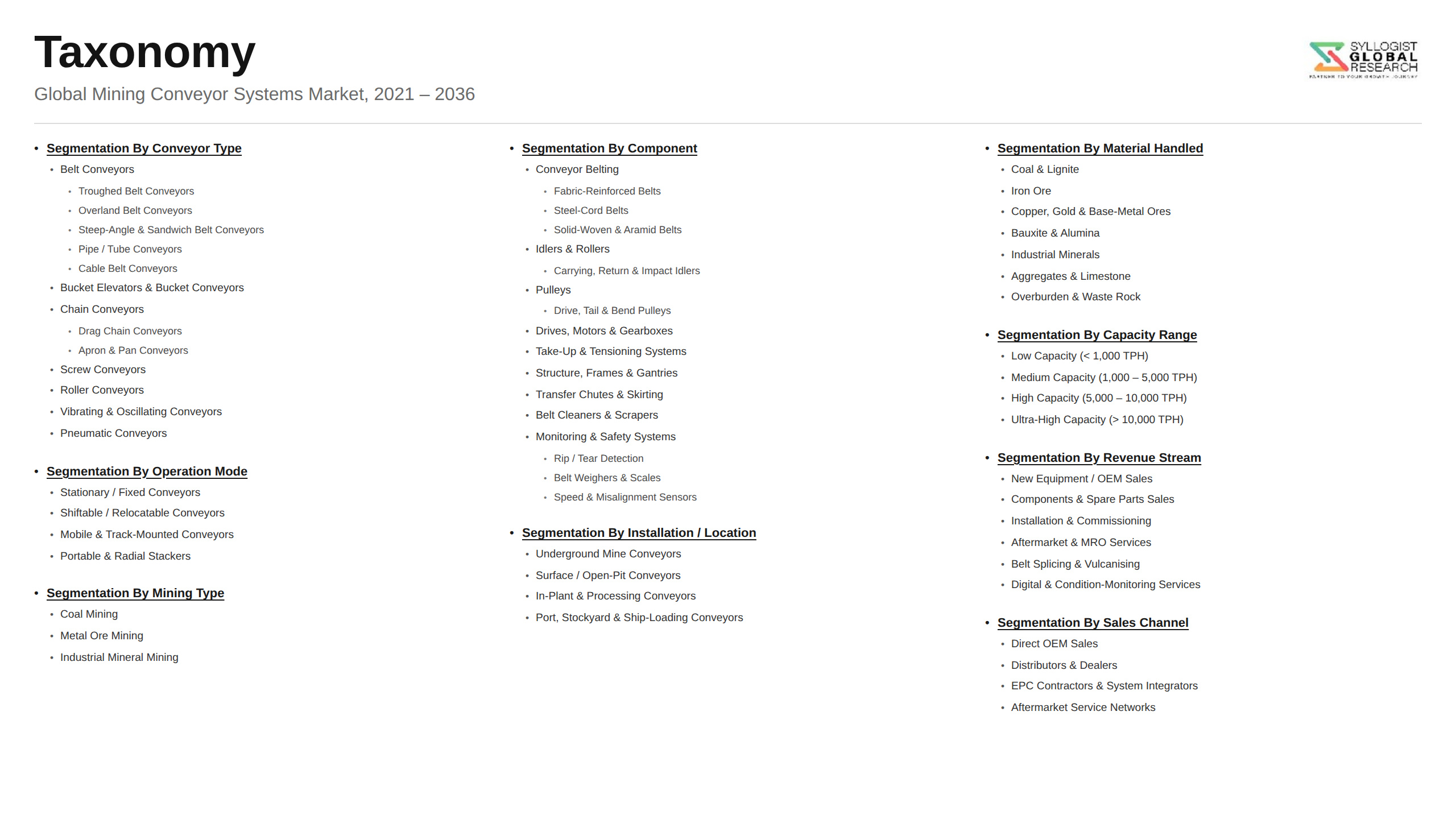
Market Segmentation
- Segmentation By Conveyor Type
- Belt Conveyors
- Cable and Steel Cord Conveyors
- Bucket and Sidewall Conveyors
- Pipe Conveyors
- Others
- Segmentation By System Type
- In-Pit Conveyors
- In-Plant Conveyors
- Overland Conveyors
- Underground Conveyors
- Others
- Segmentation By Drive Type
- Geared Drive
- Gearless Drive
- Segmentation By Component
- Belts
- Idlers and Rollers
- Pulleys
- Drives and Motors
- Structures and Frames
- Control and Monitoring Systems
- Others
- Segmentation By Application
- Surface (Open-Pit) Mining
- Underground Mining
- Segmentation By Mined Material
- Coal
- Metal Ores
- Non-Metallic Minerals
- Others
- Segmentation By Region
- North America
- Europe
- Asia-Pacific
- Middle East and Africa
- Latin America
All market revenues are presented in USD
Historical Year: 2021-2024 | Base Year: 2025 | Estimated Year: 2026 | Forecast Period: 2027-2034
Key Questions this Study Will Answer
- What is the total global market valuation of the mining conveyor systems market in 2025, projected through 2034, segmented by conveyor type, system type, drive type, component, and application, enabling conveyor manufacturers, component suppliers, mining houses, and equipment investors to identify the highest-growth segments and most durable revenue opportunities across the mining conveyor systems market?
- How are coal producers, metal ore miners, and integrated mining houses structuring procurement, in-pit crushing and conveying deployment, and truck-to-conveyor transition programs, and which ownership, contracting, and lifecycle service models are shaping deployment economics within the mining conveyor systems market through 2034?
- What energy transition mineral demand, mine development activity, and truck haulage displacement dynamics are shaping the pace and geographic distribution of conveyor system procurement across mature and emerging mining regions?
- Which conveyor technologies, including gearless drives, high-tensile steel-cord belts, in-pit crushing and conveying, overland conveyors, and predictive maintenance and automation systems, are gaining the strongest procurement traction across surface and underground applications, and what capacity, availability, energy efficiency, and total cost of ownership metrics are shaping technology selection?
- How is the competitive structure of the mining conveyor systems market organized among conveyor original equipment manufacturers, belt and component suppliers, drive and automation providers, and engineering integrators, and what partnership, acquisition, and platform expansion strategies are enabling new entrants to compete against established suppliers?
- What decarbonization mandates, electrification programs, and emissions regulation trends are reshaping the transition from diesel truck haulage to continuous electric conveying, equipment specification, and procurement timelines across major mining regions within the mining conveyor systems market?
- Which regional markets, including Asia-Pacific, Latin America, North America, the Middle East and Africa, and Europe, are projected to generate the largest incremental mining conveyor systems opportunities through 2034, and what commodity production, mine development, automation adoption, and infrastructure investment factors are shaping capability investment priorities and supplier selection in each regional mining conveyor systems market?
- Product Definition
- Research Methodology
- Research Design & Framework
- Overall Research Approach: Descriptive, Exploratory & Quantitative Mixed-Method Design
- Market Definition & Scope Boundaries: What is Included and Excluded
- Segmentation Framework
- Key Research Assumptions & Limitations
- Secondary Research
- Primary Research Design & Execution
- Data Triangulation & Validation
- Market Sizing & Forecasting Methodology
- Competitive Intelligence Methodology
- Quality Assurance & Peer Review
- Definitions, Abbreviations & Data Notes
- Executive Summary
- Market Snapshot & Headline Numbers
- Key Findings & Research Highlights
- Market Dynamics
- Regional Market Summary
- Competitive Landscape Snapshot
- Technology & Innovation Highlights
- Market Dynamics
- Drivers
- Restraints
- Opportunities
- Challenges
- Porter’s Five Forces Analysis
- PESTLE Analysis
- Market Trends & Developments
- Emerging Trends
- Technological Developments
- Regulatory & Policy Changes
- Supply Chain & Sourcing Trends
- Manufacturing & Process Trends
- Investment & Funding Activity
- Sustainability & ESG Trends
- Risk Assessment Framework
- Commodity Price Cyclicality, Mining Capex Deferral & Equipment Demand Volatility Risk
- Belt Failure, Unplanned Downtime & Production Loss Liability Risk
- Raw Material (Steel, Rubber) Price Volatility & Manufacturing Cost Escalation Risk
- Harsh Operating Environment, Abrasion, Fire & Safety Compliance Risk
- Long Project Cycles, Turnkey Execution & Contract Penalty Risk
- Regulatory Framework & Standards
- Conveyor Safety, Guarding & Machinery Directive Compliance Standards
- Fire-Resistant and Anti-Static Belt Standards for Underground Mining
- Occupational Health, Dust Suppression & Noise Emission Regulations
- Structural, Load-Bearing & Engineering Design Code Standards
- Energy Efficiency, Motor Standards & Emission Compliance Frameworks
- Global Mining Conveyor Systems Market Outlook
- Market Size & Forecast by Value
- Market Size & Forecast by Volume (Mining Conveyor Systems Installed in Units per Year and Total Conveyor Belt Length Deployed in Kilometres per Year)
- Market Size & Forecast by Conveyor Type
- Belt Conveyor
- Overland Conveyor
- Bucket Elevator
- Screw Conveyor
- Chain Conveyor
- Pipe (Enclosed) Conveyor
- Others
- Market Size & Forecast by Belt Type
- Fabric (Textile) Belt
- Steel Cord Belt
- Solid Woven Belt
- Aramid Belt
- Others
- Market Size & Forecast by Component
- Belt
- Idlers and Rollers
- Pulleys
- Drives and Motors
- Structure and Frame
- Take-Up Systems
- Others
- Market Size & Forecast by Mining Method
- Surface (Open-Pit) Mining
- Underground Mining
- In-Plant and Processing
- Others
- Market Size & Forecast by Capacity
- Up to 1000 Tonnes per Hour
- 1000 to 5000 Tonnes per Hour
- 5000 to 10000 Tonnes per Hour
- Above 10000 Tonnes per Hour
- Others
- Market Size & Forecast by Material Handled
- Coal
- Iron Ore
- Copper Ore
- Gold and Precious Metal Ore
- Bauxite and Other Metal Ore
- Overburden and Waste Rock
- Aggregates and Industrial Minerals
- Others
- Market Size & Forecast by Offering
- New Equipment (Systems)
- Spare Parts and Components
- Maintenance and Repair Services
- Retrofit and Upgrade
- Others
- Market Size & Forecast by Sales Channel
- OEM Direct Sales
- Distributor and Dealer Channel
- EPC and Turnkey Contract
- Aftermarket Service Contract
- Others
- North America Mining Conveyor Systems Market Outlook
- Market Size & Forecast
- By Value
- By Volume (Mining Conveyor Systems Installed in Units per Year and Total Conveyor Belt Length Deployed in Kilometres per Year)
- By Conveyor Type
- By Belt Type
- By Component
- By Mining Method
- By Capacity
- By Material Handled
- By Offering
- By Country
- By Sales Channel
- Europe Mining Conveyor Systems Market Outlook
- Market Size & Forecast
- By Value
- By Volume (Mining Conveyor Systems Installed in Units per Year and Total Conveyor Belt Length Deployed in Kilometres per Year)
- By Conveyor Type
- By Belt Type
- By Component
- By Mining Method
- By Capacity
- By Material Handled
- By Offering
- By Country
- By Sales Channel
- Asia-Pacific Mining Conveyor Systems Market Outlook
- Market Size & Forecast
- By Value
- By Volume (Mining Conveyor Systems Installed in Units per Year and Total Conveyor Belt Length Deployed in Kilometres per Year)
- By Conveyor Type
- By Belt Type
- By Component
- By Mining Method
- By Capacity
- By Material Handled
- By Offering
- By Country
- By Sales Channel
- Latin America Mining Conveyor Systems Market Outlook
- Market Size & Forecast
- By Value
- By Volume (Mining Conveyor Systems Installed in Units per Year and Total Conveyor Belt Length Deployed in Kilometres per Year)
- By Conveyor Type
- By Belt Type
- By Component
- By Mining Method
- By Capacity
- By Material Handled
- By Offering
- By Country
- By Sales Channel
- Middle East & Africa Mining Conveyor Systems Market Outlook
- Market Size & Forecast
- By Value
- By Volume (Mining Conveyor Systems Installed in Units per Year and Total Conveyor Belt Length Deployed in Kilometres per Year)
- By Conveyor Type
- By Belt Type
- By Component
- By Mining Method
- By Capacity
- By Material Handled
- By Offering
- By Country
- By Sales Channel
- Country-Wise* Mining Conveyor Systems Market Outlook
- Market Size & Forecast
- By Value
- By Volume (Mining Conveyor Systems Installed in Units per Year and Total Conveyor Belt Length Deployed in Kilometres per Year)
- By Conveyor Type
- By Belt Type
- By Component
- By Mining Method
- By Capacity
- By Material Handled
- By Offering
- By Country
- By Sales Channel
- Market Size & Forecast
- Market Size & Forecast
- Market Size & Forecast
- Market Size & Forecast
- Market Size & Forecast
- Market Size & Forecast
*Countries Analysed in the Global Research Portfolio: United States, Canada, Mexico, Germany, France, United Kingdom, Netherlands, Spain, Italy, Norway, Sweden, China, Japan, India, Australia, South Korea, Singapore, Brazil, Chile, Saudi Arabia, UAE, Egypt, South Africa, Israel
- Technology Landscape & Innovation Analysis
- Overland and Long-Distance Conveyor Design & High-Capacity Belt Technology Deep-Dive
- Steel Cord, Aramid & Energy-Optimised Belt Compound Technology
- Idler, Roller & Low-Friction Bearing Technology
- Variable Frequency Drive, Regenerative Braking & Energy Recovery Technology
- Belt Condition Monitoring, Rip Detection & Predictive Maintenance Technology
- IoT, Digital Twin & Remote Conveyor Performance Monitoring Technology
- Automated, Electrified & Renewable-Powered Conveyor Operations Technology
- Patent & IP Landscape in Mining Conveyor Technologies
- Value Chain & Supply Chain Analysis
- Steel, Rubber & Belt Compound Raw Material Supply Chain
- Belt, Idler, Pulley & Component Manufacturing Supply Chain
- Conveyor System Design, Engineering & Assembly Supply Chain
- EPC, Turnkey Installation & Commissioning Network
- Mining Operator Customer Channel (Coal, Metal Ore, Industrial Minerals)
- Aftermarket Spare Parts, Service & Maintenance Network
- Distributor, Dealer & Regional Sales Network
- Pricing Analysis
- Belt Conveyor System Pricing Across Capacity & Length Tiers
- Overland and Long-Distance Conveyor Turnkey Project Pricing Analysis
- Steel Cord vs Fabric Belt Pricing Differentials
- Component-Level Pricing: Belts, Idlers, Pulleys & Drives
- Aftermarket Spare Parts, Service & Maintenance Contract Pricing
- Energy Cost, Total Cost of Ownership & Lifecycle Economics
- Regional Pricing Benchmarks Across Key Mining Geographies
- Sustainability & Environmental Analysis
- Lifecycle Assessment (LCA) of Mining Conveyor Systems Across Manufacture, Operation & End-of-Life
- Energy Efficiency, Regenerative Braking & Electrified Conveying Decarbonisation
- Belt Recycling, Component Reuse & Circular Economy Performance
- Dust, Noise & Land Footprint Reduction vs Truck Haulage
- Regulatory-Driven Sustainability, SDG 9 (Industry, Innovation) & SDG 12 (Responsible Consumption) Alignment & Green Finance Eligibility
- Competitive Landscape
- Market Structure & Concentration
- Market Consolidation Level (Fragmented vs. Consolidated by Conveyor Type & Geography)
- Top 10 Players Market Share
- HHI (Herfindahl-Hirschman Index) Concentration Analysis
- Competitive Intensity Map by Conveyor Type, Application & Geography
- Player Classification
- Integrated Mining Equipment OEMs
- Bulk Material Handling System Specialists
- Conveyor Belt Manufacturers
- Idler, Pulley & Component Manufacturers
- EPC and Turnkey Solution Providers
- Regional and Independent Conveyor Fabricators
- Aftermarket Service and Maintenance Providers
- Distributors and Dealers
- Competitive Analysis Frameworks
- Market Share Analysis by Conveyor Type, Application & Region
- Company Profile
- Company Overview & Headquarters
- Mining Conveyor Product Portfolio
- Key Customer Relationships & Reference Mining Accounts
- Manufacturing Footprint & Production Capacity Coverage
- Revenue (Mining Conveyor Segment) & Order Backlog
- Technology Differentiators & IP
- Key Strategic Partnerships, JVs & M&A Activity
- Recent Developments (Contract Wins, Capacity Expansion, Product Launches)
- SWOT Analysis
- Strategic Focus Areas & Roadmap
- Competitive Positioning Map (Technology Capability vs. Market Penetration)
- Key Company Profiles
- Market Structure & Concentration
- Technology Landscape & Innovation Analysis
- Strategic Output
- Market Opportunity Matrix: By Conveyor Type, Component, Material Handled, End-Use Industry & Geography
- White Space Opportunity Analysis
- Strategic Recommendations
- Product Portfolio & Technology Investment Strategy
- Operational Excellence & Manufacturing Capacity Strategy
- Geographic Expansion & Localisation Strategy
- Customer & Mining Account Engagement Strategy
- Partnership, M&A & Ecosystem Strategy
- Sustainability & Circular Economy Strategy
- Risk Mitigation & Future Roadmap
- Strategic Priority Matrix & Roadmap
- Near-term (2025-2028)
- Mid-term (2029-2032)
- Long-term (2033-2037)