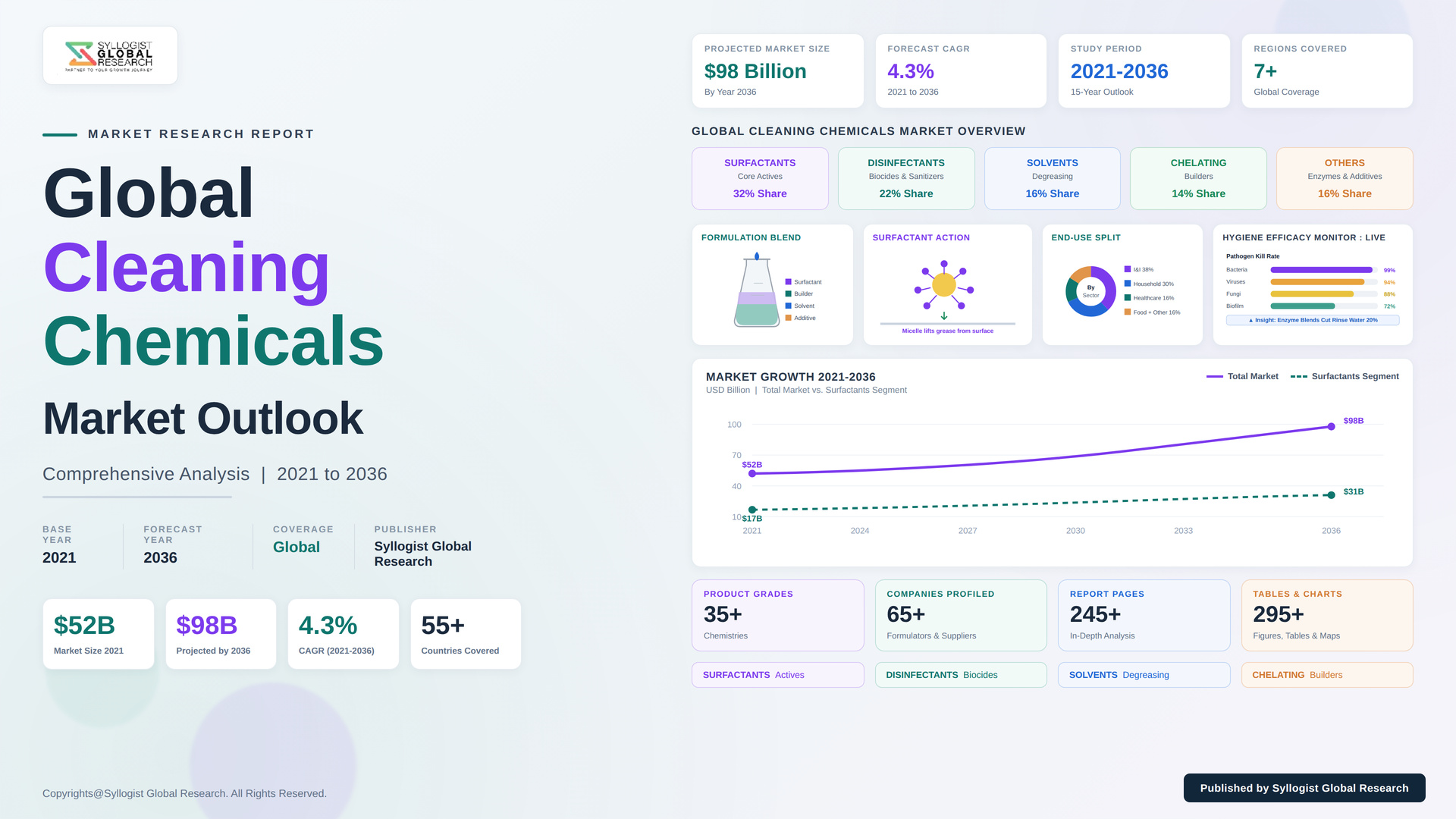
Global Cleaning Chemicals Market By Product Type, By Ingredient, By Form, By Application, By Distribution Channel, By End User, By Region, Competition, Forecast & Opportunities, 2021-2034F
Market Definition
Cleaning chemicals are formulated chemical products engineered to clean, disinfect, sanitize, degrease, deodorize, and maintain hygienic conditions across residential, commercial, industrial, institutional, and healthcare environments. The Global Cleaning Chemicals Market encompasses the formulation, manufacturing, distribution, and end use of general purpose cleaners, disinfectants and sanitizers, laundry care products, dishwashing products, floor care products, metal cleaners and degreasers, vehicle wash products, and specialty cleaning formulations built on surfactants, solvents, chlor-alkali compounds, biocides, phosphates, chelating agents, and enzymes. The cleaning chemicals market covers liquid, powder, gel, foam, and pre-moistened wipe formats supplied through direct business-to-business channels, distributors and wholesalers, retail and supermarket networks, and e-commerce platforms serving both consumer and professional buyers. Market participants include surfactant and specialty chemical producers, contract formulators, private-label manufacturers, branded consumer goods companies, industrial and institutional cleaning chemical suppliers, and distributors serving facility management contractors and end users. End users span households, commercial offices, healthcare facilities, food and beverage processing plants, hospitality operators, educational and institutional buildings, retail chains, and manufacturing and industrial sites that require sustained surface hygiene, equipment cleaning, infection control, and regulatory compliance. The global cleaning chemicals market covers standard commodity formulations and higher-specification specialty products, including bio-based and biodegradable cleaning chemicals developed to meet tightening environmental and chemical safety requirements. The cleaning chemicals market explicitly excludes cleaning equipment and machinery, personal care and cosmetic wash products, process water treatment chemicals, and non-chemical cleaning consumables, focusing exclusively on the chemical formulations used for cleaning, disinfection, and sanitization across global end-use sectors.
Market Insights
The global cleaning chemicals market is entering a sustained expansion phase, shaped by rising hygiene and sanitation standards, heightened infection control expectations across healthcare and food service settings, accelerating demand for disinfectants and sanitizers, expanding commercial and institutional building stock, and a structural shift toward sustainable and bio-based cleaning formulations. The cleaning chemicals market was valued at USD 63.4 billion in 2025 and is projected to reach USD 108.7 billion by 2034, advancing at a compound annual growth rate of 6.2% through the forecast period, as households, facility management contractors, healthcare providers, food processors, and industrial operators scale procurement of cleaning chemicals across North America, Europe, Asia-Pacific, the Middle East, and Latin America. Sustained consumption from commercial, institutional, and industrial end users continues to widen the recurring revenue base of the global cleaning chemicals market.
The cleaning chemicals market trajectory is being reshaped by the commercial maturation of green chemistry, with bio-based surfactants, biodegradable solvents, enzyme-based formulations, and low-toxicity active ingredients moving from niche positioning into mainstream product portfolios across the global cleaning chemicals market. Concentrated and dilution-ready formats are gaining share within the cleaning chemicals market as commercial and institutional buyers target lower packaging waste, reduced transport cost, and improved dosing accuracy. Disinfectant and sanitizer chemistries have retained elevated procurement priority across healthcare, food processing, and hospitality end users following heightened post-pandemic hygiene protocols, while regulatory pressure on phosphates, volatile organic compounds, and specific biocidal actives is accelerating reformulation activity across the cleaning chemicals market. Manufacturers are increasingly aligning product development around recognized environmental certifications, safer active ingredient profiles, and recyclable packaging to satisfy procurement specifications set by large commercial and institutional buyers within the global cleaning chemicals market.
Surfactants represent the largest ingredient segment within the cleaning chemicals market, supported by their central role in reducing surface tension and lifting soils, oils, and contaminants across general purpose cleaners, detergents, degreasers, and disinfectant formulations. General purpose cleaners remain the largest product category within the global cleaning chemicals market, supported by daily maintenance requirements across commercial buildings, healthcare facilities, offices, and industrial sites. Disinfectants and sanitizers represent the fastest-growing product segment within the cleaning chemicals market, propelled by sustained infection control demand across healthcare, food and beverage processing, and institutional end users. Among end users, the commercial and institutional segment contributes the largest revenue share within the cleaning chemicals market, driven by the scale and diversity of hygiene requirements across food service, healthcare, hospitality, and facility management, while manufacturing and industrial cleaning applications are gaining procurement traction within the global cleaning chemicals market as operators tighten equipment hygiene and worker safety standards.
Asia-Pacific represents the largest regional market within the cleaning chemicals market, supported by rapid industrialization, urbanization, rising disposable incomes, expanding commercial and healthcare infrastructure, and sustained hygiene awareness across China, India, and Southeast Asian economies. North America occupies a leading revenue position within the global cleaning chemicals market, propelled by rigorous food safety and healthcare hygiene regulation, a mature commercial cleaning sector, and strong uptake of premium disinfectants and specialty cleaning chemicals. Europe holds a substantial position within the cleaning chemicals market, supported by stringent environmental and chemical safety frameworks that accelerate demand for bio-based and biodegradable cleaning formulations. The Middle East and Africa and Latin America represent emerging growth regions within the cleaning chemicals market, supported by expanding hospitality, healthcare, and commercial construction activity and rising institutional hygiene investment across major urban centers.
Key Drivers
Rising Hygiene and Sanitation Standards, Infection Control Mandates, and Sustained Disinfectant Demand Across Healthcare, Food Service, and Institutional End Users Driving Cleaning Chemicals Procurement
Heightened hygiene and sanitation standards, tightening infection control mandates, and sustained demand for disinfectants and sanitizers across healthcare, food service, hospitality, and institutional end users are generating durable procurement demand within the global cleaning chemicals market. Awareness of healthcare-associated infections, foodborne contamination risk, and workplace hygiene obligations has elevated cleaning chemical consumption across hospitals, clinics, food and beverage processing plants, restaurants, hotels, schools, and commercial offices. Regulatory frameworks governing food safety, healthcare sanitation, and occupational hygiene increasingly mandate documented cleaning and disinfection protocols, converting cleaning chemicals from discretionary purchases into compliance-linked operating requirements across the cleaning chemicals market. Post-pandemic hygiene expectations have proven durable across commercial and institutional buyers, sustaining elevated baseline demand for surface disinfectants, hand sanitizers, and high-efficacy sanitizing chemistries within the global cleaning chemicals market. Facility management contractors operating under performance-based cleaning contracts are standardizing procurement around validated disinfectant and sanitizer formulations that consistently meet efficacy, contact-time, and surface-compatibility benchmarks. Expanding healthcare infrastructure, growth in organized food processing, and the scaling of hospitality and institutional building stock across emerging economies are collectively widening the installed base of end users that require sustained cleaning chemical supply, anchoring recurring, consumption-linked revenue across the cleaning chemicals market globally.
Accelerating Shift Toward Green Chemistry, Bio-Based Surfactants, and Sustainable Cleaning Formulations Driving Reformulation and Premiumization Across the Cleaning Chemicals Market
The structural shift toward green chemistry, the rising adoption of bio-based surfactants and biodegradable solvents, and growing buyer preference for sustainable cleaning formulations are driving reformulation activity and product premiumization across the global cleaning chemicals market. Commercial, institutional, and consumer buyers increasingly prioritize cleaning chemicals with safer active ingredient profiles, reduced volatile organic compound content, plant-derived surfactants, and recyclable or concentrated packaging that lowers environmental impact. Corporate sustainability commitments and procurement policies at large facility operators, retail chains, and hospitality groups are converting green cleaning chemistry from a differentiator into a specification requirement within the cleaning chemicals market. Manufacturers are responding by expanding portfolios of certified sustainable cleaning chemicals, investing in enzyme-based and bio-surfactant formulations, and pursuing recognized environmental certifications that support premium positioning and margin capture. Concentrated and dilution-ready cleaning chemical formats are gaining procurement preference across the global cleaning chemicals market by reducing packaging waste, cutting transport cost per active unit, and improving dosing precision for professional users. Green and bio-based cleaning chemicals command higher realized pricing than commodity equivalents, supporting value growth across the cleaning chemicals market even where volume growth is moderate. This sustained migration toward sustainable formulations is reshaping research and development priorities, ingredient sourcing strategies, and product roadmaps across leading suppliers competing within the global cleaning chemicals market.
Industrialization, Urbanization, and Expanding Commercial, Institutional, and Manufacturing Facility Stock Across Emerging Economies Driving Volume Growth in the Cleaning Chemicals Market
Accelerating industrialization, sustained urbanization, rising disposable incomes, and the rapid expansion of commercial, institutional, and manufacturing facility stock across emerging economies are driving durable volume growth within the global cleaning chemicals market. Growth in organized retail, healthcare, hospitality, food processing, and industrial manufacturing across Asia-Pacific, the Middle East, Africa, and Latin America is widening the installed base of facilities that require sustained cleaning chemical supply. Urban population growth and rising middle-class hygiene expectations are lifting consumption of household and consumer cleaning chemicals across high-population emerging markets, supporting broad-based demand across the cleaning chemicals market. Expansion of commercial construction, facility management outsourcing, and professional cleaning services is converting a growing share of cleaning activity into structured, recurring procurement of professional-grade cleaning chemicals. Industrial and manufacturing operators are tightening equipment hygiene, worker safety, and regulatory compliance standards, generating incremental demand for degreasers, metal cleaners, and specialized industrial cleaning chemicals within the global cleaning chemicals market. Rising foreign investment in manufacturing capacity, cold chain infrastructure, and food processing across emerging economies is further scaling demand for high-specification cleaning and sanitization chemistries. These combined industrialization and urbanization dynamics support sustained multi-year volume growth across residential, commercial, institutional, and industrial end-use categories within the cleaning chemicals market globally.
Key Challenges
Volatile Petrochemical Feedstock Prices, Surfactant and Solvent Raw Material Cost Inflation, and Supply Chain Disruption Constraining Margins Across the Cleaning Chemicals Market
Cleaning chemical formulations remain heavily dependent on petrochemical-derived surfactants, solvents, and specialty active ingredients, exposing the global cleaning chemicals market to persistent raw material price volatility, feedstock cost inflation, and supply chain disruption that compress manufacturer margins. Surfactant and solvent input costs are closely linked to crude oil, natural gas, and petrochemical intermediate pricing, generating cost swings that are difficult to pass through fully in price-sensitive segments of the cleaning chemicals market. Concentration of key surfactant and specialty ingredient production across a limited number of global suppliers and geographies heightens exposure to plant outages, logistics bottlenecks, and trade disruption within the cleaning chemicals market. Extended supply chains for surfactants, chelating agents, biocides, and specialty additives create lead-time uncertainty that complicates production planning and inventory management for formulators competing across the global cleaning chemicals market. Sudden feedstock cost inflation forces manufacturers to choose between margin compression and price increases that risk volume loss in commoditized cleaning chemical categories. Buyers with substantial purchasing scale, including large facility operators and retail chains, exert sustained pricing pressure that limits the ability of suppliers to recover input cost increases within the cleaning chemicals market. This combination of feedstock volatility, supplier concentration, and supply chain fragility continues to constrain earnings stability and complicate long-range planning across the global cleaning chemicals market.
Stringent Environmental, Chemical Safety, and Biocidal Registration Regulations Increasing Reformulation Burden and Compliance Cost Across the Cleaning Chemicals Market
Tightening environmental regulation, evolving chemical safety frameworks, and demanding biocidal product registration requirements are increasing reformulation burden, extending time-to-market, and raising compliance cost across the global cleaning chemicals market. Regulatory regimes governing chemical registration, volatile organic compound limits, phosphate restrictions, and permitted biocidal actives require manufacturers to continually reformulate cleaning chemicals, generating substantial research, testing, and registration expenditure within the cleaning chemicals market. Biocidal product approval processes are lengthy and data-intensive, requiring efficacy, toxicology, and environmental fate studies that delay commercialization of new disinfectant and sanitizer formulations across the global cleaning chemicals market. Divergent regulatory requirements across regions force multinational suppliers to maintain multiple formulation variants, complicating portfolio management and raising cost across the cleaning chemicals market. Restrictions on specific surfactants, solvents, and preservatives can render established formulations non-compliant, requiring reformulation programs that consume research and development capacity without expanding addressable demand. Small and mid-sized formulators face disproportionate compliance burden relative to large diversified producers, constraining competitive positioning within the cleaning chemicals market. Sustained regulatory tightening around chemical safety and environmental impact, while supporting long-term demand for greener chemistries, continues to raise the ongoing cost of participation and slow the pace of new product introduction across the global cleaning chemicals market.
Product Commoditization, Intense Price Competition, and Private-Label Penetration Compressing Margins Across Commodity Segments of the Cleaning Chemicals Market
Extensive product commoditization, intense price competition, and rising private-label penetration are compressing margins and constraining pricing power across commodity segments of the global cleaning chemicals market. Many general purpose cleaners, laundry products, and standard disinfectant formulations exhibit limited technical differentiation, driving purchasing decisions toward price and shifting bargaining power to large buyers within the cleaning chemicals market. Retail chains, distributors, and facility management contractors increasingly use scale to negotiate aggressive pricing and expand private-label ranges, eroding branded margin across the global cleaning chemicals market. Low barriers to entry in commodity cleaning chemical categories sustain a fragmented supplier base and persistent competitive intensity that limits realized pricing across the cleaning chemicals market. Contract cleaning and facility management outsourcing concentrate purchasing volume among professional buyers who prioritize cost per cleaning task, further pressuring supplier margins within the cleaning chemicals market. Suppliers seeking to escape commodity pricing dynamics must invest in differentiated specialty, sustainable, and high-efficacy formulations, yet those investments carry research, regulatory, and certification cost that not all participants can absorb. The combination of commoditization, private-label growth, and buyer consolidation continues to challenge profitability and reward scale, formulation differentiation, and supply chain efficiency across the global cleaning chemicals market.
Market Segmentation
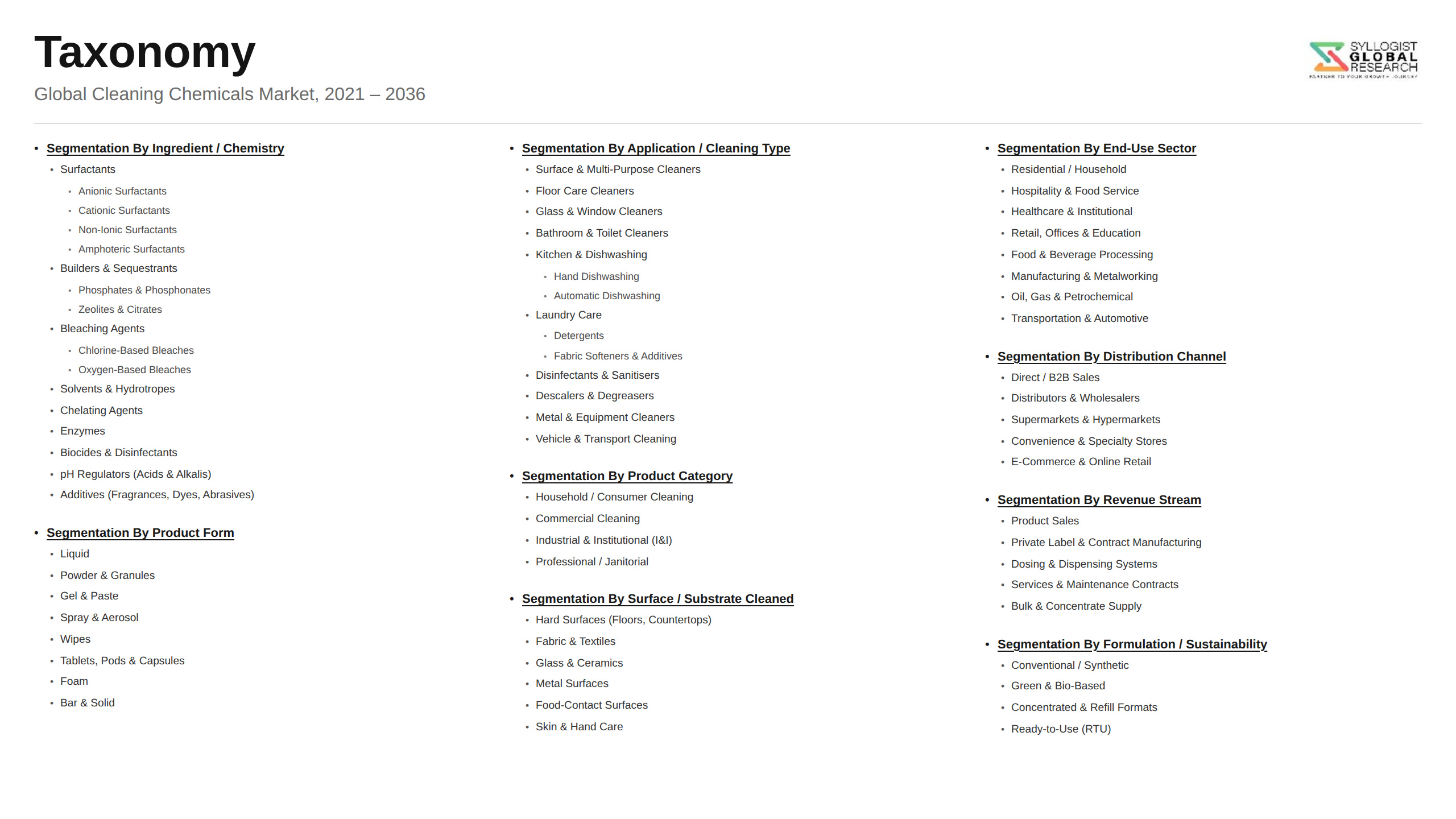
- Segmentation By Product Type
- General Purpose Cleaners
- Disinfectants and Sanitizers
- Laundry Care Products
- Dishwashing Products
- Floor Care Products
- Metal Cleaners and Degreasers
- Vehicle Wash Products
- Others
- Segmentation By Ingredient
- Surfactants
- Solvents
- Chlor-Alkali
- Biocides
- Phosphates
- Chelating Agents
- Enzymes
- Others
- Segmentation By Form
- Liquid
- Powder
- Gel
- Foam
- Wipes
- Others
- Segmentation By Application
- Surface Cleaning
- Disinfection and Sanitization
- Laundry Care
- Dishwashing
- Degreasing
- Floor Care
- Others
- Segmentation By Distribution Channel
- Direct Sales and Business-to-Business
- Distributors and Wholesalers
- Retail and Supermarkets
- E-Commerce
- Others
- Segmentation By End User
- Residential
- Commercial
- Healthcare
- Food and Beverage Processing
- Hospitality
- Institutional Buildings
- Manufacturing and Industrial
- Retail
- Others
- Segmentation By Region
- North America
- Europe
- Asia-Pacific
- Middle East and Africa
- Latin America
All market revenues are presented in USD
Historical Year: 2021-2024 | Base Year: 2025 | Estimated Year: 2026 | Forecast Period: 2027-2034
Key Questions this Study Will Answer
- What is the total global market valuation of the Cleaning Chemicals Market in 2025, projected through 2034, segmented by product type, ingredient, form, application, distribution channel, and end user, enabling cleaning chemical manufacturers, formulators, distributors, and investors to identify the highest-growth segments and most durable revenue opportunities across the global cleaning chemicals market?
- How are households, commercial buyers, healthcare providers, food processors, hospitality operators, and facility management contractors structuring procurement of cleaning chemicals, and which purchasing models, including branded supply, private-label sourcing, and contract-linked professional procurement, are shaping commercial economics within the cleaning chemicals market through 2034?
- What hygiene awareness, infection control, and sustainability dynamics are shaping the pace and geographic distribution of cleaning chemical demand across residential, commercial, institutional, and industrial end users in mature and emerging cleaning chemicals markets?
- Which cleaning chemical categories, including general purpose cleaners, disinfectants and sanitizers, laundry care products, degreasers, and specialty formulations, are gaining the strongest procurement traction, and what efficacy, safety, sustainability, and total cost metrics are shaping product selection across the global cleaning chemicals market?
- How is the competitive landscape structured among surfactant and specialty chemical producers, contract formulators, private-label manufacturers, branded consumer goods companies, and industrial and institutional cleaning chemical suppliers within the cleaning chemicals market, and what partnership, acquisition, and portfolio expansion strategies are enabling participants to compete on price, sustainability, and formulation performance?
- What green chemistry adoption, bio-based surfactant penetration, concentrated format migration, and regulatory reformulation trends are reshaping product development, ingredient sourcing, and premiumization across the global cleaning chemicals market?
- Which regional markets, including Asia-Pacific, North America, Europe, the Middle East and Africa, and Latin America, are projected to generate the largest incremental cleaning chemical demand through 2034, and what industrialization, urbanization, hygiene regulation, and infrastructure investment factors are shaping demand growth and supplier selection in each regional cleaning chemicals market?
- Product Definition
- Research Methodology
- Research Design & Framework
- Overall Research Approach: Descriptive, Exploratory & Quantitative Mixed-Method Design
- Market Definition & Scope Boundaries: What is Included and Excluded
- Segmentation Framework
- Key Research Assumptions & Limitations
- Secondary Research
- Primary Research Design & Execution
- Data Triangulation & Validation
- Market Sizing & Forecasting Methodology
- Competitive Intelligence Methodology
- Quality Assurance & Peer Review
- Definitions, Abbreviations & Data Notes
- Executive Summary
- Market Snapshot & Headline Numbers
- Key Findings & Research Highlights
- Market Dynamics
- Regional Market Summary
- Competitive Landscape Snapshot
- Technology & Innovation Highlights
- Market Dynamics
- Drivers
- Restraints
- Opportunities
- Challenges
- Porter’s Five Forces Analysis
- PESTLE Analysis
- Market Trends & Developments
- Emerging Trends
- Technological Developments
- Regulatory & Policy Changes
- Supply Chain & Sourcing Trends
- Manufacturing & Process Trends
- Investment & Funding Activity
- Sustainability & ESG Trends
- Risk Assessment Framework
- Raw Material (Surfactant, Solvent) Price Volatility & Input Cost Escalation Risk
- Stringent Chemical, Biocide & VOC Regulation Compliance Risk
- Private Label Competition, Commoditisation & Margin Compression Risk
- Feedstock Supply Concentration & Petrochemical Derivative Dependence Risk
- Demand Normalisation Post-Pandemic & Disinfectant Volume Volatility Risk
- Regulatory Framework & Standards
- REACH, TSCA Chemical Registration & Hazardous Substance Compliance Standards
- Biocidal Products Regulation, EPA Registration & Disinfectant Efficacy Standards
- VOC Emission, Ingredient Disclosure & Consumer Safety Labelling Regulations
- Ecolabel, Green Certification & Sustainable Formulation Standards
- Food-Contact, Sanitation & Institutional Hygiene Compliance Frameworks
- Global Cleaning Chemicals Market Outlook
- Market Size & Forecast by Value
- Market Size & Forecast by Volume (Cleaning Chemicals Consumed in Kilo Tonnes per Year and Product Units Sold in Million Units per Year)
- Market Size & Forecast by Product Type
- General Purpose Cleaners
- Disinfectants and Sanitizers
- Detergents
- Surface Care Cleaners
- Dishwashing Products
- Laundry Care Products
- Metal and Industrial Cleaners
- Others
- Market Size & Forecast by Ingredient
- Surfactants
- Solvents
- Chelating Agents
- Builders
- pH Regulators
- Enzymes
- Biocides and Antimicrobials
- Others
- Market Size & Forecast by Form
- Liquid
- Powder
- Gel
- Spray and Aerosol
- Wipes
- Tablets and Pods
- Others
- Market Size & Forecast by Application
- Industrial Cleaning
- Institutional Cleaning
- Commercial Cleaning
- Residential and Household Cleaning
- Others
- Market Size & Forecast by End-Use Industry
- Healthcare and Medical
- Food and Beverage Processing
- Hospitality and Foodservice
- Retail and Commercial
- Manufacturing and Industrial
- Education and Government Institutions
- Transportation
- Others
- Market Size & Forecast by Surface Type
- Floor Care
- Kitchen and Food-Contact Surface
- Bathroom and Sanitary
- Glass and Window
- Fabric and Textile
- Metal and Equipment
- Others
- Market Size & Forecast by Formulation Base
- Conventional (Synthetic)
- Green and Bio-Based
- Enzyme-Based
- Others
- Market Size & Forecast by Sales Channel
- Direct Sales (B2B)
- Distributor and Wholesaler Channel
- Retail and Modern Trade
- E-commerce and Online
- Institutional and Contract Channel
- Others
- North America Cleaning Chemicals Market Outlook
- Market Size & Forecast
- By Value
- By Volume (Cleaning Chemicals Consumed in Kilo Tonnes per Year and Product Units Sold in Million Units per Year)
- By Product Type
- By Ingredient
- By Form
- By Application
- By End-Use Industry
- By Surface Type
- By Formulation Base
- By Country
- By Sales Channel
- Europe Cleaning Chemicals Market Outlook
- Market Size & Forecast
- By Value
- By Volume (Cleaning Chemicals Consumed in Kilo Tonnes per Year and Product Units Sold in Million Units per Year)
- By Product Type
- By Ingredient
- By Form
- By Application
- By End-Use Industry
- By Surface Type
- By Formulation Base
- By Country
- By Sales Channel
- Asia-Pacific Cleaning Chemicals Market Outlook
- Market Size & Forecast
- By Value
- By Volume (Cleaning Chemicals Consumed in Kilo Tonnes per Year and Product Units Sold in Million Units per Year)
- By Product Type
- By Ingredient
- By Form
- By Application
- By End-Use Industry
- By Surface Type
- By Formulation Base
- By Country
- By Sales Channel
- Latin America Cleaning Chemicals Market Outlook
- Market Size & Forecast
- By Value
- By Volume (Cleaning Chemicals Consumed in Kilo Tonnes per Year and Product Units Sold in Million Units per Year)
- By Product Type
- By Ingredient
- By Form
- By Application
- By End-Use Industry
- By Surface Type
- By Formulation Base
- By Country
- By Sales Channel
- Middle East & Africa Cleaning Chemicals Market Outlook
- Market Size & Forecast
- By Value
- By Volume (Cleaning Chemicals Consumed in Kilo Tonnes per Year and Product Units Sold in Million Units per Year)
- By Product Type
- By Ingredient
- By Form
- By Application
- By End-Use Industry
- By Surface Type
- By Formulation Base
- By Country
- By Sales Channel
- Country-Wise* Cleaning Chemicals Market Outlook
- Market Size & Forecast
- By Value
- By Volume (Cleaning Chemicals Consumed in Kilo Tonnes per Year and Product Units Sold in Million Units per Year)
- By Product Type
- By Ingredient
- By Form
- By Application
- By End-Use Industry
- By Surface Type
- By Formulation Base
- By Country
- By Sales Channel
- Market Size & Forecast
- Market Size & Forecast
- Market Size & Forecast
- Market Size & Forecast
- Market Size & Forecast
- Market Size & Forecast
*Countries Analysed in the Global Research Portfolio: United States, Canada, Mexico, Germany, France, United Kingdom, Netherlands, Spain, Italy, Norway, Sweden, China, Japan, India, Australia, South Korea, Singapore, Brazil, Chile, Saudi Arabia, UAE, Egypt, South Africa, Israel
- Technology Landscape & Innovation Analysis
- Bio-Based and Green Surfactant Formulation Technology Deep-Dive
- Enzyme-Based and Probiotic Cleaning Technology
- Concentrated, Dilution-Control & Waterless Cleaning Technology
- Antimicrobial, Disinfectant & Long-Lasting Surface Protection Technology
- Encapsulation, Controlled-Release & Fragrance Delivery Technology
- Smart Dispensing, IoT-Enabled & Automated Cleaning System Technology
- Sustainable Packaging, Refill & Circular Formulation Technology
- Patent & IP Landscape in Cleaning Chemicals Technologies
- Value Chain & Supply Chain Analysis
- Surfactant, Solvent & Chemical Raw Material Supply Chain
- Additive, Enzyme, Fragrance & Biocide Ingredient Supply Chain
- Formulation, Blending & Manufacturing Supply Chain
- Packaging, Filling & Private Label Contract Manufacturing Supply Chain
- Distributor, Wholesaler & Institutional Channel Network
- Retail, E-commerce & Consumer Channel Network
- End-Use Customer Channel (Healthcare, Food Processing, Hospitality, Household)
- Pricing Analysis
- General Purpose Cleaner Pricing Across Consumer & Institutional Tiers
- Disinfectant and Sanitizer Pricing Across Grade & Efficacy Tiers
- Concentrate vs Ready-to-Use Product Pricing Analysis
- Green and Bio-Based Formulation Sustainability Premium Pricing
- Private Label vs Branded Product Pricing Differentials
- Raw Material Cost Pass-Through & Formulation Cost Economics
- Regional Pricing Benchmarks & Value-in-Use Pricing Models
- Sustainability & Environmental Analysis
- Lifecycle Assessment (LCA) of Cleaning Chemicals Across Formulation & Use
- Bio-Based, Readily Biodegradable & Green Chemistry Performance
- VOC Reduction, Aquatic Toxicity & Water Impact Performance
- Sustainable Packaging, Refill Systems & Circular Economy Performance
- Regulatory-Driven Sustainability, Ecolabel Adoption, SDG 6 (Clean Water) & SDG 12 (Responsible Consumption) Alignment & Green Finance Eligibility
- Competitive Landscape
- Market Structure & Concentration
- Market Consolidation Level (Fragmented vs. Consolidated by Product Type & Geography)
- Top 10 Players Market Share
- HHI (Herfindahl-Hirschman Index) Concentration Analysis
- Competitive Intensity Map by Product Type, Application & Geography
- Player Classification
- Integrated Specialty Chemical Producers
- Industrial and Institutional (I&I) Cleaning Specialists
- Consumer and Household Cleaning Brands
- Private Label and Contract Manufacturers
- Green and Bio-Based Formulation Specialists
- Ingredient and Surfactant Suppliers
- Regional and Independent Formulators
- Distributors and Contract Service Providers
- Competitive Analysis Frameworks
- Market Share Analysis by Product Type, Application & Region
- Company Profile
- Company Overview & Headquarters
- Cleaning Chemicals Product Portfolio
- Key Customer Relationships & Reference End-Use Accounts
- Manufacturing Footprint & Production Capacity Coverage
- Revenue (Cleaning Chemicals Segment) & Order Backlog
- Technology Differentiators & IP
- Key Strategic Partnerships, JVs & M&A Activity
- Recent Developments (Product Launches, Capacity Expansion, Contract Wins)
- SWOT Analysis
- Strategic Focus Areas & Roadmap
- Competitive Positioning Map (Technology Capability vs. Market Penetration)
- Key Company Profiles
- Market Structure & Concentration
- Technology Landscape & Innovation Analysis
- Strategic Output
- Market Opportunity Matrix: By Product Type, Ingredient, Application, End-Use Industry & Geography
- White Space Opportunity Analysis
- Strategic Recommendations
- Product Portfolio & Formulation Innovation Strategy
- Manufacturing Excellence & Capacity Expansion Strategy
- Geographic Expansion & Localisation Strategy
- Customer & End-Use Account Engagement Strategy
- Partnership, M&A & Ecosystem Strategy
- Sustainability & Green Formulation Strategy
- Risk Mitigation & Future Roadmap
- Strategic Priority Matrix & Roadmap
- Near-term (2025-2028)
- Mid-term (2029-2032)
- Long-term (2033-2037)