Global Animal Feed Additives Market By Type, By Source, By Form, By Livestock, By Function, By Distribution Channel, By Region, Competition, Forecast & Opportunities, 2021-2034F
Market Definition
Animal feed additives are substances incorporated into livestock, poultry, aquaculture, and companion animal feed to improve nutritional value, growth performance, feed conversion efficiency, digestion, immunity, palatability, and feed preservation. The Global Animal Feed Additives Market encompasses the manufacturing, formulation, distribution, and end use of amino acids, vitamins, minerals, feed enzymes, probiotics, prebiotics, antioxidants, acidifiers and organic acids, flavors and sweeteners, binders and pellet aids, mycotoxin detoxifiers, pigments, and antibiotic growth promoters and their functional alternatives, supplied in dry and liquid forms across synthetic and natural sources. The animal feed additives market serves compound feed manufacturers, integrated livestock and poultry producers, aquaculture operators, premix and concentrate producers, and pet food manufacturers that require consistent additive supply to meet animal nutrition, health, and food safety requirements. Market participants include amino acid and vitamin producers, feed enzyme and probiotic developers, specialty additive formulators, premix manufacturers, and distributors serving feed mills and livestock integrators. End users span poultry, swine, ruminant, and aquaculture producers, along with pet food processors, that use feed additives to optimize growth, gut health, immunity, and product quality across meat, milk, egg, and seafood output. The global animal feed additives market covers commodity nutritional additives and higher-specification functional and specialty additives, including natural antibiotic alternatives developed to support antibiotic-free and sustainable livestock production. The animal feed additives market explicitly excludes base feed ingredients such as corn, soybean meal, and forage, finished compound feed, veterinary pharmaceuticals administered outside feed, and feed processing equipment, focusing exclusively on the additive substances used to enhance animal feed across global livestock and aquaculture sectors.
Market Insights
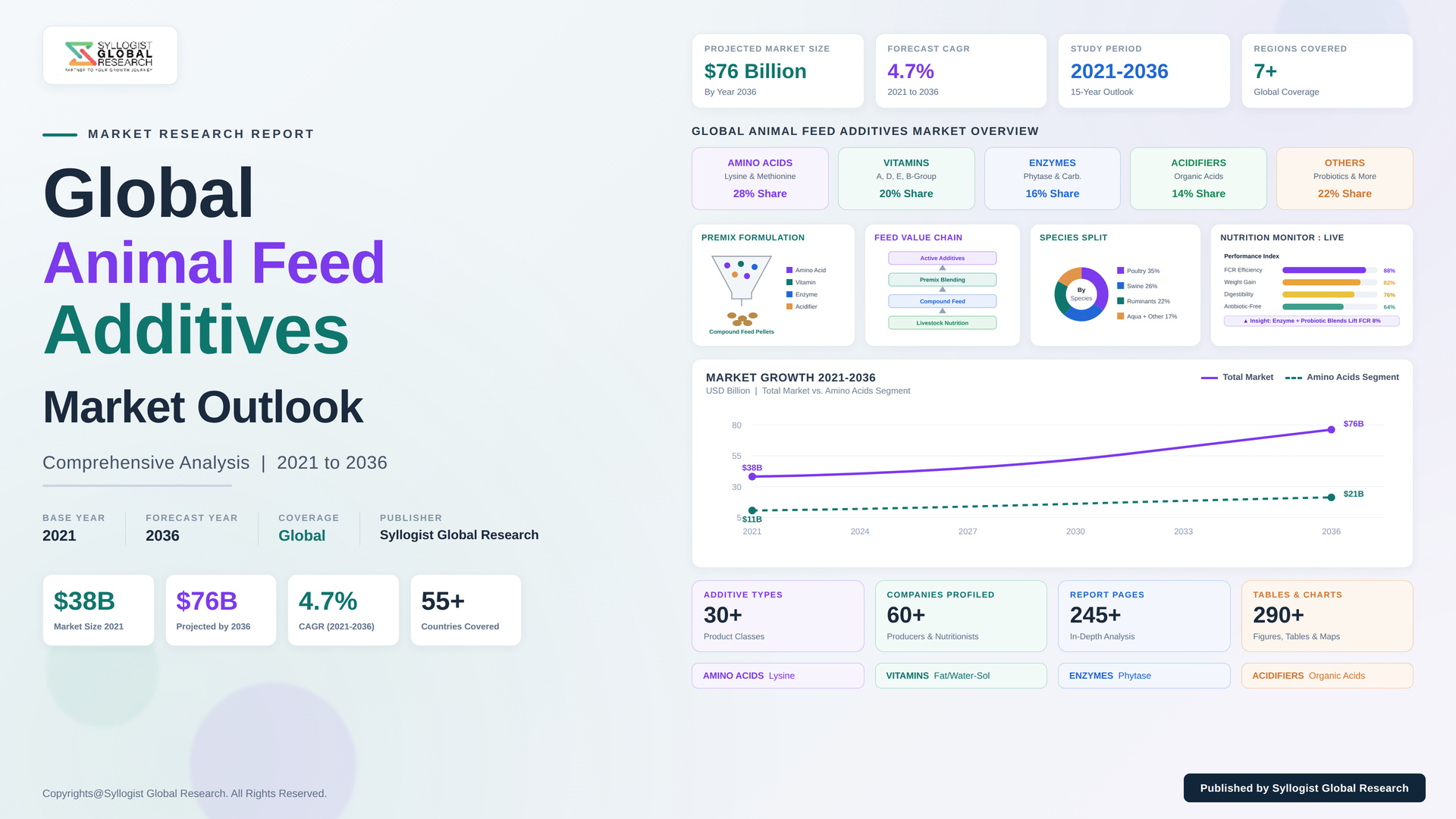
The global animal feed additives market is entering a sustained expansion phase, shaped by rising demand for high-quality animal protein, intensifying livestock and aquaculture production, tightening feed safety and traceability standards, accelerating phase-out of antibiotic growth promoters, and a structural shift toward natural and functional feed additives. The animal feed additives market was valued at USD 47.5 billion in 2025 and is projected to reach USD 78.9 billion by 2034, advancing at a compound annual growth rate of 5.8% through the forecast period, as compound feed manufacturers, integrated livestock and poultry producers, aquaculture operators, and pet food manufacturers scale additive procurement across Asia-Pacific, North America, Europe, Latin America, and the Middle East and Africa. Sustained protein consumption growth across emerging economies continues to widen the recurring revenue base of the global animal feed additives market.
The animal feed additives market trajectory is being reshaped by the accelerating phase-out of antibiotic growth promoters across major producing regions, redirecting additive spend toward probiotics, prebiotics, phytogenics, organic acids, and feed enzymes that support gut health and disease resistance without antibiotics within the global animal feed additives market. Precision animal nutrition is gaining commercial traction across the animal feed additives market, with producers adopting amino acid balancing, enzyme supplementation, and targeted functional additives to raise feed conversion efficiency and lower nitrogen and phosphorus excretion. Advances in precision fermentation are lowering production cost for bio-based amino acids, probiotics, and enzymes, narrowing the cost gap with synthetic equivalents and expanding the addressable base of the animal feed additives market. Sustainability-linked procurement policies adopted by major food companies are creating new additive specification requirements, reshaping buyer and supplier dynamics across the value chain of the global animal feed additives market.
Amino acids represent the largest type segment within the animal feed additives market, supported by their central role in protein synthesis, least-cost feed formulation, and nitrogen efficiency across poultry and swine diets. Synthetic additives retain the majority share of the global animal feed additives market on the basis of cost efficiency, proven efficacy, and precision-dosing advantages at commercial scale, while natural additives including probiotics and phytogenics represent the fastest-growing source category within the animal feed additives market, propelled by antibiotic phase-out and clean-label demand. Dry-form additives account for the largest form share of the animal feed additives market, supported by shelf stability, handling ease, and compatibility with industrial feed pelleting and blending. Among livestock, poultry represents the largest end-use segment within the global animal feed additives market, supported by the scale of commercial broiler and layer production, while aquaculture is gaining procurement traction within the animal feed additives market as intensive fish and shrimp farming expands across coastal economies.
Asia-Pacific represents the largest regional market within the animal feed additives market, supported by extensive livestock and aquaculture industries, rapid growth in commercial poultry and swine production, rising protein consumption, and expanding feed milling capacity across China, India, and Southeast Asian economies. North America occupies a leading revenue position within the global animal feed additives market, propelled by large-scale integrated livestock production, advanced precision nutrition adoption, and strong demand for antibiotic-free additive solutions. Europe holds a substantial position within the animal feed additives market, supported by stringent feed safety regulation, early antibiotic growth promoter restrictions, and elevated adoption of natural and functional additives. Latin America represents a fast-growing region within the animal feed additives market, supported by export-oriented poultry and beef production across Brazil and neighboring economies, while the Middle East and Africa constitute emerging demand centers within the global animal feed additives market as commercial livestock and poultry operations scale.
Key Drivers
Rising Global Animal Protein Demand, Population Growth, and Intensifying Livestock and Aquaculture Production Driving Sustained Feed Additive Procurement
Rising global demand for high-quality animal protein, sustained population and income growth, and the intensification of livestock and aquaculture production are generating durable procurement demand within the global animal feed additives market. Growing consumption of meat, dairy, eggs, and seafood across emerging economies is expanding commercial broiler, layer, swine, cattle, and aquaculture operations that depend on feed additives to raise growth performance, feed conversion efficiency, and animal health. As livestock production shifts from subsistence to intensive commercial systems, producers increasingly rely on amino acids, vitamins, enzymes, and functional additives to optimize output per unit of feed within the animal feed additives market. Higher feed cost and volatile grain prices are strengthening producer focus on feed efficiency, converting additives from optional inputs into economically essential tools that improve nutrient utilization and lower cost per kilogram of meat, milk, or egg output across the global animal feed additives market. Expansion of organized aquaculture, driven by rising seafood demand and constrained wild catch, is widening a fast-growing end-use base for specialized aqua feed additives. Growth in compound feed production across Asia-Pacific, Latin America, and Africa is scaling the installed base of feed mills that require consistent additive supply, anchoring recurring, volume-linked revenue across the animal feed additives market globally.
Antibiotic Growth Promoter Phase-Out and Accelerating Shift Toward Natural and Functional Additives Driving Reformulation Across the Animal Feed Additives Market
The accelerating phase-out of antibiotic growth promoters, tightening regulation of in-feed antibiotics, and rising consumer preference for antibiotic-free animal products are driving a structural shift toward natural and functional feed additives across the global animal feed additives market. Regulatory restrictions on antibiotic growth promoters across the European Union, China, and a growing number of producing countries are redirecting additive spend toward probiotics, prebiotics, phytogenics, organic acids, and feed enzymes that support gut health and disease resistance within the animal feed additives market. Producers transitioning to antibiotic-free and clean-label production increasingly standardize procurement around functional additives that maintain flock and herd performance without antibiotics, sustaining demand growth across the global animal feed additives market. Retailer and food company commitments to antibiotic-free sourcing are converting antibiotic alternatives from a differentiator into a specification requirement across major poultry and swine supply chains within the animal feed additives market. Manufacturers are responding by expanding portfolios of probiotic, phytogenic, and enzyme-based additives and investing in efficacy validation that supports premium positioning. This migration toward natural and functional chemistries commands higher realized pricing than commodity additives, supporting value growth across the animal feed additives market even where underlying volume growth is moderate.
Precision Animal Nutrition, Feed Efficiency Optimization, and Advances in Enzyme and Fermentation Technology Driving Value Growth in the Animal Feed Additives Market
The adoption of precision animal nutrition, intensifying focus on feed efficiency optimization, and technological advances in feed enzymes and precision fermentation are driving sustained value growth within the global animal feed additives market. Producers operating under narrow margins and volatile grain costs are adopting amino acid balancing, enzyme supplementation, and targeted functional additives that raise feed conversion efficiency and lower feed cost per unit of animal output across the animal feed additives market. Feed enzymes including phytase, carbohydrase, and protease are expanding nutrient availability from lower-cost feed ingredients, reducing reliance on premium raw materials and supporting broad adoption across the global animal feed additives market. Precision fermentation and biotechnology advances are lowering production cost for bio-based amino acids, probiotics, and enzymes, narrowing the cost gap with synthetic equivalents and expanding the addressable base of the animal feed additives market. Growing emphasis on reducing nitrogen and phosphorus excretion and lowering the environmental footprint of livestock production is generating demand for additives that improve nutrient utilization and support sustainability targets within the animal feed additives market. Digital feed formulation, data-driven nutrition modeling, and species-specific additive programs are further supporting differentiated, higher-value additive adoption across poultry, swine, ruminant, and aquaculture production within the global animal feed additives market.
Key Challenges
Volatile Raw Material and Feedstock Prices, Grain Cost Inflation, and Supply Chain Disruption Constraining Margins Across the Animal Feed Additives Market
Animal feed additive production remains exposed to volatile raw material and feedstock prices, grain and energy cost inflation, and supply chain disruption that compress manufacturer margins and constrain producer demand across the global animal feed additives market. Amino acid, vitamin, and fermentation-derived additive production depends on agricultural feedstocks, energy, and petrochemical inputs, generating cost swings that are difficult to pass through fully in a price-sensitive additive market. Volatile corn and soybean meal prices pressure overall feed economics, constraining the additive budget available to livestock producers and complicating procurement planning across the animal feed additives market. Concentration of key vitamin and amino acid production capacity across a limited number of suppliers and geographies heightens exposure to plant outages, logistics bottlenecks, and trade disruption within the global animal feed additives market. Extended supply chains for specialty additives, probiotics, and enzymes create lead-time uncertainty that complicates production planning and inventory management for formulators competing across the animal feed additives market. Sudden feedstock cost inflation forces manufacturers to choose between margin compression and price increases that risk volume loss among cost-conscious producers. Large integrated livestock buyers exert sustained pricing pressure that limits the ability of suppliers to recover input cost increases, continuing to constrain earnings stability across the global animal feed additives market.
Stringent and Lengthy Regulatory Approval, Divergent Regional Frameworks, and Rising Compliance Cost Constraining New Additive Introduction Across the Animal Feed Additives Market
Stringent feed additive regulation, lengthy and data-intensive approval processes, and divergent regional frameworks are extending time-to-market, raising compliance cost, and constraining new product introduction across the global animal feed additives market. Feed additives may only be marketed after scientific evaluation demonstrating safety for animal health, human health, and the environment, requiring extensive efficacy, toxicology, and residue studies that delay commercialization within the animal feed additives market. Approval timelines for novel additives can extend across multiple years and require substantial research and registration expenditure, raising the barrier to introducing new chemistries across the global animal feed additives market. Divergent regulatory requirements across the European Union, North America, China, and other producing regions force multinational suppliers to maintain multiple approval dossiers and formulation variants, complicating portfolio management within the animal feed additives market. Evolving restrictions on specific additives, antibiotics, and permitted claims can render established products non-compliant, requiring reformulation programs that consume research capacity without expanding addressable demand. Small and mid-sized formulators face disproportionate compliance burden relative to large diversified producers, constraining competitive positioning within the global animal feed additives market. Sustained regulatory tightening, while supporting long-term demand for validated functional additives, continues to raise the ongoing cost of participation and slow the pace of innovation across the animal feed additives market.
Livestock Disease Outbreaks, Herd and Flock Cycle Volatility, and Shifting Consumption Patterns Generating Demand Uncertainty Across the Animal Feed Additives Market
Recurring livestock disease outbreaks, herd and flock cycle volatility, and shifting protein consumption patterns generate persistent demand uncertainty that complicates capacity and procurement planning across the global animal feed additives market. Disease events such as avian influenza and African swine fever can sharply reduce animal populations, cutting feed and additive consumption across affected regions and disrupting demand within the animal feed additives market. Cyclical herd and flock rebuilding following disease outbreaks or margin compression generates swings in feed volume that propagate directly into additive demand, complicating production and inventory planning across the global animal feed additives market. Volatility in meat, dairy, and egg prices influences producer profitability and the additive budget available for performance and health inputs within the animal feed additives market. Shifting consumption patterns, including rising interest in alternative proteins in some mature markets, introduce longer-term uncertainty into livestock production growth assumptions that underpin the animal feed additives market. Biosecurity disruption, trade restrictions on animal products, and regional export bans further amplify demand variability that challenges suppliers planning capacity and distribution across the global animal feed additives market. This combination of disease risk, cycle volatility, and consumption shifts sustains demand uncertainty that complicates long-range planning across the animal feed additives market.
Market Segmentation
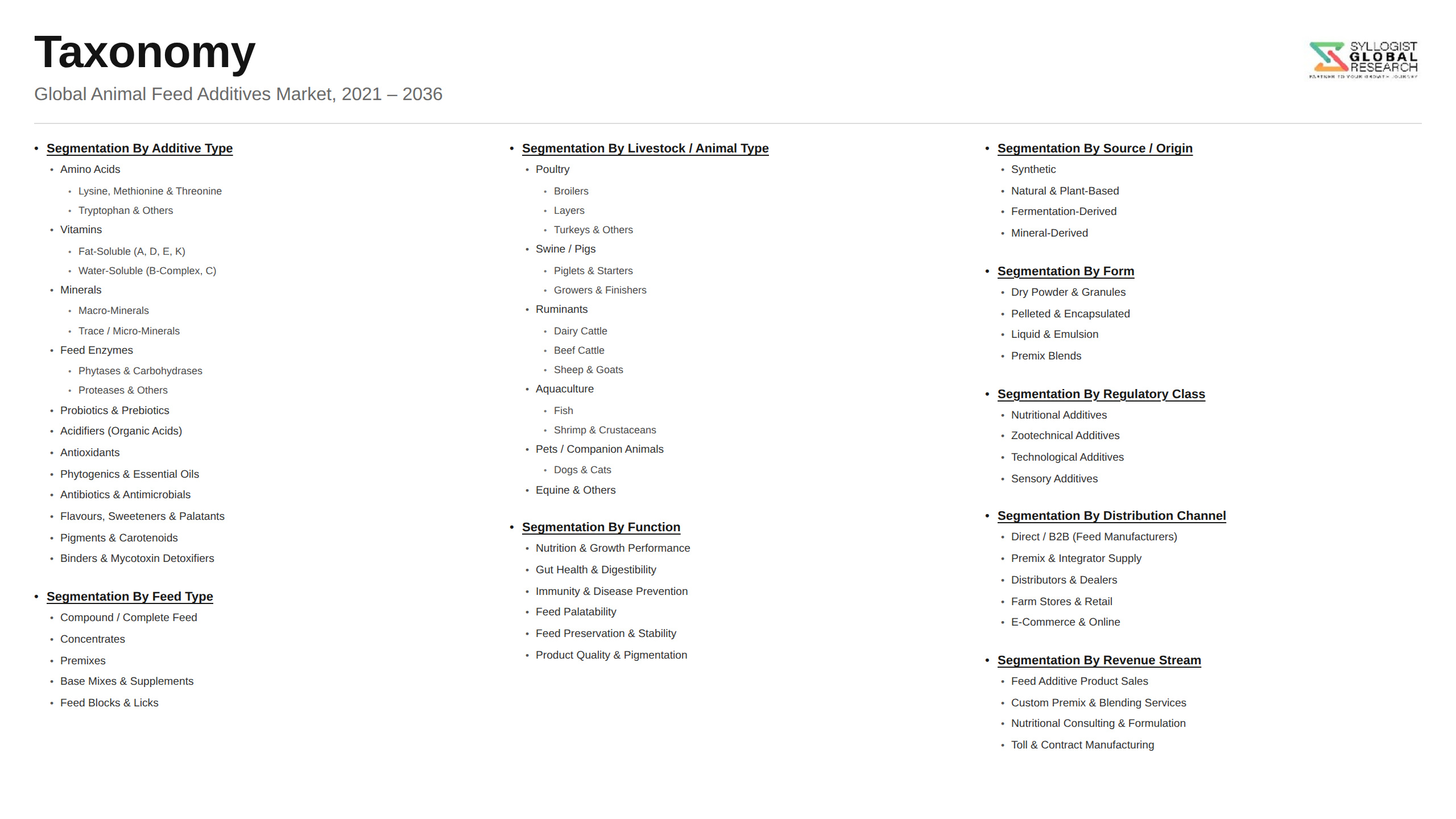
- Segmentation By Type
- Amino Acids
- Vitamins
- Minerals
- Enzymes
- Probiotics
- Prebiotics
- Antioxidants
- Acidifiers and Organic Acids
- Flavors and Sweeteners
- Binders
- Antibiotics
- Others
- Segmentation By Source
- Synthetic
- Natural
- Segmentation By Form
- Dry
- Liquid
- Segmentation By Livestock
- Poultry
- Swine
- Ruminants
- Aquaculture
- Pets
- Others
- Segmentation By Function
- Nutrition and Growth Performance
- Gut Health and Digestion
- Immunity and Disease Resistance
- Feed Preservation
- Palatability
- Others
- Segmentation By Distribution Channel
- Direct Sales and Business-to-Business
- Distributors and Wholesalers
- Online
- Others
- Segmentation By Region
- North America
- Europe
- Asia-Pacific
- Middle East and Africa
- Latin America
All market revenues are presented in USD
Historical Year: 2021-2024 | Base Year: 2025 | Estimated Year: 2026 | Forecast Period: 2027-2034
Key Questions this Study Will Answer
- What is the total global market valuation of the Animal Feed Additives Market in 2025, projected through 2034, segmented by type, source, form, livestock, function, and distribution channel, enabling additive manufacturers, feed producers, livestock integrators, and investors to identify the highest-growth segments and most durable revenue opportunities across the global animal feed additives market?
- How are compound feed manufacturers, integrated livestock and poultry producers, aquaculture operators, and pet food manufacturers structuring additive procurement, and which sourcing models, including direct supply, premix-based sourcing, and distributor-led delivery, are shaping commercial economics within the animal feed additives market through 2034?
- What animal protein demand growth, antibiotic growth promoter phase-out, and precision nutrition dynamics are shaping the pace and geographic distribution of feed additive demand across poultry, swine, ruminant, and aquaculture production in mature and emerging animal feed additives markets?
- Which additive types, including amino acids, vitamins, enzymes, probiotics, prebiotics, and organic acids, are gaining the strongest procurement traction, and what efficacy, feed efficiency, safety, and total cost metrics are shaping additive selection across the global animal feed additives market?
- How is the competitive landscape structured among amino acid and vitamin producers, feed enzyme and probiotic developers, specialty additive formulators, and premix manufacturers within the animal feed additives market, and what partnership, acquisition, and portfolio expansion strategies are enabling participants to compete on cost, sustainability, and additive performance?
- What natural additive adoption, precision fermentation cost reduction, sustainability-linked procurement, and antibiotic alternative penetration trends are reshaping product development, ingredient sourcing, and premiumization across the global animal feed additives market?
- Which regional markets, including Asia-Pacific, North America, Europe, Latin America, and the Middle East and Africa, are projected to generate the largest incremental feed additive demand through 2034, and what livestock production growth, protein consumption, feed safety regulation, and aquaculture expansion factors are shaping demand growth and supplier selection in each regional animal feed additives market?
- Product Definition
- Research Methodology
- Research Design & Framework
- Overall Research Approach: Descriptive, Exploratory & Quantitative Mixed-Method Design
- Market Definition & Scope Boundaries: What is Included and Excluded
- Segmentation Framework
- Key Research Assumptions & Limitations
- Secondary Research
- Primary Research Design & Execution
- Data Triangulation & Validation
- Market Sizing & Forecasting Methodology
- Competitive Intelligence Methodology
- Quality Assurance & Peer Review
- Definitions, Abbreviations & Data Notes
- Executive Summary
- Market Snapshot & Headline Numbers
- Key Findings & Research Highlights
- Market Dynamics
- Regional Market Summary
- Competitive Landscape Snapshot
- Technology & Innovation Highlights
- Market Dynamics
- Drivers
- Restraints
- Opportunities
- Challenges
- Porter’s Five Forces Analysis
- PESTLE Analysis
- Market Trends & Developments
- Emerging Trends
- Technological Developments
- Regulatory & Policy Changes
- Supply Chain & Sourcing Trends
- Manufacturing & Process Trends
- Investment & Funding Activity
- Sustainability & ESG Trends
- Risk Assessment Framework
- Raw Material (Amino Acid, Vitamin) Price Volatility & Input Cost Escalation Risk
- Antibiotic Growth Promoter Ban, AMR Policy & Regulatory Restriction Risk
- Feed-Grade Commodity Supply Concentration & Import Dependence Risk
- Livestock Disease Outbreak, Herd Reduction & Demand Volatility Risk
- Feed Safety, Contamination, Mycotoxin & Recall Liability Risk
- Regulatory Framework & Standards
- Feed Additive Registration, EU Authorisation & FDA Approval Standards
- Antimicrobial Resistance (AMR), Antibiotic Growth Promoter Phase-Out Regulations
- Maximum Residue Limits, Feed Safety & Contaminant Control Standards
- GMP+, FAMI-QS & Feed Ingredient Quality Certification Standards
- Labelling, Traceability & Novel Additive Approval Frameworks
- Global Animal Feed Additives Market Outlook
- Market Size & Forecast by Value
- Market Size & Forecast by Volume (Feed Additives Consumed in Kilo Tonnes per Year and Compound Feed Production Supported in Million Tonnes per Year)
- Market Size & Forecast by Additive Type
- Amino Acids
- Vitamins
- Minerals
- Enzymes
- Antibiotics
- Probiotics and Prebiotics
- Antioxidants
- Acidifiers
- Flavours and Sweeteners
- Others
- Market Size & Forecast by Livestock
- Poultry
- Swine
- Ruminants (Cattle)
- Aquaculture
- Pets
- Equine
- Others
- Market Size & Forecast by Form
- Dry (Powder and Granule)
- Liquid
- Encapsulated
- Others
- Market Size & Forecast by Source
- Synthetic
- Natural and Plant-Based
- Microbial and Fermentation-Derived
- Others
- Market Size & Forecast by Additive Category
- Nutritional Additives
- Zootechnical Additives
- Technological Additives
- Sensory Additives
- Others
- Market Size & Forecast by Feed Type
- Compound Feed
- Feed Premix
- Concentrates
- Others
- Market Size & Forecast by Livestock Production Stage
- Starter
- Grower
- Finisher
- Layer and Breeder
- Others
- Market Size & Forecast by Sales Channel
- Direct Sales to Feed Manufacturers
- Distributor and Dealer Channel
- Integrator and Farm Channel
- Online and Retail Channel
- Others
- North America Animal Feed Additives Market Outlook
- Market Size & Forecast
- By Value
- By Volume (Feed Additives Consumed in Kilo Tonnes per Year and Compound Feed Production Supported in Million Tonnes per Year)
- By Additive Type
- By Livestock
- By Form
- By Source
- By Additive Category
- By Feed Type
- By Livestock Production Stage
- By Country
- By Sales Channel
- Europe Animal Feed Additives Market Outlook
- Market Size & Forecast
- By Value
- By Volume (Feed Additives Consumed in Kilo Tonnes per Year and Compound Feed Production Supported in Million Tonnes per Year)
- By Additive Type
- By Livestock
- By Form
- By Source
- By Additive Category
- By Feed Type
- By Livestock Production Stage
- By Country
- By Sales Channel
- Asia-Pacific Animal Feed Additives Market Outlook
- Market Size & Forecast
- By Value
- By Volume (Feed Additives Consumed in Kilo Tonnes per Year and Compound Feed Production Supported in Million Tonnes per Year)
- By Additive Type
- By Livestock
- By Form
- By Source
- By Additive Category
- By Feed Type
- By Livestock Production Stage
- By Country
- By Sales Channel
- Latin America Animal Feed Additives Market Outlook
- Market Size & Forecast
- By Value
- By Volume (Feed Additives Consumed in Kilo Tonnes per Year and Compound Feed Production Supported in Million Tonnes per Year)
- By Additive Type
- By Livestock
- By Form
- By Source
- By Additive Category
- By Feed Type
- By Livestock Production Stage
- By Country
- By Sales Channel
- Middle East & Africa Animal Feed Additives Market Outlook
- Market Size & Forecast
- By Value
- By Volume (Feed Additives Consumed in Kilo Tonnes per Year and Compound Feed Production Supported in Million Tonnes per Year)
- By Additive Type
- By Livestock
- By Form
- By Source
- By Additive Category
- By Feed Type
- By Livestock Production Stage
- By Country
- By Sales Channel
- Country-Wise* Animal Feed Additives Market Outlook
- Market Size & Forecast
- By Value
- By Volume (Feed Additives Consumed in Kilo Tonnes per Year and Compound Feed Production Supported in Million Tonnes per Year)
- By Additive Type
- By Livestock
- By Form
- By Source
- By Additive Category
- By Feed Type
- By Livestock Production Stage
- By Country
- By Sales Channel
- Market Size & Forecast
- Market Size & Forecast
- Market Size & Forecast
- Market Size & Forecast
- Market Size & Forecast
- Market Size & Forecast
*Countries Analysed in the Global Research Portfolio: United States, Canada, Mexico, Germany, France, United Kingdom, Netherlands, Spain, Italy, Norway, Sweden, China, Japan, India, Australia, South Korea, Singapore, Brazil, Chile, Saudi Arabia, UAE, Egypt, South Africa, Israel
- Technology Landscape & Innovation Analysis
- Fermentation-Based Amino Acid & Enzyme Production Technology Deep-Dive
- Probiotic, Prebiotic & Postbiotic Gut Health Technology
- Phytogenic, Essential Oil & Natural Growth Promoter Technology
- Encapsulation, Controlled-Release & Feed Stability Technology
- Precision Nutrition, Feed Formulation & Digital Livestock Technology
- Mycotoxin Binder, Detoxifier & Feed Safety Technology
- Alternative Protein, Insect Meal & Sustainable Feed Additive Technology
- Patent & IP Landscape in Animal Feed Additives Technologies
- Value Chain & Supply Chain Analysis
- Feed-Grade Raw Material & Fermentation Feedstock Supply Chain
- Amino Acid, Vitamin, Enzyme & Additive Manufacturing Supply Chain
- Premix, Blending & Formulation Supply Chain
- Compound Feed Manufacturer Customer Channel
- Livestock Integrator, Farm & Producer Channel
- Distributor, Dealer & Regional Sales Network
- Cold Chain, Storage & Feed Logistics Network
- Pricing Analysis
- Amino Acid (Lysine, Methionine) Pricing Across Contract & Spot Tiers
- Vitamin and Mineral Premix Pricing Economics
- Enzyme and Probiotic Value-Added Pricing Analysis
- Natural vs Synthetic Additive Pricing Differentials
- Antibiotic Alternative & Growth Promoter Pricing Analysis
- Raw Material Cost Pass-Through & Formulation Cost Economics
- Regional Pricing Benchmarks & Value-in-Use Pricing Models
- Sustainability & Environmental Analysis
- Lifecycle Assessment (LCA) of Feed Additives Across Production & Use
- Feed Efficiency, Methane Reduction & Livestock Emission Performance
- Antibiotic-Free, Natural & Clean-Label Additive Performance
- Sustainable Sourcing, Fermentation & Circular Feed Economy Performance
- Regulatory-Driven Sustainability, SDG 2 (Zero Hunger) & SDG 12 (Responsible Consumption) Alignment & Green Finance Eligibility
- Competitive Landscape
- Market Structure & Concentration
- Market Consolidation Level (Fragmented vs. Consolidated by Additive Type & Geography)
- Top 10 Players Market Share
- HHI (Herfindahl-Hirschman Index) Concentration Analysis
- Competitive Intensity Map by Additive Type, Livestock & Geography
- Player Classification
- Integrated Animal Nutrition and Feed Additive Producers
- Amino Acid and Fermentation Specialists
- Vitamin and Mineral Premix Manufacturers
- Enzyme and Probiotic Specialists
- Phytogenic and Natural Additive Producers
- Premix and Custom Blend Formulators
- Regional and Independent Additive Producers
- Distributors and Feed Ingredient Traders
- Competitive Analysis Frameworks
- Market Share Analysis by Additive Type, Livestock & Region
- Company Profile
- Company Overview & Headquarters
- Feed Additives Product Portfolio
- Key Customer Relationships & Reference Feed Producer Accounts
- Manufacturing Footprint & Production Capacity Coverage
- Revenue (Feed Additives Segment) & Order Backlog
- Technology Differentiators & IP
- Key Strategic Partnerships, JVs & M&A Activity
- Recent Developments (Product Launches, Capacity Expansion, Contract Wins)
- SWOT Analysis
- Strategic Focus Areas & Roadmap
- Competitive Positioning Map (Technology Capability vs. Market Penetration)
- Key Company Profiles
- Market Structure & Concentration
- Technology Landscape & Innovation Analysis
- Strategic Output
- Market Opportunity Matrix: By Additive Type, Livestock, Additive Category, Feed Type & Geography
- White Space Opportunity Analysis
- Strategic Recommendations
- Product Portfolio & Additive Innovation Strategy
- Manufacturing Excellence & Capacity Expansion Strategy
- Geographic Expansion & Localisation Strategy
- Customer & Feed Producer Engagement Strategy
- Partnership, M&A & Ecosystem Strategy
- Sustainability & Natural Additive Strategy
- Risk Mitigation & Future Roadmap
- Strategic Priority Matrix & Roadmap
- Near-term (2025-2028)
- Mid-term (2029-2032)
- Long-term (2033-2037)